Coal is good. It can help get us off foreign oil. Why is Obama and, of course, city council, bashing our most abundant fossil fuel? Sure, let’s send some more cash to Venezuela and the mideast. Morons.
That would be because of the devastation to the environment in the mining and the burning (use) of coal. It isn’t an either or pick – we can (and are) creating alternatives to both coal and oil. In the meantime, decreasing the use of both as much as possible seems the only ethical and practical choice. There is no future with coal. But I agree – not with oil either.
If you were just making a joke, sorry, I missed it. I really am not sure if you are serious, Jake.
Ethical? Perhaps. Practical? You’re joking, right? O himself has said he wants to eliminate oil imports from mideast by 2019, a worthy but not practical goal. How can he did this w/o coal? Impossible unless we start 22-hour-a-day blackouts. Extreme liberals: No future w/coal. No future with nuclear. No future w/oil and gas. That leaves “alternative energy,” which makes up 6.8% of all usage currently and even under the most extreme liberal estimates (not practical estimates) might be 30% by 2020. Yup, blackouts it is. That’s your “practical” alternative.
Thanks, Jake, for pointing out the obvious — as long as we consume as we have been, the ‘liberal’ alternatives don’t measure up. Perhaps 22 hour blackouts aren’t such a far fetched idea. (I’m only partially joking here.) How much coal and oil does it take to ride our bikes. How much savings in energy would be have if a significant majority took a bus to work?
A serious question is whether we can more gently lower our standard of living?


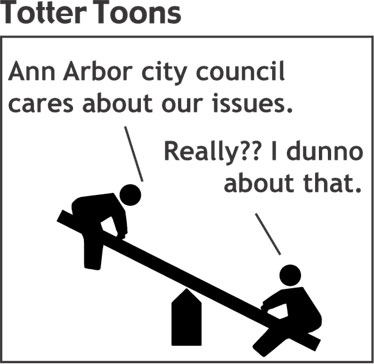
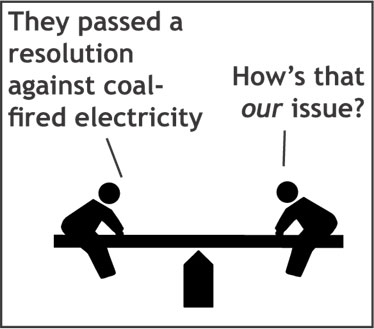
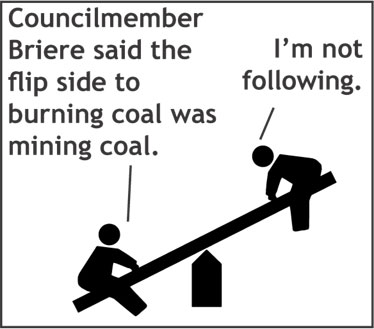
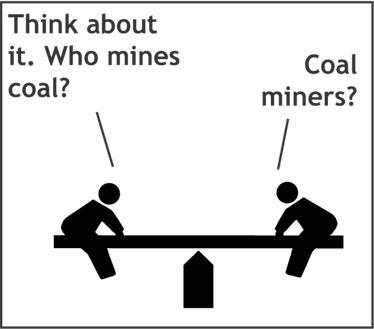
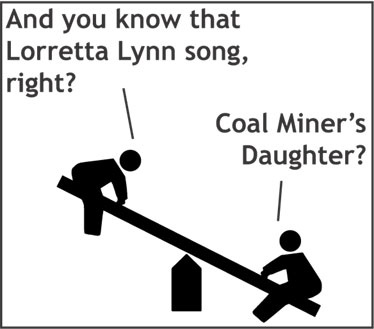
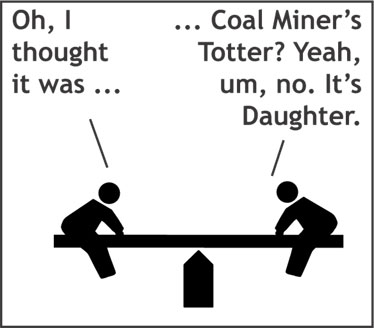

Thanks for Totter Toons, Dave!
You know that abbreviation “LOL”? I could use “COL” (for Chuckle Out Loud) for this Totter Toon. Thx, Dave!
Coal is good. It can help get us off foreign oil. Why is Obama and, of course, city council, bashing our most abundant fossil fuel? Sure, let’s send some more cash to Venezuela and the mideast. Morons.
That would be because of the devastation to the environment in the mining and the burning (use) of coal. It isn’t an either or pick – we can (and are) creating alternatives to both coal and oil. In the meantime, decreasing the use of both as much as possible seems the only ethical and practical choice. There is no future with coal. But I agree – not with oil either.
If you were just making a joke, sorry, I missed it. I really am not sure if you are serious, Jake.
Ethical? Perhaps. Practical? You’re joking, right? O himself has said he wants to eliminate oil imports from mideast by 2019, a worthy but not practical goal. How can he did this w/o coal? Impossible unless we start 22-hour-a-day blackouts. Extreme liberals: No future w/coal. No future with nuclear. No future w/oil and gas. That leaves “alternative energy,” which makes up 6.8% of all usage currently and even under the most extreme liberal estimates (not practical estimates) might be 30% by 2020. Yup, blackouts it is. That’s your “practical” alternative.
Thanks, Jake, for pointing out the obvious — as long as we consume as we have been, the ‘liberal’ alternatives don’t measure up. Perhaps 22 hour blackouts aren’t such a far fetched idea. (I’m only partially joking here.) How much coal and oil does it take to ride our bikes. How much savings in energy would be have if a significant majority took a bus to work?
A serious question is whether we can more gently lower our standard of living?