Business Section

DDA Preps Downtown Ann Arbor Process

At its regular partnerships committee meeting on May 11, 2011, the Ann Arbor Downtown Development Authority board began discussing how to implement the city council “parcel-by-parcel” resolution passed on April 4, 2011. That resolution gives the DDA responsibility for leading a process to explore alternative uses for downtown parcels: the Library Lot, old Y Lot, Palio Lot, Kline’s Lot and the Fourth and William parking structure.

Area of focus for DDA-led development process

Light pink areas are all city-owned land. The red outlined area is the DDA tax district. The green rectangle is the smaller area of focus for which the DDA has been given responsibility to lead a process to explore alternative uses of city-owned surface parking lots. The green rectangle is bounded by Ashley, Division, Liberty and William streets. (Links to higher resolution image. Map data is available on the city's website at a2gov.org/data)

The parcels are currently used as surface parking lots – except for the Library Lot, which is the construction site for an underground parking garage that, when completed, will offer around 640 parking spaces. It was previously a 192-space surface parking lot.

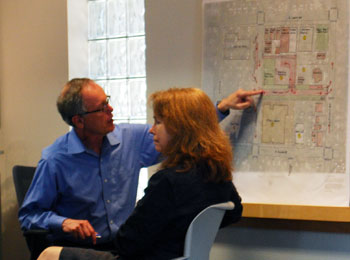
The committee meeting included a presentation on the city’s sewer system from Cresson Slotten, a manager with the city of Ann Arbor’s systems planning unit.  The agenda also included a conversation with Doug Kelbaugh, former dean of the University of Michigan’s college of architecture and urban planning, and Kit McCullough, who teaches at the school. The two are interested in helping facilitate the public process stipulated in the city council parcel-by-parcel resolution. Also interested in sharing information he’s gathering from downtown property owners is Peter Allen, a local developer who attended the partnerships meeting.

One major theme that emerged during the committee’s discussion is the idea that a public space can be successful if it is programmed, used and supported by the community, even if its design is lacking.

The parcel-by-parcel resolution was passed at the same meeting that the council voted to terminate the review process for proposals the city had solicited for use of the top of the underground parking structure.

The termination of that RFP review process came just before the council was supposed to consider formally signing a letter of intent to hammer out a development agreement for the finalist project – a hotel/conference center proposed by Valiant Partners. [Chronicle coverage: "Ann Arbor Council Focuses on Downtown"] [Full Story]

Column: Chevy Volt – Private Transit Choices

Last week The Chronicle received a cold-call from Suburban Chevrolet out at Wagner and Jackson roads with an offer to test-drive a Chevy Volt.

Chevy Volt

Even if you don't know me, this photo is a dead give-away that I am not a car guy. I deliberately shot that photo from an angle that would include Suburban Chevrolet's sign in the background, And I thought I'd nailed it – because the sign said "Suburban." (Photos by the writer.)

The sales consultant was keen to point out that Suburban Chevrolet was the first area dealership to have a vehicle available for test drives. But test-driving a car is pretty remote from The Chronicle’s mission, and even more remote from my personal transportation choice.

I share a membership in Zipcar with my wife, but don’t even remember the last time I’ve sat behind the wheel of a car myself. Zipcar, a car-sharing service, is like an insurance policy – a backup plan I never use. I get around by bicycle.

Still, in the Chevy Volt, I spotted a chance to write about a major public works construction project in downtown Ann Arbor – the Fifth Avenue underground parking structure, which will feature around 640 parking spaces on a lot that previously offered 192 spots.

Twenty-two of those new spots will be equipped with electric car charging stations. Dave Konkle, former energy coordinator for the city of Ann Arbor who now consults for the Ann Arbor Downtown Development Authority on its energy projects, identified the federal grant that’s helping to pay for the stations. The grant is worth $264,100 and will also pay for photovoltaic panels that will provide the energy for two of the spots – it was obtained through the Clean Energy Coalition’s Clean Cities Program.

That public project is closely tied to the assumption that visitors to downtown Ann Arbor will continue to make a personal choice for private transportation in the form of an automobile, and that some of those people will choose electric cars like the Volt.

The idea I want to think about in this column is that public choices depend on the sum of many private, independent choices made by actual people. It’s an idea that was driven home to me at a public transportation forum hosted earlier this week by the Ann Arbor Transportation Authority at SPARK East in Ypsilanti.

At that forum, Bob Van Bemmelen – recent Republican candidate for the Washtenaw County board of commissioners – had this advice for the AATA as it pitches to the public the idea of countywide public transit: You have to make it personal, he said.

So I’ll begin by telling you a little bit more about the Suburban Chevrolet sales guy who gave me a ride in the Chevy Volt – who is as much a car guy as I am a bicycle guy: Nic Allebrodt. [Full Story]

Three County Departments to Merge

Washtenaw County board of commissioners working session (May 5, 2011): A consolidation is underway for three county departments that share similar missions and programs: providing services to low-income residents; support for low-income housing; help for job seekers; and projects designed to spur economic development.

Conan Smith, Barbara Bergman, Mary Jo Callan

From left: Washtenaw County commissioners Conan Smith and Barbara Bergman, and Mary Jo Callan, director of the county/city of Ann Arbor office of community development, at the May 5, 2011 working session of the county board of commissioners. (Photos by the writer.)

County commissioners were given an update on these plans at their most recent working session. They’ll be asked to give initial approval to the consolidation at their June 1 meeting, with final approval on July 6.

Mary Jo Callan, who is expected to lead the new office of community & economic development, made the presentation and fielded most of the questions from commissioners. She is currently director of the office of community development, a joint department of the county and city of Ann Arbor, and one of the three departments slated to merge. The goal, Callan said, is to provide a more coherent approach to the broad spectrum of community development, from providing for basic needs to helping people get jobs. And in a climate of reduced resources, they’ll be eliminating duplication and cutting costs, she said, while making it easier for residents to get the services they need.

The three departments – the office of community development (OCD), ETCS (the employment training and community services department) and the economic development & energy department – employ nearly 60 people with a combined budget of about $16 million. Staff cuts will likely result from the changes – those and other details are still being worked out.

Most commissioners expressed support for this effort, though some wanted more information – including a business plan for the new department – before their June 1 vote.

The working session also included a presentation and discussion on the Packard Square brownfield redevelopment, an issue that was initially debated at the board’s May 4 meeting. A Chronicle report on that part of the working session will be published separately. [Full Story]
County Budget: “Not Out of the Woods”

Washtenaw County board of commissioners meeting (May 4, 2011): Budget challenges touched most agenda items, either directly or tangentially, during a four-hour board meeting.

Ronnie Peterson

Commissioner Ronnie Peterson, center, expressed dismay over the way the county is allocating its funding for human services. Other commissioners, from left: Yousef Rabhi, Barbara Bergman, Leah Gunn, Rob Turner. (Photos by the writer.)

The board got a quarterly update for the current year’s budget, as well as a progress report on development of the 2012-2013 budget. County administrator Verna McDaniel reported that thanks to a less-than-expected drop in property tax revenues, a two-year projected deficit has fallen from nearly $21 million to $17.5 million.

To address the deficit, the county is preparing to begin negotiations with its 17 labor unions, hoping to get $8 million in cuts to employee compensation and benefits over the next two years. They also hope to make $8 million in savings from organizational restructuring.

An item not on the agenda drew attention, particularly from commissioner Ronnie Peterson. A coordinated funding effort for local nonprofits – allocating funds from the county, the city of Ann Arbor, Washtenaw Urban County and Washtenaw United Way – is nearing its final stages. The county board will be asked to vote on funding recommendations at its May 18 meeting. However, nonprofits leaders have already been notified of those recommendations, and some attended the May 4 meeting to lobby for support. Peterson sharply criticized the process – which the board had approved last year – saying they seem to have ceded decision-making authority for the funding. He didn’t like it.

A development-related issue also raised financial concerns for some commissioners –  the proposed Packard Square development in Ann Arbor. The board was asked to give initial approval of a $1 million grant application and $1 million loan from the Michigan Dept. of Natural Resources and Environment, for brownfield cleanup at the site. Commissioners were also asked to authorize designation of the county’s full faith and credit as a guarantee to any loan that might be awarded, up to $1 million.

Commissioner Wes Prater argued that items related to significant financial issues must first be addressed at a working session, according to board rules. After some debate, Prater’s motion to postpone action on Packard Square was approved by a majority of commissioners, moving it to a working session the following day. A Chronicle report on that session will be forthcoming.

The meeting also included approval of expanded IT collaboration with the county, the city of Ann Arbor and the Ann Arbor Transportation Authority, and the appointment of Michael Smith as the new director for the county’s veteran services office. And during the time for communications from the board, commissioner Dan Smith indicated that he and Yousef Rabhi are working on changes to compensation for commissioners – they’ll likely be bringing a proposal to the board later this year. [Full Story]
Monthly Milestone: In Defense of Detail

Editor’s note: The monthly milestone column, which appears on the second day of each month – the anniversary of The Ann Arbor Chronicle’s launch – is an opportunity for either the publisher or the editor of The Chronicle to touch base with readers on topics related to this publication. It’s also a time that we highlight, with gratitude, our local advertisers, and ask readers to consider subscribing voluntarily to The Chronicle to support our work.

A piece of string too short to use

A piece of string too short to use

Writing on Damn Arbor, a blog maintained by a half-dozen self-described “grad students, townies, and derelicts,” Quinn Davis wondered recently: “So. If a citizen gasps during a city council meeting but no one reads about it, what’s the point?”

Davis posed the rhetorical question in the context of an article she’d written for the Washtenaw Voice, a Washtenaw Community College publication she edits. About that article, her advisor ventured: “I worry that our readership may not be that interested enough to get through 800 words you have so far.”

Here at The Ann Arbor Chronicle, we would also worry about an 800-word article. We’d wonder what happened to the other 5,000 words.

Count that exaggeration as a rhetorical flourish.

In fact, since since June of last year, we’ve routinely published items shorter than 500 words. These  items are outcomes of individual public meeting votes and other civic events – they’re collected in a sidebar section we call the Civic News Ticker. Readers can view all those items in one go on the Civic News Ticker page. Readers who prefer to receive The Chronicle using an RSS feed reader can subscribe to just the Civic News Ticker items with this feed: Civic News Ticker Feed.

But back to the rhetorical question: What is the point of ever including details that most people might not ever read, in an article that tops 10,000 words?  [Full Story]
Council Delays Pot, Takes Shots at DDA

Ann Arbor city council meeting (April 19, 2011): The city council delayed a second and final vote on two local laws that involve regulation of medical marijuana businesses in the city – one on zoning and the other on licenses.

Roger Fraser, Tom Crawford

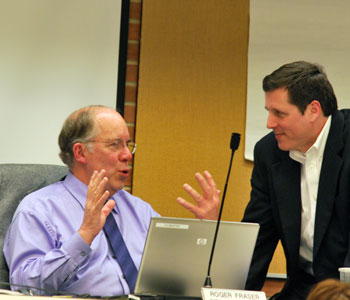
Seated is Roger Fraser, who attended his last Ann Arbor city council meeting on April 19 as city administrator – he gave a formal presentation to the council of the FY 2012 budget. He's chatting before the meeting with the city's chief financial officer, Tom Crawford, who was appointed interim administrator later in the evening. He's not telling Crawford: "Whatever you do, don't let the council tie your hands, see?" (Photos by the writer.)

After public hearings on the two medical marijuana laws, the council did not deliberate long in deciding to postpone both votes until its next meeting, on May 2. Substantive amendments that had been presented to councilmembers late that day for consideration made them reluctant to attempt grappling with the amendments in detail. The May 2 vote on the two laws will likely count only as their initial approval, assuming the amendments are adopted at that meeting. The laws would then need an additional final reading after May 2 before they are enacted.

A tweak to the city’s panhandling ordinance was given its second and final approval at the April 19 meeting. That change to the existing ordinance had come as a recommendation from a task force that worked for six months on the issue, following up on a longer effort in the early 2000s that had led to adopting the language in the existing ordinance.

The longest deliberations of the night involved a resolution of instruction to the council’s “mutually beneficial” committee, which is currently negotiating a new contract under which the Ann Arbor Downtown Development Authority would continue to manage the city’s public parking system. The direction given to the committee was not to stay firm with its previous bargaining position, but rather to escalate the city’s expectations for revenues from the public parking system.

Previously, the city’s committee had taken the position that the city should receive 16% of gross parking revenues in the first two years of a 10-year contract, and 17.5% in remaining years. That compared with the DDA’s position that the city should receive a flat 16% across all years. But at the meeting, the council voted to direct its committee to take the position that the city should receive a flat 18%. The council’s deliberations included comments directed towards the DDA that could fairly be described as inflammatory.

Called to the podium to comment on the parking revenue figures and the DDA’s overall financial health was the city’s chief financial officer, Tom Crawford. Later in the meeting, Crawford was appointed interim city administrator, effective April 28. Current administrator Roger Fraser is leaving the post to take a job as a deputy treasurer for the state of Michigan.

Although councilmembers did not comment on it, Fraser was attending his last meeting of the council as city administrator. And in his final major act, he gave a formal presentation to the council of his proposed fiscal year 2012 budget, as required by the city charter. The charter stipulates that the council will need to amend and approve the budget by May 16, its second meeting that month. [Full Story]
Washtenaw County’s Taxable Value Falls

Washtenaw County board of commissioners meeting (April 20, 2011): The county’s finances were the focus of Wednesday’s meeting, which included a presentation of the annual equalization report. That report is the basis for determining taxable value of property in the county, which in turn indicates how much tax revenue is collected by local taxing entities. In the world of municipal finance, the equalization report is a very big deal.

Raman Patel

Raman Patel, director of Washtenaw County's equalization department, presented his annual report at the April 20, 2011 board of commissioners meeting. (Photos by the writer.)

Raman Patel, director of the county’s equalization department, told commissioners there was a 2.85% drop in taxable value this year. That’s an improvement over last year’s decline, when taxable value of property in the county fell 5.33%. It’s also a smaller decrease than was projected when preparing the county’s 2011 budget, which was built on the assumption of an 8.5% drop.

The impact on local taxing entities varies. The city of Ann Arbor saw a 1.21% drop, for example, while taxable value in Ypsilanti Township fell 11.39%.

The report also highlighted a shift in the county’s largest taxpayers. Just a few years ago, the top three taxpayers were Pfizer, General Motors and Ford. Now, they are Detroit Edison, McKinley Associates and Toyota.

The meeting also included a presentation of the 2010 comprehensive annual financial report, or CAFR. Kelly Belknap, the county’s finance director, highlighted the fact that the county ended 2010 with a $5.5 million general fund surplus – slightly more than the $5.3 million calculated to carry over into the 2011 budget. Mark Kettner from the accounting firm Rehmann Robson, which conducts the county’s audit, was also on hand to give a brief report on the 2010 audit.

In other business, the board approved an amendment to the brownfield plan for BST Investments in Dexter, and set two public hearings for their May 18 meeting related to brownfield plans that are being proposed: (1) Packard Square, a complex off of Packard Street on the site of the former Georgetown Mall; and (2) the LaFontaine Chevrolet redevelopment at 7120 Dexter-Ann Arbor Road in Dexter.

The board also authorized the office of the water resources commissioner to take court action in setting winter lake levels at Portage and Baseline lakes. The office operates the dam at Portage Lake that controls those levels.

During their time for communications, commissioners raised several issues, including: (1) a call to support the special education millage renewal, which is on the May 3 ballot; (2) discussions about consolidating the office of community development, ETCS (the employment training and community services department) and the economic development & energy department; and (3) what to do about the growing deer population.

Wednesday’s meeting began with a tribute to the long-time director of the Washtenaw Community Concert Band, Jerry Robbins. [Full Story]

Planning Commission OKs Design Review

Ann Arbor planning commission meeting (April 5, 2011): In another step toward completing a years-long process to develop design guidelines for downtown properties, planning commissioners unanimously recommended approval of amendments to Ann Arbor’s city code that establish a design review board and design review procedures.

Kirk Westphal

Kirk Westphal, an Ann Arbor planning commissioner, served on the city task force that helped developed design guidelines for downtown development. (Photo by the writer.)

One person, former planning commissioner Ethel Potts, spoke during a public hearing on the topic. Potts said she was glad the design review comes early in the project approval process, but she wondered how the review would be used – that could be a challenge. Commissioners discussed the issue only briefly before the vote.

In the city’s project approval process, the design review would take place before the mandatory citizen participation meeting, so that the design review board’s comments could be incorporated into the project’s design before it’s presented to citizens. However, developers aren’t required to act on the review board’s recommendations. Though the review process is mandatory, implementation of the board’s suggestions is voluntary. [Full Story]
Residents Frustrated by Dioxane Decision

About 50 residents gathered at Ann Arbor’s Abbott Elementary School late last month to get an update – and raise concerns – over a new consent judgment that changes the cleanup requirements of 1,4 dioxane contamination caused by the former Gelman Sciences manufacturing plant in Scio Township.

Matt Naud

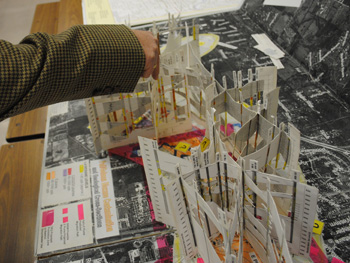
Matt Naud, the city of Ann Arbor's environmental coordinator, points to his home on a 3D map of the Pall-Gelman 1,4 dioxane plume. The map was constructed by Roger Rayle, a leader of Scio Residents for Safe Water, who brought it to the March 30 public meeting about a new consent judgment related to the plume. (Photos by the writer.)

Mitch Adelman, a supervisor with the Michigan Dept. of Environmental Quality’s remediation division, began the March 30 meeting by acknowledging the crowd’s reaction to the new agreement, which was issued earlier in the month without opportunity for public input. “I don’t expect anything I say or do tonight to alleviate your anger or frustration,” he said.

But Adelman noted that if a company like Pall – which owns the former Gelman Sciences site – proposes a remediation plan that complies with state law, “we’re obligated to accept it.”

For nearly three hours, Adelman and Sybil Kolon, MDEQ’s project manager for the Pall site, gave an update and answered questions about the new consent judgment, the history of the cleanup, and what residents might expect in the coming years. They were challenged throughout the evening by people who’ve been following this situation closely – most notably by Roger Rayle, a leader of Scio Residents for Safe Water and member of the county’s Coalition for Action on Remediation of Dioxane (CARD). Rayle has been tracking the dioxane plume for many years, and presented his own graphical renderings of data to the group.

The meeting was attended by several elected officials: Ann Arbor city councilmembers Stephen Rapundalo (Ward 2) and Mike Anglin (Ward 5); Ann Arbor Township supervisor Mike Moran; county commissioner Yousef Rabhi (District 11); and Sarah Curmi, chief of staff for state Sen. Rebekah Warren, whose district covers a large portion of Washtenaw County, including Ann Arbor and Scio Township, where the plume is concentrated. [Full Story]
Ann Arbor Council Focuses on Downtown

Ann Arbor City Council meeting (April 4, 2011): At its Monday meeting, the council focused much of its time discussing the future of downtown Ann Arbor.

higgins-counts-parcels

Councilmember Marcia Higgins (Ward 4) ticks through the list of parcels that would be the focus of a DDA-led development process. (Photos by the writer.)

Councilmembers voted on two major downtown-related agenda items – one affecting the immediate future of an individual parcel, the city-owned Library Lot. The other item involves a process by which the Ann Arbor Downtown Development Authority would lead the planning of development for multiple downtown parcels, including the Library Lot.

The council voted, over dissent from two of its members, to end the RFP process for the Library Lot and to reject a draft letter of intent they’d discussed at a March 14 work session, which would have called for the city to work with Valiant Partners to craft a development agreement for construction of a conference center and hotel on the lot. The Ann Arbor DDA is currently building a roughly 640-space underground parking garage on that parcel.

Based on a separate resolution passed by the council, the future use of the Library Lot could emerge from a process to be led by the DDA. The council required lengthy deliberations before narrowly approving an amendment that reduced the area of focus for the DDA-led process. The amendment limited the area to the square bounded by Ashley, Division, Liberty and William streets, which would include the Library Lot on South Fifth Avenue, the Kline Lot on Ashley, the old YMCA Lot at Fifth and William, and the Palio Lot at Main and William.

The resolution on the DDA-led process is part of a broader ongoing negotiation between the city and the DDA, related to the contract under which the DDA operates the city’s public parking system. That contract is being renegotiated, and since January, the city has not budged from its position that the DDA should pay the city a percentage-of-gross parking revenue of 16% in the contract’s first two years and 17.5% in years thereafter. It appears that the DDA board is gradually conceding to the city’s bargaining position. That will become clearer at the DDA board meeting on Wednesday, April 6.

The city’s negotiating position is based in part on the idea that the DDA is, as mayor John Hieftje has described it, “an arm of the city.” Hieftje’s view of the DDA as part of the city was further accentuated on Monday, when he announced at the end of the council’s meeting that he would be inviting the DDA to move its offices into newly-renovated space in the city hall building. The DDA currently leases space about a block south of city hall.

Also a part of Monday’s downtown-themed meeting was initial approval the council gave to a revision to the city’s ordinance on panhandling. That ordinance revision – which added some areas where panhandling is prohibited – will require a second reading and a public hearing in front of the council before it can be enacted.

An additional part of the downtown discussion came at the start of the council’s meeting, with a presentation on work being done to plan and study the 415 W. Washington parcel for future use as a center for artists and as a greenway park.

In non-downtown business, the council accepted a series of easements that will set the stage for TIGER II grant funds – already awarded by the federal government – to be formally obligated to the city. At stake is $13.1 million, which is currently still part of a continuing resolution for the federal budget. But that continuing resolution expires April 8, so the council was acting with some urgency.

The council also gave necessary approvals for a bus pullout to be constructed on Washtenaw Avenue, and authorized emergency purchase orders for furniture. And the council heard a presentation from Andrew Brix, the city’s energy programs manager, about efforts to increase the percentage of renewable energy that the city uses. [Full Story]
Monthly Milestone: Internet Twinkies

Editor’s note: The monthly milestone column, which appears on the second day of each month – the anniversary of The Ann Arbor Chronicle’s launch – is an opportunity for either the publisher or the editor of The Chronicle to touch base with readers on topics related to this publication.

It’s also a time that we highlight, with gratitude, our local advertisers, and ask readers to consider subscribing voluntarily to The Chronicle to support our work.

Twinkie Time

How fast can you eat a Twinkie?

I’d like to begin this month’s milestone column by sharing some good news about one of The Chronicle’s writers – Jennifer Coffman, who covers the Ann Arbor Public Schools board of education for us. Last week she gave birth to a baby girl: Eleanor Olivia Coffman. So she’s on a break from The Chronicle for a while.

Until Coffman returns, Eric Anderson will be providing The Chronicle’s AAPS board coverage. Eric grew up in Ann Arbor and is a graduate of Hope College. His experience includes work as a reporter at the Hillsdale Daily News and an editorial intern at the Washington Post Express. He’s planning to attend graduate school later this year.

Coverage of the AAPS board has become part of the meat-and-potatoes reporting provided by The Chronicle, along with reports on the Ann Arbor city council, the Washtenaw County board of commissioners and many other public bodies.

But not everything published in The Chronicle is meat and potatoes. I think it’s a relatively small portion of our overall corpus, but some of our material is probably more like a Twinkie than a piece of meat.

Many of the Stopped.Watched. items, for example, might be analyzed as more like Twinkies than a T-bone steak. Which, I think, is fine – for Twinkies, like T-bones, are also food. I wouldn’t want to make a meal out of Twinkies, though.

The Ann Arbor Active Against ALS Twinkie Run, which took place on April 1, serves as a nice analogy to the way we think of The Chronicle material that’s more like Twinkies.

On Friday evening in Gallup Park, the 271 runners who competed in the 5K race were presented with a choice on each of two laps through the park: (1) Take the time to eat a Twinkie and earn a 1-minute deduction to their finish time, or (2) Just keep running and take the straight-up meat-and-potatoes time. The annual run was observed last year as a Stopped.Watched. item. [Full Story]

Column: Arbor Vinous

Joel Goldberg

Joel Goldberg

For over 40 years, Ann Arbor wine retailer Village Corner was a fixture on South University, near the University of Michigan’s Central Campus, until it closed last November to make way for a student high-rise at 601 S. Forest.

Dick Scheer, an iconic figure in Michigan wine circles, owned the store that entire time. When it closed, Scheer stashed his inventory in temporary quarters, took his Terminator turn – “I’ll be back!” – and pledged to reopen shortly in a venue with better parking, as he told Sandra Silfven of the Detroit News.

Then, nothing. Scheer went to ground, keeping his own counsel as he sought a new location, to the not-infrequent exasperation of long-time customers and members of the media alike.

Until last week, when the website of Michigan’s Liquor Control Commission (LCC) spilled the beans: on March 17, Village Corner applied to relocate its beverage licenses to another campus-adjacent address.

North Campus, that is.

The new location, at 1747 Plymouth Road in The Courtyard Shops, sits between No Thai! restaurant and Jet’s Pizza, in a storefront formerly occupied by Tanfastic tanning salon. [Full Story]

Packard Square, Fraternity Site Plans OK’d

Ann Arbor planning commission meeting (March 15, 2011): Commissioners spent more than 90 minutes on Tuesday discussing a project that could transform the site of the former Georgetown Mall, which has been sitting vacant for well over a year.

Eric Mahler

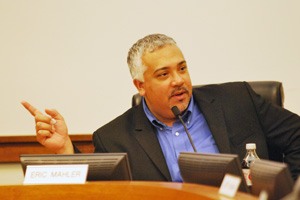
Eric Mahler, chair of the Ann Arbor planning commission. He cautioned developers of Packard Square not to try to undersell the size of their project. (Photos by the writer.)

Despite concerns raised by some commissioners, as well as residents who spoke during a public hearing, the planning commission ultimately voted to recommend approval of the site plan and development agreement for Packard Square, a complex off of Packard Street. The plan calls for 230 apartments and 23,790-square-feet of retail space in a single building.

The commission also recommended approval of two other site plans: (1) at 630 Oxford, between South University and Hill, where the University of Michigan chapter of Phi Kappa Psi plans to convert a rental duplex  into a fraternity house for up to 24 occupants; and (2) at 215 N. Fifth, where owners want to tear down the former Bessenberg Bindery building and construct a two-story, single-family house.

All votes were unanimous. The three site plans will now be considered by the Ann Arbor city council for final approval. [Full Story]

What Does Washtenaw Corridor Need?

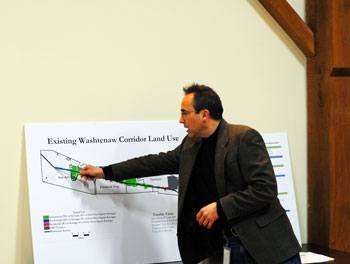
At the Ann Arbor city council’s March 7, 2011 meeting, a visitor from the east – Ypsilanti mayor Paul Schreiber – spoke during a public hearing, calling Washtenaw Avenue a “lifeline” between Ann Arbor and Ypsilanti. The road cuts through four jurisdictions: Ann Arbor, Ypsilanti, Ypsilanti Township and Pittsfield Township. The four local governmental units have been collaborating over the last two years to find ways to improve how the Washtenaw corridor functions – in terms of traffic flow, and future business/residential development.

City of Ann Arbor Planner Jeff Kahan Washtenaw Corridor Improvement Authority

City of Ann Arbor planner Jeff Kahan explains that even though the proposed district boundaries of a Washtenaw Avenue corridor improvement authority would, at its western end, not include properties adjoining the right-of-way, the right-of-way could still receive the benefit of improvements. (Photos by the writer.)

That’s what the public hearing was about. The Ann Arbor city council is considering whether to work with the other three communities to establish a corridor improvement authority (CIA) along Washtenaw Avenue. Schreiber was at Ann Arbor’s meeting to encourage the council to consider forming a CIA, thus joining with his city and the two other municipalities along Washtenaw. The council took no action on March 7 – by state statute, they cannot take the step to establish a CIA until 60 days after the pubic hearing.

A corridor improvement authority is a tax-increment finance district, similar to a downtown development authority – but specifically designed for commercial corridors instead of downtown areas. [.pdf map of proposed Washtenaw Avenue CIA district ] At the March 7 public hearing on establishing a Washtenaw Avenue CIA, Schreiber was one of only two people to speak.

But five days earlier, on March 2, around 20 people attended a presentation by city of Ann Arbor planners at Cobblestone Farm. And they were joined late in the meeting by Stephen Rapundalo, who represents Ward 2 on the Ann Arbor city council. Washtenaw Avenue is a boundary between Ward 2 on the north and Ward 3 on the south. Some of those 20 residents aired their criticisms as well as support of the CIA proposal. In addition to some concerns about the administration of the authority, attendees expressed disagreement with each other about the kinds of solutions the corridor needs.

Some agreed with the conclusions of a joint technical committee that’s been working on the issue: The corridor would benefit from added transit infrastructure and greater accessibility to non-motorized transportation, as well as increased residential density. Others saw that stretch of Washtenaw Avenue as needing mainly additional lanes in the roadway to improve traffic flow.

On the administrative side, city planner Jeff Kahan explained that the possibility of establishing a CIA along Washtenaw Avenue would be greatly helped by a revision to the relatively new state statute that allows such CIAs to be created – a revision that would explicitly articulate that the four jurisdictions could form a single authority. As the statute is currently written, four separate authorities would need to be formed, and then operated under some kind of inter-governmental agreement.

So where did this idea come from that four separate units of government might collaborate on creating a corridor improvement authority for Washtenaw Avenue? It pre-dates by at least two years Gov. Rick Snyder’s recent call for greater collaboration among government entities. But Snyder was at least indirectly involved in providing some impetus behind the effort. [Full Story]

Column: History Repeats at AnnArbor.com

When we first heard about the layoffs at AnnArbor.com last Thursday – starting with cryptic comments on Facebook, quickly spreading through the Ann Arbor News diaspora and then the broader community – I had a sickening sense of déjà vu. It was two years ago this month that the out-of-state owners of our town’s daily newspaper announced their plans to close the business, tearing apart the lives of its workers, fraying some of the Ann Arbor community’s fabric, and drawing national attention for the decision’s fearlessness or folly, depending on your view.

AnnArbor.com layoff list

Redline highlights are those AnnArbor.com staff whose names have disappeared from the staff roster.

I wrote about their decision at the time from a personal perspective. Even though I had left the News the previous year to co-found The Chronicle, it was still a place that employed many friends and colleagues I respected. Watching that organization get dismantled was emotional, for many reasons.

Although we began to hear about the layoffs on Thursday last week, we decided not to write immediately about that news. In part, we reasoned that it should be AnnArbor.com’s story to tell first, and I held out hope that executives at AnnArbor.com would be straightforward in letting the community know about their decision, and the rationale behind it.

I also hoped they would wrap into their coverage the news that three other key staff members – news director Amalie Nash, higher education reporter David Jesse and point person for reader interaction Stefanie Murray – had all been hired by the Detroit Free Press. All three left at the end of February. All had previously worked for many years at The Ann Arbor News, and had been initial hires at AnnArbor.com.

Considered separately, either the set of layoffs or the three departures would have had a significant impact on the organization. But with both events taking place within two weeks, it counts as the most dramatic personnel change since AnnArbor.com’s launch. [Full Story]

Work Session Called on Conference Center

On Tuesday, March 8, 2011, a committee appointed by the Ann Arbor city council and charged with reviewing proposals for future use of the Library Lot – the top of the Fifth Avenue underground parking structure – met for the first time since November. The expected result of Tuesday’s meeting had been that the committee would move a proposed hotel/conference center project forward to the city council.

And that’s what the committee voted to do – specifically, to recommend to the city council that a letter of intent (LOI) be signed with Valiant, the developer, which could eventually lead to a development agreement. The city council will receive a presentation on the letter of intent at a work session on Monday, March 14 at 7 p.m. at the Washtenaw County Board room at 220 N. Main St.

David Di Rita of The Roxbury Group

David Di Rita of the Roxbury Group addresses the Library Lot RFP review committee. Left in the frame in the background is local attorney Tom Wieder. Right in the frame is Vivienne Armentrout, a former Washtenaw County commissioner and author of the blog, "Local in Ann Arbor." (Photos by the writer.)

In the draft of the LOI unveiled at Tuesday’s committee meeting, the city and Valiant would try to strike a development agreement no later than four months after the signing of the LOI, with construction to start 15 months after the signing of the development agreement.

Attending the committee meeting on Tuesday was David Di Rita of The Roxbury Group, which has served as a consultant to the committee. In November, Di Rita had delivered a report to the committee recommending Valiant’s proposal over a similar project proposed by another developer – Acquest.

The majority of Tuesday’s meeting time was taken up with Di Rita delivering introductory remarks – a self-described “soliloquy” – and walking the committee through the main points of the draft LOI, or responding to committee member questions.

In his introductory remarks, Di Rita distinguished between the idea of analyzing the financial viability of a specific proposal – which he stressed that The Roxbury Group had not done – and the overall economic validity of a concept.

Key points in the draft LOI are the idea that Valiant would pay for the acquisition of development rights on the property, but could use part of that payment for the design and financing of the conference center. The city of Ann Arbor would own the conference center, and would not be held liable for its maintenance and operation costs, unless Valiant were to cease holding the management agreement. The city’s ownership could, according to the draft LOI, possibly implicate payments by Valiant to the city in lieu of taxes. The draft LOI also calls for reserving no fewer than 350 daytime parking spaces in the underground parking garage, currently under construction, for the hotel/conference center.

In addition to committee members, more than 20 people attended the meeting, filling the fourth floor conference room of city hall. Attendees in the audience included Ward 1 councilmember Sabra Briere; Ann Arbor District Library director Josie Parker; and AADL board member Nancy Kaplan. Several people who attended have expressed objections to the hotel/conference center project, based on either the substance of the proposal itself or the decision-making process.

Related to complaints about the decision process, the meeting began with an adamant request from local attorney Tom Wieder to be allowed to address the committee, which was denied by the committee’s chair, Stephen Rapundalo. [Full Story]

Photo Essay: Fat Tuesday in Ann Arbor

Editor’s note: It’s Fat Tuesday, when thoughts turn to paczki – those dense but irresistible Polish pastries that mark the last hurrah before Lent. This year, for the first time in their 18-year history, Zingerman’s Bakehouse staff got up well before dawn to make their own version, and local photographer Anne Savage was there to catch the action. She’s sharing some of her work with Chronicle readers – you can find many more photos on her new food blog, The Savage Feast. Enjoy!

Nina Huey at Zingerman's Bakehouse

Nina Huey sprinkles powdered sugar on a tray of paczki at Zingerman's Bakehouse Tuesday morning. Ingredients for the dough include bit of Spiritus, a Polish grain alcohol.

[Full Story]

DDA Passes Budget, Pig to Follow

Ann Arbor Downtown Development Authority board meeting (March 2, 2011): At its regular monthly meeting, the DDA board approved its budget for the next two years – fiscal years 2012 and 2013. The DDA’s fiscal calendar is aligned with the city of Ann Arbor’s, which runs from July 1 to June 30.

Board members of the Ann Arbor Downtown Development Authority

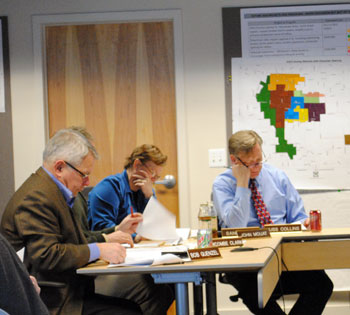
DDA board members study the budget proposal they approved at the March 2 meeting. From left to right: Bob Guenzel, Sandi Smith, Russ Collins. Obscured, sitting between Guenzel and Smith, is John Mouat. (Photo by the writer.)

For FY 2012, the DDA is budgeting for $20,118,601 in total revenues – of that amount, $3,893,943 is forecast to come from tax capture, $16,162,752 from parking revenues, and $61,906 from interest earnings. Budgeted expenses, at $20,631,328, will exceed revenues by $512,727.

The board has not yet incorporated into its budget the likely revisions that will be made to the DDA’s contract with the city of Ann Arbor, under which it manages the city’s public parking system. Those contract revisions are expected to result in a total parking-contract-related payment to the city of $2.26 million in FY 2012. The approved DDA budgets for FY 2012 and 2013 include only the roughly $1 million of payments to the city that the DDA is currently obligated to make.

While the DDA expects to be drawing down its fund balances over the next two years – due in large part to the expense of the Fifth Avenue underground parking structure that’s under construction – the longer-range forecast by the DDA shows increases in revenue that are expected to replenish reserves. The DDA estimates that its tax capture revenue will increase from its current level of roughly $3.9 million to $4.7 million by 2020. Parking revenues are also forecast to increase – due in part to the increase in parking space inventory offered by the underground garage, but also due to increases in parking rates – from an estimated $16 million next year to $22 million by 2020.

About the underground parking garage, at the February 2009 board meeting, Russ Collins had said the board needed to keep alert for their next projects after “this pig makes it through the python.” At Wednesday’s meeting, mayor John Hieftje alluded to Collins’ remark in trying to emphasize the long-range projected financial health of the DDA.

In the other business item handled by the board at its Wednesday meeting, Hieftje cast the lone vote of dissent on a vote to approve $45,000 out of $50,000 for a discretionary management incentive that’s part of the DDA’s contract with Republic Parking, which manages day-to-day operations for the city’s parking system.

The board also heard its usual round of committee reports; however, no one addressed the board during either of the opportunities for public comment. Highlights from Ray Detter’s report from the Downtown Citizens Advisory Council included an update on plans for the new Blake Transit Center and a report from the city’s panhandling task force. [Full Story]

Monthly Milestone: Institutional Memory

Editor’s note: The monthly milestone column, which appears on the second day of each month – the anniversary of The Ann Arbor Chronicle’s launch – is an opportunity for either the publisher or the editor of The Chronicle to touch base with readers on topics related to this publication.

It’s also a time that we highlight, with gratitude, our local advertisers, and ask readers to consider subscribing voluntarily to The Chronicle to support our work.

We no longer number the monthly milestones here at The Chronicle. If we did, this one for March 2011 would be number 30. Parents with young children can probably peg 30 months to 2.5 years without even doing the math. Two and a half years does not seem like a terribly long time for a publication to stay in business – especially compared to the nearly 175-year run of The Ann Arbor News. The announcement of that paper’s closure came two years ago – on March 23, 2009. Coming as it did late in the month, the grim news did not figure in The Chronicle’s March 2009 monthly milestone.

Instead, publisher Mary Morgan filled the column that month with mostly lighter fare, including a mention about the addition of the Skyclock widget to the right sidebar of this website – scroll down to the bottom under the advertisements. Now, exactly two years later, Skyclock has again earned a spot in the milestone column – which this month is a quick tour of twilight, marijuana, and snow. [Full Story]

Marijuana Law Stalls; Future Projects OK’d

Ann Arbor City Council meeting (Feb. 7, 2011): At its Monday meeting, the council made some progress on further amendments to a proposed licensing scheme for medical marijuana businesses, but ultimately decided to postpone their initial vote on the licensing law. Among the amendments made by the council on Monday night was one that provided a definition of a “cultivation facility” – something that a council caucus attendee had suggested the night before.

The postponement of an initial vote to the council’s next meeting, on Feb. 21 22, means that a final vote on licensing could not come sooner than the council’s March 7 meeting. An initial vote on zoning regulations for medical marijuana businesses was already taken by the council at its Oct. 18, 2010 meeting. On Monday, the final vote on those zoning regulations was also postponed to March 7. The council’s pattern over the last two months has been to postpone the final vote on zoning regulations for medical marijuana businesses so that it will coincide with the final vote on licensing.

Betsy and Alex de Parry

Betsy and Alex de Parry listen as councilmembers deliberate the question of whether to grant a fee waiver if de Parry resubmits his Heritage Row project to the city. (Photos by the writer.)

The council also took action on several development-related issues. Without discussion, councilmembers approved an amendment to a contract with Village Green to develop a 244-space parking deck as the first two stories of a 9-story building, City Apartments – a 156-unit residential planned unit development (PUD) at First and Washington. The contract approval is part of a series of milestones that is planned to culminate in Village Green’s purchase of the city-owned land parcel for $3 million by June 1, 2011, and with construction starting later in the summer.

The council also approved an application fee reduction, from nearly $5,000 to $2,000, for the developer of Heritage Row, a residential project proposed for Fifth Avenue just south of William Street – if  the project is resubmitted within 90 days. The resolution began as a fee waiver, but was amended to be a reduction. On resubmission, the project will go through the complete review process, starting with a citizen participation meeting.

The council also took action to implement the city’s new design guidelines for new downtown buildings. It sets a purely voluntary review and compliance process in place for now, with the expectation that the mandatory review process with voluntary compliance will be implemented later.

The council unanimously approved the city’s new capital improvements plan (CIP) after a close 6-5 vote that removed an item calling for an extension to the Ann Arbor municipal airport runway. And one item appearing in the CIP was moved ahead to possible fruition: A possible roundabout for the Maiden Lane and Fuller Road intersection will be studied and engineered under a $460,139 contract with DLZ Michigan Inc.

At Monday’s meeting, the council also authorized applications for federal matching funds to acquire development rights for two greenbelt properties.

And labor issues found their way into the deliberations in two ways. First, Stephen Rapundalo (Ward 2), chair of the council’s labor committee, gave a breakdown of the large disparity between health care costs paid by the city’s fire and police union members as contrasted with the city’s non-union staff, as well as with University of Michigan employees. Second, as part of its consent agenda, the council approved a $54,000 contract with a consultant to study fire protection service requirements in Ann Arbor. The city administrator cited such a study at a recent council budget retreat as useful if the city decides to contemplate a shift to a combined paid-on-call and full-time staff fire department. [Full Story]

DDA OKs Village Green Amendment

Ann Arbor Downtown Development Authority board meeting (Feb. 2, 2011): On a day when other government bodies scrubbed their schedules due to a blizzard forecast, the DDA board held firm to its regular first-Wednesday-of-the-month meeting time. The diminished activity downtown due to the snow led Roger Hewitt to quip during the meeting: “This will not be a particularly profitable day in the parking system, I think we can safely say.” The meeting achieved attendance of 10 out of 12 board members.

Gary Boren, Roger Hewitt, John Hieftje, Keith Orr

From left to right: DDA board members Gary Boren, Roger Hewitt, John Hieftje, and Keith Orr. (Photos by the writer.)

In their one business item, the board approved an amendment to the contract with Village Green to develop a 244-space parking deck as the first two stories of a 9-story, 99-foot-tall building, City Apartments – a 156-unit residential planned unit development (PUD) at First and Washington.

Once the parking deck portion of the building is completed and issued a certificate of occupancy, the city of Ann Arbor has agreed to issue $9 million worth of bonds to purchase the deck, and the DDA has agreed to make the payments on those bonds. The amendment to the contract provides DDA consultants access to the site during construction activities to check that construction methods conform to standards that will ensure a 75-year life for the deck.

On the city council’s agenda for Monday, Feb. 7, 2011 is their own approval of the same amendment to the Village Green contract. The contract amendment is part of a timeline put in place on Aug. 5, 2010, when the city council approved an extension of Village Green’s option to purchase the First and Washington city-owned parcel for $3 million. That timeline calls for Village Green to purchase the land by June 1, 2011.

The $3 million proceeds from the hoped-for Village Green deal were part of the financing plan for the city’s new municipal center, and would have no direct impact on the current general fund’s $2.4 million deficit that’s forecast for the FY 2012 budget. However, during deliberations some DDA board members accepted the point made by their colleague Newcombe Clark – that there are likely indirect connections between the completion of the Village Green transaction and the city’s overall budget picture, at least in terms of cash flow.

In reports and communications entertained by the board, highlights included: (1) a continued interest on the part of the University of Michigan to absorb a segment of Monroe Street into the UM Law School campus; (2) complaints from the property manager at 416 Huron St. about disrepair of an alley and adjoining sidewalks in the area, as well as a lack of maintenance on property owned by the railroad; and (3) an elaboration by the mayor on some remarks about Borders that he’d made and that had been reported in the media. [Full Story]

Column: Medical Marijuana – Drawing a Line

The Michigan Medical Marihuana Act (old-tyme spelling courtesy of the Michigan legislature) has been in effect since December 2008, but it wasn’t until last summer that seemingly every stationary object and alternative newspaper in Michigan was plastered with pot-leaf emblazoned ads for dispensaries, compassion centers, and doctors willing to recommend medical marijuana.

Photo illistration of a prescription bottle for medical marijuana

Would you want your medicine dispensed like this? (Photo-illustration by The Chronicle.)

As the business columnist for the Current, I dropped in on one such business, hoping to sit down with the good doctor and get a sense of just how all this worked. To ensure accuracy, I always record my interviews, something the subjects of those interviews usually appreciate: No one wants to be misquoted.

I was shocked when this doctor declined to be recorded. In four years of writing that column no one had ever asked that I not record: burlesque dancers, roadkill-eating geeks, foreign-born restaurateurs with unpopular social stances, even those involved in actual criminal enterprises had all been fine with a recorded interview.

But this medical doctor didn’t want me to record her talking about her medical practice, nor would she tell me her first name – although LinkedIn outed her the next day when it showed me her picture and suggested we connect as business contacts. [Full Story]

Monthly Milestone: Snowfall of Information

Editor’s note: The monthly milestone column, which appears on the second day of each month – the anniversary of The Ann Arbor Chronicle’s launch – is an opportunity for either the publisher or the editor of The Chronicle to touch base with readers on topics related to this publication.

Yardstick measuring Feb. 2, 2011 snowfall in Ann Arbor

Despite dire forecasts, snowfall amounts by Wednesday morning were closer to five inches than 13 inches. But some of the words in this article were written before the snowstorm ended. And as this photo shows, it was not hard to find some deeper drifts. (Photo by the writer.)

It’s also a time that we highlight, with gratitude, our local advertisers, and ask readers to consider subscribing voluntarily to The Chronicle to support our work.

Less often than I would like, I use a membership-funded co-working space on Main Street in downtown Ann Arbor called The Workantile Exchange to write and edit the material in this publication.

But even when I do work there, I am not all that productive, if productivity is measured by the number of words I type. Of course, I do type some words there. Some of these very words you are reading right now were typed at the Workantile. But number-of-words-typed is not how I measure the Workantile’s value to me.

So how do I assess the value of what I accomplish there?

It’s like describing the result of a snowstorm. [Full Story]

UM Research Highlighted at Regents Meeting

University of Michigan board of regents meeting (Jan. 20, 2011): The university’s top research administrator, along with a faculty member who has successfully straddled the academic and entrepreneurial worlds, addressed regents at their January meeting about how university research is aiding economic development.

Stephen Forrest, David Lampe

Stephen Forrest, left, talks with David Lampe before the start of the Jan. 19, 2011 University of Michigan board of regents meeting. Forrest, UM's vice president for research, gave a presentation on the university's research efforts. Lampe is vice president for communications. (Photos by the writer.)

Stephen Forrest, UM’s vice president for research and chair of the board for economic development agency Ann Arbor SPARK, described the concept of an “innovation pipeline,” with the input of funding and ideas yielding an output of jobs, prosperity and expanded opportunities for faculty and students. The process has leaks and clogs, he noted, but the university has strategically applied patches – citing as an example the Venture Accelerator program that launched this month.

And Jim Baker, director of the Michigan Nanotechnology Institute for Medicine and Biological Sciences, was on hand to embody the efforts of faculty who successfully translate research into economic development. Baker’s talk focused on the rewards of creating new businesses – he observed that one reason why students come to UM is to enhance their economic prospects and improve their lives. Baker talked about the importance of keeping those graduates in Michigan to aid in the state’s economic recovery – and doing that requires jobs. He noted that the four companies he has helped launch in Ann Arbor have brought in $160 million in investments and created 45 new jobs so far.

Regents took action on several items during the meeting, including approval of two projects related to the athletics department: A $52 million renovation and expansion of Crisler Arena – the second phase of a major overhaul of that facility, which was built in 1968; and a $20 million project to install video scoreboards at Michigan Stadium, Crisler Arena and Yost Ice Arena. David Brandon, UM’s athletic director, made a brief appearance at the meeting but did not address the regents publicly. And this month’s biggest athletic-related news at UM – that Brady Hoke was hired as head football coach – received only a mention as part of president Mary Sue Coleman’s opening remarks. He did not attend the meeting.

Seven people spoke during public commentary on a variety of topics. Among them were: (1) a call to reassess Fuller Road Station, a proposed parking structure and possible train station near UM’s medical campus; ( 2) questions about the medical leave of Ken Magee, executive director of UM’s Department of Public Safety (DPS); (3) thanks from the leader of the Ann Arbor Summer Festival for the university’s support of that annual event; (4) criticism of the use of live animals to train survival flight nurses; and (5) a plea for financial support for The Loyal Opposition to the Status Quo (LOSQ), a nonprofit launched to address disparities between African-Americans and Caucasians. [Full Story]

Site Plan OK’d for Avalon Housing Project

Ann Arbor planning commission meeting (Jan. 20, 2011): After a public hearing that included comments by some residents of 1500 Pauline, planning commissioners unanimously approved the site plan for an affordable housing project at that location, proposed by the nonprofit Avalon Housing.

Painting of blue houses

This painting of blue houses is not in Avalon Housing's site plan for its affordable housing proposal at 1500 Pauline. It's part of a display by fifth grade students in the lower level of the downtown Ann Arbor District Library, where the Jan. 20 planning commission meeting was held.

The project will include demolishing the existing structure and constructing five one- and two-story buildings and a community center. Though commissioners supported the project, some raised concerns over the relocation of current residents and the fact that the new complex, when completed, will have fewer units – 32, compared to the current 47 apartments. Of those, there will also be far fewer one-bedroom units – six, compared to the current 21.

Representatives from Avalon told commissioners that the lower number was sustainable – 35% of the units will be set aside for residents who’ll receive supportive services. They also said the location was more suited for families, and that there’s more need for two- and three-bedroom affordable housing units in the city.

Another project on the agenda – a site plan and special exception use for 630 Oxford – was postponed, as recommended by city planning staff. The Phi Kappa Psi fraternity wants to turn an existing rental duplex into their chapter’s permanent home, housing up to 24 residents. The housing director and some board members for the neighboring Delta Gamma sorority came to Thursday’s meeting to object to the plan, saying they did not want fraternity culture to disrupt their quiet neighborhood.

Commissioners also unanimously recommended approval of the annexation of 1575 Alexandra Blvd., a vacant 0.82-acre lot now in Ann Arbor Township. The lot is surrounded by the city’s Riverwood Nature Area – its owner plans to build a single-family home on the site.

Also at Thursday’s meeting, Wendy Rampson of the city’s planning staff reminded commissioners of a public meeting on Wednesday, Jan. 26 to get community feedback on draft recommendations for R4C and R2A residential zoning district ordinance revisions. The meeting runs from 6-8 p.m. at the lower level of the downtown Ann Arbor District Library, 343 S. Fifth Ave. [Full Story]

Marijuana Issue Lingers; DDA-City Deal Stalls

Ann Arbor City Council meeting (Jan. 18, 2011): At its most recent meeting, scheduled a day after the Martin Luther King Jr. holiday, the council was due to consider, for a second time, a first-reading of a licensing scheme for medical marijuana businesses that has been put forward by city attorney Stephen Postema.

Stephen Kunselman, Roger Fraser

In deliberations on a resolution that would have authorized the Ann Arbor Downtown Development Authority to start designing a plan to develop city-owned surface parking lots, Stephen Kunselman (Ward 3), who's speaking here, said he did not want to tie the city administrator's hands. The hands in question are visible in the right of the frame, clearly still untied. (Photos by the writer.)

After amending the licensing proposal heavily at its Jan. 3, 2011 meeting, the council had decided to postpone the measure until Tuesday’s meeting. After a relatively brief attempt to undertake further amendments, the council decided to postpone consideration again – until its Feb. 7, 2011 meeting. They also voted to extend the moratorium on opening additional marijuana dispensaries and cultivation facilities through March 31, 2011.

Not relatively brief were Christopher Taylor’s (Ward 3) opening remarks about a resolution that would have authorized the Ann Arbor Downtown Development Authority to design a plan to develop city-owned downtown parking lots.

In the end, the council decided to postpone consideration of the DDA parcel-by-parcel proposal – on a 6-4 vote, with some of those voting against postponement looking to vote it down. The effect of the postponement was likely similar to what outright rejection would have been. The clear message was this: Substantial revision to the proposal would be required to gain the kind of overwhelming support the measure will likely need to persuade DDA board members that the council is in agreement with the proposal.

Another piece of major business, which passed quietly, was approval of an overhaul of the ordinance language defining the city’s retirement system. An additional tax abatement for Edwards Brothers received a lot of discussion, but was ultimately approved.

The city also accepted a grant from the Home Depot Foundation for sustainability work, that earned praise for the city’s environmental coordinator, Matt Naud. In other city environmental action, David Stead was reappointed to the city’s environmental commission, and Steve Bean’s decision was announced that he had not sought reappointment to that commission, after a long tenure.

Th site plan for Lake Trust Credit Union at the southeast corner of West Liberty and West Stadium Boulevard was approved. And two additional parcels were added to the land that is protected by the city’s greenbelt program.

As budget season looms, Stephen Rapundalo (Ward 2), who serves on both the city council’s budget committee and the labor and administration committee, gave a status update on the city’s negotiations with its unions. [Full Story]

Lutz Rides Current Motor’s Potential

Editor’s note: The Chronicle first wrote about Current Motor back in April 2009.

On the second day of the recent press preview at the 2011 North American International Auto Show in Detroit, a group of Ann Arborites gathered around a sleek-looking, gleaming blue electric scooter and exchanged banter.

Bob Lutz

Bob Lutz, an investor in Ann Arbor-based Current Electric, plans to take one to the firm's electric scooters on the road when "the snow is off the highway." (Photos by the writer.)

“So, Bob,” says Erik Kauppi, founder and chief engineer of Current Motor, the maker of the scooter. “Are we going to see you tooling around Ann Arbor’s streets on one of these things soon?”

“Bob” is Bob Lutz, the father of the electric Chevy Volt, the sexiest young thing at the auto show – on four wheels, that is. “As soon as the snow is off the highway, I’ll stop by with my checkbook,” Lutz says.

Lutz is now retired from GM, but is far from quitting his advocacy of electric vehicles. He opened up his checkbook last year to Current Motor, becoming an investor in, and adviser to, the company. Just how much did he invest?

“It’s enough to demonstrate a solid interest and small enough so that if this fails I won’t be terribly distressed about it,” Lutz says. “That’s the way I like to invest.” But, he says, the leadership at Current is going about it the right way, so he is confident in their success. [Full Story]

Column: Accidental Auto Journalist

I am not a journalist – I just play one, as the saying goes.

Auto show media credentials

The author's media credentials for the North American International Auto Show. (Photos by the writer.)

So what was I doing at the Press Preview of the North American International Auto Show a few days ago at Cobo Hall? Even though I’m an architect in my day job, I also do some writing for EcoGeek.org, a blog focused on issues of technology and the environment. And I’ve also contributed to several other online media outlets in the past few years.

My writing sideline started with a focus on green building technology. But because of my proximity to Detroit, I found myself receiving forwarded invitations to auto industry events.

So while I’ve never particularly thought of myself as a “car guy,” I’ve come to find myself acting in the capacity of an automotive journalist. I have now attended the North American International Auto Show three or four times as a member of the press.

Despite having developed some familiarity with the process, I still feel like an interloper – as though I’m getting away with sneaking in someplace I’m not supposed to be. [Full Story]

Ann Arbor Hotel First to Get Design Review?

On the evening of Jan. 5, 2011, First Hospitality Group Inc. hosted a citizens participation meeting for the hotel project it’s proposing at the southwest corner of Washington and Division streets. The proposal calls for a 9-story, 104-room, LEED-certified building, facing South Division. The meeting, held at the downtown Ann Arbor District Library, was required by city ordinance – before submitting a site plan for the city to review, developers must invite owners of property within 1,000 feet of a proposed project to a forum that describes the plan.

Four corners at Washington and Division

The corners of Washington & Division, clockwise from top left: NW (former Ann Arbor News building); NE (411 Lofts); SE (McKinley's Towne Center); SW (parking lot, site of proposed Ann Arbor Hotel). Image links to larger file.

Much of the conversation between residents and First Hospitality’s Ira Ury revolved around the city’s downtown design guidelines. Even before the meeting, as Ury and resident Ilene Tyler introduced themselves, Tyler wanted to know if First Hospitality had used the design guidelines to develop the schematics on display.

Ury explained that his team had used the draft of the design guidelines that is available on the city’s website. But that draft, which dates from late 2009, has undergone considerable revision since February 2010, when the council appointed a task force to undertake further study and make a recommendation. The task force has been meeting almost weekly for the better part of the past year.

The task force unveiled its draft at a city council work session on Monday, Jan. 10. One key difference between the 2009 draft and the version the task force has now unveiled is the re-introduction of the original design guidelines advisory committee’s October 2007 recommendation for a design review process. It would be a mandatory process overseen by a design guidelines review board, with voluntary compliance by petitioners. But as Ray Detter, president of the Downtown Citizens Advisory Council, put it to Ury on Wednesday, if a developer doesn’t comply with the recommendations of the review board, “Everyone will know!”

Depending on the timing of city council approval of the design guidelines, First Hospitality’s project could be the first site plan that undergoes a formal design guidelines review process. At the council’s work session, Ward 4 councilmember Marcia Higgins said she planned to attach the final draft to the city council’s Jan. 18 agenda as a communications item, and to bring it forward for council approval at the Feb. 7 meeting.

What exactly are these design guidelines? Where did they come from? When might they be approved? [Full Story]

Monthly Milestone: Tom, Huck in Ann Arbor

Editor’s note: The monthly milestone column, which appears on the second day of each month – the anniversary of The Ann Arbor Chronicle’s launch – is an opportunity for either the publisher or the editor of The Chronicle to touch base with readers on topics related to this publication. It’s also a time that we highlight, with gratitude, our local advertisers, and ask readers to consider subscribing voluntarily to The Chronicle to support our work.

Envelope addressed to a Newspaper Man

Newspaper Man almost rhymes with Superman.

Holiday mail received by The Chronicle this year included an envelope addressed to “Dave Askins, Newspaper Man.”

I knew who had sent it without looking at the Virginia return address. It was from a guy nicknamed “Huck.”

Inside was a bonus – Huck’s holiday letter. It was a two-pager. The second page featured a paragraph that drew my gaze in that way your own name will when rendered in print: “So I Googled all Ann Arbor newspapers and emailed the first one for help – three hours later Mr. Dave Askins of The Ann Arbor Chronicle …”

Long story short: Richard Huckeby – “Huck The Elder” – and his lovely bride Rita were traveling across the country in early December, and were hoping to visit their friend Tom Stockton in Ann Arbor. But they were having trouble connecting via email or phone, which they’d used reliably in the past to communicate with him.

Otherwise put, Huck was looking for Tom. And Huck had asked a newspaper man for help. [Full Story]