Business Section

Ann Arbor Task Force Consults Panhandlers

Editor’s note: At its Sept. 20, 2010 meeting, the Ann Arbor city council reappointed a downtown street outreach task force – aka the “panhandling task force” – which had existed in the early 2000s. The current group’s charge is to work for no longer than six months to identify cost-effective ways to achieve better enforcement of the city’s ordinance against panhandling, and to provide help to panhandlers who are addicted to drugs.

Panhandler's cup of coins

The sum of one panhandler's afternoon collection on Dec. 31, 2010 on the sidewalk next to Border's Bookstore on East Liberty Street in downtown Ann Arbor. (Photo by Dave Askins.)

Now that the task force is roughly halfway through that six-month period, The Chronicle attended its December meeting to check in on the group’s work.

You buy local, think global, pay it forward, recycle. You’re a good person.

So how do you respond to a panhandler? Is opening your wallet helping someone in need? Or is it enabling an addiction? Can you look the other way and still consider yourself compassionate?

At the Dec. 15 meeting of the city’s panhandling task force, three paid consultants gave their perspective on the issue – as panhandlers. Geoffrey Scott said he enjoys talking to the people almost as much as he appreciates the money they give him.

But one member of the city’s panhandling task force says people don’t realize the damage they do in the name of kindness. [Full Story]
Arbor Dog Daycare Returns – and Prevails

Ann Arbor planning commission meeting (Dec. 21, 2010): More than a year after making their initial request, the owners of Arbor Dog Daycare were granted a special exception use on Tuesday, allowing the South Main Street business to expand.

Chris Cheng, Jon Svoboda

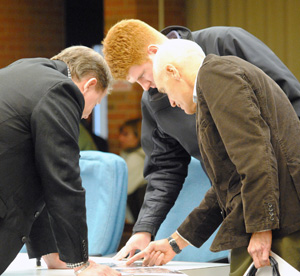
Chris Cheng, left, of the Ann Arbor planning staff talks with Jon Svoboda, co-owner of Arbor Dog Daycare. (Photos by the writer.)

Several conditions were added, including requirements related to the number of dogs allowed outside, and action to be taken if there’s continuous barking. Noise concerns had been a reason cited by commissioners who previously voted against the request.

Also at Tuesday’s meeting, the commission granted a special exception use and approved the site plan for Allen Creek Preschool, which plans to tear down an existing house and build a larger one at its Franklin Street location.

Commissioners also heard several updates and communications, including a request for feedback on a draft resolution regarding a proposed development agreement between the city and the Ann Arbor Downtown Development Authority. [Full Story]

Active Use of Work Space: Film Premiere

On Wednesday night at the Workantile Exchange – a membership-funded coworking space on Main Street, between Washington and Huron – local video producer and urban researcher Kirk Westphal premiered his two newest films.

Workantile Exchange Urban Planning Council Manager Form of Government

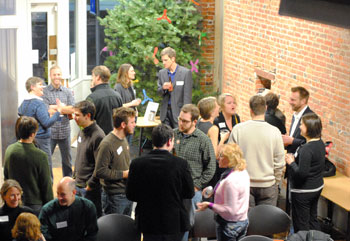
Pre-premiere socializing at the Workantile Exchange for films on urban planning and forms of local government. (Photos by the writer.)

The first film, “The Great Street Toolkit,” focuses on urban planning. The second, “The Council-Manager Form of Local Government,” is an introduction to how the council-manager system is different from a strong mayor system. The city of Ann Arbor uses a modified version of the council-manager form.

As Westphal himself noted lightheartedly, it was the “true wonks” in the audience who stayed for the second film – on council-manager government.

And it turns out that most of the 30 people in the audience were true wonks.

But linked indirectly to the evening in multiple ways was one person who was not in the audience at all –  local developer and downtown property owner, Ed Shaffran. [Full Story]

Next Step Taken on Huron Hills Proposal

About 50 people showed up Friday morning in the city council chambers to hear a presentation by Miles of Golf partners about their proposal to assume operations of the city-owned Huron Hills golf course, and move their business there.

Doug Kelly, Andrew Walton, Chris Mile

Chris Mile, right, co-founder and president of Miles of Golf, discusses the firm's proposal for Huron Hills golf course with Doug Kelly, left, the city of Ann Arbor's director of golf, and Andrew Walton, the Huron Hills golf supervisor. (Photos by the writer.)

During the 90-minute meeting, president Chris Mile and other partners with the Pittsfield Township business gave a presentation and answered questions from a seven-member selection committee. Members of the public were allowed to submit questions, which city staff said will be answered and posted online within the next couple of weeks.

Much of the presentation covered the same material found in the Miles of Golf initial response to the city’s request for proposals (RFP), as well a separate financial report. [.pdf file of Miles of Golf RFP response] [.pdf file of Miles of Golf financial proposal] The business has proposed operating the 18-hole, 116-acre course essentially unchanged for three to five years. Then, it plans to build a new facility on what is now the front seven holes – land east of Huron Parkway – with a driving range, teaching center and golf shop. It would relocate its current operations, which are located off of Carpenter Road, south of Packard, and convert the remainder of Huron Hills into a 9-hole course. They’re also hoping to partner with Project Grow or Food Gatherers, to put in a community garden on land they don’t plan to use for golf.

To fund construction, the proposal calls for the city to issue a $3 million bond, which Miles of Golf would pay off over 20 years. The business proposes to pay additional funds to the city during that time, totaling about $1 million. Miles of Golf also estimates that the city would save about $5 million over the 20 years, since it would no longer be paying to operate the course – an estimated $250,000 per year.

During their presentation, Miles of Golf partners addressed concerns that have been raised in the community. They stressed that the project would not put up perimeter fencing or pole lights, and that the land would remain accessible for winter activities, like sledding. Nor do they plan to build a banquet center – though they do hope to eventually sell food and beverages on the site, including alcohol. Currently, Huron Hills does not have a liquor license, though the other city course, Leslie Park, does.

Miles of Golf submitted one of only two proposals that were made in response to the city’s RFP, which was issued in September. The selection committee rejected the second proposal, which had been submitted by a group called Ann Arbor Golf. It called for operating Huron Hills as a public, 18-hole golf course via a new nonprofit entity, the Herb Fowler Foundation of Huron Hills. [.pdf of nonprofit proposal]

In an email to The Chronicle, Paul Bancel – one of the leaders of Ann Arbor Golf – said they’d been told by city staff that their proposal was rejected because they hadn’t provided an adequate plan for staffing the golf course, hadn’t identified the roles of the key individuals in their organization and didn’t include any bank references. The group was disappointed the committee did not choose to interview their group, Bancel wrote – they were not asked any questions, nor were they asked to provide any clarifications about their proposal. [Full Story]

Monthly Milestone: To Address a Meeting

Editor’s note: The monthly milestone column, which appears on the second day of each month – the anniversary of The Ann Arbor Chronicle’s launch – is an opportunity for either the publisher or the editor of The Chronicle to touch base with readers on topics related to this publication. It’s also a time that we highlight, with gratitude, our local advertisers, and ask readers to consider making a voluntary subscription to support our work.

submit comment button

For regular attendees of Ann Arbor city council meetings, this piece of art is easily recognizable as a "photo-illustration" – there's no "submit comment" button for the public commentary slot on the paper agenda.

I’m fond of using the milestone column as an occasion to highlight some of the work our readers do when they write comments about material we publish.

So I’d like to begin this month’s column with a request: Stop reading the words on this page and fetch yourself a stopwatch.

Now go read some different words – all 972 of them – assembled into a coherent comment by a reader, Richard Murphy, about a recent Chronicle column: Murph’s comment on the purpose of downtown development authorities.

How long did that take you? [Full Story]

Heritage Row Redux: Again

Based on its Dec. 6, 2010 agenda, on that evening the Ann Arbor city council will begin a multiple-meeting reconsideration of the Heritage Row proposal from Alex de Parry. The Heritage Row project was previously presented to the city council as a residential project for South Fifth Avenue that would renovate seven houses and construct three new 3.5-story apartment buildings behind those houses, with an underground parking garage and a maximum 82 apartments, with no more than 163 bedrooms.

The proposal to be reconsidered includes the following revisions: (1) The top floor the new south building would be removed from the design; (2) The density is reduced from 79 units to 76 units and the number of bedrooms is reduced from 154 to 147; (3) The project will include five affordable units at the 50% AMI (average median income) level, in addition to six affordable units at the 80% AMI level; and (4) The three new buildings will be LEED certified [.pdf of current proposal] Except for the removal of a top floor from one of the newly designed buildings, de Parry had in principle indicated agreement with the other revisions at a Sunday evening council caucus on Sept. 19. [Full Story]

Low-Income Housing Project Planned

Documents filed on Monday with the city of Ann Arbor’s planning staff show details of an affordable housing project at 1500 Pauline that includes tearing down the existing apartment buildings and rebuilding a combination of apartments, townhomes and a community center.

Apartments at 1500 Pauline

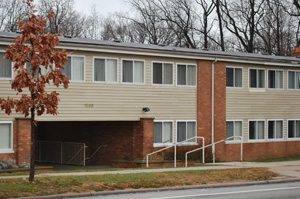
Entrance to the apartment complex at 1500 Pauline in Ann Arbor. (Photos by the writer.)

The project is being proposed by the Ann Arbor nonprofit Avalon Housing, though the property is still owned by the Washtenaw Affordable Housing Corp. Avalon took over operations of several WAHC properties, including 1500 Pauline, in 2009.

Also filing with the city on Monday was the Michigan Alpha Chapter of the Sigma Phi Epsilon fraternity, which is seeking a special exception use to transform the Memorial Christian Church building at the corner of Tappan and Hill into a fraternity house. [Full Story]

Column: Arbor Vinous

Joel Goldberg

Joel Goldberg

Although local restaurant wine markups vary widely, you might figure that wine prices in the cutthroat-competitive supermarket world would be more consistent, one to the next.

You’d figure wrong.

One fine example: Italy’s ubiquitous Santa Margherita Pinot Grigio. Fuhgedabout its modest crowd-sourced ratings; the wine’s a staple on most grocery store shelves, including seven of the eight Ann Arbor supermarkets I visited in late October.

If you’re a west-sider who shops at Plum Market, you’ll pay $17 to take home the current 2009 vintage.

Wanna spend more? No problem. On the south side, Meijer sells the same bottle for $19. Joe’s will Trade one in exchange for $21. And if buying the wine at Whole Foods makes you no healthier, its $24 price tag is likely to perk up the chain’s bottom line.

But if you really have money to burn, head east toward Hiller’s for the daily double: you’ll settle for the prior year’s vintage and they’ll soak you for $26 – a whopping $9 (53%) more than Plum’s price.

This may be an outlying example, but it’s far from atypical. The survey found prices on individual bottles can vary as much as 80% among the eight local markets, and your total tab for the identical assortment of wines will be 30% higher or lower, depending on where you shop. [Full Story]

Monthly Milestone: Election Day Edition

Editor’s note: The monthly milestone column, which appears on the second day of each month – the anniversary of The Ann Arbor Chronicle’s launch – is an opportunity for either the publisher or the editor of The Chronicle to touch base with readers on topics related to this publication. It’s also a time that we highlight, with gratitude, our local advertisers, and ask readers to consider making a voluntary subscription to support our work.

It’s election day, so I’ll start this monthly milestone – our 26th, for those keeping score – by badgering you to tell your family, friends and neighbors to go vote. (As a Chronicle reader, you will need no reminder yourself, of course.)

Participants at an Poynter Institute workshop

George Packer (right foreground), a staff writer for The New Yorker, spoke to a recent workshop for nontraditional journalists at The Poynter Institute in St. Petersburg, Florida. (Observant Chronicle readers will spot me sitting at the back of the classroom.) (Photo by Jim Stem, courtesy of The Poynter Institute.)

Frankly, I’ll be glad to bid farewell to Election 2010. Regular Chronicle readers know that while we’re huge fans of good governance and the democratic process, our patience is pretty thin for typical horse-race coverage of elections – complete with endorsements and accusations trotted forth by candidates, which mainstream media then use to whip themselves into a breathless, panting herd.

I’ll also be glad to have elections behind us because the month leading up to Nov. 2 has been especially taxing for The Chronicle – in good ways. But I’m looking forward to a return to our baseline level of overwork. One reason for the extra effort relates to preparation for the first candidate forum ever hosted by The Chronicle. Held on Oct. 21 at Wines Elementary for Ward 5 city council candidates, the event took a nontraditional approach. Chronicle editor Dave Askins described our thinking behind the forum’s task-based format in a recent column. You can read about the forum itself in a separate report. And if you want to review The Chronicle’s election coverage, you can find a list of election-related articles here.

Another reason that the month was busier than usual relates to an out-of-state trip I made to The Poynter Institute in St. Petersburg, Florida. I was a visiting faculty member there at a workshop for nontraditional journalists. In this month’s column, I’d like to focus on the Poynter visit, with some observations about The Chronicle’s work, plus a national perspective based on remarks by George Packer of The New Yorker, who also spoke at Poynter. [Full Story]

University Bank Project Postponed

Ann Arbor planning commissioner meeting (Oct. 19, 2010): Three projects were considered at the Oct. 19 planning commission meeting, and commissioners voted to postpone two of them.

Hoover Mansion

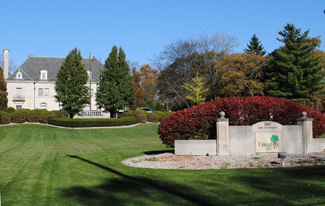
The headquarters of University Bank, in the building known as the Hoover Mansion on Washtenaw Avenue. A request to increase parking on the site was postponed by the Ann Arbor planning commission at its Oct. 19 meeting. (Photos by the writer.)

One of those projects – related to an expansion of Arbor Dog Daycare – has already appeared before the commission multiple times. Most recently, the proposal was rejected by commissioners in September, primarily due to concerns about noise generated by dogs using the outdoor dog run. Owners Jon and Margaret Svoboda had asked that their request be reconsidered, and commissioners agreed to the reconsideration. But after an hour of discussion on Tuesday evening, commissioners voted to postpone again, asking staff to explore possible conditions – such as an annual review or written policy requirement – that could be added to the special exception use to address the problem of continuously barking dogs.

Also postponed was a request to add more parking to the site of the University Bank headquarters in the building known as the Hoover Mansion on Washtenaw Avenue, and to allow up to 10 additional employees to work at that location. The planning staff had recommended denial of the request, stating that the project impacts natural features and doesn’t offer an overall benefit to the city. However, commissioners asked planning staff to work with bank officials to come up with an alternative proposal for locating new parking.

During a public hearing on the project, bank president Stephen Ranzini told commissioners that if the bank can’t get the additional parking, it could trigger a decision to leave that location and expand elsewhere. He noted that the building, which he said sat vacant for nearly three years before being acquired by the bank, is extremely expensive to maintain, and described himself as a good steward for the property.

A third proposal considered by the planning commission on Oct. 19 – adding parking spots to the Briar Cove Apartments complex on the city’s southwest side – was approved unanimously. [Full Story]

Medical Marijuana Zoning Heads to Council

Ann Arbor Planning Commission meeting (Oct. 5, 2010): Zoning for medical marijuana businesses was the main agenda item for the commission’s Oct. 5 meeting. The issue drew more than a dozen people to council chambers, and six people spoke at a public hearing on the topic.

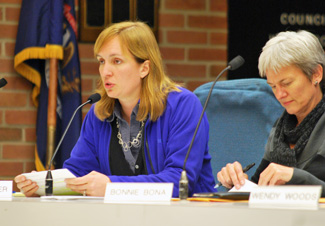
Jill Thacher, Bonnie Bona

Jill Thacher, left, of the city of Ann Arbor's planning staff, has been the point person in drafting a zoning ordinance to address medical marijuana businesses. She outlined changes to the draft ordinance at the Oct. 5 planning commission meeting. Next to Thacher is planning commissioner Bonnie Bona. (Photos by the writer.)

The draft ordinance that was ultimately approved unanimously, and forwarded to the city council, contained several changes from the version that the commission considered at its Sept. 21 meeting. During the Oct. 5 deliberations, commissioners also approved three out of four proposed amendments, some of them in response to input from the public.

In a separate vote, the commission approved a motion to recommend that the city council institute a medical marijuana business license. Eric Mahler cast the lone vote of dissent. There was little discussion and no details about what the license would entail, aside from a general intent “to address issues that fall outside the scope of the zoning ordinance, such as building security and code compliance for electrical use, fire suppression, and ingress/egress.”

Commissioner Jean Carlberg questioned Kristen Larcom of the city attorney’s office about whether the license would only apply to dispensaries, or if it would be required of cultivation facilities and “home occupation” businesses as well. In reply, Larcom said she didn’t know – they hadn’t yet drafted it. Commissioner Kirk Westphal asked if the license might include a cap on the number of dispensaries in the city – Larcom said that it might.

In their final item of business, planning commissioners unanimously agreed to reconsider a petition they had rejected at their Sept. 21 meeting – to a special exception use that would allow for the expansion of Arbor Dog Daycare, a business located at 2856 S. Main St., near the corner of Eisenhower. They then immediately tabled action on the item until their Oct. 19 meeting. The owners spoke during public commentary urging commissioners to reconsider, but later in the meeting commissioner Jean Carlberg said she’d spent more than an hour in the neighborhood near the business, and was disturbed by the level of noise coming from barking dogs there. [Full Story]

Washtenaw Faces $20M Deficit in 2012-13

Washtenaw County Board of Commissioners meeting (Oct. 6, 2010): Financial concerns emerged in a variety of ways at Wednesday night’s meeting.

Jeff Krcmarik, Martha Friedlander

Jeff Krcmarik, the county's environmental program supervisor, talks with Martha Friedlander, chair of the science department at Greenhills School in Ann Arbor. Friedlander was on hand to receive a county environmental excellence award on behalf of Greenhills, one of several such awards given out at Wednesday's meeting. (Photos by the writer.)

Commissioner Conan Smith, who’s leading a budget advisory team, gave a grim update on an anticipated deficit that’s facing the county for 2012 and 2013. Originally projected to be $16 million, the administration now believes the two-year deficit could be $20 million or more, with possible adjustments necessary to address a shortfall in 2011 as well. Declining property tax revenues and uncertain state funding are primary factors.

Smith said cuts made to deal with a $30 million deficit in 2010-11 had brought them down to the bone, and now structural changes will be needed. “Some of what the county does will likely disappear in the process,” he said.

Budget issues also were central to a public hearing on the proposed Act 88 millage, which commissioners have used previously to fund programs related to economic development. It’s a millage they can levy without voter approval. During the public hearing, commissioners heard from supporters of the Food System Economic Partnership (FSEP) and Ann Arbor SPARK – both groups have been funded from Act 88 millage revenues. David Klingenberger of The Brinery, for example, told commissioners that FSEP is helping him build a pickle empire in Washtenaw County. But two people from the Washtenaw County Farm Bureau spoke out against the millage, arguing that property owners are already burdened and that any new tax needs to be on the ballot for voter approval.

Also at Wednesday’s meeting, Tom Wieder spoke during public commentary to call for an investigation into per diem spending by commissioner Mark Ouimet. Based on documents obtained under the Freedom of Information Act, Wieder contends that Ouimet claimed per diem payments to which he wasn’t entitled, and that his spending far exceeded other commissioners. Ouimet responded by saying that if any discrepancy is found in his expense reports, “obviously I’d want to know about it so I can take care of it.”

Ouimet, a Republican from Scio Township, is running for state representative in the 52nd District against Democrat Christine Green. Wieder is listed on a page of endorsements on Green’s campaign website. [Full Story]

In the Archives: Earth Closets

Editor’s note: Michigan’s economy in 2010 is in the crapper. So the theme of jobs growth and economic development is a part of political campaigns statewide – from city council contests on up to the gubernatorial race. Yet no candidate has identified indoor non-flushable toilets as a growth industry in Michigan – perhaps with good reason. We tried that before and it didn’t work out.  Local history author Laura Bien deftly treats this delicate topic with her trademark deadpan prose.

heap-closet-small

Description of William Heap's earth closet. (Image links to higher resolution file.)

In the late 19th century two University of Michigan professors of medicine and an Ypsilanti doctor championed a new sanitation technology. Despite their efforts spanning nearly 20 years, the earth closet turned out to be arguably the least enthusiastically adopted invention in Michigan history.

It was an era of primitive indoor toilets connected to odoriferous privy vaults – if you were lucky. Even elegant urban houses had backyard outhouses – such as Ann Arbor’s historic Kempf House.

Patented in England in 1873 by Henry Moule, the earth closet resembled a wooden box with a rear metal hopper. The hopper was filled with clean dry dirt. After using this commode, the user turned a small handle that dropped a small portion of dirt into the pail, covering its contents and rendering them allegedly odor-free. In time, the pail was removed and emptied, often on one’s garden. Lower-tech earth closets without a hopper had a nearby bucket of dirt on the floor.

It was a 19th-century composting toilet. [Full Story]

Monthly Milestone: Dough Re Mi

Editor’s note: The monthly milestone column, which appears on the second day of each month – the anniversary of The Ann Arbor Chronicle’s launch – is an opportunity for either the publisher or the editor of The Chronicle to touch base with readers on topics related to this publication. It’s also a monthly reminder to readers who read The Chronicle’s material with a feed reader or some other ad-free mechanism to click through to have a look at the recent ad archive. Some of them are very pretty.

Physically attending various events for The Chronicle has its rewards. Had I stayed home and watched a recent League of Women Voters candidate forum on television, I would have missed the pre-event sound check at CTN studios where the event was taped. The Ward 2 and 5 city council candidate debate is now available online offered through CTN’s video-on-demand feature. [Chronicle coverage of that debate is forthcoming.]

The city council forum combined the races for the two wards. Seated on the CTN stage – at a table decked out with red-white-and-blue bunting – from left to right were the Ward 2 candidates, Democrat Tony Derezinski and Libertarian Emily Salvette, followed by Ward 5 candidates: independent Newcombe Clark, Republican John Floyd and Democrat Carsten Hohnke.

Before taping at the CTN studios, the mic check began with a request from CTN studio technicians for candidates to say something. They began with Tony Derezinski, seated farthest to the left. He deadpanned: “Doe, a deer, a female deer.” [Full Story]

Column: Arbor Vinous

Joel Goldberg

Joel Goldberg

In the far corner, wearing synthetic trunks: Steve Heimoff, west coast editor of Wine Enthusiast magazine. I pilfered part of the column title from him; fortunately, Steve’s pretty laid back about such things.

Unlike “natural, schmatural” wine, over which he turns apoplectic: “‘Greenwashing’ is the perfect way to describe a large part of the whole natural, green, sustainable, organic, biodynamic thing. Everybody wants to portray his practices as purer than the other guy’s practices. It’s a holier-than-thou world out there, and IMHO that goes for the whole greenie-natural crowd.”

And here in the near corner, Ann Arborites Stacey and Rob DeAngelis, dressed in the all-natural cloak of DeAngelis Cantina del Vino, whose tasting room opens later this month. It’s the only winery with an Ann Arbor mailing address, though you’ll find it deep in Scio Township.

Not for them, the typical 21st century winemaker’s arsenal of chemicals, sulfites, color enhancers and designer yeasts.

What’s in the wines? “Just the grapes,” says Stacey DeAngelis, whose picture appears on their label.

She’s not kidding. [Full Story]

Potential Bidders Eye Huron Hills Golf

About a dozen people attended Monday afternoon’s pre-bid meeting for those interested in responding to the city of Ann Arbor’s request for proposals (RFP) seeking a public/private partnership for the Huron Hills Golf Course.

Doug Davis, Doug Hellman

Doug Davis of Miles of Golf, left, and Doug Hellman of KemperSports were two of about a dozen people who attended Monday's pre-bid meeting for the Huron Hills Golf Course RFP. (Photo by the writer.)

Anyone who plans to submit a response to the RFP was required to attend the meeting, which lasted 30 minutes and was followed by a field trip to tour the course. Among those attending were Doug Davis and Chris Mile of Miles of Golf, Doug Hellman of KemperSports, Joe Spatafore of Royal Oak Golf Management, and William Arlinghaus of Greenscape.

Also attending were several citizens who have publicly opposed the RFP process, including Ted Annis, Nancy Kaplan, Myra Larson and Paul Bancel. Some are involved in the citizens group Ann Arbor for Parkland Preservation (A2P2).

The meeting, led by city parks manager Colin Smith, was a chance for potential bidders to ask questions or request additional information. The deadline to submit proposals is Oct. 29. [.pdf file of Huron Hills RFP] [Full Story]

Fuller Road Station Plan Gets Green Light

Ann Arbor Planning Commission meeting (Sept. 21, 2010): In a marathon meeting that lasted past midnight, the planning commission handled two major projects: Site plan approval for Fuller Road Station, and a medical marijuana zoning ordinance.

Rita Mitchell

Rita Mitchell and Peter Zetlin talk during a break at the Sept. 21 Ann Arbor planning commission meeting. Both spoke against the proposed Fuller Road Station during a public hearing on the site plan. (Photos by the writer.)

City council chambers were packed with people wanting to address the commission on those two issues, which were the final two items on the night’s agenda.

Before getting to those, commissioners dealt with several lower-profile items. One was a request by the owners of Arbor Dog Daycare asking for permission to expand their business. A neighbor came to oppose it, saying “to expand the operation means more barking.” The commission voted on it twice – an initial vote, then a reconsideration at the end of the meeting at the request of commissioner Evan Pratt, who arrived late and missed the first vote. In both cases, the project failed to get the necessary six votes for approval.

The commission also approved the site plan for a Lake Trust Credit Union branch at the southeast corner of West Stadium and Liberty, despite some concerns about tearing down the existing building.

Later in the meeting – after three hours of staff presentations, a public hearing and commissioner deliberations – Fuller Road Station’s site plan did win approval, with two commissioners dissenting. The project will now move to city council for a vote.

And the final public hearing of the night – on zoning changes that would regulate dispensaries and “home occupations” for medical marijuana – drew 15 speakers. All of them, to varying degrees, urged commissioners not to restrict safe access to medical marijuana. The planning staff had recommended postponement, and commissioners followed that advice. They voted unanimously to postpone action on the proposal, allowing time to incorporate feedback heard during the meeting’s public hearing. The commission is expected to take up the issue again at its Oct. 5 meeting. [Full Story]

Licensing or Zoning for Medical Marijuana?

At the Aug. 5, 2010 meeting of the Ann Arbor city council, councilmembers considered a resolution originally drafted by city attorney Stephen Postema to impose a temporary moratorium on the dispensing and growing of medical marijuana. The city council ultimately passed a modified version of the moratorium, with exemptions for patients and caregivers, a grandfathering-in of existing facilities in the city and a reduction in the length of the moratorium from 180 to 120 days. The moratorium ends Dec. 3.

Ann Arbor ordinance review committee

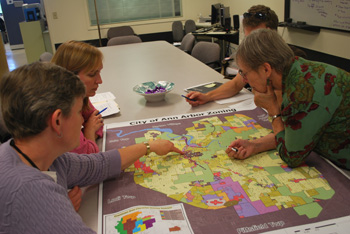
Ann Arbor planning staff and members of the planning commission's ordinance revisions committee discuss existing zoning areas and implications of ordinance changes at their Sept. 13 meeting. Clockwise from left: Wendy Rampson, Jill Thacher, Kirk Westphal, Jean Carlberg. (Photo by the writer.)

The resolution passed by the council also directed the city staff and planning commission to look at possible zoning ordinance changes, with the intent of regulating medical marijuana in Ann Arbor. The resolution does not mention other regulatory approaches, such as licensing.

Since then, the city’s planning staff and the ordinance revisions committee of the planning commission have been developing recommendations to change the city’s zoning code. The changes would regulate medical marijuana dispensaries as well as marijuana grown by registered caregivers as a “home occupation.”

At a Monday, Sept. 13 meeting of the ordinance revisions committee, the group mentioned a parallel track that’s being pursued by the city attorney’s office: licensing of medical marijuana dispensaries. Wendy Rampson, head of the city’s planning department, said that Postema has also been working with the Michigan Association of Municipal Attorneys regarding an approach to licensing medical marijuana. Postema is president of that group. [Full Story]

Zingerman’s Expansion Moves Ahead

Ann Arbor Historic District Commission meeting (Sept. 9, 2010): The last-minute addition of a closed session – which lasted nearly an hour, just prior to deliberations on the Zingerman’s Deli expansion – added a bit of drama to Thursday’s meeting. But ultimately commissioners unanimously approved all projects on their agenda, with only a few concerns cited.

Members of the Ann Arbor Historic District Commission in back of the Zingerman's Deli Annex

Members of the Ann Arbor Historic District Commission talk with architect Ken Clein, right, in back of the Zingerman's Deli Annex on Sept. 7. Clein is with Quinn Evans Architects, which is handling the proposed expansion project. (Photos by the writer.)

The highest-profile of those projects, of course, was a plan to expand the Zingerman’s Deli operations at the corner of Detroit and Kingsley streets, in the Old Fourth Ward historic district. About a dozen representatives affiliated with Zingerman’s attended the meeting, including co-founder Paul Saginaw and managing partners Grace Singleton and Rick Strutz.

In 2008, commissioners rejected the company’s first attempt to gain HDC approval – in the form of a “certificate of appropriateness,” which included asking permission to tear down a small house on their property that had been gutted by fire. Since that initial rebuff by the HDC, Zingerman’s has been working on an alternative path, gaining approval from the city’s planning commission and city council, and returning to the HDC for a “notice to proceed.”

On Thursday, the commission granted the notice to proceed, which will allow the project to move forward. Several commissioners addressed concerns raised during public commentary about this project setting a precedent, saying that Zingerman’s is a unique business and this expansion is unique as well.

But commissioner Lesa Rozmarek, while noting that she would support the project and that overall Zingerman’s is an asset to the community, also said she wanted it on the record that she felt Zingerman’s had threatened the commission with the prospect of leaving the area if they didn’t get approval. The project sets a bad precedent, she said, adding that “it’s opening a big door that hopefully we can shut after this application.”

Later in the meeting Saginaw responded to Rozmarek’s comments, denying that anyone from Zingerman’s threatened to leave the city – though at one point they did consider moving out of that location to another site within Ann Arbor, he said. Saginaw said he believed the HDC was able to approve the project on its merits.

In other business, the commission issued certificates of appropriateness for three projects: 1) a solar panel installation at 217 S. Seventh St., 2) a request to add an exterior sign near the front door of 209-211 S. State St., where a CVS pharmacy is being constructed, and 3) a proposal for a 1.5-story addition on the back of 442 Second St.

The solar project is being installed on the home of Matt Grocoff, founder of Greenovation TV. Grocoff had attended last month’s HDC meeting, when two other solar panel installations were approved, including one at the historic Michigan Theater building on East Liberty. On Thursday, Grocoff told commissioners that when his solar panels are installed, his home will be the oldest in the nation to achieve net zero energy status, using only energy generated on-site. [Full Story]

Column: Seeds & Stems

Marianne Rzepka

Marianne Rzepka

The sky was full of fast-moving clouds – disappearing remnants of a morning’s rain – and temperatures were falling from a week of 90-degree weather into the 70s.

A breeze was the final touch to the perfect weather at Kirk Jones’ Good Scents Gardens in Ypsilanti Township.

“Being out here,” said Jones. “I like this.”

Good thing, because the flowers he grows there are his business. Jones uses the yarrow, zinnias, butterfly weed and agastache for bouquets he puts together and personally delivers to regular subscribers.

Jones explains it as a twist on the idea of community supported agriculture, or CSA, in which subscribers pay a set amount for one season of produce from a local farm. Instead of picking up a carton of vegetables once a week, Good Scents’ customers get a floral bouquet delivered to their home or business once a week.

Like a CSA, in which a subscriber’s take depends on what and how much the farmer raises over a season, Good Scents’ customers get what Jones chooses to plant and what comes up each year. No matter what, he said, they will get a bouquet of flowers each week over the 26-week season. [Full Story]

More Solar Energy Projects In the Works

Bonnie Bona insists that the best way to make pesto is with a mortar and pestle. While she admits the method is more labor-intensive than using a food processor, Bona cites it as yet another tip to become more eco-friendly.

MIchigan Theater Building on East Liberty

The plain brick wall on the Michigan Theater Building on East Liberty in downtown Ann Arbor – rising up behind the storefronts – will be the site of a solar panel installation funded by XSeed Energy, a program of the Clean Energy Coalition and the city of Ann Arbor. (Photos by Mary Morgan.)

As a project manager for the Ypsilanti-based Clean Energy Coalition, Bona specializes in this art of saving energy. She is quick to add, however, that “my goal isn’t to make people sacrifice and suffer. It’s to make them see opportunities where life can be better and, oh, by the way, it uses a lot less energy.”

But it’s not just about using less energy. Bona and others in the Ann Arbor area are involved with projects that focus on generating alternative energy, too – in particular, solar power. Prompted in part by the lure of tax credits and available state and federal funding, an increasing number of efforts are underway to install solar panels on individual residences, businesses, nonprofits and schools – including, as one recent example, the Rudolf Steiner School of Ann Arbor.

And in mid-August, the Ann Arbor Historic District Commission unanimously approved two solar installation projects in historic districts, one for a private home on South Seventh Street, and another at the Michigan Theater. With some citing concern over aesthetics, commissioners acknowledged that they’ll likely see more of these requests in the future, and discussed the need to develop guidelines for solar installations within the city’s historic districts. [Full Story]

Column: Arbor Vinous

Joel Goldberg

Joel Goldberg

Imagine a restaurant that thrives and grows based on its friendly service, consistent products, strong marketing and support for and from its community.

But peek in the kitchen and you discover packaged mixes, pre-sliced produce, shortcut recipes and commercially-prepared dishes, straight from a central commissary or food-service supplier.

Its primarily pre-packed ingredients never spoil, but neither do they ever taste truly fresh. Menu items don’t vary from one visit to the next, thanks to consistent sourcing and preparation – but neither do they ever excite, or rise above the overall uniformity and mediocrity of their processed flavors.

Now imagine that this restaurant is, instead, a winery. And let’s consider the curious case of downtown Saline’s Spotted Dog, which just announced a capacity-tripling expansion accompanied by positive nods from some local media.

The affable John Olsen, a refugee from the world of corporate tech support, looks up from behind the tasting counter as you enter the Spotted Dog, a brick-walled, 1,600-square-foot storefront just off the corner of Michigan Avenue and Ann Arbor Street.

Olsen, who co-owns the winery with his wife, Jill, is tediously affixing labels to a batch of newly-filled bottles. Such is life at a micro-winery, where hand labor often stands in for expensive and space-consuming machines. [Full Story]

Column: Two-Year Milestone

Editor’s Note: The monthly milestone column, which appears on the second day of each month – the anniversary of The Ann Arbor Chronicle’s launch – is an opportunity for either the publisher or the editor of The Chronicle to touch base with readers on topics related to this publication.

Letter from The Ann Arbor Chronicle to the Ann Arbor District Library

Letter from The Ann Arbor Chronicle to the Ann Arbor District Library.

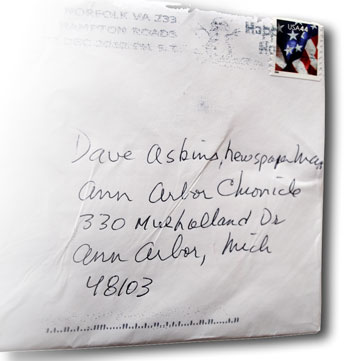
Last month I trekked over to the Ann Arbor District Library to hand-deliver a paper document to the library’s director, Josie Parker. It was a letter that stated our intent, as owners of The Ann Arbor Chronicle, to grant all necessary legal authority to the AADL to preserve public access to our publication’s archives, in the event that The Chronicle closes or that we get hit by a bus.

It was an important decision for us, and one we didn’t take lightly – “we” being me and my husband Dave Askins, who’s editor and co-owner of The Chronicle. For me, The Chronicle has always been a convergence of the professional and the personal. Launching the publication on Sept. 2, which is also our wedding anniversary, reflects that connection. So choosing how to ensure the preservation of The Chronicle’s archives was more than a business decision.

The corpus of civic affairs and local government reporting that we’ve compiled in The Chronicle’s first two years, we believe, is a community asset worth preserving. During my tenure at The Ann Arbor News, I was always appalled at the condition of the archives there, neglected and deteriorating in a basement space we called The Cage. I was thrilled when the AADL negotiated to become caretaker of that massive collection, some items dating back to the late 1800s. Given the AADL staff’s obvious competence and eagerness to dig into the project – organizing more than 1 million items – it seemed a natural fit to ask that they consider shepherding our much less space-demanding slice of local journalism, too.

The Chronicle, of course, was born digital, and at this point would fit on a thumb drive. Although we’d likely be classified by most folks as “new media,” in many ways we embrace an ethos that runs contrary to current trends. And that’s why I liked the idea of walking a few blocks to the library and handing over a letter – a physical artifact that outlines the hopes of a digital future. And on this occasion of The Chronicle’s second anniversary, I’d like to chew on that notion a little more, and talk about what its implications might be. [Full Story]

Payments, Permits in Lieu of Parking

Ann Arbor Planning Commission meeting (July 20, 2010): Parking is a frequent topic for planning commissioners, though often tangentially, as it relates to specific developments. The issue was brought up more directly at their July 20 meeting, when Susan Pollay – executive director of the Ann Arbor Downtown Development Authority – made a guest appearance.

Entrance to Liberty Square parking structure on East Washington

The entrance to Liberty Square parking structure on East Washington Street, between Division and State. Parking contracts between the DDA and developers include permits for spaces in this structure. (Photo by the writer.)

Pollay was on hand to describe and answer questions about a DDA proposal for a payment-in-lieu-of-parking program, known as a PILOP. The planning commission won’t be acting on the proposal, which sets out options for developers to meet the city’s parking requirements for new buildings. But Pollay was asking for feedback, before crafting a resolution that council will likely consider later this year. The proposal that Pollay presented would have developers pay for parking permits, plus a monthly surcharge. Some commissioners voiced preference for taking payments from developers to support the parking system, but not including parking permits as part of the deal.

Commissioners also approved a site plan for a drive-thru pharmacy at the Kroger on South Maple, and as well as rezoning for the Ann Arbor Guest House, a proposed residence on Dhu Varren Road for people with relatives in the hospital.

And while they initially seemed poised to approve revisions to their bylaws, commissioners ultimately postponed that vote, hoping to bring someone from the city attorney’s staff to an upcoming meeting to answer questions about some of the proposed changes. [Full Story]

Know Your DDA Board: John Splitt

As John Splitt walked in to greet me at the Espresso Royale on State Street, his familiarity with the shop and street was immediately apparent.

splitt-with-board3

John Splitt holds the commemorative plaque he received last month as outgoing chair of the Ann Arbor Downtown Development board. It's fashioned from earth retention lumber from the underground parking structure currently under construction along Fifth Avenue.

Splitt strolled into the cafe, having walked from his dry-cleaning business, Gold Bond Cleaners. “It’s located on Maynard Street, just on the other side of the arcade,” he said, motioning toward Nickels Arcade, a covered passage connecting Maynard and State.

State Street holds a special significance for Splitt as the gateway to his community involvement. In 2004, Splitt joined the board of the State Street Area Association, an experience he described as an educational process, that “opens your eyes to some of the larger downtown issues.” Once on the association’s board, his interest in community service continued, and in 2006 he was appointed to the board of the Ann Arbor Downtown Development Authority (DDA). [Full Story]

Monthly Milestone: Vote for The Chronicle

Editor’s note: The monthly milestone column, which appears on the second day of each month – the anniversary of The Ann Arbor Chronicle’s launch – is an opportunity for either the publisher or the editor of The Chronicle to touch base with readers on topics related to this publication. It’s also a monthly reminder to readers who read The Chronicle’s material with a feed reader or some other ad-free mechanism to click through to have a look at the recent ad archive. Some of them are very pretty.

campaign yard signs

Campaign yard signs. We caution against altering other candidates' yard signs ... except digitally.

Publisher of The Chronicle, Mary Morgan, wrote a recent column explaining why this publication is not making endorsements of particular candidates for tomorrow’s primary election. She appealed to an analogy of candidates as race horses. But we expect the winning thoroughbreds to pull the plow as draft horses once they’re elected.

The draft horse analogy works just as well for The Chronicle as a publication. Mostly what we try to do is plow the field of civic and community affairs in a way that’s as predictable and straight as a furrow left by a well-drilled draft team. We are somewhat plodding.

It’s still worth pointing out that we’ve made some of our coverage a bit more sprightly by filing basic results on individual issues straight from public meetings via the Civic News Ticker. We’re successfully piloted the Ticker over the last month. And we’re now content to commit to it as a stable feature. Readers no longer need to wait for days on end to find out how a vote turned out.

But teams of draft horses – no matter how well drilled, or how sprightly they step on occasion – are not typically recorded in history the same way as names like Secretariat or Man o’ War. Most Chronicle readers would be hard pressed to provide the name of some specific draft horse, past or present – other than perhaps the fictional Boxer from Orwell’s “Animal Farm.”

So for this month’s milestone column I’d like to highlight some of the other draft horses on The Chronicle team – besides Mary Morgan and me. I’d like to make it more clear when readers voluntarily send us subscription dollars, they’re “voting” not just for the two founders of this publication whose livelihoods depend on its financial success. Voluntary subscribers are also voting for the other freelance writers who are helping to pull The Chronicle’s plow, and who earn part of their livelihoods from their work for The Chronicle.

Otherwise put, draft horses need some hay to eat. And maybe even some sugar cubes. [Full Story]

Column: Free to Love Craigslist

Jo Mathis

Jo Mathis

[Editor's note: Jo Mathis was a columnist and reporter for The Ann Arbor News until it closed in July 2009.]

Many factors led to the shutdown of The Ann Arbor News one year ago, and most begin with a capital I.

Because of the Internet, Google became a verb that allowed instant, round-the-clock information, much of which was provided free of charge by newspapers that nonetheless expected people to continue paying for the print version.

Because of the Internet, there are endless ways to fill free time, which meant the daily newspaper became less and less a necessary part of people’s routine.

Because of the Internet, advertisers – by far our main source of income – could reach more targeted audiences at a much lower cost. (A snippy subscriber once said the only reason she got the paper was for the Meijer ads. I wanted to ask, “Haven’t you heard of meijer.com?”)

And because of the Internet, a nerd named Craig Newmark was able to start a little thing called Craigslist, which put a deadly dagger into classified sections everywhere. [Full Story]

Column: Comments, Complaints, Condiments

You say “tomato” …  I say they’re gross.

dinty-moore-sandwich

#4 Zingerman's Sandwich – the Dinty Moore: Corned beef, lettuce, tomato, Russian dressing on rye bread.

But it is a fact of life that others have deemed tomatoes to be a tasty treat. They’re included in various standard salads, soups, sauces and sandwiches. Take a sandwich from Zingerman’s Deli, for example, the Dinty Moore (#4):  Corned beef, lettuce, tomato, Russian dressing on rye bread.

I’m almost certain that a sandwich artist properly trained in the culture of Zingerman’s customer service would enthusiastically build me a tomato-less Dinty Moore.

But I do not want to be served such a sandwich.

I want that sandwich served to me the way the sandwich designer conceived it – with a tomato. I can then alter the sandwich to suit my individual taste by manually removing the tomato.

Why not just order a tomato-less sandwich and avoid the tomato traces that are inevitably left behind, no matter how aggressively the corned beef is blotted with a napkin? Because I want the option – up until the very last possible moment – of leaving the tomato on the sandwich, or restoring the tomato to its proper place atop the beef.

Those trace tomato flavors on my sandwich remind me that I still, apparently, dislike tomatoes. But maybe someday, it’ll occur to me that, Wow, that tastes terrific, I should put that tomato slice back on the sandwich!!

I’d like our readers to think of the public commentary we include in The Ann Arbor Chronicle’s meeting reports the same way I think of tomatoes. We include the public commentary, just in case you decide that you’d like to have a bite.

So let’s go back a year ago, to a tomato still preserved in The Chronicle’s archives as fresh as the day resident Jim Mogensen picked it. He was talking about video recording equipment to be installed in Ann Arbor police cars.

And yes, I’m going find a way, by the end of this column, to connect video recording equipment in police cars to Zingerman’s sandwiches. [Full Story]

Zingerman’s Moves on to HDC

Ann Arbor City Council meeting (July 19, 2010): On Monday night, Zingerman’s Deli partners enjoyed complete support with no dissent from the city council, or the community at large, for their plans to expand the Detroit Street location. The council approved the site plan for the 10,000-square-foot addition, as well as a brownfield application.

stephen-rapundalo-pointing-july-19-2010

Stephen Rapundalo (Ward 2) and Ann Arbor chief of police Barnett Jones chat during a break in the July 19 council meeting just after passage of a new pedestrian ordinance. During deliberations on that ordinance, Jones had cited the Canadian cultural practice of pedestrians standing on the curb and simply pointing to the crosswalk, which prompts motorists to stop for them. The remark had earned a thumbs-up from Rapundalo, who is a dual U.S.-Canadian citizen.

Intended as an extra measure of support for Zingerman’s was a third resolution communicating to the city’s historic district commission (HDC) the council’s view that the project represents a substantial benefit to the community. The proposal includes demolition of one house and the integration of another house into the architecture of the proposed new construction. Because the site is located in the Old Fourth Ward, the HDC will need to give its approval, in order for the project to be built. The message sent by the council to the HDC was clear: We want this project approved.

The council also sent a clear message to its firefighter and police unions, which the city hopes will soon ratify contracts that will save the city money. At the meeting, the council approved labor agreements with two other groups – the Teamsters civilian supervisors and the Teamsters police professional assistants. That added to bargained changes with the police deputy chiefs union that were approved at the council’s previous meeting on July 6. All three agreements reflected cost savings to the city through greater contributions by union members to health and retirement benefits and no increase in wages.

The implicit message to the firefighter and police unions was given explicit form through a position statement from the council’s labor committee and read aloud by Stephen Rapundalo (Ward 2), the chair of that committee. The statement calls on those unions to follow the example of the three who have already ratified contracts.

The council also gave final approval to a new pedestrian safety ordinance, which requires motorists to stop for pedestrians who are in, or even approaching, crosswalks that lack any traffic control device. During deliberations, the council swapped in “stop” to make the ordinance stronger than the originally proposed “yield.”

In other business, the council authorized the specific allocation of over $1 million in already-budgeted funds to nonprofits providing human services, approved liquor licenses for two downtown businesses, authorized the hire of a community energy coordinator using federal funds, got an update on the future of the Library Lot, and heard public commentary on a range of issues. [Full Story]

AHP Zoning Revisions Go to City Council

Ann Arbor Planning Commission meeting (July 8, 2010):  The 4th of July holiday caused some reshuffling of city meeting times and locations, and sent planning commissioners to the Ann Arbor District Library on Thursday night to conduct their business.

Wendy Rampson, Eric Mahler

Wendy Rampson, head of the city's planning staff, and Eric Mahler, newly elected chair of the Ann Arbor planning commission, at the commission's July 8, 2010 meeting. (Photos by the writer.)

That business included approval of revised area, height and placement (AHP) standards that have been under review for more than two years. The revisions have pulled back from some of the original proposals – for example, there’s no longer an uncapped building height in certain districts. It’s the first significant overhaul of these standards in roughly 50 years, with the goal of reflecting prevailing community values. The recommendations will now be forwarded to city council for final approval.

The planning commission also voted to postpone action on a project at the Kroger on South Maple. The grocery is adding a drive-thru pharmacy, and needs city approval to reconfigure its parking lot to accommodate the drive-thru lane. A few unresolved issues led commissioners to push back consideration until their July 20 meeting.

And the commission elected a new slate of officers, with local attorney Eric Mahler replacing architect Bonnie Bona as chair. [Full Story]