Education Section

UM Regents Criticize “Formula Funding”

University of Michigan board of regents meeting (Nov. 17, 2011): A meeting that began 20 minutes late included two items that spurred discussion among regents: The possible use of a formula to allocate state funding for higher education, and the need for a more comprehensive housing strategy on the Ann Arbor campus.

Block M cookies

Regent Andrea Fischer Newman passed around a tray of Block M cookies before the Nov. 17 board meeting. Later, regent Martin Taylor objected to a potential "cookie cutter" approach to appropriating money for higher education, via formula funding. It was fairly clear that he wasn't referring to these cookies. (Photos by the writer.)

This year, as part of the standard budget appropriations process, the state also has asked universities to provide suggestions for how to implement “formula funding” – a mechanism that’s being considered as a way to standardize appropriations for higher education. Martin Taylor and other regents expressed concerns over the approach, and asked for revisions to a letter being sent from the university to the state budget director that would explicitly state UM’s opposition to this kind of funding model.

Also on the agenda were two requests related to renovations at East Quad on central campus and Baits II on north campus. The topic prompted regent Andrea Fischer Newman to call for a broader strategy for student housing in the coming decades, saying that more attention needs to be given to that aspect of the university. Regent Larry Deitch noted that UM charges a healthy price, and he doesn’t believe there’s full value for UM’s lower-division students when some facilities aren’t up to snuff.

The child rape scandal at Penn State was mentioned at two points during the Nov. 17 meeting. Toward the start, board chair Denise Ilitch read a brief statement on behalf of the regents, saying that the board fully supported president Mary Sue Coleman’s Nov. 16 letter to the campus community. The university plans to use this tragic situation, Ilitch said, for thoughtful re-examination of UM’s values, culture and priorities.

At the end of the meeting, Douglas Smith spoke during public commentary, criticizing the university for not protecting alleged victims of sexual assault by UM athletes Brendan Gibbons and Jordan Dumars. Penn State was only an anomaly because the victims were children, he said. But it’s not an anomaly for university administrators to protect their athletic programs rather than the victims, he added – that’s the norm.

Two others spoke during public commentary. Stephen Raiman, founder of Students Against GSRA Unionization, lobbied regents to reverse their previous vote of support for the right of graduate student research assistants to unionize. And Courtney Mercier, founder of Michigan Student-Athletes for Sustainability, advocated for support to improve integration of the athletic department into the university’s sustainability efforts.

Student filmmakers also made a presentation during the meeting, highlighting video public service announcements (PSAs) they’d made for UM’s “Expect Respect” campaign. After they finished, Ilitch asked whether they’d be interested in making a PSA for the regents, too. [Full Story]

Column: Speaking Truth to Power

John U. Bacon

John U. Bacon

College football coaches are far from the richest people in sports, but they could be the most powerful. That might seem far-fetched, but not to the disciples of Bear Bryant, Woody Hayes, and Tom Osborne, to name just three, who rose to become almost spiritual leaders at their schools.

At University of Michigan president James Duderstadt’s retirement banquet in 1996, he said being president wasn’t easy, but it came with some nice perks. He even got to meet the man thousands of people considered God. “No,” he said, “not Bo Schembechler, but the Dalai Lama.”

It got a laugh, but it also revealed how much presidents both fear and resent their coaches’ power, which can eclipse almost everything else on campus. The best that schools can hope for is an enlightened despot, one who keeps things clean – while winning ten games a year and beating their arch-rival.

Michigan has been lucky. Its biggest icons – Fielding Yost, Fritz Crisler, and Bo Schembechler – were not just revered, they were restrained, refusing to resort to the dirty tactics their opponents used on and off the field.

No one in the history of Penn State stamped the school more than Joe Paterno did. He led the Nittany Lions to five perfect seasons, and did it the right way. He didn’t spend a dollar to expand his humble ranch home, instead donating more than $4 million to expand the university.

As Mark Twain said, once a man earns a reputation for hard work, he can sleep until noon. Likewise, Paterno’s image eventually took on a life of its own, one so powerful no mere mortal dared question it.

The acid test was his former top assistant, Jerry Sandusky, who received the first formal complaint about his questionable conduct from a boy’s mother back in 1998. This introduced a pattern of reports, with all of them systematically squelched by Paterno and Penn State. Having seen Michigan’s coaches spend 16-hour days together – which is typical at that level – I find it impossible to believe Penn State’s coaches weren’t all too aware of Sandusky’s behavior, and the danger it posed. [Full Story]

AAPS Budget Forum Feedback

Ann Arbor Public Schools budget forum (November 14, 2011): It was standing-room only in the Pioneer cafeteria annex as over 140 people gathered to hear an overview of how the school district is funded, and to add their ideas to the mix as the district faces an anticipated $14 million shortfall in 2012-13.

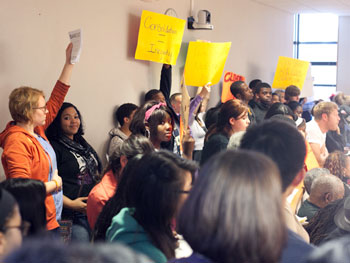
Robert Allen (standing at right) with the large gathering at the budget forum held Nov. 14 at Pioneer High School. (Photos by the writer.)

The district’s approved budget for 2011-12 is $183.62 million.

As staff scrambled to bring in more folding chairs and photocopy additional handouts, AAPS superintendent Patricia Green and AAPS deputy superintendent of operations Robert Allen opened with a presentation on funding and budget challenges.

The presentation had been tweaked since a similar forum held last week. [For the details from that forum, see previous Chronicle coverage: "AAPS Seeks Public Input on Budget"]

This report highlights some of the changes made to the budget presentation, but focuses on the questions and suggestions offered by the community members who attended Monday’s forum. [Full Story]

AAPS Seeks Public Input on Budget

Ann Arbor Public Schools budget forum (November 10, 2011): About 60 people joined AAPS superintendent Patricia Green, deputy superintendent of operations Robert Allen and the rest of the AAPS top administrators at a budget forum last Thursday evening.

Glenn Nelson AAPS

Ann Arbor Public Schools board trustee Glenn Nelson (light blue shirt), listening to parents at the AAPS budget forum on Nov. 10. (Photos by the writer.)

The forum served two distinct purposes: (1) to educate the public on school funding issues, including its specific challenges for crafting next year’s (2012-13) budget; and (2) to solicit ideas from the public on how the district can reduce its budget by $14 million.

The current fiscal year’s approved budget is $183.62 million.

The district typically schedules budget forums in the spring, but this year wants to involve the community earlier than that.

A second forum will take place Monday, Nov. 14 at 6:30 p.m. in the cafeteria annex at Pioneer High School.

At Thursday’s event, Allen said that the district is projecting a $14 million deficit for the 2012-13 school year. Over the past five years, the district has made a cumulative total of nearly $50 million in cuts. [Full Story]

Election 2011: Final AAPS Candidate Forum

All six candidates for the Ann Arbor Public Schools board of education attended a 90-minute forum at Ann Arbor Open @ Mack school on Thursday evening, Nov. 3. It was the final public candidate forum before next Tuesday’s election. About 50 people, including teachers and parents of AAPS students, filled the small auditorium. Several candidates remarked that it was the best-attended event of the election season.

No Nut sign

A "No Nut" sign was posted at the entrance to Thursday's AAPS board candidate forum. It did not appear to relate to the event. (Photos by the writer.)

Candidates for the two open seats – each for four-year terms on the seven-member school board – are Albert HowardAhmar IqbalPatrick LeonardLarry Murphy, and incumbents Simone Lightfoot, and Andy Thomas.

The forum was hosted by the Ann Arbor Open Coordinating Council, and was moderated by AAOCC co-chair Sascha Matish. After brief opening statements from all candidates, they responded to a series of six questions that had been submitted by parents whose children attend Ann Arbor Open.

Questions covered the topics of programs of choice, standardized testing, state-mandated initiatives, the district’s budget, class size, and the proposed technology millage. Summaries of each candidate’s answers are provided below, presented in the order in which they responded.

For previous Chronicle coverage of the school board candidates, including more about their backgrounds, see: “Forum for Six AAPS Candidates“ and “Election 2011: AAPS Board Candidate Forum.”

This year, the general election falls on Nov. 8. Readers who are unsure where to vote can type their address into the My Property page of the city of Ann Arbor’s website to get that information. Polls are open from 7 a.m. to 8 p.m. [Full Story]

AAPS Board Tackles Procedural Issues

Ann Arbor Public Schools board of education regular meeting (October 26, 2011): The board spent the better portion of its meeting discussing a large set of changes to the procedures it uses to conduct its business.

Stemming directly from discussions held at the board’s Oct. 14 retreat, the changes covered the board meeting agenda structure and its committee structure.

Deb Mexicotte Susan Baskette AAPS mission

AAPS board president Deb Mexicotte (left) and Trustee Susan Baskett discuss linking the AAPS strategic plan to board discussion. Baskett is holding a copy of the plan's mission and goals. (Photo by the writer.)

The proposed changes were initially presented as special briefing items, meaning they could have been approved by board action that night. But in the end, the board approved just two of the changes at their Oct. 26 meeting – linking all agenda items directly to the strategic plan, and adding a section to the agenda to clarify facts related to public commentary. The board put off making two other decisions – one that would officially change the board’s committee structure, and another adding time limits to meetings.

The most substantive change – meeting monthly as a “committee of the whole” instead of maintaining two standing committees of three trustees each– was examined in light of the 21 board policies that such a change would affect. A large part of the policy discussion centered on how items are put on the board agenda, and how changing the committee structure could affect that process.

Responding to some trustees who said that they would like more time to let the proposed policy amendments “marinate” before committing to them, board president Deb Mexicotte led the board to treat the proposed changes as first briefing items. Issues typically come before the board as a first briefing and are then voted on at a subsequent meeting as a second briefing item.  Mexicotte later moved, and the board agreed, to meet as a committee of the whole on Nov. 2. The board will then vote on the policy changes necessary to enact the committee structure changes at the next regular meeting on Nov. 16.

The final suggested change – adding time limits to agenda items and meetings – was discussed in some detail, but not acted upon officially at Wednesday’s meeting. Board president Deb Mexicotte said she would present a summary of the discussion regarding time limits at the Nov. 2 committee meeting.

Also at Wednesday’s meeting, the board heard public commentary on the upcoming NAACP freedom fund dinner, class sizes, transparency, transportation, and special needs services. Trustees also approved a series of policy updates as part of a short consent agenda. [Full Story]

AAPS Trustees Lament State’s “Hoops”

Ann Arbor Public Schools board of education meeting (Oct. 12, 2011): Reaction to new state-level legislation and how it’s affecting the school district was a common theme of nearly every section of the Oct. 12 AAPS board meeting.

Robert Allen Ann Arbor Public Schools

AAPS deputy superintendent of operations Robert Allen (left) and Washtenaw Intermediate School District transportation director Tom Moore addressed the board's questions regarding transportation. (Photo by the writer.)

At the meeting, the board passed the necessary set of resolutions to qualify for the restoration of $1.6 million of support from the state, as board members criticized the state’s process as “hoops” they needed to jump through.

Budget constraints came up in most of the topics on which the board took action, as well as during two informational updates – one on the bus service, and one on the results of an insurance audit undertaken by the district. Multiple speakers who addressed the board urged trustees to take political action and to lead the community in legislative advocacy and state-level reform.

Transportation service changes were again a major point of discussion at the Oct. 12 meeting. Board members questioned the success of the district’s bus service consolidation with the Washtenaw Intermediate School District. Four parents spoke at public commentary about safety concerns resulting from loss of bus service, especially with the winter weather approaching.

At last Wednesday’s meeting, the board also voted to purchase additional algebra textbooks, approved the printing of the Rec & Ed catalogue, and renewed a contract for therapeutic services needed for special education students. [Full Story]

Election 2011: AAPS Board Candidate Forum

A candidate forum held Monday evening, Oct. 3, 2011 invited six candidates for two seats on the Ann Arbor Public Schools (AAPS) board of education to make brief statements and share their answers to five questions.

AAPS candidates 2011

Simone Lightfoot draws a number out of the hat, held by League of Women Voters member Judy Mich, to determine speaking order. From left to right (front to back): Albert Howard, Ahmar Iqbal, Patrick Leonard, Simone Lightfoot, Larry Murphy, Andy Thomas. (Photos by the writer.)

Candidates were asked about bullying, their candidacies, technology, transportation, and partnerships between AAPS and other entities. The forum was sponsored by the local League of Women Voters, and broadcast live from the studio at Community Television Network (CTN).

The video can be re-played online through CTN’s video-on-demand service.

League member Susan Greenberg opened the forum, introducing the six school board candidates – Albert Howard, Ahmar Iqbal, Patrick Leonard, Larry Murphy, and incumbents Simone Lightfoot, and Andy Thomas.

Election Day is Nov. 8. Voters will be asked to choose up to two candidates to serve four-year terms on the seven-member board. Board members not standing for election this time around are: Deb Mexicotte, Glenn Nelson, Irene Patalan, Christine Stead and Susan Baskett.

Greenberg explained that the League of Women Voters is open to all citizens over the age of 18, male and female, and referred the public to the League website for membership information. She added that one purpose of the League is to assist voters in making informed choices at the polls, and as such, it holds forums such as this one.

Finally, Greenberg noted that the questions for Monday’s forum were selected by a committee of League members from suggestions sent in by the community, and introduced forum moderator Judy Mich.

Mich welcomed “viewers, voters, and candidates” and provided some information on how the forum would be conducted. She explained that  the League’s policy is to alternate the person who first responds to a new question, and then allow each of the other candidates to respond to the same question. For the opening and closing statements, candidates drew numbers to determine their speaking order.

Candidate responses are presented in the order in which they were given. For previous Chronicle coverage of the candidates, including more about their backgrounds, see: “Forum for Six AAPS Candidates[Full Story]

Forum for Six AAPS Board Candidates

The Ann Arbor area League of Women Voters (LWV) will hold a candidate forum on Monday, Oct. 3 from 7-8 p.m. at the Community Television Network studio, 2805 South Industrial Highway, Ann Arbor. The public is invited to attend but not to participate. The forum will also be broadcast live on CTN’s CitiTV Channel 19.

Two seats on the Ann Arbor Public Schools board of education are up for election on the Nov. 8, 2011 ballot, each for four-year terms. The seats are currently held by Simone Lightfoot and Andy Thomas, who are both seeking re-election. Challenging the incumbents are: Albert Howard, Ahmar Iqbal, Patrick Leonard, and Larry Murphy. [Full Story]

Literacy Coalition Faces Uncertain Future

In April 2010, Washtenaw County commissioners marked a transition – handing over leadership for a literacy coalition the county had spearheaded.

Washtenaw Literacy Coaltion meeting

At left, Amy Goodman, executive director of Washtenaw Literacy (a different entity from the Literacy Coalition of Washtenaw County), led the Sept. 26 membership meeting of the Literacy Coalition of Washtenaw County.

At the time, the Literacy Coalition of Washtenaw County had just hired its first executive director – Vanessa Mayesky – and reported progress in goals outlined in the county’s ambitious Blueprint to End Illiteracy.

But at a recent working session of the county board, commissioner Rob Turner reported that the coalition is now in crisis.

Mayesky resigned earlier this month to take a job at the University of Michigan, and funding for the coalition’s efforts is nearly depleted. Amy Goodman, chair of the coalition’s steering committee, had sent out an email on Sept. 20 stating that the coalition is at a crossroads. Based on the coalition’s financial situation, action needed to be taken, she wrote – and one of the options is to dissolve the coalition.

Goodman’s email was also a call for supporters to attend a Sept. 26 membership meeting at the NEW Center, to give input on the future of the coalition. At that meeting, which The Chronicle attended, Goodman and other steering committee members outlined the status of coalition finances. The faltering economy has tightened funding from both private and government sources, and the situation has been made even more challenging by a new coordinated funding approach being used by the county, city of Ann Arbor, Washtenaw United Way and other funders.

The coordinated funding focuses on six community priorities, ranging from homelessness to health care. But despite intense lobbying from coalition members – who noted that illiteracy is at the root of nearly every other social challenge, including unemployment and poverty – literacy is not on that list of coordinated funding priorities.

Options discussed at Monday’s meeting include: (1) trying to operate the coalition at a fully-funded level, which would entail raising funds for an annual budget of at least $71,000; (2) operating at a significantly reduced capacity, with a part-time coordinator and annual budget of $45,000; (3) creating a volunteer group to continue the effort; or (4) dissolving the coalition completely. [Full Story]

AAPS Families Challenged By Busing Changes

Ann Arbor Public Schools Board of Education meeting (Sept. 14, 2011): The main topic of discussion at Wednesday’s meeting of the board of education was transportation, specifically cuts to bus service that the district has made this school year.

The full 45 minutes of public commentary time was used at the meeting, and it was almost exclusively devoted to the transportation. Public commentary was bookended by pleas from administrators to view the transportation cuts as necessary in the context of severe state funding decreases. Ann Arbor Public Schools superintendent Patricia Green warned, “Although we have had a lot of pain, be aware that this is not the end of the budget reduction cycle.”

Later in the meeting, Brit Satchwell, president of the local teachers’ union, jettisoned the remarks he had prepared for his regular report to the board, and instead made an openly partisan, passionate speech echoing the outraged sentiment expressed during public commentary, and imploring the community to unify in opposition to Gov. Rick Snyder instead of blaming each other.

Describing Snyder as “the man whose finger hit the first domino,” Satchwell argued, “The Republicans have taken $1 billion from students and the elderly and turned it into corporate tax breaks … We are dealing with ideologues who will not compromise and will not be moved by facts … We have to step back and look at the source of the problem.”

Also at Wednesday’s meeting, the board approved the district’s choice of auditors and financial institutions, and the recently ratified tentative agreement with the AAEA-P, the union representing the district’s paraprofessionals. It also reviewed two bids under consideration – one for the publishing of the Rec & Ed course catalog, and one for the contracting of therapeutic services needed to meet the needs of special education students. Both bids will return to the board for a second briefing and vote at its next meeting. [Full Story]

AAPS Admin Meets Board Candidates

Editor’s note: Jennifer Coffman covers Ann Arbor Public Schools board meetings for The Chronicle.

Patricia Green Superintendent of Ann Arbor Public Schools

Patricia Green is the new superintendent of the Ann Arbor Public Schools, a job she started this summer. (Photos by the writer.)

To develop additional background understanding of the board, she attended a recent forum for candidates in the Nov. 8 school board elections. The forum was hosted by AAPS staff. Other media reports from that forum raised questions about what was actually said at that meeting. So The Chronicle asked Coffman to write up her notes from that forum. 

Four of the six candidates running for AAPS school board met with top AAPS administrators for an informal question-and-answer session held at the Balas administration building on Aug. 23, 2011.

After brief introductions, Patrick Leonard, Larry Murphy, Ahmar Iqbal, and Albert Howard asked administrators for more information about a variety of topics.

Those topics ranged from busing, to the district’s role in school board elections, to prayer in public schools. The two incumbents in the race – board secretary Andy Thomas and trustee Simone Lightfoot – did not attend the forum. [Full Story]

AAPS to Float February Tech Millage

Ann Arbor Public Schools board of education meeting (August 10, 2011): AAPS board of education trustees approved a resolution at their Aug. 10 meeting to ask voters to fund $45.8 million in technology improvements across the district.

Andy-Thomas-magnifying-glass

Trustee Andy Thomas uses a magnifying glass to review the amortization table presented as part of the bond proposal during an Aug. 9 special meeting. (Photo by the writer.)

The request to the voters will take the form of a tax to be paid by property owners over the next 13 years at an average rate of around .51 mills to support the sale of bonds. The rate will vary because the bonds will be issued in series in order to ensure that the equipment purchased with the bonds has a useful life longer than it takes to pay off the bonds used to purchase it. [A rate of .51 mills is $0.51 for every $1,000 of a property's taxable value.]

Trustees plan to place the measure on the Feb. 28, 2012 ballot – the fourth Tuesday of the month. Previously, the board had discussed the possibility of placing it on the Nov. 8, 2011 ballot.

If approved, the millage would pay for a bond that would fund upgrades to equipment previously purchased with a 2004 bond, including student, teacher, and administrative computers, as well as upgrade infrastructure such as switches, servers, and the district’s wireless “backbone.”

The new bond would also include support for new classroom technologies and administrative software.

The Aug. 10 decision to place the technology millage on the February 2012 ballot came after discussion at a special board meeting on Aug. 9, which was called to allow for trustees to share feedback they had received from the community since directing administration to prepare for a tech bond at a study session on July 13.

The Aug. 10 meeting also included trustees’ unanimous vote supporting a new DVD recommended by the district’s Sexual Health Education Advisory Committee (SHEAC). [Full Story]

UM Regents Briefed on Depression Center

University of Michigan board of regents meeting (July 21, 2011): Ten years after the 2001 board of regents authorized its formation, the UM Depression Center has become a national leader in breaking the stigma and improving the treatment of this common, debilitating illness.

John Greden

John Greden, director of the University of Michigan Depression Center, briefed regents at their July 21, 2011 board meeting. (Photos by the writer.)

That message was delivered by the center’s director, John Greden – the man whose vision was instrumental in creating it a decade ago. Greden briefed regents on the center’s progress so far, describing its research and outreach efforts, including its leadership in developing a national network of depression centers that he said is strengthening the fight against the illness. He also indicated the center will be launching a fundraising campaign in the near future, to raise more resources in the face of overwhelming demand for services.

In addition to Greden’s report, regents voted on a range of items. The most significant in terms of a financial commitment was approval of a $116 million “deep” renovation of East Quad, a large dorm on East University Avenue. It’s also the home to UM’s Residential College. At the board’s May 19, 2011 meeting, philosophy professor Carl Cohen had raised concerns about the impact of the renovations as initially designed, saying the RC would be pushed into smaller, inadequate space and would “atrophy and fade away.” A schematic design hasn’t yet been presented to the board for approval.

Among other actions, regents also approved a new joint master’s degree program in entrepreneurship to be offered by the College of Engineering and the Ross School of Business. They authorized renaming the department of geological sciences – it will be called the department of earth and environmental sciences. Regents also approved a $698,364 purchase of land at 417 S. Division, next to the UM Institute for Social Research. Within the past year, that’s the third property – all with apartment buildings – that the university has bought to accommodate ISR’s expansion project. Regents approved that project last year.

In the context of board committee assignments, regent Martin Taylor alerted his colleagues that he’d talked with the university’s general counsel about possible conflict of interest issues that might arise for him in the future. The board’s health affairs committee will likely be involving all regents in overseeing a strategic plan for the UM health system – Martin also serves as a director of Blue Cross Blue Shield of Michigan.

Only one person spoke during public commentary. Dan Benefiel, a leader of the Willow Run Tea Party Caucus, sharply criticized the university’s support of globalism and its relationship with China, a country that he accused of stealing intellectual property and trade secrets from the U.S. The “Trojan Horse of China” must be stopped from “unleashing its unsavory minions” on America, he said. [Full Story]

Column: Saying Thanks to Teachers

John U. Bacon

John U. Bacon

Teachers in our country rarely get the respect they deserve – a uniquely American pathology. But this year they’ve endured not just indifference, but disrespect – and from Congressmen, no less.

Teachers are now blamed not just for falling test scores, but failing state budgets and rising healthcare costs.

There was once a politician who took a different view. In 1787, Thomas Jefferson’s Northwest Ordinance – what some scholars believe to be one of the three most important documents in the founding of America, along with the Constitution and Declaration of Independence – provided funding for public schools and universities. In it, he declared, “Religion, morality, and knowledge being necessary to good government and the happiness of mankind, schools and the means of education shall forever be encouraged.”

The idea is so central to American public education, the University of Michigan has it engraved on the façade of its central building, Angell Hall. But few of the people walking by Angell Hall even know the line is there, or why. Ignorance makes it easy to take what’s good for granted. [Full Story]

AAPS Board Hands Off Athletics Cuts

The Ann Arbor Public Schools (AAPS) board of education welcomed its new superintendent, Patricia Green, to her first set of public meetings on Wednesday, July 13, and trustees gave direction to Green and her administration on three issues: the athletics budget; a statistics “dashboard”; and a technology upgrade bond.

Glenn Nelson, John Young, Dottie Davis

Left to right: AAPS trustee Glenn Nelson; John Young (athletic coordinator at Skyline High School); Dottie Davis (AD at Huron High School). (Photos by the writer.)

After sharing divergent opinions over many hours of candid discussion, trustees directed AAPS administration to use their “best judgment” in making $475,000 worth of cuts to athletics district-wide.

They also informally requested that the administration create a “dashboard” of district statistics, as required to qualify for additional “best practices” funding from the state.

Finally, through a formal resolution, the board directed the AAPS administration to work toward placing a technology bond on the November ballot. The bond, if passed, would levy a new millage to upgrade computers and other technological devices throughout the district.

The direction given by the board on those three issues came as a result of an unusual combination of meetings on Wednesday.

First, during a planning committee meeting lasting from 3-5:30 p.m., a revised set of athletics cuts was discussed by that committee and relevant members of the administration. Then, at 5:40 p.m., the remaining trustees arrived and board president Deb Mexicotte called a regular board meeting to order, which was recessed immediately into a study session.

During the study session discussion, which lasted over four and a half hours, the board discussed four items – the athletics cuts, the “dashboard,” a technology bond, and the possibility of offering all-day kindergarten district-wide. At the conclusion of the study session, the board resumed its regular meeting for just five minutes in order to take formal action on only one of the items – pursuing a technology bond. [Full Story]

AAPS to Revisit Cuts to Athletics

Ann Arbor Public Schools (AAPS) board of education meeting (June 29, 2011): Days before their most recent meeting, Ann Arbor Public Schools board trustees were hit with a surprise — the $475,000 reduction in athletics approved as part of the district budget had led to the elimination of entire sports programs instead of the trimming of transportation, training, and coaching costs they had expected.

AAPS Athletics at podium

The Ann Arbor Public Schools three athletic directors appeared before the board: Dottie Davis (AD at Huron); Lorin Cartwright (AD at Pioneer); and John Young (AD at Skyline).

After hearing significant public commentary on the issue, trustees held a lengthy public discussion with the three AAPS athletic directors (ADs) at the June 29 meeting, and ultimately requested that they revisit the cuts. “We’d like some more thinking on this,” said trustee Christine Stead, “and a different answer.”

The athletic budget reductions will be the main topic of the board’s July 13 planning committee and board meetings at 3:00 p.m. and 5:30 p.m., respectively. Both meetings are scheduled to take place in the main conference room of the Balas administration building, and are followed by a study session 6:00 p.m. The study session will focus on the possibility of requesting that voters approved new millages to support district-wide all-day kindergarten and technology upgrades.

Also at the meeting, multiple people spoke in support of continued AAPS support of literary arts programs at the Neutral Zone teen center, arguing that is a nationally-recognized program that deserves continued funding from the district.

Finally, the board renewed the district’s food service contract with Chartwells, approved three new employee contracts, and held the first public hearing on a new video being recommended by the district’s Sexual Health Education Advisory Committee (SHEAC). [Full Story]

AAPS Info Session Draws Possible Candidates

On Thursday evening, June 30, 2011, the Ann Arbor Public Schools hosted an information session for prospective candidates for election to the AAPS board of trustees. Two board seats will be up for election on Nov. 8, 2011, both for four-year terms beginning Jan. 1, 2012. The two incumbents – trustees Simone Lightfoot and Andy Thomas – have told The Chronicle that they will seek re-election.

Voters will choose up to two from the field of candidates, and the top two vote-getters will take seats on the board.

Thomas, along with two other prospective candidates – Larry Murphy and Ahmar Iqbal – attended the informational meeting. The deadline to file an intention with the Washtenaw County clerk’s office to run for a school board seat is Aug.16 at 4 p.m.

In response to questions from Murphy, Iqbal, and Thomas, longtime board members Deb Mexicotte, Glenn Nelson, and Susan Baskett reflected on several topics: the campaigning and election processes; closing schools; the recent dearth of candidates in local school board elections; dealing with displeased constituents; the time commitment involved in serving as a trustee; the role of board members; skills needed on the board; the use of outside consultants; and countywide enhancement millage campaigning. [Full Story]

UM Tuition, Budget Increases Cause Concern

University of Michigan board of regents meeting (June 16, 2011): Despite dissent from two regents, the board approved tuition and fee increases for the coming school year, as part of its FY 2012 budget. Regents Denise Ilitch and Larry Deitch objected to the increase, saying it would become more difficult for middle- and working-class families to afford a Michigan education.

Denise Ilitch, Tom Partridge

University of Michigan regent Denise Ilitch, who was elected chair at the June 16, 2011 meeting, listens to local resident Tom Partridge, a frequent public commenter at meetings of various governing boards in and around Ann Arbor. He did not sign up to speak during public commentary at the regents meeting, but approached regents individually before the start of the session. (Photos by the writer.)

Tuition and fees will increase 6.7% for most in-state first- and second-year undergraduates at the Ann Arbor campus, for a total of $12,634 per year ($6,317 per term). Most out-of-state undergraduates will pay a total of $37,382 per year ($18,891 per term).

Voting against the tuition increases were regents Denise Ilitch and Larry Deitch. Ilitch has voted against increases for three straight years, but this is the first no vote for a tuition proposal that Deitch has cast in his 19-year tenure on the board. He objected to the higher percentage increase that in-state students were bearing compared to out-of-state students, as well as to the state-level budget process, which threatens additional state funding cuts for public universities if they raise tuition by more than 7%. He contends that the “cut-and-cap” approach results in tuition increases that are higher than they might otherwise be.

This is the second wave of increases for students this fall. At their May 19 meeting, regents had voted to raise residence hall rates at the Ann Arbor campus by 3%. The rate increase for Northwood Community Apartments – housing primarily for graduate students and families on UM’s north campus in Ann Arbor – is 1% for the 2011-12 academic year.

In presenting the budget at the June 16 meeting, university officials emphasized the context for these increases: The FY 2012 budget reflects a $47.5 million cut in UM’s state appropriation down to $268.8 million – a decline of 15% compared to FY 2011, and the lowest amount of state aid received since FY 1964, when adjusted for inflation. The budget attempts to soften the tuition hike by adding $9.2 million in student need-based financial aid.

Tuition makes up a large portion of the general fund operating budget. For the Ann Arbor campus, the budget of $1.58 billion in FY 2012, which begins July 1, reflects a 2.2% increase from FY 2011.

Regents also approved the FY 2012 budget for the UM Hospitals and Health Centers – revenues are projected at $2.169 billion, with a $23.5 million operating loss. The loss is due in large part to $89.4 million in costs related to the new C.S. Mott Children’s and Von Voigtlander Women’s Hospitals, which open in November.

UM athletic director Dave Brandon gave a briefing on the athletic department budget, though it doesn’t require separate regental approval. The budget calls for a $11.4 million surplus and projected revenues of $121 million, including $45.5 million from ticket sales.

In addition to budget items, the board conducted other business during Thursday’s meeting, approving several construction projects – including a major renovation of Yost Ice Arena – and electing new officers: Ilitch as chair, and Deitch as vice chair. In her first action as board chair, Ilitch asked to enter a statement into the record. Though she didn’t read the statement or refer to its topic at the meeting, it was a response to a May 27, 2011 editorial in the Detroit Free Press about a resolution approved at the regents’ May 19 meeting. The resolution supported the right of graduate student research assistants to unionize.

That issue also arose at the meeting during public commentary. Dan Benefiel – a member of the Willow Run Tea Party Caucus and the Washtenaw County Republican Party executive committee – told regents he’s concerned that their decision will eventually lead to the unionization of college athletes. He called the vote a “leftist intrusion on American educational institutions.” [Full Story]

Spend or Save? Budget Splits AAPS Board 5-2

Ann Arbor Public Schools board of education meeting (June 8, 2011): After hours of debate, Ann Arbor Public Schools trustees passed a 2011-12 budget early Thursday morning on a 5-2 vote, with trustees Simone Lightfoot and Christine Stead dissenting.

bus map AAPS

This map shows the relationship between locations of students' homes and the district's elementary and high schools. It was the focus of much of the board's discussion on June 8, 2011 when trustees approved the 2011-12 budget.

The original budget proposal brought to the board in April suggested cuts to 70 teaching positions, eliminated high school busing entirely, and used $1.73 million of fund equity. In the interim, the state offered school districts one-time payments to offset increases in retirement costs, as well as possible one-time grants for use of “best practices” as defined by the state. Those funding changes prompted board members to hold a study session earlier this month to offer AAPS administrators direction in how the temporary funding should be applied to the budget.

Based on that feedback, AAPS interim superintendent Robert Allen presented an amended budget at the June 8 board of education meeting. That amended budget slightly decreased the rise in class sizes, added back high school bus service by offering common pick-up points instead of traditional bus stops, and used less of the district’s fund equity.

During the budget discussion, trustees disagreed about multiple details of the budget, but the area of greatest contention was the proper amount to maintain in the district’s fund balance. Ultimately, the budget as presented passed with one major amendment, which moved $300,000 back out of fund equity and put it into the high school transportation budget, in order to allow for more common pick-up sites if needed.

In this meeting report, The Chronicle charts the board deliberations through the entire discussion. For a previously published nuts-and-bolts description of the approved budget, see “AAPS Board Sets 2011-12 Budget.”

Also at this meeting, updates to the district’s strategic plan and a set of board policies were approved. More policy updates, along with the district’s food service contract, were reviewed as first briefing items. [Full Story]

AAPS Board Sets 2011-12 Budget

The 2011-12 Ann Arbor Public Schools (AAPS) budget, approved by the board of education on June 8, will cut 62.3 teaching positions, modify bus service to high school students, and require the use of $810,000 of the district’s fund balance.

The $183 million budget went through many iterations since originally proposed in April, before the board approved it on Wednesday evening on a 5-2 vote. Trustees Simone Lightfoot and Christine Stead dissented.

Details on the board deliberations that led to the split vote on the budget will be included in The Chronicle’s forthcoming meeting report, along with the other board business transacted that evening.

This brief highlights the key elements of the approved budget. [Full Story]
Ann Arbor School Board Weighs Cuts

When the board of education trustees meet on Wednesday evening to pass the fiscal year 2011-12 budget for the Ann Arbor Public Schools, they will have to choose between what to cut now and what to cut later.

AAPS Robert Allen

AAPS interim superintendent Robert Allen and board chair Deb Mexicotte. (Photo by the writer.)

School districts across Michigan are facing an ongoing structural deficit in state funding, along with significant anticipated cuts in reimbursement for special education services, and increases in mandated payments into the Michigan Public School Employees Retirement System (MPSERS).

Since the AAPS board last met on May 25, Michigan legislators passed a budget for the upcoming state fiscal year, which begins in October 2011 – though it still awaits Gov. Rick Snyder’s signature. The budget includes a one-time provision to offset the increase in school districts’ MPSERS payments, as well as one-time grants to districts that meet at least four out of five “best practice” guidelines, as defined by the state.

For AAPS, this means the district could receive as much as $4 million more in state funding than anticipated when its 2011-12 budget was proposed – a $2.4 million retirement offset, and a possible $1.6 million in best practice grant funding. In light of these changes, AAPS trustees met Friday, June 3 to review possible amendments to the budget proposal they will be considering Wednesday. No binding decisions were made at the study session, and there was no consensus among trustees about how much to defer to recommendations brought by the administration.

Changes to transportation services and class sizes generated the most discussion. The proposed budget includes a reduction of 70 teaching positions, which would raise class sizes at all grade levels by two or three students per classroom. Administration has proposed bringing back 7.7 of those 70 positions, though trustees discussed whether the district should add back even more.

The board also discussed the possibility of proposing additional local millages. Revenues could be used to refresh technology districtwide and build more classrooms, allowing AAPS to offer all-day kindergarten at all elementary schools. Ballot language for any proposed millages would need to be completed by the end of August to be voted on this fall.

Two four-year terms for board of education trustees will also be on the Nov. 8 ballot, for seats currently held by trustees Simone Lightfoot and Andy Thomas. [Full Story]
School Board Calls Extra Session on Budget

Ann Arbor Public Schools board of education meeting (May 25, 2011): The May 25 meeting of the AAPS board of education opened on a somber note, with board president Deb Mexicotte requesting a moment of silence to honor Huron High School junior Seth Harsch, who died Tuesday after stepping in front of a train. Mexicotte noted that crisis counselors have been on hand at Huron to offer support to students and staff, who are dealing with the loss to their community.

A handful of residents addressed the board during a public hearing on the proposed 2011-12 AAPS budget. The board will hold an additional study session on the budget on Fri., June 3 at 3:30 p.m. in the main conference room of the Balas administration building, and the public is invited.

The session will focus on prioritizing objectives, in case the finalization of the state budget leads to greater revenue for the district than initially expected. If revenue projections increase, the board may choose to restore high school busing, decrease class sizes, or make other amendments to the currently proposed budget. A final vote on the budget is scheduled for June 8.

Public commentary on the Haisley Elementary School parking lot continued. Although many of the speakers requested additional changes to the design, the board approved the proposal as it had been presented at the board’s first briefing, along with a host of other facilities improvement projects. Trustees also approved the purchase of a new standardized assessment tool, the Northwest Evaluation Association Assessment (NWEA), primarily for use in grades K-5.

Late in the meeting, which lasted over seven hours, the board engaged in a frank discussion regarding the Washtenaw Intermediate School District’s (WISD’s) budget as it relates to state reimbursement of special education services as well as local tax levies. Though trustees eventually passed a proposal in support of the budget, some board members registered strong concerns.

Finally, the board heard first briefings on a number of other items, including the 2011 millage resolution that will accompany the final budget vote, and updates on both the AAPS strategic plan and a set of board policies. [Full Story]

UM Grad Researchers Get Right to Unionize

University of Michigan board of regents meeting (May 19, 2011): This month’s regents meeting, held at the Dearborn campus, began with rare public discord between a majority of board members and UM president Mary Sue Coleman – and an even rarer public debate between regents.

Mary Sue Coleman

University of Michigan president Mary Sue Coleman before the start of the May 19, 2011 regents meeting, which was held at the Fairlane Center on UM's Dearborn campus. (Photos by the writer.)

The issue was a resolution introduced at the start of Thursday’s meeting – an item not originally on the agenda – to support the rights of graduate student research assistants to decide whether to organize and be represented by a labor union. Before the vote, Coleman spoke out against the move, describing the relationship between graduate researchers and faculty as a special one that was fundamentally different than an employee-employer relationship. Changing the nature of that interaction could affect the university in significant ways, which she said caused her deep concern. The board’s two Republican regents – Andrew Richner and Andrea Fischer Newman – also objected to the resolution, both criticizing the fact that it had been introduced at the last minute without time for adequate discussion.

The resolution passed on a 6-2 vote, with Richner and Newman dissenting. It was notable in part because, with the exception of votes regarding tuition increases, nearly all votes by the board are unanimous, and in accord with the administration’s recommendations.

The meeting also included a variety of other action items, but none that spurred commentary by regents. They voted to increase room and board rates for 2011-12 by 3%, approved the schematic design for a $52 million expansion of Crisler Arena, and authorized the tenure or promotion of 169 faculty members on the Ann Arbor campus.

Regents also authorized creation of the Institute for Health Care Policy & Innovation, a new venture to be housed at renovated space in the North Campus Research Complex (NCRC) – a $13.7 million renovation project that regents also authorized at the meeting. Ora Hirsch Pescovitz, executive vice president for medical affairs, said the institute will be the largest co-located group of health care researchers anywhere in the world.

In other action related to the NCRC, regents approved agreements – among a collection of 17 conflict-of-interest disclosures – with six start-ups that will lease space in the former Pfizer site, as part of the university’s Venture Accelerator program.

And in another item added to the agenda during the meeting, regents voted to approve the hiring of Lisa Rudgers as UM’s new vice president for global communications and strategic initiatives, effective June 1 with a salary of $270,000.

The board also got an update from Sue Scarnecchia, UM’s vice president and general counsel, on the Compliance Resource Center – a new website that coordinates various compliance efforts at the university.

At the end of the meeting, philosophy professor Carl Cohen spoke during public commentary, passionately urging regents to intercede in the renovation of East Quad in order to prevent the Residential College from being pushed into smaller, inadequate space. The RC is a living-learning program that Cohen helped start in the 1960s, and that’s housed at East Quad. If regents did nothing, he said, “your Residential College will atrophy and fade away.” [Full Story]

Summers-Knoll School Preps to Relocate

Ann Arbor planning commission meeting (May 17, 2011): The most recent meeting of the Ann Arbor planning commission paved the way for the relocation of Summers-Knoll School to a larger facility on Platt Road.

Summers-Knoll, a private school for grades K-8, plans to move from its current location at 2015 Manchester Road in Ann Arbor, which housed 42 students. The new building at 2203 Platt will accommodate up to 144 students.

The move required the planning commission to grant a special exception use, allowing the office building to be converted into a school. After their deliberations, the commission voted unanimously to approve the special exception use, after some conditions were added. It was the only action item on the commission’s agenda, and no one spoke during public commentary at the meeting. [Full Story]

AAPS Board: No Principal Sharing in 2011-12

Ann Arbor Public Schools (AAPS) board of education meeting (May 11, 2011): After hearing significant public commentary on the matter, and following a spirited discussion, the AAPS board voted 5-2 to eliminate a plan to share principals among elementary schools from the proposed 2011-12 AAPS budget. A public hearing on the budget will be held as part of the next regular board meeting at 7 p.m. on May 25.

Public commentary was also rich with concerns regarding a proposed expansion of the parking lot at Haisley Elementary, which was discussed by the board at length as a first briefing item. It will come up for a vote at the May 25 meeting.

At the May 11 meeting, which lasted past 1:30 a.m., the board also approved upgrades to the district’s PowerSchool communication system, SISS assistive technology, and the elementary math curriculum. They also heard a first briefing on a proposal to purchase a new standardized assessment tool to complement the Michigan Educational Assessment Program (MEAP), and were updated on the progress of the Widening Advancement for Youth (WAY) Washtenaw program. [Full Story]

UM Regents Applaud $56M Taubman Gift

University of Michigan board of regents meeting (April 21, 2011): Other business at Thursday’s regents meeting was upstaged by a late addition to the agenda – news that billionaire Al Taubman was giving another $56 million to the university.

Eva Feldman, Al Taubman, Judy Taubman

Al Taubman, who recently donated $56 million to fund medical research at UM, is flanked by his wife Judy Taubman, right, and Eva Feldman, a UM neurology professor and director of the Taubman Medical Research Institute. Seated behind them is Kellen Russell, who won a national championship in wrestling and was also recognized by regents at their April 21, 2011 meeting. (Photos by the writer.)

The donation – to fund work at UM’s Taubman Medical Research Institute – brought his total gifts for that institute to $100 million, and his total overall UM contributions to more than $141 million. He is the largest individual donor to the university.

In conjunction with this latest gift, regents approved the renaming of the Biomedical Science Research Building – where the institute is housed – in honor of Taubman.

In thanking Taubman, board chair Julia Darlow called his gift transformative, and noted that his name has been “stamped” on the university in many ways – at the Taubman College of Architecture & Urban Planning, the Taubman Gallery at the UM Museum of Art, Taubman Health Care Center, Taubman Health Sciences Library, and the Taubman Scholars program, among others. Though he did not complete a degree, Taubman did study architecture at UM and has been involved with the institution for decades.

The real estate developer, who’s widely credited with popularizing the modern shopping mall, is not without controversy. Taubman maintains his innocence, but the former owner of Sotheby’s auction house served about nine months in federal prison in 2002 for an anti-trust conviction related to a price-fixing scheme with Christie’s, a major competitor. At the time, university officials stood by him in the face of calls to remove his name from UM buildings.

In addition to announcing Taubman’s most recent gift, the regents handled a variety of other items during their April meeting. They unanimously approved an extension of the maximum allowable tenure probationary period to 10 years, and before voting heard from several UM faculty members on both sides of the issue. Regents also approved several million dollars in infrastructure projects, as well as a new degree program in health informatics.

Chris Armstrong, who made national news after being harrassed by a former state assistant attorney general, gave his last report as outgoing student government president and was thanked by university executives for his leadership. Regent Libby Maynard told Armstrong he’d helped all of them grow during the year.

And during the time set aside for public commentary, students and staff raised several issues, including negotiations with the nurses union, campus sustainability efforts, and a proposal to partner with an Israeli university for study abroad. [Full Story]

AAPS Board to Address 2011-12 Deficit

Ann Arbor Public Schools board of education meeting (April 20, 2011): Wednesday’s meeting of the AAPS board of education outlined the district’s planned budget cuts for the 2011-12 fiscal year, which begins July 1. The district needs to cut about $15 million from their budget in response to reductions in education funding they expect to be handed down from the state.

Robert Allen

Robert Allen, interim superintendent of the Ann Arbor Public Schools, addresses the board of education at their April 20, 2011 meeting.

The proposed cuts would eliminate 70 teaching positions, and would likely lead to changes in the district that include larger class sizes, fewer elective options and new roles for teachers. Other proposals include eliminating busing for high school students, cutting salaries and benefits, and creating “shared” principal positions at four elementary schools. On the revenue side, the budget plan calls for expanding the district’s Schools of Choice program and increasing parking fees at Pioneer High School for University of Michigan football and basketball games.

Interim superintendent Robert Allen delivered the presentation, saying that this year’s budget preparations were the most difficult he’s had in his five years working with the district’s finances.

“Although we have made similar cuts, it is even more difficult to make them on the heels of the $18 million we reduced last year,” he said. “We tried to keep the cuts away from the classroom, but at some point that becomes impossible.”

Allen said the district’s structural deficit, which creates an annual hole of $6-7 million dollars, will not go away until it’s dealt with directly. ”We’ve been facing the structural deficit for about 10 years and we can’t address it by cutting,” he said. “We have to fix the structure.”

The deficit could grow even larger – by nearly $6 million – if voters don’t pass a special education millage renewal that’s on the May 3 ballot. At several points throughout the meeting, board members and AAPS staff urged the public to support the millage renewal.

Allen closed his introduction by saying that the district tried to make the cuts in an equitable manner, adding that everyone should maintain efforts to lobby state representatives to come up with a permanent fix for budget woes.

The budget update was an informational item at Wednesday’s meeting and will come back before the board as a briefing item next month before it can be approved. [Full Story]

AAPS Gets Update on Achievement Gap

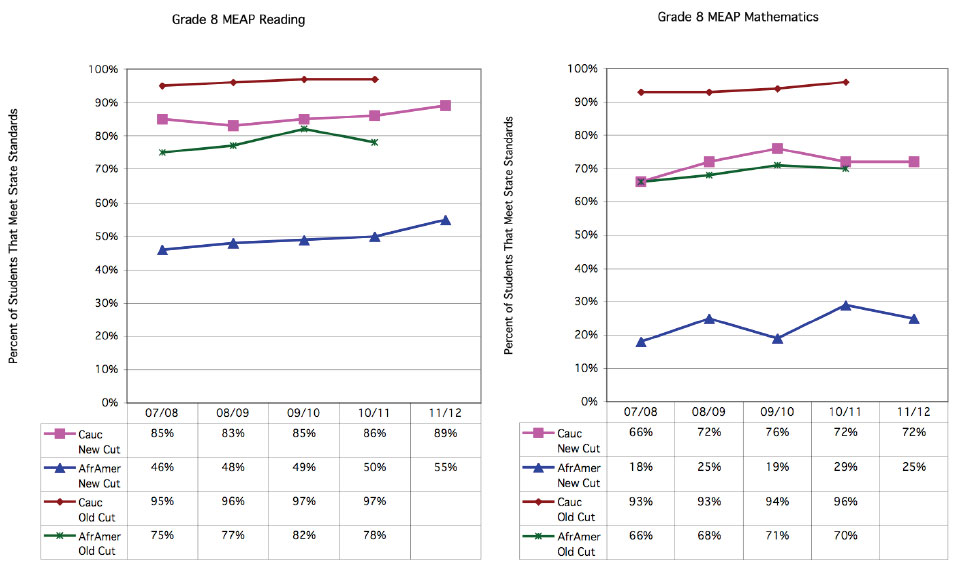
The April 13 study session of the Ann Arbor Public Schools board was highlighted by an update on the district’s efforts on equity initiatives, as well as some blunt discussion about race in the Ann Arbor public schools. Study sessions are meetings of the board scheduled as needed to gather background information and discuss specific issues that will be coming before them in the future.

The session included a presentation from Glenn Singleton, a facilitator for the Pacific Educational Group (PEG). PEG was hired by AAPS in 2003 to assist in the district’s efforts to close the achievement gap – a disparity in academic performance between minority students and other students.

Singleton, who led a majority of the discussion, criticized the board on a number of points, contending that a lack of continuity in leadership has impeded progress in closing the gap. He also said the board has not shown full support for closing the achievement gap, resulting in uncertainty for principals, administrators and other building leaders as to the board’s commitment to solving the problem.

Interim superintendent Robert Allen was on hand and provided background on the district’s involvement with PEG. Allen said that Singleton was touching base with the district and visiting AAPS schools. Singleton was doing walkthroughs to evaluate the district’s progress on closing the achievement gap using techniques suggested by PEG.

“At this point we can have a meaningful evaluation of where we are with the equity work and what we’ll need to do to achieve our goals,” Allen said. The study session focused on lack of board support, failures in leadership structure and the need for “courageous conversations.” [Full Story]

AAPS Board Opposes State Aid Transfer

Ann Arbor Public Schools board of education regular meeting (March 30, 2011): Wednesday’s meeting of the Ann Arbor Public Schools board began by welcoming incoming superintendent Patricia Green to the district. Trustees selected Green, who’s been superintendent of schools at North Allegheny School District in Pennsylvania, as the next AAPS superintendent at their March 5 special meeting.

Patricia Green

Patricia Green, incoming superintendent of the Ann Arbor Public Schools, spoke during the AAPS board's March 30 meeting. She starts her job in July. (Photo by the writer.)

Green was in town for a brief visit to meet with members of the administration and will start her tenure here in July. Noting that she hopes to make one more visit before then, Green stated her commitment to connecting with the district and encouraging members of the community to reach out.

Wednesday’s meeting was highlighted by talk of how to deal with looming budget issues. The board discussed – then unanimously approved – a resolution opposing the transfer of some state School Aid Fund money, which has traditionally financed K-12 schools, to fund higher education instead. Trustee Andy Thomas called the proposed transfer “a rob-Peter-to-pay-Paul scenario, done in a very underhanded manner.”

Budget issues were also a key part of a report to the board by Brit Satchwell, president of the Ann Arbor Education Association, the teacher’s union. He said the union’s efforts are focused on educating the public about sacrifices the district would have to make to accommodate proposed cuts, keeping in mind concessions that have already been made.

Also during Wednesday’s meeting, the board voted to expand the district’s schools of choice program. They got an update about a partnership with the University of Michigan involving Mitchell Elementary and Scarlett Middle schools, and heard a report on efforts to reduce energy costs throughout the district.

Four people spoke during the time set aside for public commentary. Speakers expressed concern over the district’s scheduling of events in conflict with religious holidays, and objected to a proposed expansion of the parking lot at Haisley Elementary School. [Full Story]