


Entertainment Section
Sunday Funnies: Bezonki
Column: Greek Drama In A Public Park
I was first introduced to Greek drama in my sophomore year of high school.
Here’s bit of friendly advice to high school teachers everywhere: If you take a group of kids in southern Indiana and assign them parts in Anouilh’s Antigone to read aloud sitting at their desks, at least one of those kids will contemplate stabbing out his own eyes as a way to avoid doing that.
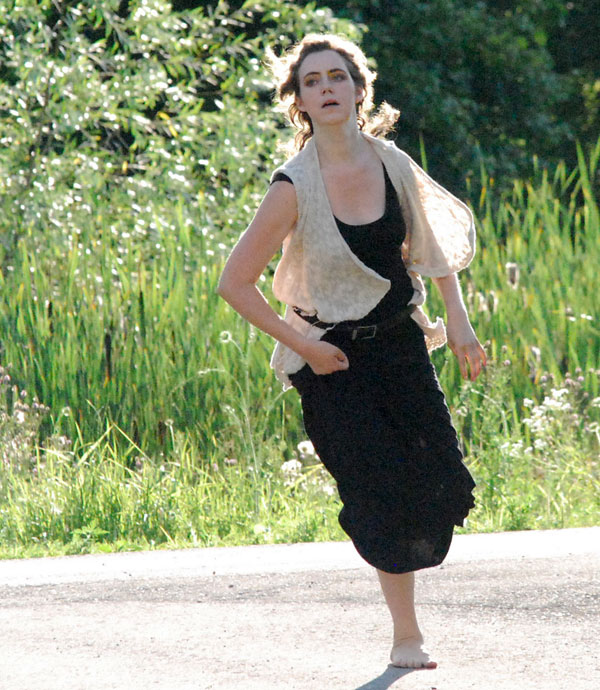
This is Emily Caffery as Elektra, making her entrance onto the stage at West Park on opening night, July 10, 2014.
Because I am not a hero in a Greek play, I did not act on the inclination. But based on that first exposure to Greek drama, I did not develop an appreciation for it, or any other literary tradition. In literary terms, this failure to “develop an appreciation” for Greek drama is, I believe, accurately described as “understatement.”
So I must avail myself of another highfalutin literary device (irony) to urge you, Chronicle readers, to attend one of the upcoming performances of “Elektra,” this year’s Penny Seats Theatre Company West Park production.
Opening night was July 10. It will be performed over three weekends: July 10-12, July 17-19 and July 24-26. Buy a ticket.
To be clear, it’s not Greek drama I’m trying to sell you. I’d like to sell you on the idea of Greek drama performed in West Park, one of 157 parks here in Ann Arbor.
I want to sell you on that idea, because mostly when you read about Ann Arbor’s parks in The Chronicle, it’s in some super policy-wonky context. Sometimes that context is the city council, when it’s engaged in its own park-based drama. Or it’s our coverage of the park advisory commission.
So in the Penny Seats production of “Elektra,” I spotted an opening to pitch Ann Arbor’s parks to readers – in a different way than we typically cover them.
West Park is just west of downtown, between Chapin and Seventh streets. Motorists on Huron Street will be familiar with the park’s general location, even if they don’t know the park itself: It’s north of the HAWK crosswalk pedestrian signal as you pass the Y building.
Pedestrians who cross Huron at the HAWK crosswalk, and head a half block north along Chapin, will find the park entrance on the left. From that direction, the park offers a fairly conventional playground, a basketball court and a Project Grow gardening plot. A bit farther to the west, hugging the northern portion of the park, is a baseball field. And to be perfectly clear, that’s a baseball (not softball) field – which has been described by players as the best place to play baseball in all of lower Michigan. To the south, there’s a pond or wetland type area. A boardwalk leads across it, so you can stop along the way and make friends with a frog, some duck or a muskrat.
On up the hill to the west, past the ball field and the wetland, is the bandshell, with a series of seatwalls. The Penny Seats production of “Elektra” is being performed on the apron immediately in front of the seatwalls, not on the bandshell stage.
I attended opening night of “Elektra.”
I’ll grant you that the opening to this column might have convinced you that I am not to be trusted on theatrical matters. I do have one credential, however. The summer after that high school English class – the one that made me think about stabbing out my eyes – our teacher bused us up to the Shakespeare Festival in Stratford, Ontario. We attended a half-dozen performances. So I think I have some frame of reference for what a professionally-produced stage performance is supposed to look and sound like.
And professional is what the Penny Seats production sounds like. Listen for yourself: [.mp3 Elektra Snippet 1] [.mp3 Elektra Snippet 2] [.mp3 Elektra Snippet 3] [Full Story]
Sunday Funnies: Bezonki
Column: The Jeopardy of Game Shows

John U. Bacon
Last night, I tried my luck on the NPR game show, “Ask Me Another,” which will air in a few weeks. But it brought back memories – traumatic ones – of my disastrous try-out for the Jeopardy game show 24 years ago.
“I’ll take ‘Humility’ for $100.”
“He was one of 48 people to fail the Jeopardy test on Thursday, June 21, 1990.”
“Ah, ‘Who was John Bacon?’”
“That’s correct – you control the board.”
“I’ll take ‘Lame Excuses’ for $100 please, Alex.”
It seemed like a good idea at the time. There I was, lying on the couch with a cold beer and a bag of chips, earning thousands of imaginary dollars for yelling things like “Millard Fillmore,” “The St. Louis Browns” and “Mesopotamia,” when they invited anyone who would be in Los Angeles to try out for the show. Sure enough, I was leaving for LA in 10 days, so I figured, Why not?
Why not, indeed.
“Under ‘Human Folly’ for $300, we have this answer: ‘Time better spent doing something productive, such as cleaning your toilet.’”
“What is ‘Preparing for the Jeopardy Test’?” [Full Story]
Photos: Skatepark Grand Opening
Ann Arbor celebrated the opening of its new skatepark on Saturday, June 21.
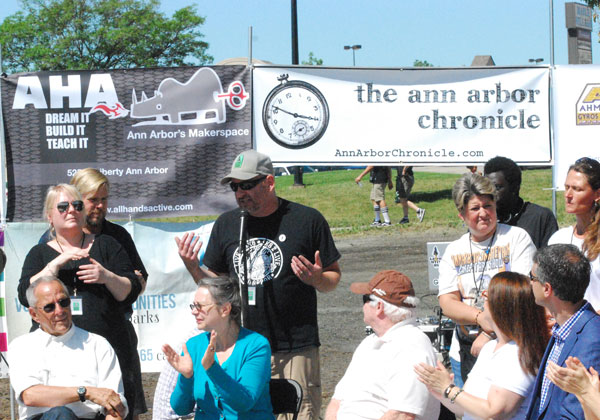
Trevor Staples addressed the gathering at the grand opening of Ann Arbor’s new skatepark.
The facility is located on the southeast corner of Maple and Ann Arbor-Dexter roads on Ann Arbor’s west side, in Veterans Memorial Park.
Festivities surrounding the late morning ceremonial ribbon cutting were started off by remarks from Trevor Staples, president of the Friends of the Ann Arbor Skatepark.
He reminded everyone that the park where the skating facility has been constructed is not just named Ann Arbor’s Veterans Memorial Park. The entire park, he noted, was a memorial to veterans who served our country, and he asked for a moment of silence to reflect on their sacrifice.
The ribbon cutting ceremony itself featured several speakers who recited the history of the more than seven-year effort that finally resulted in the skatepark’s construction.
The day’s events included skating competitions that culminated in some demonstration skates by pro skaters – including Tony Hawk and Andy MacDonald. Although the half pipe facility is no longer there, MacDonald learned to skate at Ann Arbor’s Veterans Memorial Park, at a facility that had been constructed on the opposite side of the park.
Below are some photos of MacDonald, Hawk and other skaters who celebrated the opening. [Full Story]
Sunday Funnies: Bezonki
Column: Hank Aaron’s Impressive Run
John U. Bacon
This week marks the 40th anniversary of one of baseball’s signature moments: Hank Aaron hitting his record 715th home run, to surpass Babe Ruth’s 39-year old record. But to appreciate how special that was, you have to understand who Hank Aaron is – and what he faced.
You’ve heard of Babe Ruth, who might be the best-known American athlete of the last century. Ruth loved the fans, and the fans loved him right back.
That’s why, when another New York Yankee, Roger Maris – a nice, humble guy – started closing in on Ruth’s record of 60 home runs in a single season in 1961, he became so stressed by Ruth’s fans rooting against him that his hair started falling out.
When Hank Aaron approached Ruth’s career home run record, he had it worse, for two very simple reasons: 714 home runs was the baseball record, a number even casual fans knew. And second, unlike Maris, Aaron is black. Of course, that shouldn’t matter in the least – but it mattered a lot in 1974. [Full Story]
Sunday Funnies: Bezonki
Column: Michigan Stadium’s Big Open House
John U. Bacon
One debate I could do without is the question of who is a real Michigan fan, and who isn’t?
On the face of it, the question is pretty stupid. A Michigan fan is a fan of Michigan. And beyond the surface, it’s still pretty stupid. But let’s play it out.
The argument goes that only those who attended Michigan can call themselves Michigan fans. The rest? They’re mere “Walmart Wolverines” – fans who could have picked any school to cheer for, as well as any other, just like we pick the pro teams we want to follow, with no other connection than geography.
Why shouldn’t hard-cord alumni turn their backs on their non-degreed brethren?
There’s a history here, going back to James B. Angell, Michigan’s longest serving – and most important – president. [Full Story]
Sunday Funnies: Bezonki
Column: Highs, Lows of Winter Olympics
John U. Bacon
Why in the world are the Winter Olympics in Sochi, one of Russia’s warmest places? Chalk it up to corruption – both the Russians’, which we’ve come to expect, and the International Olympic Committee’s, which … we’ve also come to expect. The IOC hasn’t just shown a willingness to be bought, but an insistence. If you don’t pay ‘em, you ain’t getting the Olympics.
That’s how you get a Winter Olympic skating rink built in the shade of palm trees. The warm weather is funny, unless you spent your entire life training for these Olympics, and there’s no snow. Then it’s just heartbreaking.
Sochi will also be remembered for the bronze water you can’t drink, and the ritual police beatings of a punk music group called Pussy Riot – which is the kind of name you come up with when you want to call yourself something shocking, but you don’t know English very well.
But this is important, for two reasons. First, it allows journalists to say Pussy Riot on the air. I don’t think my boss will let me say it next week. And second, it restores our sense of moral superiority. This way, we can still hate the Russians – then beat them in hockey.
And that’s exactly what the Americans did, thanks to a guy named T.J. Oshie. [Full Story]
Sunday Funnies: Bezonki
Sunday Funnies: Bezonki
Happy New Year!

Sunday Funnies: Bezonki
Column: Athletes and The Power of Boycott
John U. Bacon
The Grambling State University football team plays in the unheralded Southwestern Athletic Conference, in the division beneath the big boys. They had an 11-game losing streak, stretching back into the 2012 season.
In short, this was not a team that warranted national attention.
But the Grambling Tigers finally got some last month. No, they didn’t notch their first win that day – or even another loss. They didn’t play – and it wasn’t due to bad weather or a bye week. The players simply refused to take the field.
Grambling is a historically black college with a rich tradition. Their legendary coach, Eddie Robinson, won 408 games, which set the record Joe Paterno would break, then relinquish, due to NCAA sanctions.
One of Robinson’s biggest stars was Doug Williams, the first African-American quarterback to lead his team to a Super Bowl title.
But, as a coach, Williams was more beloved than successful. His Grambling teams couldn’t get it done, while the school itself suffered draconian budget cuts. The players had to travel by bus and work out in a weight room so decrepit, several suffered staph infections.
This fall, it all came to a head. [Full Story]
Column: The Hope for Hoke
John U. Bacon
Moments before the Michigan Wolverines introduced Brady Hoke as their new head football coach in 2011, Michigan fans had lots of questions. Why not hire a national star like Les Miles or Jim Harbaugh, who both played at Michigan? Who was Brady Hoke? Was he up to the task of taking over the Wolverines, and returning the team to glory?
Hoke answered these questions by nailing his first press conference. He won over more Michigan fans in just a few minutes than his predecessor, Rich Rodriguez, had been able to capture in three years, for a variety of reasons. When a reporter asked Hoke if the Wolverines would be rebuilding in his first season, he famously replied, “This is Michigan, for godsakes” – and a star was born.
It’s hard to remember a happier honeymoon than Hoke’s. In his rookie season, the Wolverines beat Notre Dame, Nebraska and Ohio State – the latter for the first time in eight years. They won their first BCS bowl game since a young man named Tom Brady did the job in 2000, en route to an 11-2 record. From the fans in the stands to the team in the trenches, the love for Coach Hoke was universal.
But then a great senior class graduated, the schedule got tougher, and Michigan’s amazing luck finally ran out. Hoke’s second team went 8-5, but most fans gave Hoke a pass, and I believe rightly so.
But the Wolverines don’t look much better this year, and might even be worse. [Full Story]
Sunday Funnies: Bezonki
Halloween 2013: Cuteness in Costume
Editor’s note: Since 2008, Myra Klarman, a professional photographer based in Ann Arbor, has been sharing with Chronicle readers her images from the annual Main Street Halloween Treat Parade. [Take a look at her photos from 2012, 2011, 2010, 2009, and 2008 as well.] This year was a bit damp, but trick-or-treaters – and Myra – were undaunted. We hope you enjoy the festivities – Happy Halloween!
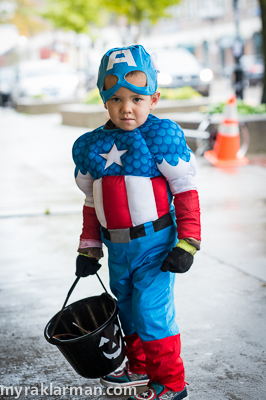
“These muscles are all natural – no scare-oid use was involved.”
Monthly Milestone: Watching Words
The Chronicle’s November milestone column comes to you a few days earlier than the customary second day of the month. That’s because I wanted to include a quick preview of a performance scheduled for Nov. 1 at the Kerrytown Concert House – by mezzo soprano Laurie Rubin.

Laurie Rubin. (Photo from press kit.)
The Chronicle has rarely, if ever, written about entertainment. And as I explained to Laurie, when she called me up to make her pitch, our approach to covering Ann Arbor’s community doesn’t include standard “preview” pieces for live performances.
The boilerplate explanation I typically use on the phone includes a description of The Chronicle’s preferred strategy for giving readers advance notice of interesting performances. That strategy is an event listing that runs off Internet standards-compliant data feeds and helps to strengthen the community’s “calendar web.” So obviously the tactic here is partly designed to bore the caller to death, so that they’ll just give up and accept the fact that I’m not going to write a preview article about their performance.
You will find Laurie’s Nov. 1 Kerrytown Concert House performance included in The Chronicle’s event calendar, categorized as music.
Fortunately for you, dear readers, Laurie declined my gambit that she surrender to my boring, rambling talk about data feeds and technology platforms. Instead she expressed a weirdly geeked-out interest in these data feeds and calendars, which I probably seemed very excited about. She instantly grasped the concept of maintaining a calendar that automatically generates a data feed that any publication or individual can access. I didn’t figure that an opera singer would be such a receptive audience for that sort of thing. But at least she had stopped talking about her Nov. 1 performance at Kerrytown Concert House, so that was a good thing, from my point of view.
But in closing out the conversation, Laurie renewed her pitch for a preview article, based on her memoir, “Do You Dream in Color: Insights from a Girl Without Sight.” Even though I was still thinking to myself, “No preview articles! Not even for blind opera singers!” I figured Laurie might be a receptive audience for some additional conversation about a different topic.
That topic is an accessibility project for public meetings that The Chronicle has been working on somewhat sporadically. The idea is to provide digital streaming text for members of the deaf and hearing-impaired community to read – either live at public meetings or during a video replay. Yes, I fully understood that I was talking to a self-described “blind girl” – for whom this particular accessibility project offered zero obvious benefit. Yet Laurie turned out to be a willing conversation partner. And in The Chronicle’s basic technological approach, she saw a potential benefit to the blind and visually impaired community that would never have occurred to me. [Full Story]
Column: Why Jim Leyland’s Way Worked
John U. Bacon
When you’re 68, working in a young man’s game, announcing your retirement is not a surprise. But Detroit Tigers manager Jim Leyland has a few underappreciated qualities that are worth remembering.
Jim Leyland was a baseball man to the core. Raised in Perrysburg, Ohio, the son of a glassworker, he grew up wanting to do one thing: Play baseball.
He was good, very good, so the Tigers signed him up to play catcher in their minor league system. But just to get to the majors, you need to be great – and after seven years battling to get to the big leagues, Leyland realized he wasn’t great. Not as a player, at least.
So he decided to become a manager, and worked his way up from Detroit’s lowest minor league team to its highest. That climb took him from Bristol, Virginia, to Clinton, Iowa, to Montgomery, Alabama, then Lakeland, Florida, and finally Evansville, Indiana – Detroit’s top farm club. [Full Story]
Column: In Praise of The Mud Bowl
John U. Bacon
Tomorrow morning, one of Michigan’s oldest traditions will be on display. No, not at the Big House, but at the Sigma Alpha Epsilon fraternity house.
That’s where they’ve played something they call The Mud Bowl every year since 1933, the same season Jerry Ford played center for the national champion Wolverines, and Columbia University won the Rose Bowl.
Back then, the leap from the Mud Bowl to the Rose Bowl was a lot smaller than it is today. Oh, and a new venture called the National Football League was little more than a decade old, but few cared. Today college football is a lot closer to the NFL than it is to the Mud Bowl – which still doesn’t charge its spectators a dime.
Last fall, I woke up on a cold, rainy Saturday morning to see the tradition for myself. [Full Story]
Sunday Funnies: Bezonki
Sunday Funnies: Bezonki
Sunday Funnies: Bezonki
Sunday Funnies: Bezonki
Column: Gordon Gee’s Greatest Gaffes
John U. Bacon
Ohio State University president Gordon Gee’s ability to put money in the bank – both his and his university’s – was equaled only by his ability to put his foot in his mouth. Well, this week he was finally fired – er, retired. Entirely voluntarily, of course. Not pushed at all. Nooooo.
Over his long career as president of West Virginia, Colorado, Brown, Vanderbilt and Ohio State – twice – Gee has raised billions of dollars, while delivering a seemingly endless stream of gaffes, slanders and just plain stupid comments, which culminated in his unexpected departure.
In politics, they say, when a man is shooting himself in the foot, don’t grab the gun. In that spirit, I’ll let the man’s words speak for themselves.
In 1992, when the Buckeyes ended their four-game losing streak against Michigan with a 13-13 tie, Gee said, “This tie is one of our greatest wins ever.” Ooo-kay. [Full Story]
Sunday Funnies: Bezonki
Column: Hockey Fans Ask – Now What?
John U. Bacon
Most sports fans are happy just to see their team make the playoffs. But Detroit Red Wings fans have been able to take that for granted for a record 22 straight seasons. The last time the Red Wings didn’t make the playoffs, not one current NHL player was in the league. Some of the current Red Wings weren’t born. Nine current franchises weren’t yet created.
But the record seemed doomed to be broken this season.
To start, there almost wasn’t a season at all, thanks to the contract dispute between the players and the owners, who both thought the other side was making too much money. And, of course, both sides were right – setting up a game of chicken between self-destructive lunatics.
When a federal mediator finally brought them to their senses in January, they had just enough time left to play a 48-game schedule – which actually seemed about right. But the Red Wings came out flat-footed, falling so far behind they had to win their last four games just to sneak into the seventh of eight playoff spots.
In the first round, they faced the Ducks of Anaheim – formerly the Mighty Ducks – which is already an affront to everything that is holy about hockey.
Amazingly, the Red Wings beat them in seven games – quite an upset. Their reward: an even tougher opponent, the top-seeded Chicago Blackhawks, who earned at least one point in their first 24 games, which is a record.
But for hardcore hockey fans – and really, are there any other kind? – this series was a reward. [Full Story]