The Ann Arbor Chronicle masthead
it's like being there

Environment Section

Column: The 10% Local Food Challenge

Eating Thin Mints recently got me thinking about locally produced food.

Two buttons supporting locally grown food

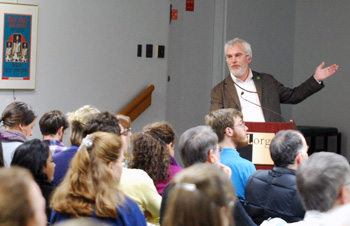
Many participants in the March 2 Homegrown Food Summit wore buttons like these, supporting locally grown food. (Photos by the writer.)

It’s Girl Scout cookie season, and on Saturday – after swinging through the Ann Arbor Farmers Market – I encountered a Brownie and her dad set up at the corner of Main and Liberty, their table loaded with boxes of Thin Mints, Samoas, Tagalongs and an assortment of other cookies that I remember selling too, back in the day. I bought three boxes.

At $3.50 per box, the cookies aren’t outrageously priced – though the boxes seem to get smaller every year. But later, in doing a quick calculation of all the food I’d bought that day, I realized that in buying those cookies, I’d failed to meet a challenge I’d heard earlier in the week: Spend 10% of your food budget on locally produced food.

The “10% Washtenaw” challenge was issued at the Homegrown Local Food Summit, a day-long event on March 2 that drew over 200 people to the Dana Building on the University of Michigan campus. Many of the people at the summit already surpass that goal in a fairly dramatic way. The real challenge, organizers acknowledge, is how to convince the rest of us to do the same. [Full Story]
Burning Interest in Ann Arbor Parks

Ann Arbor Park Advisory Commission (Feb. 23, 2010): Approval of new policies for gifts, sponsorships and naming opportunities in the parks system was the only vote taken at Tuesday’s PAC meeting.

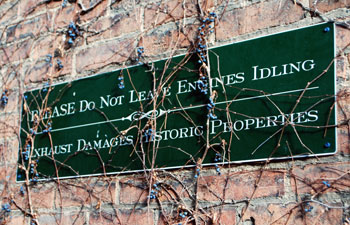
A sign at the entrance to Ann Arbor's West Park

A sign at the entrance to Ann Arbor's West Park, which will be closed in March through the summer for extensive renovations. (Photo by the writer.)

But commissioners heard updates on a range of issues, from capital projects – including the months-long closing of West Park, starting in March – to a report on the greenbelt program.

And though snow has blanketed the area, work is underway to prep for controlled burns throughout the city’s parks and natural areas. Commissioners got a report on that effort, which includes a public meeting on March 2 and volunteer training the following day. The topic also provided some fodder for puns – in introducing the presentation, PAC chair Scott Rosencrans joked that they’d be “burning with interest” to hear the report. [Full Story]

Transit Forum Critiques Fuller Road Station

Chris Leinberger was blunt in his assessment of the proposed Fuller Road Station: If the parking structure is built as proposed, in 20 years it will be torn down.

Fuller Road parking lot

The city-owned Fuller Road parking lot, site of the proposed Fuller Road Station. To the south of the lot is the University of Michigan medical complex. (Photos by the writer.)

Speaking at a forum on transit-oriented development, Leinberger – a University of Michigan professor of practice in urban planning – said current plans for the joint UM/city of Ann Arbor project do a good job of incorporating different kinds of transit, from bikes and buses to perhaps, eventually, commuter rail.

But Leinberger criticized the project for taking some of Ann Arbor’s most valuable land and turning it into something that won’t generate revenue for the city. He told Eli Cooper, the city’s transportation program manager, that “whoever’s in your position 20 years from now will tear it down.”

Monday’s forum, held at the UM Art & Architecture building on north campus, was organized by members of the WALLY Coalition and the 208 Group, among others, to focus on local transit-oriented development efforts. Moderated by local developer Peter Allen, the event included presentations by Cooper, Richard Murphy of the city of Ypsilanti and Shea Charles, Howell’s city manager. [Full Story]

Fleshing Out Fuller Road Station

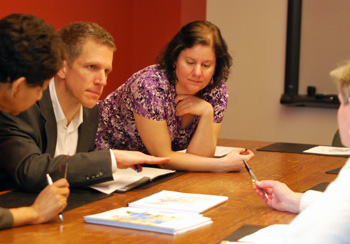
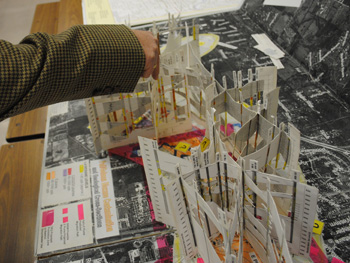
At left: Architect John Mouat, a member of the Fuller Road Station design team, talks with Eli Cooper, the city's transportation manager, before the start of the Feb. 10 citizen participation forum. Moaut is a partner in the Ann Arbor firm of Mitchell and Mouat. (Photos by the writer.)

At left: Architect John Mouat, a member of the Fuller Road Station design team, talks with Eli Cooper, the city's transportation program manager, before the start of the Feb. 10 citizen participation forum. Mouat is a partner in the Ann Arbor firm of Mitchell and Mouat. (Photos by the writer.)

For Eli Cooper, the city of Ann Arbor’s transportation program manager, a project like the proposed Fuller Road Station happens “once in a lifetime” – an opportunity for the city, he says, to take a vision and make it reality in a fairly short time.

What it will take to reach that reality was the topic of a Feb. 10 public meeting on the Fuller Road Station, a joint University of Michigan/city of Ann Arbor project. Its first phase entails a parking structure with about 1,000 spaces – nearly 80% of them earmarked for UM use.

But much of the presentation by city staff and members of the design team focused on the broader goals for that site, which they hope will eventually include a train station for commuter rail. [Full Story]
Greenbelt Commission Backs County Tax

Ann Arbor Greenbelt Advisory Commission meeting (Feb. 10, 2010): Citing benefits to the city’s own greenbelt program, members of the greenbelt commission at their Wednesday meeting voiced support for a county land preservation millage, which is up for renewal this year.

The commission passed a resolution urging the city council formally to endorse the millage, though it’s up to the Washtenaw County Board of Commissioners to decide whether to put the millage on the ballot. It’s not yet clear the board will do that.

Greenbelt commissioners also discussed the implications of new, lower appraisals that had just been received on the Braun and Gould properties in Ann Arbor Township. The city already has binding purchase agreements with the owners based on older, higher appraised values, but recently learned that new appraisals will result in fewer federal matching funds for the acquisitions. The city could be on the hook for more money than was anticipated to close these deals.

Related to that, some commissioners raised concerns over information they’d received last month from the city attorney’s office, which appeared to be in conflict with what they were being told by staff at Wednesday’s meeting. [Full Story]
County Seeks Input on Parks Master Plan

Donald Staebler was without question the oldest resident to show up at a Jan. 26 public meeting on the Washtenaw County Parks & Recreation master plan. And the 99-year-old farmer had a very specific reason why: He sold his farm to the county nearly 10 years ago, and he wants to see what they’re going to do with it.

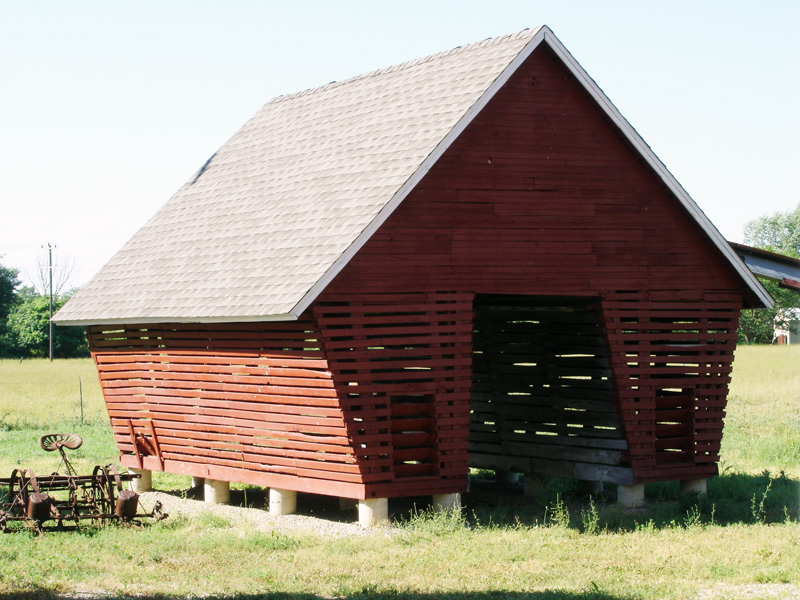
The barn and out buidlings at Staebler Farm, on Plymouth Road in Superior Township. Washtenaw County Parks & Recreation bought the farm in 2001, will be developing master plan for the property in the coming years.

The barns and out buildings at Staebler Farm, on Plymouth Road in Superior Township. Washtenaw County Parks & Recreation bought the farm in 2001, and will be developing a master plan for the property in the coming years. (Photos by The Chronicle.)

“I’m open to suggestions,” Staebler told The Chronicle, “and willing to give up plenty of what I know.”

During their presentation about a five-year master plan for the parks system, county staff outlined plans for the Staebler Farm – a proposed $2.3 million investment – as well as for several other county parks, recreational facilities and preserves. It was one of three public meetings to get input on the master plan; the next meeting will be on Wednesday, Feb. 3, at the Dexter Library, starting at 7 p.m.

A draft of the master plan – which is also available online – includes items in an extensive capital improvement program that was approved last year by the county’s Parks & Recreation Commission. Several of the largest projects are planned for Rolling Hills Park, including the addition of a dog park, an expansion of the water park and construction of softball fields and an amphitheater. The county also plans to invest nearly $12 million in greenway and non-motorized trails over the next five years. [Full Story]

County Natural Areas Tax Up for Renewal

A resolution to hire Verna McDaniel as the next county administrator is on the Feb. 3 agenda for the Washtenaw County Board of Commissioners, and commissioners gave her a round of applause on Wednesday when that agenda item was announced at their administrative briefing.

But it was an item not on the agenda that yielded the most animated discussion on Wednesday: A countywide millage for Washtenaw County’s Natural Areas Preservation Program. The tax, which was first approved by voters in November of 2000 and took effect in 2002, will expire in 2011 and would need to go back to voters this year for renewal. Based on comments at Wednesday’s briefing, the millage renewal might face resistance from some commissioners. [Full Story]

Environmental Indicators: Resource Use

Editor’s Note: This is the second in a series written by Ann Arbor city staff on the environmental indicators used by the city of Ann Arbor in its State of Our Environment Report.

Trash and Recycling in Ann Arbor

Recycling totes and a trash cart await collection in Ann Arbor. The totes will be replaced with bins similar to the blue trash cart in mid-2010. (Photo by The Chronicle.)

Although Matt Naud, the city’s environmental coordinator, is listed as the author of this piece, he received “a boxload of help” from Adrienne Marino, Tom McMurtrie, and Nancy Stone.

The SOE report is developed by the city’s environmental commission and designed as a citizen’s reference tool on environmental issues and as an atlas of the management strategies underway that are intended to conserve and protect our environment. The newest version of the report is organized around 10 environmental goals developed by the environmental commission and adopted by the city council in 2007. This installment focuses on responsible resource use.

All installments of the series are available here: Environmental Indicator Series.

With the closing of the 2009 holiday season, and many of us surrounded by lots of new “stuff” – including the associated boxes and packaging – and even a few of us with New Year’s resolutions to “simplify” our life in the coming new year, it seems like a good time to talk about all of the stuff we buy, use, reuse, recycle, and then throw out in Ann Arbor. [Full Story]

Dispute over Superior Township Settlement

There’s broad consensus on open space and farmland preservation among Superior Township’s roughly 13,000 residents.

A sign opposing property rezoning in Superior Township

A sign opposing property rezoning in Superior Township. (Photos by the writer.)

It’s evident in words like those on a banner in the township hall touting a commitment to preservation. It’s evident in actions like voter approval of a special tax to defend the community’s growth-management plan.

But for all the agreement, there’s discord over the means to that end.

Rather than fighting a lawsuit they say they expected to win, township officials have struck a deal with a development group that sued after a zoning change was denied.

Disappointed residents say the settlement bails out the developers, and is a retreat from a strategy of enacting and defending a strong master plan and zoning. Township officials say buying land and development rights – as the $400,000 settlement deal will do – is the only sure way to end the battle for good.

The real goal isn’t a legal victory, but the conservation of the community’s rural character, says township supervisor Bill McFarlane. “I feel we would have won the lawsuit this time, but land values will eventually go up again and we could be fighting this again in a year, or two years or five years.” [Full Story]

Fee Increase Suggested for Athletic Fields

Ann Arbor Park Advisory Commission (Jan. 19, 2010): As part of a project to upgrade the athletic fields at Fuller and Olson parks, members of the city’s Park Advisory Commission approved an increase in fees to use those fields. One commissioner described the fields, which had previously been in serious disrepair, as “a thing of beauty.”

Sign at the entrance to the Fuller Park soccer fields, next to Fuller Pool.

Sign at the entrance to the Fuller Park soccer fields, next to Fuller Pool. (Photos by the writer.)

Three speakers during public commentary, all representing groups that use the fields heavily, said they didn’t have a problem with the fee hike, but hoped that the change could be phased in over three years, rather than implemented this season. The recommendation for an increase, along with changes in how the fields are used, will be forwarded to city council.

Commissioners also approved recommendations from the task forces that are working to raise revenues and cut costs for Mack Pool and the Ann Arbor Senior Center. Commissioner Tim Berla clarified that the PAC resolution was primarily an “atta boy!” for the work of the staff and task forces, and support of the direction they’re headed. The recommendations – which aim to keep those operations open – will be presented to city council at their Feb. 8 meeting.

And finally, as a bonus for readers who stick with this report until the end: One commissioner is championing an urban dog park, and has identified a potential location within the city. [Full Story]

Local Food Isn’t Just for Eating

“How about a round of applause for beets?!” Kim Bayer asked the group gathered for dinner on Thursday night.

Slow Food Huron Valley

The table was filled at the potluck for Slow Food Huron Valley, held at Hathaway's Hideaway on South Ashley. To make it a zero-waste event, people brought their own dishware. (Photos by the writer.)

When a room of people cheers for root vegetables – and later, for pie – there’s probably a theme at hand. On Thursday, the theme was locally grown food, fêted at a potluck hosted by Slow Food Huron Valley. The 30 or so people at Hathaway’s Hideaway on South Ashley heard an update on the nonprofit’s activities over the past year, and got a preview of what’s to come in 2010.

There was also plenty to eat and drink: Derby sandwiches (with pickles, bacon and mayo), parmigiano pumpkin soup with prosciutto, spinach walnut pesto, vegan “slop,” sweet potato pie – most of these and other dishes made from locally grown or produced food.

The connection between the meal and the mission of Slow Food Huron Valley was clear, as Bayer – a member of the group’s leadership team – told the diners: “Good food needs to be a basic human right.” [Full Story]

Leslie Science Center Turns Calendar

Hijin Kim, wearing his New Year's Eve mask, salutes the end of 2009 with a pencil. Later, he told The Chronicle: "Masks are scarier than hats." (Photos by the writer.)

Hajin Kim, wearing his New Year's Eve mask, salutes the end of 2009 with a pencil. Later, he told The Chronicle: "Masks are scarier than hats." (Photos by the writer.)

Bob Voakes is sitting in the front room of the main Leslie Science and Nature Center building, encircled by more than a dozen children sprawled on the floor. “It’s a special day today – does anyone know what day it is?”

“New Year’s Eve!” they cry out.

It would be hard not to know the answer – everyone is wearing New Year’s Eve hats or masks that they’d made earlier that morning, using construction paper and markers.

They’re all enrolled in the holiday break camp program, with a full agenda of crafts, sledding, hiking, searching for animal tracks, s’more-making, and “who knows what other exciting things we might do!” Voakes, a staff member, tells the kids.

Just down the hall – in Dr. Eugene Leslie’s former study – someone else has a full agenda, too: executive director Kirsten Levinsohn, who’s getting ready to step down from the post in February, after 20 years at the center. With the sound of children happily hollering in the background, Levinsohn talked about the upcoming transition, and why it’s an exciting time for LSNC. [Full Story]

Column: Pedaling and the Price of Recycling

Styrofoam baler

Styrofoam baler with gates open, and the masher in the "down position." In this position, the operator can slide wires through slots in the top and the bottom to wrap the bale securely, before releasing the pressure on the masher. (Photos by the writer.)

About once a month, I load up my bicycle cargo trailer with an assortment of gallon jugs – plastic and glass – plus a mountain of rigid Styrofoam, then pedal off to Recycle Ann Arbor’s drop off station at the corner of Platt and Ellsworth.

When I drop my load of recyclables there, I’m not wearing my Ann Arbor Chronicle editor’s hat. Rather, I’m working as the sole-proprietor of a (very) small bicycle-based business called HD Hauling and Delivery.

I bring this up mostly to establish some sort of credibility as a friend of the environment.

That way when I reveal what I’ve been thinking about recently, there might be a brief hesitation before readers reach into their recycling totes, retrieve a well-rinsed artisanally-crafted mayonnaise jar, and chuck it at my noggin. Not that it will do those readers any good – I generally wear my bicycle helmet, even when I’m just typing.

Now, when I say I’ve been “thinking about” the idea of turning Huron Hills Golf Course into a landfill, I’m not saying that I advocate creating a landfill there. I’m not even saying that it’s a good idea to research the question. I’m just saying that the idea crossed my mind, okay? Why?

It’s because of a recent decision by Recycle Ann Arbor to charge a $3 entry fee for their drop off station, starting Jan. 2, 2010. How do you whack a rhetorical ball all the way from that $3 fee to a landfill at Huron Hills Golf Course? Believe me, you need a lot of club. Fore! [Full Story]

Parking in the Parks, Art on the River

Ann Arbor Park Advisory Commission meeting (Dec. 15, 2009): If projects discussed by the city’s park advisory commission move ahead, next year will bring a series of art installations to the Huron River, and turn two city parks into parking lots for University of Michigan home football games.

This image shows how wire sculptures on the Huron River might appear, if a project proposed by a University of Michigan visiting professor gets approval from the state and city. (Image courtesy of William Dennisuk.)

This image shows how wire sculptures on the Huron River might appear, if a public art project proposed by a University of Michigan visiting professor gets approval from the state and city. (Image courtesy of William Dennisuk.)

At its Dec. 15 meeting, park commissioners raised concerns but ultimately signed off on a city staff proposal to use parts of Allmendinger and Frisinger parks for football parking during the 2010 season. The plan could raise an estimated $34,000 in net revenues for the city.

In a separate move, the commission gave the go ahead for UM to apply for a state permit that’s needed to install a series of wire sculptures at four locations along the Huron River, from Argo to Gallup. It’s an ambitious project by UM visiting artist William Dennisuk, designed to bridge the town/gown communities – assuming that the project itself gets approval from the city and state.

Commissioners also got a budget update from Jayne Miller, the city’s community services director, who told them to anticipate additional cuts over the next two years, and described how that might affect parks and recreation. [Full Story]

Northfield to Greenbelt: Keep Out

Ann Arbor Greenbelt Advisory Commission meeting (Dec. 9, 2009): During a relatively brief final meeting of 2009, members of the greenbelt advisory commission got reports on the program’s finances and its preservation activity for the last fiscal year.

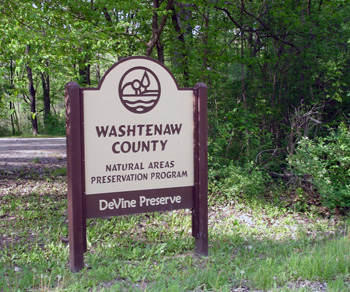
Preserve Washtenaw sign

Signs like these will be used to mark land that's preserved through a variety of programs, including the Ann Arbor greenbelt. (Photos by the writer.)

Also discussed was a direct rebuff to the greenbelt program from Northfield Township’s supervisor, who wrote that the township wasn’t supportive of “an outside community exerting its influence on our community.”

Peg Kohring of The Conservation Fund, which manages the greenbelt program for the city, had approached the township on behalf of landowners who were interested in participating in the greenbelt.

Commissioners strategized over how to respond, and are forming a group to talk with township officials about their concerns. [Full Story]

River Report Remanded, Art Rate Reduced

Ann Arbor City Council meeting (Dec. 7, 2009) Part I: Based on dialog at the city council’s budget retreat on Saturday, and the absence of any action at Monday’s council meeting to prevent it, layoff notices to 14 firefighters will be sent sometime this week.

Mayor John Hieftje also gave some additional detail on a proposal he’d mentioned at the council’s budget retreat on Saturday: an across-the-board wage cut of 3% for all city employees, which would include councilmembers.

Carsten Hohnke Ann Arbor City Council

Carsten Hohnke (Ward 5) presents his case for having a plan for the Huron River. (Photos by the writer)

Though the topics of firefighters and wage cuts were mentioned during the council’s communications section of the meeting, what pushed the meeting to nearly midnight were deliberations on two resolutions: (i) a three-year reduction of the Percent for Art program to effectively a “Half-Percent for Art” program, and (ii) acceptance of the Huron River and Impoundment Management Plan (HRIMP).

Both resolutions passed, though the HRIMP resolution was heavily amended. The material effect of the amendment was that it was not technically “accepted” by the council, but rather remanded to the city’s park advisory commission and the environmental commission. [Full Story]

Environmental Indicators: Creeksheds

yellowlevel

Overall creekshed indicator for Ann Arbor: fair (yellow) and stable (level arrow).

Editor’s Note: This is the first of what The Chronicle intends to become a series of pieces on the environmental indicators used by the city of Ann Arbor in its State of Our Environment Report. The report is designed as a citizen’s reference tool on environmental issues and as an atlas of the management strategies underway that are intended to conserve and protect our environment. The newest version of the report is organized around 10 Environmental Goals developed by the city’s Environmental Commission and adopted by City Council in 2007.

The first in the series is an introduction to the creeksheds indicator by the city’s environmental coordinator, Matt Naud.

The overall creekshed indicator for the city is yellow (fair) and stable (level arrow). But that overall picture is composed of individual indicators for each of the creeksheds that drain into the Huron River – the central natural feature of Ann Arbor. More than 10 miles of the Huron are located within the city limits.

We assess individual creeksheds, not just the Huron River watershed as whole, because that allows us to focus on exactly the areas that need the most improvement.  Seven different creeks within the city of Ann Arbor flow into the Huron: Allen Creek, Fleming Creek, Honey Creek, Malletts Creek, Millers Creek, Swift Run Creek and Traver Creek. [Full Story]

Greenbelt Explores Support for Small Farms

The main topic of discussion for the Ann Arbor Greenbelt Advisory Commission’s November meeting could be distilled into this: How can the greenbelt program support the development of small farms, and ensure that farm properties remain farms, even when the property changes ownership?

It’s an unlikely resource that might actually be able to help answer those questions: the federal housing programs administered by the Office of Community Development, a joint county/city department.

Jennifer Hall, OCD housing program coordinator, attended the Nov. 4 meeting of the greenbelt group and floated some ideas for how federal funding might provide resources to retain land for the farming community.

The commission also heard from the managing organization of the greenbelt program, The Conservation Fund, about strategies for preserving small farms. [Full Story]

Parks Update: Golf, Birds, River Art

Ann Arbor Park Advisory Commission (Nov. 17, 2009): With the golf season coming to an end, the city’s Park Advisory Commission got a status report from Ann Arbor’s director of golf, Doug Kelly. He did not, however, provide a recipe for his chicken salad, which he added to the menu this summer at the two city-owned courses. Then again, no one asked – but someone did ask when the golf courses were expected to break even.

The sign for the city's Huron Hills Golf Course at the corner of Huron River Parkway and Huron River Drive. (Photo by the writer.)

The sign for the city's Huron Hills Golf Course at the corner of Huron River Parkway and Huron River Drive. Though the city's Leslie Park Golf Course closed for the season on Sunday, Huron Hills will be open "until the snow flies," according to its website. (Photo by the writer.)

Also at the meeting, PAC honored Roger Wykes, the 2009 Natural Area Preservation volunteer of the year. Wykes helps out with the city’s breeding bird survey – commissioners heard details about that project from ornithologist Dee Dea Armstrong.

And an artist who’s spending this year as a visiting lecturer at the University of Michigan made a pitch for an art installation along the Huron River – a project that he envisions will help build a bridge between the university and the community of Ann Arbor. [Full Story]

City, MDEQ Agree: Argo Headrace Shut

Argo Dam headrace closure

Argo Dam headrace closure. Without the metal plate, water would flow from left to right (bottom to top) in the photograph. The greenish metal plate is wedged into the concrete slot in shim-like fashion. The slot continues along to the bottom of the channel. (Photo by the writer).

The city of Ann Arbor and the Michigan Department of Environmental Quality have moved towards resolving a dispute about what needs to be done to address problems with the earthen embankment next to Argo Dam. Late this summer, the MDEQ had issued an order to the city to close off the flow to the headrace and dewater it by Nov. 1. That order was based on concerns about the structural integrity of the earthen berm dating back several years.

The city had retained the law firm Bodman, LLP on the matter, and filed a contested case with the MDEQ, asking for a 90-day stay on the MDEQ’s order, which includes a stoppage of flow in the headrace, and its dewatering.

The order also includes other points, among them a need for the city to make a decision on the dam-in/dam-out question. Whether to keep Argo Dam in place or remove it has been the focus of community-wide conversation on that topic, which has taken place with great intensity over the last nine months, but which has a years-long history.

The MDEQ agreed to the city’s request for a stay on all elements of its order except for shutting the water flow to the headrace. The city has now complied with the MDEQ’s order to close the headrace. [Full Story]

PAC Gets Briefed on Rentals, Preservation

A fence separates this pavilion from the Olson Dog Park.

A fence separates this pavilion from the Olson Dog Park – the dog seen to the right is inside the fenced-in dog park. One couple that uses the park has suggested moving the pavilion inside the fence, so that owners can have a place to take shelter from the elements while their dogs play. (Photo by the writer.)

Ann Arbor Park Advisory Commission (Oct. 20, 2009): Last week’s meeting of the Ann Arbor Park Advisory Commission (PAC) was in many ways a buffet of updates and tutorials, accented with a soupçon of art and a dash of dog park.

City staff talked to commissioners about special events planning and facilities rental at the parks, and gave an overview of how the city’s natural areas are prioritized for restoration. PAC also got a time line for the state-mandated rewrite of the Parks, Recreation and Open Space plan, known as PROS.

But we’ll start with the saga of a man and his dog, and what he’d like the city to do to make their time together more enjoyable. [Full Story]

Special District Might Fund Energy Program

infrared scan of switchplate to external wall

Infrared scan of light switch plate on the interior of an outside wall. The scan was made during a homeowner energy audit. Cold-to-hot on the color scale is: black, purple, dark blue, light blue, green, yellow, red. The scan, made during a blower test that caused air to infiltrate the house at a high rate, shows that there are significant air leaks around the plate.

Most homeowners would say that they’d love to save a few dollars on heating their houses. And caulk is cheap, right? So why would a homeowner who feels a draft hesitate to invest in a caulking gun and a tube of caulk? One possible reason: To do a really good, comprehensive job sealing up a whole house could require a $3,000 investment – in labor, caulk, spray foam, weatherstripping, and other materials.

So if  homeowners are going to spend a few thousand dollars to improve the energy efficiency of their houses, maybe there’s a more cost-effective investment they could make – like throwing $2,000 worth of extra insulation in the attic.

The city of Ann Arbor has a similar challenge – if it receives more than $1 million in federal stimulus funding from the U.S. Department of Energy to invest locally. Andrew Brix, energy coordinator for the city, and other city staff need to answer the question: How do you spend that money in the most cost-effective way for the community?

Their tentative answer could include financial help for homeowners in the form of loans set up through a self-assessment energy financing district – help for homeowners like the one faced with the $2,000-for-air-sealing versus $3,000-for-attic insulation question.

The Chronicle didn’t pull those numbers out of a hat. We pulled them out of a Matt – as in Matt Naud’s energy audit report. Naud is the environmental coordinator for the city of Ann Arbor, and he agreed to let us shadow the Recycle Ann Arbor energy audit team as they conducted their analysis of his house. [Full Story]

Growing the Board at Project Grow

garden tomato cages in foreground late season garden in background

Project Grow site at Greenview last Sunday. Near the end of the growing season, gardeners were starting to clear out cages and wire, preparing the plots for the fall tilling. (Photo by the writer.)

At the Project Grow annual meeting, held on Oct. 8 at the Leslie Science Center, the same contentious issue surfaced as at last year’s meeting: Should the organic gardening nonprofit add members to its board or not?

Last year the answer was yes: Kirk Jones and Royer Held were voted onto the board by the members present at the meeting. [Chronicle coverage: "Project Grow Board Expands"]

This year was no different. In addition to re-electing Damaris Suffalko as a continuing board member, members elected Andrew Comai, David Corsa and Alice Telesnitsky as additions.

The ease with which board members can be added by a member vote is a function of Project Grow’s incorporation as a 501(c)3 membership organization as contrasted with a 501(c)3 directorship organization.

And although the meeting’s written agenda indicated board president Devon Akmon as a candidate for re-election to the board, he withdrew his name in the course of the meeting, which an attendee aptly summarized at one point by saying, “It feels very tense in here.”

The departure of Akmon from the board prompted board member Catherine Riseng to caution the roughly 40 people in the room: “We’re going to miss his skills more than you can possibly realize.”   [Full Story]

Michigan Tailgate Tries for Zero Waste

woman with brown T-shirt holding hands as if to catch something standing next to recycling station

This is not Martavious Odoms of the University of Michigan football team preparing to catch a winning touchdown pass from Tate Forcier. It's Alexi Ernstoff, who's preparing to "take the snap" from an UM alum who's got a plate piled with refuse headed her direction. (Photo by the writer.)

In Ann Arbor on Saturday, the visiting Hoosiers came up three points shy in a homecoming game against the University of Michigan football team. Final score: 36-33.

And at a pre-game tailgate hosted by the UM Alumni Association, a team of  Student Sustainability Initiative (SSI) volunteers came up at least three coffee creamer containers shy of their goal: a “zero waste” tailgate.

Those three coffee creamer containers came from Edward J. Vander Velde – from the 50th reunion class of 1959 – who kidded the volunteers who were staffing one of the waste stations inside Oosterbaan Fieldhouse, saying, “We’re still short of perfect!”

The coffee creamers weren’t the only items that still wound up in the trash instead of the compost bins, or the paper containers, or the bottle receptacles.

But according to SSI board member Greg Buzzell, who’s studying at UM’s Erb Institute, early post-tailgate estimates are that the zero-waste effort diverted about 500 pounds of material from the landfill to the compost pile, and that the tailgate generated “really very minimal” trash. [Full Story]

How to Sustain a Local Economy

Panelists at the Sept. 23 Michigan Peaceworks forum on the local economy, from the left: Tom Weisskopf, University of Michigan economics professor; Ellen Clement, Corner Health Center executive director; Jeff McCabe, People's Food Co-Op board member; Lisa Dugdale, Transition Ann Arbor; Michael Appel, Avalon Housing executive director; John Hieftje, mayor of Ann Arbor.

Panelists at the Sept. 23 Michigan Peaceworks forum on the local economy, from the left: Tom Weisskopf, University of Michigan economics professor; Ellen Clement, Corner Health Center executive director; Jeff McCabe, People's Food Co-Op board member; Lisa Dugdale, Transition Ann Arbor; Michael Appel, Avalon Housing executive director; John Hieftje, mayor of Ann Arbor. (Photo by the writer.)

When The Chronicle entered the lower level meeting room of the downtown Ann Arbor library, the first things we noticed were three large trays of peanut butter and jelly sandwiches, cut into bite-sized wedges. As public forums go, this was an offbeat gnoshing choice.

It turned out that the sandwiches – and apples, soft drinks, potato chips and other food – were all sourced from Michigan, in keeping with the theme of Wednesday night’s event. The panel discussion focused on the state’s economic crisis, and how the community can respond to it.  Buying local products is one example.

Starting a local currency is another possibility – the Ann Arbor Downtown Development Authority is funding a study to look into that. Generating  electricity locally is also an opportunity – Mayor John Hieftje told the group that he didn’t think the dam at Argo Pond would be removed, in part because it might be used for hydropower in the future.

The forum – “Michigan’s Economic Situation: Crisis or Opportunity?” – was hosted by Ann Arbor-based Michigan Peaceworks and Washtenaw Voice, a coalition of local nonprofits that are working together to increase voter turnout and bolster the community in other ways. Michigan Peaceworks is the lead agency in this effort, part of the broader Michigan Voice initiative.

State and national issues were part of the discussion, but most of the six panelists focused on how the local community can take action in specific areas, including food, health care, housing and the environment. [Full Story]

City Seeks Feedback on Transit Center

At Tuesdays meeting of the Ann Arbor Park Advisory Commission, Eli Cooper shows a conceptual design for a proposed transit center on Fuller Road

At Tuesday's meeting of the Ann Arbor Park Advisory Commission, Eli Cooper shows the original conceptual design for a proposed transit center on Fuller Road. A newer version (see below) includes two buildings and a possible roundabout at Fuller and Maiden Lane. (Photo by the writer.)

Tim Berla of the Ann Arbor Park Advisory Commission has a suggestion to liven up the proposed Fuller Road transit center: Add a pub. You can bet that people who use the nearby city athletic fields would grab a post-game beer there, he told Eli Cooper at Tuesday’s PAC meeting.

Cooper, the city’s transportation program manager, was soliciting feedback from PAC members and giving them an update on the project known as FITS – the Fuller Intermodal Transportation Station. FITS is  a joint venture by the University of Michigan and the city of Ann Arbor that would include 900 parking spaces in a multi-level structure.

Cooper made clear that the two partners are hoping to get more input from the general public, too. To that end, on Thursday, Sept. 17, the city will host two public forums at city hall, from 3-5 p.m. and 6-8 p.m. After incorporating feedback from a variety of stakeholders, Cooper said the city hoped to present the facility’s conceptual design for approval at the city council’s Oct. 19 meeting.

Meanwhile, at Tuesday’s meeting several PAC commissioners had questions about the project, including a query about the designation of the city-owned land being used: In the city’s master plan, it’s designated as parkland – which didn’t originally mean a place to park cars. For zoning purposes, however, parkland is under the broader designation of “public land” – which can include transportation uses. [Full Story]

Downtown Design Guides: Must vs. Should

man sits at table with palms in up-turned gesture

Eric Mahler, city of Ann Arbor planning commissioner, questioned whether the downtown design guidelines, as currently drafted, would pass legal muster, if they were implemented in a mandatory-compliance system. (Photo by the writer.)

Almost every child learns in school that a haiku is a short poem with three lines – lines that adhere to a 5-7-5 syllable count pattern.
But only some children learn that not all poems conforming to that 5-7-5 rule are good haikus. For example:

I saw a tower/Looming, stretching really tall/
Is it ever high!

Many readers will recognize those lines as a generally failed poem. But what specifically makes it a bad haiku, even though it follows the rule? The first-person narrative, the lack of seasonal referent, the lack of any kind of “aha!” moment – there are any number of ways in which that poetic effort fails to meet basic haiku design guidelines.

Similarly, a proposed new downtown Ann Arbor building that follows a basic height rule of “180 feet maximum” – specified in the zoning regulations – might still be generally recognizable as a poorly-designed building.  [Full Story]

Laws of Physics: Homeless Camp Moves

Apple tree near the park and ride lot at I-94 and Ann Arbor-Saline

An apple tree near the park-and-ride lot at I-94 and Ann Arbor-Saline Road. (Photo by the writer.)

Every school child learns that Newton “discovered” gravity when an apple fell out of a tree and bonked him on the head.

Near the park-and-ride lot at I-94 and Ann Arbor-Saline Road stands an apple tree. Most, but not all, of the tree’s fruit this season has already succumbed to Newton’s Law of Universal Gravitation.

About 50 yards northwest of that apple tree is the new – and likely very temporary – location of “Camp Take Notice” – a tent camp where maybe a dozen homeless people spent the first night in September. Standing under the apple tree Tuesday afternoon, The Chronicle spoke by phone to Ellen Schulmeister, executive director of the Shelter Association of Washtenaw County.

Schulmeister characterized the “bottom line” for the homeless: “It’s simple physics,” she said. “People have to be some place, and if people don’t have a place to be, they will find a place to be.”

If it’s a matter of physics, then it’s perhaps perfectly natural that the guy who drove the U-Haul truck to move the camp from its previous location – behind Toys R Us at Arborland – is a University of Michigan doctoral student in physics, Brian Nord.

This is a story that does not yet have an end, nor will it likely ever have one. But we can write down the part we know so far, which began with a Chronicle visit to the camp behind Arborland earlier this summer, and goes through a visit from a Michigan State Trooper to the new camp location early Tuesday evening. [Full Story]

MDEQ to Ann Arbor: Close Argo Millrace

Likely point of closure for the headrace (millrace) at Argo Dam.

Likely point of closure for the millrace (also known as the headrace or canal) at Argo Dam. (Photo by the writer.)

As part of an intro to an interview with the chair of the Ann Arbor Park Advisory Commission, Scott Rosencrans, which The Chronicle published on Aug. 25, we reported that a letter from the Michigan Department of Environmental Quality had been sent to the city of Ann Arbor. The MDEQ letter included an order to close the millrace at Argo Dam.

The communication from the state agency didn’t come out of the blue – it was a reply to a request sent to MDEQ by the city of Ann Arbor asking for an extension to a July 31, 2009 deadline for action on Argo Dam.

With the text of both letters now available, we take a look at those communications, after briefly considering some historical context. That context dates back to a 2004 letter from the MDEQ about toe drains in the earthen berm next to the dam, and includes formation of a study committee, a public engagement process that extended over most of the first half of this year, recommendations from the city’s Park Advisory Commission and Environmental Commission, and a city council work session.

A key date from the most recent MDEQ letter is Nov. 1, 2009, by which time it has ordered the city of Ann Arbor to close off and drain the millrace. But it leaves both the dam-in and dam-out options available to the city. On a dam-in scenario, the MDEQ wants the toe drains in the earthen berm repaired by Dec. 31, 2010. On a dam-out scenario, the MDEQ wants the removal completed by December 2012. Either way, the city is supposed to have its study of options completed by April 30, 2010.

Based on a Tuesday phone conversation with Matt Naud, the city’s environmental coordinator, one possible timeline for next steps would have the city council conducting a mid-September work session on the topic, with clear direction coming at the council’s second meeting in September. Whatever that direction from council is, said Naud, it’s going to start costing money to implement the next steps – on the order of five-figure dollar amounts at least. [Full Story]

Talk with Rosencrans: Dams, Movies, Jobs

Carpenter's Level on a teeter totter

To address excessive creaking, a recommendation from Rosencrans (a carpenter) was to level up the totter's base – a suggestion already implemented. (Photo by the writer.)

[Editor's Note: HD, a.k.a. Dave Askins, editor of The Ann Arbor Chronicle, is also publisher of an online series of interviews on a teeter totter. Introductions to new Teeter Talks appear on The Chronicle.]

In recent coverage of the Park Advisory Commission, The Ann Arbor Chronicle reported that Scott Rosencrans had just been elected chair by his colleagues on that body.

So despite the fact that he did not prevail in the recent city council Democratic primary election in Ward 5, Rosencrans will continue to serve the Ann Arbor community – by chairing  PAC. Among the topics we discussed on the totter was Argo Dam, which was a campaign issue that might have affected how Ward 5 residents voted. Incumbent Mike Anglin was against removing the dam, while Rosencrans supported its removal if the rowing community could be accommodated. Rowers make heavy use of Argo Pond. [See additional Chronicle dam coverage.]

Back in 2004, the  Michigan Department of Environmental Quality alerted the city of Ann Arbor to problems related to the earthen berm to the east of the dam. That berm separates the mill race – used by canoists to reach a portage around the dam – from the river. A task force and study lasting at least two years culminated in a months-long community dialogue on the future of the dam earlier this year. The city council has made no decision on a dam-in or dam-out solution.

The city recently sent a letter to the MDEQ asking for another extension in the deadline for a decision on how to address problems with the dam’s toe drains. And Byron Lane, chief of the dam safety program with the MDEQ, has sent a response. [Full Story]

» Text size:

larger text default text smaller text

Skyclock