Environment Section

In the Archives: Carp-ocalypse

Editor’s note: Faced with evidence that Asian carp have managed to find their way past an electrical barrier, earlier this month Gov. Jennifer Granholm called for aggressive action to prevent the fish from entering the Great Lakes: “In the meantime, we must use every available tool at our disposal to protect the Great Lakes, including closing the locks, expanding eDNA testing and applying additional rotenone as necessary.”

This week, The Chronicle’s local history columnist Laura Bien takes a 40-year look back into the past at the use of rotenone on a local lake – Ford Lake. That body of water received a passing mention in Matt Naud’s environmental indicator column on phosphorus – it involved a 1991 algal bloom.  But back in the early 1970s Ford Lake wasn’t blooming algae, it was blooming fish.

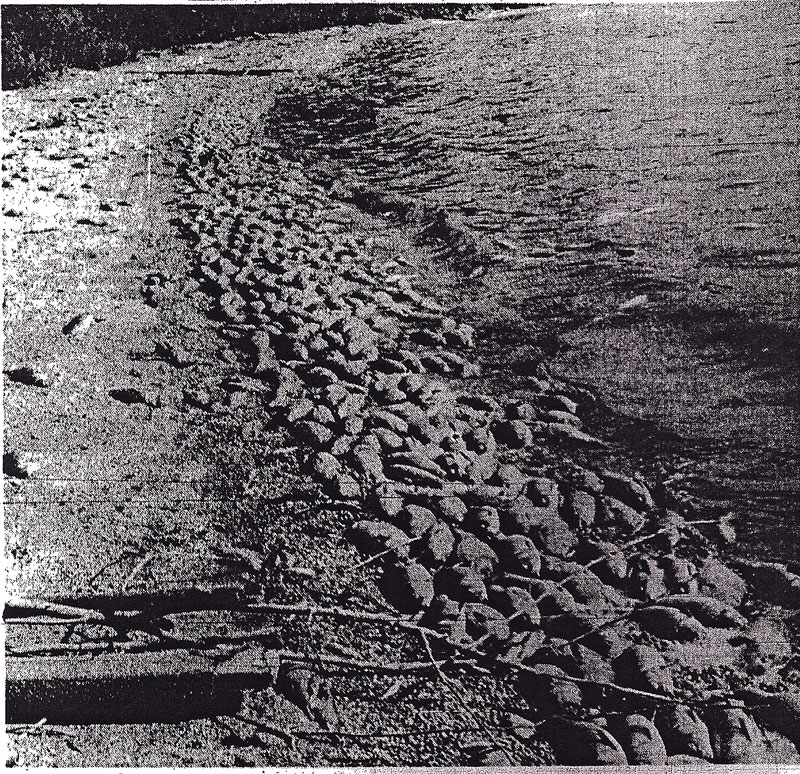
Shoreline of Ford Lake after the fish kill.

In 1973, the Michigan Department of Natural Resources wanted to turn Ypsilanti’s Ford Lake into a fisherman’s paradise. They planned to stock it with muskellunge, rainbow trout, and large- and smallmouth bass.

The only problem was the lake’s population of “rough fish” – mostly the common carp, plus bullheads and suckers. Carp are not native to Michigan. They were introduced in the late 19th century by the era-equivalent of the DNR as a valuable food fish that was cheap to keep on artificial ponds dug on farmers’ land. The farmers’ aquaculture projects inevitably spilled into Michigan waterways.

A century later, the DNR planned to douse Ford Lake with the piscicide rotenone to kill the carp and other rough fish, then whisk the remains into the Ypsilanti Township landfill and restock the pond.

Instead, the project led to a statewide ban on rotenone. [Full Story]

Two Dam Options for Argo

Ann Arbor Park Advisory Commission meeting (July 20, 2010): At their July meeting, park commissioners received updates on two projects that have drawn a fair amount of controversy: Argo Dam, and the Fuller Road Station.

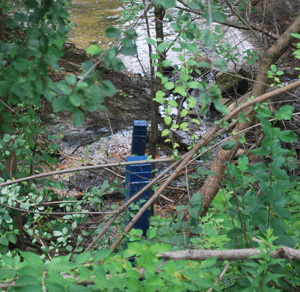
Piezometers at Argo Dam

Looking down from the Argo Dam embankment, toward the Huron River. The blue metal casings hold piezometers to measure water pressures in the earthen berm. (Photos by the writer.)

First up was Argo, and city staff outlined details of a consent agreement signed with state regulators in May, which identifies steps the city must take to deal with safety issues at the dam. The city will be pursuing two options: getting bids to repair the toe drains on the dam’s earthen embankment; and issuing a request for proposals (RFP) for an entire embankment reconstruction. Ultimately, city council will choose between the options, based in part on a recommendation from PAC.

During public commentary, two speakers affiliated with the Huron River Watershed Council urged commissioners also to recommend  getting a bid for an additional option – removal of the dam. And during a discussion after the staff presentation, commissioner Tim Berla called out the city council for not taking a vote on the dam-in/dam-out question. He said that by not voting, the council essentially made a back-door decision not to remove the dam. From an accountability standpoint, he said, a vote should be taken.

Commissioners were also updated on Fuller Road Station, a large parking structure and transit center – and possibly a train station eventually – proposed to be built on city land that’s designated as parkland. The joint project by the city and the University of Michigan was the subject of a resolution that PAC passed at its June 15 meeting, asking city council for more transparency in the process and to ensure the project results in a net revenue gain for the parks system. During the July 20 presentation at PAC, initial designs were presented and potential funding sources were discussed. Eli Cooper, the city’s transportation program manager, also told commissioners that Greyhound, which had initially expressed interest in the station, has now backed off – at this point, it doesn’t appear the bus company will use that site.

Later in the meeting, commissioner Dave Barrett gave an update on work that he and Berla are doing to assess the condition of the city’s ballfields. Some fields are in really bad shape, he reported. “It’s fair to say we have some work to do.” [Full Story]

Leveling the Field for Small Farms

Ann Arbor Greenbelt Advisory Commission meeting (July 14, 2010): Small farms and local food production again was a focus of the greenbelt advisory commission (GAC), as they considered revisions to easement language and scoring criteria for the greenbelt program.

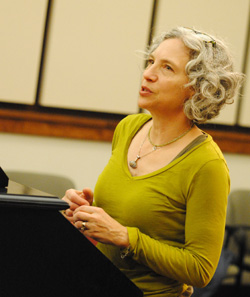
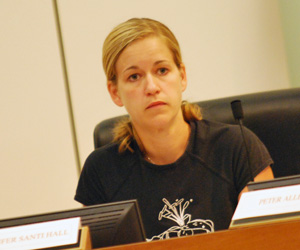
Jennifer S. Hall

Jennifer Santi Hall was elected chair of the city's greenbelt advisory commission at their July meeting, replacing Laura Rubin in that role. (Photos by the writer.)

The discussion prompted one commissioner, Dan Ezekiel, to underscore that they weren’t trying to favor small farms – they were simply trying to offset the advantages that the program has previously afforded to larger farms.

A review of revisions to the greenbelt program’s scoring criteria included a robust discussion about the meaning of “local food economy.” One of the proposed revisions would award points to farms that produce local food and contribute to the local food economy.

Commissioner Tom Bloomer, a Webster Township farmer, argued that all farms in Washtenaw County contribute to the local food economy, either directly or indirectly. Jennifer Santi Hall, who had proposed the change, agreed to withdraw the item from the scoring criteria so that they could refine the language. But she noted that it was important to find some way of including criteria for local food production, to align the scoring of applications with the greenbelt program’s strategic plan, which includes a section on the local food economy.

Later in the meeting, after nearly an hour in closed session to discuss land acquisition, the commission recommended allocating nearly $3 million in five separate deals, the majority of them for the purchase of development rights of local farms. Those recommendations will be forwarded to city council for final approval. [Full Story]

Column: Seeds & Stems

Marianne Rzepka

Marianne Rzepka

If you like going touring other people’s gardens – especially because someone else is doing all the work – you’ll love Hidden Lake Gardens.

They’ve got a guy who mows the lawns full time, along with a couple of part-timers. They’ve got people on their staff who can move a full-grown tree in less than half an hour. They’ve got volunteers who help weed and dig and plant, all so you can take the time to literally stop and smell whatever flower is currently blooming.

There are acres of displays, including an extensive collection of dwarf and rare conifers, a hillside of hostas, and the requisite annuals and perennials, along with a tidy conservatory and miles of trails. If you bring your lunch (yes, there are picnic areas) and some bug spray, you’ll be able to spend the day looking at plants, listening to the birds and appreciating the swaths of lawn that someone else has to mow.

“Our mission is the enjoyment and education of the public,” says Steve Courtney, who manages the site for Michigan State University, “and enjoyment is first.”

Courtney recently gave me a guided tour of the grounds. Located west of Tipton, in Lenawee County, Hidden Lake Gardens is at least a 40-minute drive from Ann Arbor (if you can avoid any backups at the construction on M-52, south of I-94). But if it were any closer, it wouldn’t be the quiet hideaway I found when I went to visit last week. [Full Story]

Zingerman’s Project Seeks Brownfield Status

The major renovation and expansion in the works for Zingerman’s Deli cleared its most recent major hurdle in May, gaining site plan approval from the Ann Arbor planning commission. While the site plan now moves on to city council, the business is taking action on another front as well: Applying for support from the local and state brownfield program.

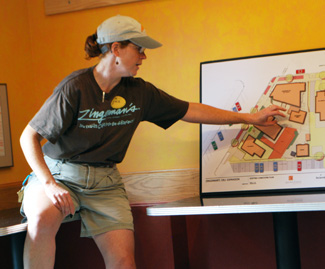
Grace Singleton

Grace Singleton, a managing partner with Zingerman's Deli, talks about plans to apply to the local and state brownfield program as part of the deli's renovation plans. The business hosted a public meeting about the plans on June 21. (Photos by the writer.)

On June 21, Zingerman’s hosted a public meeting to answer questions about their plans for the brownfield application. Matt Naud, the city’s environmental coordinator, was on hand as well, and distinguished between this project and those that are typically associated with the term “brownfield.” In the case of Zingerman’s Deli, “it’s economic development,” he said, “It’s not about environmental cleanup.”

Specifically, brownfield status would allow Zingerman’s to be eligible for tax increment financing (TIF), a mechanism that would let the business recoup certain qualified expenses related to the project – possibly as much as $817,000 over 15 years.

It’s a different approach than the brownfield application most recently approved by city council for the Near North affordable housing project on North Main. In that case, the site’s need for environmental cleanup qualifies it for a brownfield status. Zingerman’s application also differs from Near North’s in that Near North isn’t seeking reimbursement through TIF. Both projects plan to apply for Michigan Business Tax credits. [Full Story]

Ann Arbor Planning with the PROS

Ann Arbor’s master plan for parks gets updated every five years, a massive undertaking that takes about a year to complete. City parks planner Amy Kuras outlined the process at an October 2009 meeting of the park advisory commission, noting that she’d be seeking input from a variety of groups and the general public on the Park and Recreation Open Space (PROS) plan.

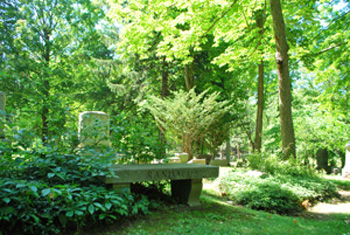
Forest Hill Cemetery

Forest Hill Cemetery in Ann Arbor. Planning commissioners pointed to cemeteries and the University of Michigan campus as adding to the downtown greenspace, in addition to city-owned parks. The discussion prompted one commissioner to quip: "Bring a basket to the casket!"

One of those focus groups took place at a working session for planning commissioners earlier this month, where Kuras asked for feedback on a range of topics, including the possibility of changing zoning to better protect parkland – an issue raised during debate about the proposed Fuller Road Station.

Also discussed were the role of parks and open space in the downtown area, and whether the city should acquire land for an Allen Creek greenway. And commissioners weighed in on the city’s practice of asking developers to contribute land or cash in lieu of land for parks – developers of Zaragon Place 2 will likely be paying the city $48,000 for that purpose, for example.

The nearly two-hour discussion touched on a whole host of other topics as well: How far should the city go in crafting public/private partnerships, like putting cell phone towers in parks? Beyond a traditional playground, how can the city become more kid-friendly – with amenities like fountains, or objects to climb on? Are pedestrian malls really an awful idea?

The city is soliciting more general public input on the PROS plan in several ways: via an online survey, email that can be sent to prosplan@a2gov.org, and a series of public meetings. The next meeting is set for Tuesday, June 29 at 7 p.m. at Cobblestone Farm Barn, 2781 Packard Road. The current 232-page PROS plan (a 10MB .pdf file) can be downloaded from the city’s website. [Full Story]

Column: Seeds & Stems

Marianne Rzepka

Marianne Rzepka

There’s a lot to learn from growing a garden, and a lot of Ann Arbor’s schools are finding that out.

Gone are the days when plant studies meant each student sprouted a lone bean seed in a Styrofoam cup. Now students as young as 5 are planting vegetable gardens and watching them grow.

“It’s, like, cool to see things grow,” says Yonatan Hodish, 13, a seventh grader at Ann Arbor Open @ Mack.

I visited garden projects at three Ann Arbor schools – Ann Arbor Open, Bryant Elementary and Burns Park Elementary – to see how tending a garden is helping kids learn. Though much of the growing season is ahead of us, students were able to harvest some early crops before leaving on Friday for summer vacation. Volunteers will tend the gardens over the summer, but kids will return in the fall to see how the foundation they laid this spring has paid off in edibles. [Full Story]

Greenbelt: How Best to Support Small Farms?

Ann Arbor Greenbelt Advisory Commission meeting (June 9, 2010): Under typical agreements crafted for the city’s greenbelt program, only 2% of land protected by a greenbelt conservation easement is allowed to be covered by an impervious surface – a house, for example, or roads.

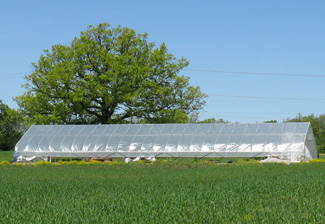
A hoop house at Sunseed Farm

A hoop house at Sunseed Farm, northwest of Ann Arbor. (Photo by Marianne Rzepka.)

To date, that hasn’t been an issue for most parcels in the program, which are fairly large – more than 40 acres. But as the greenbelt advisory commission (GAC) considers ways to support small farms – in the 15-20 acre range – some challenges have emerged. A farm of that size with hoop houses, for example, might easily result in covering more than 2% of the land.

During the public portion of this month’s GAC meeting, commissioners discussed how to address this and other issues that might require modifying the language in conservation easements for the city’s greenbelt program. Also addressed were strategies to ensure that the land stays in agriculture for future generations.

No action was taken at the June 9 meeting, and comments from commissioners indicate there’s also no clear consensus yet for how to handle this relatively new greenbelt focus. [Full Story]

PAC Softens Stance on Fuller Road Station

Ann Arbor Park Advisory Commission working session (June 1, 2010): Members of the Ann Arbor Park Advisory Commission took another crack at drafting a resolution regarding the proposed Fuller Road Station, softening some of the language that had previously called for city council to abandon the project. The station includes a large parking structure, bus depot and possible train station for commuter rail, to be built in partnership with the University of Michigan near the UM medical complex.

The changes are in response to a plea for unity by mayor John Hieftje, who had attended PAC’s May 18 meeting where he spoke with commissioners for an hour about their concerns. He told commissioners that the city has a better chance of getting federal funding for the project if they show a united front.

PAC members have been concerned that if the project moves forward, the city would receive less revenue from UM for parking than it currently gets from the surface lots it leases to the university on Fuller Road. Those revenues support the city’s park operations. Among other issues, some commissioners are also troubled that the structure is to be built on land that’s designated as parkland, and that there’s been limited opportunity for public input.

Immediately following a June 1 meeting of PAC’s land acquisition committee, which includes all members of the commission, PAC members stayed for a working session on the Fuller Road Station. Chair Julie Grand brought a revised resolution to consider, and the group thrashed through issues and language to come up with a draft that will be discussed at PAC’s June 15 regular meeting.

In addition, commissioner Tim Berla plans to propose an alternative resolution, which he emailed to other PAC members on Monday. His resolution focuses on process – asking that the city council and staff be fully transparent in providing details about the agreement to the public. [Full Story]

Environmental Indicators: Trees

Editor’s Note: This is the fourth in a series of Chronicle pieces on the environmental indicators used by the city of Ann Arbor in its State of Our Environment Report. The report is developed by the city’s Environmental Commission and designed as a citizen’s reference tool on environmental issues and as an atlas of the management strategies underway that are intended to conserve and protect our environment. The report is organized around 10 Environmental Goals developed by the Environmental Commission and adopted by city council in 2007.

Ann Arbor Tree Town

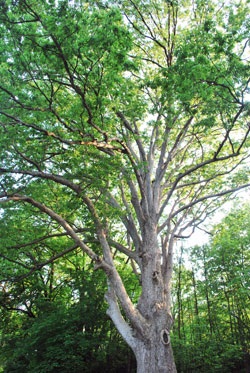
This is one of Ann Arbor's more significant trees. Some readers will undoubtedly recognize it and will know its location, type, and age – which they're invited to leave in the comment section.

This month’s report is also an invitation to all readers to participate in the development of Ann Arbor’s first comprehensive Urban Forest Management Plan. A public workshop to help kick off the planning effort is being held on June 1, 2010 from 7-9 p.m. at Forsythe Middle School, 1655 Newport Road.

This spring has been exceptional with both beautiful weather and ample rain. The trees seemed to have noticed, with their early bud break in April and full canopies by mid-May. While we worried for those tender emerging leaves when the temperature dipped below freezing, the trees handled the dips in temperatures just fine and are now flourishing.

That’s good news because the city receives exceptional benefits from our trees. A recent analysis of the publicly managed trees (i.e., trees along streets and mowed areas of parks) estimated that they provide $4.6 million in benefits each year. When you factor in the cost for management, the city receives $2.68 in benefits for every $1 it spends on the municipal forestry program. We think that’s a pretty good rate of return.

What are these benefits and how were they calculated? [Full Story]

Column: What, If Anything, Is a Bicyclist?

Temperatures hit the high 70s at Sunday’s Artisan Market near Kerrytown, where volunteers for Common Cycle were helping people learn about bicycle repair.

pic-collage-bicycles

Top to bottom: Tom Wright, Frank Schwende, Thomas Kula. (Photos by the writer.)

And as the weather gets warmer, the primary election season will also start to heat up – just as surely as journalists will appeal to hackneyed clichés to describe it. For local office candidates, as well as commentators on local races, part of the sport is to categorize the community into convenient groupings – like parents, homeowners, renters, students, landlords, environmentalists, developers, new urbanists, preservationists, park-lovers, young professionals, old hippies, the handicapped, business people, transit riders, etc.

I’m not certain that bicyclists would make the list as a voter group. But they’ll serve to make the point I want to make.

Yes, that non-exhaustive list of groupings is a sometimes useful and convenient set of labels. But just as the word “zebra” is a convenient label for those horse-shaped animals with a black and white pattern of stripes, that doesn’t mean that all of those “zebras” are necessarily biologically related.

The title of this column, in fact, is a play on the title of a fairly famous essay by Stephen Jay Gould: “What, If Anything, Is a Zebra?” That essay was written back in the early ’80s and I’m not sure if the evolutionary biologists ever settled the question. I don’t really care – zebras don’t live around these parts, and even if they did, they’re notorious non-voters.

But bicyclists do live around here. And they’ll serve as well as any grouping to illustrate the fact that among any “community” we include in a list of labels, there’ll be smaller sub-communities that have more specialized interests. So we’d do well to avoid thinking of these convenient labels as reflective of any one coherent community.

This column takes a look at three groups of people that could fairly be labeled “bicyclists,” with the idea that they’re separate groups, with maybe some overlap in people, but which are fundamentally different: Washtenaw Bicycling and Walking Coalition, Bicycles Are Traffic, and Common Cycle. I look at each group through the lens of one of their events I’ve attended over the last week and a half. [Full Story]

Hieftje Urges Unity on Fuller Road Station

Ann Arbor Park Advisory Commission meeting (May 18, 2010): During an hour-long presentation and Q&A, Ann Arbor mayor John Hieftje urged park commissioners to support the proposed Fuller Road Station, saying he’d like the city to present a unified front as they pursue federal funding for the $46 million project – a large parking structure, bus depot and possible train station for commuter rail.

Amy Kuras, Jim Kosteva

Jim Kosteva, right, talks with Ann Arbor parks planner Amy Kuras during Tuesday's meeting of the Ann Arbor park advisory commission. Kosteva, director of community relations for the University of Michigan, was on hand for a discussion of the Fuller Road Station, though he did not address the commission. (Photos by the writer.)

Heiftje’s presentation had not been on the agenda, but the commission was set to discuss a resolution that called for city council to stop the project, or at the least negotiate better terms with its partner, the University of Michigan. Several commissioners have expressed concerns about the project, which would be on city-owned property designated as parkland. Under proposed terms – which Hieftje said are not finalized – the city would receive less revenue from UM for parking than it currently gets from the surface lots it leases to the university on Fuller Road. Those revenues support the city’s parks operations.

Another public meeting on the project is set for Wednesday, June 2, from 7-9 p.m. at city council chambers, 100 N. Fifth Ave.

Also at Tuesday’s meeting, commissioners got a brief update on the urban forestry management plan – the first of two public meetings is set for Thursday at Tappan Middle School from 7-9 p.m. to get input on developing a plan to manage the city’s trees.

The artist selected for a public art project at West Park – Traven Pelletier of Lotus Gardenscapes – spoke briefly about his design. And in a third-quarter financial update for parks and recreation, commissioner Sam Offen reported that they’re in better shape than expected, needing less general fund support than they had originally budgeted for the current fiscal year. [Full Story]

Column: Seeds & Stems

Marianne Rzepka

Marianne Rzepka

Tomm Becker hasn’t been afraid of a spring frost killing the lettuce, tomatoes, cilantro, kale and chard he’s growing at Sunseed Farm.

That’s because he’s growing them under the plastic cover of a 30-by-96-foot hoop house, which since last fall has been a source of vegetables through most of the winter.

Hoop houses let the sun in, and the solar-powered heat warms up the soil and keeps tender plants from freezing in early and late frosts. When a strong wind flapped the hoop house cover at Sunseed Farm last week, it blew through the openings where the plastic had been hoisted to provide ventilation. The day before had brought cold temperatures and heavy rains that flooded the nearby rye field, so the side flaps had been down to keep the heat in.

“The great thing (about hoop houses) is you can control everything,” Becker says.

Hoop houses aren’t just for farms – a backyard hoop house can give anyone a head start on the season. Then even into the winter, you can grow some cold weather crops – like lettuce – or store root crops, like carrots.

But like anything else in your garden – ponds, chickens, a compost pile – a hoop house is a project that never stops. [Full Story]

Pleas for Human, Safety Services at Council

Ann Arbor City Council meeting (May 3, 2010): Several speakers addressed the city council at its Monday meeting asking for continued funding for human services and to avoid layoffs in the city’s police and fire departments.

Fire fighters informational picket

Firefighters held an informational demonstration Monday afternoon before the city council's meeting at Station 1, which is located across the street from city hall. Firefighters from Flint, Dearborn, Dearborn Heights, Ann Arbor Township, Ypsilanti, Battle Creek and Ann Arbor took part in the demonstration. (Photos by the writer.)

And Margie Teall (Ward 4), who faces two challengers in the August Democratic primary, announced a planned amendment to the city’s proposed budget that would maintain human services funding at FY 2010 levels. The amendment, which will be brought forward at the council’s May 17 meeting, would also avert as many layoffs in the police and fire departments as possible, she said.

The previous evening at the council’s Sunday night caucus, Mike Anglin (Ward 5) and Sabra Briere (Ward 1) had already indicated they would support using part of a possible $2 million payment from the Downtown Development Authority to avoid police and firefighter layoffs.

The council’s plan for funding the amendment, reported Teall, is to use a $2 million payment from the Downtown Development Authority that it hopes the DDA board will approve at its May 5 board meeting. Even if the DDA board approves the payment, which is very likely but not certain, not all safety services layoffs in the city administrator’s proposed budget could be covered. Averting the elimination of 35 positions across police and fire departments combined would require $3.6 million. The restoration of human services funding would require another $260,000. And that would still result in the city tapping its general fund reserves for $1.5 million.

In its business for the evening, the council passed a resolution added late Monday to the council agenda, which strikes an agreement between the city and the Michigan Dept. of Natural Resources and Environment for the future of the embankment along Argo Dam. It will allow the headrace to be re-opened by the end of this week.

The council also approved on first reading a revision to the city’s sidewalk occupancy permit system to include sandwich board signs. And the residential development now called Heritage Row – proposed along Fifth Avenue south of William Street – was approved at the council’s first reading with no discussion, but with dissent from Mike Anglin. Both of those measures will need to come back before the council for a second reading to gain approval.

The council also approved received the mayor’s nomination of the appointment of Anya Dale to the AATA board, replacing Paul Ajegba, whose term expired on May 1. Ajegba had been elected by his colleagues last fall to chair the board. Dale is a Washtenaw County planner. Her appointment will be presented for confirmation at the council’s May 17, 2010 meeting.

The council also approved some additional road closures for the June 6 Dexter-Ann Arbor Run. [Full Story]

Washtenaw Natural Areas Tweaked for Ballot

Washtenaw County Board of Commissioners working session (April 22, 2010): At their Thursday meeting, commissioners were briefed on proposed changes to the county’s Natural Areas Preservation Program, which would help the county protect more land that’s being used for farming.

Bob Tetens, Susan Lackey

Susan Lackey, executive director of the Legacy Land Conservancy, confers with Bob Tetens, director of Washtenaw County Parks & Recreation, before the start of Thursday's working session of the county board of commissioners. (Photo by the writer.)

The proposal comes as the board prepares to place a renewal of the 10-year NAPP millage on the November ballot. The current millage, which raises about $3 million annually to preserve natural areas in the county, expires at the end of 2010.

Also at Thursday’s meeting, commissioners heard a report on internal controls used within the county government, both in finance and other areas. This has been topic that commissioner Wes Prater has pushed the board to address for several months.

Highlights from a draft report were presented by staff of the county’s new energy and economic development department. The report includes data on job losses, education, housing, transit and other factors, and presents four strategies for improving the county’s economy. Tony VanDerworp, who leads the department, explained that the report is required by the U.S. Dept. of Commerce’s Economic Development Administration so that the county can apply for grants from the EDA.

Finally, Verna McDaniel, incoming county administrator, said she plans to hold a meet-and-greet for candidates of the deputy administrator job on May 5 before that evening’s board meeting, to get commissioners’ feedback on a potential hire. [Full Story]

Washtenaw Assessed Property Values Drop

Washtenaw County Board of Commissioners meeting (April 21, 2010): The economy was a theme throughout much of last week’s county board meeting, whether commissioners were hearing that this year’s tax revenues have fallen – but not as much as expected – or debating the virtues of a drug discount plan for residents. And concerns over the ability to pay additional road commissioners was one reason cited for tabling a motion to expand that group. The board also got an update on the Detroit Aerotropolis project, which is viewed by some as a way to boost economic development on the county’s east side.

Also at Wednesday’s meeting, commissioners authorized the issuance of up to $405,000 in bonds for a porous pavement project on Sylvan Avenue in Ann Arbor – the Ann Arbor city council had approved a construction contract for the project at their April 19 meeting. The city is working with the county’s water resources commissioner on this effort. If successful, it could pave the way for more porous resurfacing of local roads.

In the category of the local agricultural economy, the board honored the Horning family of Manchester for their work as progressive dairy farmers – Earl Horning in turn invited the public to a June 26 “Breakfast on the Farm” event. “We’d like our city friends to come and visit us,” Horning told commissioners. [Full Story]

Park Commission OKs Fee Increases, Budget

Ann Arbor Park Advisory Commission meeting (April 20, 2010): At Tuesday’s meeting, park commissioners gave their blessing to proposed fee increases and the parks budget for FY 2011, recommending that city council approve both items.

Karen Levin, Gwen Nystuen, David Barrett

Gwen Nystuen, center, passes out copies of a draft resolution to Karen Levin and David Barrett, her colleagues on the Ann Arbor park advisory commission. Nystuen is proposing that PAC form a subcommittee to review the impact of the Fuller Road Station. (Photos by the writer)

The proposed budget would keep all of the city’s 157 parks open, but would cut back maintenance – mowing and snow removal – on 17 parks. The budget also proposes keeping open Mack Pool and the Ann Arbor Senior Center, which had previously been slated to close. A handful of supporters for those two groups who attended Tuesday’s meeting applauded when commissioners approved the budget.

Only one commissioner – Gwen Nystuen – voted against recommending the budget, citing objections to a proposed rollback of funds for the city’s Natural Area Preservation (NAP) program.

Nystuen also floated a proposal to form a subcommittee that would review the impact of the Fuller Road Station. That project, which is jointly funded by the city and the University of Michigan, would initially include a large parking structure and bus station on city-owned land that’s designated as parkland. Nystuen has been vocal about her concerns over setting a precedent with this project, and frustrated that PAC hasn’t taken a more active role on the issue.

Commissioners also got a brief update on the status of an RFP being drafted by city staff for the possible privatization of the Huron Hills Golf Course, and heard from an organizer of the Ann Arbor skatepark during public commentary, who invited commissioners to an April 25 design workshop. [Full Story]

Building a Sustainable Ann Arbor

About two dozen members of three Ann Arbor commissions gathered last week for a rare joint meeting, a two-hour, wide-ranging discussion focused on the issue of sustainability. Bonnie Bona, chair of the city’s planning commission, said the working session was meant to start a conversation, with the goal of moving the city toward a sustainable future.

David Stead, Jean Carlberg, Fulter Hong

From left: David Stead, Jean Carlberg, and Fulter Hong at an April 13 working session on sustainability. They are members of the environmental, planning and energy commissions, respectively. (Photos by the writer.)

The discussion touched on the conceptual as well as the concrete, with some commissioners urging the group to tackle practical considerations as well. The chairs of each commission – Bona, the energy commission’s Wayne Appleyard, and Steve Bean of the environmental commission – set the stage by talking about the roles of their appointed public bodies, and how sustainability might be incorporated into their work.

Specific ideas discussed during the session included financing energy improvements in households through a special self-assessment on property tax bills, and tapping expertise at the University of Michigan.

More than midway through the meeting they were joined by Terry Alexander, executive director of UM’s Office of Campus Sustainability. He described UM’s efforts at implementing sustainable practices on campus as well as creating a living/learning environment for students, teaching them what it means to be a “green citizen.”

Toward the end of the meeting, Bona noted that the issue extended far beyond the three commissions gathered around the table. Housing, parks and other areas need to be involved as well, she said, if they were truly to tackle the three elements of sustainability: environmental quality, social equity, and economic vitality. Bean said he and the other chairs would be meeting again and come up with some specific examples for what steps might be taken next. “You’ll be hearing from us,” he said. [Full Story]
Greenbelt, Park Commissions Strategize

Though they share oversight for portions of the same millage, the city’s park and greenbelt advisory commissions had never officially met – until last week.

Peter Allen, Scott Rosencrans, Peg Kohring

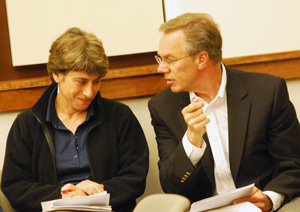
Scott Rosencrans, center, is chair of the city's park advisory commission, but will be stepping down from PAC when his term ends this month. At Rosencrans' right is developer Peter Allen, a member of the greenbelt advisory commission. In the background is Peg Kohring of The Conservation Fund, which manages the land acquisition millage for the parks and greenbelt.

As members arrived at the Ann Arbor Senior Center, where their joint meeting was held on April 6, some knew each other, but many others needed to introduce themselves. Among them were an attorney, a farmer, an ecologist, a teacher, a carpenter, a developer, a research scientist, a landscape architect – and many avid users of the local parks.

Scott Rosencrans, chair of the park advisory commission, told the group he thought it was important to strengthen communication between the two commissions, given the overlap in their strategic goals. And even though he’s stepping down from PAC when his term ends later this month, “hopefully you’ll pursue that,” he said.

At last week’s meeting, commission members got overviews of the parks and greenbelt programs from staff of The Conservation Fund, which manages the greenbelt and parks acquisition programs. In some ways, the meeting was a mini-tutorial for each group on the activities of the other, and an informal discussion about some ways to partner in the future.

There was also some frustration about what they couldn’t discuss. Typically, PAC’s land acquisition committee – a committee of the entire PAC membership – and the greenbelt commission spend much of their meetings in closed sessions, to discuss negotiations with landowners. But because each group needed a six-member quorum required by the Open Meetings Act to enter a joint closed session – and only five members of GAC attended – all of the meeting remained public. There was one property in particular that some commissioners and staff wanted to discuss in private, but couldn’t. About their inability to undertake that discussion, Peg Kohring of The Conservation Fund said, “It’s killing me!” [Full Story]

St. Joe’s Plows Ahead with Local Food

Head north on Hewitt Road from Washtenaw Avenue, past Eastern Michigan’s Rynearson Stadium to the edge of the St. Joseph Mercy Hospital campus. Off to the right is a plot of land that the health provider is now returning to a previous use – farming.

Hank Beakly with horses

Hank Beekley with his team of draft horses – a Belgian and a Shire – disks the field. The hospital building is visible in the background. The view is roughly to the northwest. (Photos by the writer.)

The centerpiece of the current effort is a 30 x 96-foot hoop house, which began construction on Monday. It will be joined by a second hoop house later in the summer, and plans call for a dozen of the structures to be built in the coming years.

The vegetables grown on the plot will be used in the hospital cafeteria and patient meals, and sold at a farmers market, with excess donated to Food Gatherers.

On Monday and again on Wednesday this week, Hank Beekley and his team of draft horses helped with the effort to transform about an acre of St. Joseph’s 356-acre campus in Superior Township to productive farming.

Tuesday was an off day for the horses – wet conditions were the key factor. But Beekley himself was there on Tuesday, along with other volunteers and St. Joseph’s staff to help build the first hoop house, which was already off to a good start based on Monday’s work. [Full Story]

Environmental Indicators: Phosphorus

Editor’s Note: This is the third in a series written by Ann Arbor city staff on the environmental indicators used by the city of Ann Arbor in its State of Our Environment Report.

The State of Our Environment Report is developed by the city’s environmental commission and designed as a citizen’s reference tool on environmental issues and as an atlas of the management strategies underway that are intended to conserve and protect our environment. The newest version of the report is organized around 10 environmental goals developed by the environmental commission and adopted by the city council in 2007.

Phosphorus periodic table

Phosphorus takes its place in the periodic table of elements with atomic number 15. Too much P is not good for the Huron River.

This installment focuses on phosphorus levels in our creeks and river. Adrienne Marino is a recent graduate of the University of Michigan School of Natural Resources and Environment and is an Environmental Programs Assistant with the city of Ann Arbor. Matthew Naud is the Environmental Coordinator at the city of Ann Arbor and can be reached at mnaud@a2gov.org.  Elizabeth Riggs with the Huron River Watershed Council and Molly Wade with the city of Ann Arbor provided additional input on the regulatory issues.

All installments of the series are available here: Environmental Indicator Series.

April showers will surely give way to May flowers and the start of lawn care season in southeast Michigan. As you tend to your lawn this spring and summer, you should know that your choices regarding lawn maintenance – especially fertilizer application – have large and measurable effects on the health of the Huron River and on the natural and human communities who depend on it.

How do we know this? The city of Ann Arbor’s ordinance regulating phosphorus-based lawn fertilizers took effect at the beginning of 2007. And sampling of Huron River phosphorus levels by University of Michigan scientists shows significant decreases in total phosphorus levels in 2008 and 2009. Huron River Watershed Council sampling of the creeksheds support these findings. [Full Story]

“It Looks Like a Great Burn Day”

Like many articles in The Chronicle, this one begins at a public meeting. But unlike any others, it ends in a partially burned woods at Argo Nature Area, where a crew clad in yellow fire-retardant suits kicked up puffs of smoke as they strode through the ashes of their work.

Burn crew gear

Gear for a member of the city's Natural Area Preservation burn crew, on the stoop of the Leslie Science & Nature Center. (Photos by the writer.)

On the path from one to the other, we learned about sling psychrometers, drip torches, council rakes and what kind of leaves burn best. Our guides were the staff and volunteers of Ann Arbor’s Natural Area Preservation program, who will be wrapping up the spring burn season later this month.

We first got an overview of the city’s controlled burn program from NAP’s manager, Dave Borneman, who made a presentation about it at the February meeting of the Ann Arbor park advisory commission. He described the ecological rationale behind a burn, citing the benefits it brings by controlling invasive species and rejuvenating the land.

As it turns out, Borneman was also the “burn boss” when we tagged along on a burn last Friday – the first one done by NAP in Argo’s lowland area.

But the day for the crew began at their offices in the Leslie Science & Nature Center building, on Traver Road – so that’s where we’ll start, too. [Full Story]

Sculptor Tries to Weld City, University

A William Dennisuk sculpture in progress

A student stands next to the sculpture-in-progress by William Dennisuk, in the studio of the University of Michigan School of Art & Design. When finished, the piece made of bronze rods will be flipped – its base is at the top of the photo. (Photos by the writer.)

William Dennisuk is still waiting for the state to sign off on a public art installation that could dot a stretch of the Huron River with large vase-like sculptures. As he waits, he spends most of his days in a studio, hoping to complete the project before he returns to Finland later this year.

The Chronicle first met Dennisuk – a visiting artist and lecturer at the University of Michigan School of Art & Design – when he came to the October 2009 meeting of the Ann Arbor Park Advisory Commission. He described his project, called Vessels, as a way to bring together the city and campus communities, and to raise awareness about how we interact with the natural world.

When The Chronicle dropped by the art school’s studio recently to get an update on the project, Dennisuk said that working through the required approval process took longer than expected. Also taking longer than projected was working through his own learning curve for some new techniques he’s trying with these sculptures.

Although he had hoped to install his artwork in April, now it looks like late May will be a more realistic goal. [Full Story]

Column: Seeds & Stems

Marianne Rzepka

Marianne Rzepka

Gardeners spend a lot of time working in their own world – moving the perennials, planning their walkways or weeding their vegetables.

But for some gardeners, the Michigan Conservation Stewards program has ushered in a larger world outside their backyard landscapes.

“My garden is something I do for me, but the stewardship program is what I do for others and for the larger environment,” says Mary Duff-Silverman, who went through the course last year.

The stewardship program introduces participants to the plants, animals and forces of nature that defy outsiders’ attempts to impose order. Instead, the steward-in-training has to understand the rules of that larger environment, with its invasive plants, water aeration, ground water and other natural processes.

This spring is only the second year the course has been offered in Washtenaw County. It’s a series of 11 classes that range over a number of ecological topics, including the ecosystems of wetlands, forests, lakes and streams.

This year’s program begins Saturday, April 10. If you’re interested, get more information online – you can also download the three-page application form from that website. [Full Story]

Ann Arbor Airport Study Gets Public Hearing

At its Feb. 2, 2009 meeting, the Ann Arbor city council authorized funding for an environmental assessment of a proposed 800-foot lengthening of the runway at Ann Arbor’s municipal airport. The assessment began on May 4, 2009.

Run up area on airport extension

Jon Von Duinen, of the consulting firm URS, points to the "run up" area which would be located at the spot where the existing runway ends. Under the recommended option in the environmental assessment, this would put the "run up" area 950 feet from the end of the extended runway. The "run up" area is where aircraft bring their engines up to full power to test that everything is in working order. (Photos by the writer.)

And on Wednesday evening, from 4-7 p.m. at Cobblestone Farm, a combination of a dozen government officials and consultants held an open-house style public hearing on the draft report of that environmental assessment.

At any given time, during the hour The Chronicle spent at the public hearing, the hosts outnumbered visitors. In a phone interview the following day, Molly Lamrouex – with the aeronautics division of the Michigan Department of Transportation (MDOT) – told The Chronicle that around 20 people had filtered through Cobblestone Farm over the three-hour period.

The time for submission of written comments on the environmental assessment has been extended from April 12 to April 19 at 5 p.m. Emails can be sent to lamrouexm@michigan.gov.

In the context of the controversy about the runway extension – which has played out at Ann Arbor city council meetings over the course of the last year – the public hearing was somewhat subdued. [Full Story]

Column: Recycling Virtues and MORE

The city of Ann Arbor made a recent decision to convert to a single-stream curbside recycling system, plus implement an incentive coupon reward system to encourage people to participate in the program.

apple and orange

Orange (left) and apple (right). The orange is larger than the apple. Its skin is bumpy in contrast to the apple's smooth covering. Also, the apple has a stem. (Photo by the writer.)

The decision came under some criticism for its initial capital costs, the possible reduction in quality of the resulting recycled material, as well as for its emphasis on coupon rewards for recycling more – which some people feared could feed back into a loop causing more consumption.

I think there are fair questions that can be asked about cost and quality.  What I missed, however, was a convincing sales pitch – one that included options within the basic idea of a single-stream system with an incentive program. In this column, I take a look at what I’d have found to be a more convincing sales pitch. [Full Story]

City Settles Lawsuit: Must Conduct Study

On March 15, the Ann Arbor city council voted to direct its city attorney to settle a lawsuit filed in August 2009 over the construction of an underground parking garage on the city-owned Library Lot site along Fifth Avenue. The lawsuit addressed environmental concerns, open meetings and freedom of information issues, as well as nuisance allegations by neighboring property owners.

Now the city of Ann Arbor has settled that lawsuit, accepting a range of requirements under the agreement.

Under terms of the settlement signed on Monday, the city has agreed to comply substantively with a request that one of the plaintiffs – The Great Lakes Environmental Law Center – had originally made over two months before the lawsuit was filed. That request was to conduct a study of environmental impacts associated with construction of the new underground parking structure, which is being built by the Downtown Development Authority.

The lawsuit settlement does not resolve the question of whether city councilmembers committed violations of the Open Meetings Act, when they communicated during their meetings via email about an agenda item related to approval of bonds for the parking structure.

However, the Ann Arbor city council is required by the settlement terms to discuss publicly, at one of their April 2010 meetings, the possibility of establishing a council rule that addresses which email accounts they use to conduct city business. [Full Story]

Concerns Voiced Over Fuller Road Station

Ann Arbor Park Advisory Commission meeting (March 16, 2010): Fuller Road Station was the focus of this month’s PAC meeting, including a presentation by Eli Cooper and others on the project’s team. Five people spoke on the topic during public commentary as well – all of them concerned about the proposed parking structure and transit center.

Greta Brunschwyler, Sam Offen, Jason Frenzel

From left: Greta Brunschwyler, the new executive director at the Leslie Science & Nature Center, talks with park advisory commissioner Sam Offen and Jason Frenzel, volunteer and outreach coordinator for the city's Natural Area Preservation program, prior to the March 16 PAC meeting. (Photo by the writer.)

Several commissioners had pointed questions for Cooper. Sam Offen pressed him on the issue of revenues, noting that when the parking structure is built, the university might have no need for the spaces it leases from the city on the opposite side of Fuller Road – resulting in a loss of about $38,000 per year to the city.

Also attending the meeting was Greta Brunschwyler, the new executive director at the Leslie Science and Nature Center, who started the job on March 4 and came to introduce herself to park commissioners and staff.

Leslie Science and Nature Center is where Jason Frenzel’s office is located. Frenzel, volunteer and outreach coordinator for the city’s Natural Area Preservation program, gave a brief presentation about volunteer opportunities.

Scott Rosencrans, PAC’s chair, wasn’t able to attend the meeting, which was led in his absence by vice chair John Lawter. Lawter announced that Rosencrans has decided not to seek reappointment to PAC when his term ends in mid-April. So not only will PAC need to elect a new chair, Lawter said, there will also be an opening on the commission. [Full Story]

In the Archives: The Toad Survey of 1910

Editor’s note: Leslie Science and Nature Center is soon launching its frog and toad survey after holding a kick-off orientation meeting on Feb. 24. Other Leslie frog-related events include Frog Fest on May 15, 2010. Partly in that context, local history columnist Laura Bien takes a froggy look back.

Michigan’s inaugural 1996 Frog and Toad Survey started strong. “I have talked with coordinators in other states,” wrote state frog and toad survey coordinator Lori Sargent in the survey report, “and most are finding it difficult to find enough people to volunteer. Perhaps that says a lot about Michiganians – we care about our natural resources.”

Frog Island Ypsilanti

Ypsilanti's Frog Island, seen here looking north along the present-day eastern side of the running track, was the site in 1895 of Henry Scovill's lumber yard.

So much so that Ypsilantians have been surveying frogs and toads for over a century … off and on.

“Five years ago as we sat on our porch one summer evening a toad hopped out from around the corner to the concrete walk,” was the way one resident was quoted in the July 9, 1907 Ypsilanti Daily Press. “We watched it ‘walk’ down to the street sidewalk and within half an hour or so back it came.”

The Normal Park resident continued, “The next night as we were again sitting on the porch, one said, ‘I wonder whether our toad will be out tonight?’ It was but a few minutes when out it hopped and started down the walk. Within the hour it came back.” [Full Story]

Column: Seeds & Stems

Marianne Rzepka

Marianne Rzepka

Friends don’t ask me how I feel about February. They’ve already heard me say that there’s a reason why the worst month in the year – cold, icy, gray – is the shortest month. And when it’s over, it’s still winter.

So when the first of March rolled around this year – coming in like a lamb, instead of a lion – I was left blinking in the sun and looking like I just crawled out of hibernation. There was sun and steadily rising temperatures, so sue me if I think spring is already here.

But though the temperatures are already in the 50s, these weeks can be the winter of a gardener’s discontent.

We want to get out there, we want to start digging, but we know it’s just too darn early. It’s even too early to set up the grow lights to start my tomato plants from seed. Some stoics will tell you it’s even too early to walk on your lawn! [Full Story]