Govt. Section

Council Takes Step to Alter Pedestrian Law

Ann Arbor city council meeting (Nov. 10, 2011): A further revision to the city’s pedestrian safety ordinance took up most of the council’s time at Thursday’s meeting.

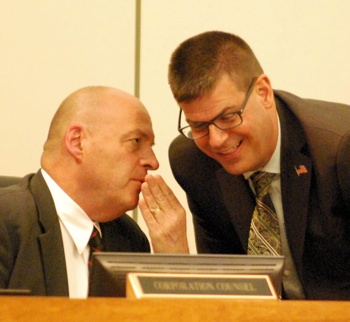
Rapundalo signing student attendance sheets

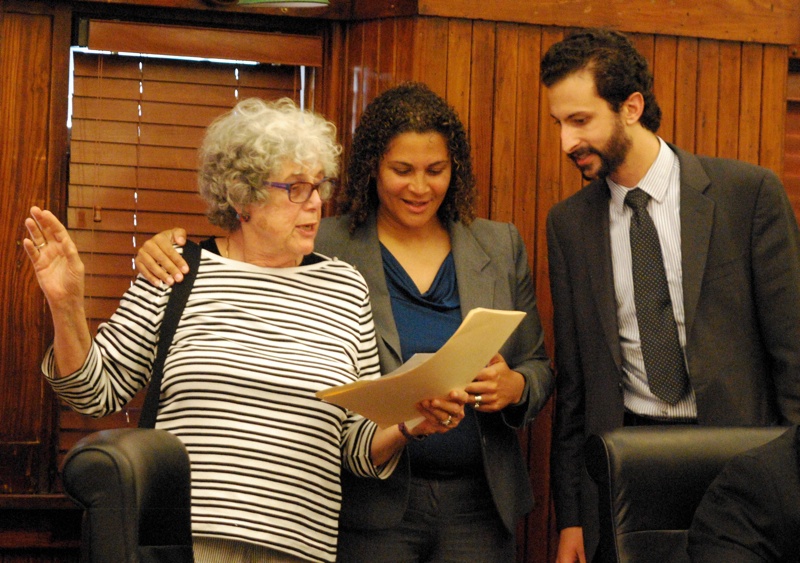
Stephen Rapundalo (Ward 2) was first to arrive at the council's meeting and was rewarded by a dozen or so requests from high school students who needed a signature to attest to their attendance for a class assignment. It was Rapundalo's last meeting, having lost the Ward 2 election on Tuesday, Nov. 8, to Jane Lumm. (Photos by the writer.)

The council had made several revisions to the law in 2010, including a requirement that motorists accommodate not only pedestrians who are “within” a crosswalk, but also those who are “approaching” a crosswalk. Thursday’s initial revision amended out the “approaching” language in favor of the following wording: “… the driver of a vehicle shall stop before entering a crosswalk and yield the right-of-way to a pedestrian stopped at the curb or ramp leading to a crosswalk and to every pedestrian within a crosswalk.”

The second and final vote on the pedestrian ordinance change is expected to come after a council working session in December, and after a public hearing at the council meeting when the final vote is taken. Based on deliberations on the change at Thursday’s meeting, the outcome of that vote is not a foregone conclusion, and further revisions might be possible.

The council also took action at the Nov. 10 meeting that will allow two downtown residential projects to start construction. The council approved the site plan for The Varsity Ann Arbor, a “planned project” consisting of a 13-story apartment building with 181 units at 425 E. Washington, between 411 Lofts and the First Baptist Church.

And the final deal was approved with Village Green to purchase the city-owned parcel at First and Washington. On that site Village Green will build a 244-space parking deck as the first two stories of a 9-story building with 156 dwelling units – City Apartments.

The council gave final approval to a change in its taxicab ordinance, spelling out conditions under which licenses can be revoked or suspended.

The council also gave final approval to two ordinances that make retiree health care and pension benefits for two of the city’s larger unions parallel to benefits for non-union employees. The approvals gave Stephen Rapundalo (Ward 2) an opportunity to comment on the labor issues that had been a centerpiece of his re-election campaign, which concluded unsuccessfully on Tuesday.

It was due to the election held on Tuesday that the council’s meeting was shifted from its regular Monday meeting slot to Thursday. The shift is stipulated in the city charter. All council incumbents won their races except for Rapundalo, a Democrat defeated by Jane Lumm, who was running as an independent. Rapundalo began his final meeting by signing multiple attendance sheets for high school students who were attending the meeting on a class assignment, and ended it by hearing praise from his colleagues around the table. [Full Story]

Ann Arbor Greenbelt Eyes Future Land Deals

Ann Arbor greenbelt advisory commission meeting (Nov. 9, 2011): Skyline High School students on class assignment outnumbered commissioners at Wednesday’s meeting. More students might have attended, but some learned of a meeting of the city’s medical marijuana advisory board scheduled for the same time, and were drawn to that instead.

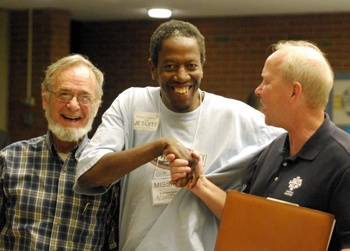
Skyline High students, Dan Ezekiel

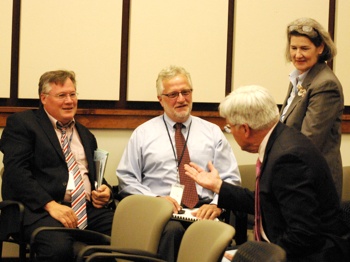
Skyline High students get their attendance sheets signed by Dan Ezekiel, chair of the greenbelt advisory commission. Some students recognized Ezekiel from his other job – a science teacher at Forsythe Middle School.

Those who did stay witnessed a brief meeting that included a recess to wait until a sixth commissioner arrived – GAC requires six members to hold a closed session, which they needed in order to discuss possible land acquisition.

Briefly participating in that closed session was Jack Smiley, former executive director of the Southeast Michigan Land Conservancy. The conservancy hopes to partner with Ann Arbor’s greenbelt program on property in the Superior Greenway – land between Ann Arbor and Detroit that’s protected from development.

In other business, commissioners briefly discussed ways to communicate better about the greenbelt program with the public, building on what they viewed as a successful bus tour of protected greenbelt land in October. One possibility is a forum this winter at the Ann Arbor District Library, where the public could meet with landowners whose property is part of the greenbelt.

The one action item at Wednesday’s meeting was a vote to pre-authorize staff of The Conservation Fund, which manages the greenbelt program under contract with the city, to conduct appraisals for potential land acquisitions through Dec. 31.

Typically, GAC votes to authorize appraisals on specific parcels, as part of the application process that landowners make for being part of the greenbelt. But the city council is expected to vote on a possible expansion of greenbelt boundaries in December, after GAC’s meeting that month. GAC voted to recommend the expansion at its September 2011 meeting. It’s expected that some landowners within the expanded boundaries might want to apply for the greenbelt, and a February deadline to seek matching federal dollars makes the timeline for getting appraisals shorter than usual. Pre-authorization gives staff flexibility to move forward with the process.

Commissioners are also awaiting finalization of Shannon Brines’ appointment to GAC. The city council was expected to vote on his appointment at its Nov. 10 meeting. But the council postponed the vote to Nov. 21 – due to a procedural issue, not any substantive concern about his appointment. [Full Story]
General Election 2011: Results Roundup

Voters in Ann Arbor elections held on Nov. 8 confirmed the city’s general preference for incumbent candidates, both on the city council and on the school board. Out of a field of six, voters gave the two incumbents on the Ann Arbor Public Schools board of trustees – Andy Thomas and Simone Lightfoot – each a four-year term.

Lumm-Rapundalo

Map A: Breakdown by precinct of the vote in Ward 2, with white shading to indicate Jane Lumm's weakest precinct (2-2 with 33%) and black her strongest precinct (2-5 with 71%). Shades of gray show relative strength of Lumm's support. Incumbent Stephen Rapundalo managed a majority in 2-9 and 2-2, but in 2-2 only three people voted. (Image links to dynamic Google Map.)

And the preference for Democrats, which the city of Ann Arbor has shown in recent years, was generally also confirmed in Tuesday’s city council results. Four of five Democratic incumbents were given another two-year term on the 11-member body. Sabra Briere (Ward 1), Stephen Kunselman (Ward 3), Marcia Higgins (Ward 4) and Mike Anglin (Ward 5) all easily kept their seats.

The lone Democratic incumbent who lost was Stephen Rapundalo. He was defeated on Tuesday by Jane Lumm, who served previously on the city council as a Republican, but who ran against Rapundalo as an independent. Rapundalo himself is a former Republican, but served three terms on the council as a Democrat.

Ann Arbor voters also said yes to all three proposals on Tuesday’s ballot. They approved a renewal of the 2.0 mill street repair tax, the addition of a .0125 mill sidewalk repair tax, and a change to the composition of the city’s retirement board of trustees.

Sylvan Township voters were in a less agreeable mood, voting to reject a 4.75 mill tax that would have been used to reimburse Washtenaw County for some bond payments on which Sylvan will likely default in 2012. The county will likely file a lawsuit to recover the money through a property assessment.

In The Chronicle’s travels to polling stations throughout election day, turnout was described by precinct workers as light to moderate. It ranged from a low of less than 1% in three predominantly university student precincts, to a high of 26.6% in Precinct 5 of Ward 2 – the ward with the most hotly contested race. Countywide, turnout was 11.24%, according to the county clerk’s office. However, several election workers noted that percentages are hard to gauge, given that many voters are still registered even if they’ve left the area – as is the case with many voters who register as college students.

Complete results are available on the Washtenaw County clerk’s election results website. [Full Story]

Election Day: November 2011

It’s Election Day. Voters in the Ann Arbor Public Schools district have a choice of six candidates to fill two open seats on the AAPS board of trustees. And Ann Arbor city residents in four of five wards will have a choice about their representation on the 11-member city council.

Sign at Angell Elementary School

A sign directing voters at Angell Elementary School, where two precincts for Ann Arbor's Ward 2 are located. As of 7:05 a.m., five voters had arrived. It's unlikely the one-voter-per-minute pace will continue, but poll workers expect a higher turnout than the 68 people who voted here in the August primary.

If you’re still researching the candidates for the school board or for the city council, check out Chronicle coverage of the candidate forums.

City of Ann Arbor voters will also be presented with three ballot proposals, two of them involving approval of taxes for street and sidewalk repair. Proposal 1 would renew an existing street repair property tax at a rate of 2 mills. [A mill is $1 for every $1,000 of a property's taxable value.] Assuming Proposal 1 is approved, Proposal 2 would levy an additional 0.125 mills – for sidewalk repair. If Proposal 2 is approved by voters, the city would not start a new 5-year inspection cycle. Under that inspection program, property owners are formally notified that sidewalks adjacent to their property need repair and then must undertake those repairs themselves.

Attitudes of city council challengers towards the sidewalk millage are negative. Some current city councilmembers have offered only reluctant support for the sidewalk millage or else have a complete lack of a position on the question. Mayor John Hieftje, who is not up for re-election this year, has clearly stated his lack of a position on the sidewalk millage.

Proposal 3 is less controversial, enjoying solid support among councilmembers and challengers. It would change the makeup of the retirement system’s board of trustees so that fewer beneficiaries of the system are included on the board.

Polls are open today from 7 a.m. until 8 p.m. A good place to get partial unofficial results (that are as close to official as you can get) is the Washtenaw County clerk’s office election results website.

To find your polling place, type in an address on the My Property page of the city of Ann Arbor’s website, and click on the Voter tab.

The Chronicle has established somewhat of an Election Day tradition: We tour as many precinct locations as we can through the day and file mini-reports from the polls. So we’re off – check back throughout the day for updates, appended after the jump. Add your own observations from the polls in the comments. [Full Story]
Animal Issue Dominates County Budget Talks

Washtenaw County board of commissioners meeting (Nov. 2, 2011): At a meeting that lasted nearly five hours, commissioners gave initial approval to the county’s 2012-2013 general fund budget, following a discussion dominated by the topic of funding for state-mandated animal control.

Jenny Paillon, Yousef Rabhi

Jenny Paillon, director of operations for the Humane Society of Huron Valley, reviews some HSHV financials with county commissioner Yousef Rabhi (D-District 11) during a break at Wednesday's board of commissioners meeting. (Photos by the writer.)

With supporters of the Humane Society of Huron Valley (HSHV) demonstrating outside the county administration building and speaking during public commentary at the meeting, commissioners debated at length over how to handle its contract with the non-profit. The proposed budget calls for cutting HSHV’s contract from $500,000 this year to $250,000 in 2012 and 2013.

HSHV’s current two-year contract expires at the end of 2011, and leaders of the humane society have expressed reluctance to sign a new one with such a significant cut, saying that even at the current rate the county is not paying what the services are worth. [.pdf of HSHV analysis of legal and financial costs for mandated services]

For their part, some commissioners contended that they don’t yet know the actual cost of providing mandated services, and that HSHV hasn’t provided them with the kind of financial data they need to make an informed decision.

In the budget that received initial approval, the line item that originally earmarked $250,000 in annual payments to HSHV in 2012 and 2013 was renamed to “Mandated Animal Control,” a generic reference that reflects the possibility that the county might contract with another agency for animal control services – an option they discussed explicitly.

Board chair Conan Smith also proposed an amendment to move that line item out of the county’s funding for outside agencies, where it has traditionally been listed, and add it to the budget for the sheriff’s office. The funding could then be combined with a line item of $180,000 that is already part of the sheriff’s budget – for animal control officers. The county recently has discussed the possibility of paying HSHV $250,000 plus $180,000 – a total of $430,000 – if the humane society also takes responsibility for the work now done by the animal control officers. The shift in fund categories was approved on a 8-3 vote, with dissent from Rob Turner, Rolland Sizemore Jr., and Ronnie Peterson.

After the vote, sheriff Jerry Clayton spoke to the board during public commentary, saying he hadn’t been notified that this shift in funding to his office might occur. He expressed a range of concerns about the decision.

After making two other amendments not related to animal control, the board ultimately gave initial approval to the budget on a 9-1 vote, with dissent from Sizemore, who said he still has questions about it. Felicia Brabec abstained. Appointed two weeks ago to fill Kristin Judge’s vacated seat in District 7 (Pittsfield Township), Brabec indicated she’d like more time to review the budget document. Additional amendments are expected before the board takes a final vote on the budget, likely at its Nov. 16 meeting.

The board also got a third-quarter 2011 update from the county’s finance staff, projecting a nearly $1 million shortfall for the year, which will be covered by use of the county’s fund balance.

In other business, the county voted to create a planning task force for a new pilot program in agribusiness. Called ”Seeds for Change: Growing Prosperity in Ypsilanti,” the project is intended to provide job training and placement to unemployed workers interested in agricultural employment, and to offer shared commercial kitchen space and business support to local agribusiness entrepreneurs. No funding has yet been identified for the effort. [Full Story]

2011 Ward 2 Race: Looking Ahead to the ’90s

On a rainy Wednesday evening late last month, around 55 Ann Arbor residents gathered inside the Thurston Elementary School media center to hear Ward 2 Ann Arbor city council candidates respond to questions. This year, the general election in Ward 2 is contested between three-term Democratic incumbent Stephen Rapundalo and independent challenger Jane Lumm, who served on the council as a Republican from 1994-1998.

Stephen Rapundalo Jane Lumm Ward 2

Stephen Rapundalo and Jane Lumm were adamant in their positions, but appeared in relatively good humor. (Photos by the writer.)

Rapundalo has made the city’s past and future a central theme of his campaign, and the Oct. 26 event amply reflected that. Rapundalo spent much of the evening trying to characterize the city councils of the 1990s, on which Lumm served, as unable to work cooperatively as a group. That contrasts with his own approach and that of the current council, said Rapundalo, which is based on consensus and cooperation, even if councilmembers don’t agree on everything.

Even as Rapundalo appealed to the past in criticizing Lumm – for supporting what he called luxurious labor contracts during her tenure of service – he also criticized what he perceives her attitude to be towards the future. He calls it a “hunker down” mentality, which he says doesn’t take into account the steps the city needs to take to ensure future generations have what they need.

For her part, Lumm tells a narrative in which city government has become, since the time she served on the council, disconnected from the priorities of residents. She wants to restore community input and open conversation back to city government, which she contends is now lacking. At the Thurston forum, she responded to Rapundalo’s criticism about her prior service as a councilmember by saying she welcomed the comparison between “the bad old days” and now. She characterized herself as a fiscal watchdog, who pressed financial issues, even if there was not the same appetite for that on the rest of the council.

Certain aspects of Lumm’s record are portrayed on Rapudalo’s campaign website in a way that could fairly be described as out of context. [A closer examination of Rapundalo's portrayals based on city council minute archival material is included in The Chronicle's write-up of the League of Women Voters forum, earlier in the campaign: "2011 Election: Ward 2 City Council"] At the Thurston forum, however, Rapundalo was right about a point of contention that emerged over whether Lumm had enjoyed a Republican majority on a city council committee. The city council archives show a 3-2 Republican majority on the labor negotiating committee in 1996.

The forum was hosted by the Orchard Hills/Maplewood Homeowners Association, moderated by Peter Mooney, who’s president of that group. Rapundalo is a member of the association, and Thurston Elementary is in Rapundalo’s neighborhood. But if there was a general leaning among the assembly, it seemed to be in favor of Lumm – based on response to a few laugh lines sprinkled throughout the forum.

The format of the event contrasted with many other similar events, in that it featured no rigid time constraints on candidate responses – just a general guideline from Mooney to try to limit responses to around three to four minutes.

Mooney took questions written by audience members on cards and synthesized them into prompts for the candidates. Paraphrased questions and responses below are summarized in the order they were given. [Campaign websites: Jane Lumm , Stephen Rapundalo] [Full Story]

Election 2011: Final AAPS Candidate Forum

All six candidates for the Ann Arbor Public Schools board of education attended a 90-minute forum at Ann Arbor Open @ Mack school on Thursday evening, Nov. 3. It was the final public candidate forum before next Tuesday’s election. About 50 people, including teachers and parents of AAPS students, filled the small auditorium. Several candidates remarked that it was the best-attended event of the election season.

No Nut sign

A "No Nut" sign was posted at the entrance to Thursday's AAPS board candidate forum. It did not appear to relate to the event. (Photos by the writer.)

Candidates for the two open seats – each for four-year terms on the seven-member school board – are Albert HowardAhmar IqbalPatrick LeonardLarry Murphy, and incumbents Simone Lightfoot, and Andy Thomas.

The forum was hosted by the Ann Arbor Open Coordinating Council, and was moderated by AAOCC co-chair Sascha Matish. After brief opening statements from all candidates, they responded to a series of six questions that had been submitted by parents whose children attend Ann Arbor Open.

Questions covered the topics of programs of choice, standardized testing, state-mandated initiatives, the district’s budget, class size, and the proposed technology millage. Summaries of each candidate’s answers are provided below, presented in the order in which they responded.

For previous Chronicle coverage of the school board candidates, including more about their backgrounds, see: “Forum for Six AAPS Candidates“ and “Election 2011: AAPS Board Candidate Forum.”

This year, the general election falls on Nov. 8. Readers who are unsure where to vote can type their address into the My Property page of the city of Ann Arbor’s website to get that information. Polls are open from 7 a.m. to 8 p.m. [Full Story]
Public Hearing Starts Without Aparkolypse

Ann Arbor Downtown Development Authority board meeting (Nov. 2, 2011): At a meeting that included no business requiring a vote, the Ann Arbor DDA board began a public hearing on possible parking rate increases for the city’s public parking system.

DDA public hearing

Deanna Relyea spoke to the Ann Arbor DDA board at the Nov. 2 public hearing on behalf of the Kerrytown District Association. (Photos by the writer.)

The hearing will continue at the board’s Dec. 7 meeting, after a Nov. 14 joint working session with the Ann Arbor city council, when the two bodies will discuss proposed increases. A vote by the DDA board on the rate increases would not come until January.

Around a half dozen people spoke at the initial opportunity for public comment on the proposed rate increases, most either downtown merchants or representatives of merchant associations. They were uniformly in support of one feature of the proposal – no extension of meter enforcement past 6 p.m. Extension of enforcement hours has been actively on the table for at least two years. Based on board discussion at Wednesday’s meeting, evening enforcement could eventually be implemented – but not for the current rate increase cycle.

Those who spoke at the initial part of the hearing were generally opposed to increasing rates, but also acknowledged the financial decisions the DDA faces. And some speakers put part of the blame for that situation on the city of Ann Arbor. Under a new contract, the city of Ann Arbor now receives 17% of gross public parking revenues, which could otherwise be put back into the parking system, reducing the pressure to raise rates. Under the contract, the DDA operates the system, and is responsible for ongoing maintenance. Rates are controlled by the DDA in consultation with the city council.

The details of proposed parking rate increases were first announced towards the end of last week, most of which would be implemented starting in September 2012. Some increases would be implemented starting in February. [.pdf of DDA proposed parking rate changes]

Highlights of the changes to be enacted in September 2012 include predominantly $.10/hour increases: hourly structure parking rates would increase from $1.10/hour to $1.20/hour; hourly parking lot rates would increase from $1.30 ($1.50 after 3 hours) to $1.40 ($1.60 after 3 hours;) hourly parking meter rates would increase from $1.40/hour to $1.50/hour; monthly parking permit rates would increase from $140/month to $145/month.

The board’s meeting included the usual range of reports, including the quarterly financial numbers and parking report, and updates on the Fifth Avenue underground parking garage construction as well as the most recent development in the Nov. 8 sidewalk millage ballot proposal.

At the city council’s Oct. 17 meeting, the council passed a resolution clarifying how the millage proceeds would be used inside the DDA’s geographic district. And at the DDA’s Wednesday meeting, mayor John Hieftje gave the clearest public indication to date that he does not want to take a position on the sidewalk millage, saying that residents would have to “figure it out for themselves.”

The board also held a closed session, under the provision of the Michigan Open Meetings Act that allows such a session to discuss the meaning of legal advice contained in a written document protected under attorney-client privilege.  [Full Story]

Ann Arbor Senior Center: Changes Reviewed

Ann Arbor park advisory commission meeting (Oct. 18, 2011): Having skipped a meeting in September, park commissioners faced a full agenda at their October session, highlighted by a consultant’s report on the Ann Arbor senior center.

Christopher Taylor, Sam Offen, Tim Doyle

Ann Arbor city councilmember Christopher Taylor, left, accepts a ballot from Tim Doyle, right, a park advisory commissioner. In the center is Sam Offen, who was re-elected as chair of PAC's budget committee. Taylor is a non-voting ex-officio member of PAC.

The report – including 16 recommendations for changes to improve the Burns Park center and senior services – is the latest in an effort that dates back to 2009, when the city considered closing the center. Suggestions include: (1) expanding programs to other locations, particularly to low-income senior housing; (2) partnering with other programs in the area, such as the popular travel program offered by Pittsfield Township’s senior center; and (3) possibly making the Burns Park facility more of a community center, and renaming it to reflect that broader mission.

Staff will be taking this report and incorporating elements of it into a strategic plan, which will be reviewed by PAC and city council before action is taken.

The meeting also included votes to recommend awarding contracts for renovations at Island Park, and support for a bioremediation pilot project at Southeast Area Park. Matt Naud, the city’s environmental coordinator, told commissioners that the test would determine the effectiveness of an approach to remove an existing vinyl chloride plume. The process would involve giving nutrients to naturally occurring microorganisms that can break down the contaminant. The plume resulted from vinyl chloride being released from the now-closed city landfill into groundwater on the south side of Ellsworth Road.

Margaret Parker, a member of the Ann Arbor public art commission (AAPAC), gave a presentation about two potential public art projects along the Huron River – at the Argo Dam bypass, and the Gallup Park canoe livery. Since the work would likely be on city-owned parkland, members of the parks staff and park advisory commission would be part of a task force for the project. Laura Rubin, executive director of the Huron River Watershed Council, also attended PAC’s meeting. She spoke in support of a more comprehensive vision for art as part of RiverUp!, an effort to improve a 104-mile stretch of the Huron River.

During public commentary, commissioners heard suggestions for several ways to improve non-motorized connections between South State and South Main streets.

The October meeting also included a review of FY 2011 and first-quarter FY 2012 financials for the parks system, and PAC’s annual election of officers. There were no deliberations, and current officers – including PAC chair Julie Grand – were re-elected unanimously. [Full Story]

Washtenaw Transit Talk in “Flux”

Ann Arbor Transportation Authority board meeting (Oct. 20, 2011): Over the last two weeks, several significant developments in transportation planning have unfolded in and around Ann Arbor, not all of them at the most recent meeting of the AATA board.

Michael Ford

AATA CEO Michael Ford adjusts the microphone for board member Charles Griffith at the board's Oct. 20 meeting. (Photos by the writer.)

At an Oct. 10 Ann Arbor city council work session, the council received an update on the high capacity connector study for a geographic area that broadly connects the boomerang-shaped swath from Plymouth Road and US-23 down through Ann Arbor to South State Street.

Most significantly, the swath connects the University of Michigan’s north, central and medical campuses. The basic conclusion of that study was delivered to the AATA board several months ago: Sufficient ridership exists in the core of that area to support some kind of high-capacity “fixed guideway” system like Bus Rapid Transit (BRT), light rail, or elevated guideway.

What’s new are the steps that are now being taken to secure funding for the next phase of the connector study: An analysis that will yield the “preferred alternative.” That alternative will include selection of a specific transportation technology, as well as proposed routes and station locations.

Funding for part of that alternatives analysis was announced on Oct. 13 by the U.S. Dept. of Transportation – $1.2 million has been awarded to the AATA. However, that funding won’t cover the cost of the environmental study component of the project.

Related to that project, on Oct. 19 the Washtenaw Area Transportation Study (WATS) policy board voted to add the alternatives analysis to its Unified Planning Work Program. Next up will be formal action by the Southeast Michigan Council of Governments (SEMCOG) and the Michigan Dept. of Transportation that will facilitate funding applications to the Federal Highway Administration by the spring of 2012. Work on the study might begin before complete federal funding is in place.

The high-capacity connector study is taking place in the context of AATA’s countywide transportation master plan, which the board approved earlier this year, after more than a year of development. On Oct. 20, a day after the WATS policy board vote, the first meeting of a group was held that could become the board of a new countywide transportation authority. That new authority could be formed under Michigan’s Act 196 of 1986 – the current group is called the U196 board, short for “unincorporated Act 196.” Their first meeting was relatively informal, but members determined to schedule meetings for November and December instead of waiting until January 2012.

The following week, on Oct. 26, Gov. Rick Snyder gave a speech outlining key components of a sketch for improved transportation infrastructure in the state. The speech included a call for the formation of a regional transit authority in southeast Michigan that could include Wayne, Oakland, Macomb and Washtenaw counties.

Two days later, on Oct. 28, the content of the governor’s speech was part of the focus of conversation for a transportation financial planning group, led by former Washtenaw County administrator Bob Guenzel and McKinley Inc. CEO Albert Berriz. The group convened its second of four meetings that it expects to hold before the end of the year. In early 2012, the group is expected to deliver a white paper to the U196 board with recommendations on funding options for countywide transit.

At that meeting, the group heard from Dennis Schornack, a special advisor to Snyder on transportation. Schornack sketched out the contents of a still “somewhat secret” three-bill package that would establish a regional transit authority (RTA), including Wayne, Oakland, Macomb and Washtenaw counties. Reaction of the financial planning group to the RTA seemed sanguine. The idea of possibly funding transit through vehicle registration fees (enacted on an ad valorem basis), as an alternative to floating a countywide transit millage, appeared to be the most attractive aspect of the possible RTA.

Berriz concluded that Schornack’s presentation had thrown the group’s conversation into a state of flux.

Amid that activity, the AATA board did its part to keep the existing buses running, by convening its regular monthly meeting on Oct. 20. Of its action items, the most significant was a resolution authorizing its CEO to begin negotiations with Michigan Flyer to contract for bus service between downtown Ann Arbor and Detroit Metro airport.

Given the possibility that an RTA could be in Ann Arbor’s future, Schornack’s advice on the Detroit-Ann Arbor airport contract was this: Keep it short-term. [Full Story]

General Election 2011: City Council Money

For nine candidates in Ann Arbor city council races this year, Oct. 28 was the pre-election campaign filing deadline.

Overridge Drive

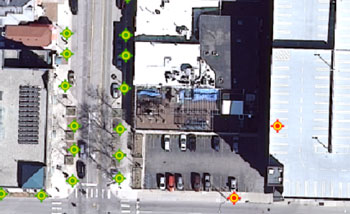
Magenta dots indicate addresses of donors to the campaign of Ward 2 independent Jane Lumm. Overridge Drive is Lumm's home street, located near Huron Hills golf course, visible to the north in this image.

In an uncontested Ward 1 race, documents filed with the Washtenaw county clerk’s office show Democratic incumbent Sabra Briere raised $3,640 from 48 donors since the primary election (which for her was also uncontested).

In the contested Ward 3 race, Democratic incumbent Stephen Kunselman raised an additional $20 from one donor, bringing his total to $4,045 for this year’s election cycle. Kunselman prevailed in a three-way primary in August. Kunselman’s Republican challenger David Parker filed a waiver request – which is allowed if a candidate expects to spend less than $1,000.

In Ward 4, Democratic incumbent Marcia Higgins raised $1,075 from seven donors, compared with no contributions raised by her Republican opponent Eric Scheie. Scheie filed a negative balance (–$1,173.73), which earned him a notice of error from the county clerk’s office – the source of funds used to pay for expenditures must be given, even if it is a loan by the candidate to the campaign.

In Ward 5, Democratic incumbent Mike Anglin, who also had a contested primary, raised an additional $185 from three donors to bring his total this year to $7,405. Anglin’s Republican challenger Stuart Berry filed a waiver request.

In Ward 2, filing documents for Stephen Rapundalo show he raised an additional $4,420 since the primary, which was a contested race for him, bringing the total indicated on his paperwork for this year’s campaign to $8,505. [The Chronicle's arithmetic calculates $4,380, not $4,420, for this filing period.]

Independent challenger Jane Lumm, who of course did not participate in a partisan primary, outpaced all other candidates’ combined totals since the primaries by raising $18,950 from 193 donors.

After the jump we break down the Ward 2 contributions with charts and maps. [Full Story]

DIA Outdoor Art Likely for Ann Arbor

Ann Arbor public art commission meeting (Oct. 26, 2011): Commissioners were briefed on two possible public art projects at their monthly meeting: a partnership with the Detroit Institute of Arts, and the potential for incorporating public art into a rain garden on property the city is buying at First & Kingsley.

Connie Pulcipher

Connie Pulcipher of the city's systems planning staff led the public art commissioners in a discussion to prep for a November working session with the city council. (Photos by the writer.)

But most of their 2.5-hour meeting was spent prepping for a Nov. 14 working session with Ann Arbor city council, focusing on the city’s Percent for Art program.

The council working session was prompted in large part by a resolution proposed by councilmember Sabra Briere, which she brought forward at the council’s Sept. 19 meeting. The resolution would revise the city’s public art ordinance explicitly to exclude sidewalk and street repair from projects that could be tapped to fund public art. It would also require that any money allocated for public art under the program be spent within three years, or be returned to its fund of origin. The council ultimately postponed action on the resolution until its Nov. 21 meeting, with a working session scheduled in the interim to focus on the Percent for Art ordinance.

The timing of the proposed ordinance change is related to two proposals on the Nov. 8 ballot: (1) renewal of a 2.0 mill tax to fund street repair; and (2) imposing a 0.125 mill tax to fund the repair of sidewalks – which is currently the responsibility of adjacent property owners.

At AAPAC’s Wednesday meeting, Connie Pulcipher of the city’s systems planning unit led commissioners in a discussion to organize their thoughts before the council work session. She asked them to identify the program’s biggest challenges, from the community’s perspective, as well as the primary causes and possible solutions to those challenges.

Commissioners cited a range of issues, including: (1) a lack of public awareness about the program, its constraints, funding sources, and AAPAC’s role; (2) the perception that not enough art is coming out of the program, and that the process is too slow; (3) the complaint that local artists aren’t given preference; and (4) the sense that in this difficult economy, city funds shouldn’t be spent on public art.

In addition to offering ways to address these challenges, commissioners also discussed their own workload. They noted that AAPAC is still relatively new and is one of the few city commissions that hasn’t enjoyed consistent staff support over the years. Although a new part-time public art administrator was hired this summer, the program had no dedicated staff person for about a year.

Wednesday’s meeting began with two presentations. Larry Baranski of the DIA talked about how Ann Arbor might participate in the museum’s Inside|Out project, which involves installing framed reproductions from the DIA’s collection at outdoor locations on building facades or in parks. Also, Patrick Judd of Conservation Design Forum and Jerry Hancock, Ann Arbor’s stormwater and floodplain programs coordinator, floated ideas for possible public art in a rain garden that’s being designed for property at the corner of Kingsley and First, located in a floodplain. Commissioners were generally receptive to both ideas, but plan to discuss them in more depth at their monthly meeting in November. [Full Story]

Column: City Council as a Historic Body

By now, most Chronicle readers are likely weary of reading about the controversy involving Heritage Row versus City Place – two proposed developments for Fifth Avenue south of William Street. For my part, I am certainly weary of writing about it. [timeline]

By way of brief recap, Heritage Row was a planned unit development for the site, which would have preserved a row of seven houses to historic district standards (in the version presented to the city council in summer 2010) and constructed three apartment buildings behind them. City Place is a “matter-of-right” project that will likely start construction in the next few weeks. [Most recent Chronicle coverage: "Chapter Added to Fifth Ave. Historic Saga"]

Why will we likely see the demolition of those seven houses instead of their preservation in some form? At the city council’s Oct. 24 meeting, Christopher Taylor (Ward 3) called it a failure by the city council to reach a compromise – on something that was less than ideal, but still reasonable.

The functioning of the city council as a body is an issue that has emerged as part of the Ward 2 city council race this year, which is being contested between independent Jane Lumm and Democratic incumbent Stephen Rapundalo. Lumm served on the council in the mid-1990s and has faced criticism from Rapundalo for being part of a group that he contends was characterized by brinksmanship and an inability to work constructively despite disagreements.

The functioning of the city council as a body is one of the themes of a email message written earlier today to members of the city council by Larry Kestenbaum. As far as I’m aware, Kestenbaum is not involved in the campaign of either Ward 2 candidate – that’s not his home ward, and he is not listed as a supporter on either of the candidates’ websites. In any case, the specific point of his email message was about the demolition of the seven houses on Fifth Avenue.

Kestenbaum is known to many in the community as the Washtenaw County clerk, an elected position. But he was not writing to the council as the clerk. He’s also an attorney who has a degree in land use and historic preservation from Cornell University. He served on Ann Arbor’s historic district commission in the 1990s. Also in that decade, he taught a course in historic preservation law at Eastern Michigan University. He lives in Ann Arbor.

Though his message to the council comes now, after the decisions on the South Fifth Avenue development seem to have finally been made, Kestenbaum did not exactly come late to the party as far as expressing his views on that area of the city. Writing on the now defunct ArborUpdate in August 2008, Kestenbaum stated: “I’d redesignate all of the former individual historic properties that were left unprotected after that bad court decision on 9/11/2001. And I think the area immediately south of William Street, along Fifth and Hamilton for example, should be a [historic] district.”

I think Kestenbaum’s recent email is unlikely to persuade any member of the council to take the action he suggests. But in my view, it’s a particularly well-written exposition of the idea that a city council is fairly judged by what it accomplishes as a body, not by the individual actions of its members. I think it’s important to preserve that exposition in The Chronicle’s archives.

It’s also important to preserve in the archives if it turns out that Kestenbaum’s message does manage to convince the council to set a process in motion to establish a historic district for the area.

And that’s why we’re sharing it with readers. Kestenbaum’s message begins after the jump. [Full Story]

Chapter Added to Fifth Ave. Historic Saga

Ann Arbor city council meeting (Oct. 24, 2011): Monday’s meeting was added to the council’s calendar specifically for the purpose of taking a second and final vote on the Heritage Row planned unit development (PUD). The project would have rehabbed or reconstructed a row of seven existing houses on Fifth Avenue, south of William Street, and built three new apartment buildings behind them.

Carsten Hohnke Mike Anglin Ann Arbor City Council

In the foreground is Carsten Hohnke (Ward 5) as his council colleague Mike Anglin (Ward 5) explained the reasons why he wanted to appoint a historic district study committee for the area south of William Street along Fourth and Fifth avenues.

Heritage Row had been considered and rejected more than once before by the council, with a history in front of Ann Arbor’s legislative body dating back well over a year. The project had been brought back for reconsideration because the demolition of the seven houses was apparently imminent – as part of the construction of City Place. City Place is a different, already-approved project on the same Fifth Avenue site by the same developer.

But by the Friday before Monday’s meeting, all four agenda items related to Heritage Row (site plan, zoning ordinance and their respective public hearings) had been deleted from the agenda. The developer had withdrawn the Heritage Row project.

With the construction of City Place a virtual certainty – along with demolition of the houses – on Monday afternoon Mike Anglin (Ward 5) placed a proposal on the agenda that would have started a procedure to establish a historic district in the area. The related moratorium on demolition in the study area would have, at least temporarily, blocked the City Place development.

But in the end, the council was in no mood to repeat the same exercise it had gone through two years ago. At that time, the council had appointed a historic district study committee, then subsequently rejected the committee’s recommendation that a historic district be established in the neighborhood. Arguing against the establishment of a historic district study committee this time around, Tony Derezinski (Ward 2) said he didn’t want the council to become a joke. Later during deliberations Margie Teall (Ward 4) ventured that already, “We’ve become a bit of a joke.”

Also on Monday afternoon, two other items – which asked the council to reconsider votes it had taken at the Oct. 17 meeting about the City Place project – were placed on the agenda by Stephen Kunselman (Ward 3). Kunselman was not interested in getting the votes reversed, but had questions he wanted answered. While other councilmembers agreed to reconsider the items, the council then dispatched them with unanimous votes after Kunselman’s questions.

That left one item on the agenda – added on Friday after the agenda’s Wednesday publication – that actually resulted in a vote that might change the course of events in the city. The resolution directed city staff to make recommendations on improvements to crosswalks throughout the city. Councilmembers expressed some interest in tweaking a new pedestrian ordinance that it approved on July 19, 2010.

Also at the meeting, the council went into closed session to discuss the city attorney’s performance evaluation. It resulted in no change to city attorney Stephen Postema’s salary, but allowed him to cash out 250 hours of accrued time before Dec. 31, 2011. [Full Story]

Head Start Advocates Make Emotional Plea

Washtenaw County board of commissioners working session (Oct. 20, 2011): The fate of Washtenaw Head Start was the focus of the county board’s most recent working session, as advocates for the preschool program filled the boardroom and lobbied for continued support. A proposal to relinquish control of Head Start, which the county has administered and helped fund for 46 years, is part of the 2012-2013 budget.

Head Start supporters

Washtenaw Head Start supporters filled the county boardroom on Oct. 20 at a working session of the board of commissioners. (Photo by the writer.)

Eighteen people spoke during public commentary, many of them staff or parents of children in Head Start – and many with their children in tow. They described how transformative the preschool program has been in their lives, and made passionate appeals for the county to keep administering it.

The county administration first made a formal proposal to the board at a July 21 working session, when county administrator Verna McDaniel and her staff laid out details of a transition. McDaniel noted that the county isn’t in the business of education, and that it made sense to consider moving the program to another grantee – especially in light of a projected $17.5 million general fund deficit that the county was facing in 2012-2013.

If approved by the board, the county would notify the federal Head Start program of its intent to relinquish its grantee status. County support would continue through 2012 – a line item of $528,000 for 2012 is in the proposed general fund budget, part of Head Start’s total $4.8 million budget. But the county would hand off the local Head Start to federal administrators at the start of 2013. Federal officials would then be responsible for selecting another agency to take over the program.

Pat Horne McGee – Washtenaw Head Start’s executive director – received a standing ovation from the audience at the start of her presentation to commissioners. She noted that October is national Head Start awareness month, and that usually she’s there to accept a board resolution of appreciation. Horne McGee then reviewed a 9-page document she had originally distributed to the board this summer, which highlighted the program’s achievements and economic impact, and which proposed alternatives that would allow the county to continue administering the program.

Several commissioners stated their support for Head Start, but noted that the county wasn’t best-suited to administer it. However, Ronnie Peterson protested bitterly over how the process was being handled, accusing others – but not naming anyone specifically – of holding backroom talks with Washtenaw Intermediate School District officials about taking over the program. [The county could have input on the choice, but would not be empowered to decide which agency is selected. The possibility of WISD being the next grantee was discussed at the July 21 working session – Peterson attended that meeting and expressed similar concerns.]

It’s likely that commissioners will continue to discuss the future of Head Start, as part of their ongoing budget deliberations. They have until the end of the year to approve the budget, but only three more regular meetings are scheduled before then.

The Oct. 20 working session also included a very brief presentation about the county’s contracts for outside professional services. This report focuses on the topic of Head Start. [Full Story]

Nonprofit Supporters Lobby for County Funds

Washtenaw County board of commissioners meeting (Oct. 19, 2011): Lining Main Street in front of the county administration building, a dozen or so protesters stood in the rain – many with their dogs – holding signs in support of the Humane Society of Huron Valley (HSHV), which faces a dramatic funding cut under the proposed 2012-2013 county budget.

Supporters of the Humane Society of Huron Valley

Supporters of the Humane Society of Huron Valley in front of the Washtenaw County administration building at Main and Catherine, prior to the Oct. 19 board of commissioners meeting. (Photos by the writer.)

Inside during their meeting, county commissioners heard from a stream of supporters for various nonprofits, all urging the board to maintain funding for services – from the care of animals to basic safety net services like housing and food. The proposed budget calls for $1.2 million in cuts to outside agencies, including many nonprofits. Funding levels would drop from about $3 million this year to $1.8 million in each of the next two years. The cuts are proposed to address a projected $17.5 million deficit over the next two years.

Much of the public commentary came from HSHV supporters, who argued that the county is already getting more services than it pays for under its contract with the nonprofit, even before cutting annual funding from $500,000 to $250,000. That contract expires at the end of 2011, and leaders from the county and HSHV will be meeting later this month to try to reach an agreement for providing services – including those mandated by the state.

The budget was the focus of much of Wednesday’s three-hour meeting, which started with the appointment of Felicia Brabec to fill the vacant District 7 seat. Commissioners expressed support for the nonprofits they fund, but several argued that cuts are necessary because of the county’s declining revenues. They also pointed to discussions at the state level of eliminating the personal property tax. A recent analysis prepared by county staff estimates that repeal of the PPT would cut county revenues by $5.559 million, and would eliminate a total of $42.961 million in revenues for all local governments in Washtenaw County. [.pdf of PPT report]

Some commissioners urged the public to contact state legislators and oppose the PPT repeal, while others asked that everyone dig into their own pockets and contribute to local nonprofits that face funding cuts. Several commissioners expressed support for putting a human services millage on the ballot as a way to raise money for these safety net services. It would not be possible to add it to the Nov. 8 ballot, but could be considered for 2012. Wes Prater also argued that not enough cuts have been made in the budget – he believes county departments can find additional ways to trim their expenses.

In the only formal action related to the proposed budget, a resolution proposed by Yousef Rabhi reallocated $26,230 in annual dues (or $52,460 over two years) paid to the Michigan Association of Counties, transferring those funds to the Delonis Center, a homeless shelter in Ann Arbor. The resolution was unanimously approved. It followed action at the Ann Arbor city council’s Oct. 17 meeting, when councilmembers appropriated $25,000 from the city’s general fund reserve to keep the Delonis Center’s warming center open this winter. At the council’s meeting, mayor John Hieftje noted that the Delonis Center is a partnership between the city and county, and he hoped the county would uphold its end.

Final decisions on the budget haven’t yet been settled. The board must pass a budget by Dec. 31, and has only three more regular meetings scheduled for the year. The budget must first be voted on by the Ways & Means Committee – a committee of the whole board – then voted on a final time at a regular board meeting.

Though much of the Oct. 19 meeting focused on 2012-2013 budget issues, the board gave final approval to several other items, including: (1) creating a study committee to explore a historic district in Salem Township; (2) renewing a two-year contract with Governmental Consultant Services Inc., a Lansing-based lobbying firm; and (3) authorizing a contract with Sylvan Township related to the township’s bond repayment schedule.

And in non-budget public commentary, Douglas Smith submitted an appeal to the board for a Freedom of Information Act request that had been denied by the county, related to an incident that he says involves a high-ranking member of the sheriff’s office. The board did not respond publicly to his request, other than to clarify with the county’s corporation counsel that appeals are handled by the county administrator. [Full Story]

Council Moves on Future of Fifth Avenue

Ann Arbor city council meeting (Oct. 17, 2011): At its meeting last Monday, the Ann Arbor city council acted on two different residential development projects for the block of Fifth Avenue just south of William Street. Both projects are owned by the same developer.

Margie Teall Jeff Helminski

Margie Teall (Ward 4) with Heritage Row and City Place developer Jeff Helminski. (Photos by the writer.)

At the time of their votes – on the matter-of-right City Place and the planned unit development Heritage Row – councilmembers knew that one set of actions would become moot. Only one of the projects, located on the same site, would be built. A few days after the meeting, news emerged that Heritage Row is now off the table and that City Place will move forward, with construction planned to start sometime this fall.

That meant that the council’s action last Monday, to give initial approval to the Heritage Row project, will ultimately have no effect. Developer Jeff Helminski requested that the item be pulled from the council’s Oct. 24 meeting – a meeting that had been added to the council’s calendar specifically to take a second and final vote on the Heritage Row project.

At their Oct. 17 meeting, the council took two actions on the already-approved City Place project – one to allow flexible application of the city’s new landscape ordinance, and a second to approve additional windows on the upper stories and to change the siding. That added to an Oct. 3 decision by the council to allow greater flexibility in the sequencing of City Place construction.

Also on Monday, the council confirmed two appointments to the city’s zoning board of appeals. The ZBA is a body that has purview to hear any challenges to city decisions about the correct application of city ordinances and the appropriateness of administrative decisions, including those associated with matter-of-right projects like City Place.

In other real estate development news out of Monday’s meeting, the council approved changes to the elevations for City Apartments, a residential project at First and Washington scheduled to start construction yet this season. The council is expected to authorize the sale of the city-owned parcel at its Nov. 10 meeting.

The council approved the annexation into the city of a township parcel where Biercamp Artisan Sausage & Jerky has set up shop. A tax abatement for Arbor Networks, a computer network security firm, was also approved by the council.

Another significant item on the council’s agenda was the appropriation of $25,000 from the city’s general fund reserve to keep the warming center open this year, which is operated by the Shelter Association of Washtenaw County in the Delonis Center on Huron Street.

The council also approved a resolution of intent on the use of sidewalk and street millage funds, which voters will be asked to approve at the polls on Nov. 8. The resolution was amended to clarify how funding will work for sidewalk repair adjacent to commercial properties inside the Ann Arbor Downtown Development Authority district. [Full Story]

Commission OKs Arbor Hills Crossing

Ann Arbor planning commission meeting (Oct. 18, 2011): In its main business of the evening, the planning commission recommended approval of the site plan for Arbor Hills Crossing, a proposed retail and office complex at Platt and Washtenaw.

Action had been postponed at the commission’s June 7, 2011 meeting so that the developer – Campus Realty – could address some outstanding issues with the plan.

Arbor Hills Crossing rendering viewed from northeast at Washtenaw Avenue and Platt Road.

A rendering of Arbor Hills Crossing at the southeast corner of Washtenaw Avenue and Platt Road – three of the buildings front Washtenaw. (Image links to higher resolution .pdf)

Commissioners were satisfied with the revisions the developer had undertaken to the plan in response to their comments made at the June 7 meeting. Commissioner Bonnie Bona characterized the site plan as essentially a disguised strip shopping center, but allowed that it was a good strip shopping center.

Arbor Hills Crossing will next go before the city council for its approval.

The commission also granted three separate requests for flexible application of the new landscape ordinance approved by the city council in June 2011. Those requests were from: (1) Gallup One Stop gas station and convenience store; (2) the University of Michigan Credit Union (formerly the Ann Arbor News building); and (3) Glacier Hills.

The commission meeting included its usual range of updates on city council and planning staff activity. [Full Story]

Heritage Row Proposal Withdrawn

According to a city council source, developer Jeff Helminski has withdrawn the revised proposal for Heritage Row, a planned unit development on South Fifth Avenue. A different project, City Place, is now expected to be built on the same site by the same developer, though some possibility exists to contest the City Place project via the city’s zoning board of appeals.

The plan for the matter-of-right City Place would demolish seven houses and construct two apartment buildings separated by a parking lot. The two City Place buildings would comprise 144 bedrooms in 24 6-bedroom units. By contrast, Heritage Row would have constructed three buildings behind the row of seven houses and either rehabilitated or reconstructed the seven houses. That project would have included up to 85 units with 180 bedrooms. [Full Story]

Ann Arbor Library Set to Publish “Old News”

Ann Arbor District Library board meeting (Oct. 18, 2011): On Friday, the public will get online access to 18,000 articles, 3,000 photos, and an index with over 160,000 names – the initial phase of a massive digitization of The Ann Arbor News archives being undertaken by the library.

Old bound copies of The Ann Arbor News

Old bound copies of The Ann Arbor News from the early 1900s. The archives are stored in a climate-controlled office complex on Green Road.

Andrew MacLaren – one of the librarians who’s been working on the project since the library took possession of the archives in January 2010– gave board members a brief preview of what AADL is unveiling at a reception on Friday. Called “Old News,” the online archives will initially feature items selected for digitization primarily by library staff, with a focus on the 1960s and ’70s, but with other eras included as well.

The hope is that future additions to the collection will be driven in large part by queries from the public. As librarians respond to research requests – people seeking newspaper articles or photos about specific events, institutions, or individuals – AADL staff will digitize their findings to be posted online for anyone to access.

The launch will also include special features from the collection that the library staff felt would draw more interest, including hundreds of articles and photos related to John Norman Collins, a serial killer whose killings in the late 1960s drew national attention. Other features include the history of West Park, and the 1968 Huron River floods.

Podcasts will be posted of interviews with former Ann Arbor News staff – including long-time crime reporter Bill Treml and photographer Jack Stubbs. AADL staff is also interviewing owners of “heritage” Ann Arbor businesses. Initial podcasts include conversations with David Vogel of Vogel’s Lock & Safe, and Charles Schlanderer Jr. and Charles Schlanderer Sr. of Schlanderer & Sons Jewelry. Additional podcasts will be added to the collection over time.

Though the cornerstone of this collection is from the 174-year-old Ann Arbor News – which its owners, New York-based Advance Publications, shut down in mid-2009 – another 97,000 articles from local 19th century newspapers will be part of the initial launch, too.

At Tuesday’s board meeting, AADL director Josie Parker praised the librarians who’ve been the primary staff working on this project – MacLaren, Amy Cantu, Debbie Gallagher, and Jackie Sasaki – and thanked board members as well for their support. It was the board’s decision in 2009 to move ahead with the project that made the resulting work possible, she said. The library does not own the originals or hold the copyright to the material, but the library did not need to pay for the archives. AADL still incurs costs related to the project, including staff time, insurance, and leasing of the Green Road offices where the archives are located. That location is not open to the public.

A reception for the launch is planned for Friday, Oct. 21 at 7 p.m. in the downtown library, 343 S. Fifth Ave. The event will feature a talk on the digitization of newspapers by Frank Boles, director of the Clarke Historical Library at Central Michigan University. [Full Story]

County Board Meets District 7 Candidates

For 90 minutes on Monday evening, two candidates for the District 7 seat on the Washtenaw County board of commissioners – Democrats Felicia Brabec and Christopher Nielsen – answered questions from current commissioners about their interests and how they would approach the job.

Chris Nielsen, Felicia Brabec

Christopher Nielsen and Felicia Brabec were interviewed by Washtenaw County commissioners, who'll be voting to appoint one of them to the open District 7 seat on the county board. The interviews took place at a public meeting in the Pittsfield Township hall. (Photos by the writer.)

The board will vote to appoint one of the candidates at its Oct. 19 meeting, filling the position vacated after Kristin Judge resigned earlier this month.

Monday’s interviews were held at the Pittsfield Township hall – the district covers the township, and both candidates live there. It was fairly informal, with questions about why they want the job, what their passions and priorities are, and how they’d work to build trust and relationships with their constituents, county staff and other commissioners. At the end of the meeting, several commissioners praised both candidates, saying either one would serve District 7 well.

The meeting was sparsely attended. The audience included Pittsfield Township supervisor Mandy Grewal and Barb Fuller, deputy supervisor. Former township treasurer Christina Lirones also attended, and posed a question during public commentary to elicit the relationships between the candidates and Judge. Lirones noted that Judge had run on the same slate as current township elected officials, and Lirones wanted representation on the county board by someone who isn’t lockstep with the current township leadership.

Brabec responded that Judge had encouraged her to consider applying, and that their husbands work together. Several commissioners said that Judge had set up meetings with them and Brabec, but they felt that Brabec was an independent thinker and said that Judge hadn’t pushed inappropriately for Brabec’s appointment.

Nielsen is a friend of former county commissioner Jeff Irwin, and worked on Irwin’s 2010 campaign for state representative. Board chair Conan Smith said having someone who’s done the job who can vouch for the candidates is important, and he noted that’s the case with both candidates.

The appointee will serve until special elections in early 2012 – a primary on Feb. 28, and a special election in May. The date for the May election will be set by the board at Wednesday’s meeting. The winner of that election will serve the remainder of the term, through 2012.

One person – Republican Richard Conn – has already filed for the 2012 special election in District 7. However, according to deputy county clerk Matt Yankee, since the election hasn’t been officially set by the county board, Conn might have to refile if the election dates are different from those he’s indicated in his filing affidavit – Feb. 28 and May 8. [Full Story]

County Weighs Funding for Nonprofits, Dues

Washtenaw County board of commissioners working session (Oct. 13, 2011): Supporters of the Humane Society of Huron Valley turned out to a special budget-focused working session on Thursday, urging county commissioners to maintain current funding levels for the nonprofit.

Supporters of the Humane Society of Huron Valley

Kate Murphy, left, and Anne Alatalo attended the county board's Oct. 13 working session to voice support for funding the Humane Society of Huron Valley. (Photos by the writer.)

HSHV, which is under contract with the county to provide state-mandated animal control services, is among several outside agencies that the county funds. The proposed two-year budget for 2012 and 2013 includes a total of $1.2 million in annual cuts to outside agencies – the county budget would drop HSHV’s annual funding from $500,000 to $250,000. HSHV’s current contract with the county ends on Dec. 31. Some commissioners expressed dismay, but indicated that in light of other pressing needs – like food and shelter for struggling families – the cuts to HSHV are appropriate.

The other outside agency item that received attention on Thursday was the county’s $125,000 membership with the Southeast Michigan Council of Governments, as well as $10,000 for water quality work provided by SEMCOG. Paul Tait, SEMCOG’s executive director, attended the meeting with two other staff members to answer questions and urge commissioners to retain their participation in the regional planning group. None of the six other counties who are part of SEMOG are withdrawing their membership, Tait said.

Several other budget cuts are proposed in this category, including a decrease in funding to the Delonis Center homeless shelter (from $160,000 to $25,000) and the Safe House domestic violence shelter (from $96,000 to $48,000). Money for the county’s coordinated funding of human services – targeting six priority areas, including housing and food – will drop by $128,538 (from $1,015,000 to $886,462).

But most of Thursday’s discussion by the board focused on the two areas that received attention during public commentary: SEMCOG and HSHV. In addition, Chuck Warpehoski, director of the Interfaith Council for Peace and Justice, spoke on behalf of 94 co-signers of a letter urging the county to continue funding human services.

The board will also hold a public hearing on the budget at its Oct. 19 meeting, and it’s likely that supporters from other groups will address the board at that time.

Setting the stage for the board’s discussion on Thursday, commissioners got a staff update on the need for basic assistance in the county. It was not encouraging news. [Full Story]

Finalists Selected for Housing Director

At a special meeting on Wednesday, Oct. 12, 2011, board members of the Ann Arbor housing commission deliberated on four finalists for the job of executive director. The position would oversee the city’s public housing and Section 8 programs, at a time of uncertain federal funding and increasing need. Board president Marta Manildi described it as perhaps the most important decision the board will make.

Andy LaBarre, Ronald Woods

From left: Ann Arbor housing commissioners Andy LaBarre and Ronald Woods at the Oct. 12 special meeting. (Photos by the writer.)

Commissioners praised all four candidates, but Jennifer L. Hall emerged as the leading choice. Four of the five housing commissioners selected her as their first choice in a straw poll at the beginning of the meeting. Hall currently serves as housing manager for the Washtenaw County/city of Ann Arbor office of community development. In advocating for Hall, board member Leigh Greden – a former city councilmember – noted that her knowledge of the local community is a strong asset.

But after about 90 minutes of discussion, commissioners decided to move ahead with three of the four finalists: Hall, Damon Duncan and Bill Ward. Both Duncan and Ward have more extensive public housing experience than Hall, primarily with the Detroit housing commission. The other finalist, Nick Coquillard, has served as deputy director of the Ann Arbor housing commission and is now interim director.

During the meeting, much of the discussion focused on the vision, leadership and management styles of the candidates, and how those styles would fit the existing staff focus on teamwork and customer service. As a backdrop to the discussion, the housing commission has seen some dramatic leadership changes over the past two years – including dissolution of the previous board in 2010, and a previous change in executive directors.

At the beginning of the meeting, Ronald Woods, the only commissioner who did not indicate a preference for Hall, asked whether it would be possible to conduct some of their discussion in closed session. He felt it would allow for a more candid exchange of opinions. But Kevin McDonald of the city attorney’s office informed the board that this was a public hiring process, and needed to be held in public view.

The executive director of the housing commission is one of only four positions in city government that is required to have a public hiring process, McDonald told the board. The other positions are city administrator, city attorney, and executive director of the Ann Arbor Downtown Development Authority.

The board will take up the hiring decision again at their regular meeting on Wednesday, Oct. 19. The meeting is open to the public and starts at 6 p.m. at Baker Commons, 106 Packard (the corner of Packard and Main) – a housing commission property. It’s possible that commissioners will make a final decision then, or continue the discussion at a later date. [Full Story]

2011 Election: Ward 2 City Council

Independent Jane Lumm is challenging Democratic incumbent Stephen Rapundalo in the Ward 2 Ann Arbor city council race, and they both participated in the recent candidate forums hosted by the local League of Women Voters (LWV).

Jane Lumm and Stephen Rapundalo Ward 2 Ann Arbor city council

Independent Jane Lumm (left) and Stephen Rapundalo (right) before the start of the League of Women Voters Oct. 5 forum. They're vying to represent Ward 2 on the Ann Arbor city council. (Photo by the writer.)

The forums on Oct. 5, 2011 were held for all four of the city’s five wards that have contested races. Replays are available via Community Television Network’s video on demand service. [Ward 2 CTN coverage]

The Ann Arbor council is an 11-member body, with two representatives from each ward, plus the mayor. All members of the council, including the mayor, serve two-year terms. In a given year, one of the two council seats for each ward is up for election. In even-numbered years, the position of mayor is also up for election.

This year, the general election falls on Nov. 8. Readers who are unsure where to vote can type their address into the My Property page of the city of Ann Arbor’s website to get that information. A map of city ward boundaries is also online.

Of the four contested races this year, the Ward 2 contest likely poses the greatest chance for a challenger to take an incumbent’s seat. Lumm previously served on the city council in the 1990s, has been active in the community, enjoys good name recognition and has achieved a broad coalition of support across party lines. She served previously on the council as a Republican. Lumm’s supporters include some who previously supported Rapundalo as recently as in the August Democratic primary.

One measure of Rapundalo’s own perception that Lumm poses a significant threat is the tenor of his campaign – as reflected in his website as well as his closing comments at the LWV debate. In those comments, he attempted to paint Lumm – and the city councils of the 1990s – as having created a mess that he’s had to clean up. Specific votes cast by Lumm are described and criticized by Rapundalo on his website without their full context. The context for some votes by Lumm – votes that are cited and criticized on Rapundalo’s website – reveal a kind of garden-variety fiscal conservatism that Rapundalo is also known for.

Topics addressed by the two candidates, presented in chronological order below (annotated to include historical context), include the proposed Fuller Road Station, the retirement board charter amendment, street repair millage, finance, human services, public art, and the Ann Arbor Downtown Development Authority. [Full Story]

2011 Election: Ward 5 City Council

Two Ward 5 candidates were among those who participated in forums hosted on Oct. 5, 2011 by the local League of Women Voters (LWV). The candidate forums for Ann Arbor city council covered all four of the city’s five wards that have contested races.

Mike Anglin Stuart Berry Ward 5 Ann Arbor city council

Democratic incumbent Mike Anglin (left ) and Republican challenger Stuart Berry (right) before the League of Women Voters forum on Oct. 5. The two men are vying for a seat on the Ann Arbor city council representing Ward 5. (Photo by the writer.)

This report focuses on the forum for Ward 5, where Republican Stuart Berry is challenging Democratic incumbent Mike Anglin. A replay of the forum is available via Community Television Network’s video on demand service. [Ward 5 CTN coverage]

The council is an 11-member body, with two representatives from each ward, plus the mayor. All members of the council, including the mayor, serve two-year terms. In a given year, one of the two council seats for each ward is up for election. In even-numbered years, the position of mayor is also up for election.

This year, the general election falls on Nov. 8. Readers who are unsure where to vote can type their address into the My Property page of the city of Ann Arbor’s website to get that information. A map of city ward boundaries is also online.

Although the election in Ward 1 is not contested – Democratic incumbent Sabra Briere is unopposed – voters in that ward will have a chance to vote on three ballot proposals along with other city residents. The first two ballot questions concern a sidewalk/street repair tax; the third question concerns the composition of the city’s retirement board of trustees.

Ballot questions were among the issues on which LWV members solicited responses from candidates. Other topics addressed by the two Ward 5 candidates, presented in chronological order below, included the proposed Fuller Road Station, high-rise buildings, human services, public art and finance. [Full Story]

2011 Election: Ward 4 City Council

On Oct. 5, 2011 the local League of Women Voters (LWV) hosted candidate forums for Ann Arbor city council candidates in all four of the city’s five wards that have contested races.

Eric Scheie Ward 4 Ann Arbor

Republican candidate for Ward 4 city council Eric Scheie, before the League of Women Voters forum on Oct. 5. On Scheie's website, he gives the pronunciation of his name, which is pronounced "Shay." During small talk among LWV members before the start of the meeting, they drew upon a character familiar from American history to help remind themselves of the pronunciation: "It's 'Shay' as in Shay's Rebellion." (Photo by the writer.)

This report focuses on the forum for candidates in Ward 4, where Republican Eric Scheie is challenging Democratic incumbent Marcia Higgins. A replay of the forum is available via Community Television Network’s video on demand service. [Ward 4 CTN coverage]

Higgins did not attend the forum, sending her regrets in a written statement, which was read aloud: “I’m confirming that I will not be in attendance tomorrow evening due to a family commitment on Oct. 5. I appreciate the league’s focus on debating the issues and time spent on bringing debate to the public. Thank you for the invitation to participate.” The LWV indicated that holding the forum without Higgins would be consistent with its “empty chair” policy.

Higgins began her city council career as a Republican, first winning election to the council in 1999. She changed parties to become a Democrat in 2005. Many observers believe it’s not possible to be elected to the council as a Republican in Ann Arbor’s current political climate.

At the LWV forum, Scheie explicitly addressed the issue of party membership, saying that he was running as a Republican precisely because of the lack of opposition politics in Ann Arbor – “Republican” has become a dirty word in Ann Arbor, he said.

The council is an 11-member body, with two representatives from each ward, plus the mayor. All members of the council, including the mayor, serve two-year terms. In a given year, one of the two council seats for each ward is up for election. In even-numbered years, the position of mayor is also up for election.

This year, the general election falls on Nov. 8. Readers who are unsure where to vote can type their address into the My Property page of the city of Ann Arbor’s website to get that information. A map of city ward boundaries is also online.

Scheie responded to LWV questions on the street/sidewalk repair millage, the proposed Fuller Road Station, high-rise buildings, human services and public art. [Full Story]

2011 Election: Ward 3 City Council

On Oct. 5, 2011 the local League of Women Voters (LWV) hosted candidate forums for Ann Arbor city council candidates in all four of the city’s five wards that have contested races.

Stephen Kunselman David Parker

Democratic incumbent Stephen Kunselman (left) and Republican challenger David Parker (right) before the start of the League of Women Voters forum on Oct. 5. The men are vying for a Ward 3 city council seat. (Photos by the writer.)

This report focuses on the forum for Ward 3, where Republican David Parker is challenging Democratic incumbent Stephen Kunselman. A replay of the forum is available via Community Television Network’s video on demand service. [Ward 3 CTN coverage]

The Ann Arbor council is an 11-member body, with two representatives from each ward, plus the mayor. All members of the council, including the mayor, serve two-year terms. In a given year, one of the two council seats for each ward is up for election. In even-numbered years, the position of mayor is also up for election.

This year, the general election falls on Nov. 8. Readers who are unsure where to vote can type their address into the My Property page of the city of Ann Arbor’s website to get that information. A map of city ward boundaries is also online.

Although the election in Ward 1 is not contested – Democratic incumbent Sabra Briere is unopposed – voters in that ward will have a chance to vote on three ballot proposals, along with other city residents. The first two ballot questions concern a sidewalk/street repair tax; the third question concerns the composition of the city’s retirement board of trustees.

Ballot questions were among the issues on which LWV members solicited responses from candidates. Kunselman indicated he would support the street and sidewalk repair millages, but only reluctantly. Parker said he would not support the sidewalk millage. They both supported the proposal to change the composition of the retirement board.

Other topics, presented in chronological order below, include the proposed Fuller Road Station, city finances, the Ann Arbor Downtown Development Authority, human services, public art, and the planned Allen Creek greenway. [Full Story]

Local Food Activist May Join Greenbelt Group

Ann Arbor greenbelt advisory commission meeting (Oct. 12, 2011): Local farmer and food activist Shannon Brines could become the next member of the city’s greenbelt oversight group, if Ann Arbor city council acts on a recommendation made on Wednesday.

Catherine Riseng, Liz Rother

From left: Greenbelt advisory commissioners Catherine Riseng and Liz Rother. (Photo by the writer.)

The greenbelt advisory commission (GAC) voted unanimously to recommend Brines for the appointment, which would fill the one open position, an at-large seat. Brines owns Brines Farm in Dexter but lives in Ann Arbor’s Fifth Ward – which GAC member Carsten Hohnke represents on city council. Hohnke, who did not attend Wednesday’s meeting, will likely be the councilmember to put forward Brines’ nomination to council.

Brines also works for the University of Michigan School of Natural Resources and Environment (SNRE), as does GAC vice chair Catherine Riseng. At Wednesday’s meeting, Riseng told commissioners that she’s been appointed to an advisory committee for the county’s natural areas preservation program, and hopes to serve as a liaison between the two groups.

In other action, the commission voted to write a letter of support for continued funding of a federal program for farmland preservation. As Congress hammers out the 2012 farm bill, funds for the program could be at risk. The city received nearly $2.8 million in federal dollars for greenbelt properties during the last fiscal year.

At Wednesday’s meeting the commission also discussed forming a committee to develop a communications plan for the greenbelt program. The intent is to get the word out about the program’s achievements in a consistent, coordinated way.

One of the program’s ongoing efforts at communication is coming up later this month. On Saturday, Oct. 22, a two-hour bus tour will highlight some of the farmland and other properties that are being preserved by the greenbelt program. The tour runs from 11 a.m.-1 p.m. and starts from the Ann Arbor farmers market. Boxed lunches are included in the $15 fee. [Full Story]

Two Candidates Apply for County Board Seat

Washtenaw County board of commissioners administrative briefing (Oct. 12, 2011): At Wednesday’s 4 p.m. agenda briefing for their Oct. 19 meeting, Washtenaw County commissioners were told that only one person had applied by that point to fill the District 7 vacancy on the county board, following the recent resignation of Kristin Judge.

Felicia Brabec

Felicia Brabec, right, talks with Greg Dill at the Oct. 5 meeting of the Washtenaw County board of commissioners. She's one of two candidates for an appointment to fill the District 7 seat on the county board. (Photo by the writer.)

The deadline to apply was 5 p.m. – an hour away. Conan Smith, who chairs the board of commissioners, said that at 5:01 p.m. they would cancel a scheduled Monday meeting to interview candidates, assuming that no one else applied.

But at about 4:15 p.m., another candidate – Christopher M. Nielsen – turned in an application too. So he’ll join Felicia Brabec, who applied earlier this week, in vying for the board seat to represent Pittsfield Township.

Candidates will be interviewed  on Monday, Oct. 17 at the Pittsfield Township Hall (6201 W. Michigan Ave.) starting at 5:30 p.m. Commissioners – seven Democrats and three Republicans – are expected to make an appointment at their board meeting on Wednesday, Oct. 19.

Peter Simms, deputy county clerk, told commissioners that the staff had received several calls from people who expressed interest in the appointment, but also some confusion about what it entailed. The person appointed to the board won’t serve a full term – they’ll be representing District 7 only until special elections are held. There will be a Feb. 28, 2012 primary for that seat, followed by a May 2012 special general election. The winner of that election would serve a truncated term for the current District 7, through 2012. Redistricting of the county board, which takes effect in 2013, will reduce the number of districts in the county from 11 to 9. Candidates for the new districts will compete in an Aug. 7 primary and November general election. [Full Story]

County Road Proposal Gets More Scrutiny

Washtenaw County board of commissioners working session (Oct. 6, 2011): After a lengthy discussion at their Oct. 5 meeting, county commissioners again tackled the issue of road repair at their working session the following evening.

Ken Schwartz

Ken Schwartz, a Washtenaw County road commissioner, talks with Curtis Hedger, the county's corporation counsel, before the start of the Oct. 6 county board of commissioners working session. (Photos by the writer.)

This time, however, the board heard directly from representatives of the road commission: Ken Schwartz, a former county commissioner who’s now one of three road commissioners; and Roy Townsend, the road commission’s director of engineering. Schwartz was instrumental in identifying a 1909 state law that would allow the county board to levy a millage for road repair without voter approval.

But in presenting the proposal for a set of possible road projects throughout the county costing about $8.7 million, Schwartz backed off from advocating for a millage. Instead, he said the road commission was simply bringing forward a list of needed projects and the amount that it would cost to pay for them. It’s up to the board of commissioners, he said, to decide what funding source to use, or whether to act on the proposal at all.

Commissioners expressed a variety of concerns during the hour-long discussion. Board chair Conan Smith worried about “tax weariness,” indicating that other countywide millages might be in the offing. Yousef Rabhi was cautious about taking action that could jeopardize a street repair millage that’s on the November ballot in Ann Arbor.

Smith also broached the issue of possibly expanding the road commission board – a controversial topic that was last discussed seriously in 2010. Currently there are three road commissioners, and Smith wondered how often the small size caused concerns over violating the state’s Open Meetings Act.

The road repair proposal and related issues will almost certainly be taken up again. The board has pushed back consideration of the plan to its Dec. 7 meeting.

Other topics of the Oct. 6 working session included an update on the county’s fiscal “score card,” and a presentation by bond attorney John Axe about factors contributing to the county’s bond ratings. This report focuses on the road repair issue. [Full Story]