Meeting Watch Section

Tension Grows in Medical Marijuana Debate

Ann Arbor city council meeting (April 2, 2012) Part 1: At a meeting that lasted until midnight, the Ann Arbor city council dealt with a full agenda, including several medical marijuana issues.

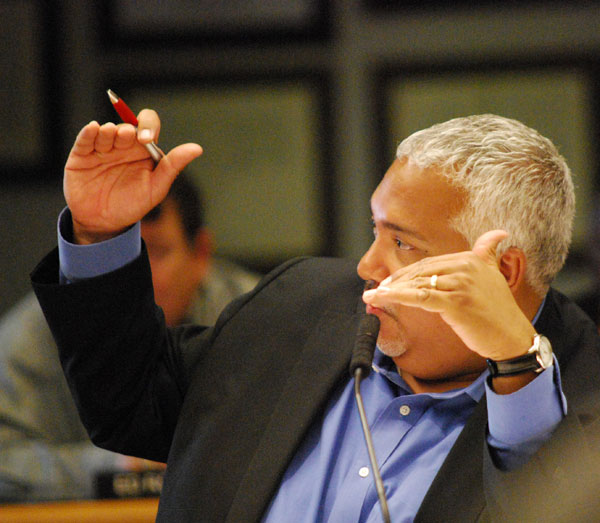
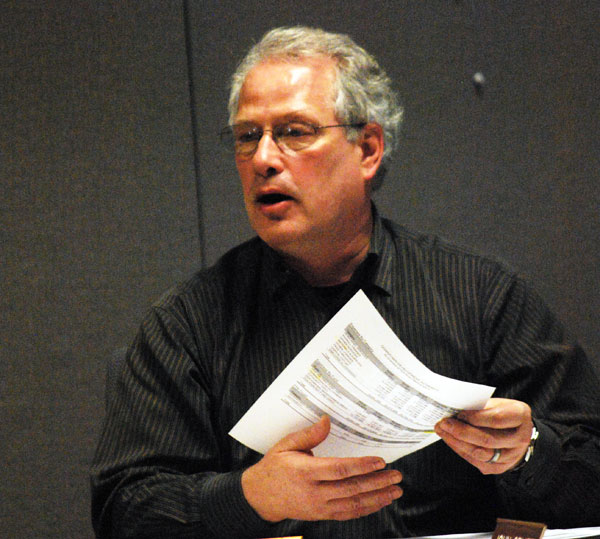
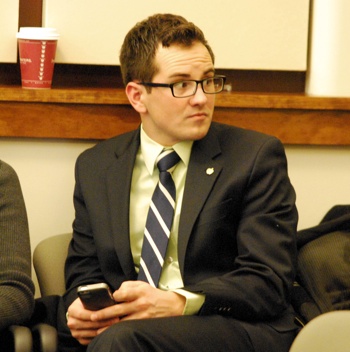
Sabra Briere (Ward 1) Tony Derezinski (Ward 2)

Ann Arbor city councilmembers Sabra Briere (Ward 1) and Tony Derezinski (Ward 2). (Photo by the writer.)

Part 1 of this meeting report focuses just on the medical marijuana-related items. In a separate article, The Chronicle has analyzed some of the key issues at stake: “Ann Arbor Marijuana Licenses: Who Decides?

In front of the council for its consideration were three separate agenda items involving medical marijuana: (1) revisions to the city’s medical marijuana licensing ordinance as recommended by the licensing board; (2) direction to the city planning commission to make a recommendation on revisions to the city’s medical marijuana zoning ordinance; and (3) direction to the city attorney to delay enforcement action against dispensaries.

The council unanimously postponed consideration of the licensing ordinance revisions until June 18 – the council’s second meeting that month. During deliberations on the licensing ordinance, several councilmembers expressed concerns about the board-recommended revisions, in particular one that would allow the city council to waive requirements of the licensing ordinance for a dispensary.  In postponing, councilmembers wanted to give the planning commission enough time to act on its direction to review the medical marijuana zoning ordinance and give a recommendation to the city council. The intent is to bring forward any changes to the licensing and zoning at the same time.

The direction to the planning commission passed on a 9-1 vote, with dissent from the Tony Derezinski (Ward 2), who is the city council’s representative to the planning commission. [Marcia Higgins (Ward 4) was absent, leaving the 11-member council with 10 members present.]

The council tabled the resolution directing the city attorney to delay enforcement activities. The tabling was achieved on a 6-4 vote. Voting against the tabling were mayor John Hieftje, Sabra Briere (Ward 1), Margie Teall (Ward 4) and Mike Anglin (Ward 5). A tabled resolution will demise if it’s not brought back for consideration in six months.

The medical marijuana licensing board made recommendations on the award of licenses to 10 dispensaries at its  Jan. 31, 2012 meeting. Given remarks made at the council’s April 2 meeting by Sandi Smith (Ward 1), Carsten Hohnke (Ward 5) and Stephen Kunselman (Ward 3), there’s some sentiment in support of having the council go ahead and vote on those recommendations – before the council considers ordinance revisions in June. But it’s not clear whether the city attorney’s office would be prepared before June to provide advice on the license awards.

This report includes coverage of public commentary and council deliberations on the medical marijuana items, presented in detail. Other agenda items from the April 2 meeting will be included in a separate forthcoming report. [Full Story]
Long-Term Planning for Ann Arbor Public Art

Ann Arbor public art commission meeting (March 28, 2012): With four of the nine commissioners absent, AAPAC approved the budget for its next major project, allocating up to $400,000 for art tied to the East Stadium bridges reconstruction.

Rose White Park

Rose White Park, adjacent to East Stadium Boulevard, is one location being considered for public art in a $400,000 budget approved by public art commissioners for the East Stadium bridges project. The blue tarp on the fence in the background serves to separate the park from the bridge construction. (Photos by the writer.)

A task force had recommended that the project be well-funded, because the location would be a highly visible landmark marking an entrance into the city – it’s near Michigan Stadium and the Crisler Center, for example. No artist has been selected yet, nor has a request for proposals been issued – that’s under review by the city attorney’s staff.

The artist would have a large role in selecting locations for the artwork. Places for art might include the underpass and staircases at South State Street; the fence along Rose White Park, which is adjacent to East Stadium Boulevard; or the bridges themselves, spanning over railroad tracks and South State Street. Any final project and budget would require the city council’s approval.

The commission postponed action on a proposal related to artwork at Argo Cascades, the new Huron River bypass near Argo Pond. Neither of the two commissioners who serve on a task force for the project – Malverne Winborne and John Kotarski – attended the AAPAC meeting, and other commissioners felt more information was needed before moving forward.

Final touches were put on an annual public art plan for FY 2013, describing projects that AAPAC intends to work on between July 1, 2012 and June 30, 2013. [.pdf of FY 2013 annual public art plan] In addition to specific art projects like those for the East Stadium bridges and a mural at Allmendinger Park, the two-page document calls for developing a master plan for public art to guide future decision-making through 2016.

During the meeting, Aaron Seagraves – the city’s public art administrator – noted that nominations are being accepted through April 13 for the Golden Paintbrush awards, which recognize local contributions to public art. A nomination form can be downloaded from the commission’s website.

The March 28 meeting was attended by three people who were not affiliated with the commission, including Jack Urban, a Kalamazoo County commissioner and chair of the Kalamazoo public arts commission. He noted that unlike Ann Arbor, the Kalamazoo public art commission does not have a funding source. So the group is looking to establish itself and seek financial support, he said. [Full Story]
UM Regents Split on State House Lawsuit

University of Michigan board of regents special meeting (April 2, 2012): At a special meeting held on Monday afternoon that lasted less than 30 minutes, the board passed a resolution directing UM administrators to file an amicus brief in support of a lawsuit filed by Michigan House Democrats against the GOP majority. The lawsuit indirectly related to recent legislation regarding graduate student research assistants (GSRAs), which had been given “immediate effect” by a voice vote of the legislature.

Julia Darlow, Mary Sue Coleman

From left: University of Michigan regent Julia Darlow talks with UM president Mary Sue Coleman after the April 2 special meeting of the board. Darlow was the only regent physically present for the meeting. All other regents participated via conference call. (Photos by the writer.)

Dissenting in the 5-3 vote were the board’s two Republican regents – Andy Richner and Andrea Fischer Newman – as well as Democrat Libby Maynard. Richner and Newman objected vigorously to the action. Richner said it was inappropriate to intervene in a “political spat,” and worried that the vote could have long-term implications that the regents may regret. Newman said the issue involved House procedural rules that Democrats and Republicans have both used in the past.

Denise Ilitch, who voted with the Democratic majority, said the view of Richner and Newman was hypocritical. She said that they had testified at legislative hearings in support of legislation that had the effect of preventing GSRAs from unionizing. Maynard said her opposition was for very different reasons than those given by Richner and Newman, and indicated that she wasn’t comfortable in general with the university filing amicus briefs.

Except for Julia Darlow, all other regents participated in the meeting via conference call.

A hearing on the lawsuit took place earlier in the day at Ingham County Circuit Court, where judge Clinton Canady III ruled in favor of the Democrats and issued a stay on legislation that had been given immediate effect, including the GSRA legislation. That law – which regents had voted to oppose at a Feb. 21 special meeting – made explicit that GSRAs are not entitled to collective bargaining rights under Michigan’s Act 336 of 1947. There are more than 2,000 GSRAs at the university.

Republicans are expected to appeal Canady’s ruling. The motion that was passed by a majority of regents on Monday directed UM administrators to file an amicus “friend of the court” brief in any appeal as well. Jeff Irwin, a Democrat from Ann Arbor’s District 53, is one of the plaintiffs in the lawsuit. [Full Story]
Park Commission Briefed on Millage Renewal

Ann Arbor park advisory commission meeting (March 20, 2012): At their monthly meeting, park advisory commissioners were briefed on two millages that help fund Ann Arbor’s park system, including one that will likely be on the November ballot for renewal.

Ducks in West Park

Creatures in West Park will not be able to participate in the November millage vote, even though they apparently can get their ducks in a row. A parks millage that's up for renewal helped pay for some of the recent renovations to the park, including the boardwalk, bandshell plaza and entry stairs. (Photos by the writer.)

The park maintenance and capital improvements millage, a six-year tax, brings in about $5 million annually and accounts for about 45% of the parks budget – including the entire funding for the natural areas preservation (NAP) program. Voters will likely be asked to renew it at 1.1 mills from 2013-2018, assuming the city council votes to put the millage on the Nov. 6 ballot at that rate. PAC chair Julie Grand – who has served on a working group to strategize about the renewal – said concerns about the economic climate are a major reason why an increase isn’t being recommended.

During the millage discussion, city councilmember Mike Anglin said he supports the millage but has concerns about Fuller Park, noting that talks regarding Fuller Road Station aren’t over. Parks manager Colin Smith pointed out that no millage funds have been or would be spent on Fuller Road Station. Grand cautioned against connecting the millage renewal to Fuller Road Station, saying it’s important to inform the public clearly about what the renewal means.

To provide that information, the city plans to hold four public forums in April, and a public hearing on the millage will be scheduled for PAC’s April 17 meeting. The city also plans to launch a website in early April with more information about the millage.

Also at the March 20 meeting, commissioners got a mid-year update about the open space and parkland preservation millage, which funds the greenbelt program and park acquisitions. Fuller Road Station was a backdrop to this discussion too, when commissioner Gwen Nystuen asked about protections that are afforded land acquired through this millage.

Land acquisition also came up in two other contexts during the meeting. The future of property owned by MichCon – located north of Broadway Street, between the Huron River and the railroad tracks – was part of the discussion during an update on environmental cleanup at the site. A DTE Energy representative indicated that senior management sees the potential for redevelopment there, but no plans are finalized. It’s expected that DTE Energy, which owns the property through its MichCon subsidiary, will eventually sell the site.

And speaking during public commentary, Ann Arbor resident Larry Baird advocated for the city to acquire land to fill gaps in the Border-to-Border Trail, which roughly follows the Huron River. Specifically, he characterized a connection between Bandemer Park and Barton Nature Area as the top priority, and urged the city to focus more on this project than on high-speed rail.

In the agenda’s one action item, commissioners recommended awarding a $79,980 contract to Michigan Recreational Construction Inc. to handle renovations at Placid Way Park. The resolution also recommends an additional 10% contingency of $7,998 for a total project cost of $87,978. The 1.32-acre neighborhood park is located on the city’s north side near the larger Dhu Varren Woods Nature Area and Foxfire South Park. The project would be funded from the park maintenance and capital improvements millage. [Full Story]

Despite Concerns, North Maple Housing OK’d

Ann Arbor planning commission meeting (March 20, 2012): After raising a series of concerns about a new residential development on North Maple Road, a majority of planning commissioners recommended it for approval on a 6-2 vote.

Public hearing sign posted for the proposed Maple Cove housing project

A public hearing sign posted at the site of the proposed Maple Cove residential development on North Maple, north of Miller Road on the city's west side. The project includes seven single-family homes and two apartment buildings. (Photos by the writer.)

The Maple Cove Apartments & Village development is proposed on nearly 3 acres at 1649 N. Maple, north of Miller Road on the west side of North Maple. It would consist of a small court with seven single-family homes, as well as two 3-story apartment buildings each with 18 one-and two-bedroom apartments. There will be two separate entrances off of North Maple – one for the houses, and another for the apartments. This was one of the issues raised by commissioners, as several of them preferred a single entrance to minimize conflicts between pedestrians and vehicles.

Pedestrian safety was also a concern for the drive into the single-family housing section of the development – there are no plans for a sidewalk on that street. Another concern raised by a neighbor during the public hearing – and echoed by some commissioners – was the potential for crime at the apartments, and whether crime data from nearby complexes should be requested to help evaluate the Maple Cove project. Tony Derezinski, a city councilmember who also serves on the planning commission, called using crime data as one of the criteria for approval a “slippery slope” and advised against it.

The possibility was floated to postpone action on the project until some of these concerns could be addressed, but no one made a formal motion to that effect. Brad Moore, a representative for the developer, pointed out that the project as proposed conforms with the city’s zoning ordinances.

Voting against the project were Bonnie Bona and Eric Mahler. The site plan will now be considered by the city council for approval.

Commissioners dispatched a second project on the agenda relatively quickly. After posing a few minor questions, they unanimously recommended approval of a new pump station at the city’s water treatment plant, on Sunset east of Newport Road. [Full Story]

AAPS Mulls Revenue Enhancement Proposals

Ann Arbor Public Schools Board of Education regular meeting (March 21, 2012): At its Wednesday evening meeting, trustees of the Ann Arbor Public Schools (AAPS) heard and discussed a variety of revenue enhancement proposals from the administration.

Christine Stead Ann Arbor Public Schools

Trustee Christine Stead directs a question to superintendent Patricia Green while trustee Glenn Nelson looks on. (Photos by the writer.)

The proposals ranged from digital billboards on district property to enrolling international students into the district. Board reaction to the proposals was mixed.

Trustee Christine Stead described the proposals as creative, but requested the opportunity to see “both sides of the ledger” – both revenue enhancements and cuts. Trustee Andy Thomas said he was “underwhelmed” by the revenue projections.

After a special briefing on a resolution to re-fund the 2004 Building and Sites Bond, the board unanimously approved the resolution. The re-fund, or “refinance,” of the bond would mean a slightly reduced millage rate for taxpayers. The re-funding will only go through if market conditions remain favorable. [Full Story]

County Acts on Disaster Relief, Health Care

Washtenaw County board of commissioners meeting (March 21, 2012): Public health, welfare and budget issues dominated the most recent county board meeting, which began with a briefing on the aftermath of a March 15 tornado touchdown in the Dexter area.

Mark Ouimet, Pat Kelly

Dexter Township supervisor Pat Kelly, right, attended the March 21, 2012 Washtenaw County board of commissioners meeting to thank the county for its help in the aftermath of the March 15 tornado that touched down in the township and caused considerable damage. To the left is Mark Ouimet, a former county commissioner who is now state representative for District 52, which includes the Dexter area.

Pat Kelly, Dexter Township supervisor, attended the meeting along with Mark Ouimet, a former county commissioner who is now state representative for District 52, which includes the Dexter area. Both thanked the county for its support and praised county staff – from sheriff’s deputies who provided security, to parks workers and others who helped with cleanup.

Later in the meeting, the board unanimously approved up to $500,000 from capital reserves to fund disaster relief and assistance to residents, including overtime costs for staff and payment for dumpsters to haul away debris. County administrator Verna McDaniel said that full amount might not be used, but it’s also possible that she’ll return to ask for more funding if it’s needed.

The board received a budget update for 2011 from finance staff, with the caution that minor changes might be made after an audit is completed. Although the originally approved budget had anticipated needing to use more than $5 million from the county’s general fund balance, only about $800,000 was actually used for the year – significantly less than expected.

Also related to the budget, the board authorized the county treasurer, Catherine McClary, to borrow up to $45 million against the amount of delinquent property taxes in all of the county’s 80 taxing jurisdictions. This is a standard request at this time of year as taxing jurisdictions – including cities, townships, schools systems and libraries, among others – turn their delinquent taxes over to the county, and are reimbursed for that delinquent amount. The county treasurer then assumes responsibility for collecting the delinquent taxes.

McClary noted that delinquent taxes are a leading economic indicator, and in that respect the trend is positive. This year, there is a drop in delinquent taxes for the first time since 2005. All jurisdictions saw a decrease, she said, and that’s really good news for the economy. McClary also gave her annual treasurer’s report for 2011, noting that revenues earned from delinquent taxes and fees totaled $5.557 million – about $3 million more than had been budgeted.

Also at the March 21 meeting, the board took a first step toward becoming a charter member of the Washtenaw Health Initiative (WHI), an effort to expand health care coverage for the county’s low-income residents. The membership includes a $10,000 annual fee in both 2012 and 2013, which would be funded through the county’s office of community and economic development. The 8-1 vote included dissent from Alicia Ping, who said she preferred funds to go directly to services, not for administrative purposes. Barbara Bergman was absent and Ronnie Peterson was out of the room when the vote was taken.

Among its other action items, the board gave final approval to creation of a county food policy council, and to an increase in certain fees charged by the public health department.

As an item for future discussion, several commissioners raised concerns over the issue of hydraulic fracturing – known as “fracking” – in rural parts of the county, to access oil or gas. Paxton Resources, a Gaylord, Mich.-based firm, has been acquiring mineral rights in the county’s rural areas for several months. A group of local residents called “No Paxton” has formed to oppose the company’s actions. The board discussed the possibility of a resolution urging more state oversight of the practice, and will likely schedule a working session on the issue. [Full Story]

Council Votes on Liquor, Delays on Marijuana

Ann Arbor city council meeting (March 19, 2012): With only eight out of 11 city councilmembers in attendance, the council found some of its business a challenge to complete.

Tony Derezinski (Ward 2), Jane Lumm (Ward 2) and Stephen Kunselman (Ward 3)

From left: Ann Arbor city councilmembers Tony Derezinski (Ward 2), Jane Lumm (Ward 2) and Stephen Kunselman (Ward 3) as they arrive to the March 19 meeting. Lumm was clearly feeling ill and was encouraged by her colleagues to head home, advice she heeded. (Photos by the writer.)

The council postponed for a second time (without deliberation) a resolution that would direct Ann Arbor’s city attorney to delay enforcement activities against medical marijuana dispensaries, except in limited circumstances. The only reason offered for postponing was to allow the absent councilmembers to participate in that vote. The same resolution had been postponed previously, at the council’s March 5 meeting. On that occasion, other deliberations had pushed the council’s meeting past midnight, and councilmembers had wanted to deal with the issue while they were fully awake.

And the council found itself unable to muster a six-vote majority for any intermediate action on a proposed change to the landscape and screening ordinance – and thus wound up simply defeating it. The changes would have restricted additional landscaping requirements just to those site plans requiring planning commission or city council approval, and would have exempted R4C (multi-family residential) districts from certain buffering requirements. Attempts to amend, postpone and table the resolution all failed on 5-3 votes, one vote short of the majority needed.

Several agenda items highlighted the Ann Arbor police department in some fashion. The council authorized the purchase of four new police vehicles, along with a street sweeper. And a new contract with the command officers union was one of two labor contracts ratified by the council at its meeting – the other was with the firefighters union. Deputy chief John Seto, who’ll be interim police chief when Barnett Jones retires at the end of the month, briefed the council on police activity on St. Patrick’s Day as well as during a severe storm the week before. Seto also was criticized during public commentary for a traffic stop he’s alleged to have made as a patrol officer in the mid-1990s.

The police department was also a key actor in the city council’s action to recommend to the Michigan Liquor Control Commission that the liquor license not be renewed for Dream Nite Club, located on Fourth Avenue in downtown Ann Arbor. At an administrative hearing earlier in the day on that issue, much of the evidence presented by the city was based on police reports or police officer testimony.

In other business, the council approved an upgrade to control room equipment for Community Television Network. The city also added a total of around 160 acres to its greenbelt program, while selling a tiny wedge of property on Summit Street that had a murky history. Also related to land and its use, the city gave final approval to a rezoning request for the Les Voyageurs Society property located near Argo Dam.

The council passed a resolution expressing opposition to pending state legislation, which has already won approval from the Michigan house of representatives, that would allow grass clippings to be dumped in landfills under certain conditions.

The topic of Fuller Road Station emerged during public commentary as well as during remarks at the council table.

And councilmember Stephen Kunselman (Ward 3) alerted his council colleagues that he’d be pressing two issues in the near future: (1) getting a written, public legal opinion from the city attorney regarding the city’s Percent for Art program; and (2) getting a calculation by the city treasurer of the tax capture to which the Ann Arbor Downtown Development Authority is entitled. [Full Story]

AADL’s Director Marks 10-Year Anniversary

Ann Arbor District Library board meeting (March 19, 2012): Monday’s relatively brief library board meeting was punctuated by a celebration of AADL director Josie Parker’s 10 years in that role.

Josie Parker

Josie Parker with a bouquet given to her by Ann Arbor District Library board members to celebrate her 10th anniversary as AADL director. (Photo by the writer.)

During her director’s report, Parker spoke at length in praise of the library’s staff and their service ethic, saying ”that ethic is what makes this library a great library” and one she is proud to lead. The board passed a resolution recognizing her decade of leadership, citing a list of accomplishments that included the opening of three new branches and the library’s role in taking on the Washtenaw Library for the Blind and Physically Disabled and the digitization of the Ann Arbor News archives. Cake was served.

Earlier in the meeting as part of the board’s committee reports, Ed Surovell noted that for the first time in more than 15 years, the library staff doesn’t have sufficient information at this point to draft a budget for the coming fiscal year. Typically in March the board’s budget and finance committee, on which Surovell serves, will review the draft budget before it goes to the full board in April. That committee review process has been delayed because of uncertainties regarding future revenues, including funds the library receives from personal property taxes and penal fines.

Parker, who chairs the Michigan Library Association’s legislative committee, later told the board that she’s been spending a lot of time in Lansing, talking with state legislators and testifying in committee hearings about the importance of funding public libraries. She told The Chronicle that the budget process is expected to be back on track in April, after Washtenaw County’s equalization report is completed. That annual report is the basis for determining taxable value of property in the county, which in turn indicates how much tax revenue is collected by local taxing entities. The library board typically adopts a budget in May, for the fiscal year beginning July 1.

As part of another committee report, Prue Rosenthal noted that a new facilities committee had met to discuss the condition of the downtown building and what kinds of issues the board should be thinking about going forward. Board president Margaret Leary later clarified that the group met informally and that the committee hasn’t been officially created – that’s expected to occur with a board vote at the April 16 meeting. [Full Story]

AATA Receives Unqualified Audit

Ann Arbor Transportation Authority board meeting (March 15, 2012): After waiting out a tornado warning in the basement of the downtown Ann Arbor District Library building, the AATA board made relatively quick work of its monthly meeting.

Auditors David Helisek and Pam Hill of Plante Moran PLLC.

Auditors David Helisek and Pam Hill of Plante Moran. (Photos by the writer.)

Still, the board transacted two pieces of business. The first was to approve the report of its auditor, Plante Moran. The overall opinion was “unqualified,” which is the highest rating that can be given. Still, the audit revealed some issues that need to be addressed, one of which was dealt with as part of the audit – the recording of revenue from the tax levy in the year it’s received. That actually increased the amount of AATA net assets by $7 million, but is an accounting change, not an actual change. The auditors found one case of a contract that should have been subjected to Davis-Bacon compliance requirements but was not.

Another issue identified by the auditor involves the AATA’s practice of investing in fuel futures as a hedge against the volatility of diesel prices – the advice was to review the practice with legal counsel. Plante Moran also flagged an issue involving the shelf-life of federal grants – but the AATA and auditors see that issue differently.

The second business item was approval of revisions to the AATA management personnel handbook – it was part of a periodic review and revision. Among myriad other changes, the amended document adds “sexual orientation” to the list of protected classes. [Full Story]

Board Applauds AAPS Achievement Gap Plan

Ann Arbor Public Schools Board of Education committee-of-the-whole meeting (March 14, 2012): AAPS trustees discussed the details of superintendent Patricia Green’s newly-minted Achievement Gap Elimination Plan, as presented to them by a set of administrators at their March 14 committee meeting.

After being walked through it, trustees applauded the plan – literally, and most of their comments characterized the AGEP with words like “integrated,” “robust,” “powerful,” and “inspiring.”

AAPS committee of the whole

From left, AAPS trustees Susan Baskett, Irene Patalan, Glenn Nelson, and Christine Stead at their March 14 committee-of-the-whole meeting, held at Mitchell Elementary School. (Photos by the writer).

Still, the board registered some concerns.  Among many elements, the AGEP emphasizes the use of data to inform instruction, and the professional development of teachers. These features of the plan led to a somewhat cool reception from trustee Simone Lightfoot, who wanted to see more emphasis on “common sense” over data, and more emphasis on children than on adults. Trustee Susan Baskett expressed some skepticism based on her experience with the follow-through she’s seen from past AAPS administrations. And, multiple trustees questioned how a wholehearted commitment to the AGEP would affect the district’s allocation of resources.

At its committee meeting, the board did not take any action related to the AGEP. More details of the plan, along with the board’s discussion, are presented below, after the jump.

Also at the committee meeting, the board heard from parents concerned about rising class sizes at the preschool, and heard a review of the student intervention and support services (SISS) department.

A discussion on revenue enhancement ideas was postponed. [Full Story]

UM Students Lobby Regents to Take Action

University of Michigan board of regents meeting (March 15, 2012): About 100 people – most of them students advocating for tuition reform or changes to the University of Michigan’s childcare subsidy – packed this month’s venue for the regents meeting: The Michigan Union’s cavernous Pendleton Room.

Genevieve Urbain

Genevieve Urbain awaits her turn to speak during public commentary at the March 15, 2012 UM board of regents meeting. She was one of three people who spoke on the topic of Willis Ward, urging regents to find a way to honor the African-American athlete who played football for UM in the 1930s. (Photos by the writer.)

With minimal discussion, regents dispatched a variety of action items during the meeting, including several related to health education, facilities and athletics. They authorized a $50 million new building for the School of Nursing, as well as $20.5 million in renovations at the Taubman Health Care Center. In athletics-related items, regents approved renaming the Crisler Arena to Crisler Center, reflecting the broader uses there, as it has expanded in recent years. The board also authorized a $2 million increase in the budget for renovations at Yost Ice Arena, bringing that project to $16 million.

Ron Zernicke, dean of the School of Kinesiology, gave the meeting’s only presentation. He described the school’s facilities and academic programs, and the pressures of its increasing student enrollments. For undergraduates, kinesiology is the fourth largest school at UM’s Ann Arbor campus, with 877 students.

As part of her opening remarks, UM president Mary Sue Coleman reported that Fred White – a retired university auditor –has been hired as project manager to implement recommendations from an internal audit. The audit relates to an incident last year involving child pornography allegedly viewed on a UM health system computer. White will also serve as a liaison for an external review ordered by the board at its February meeting.

Several reports were received during the meeting as items of information, including the regular report on internal audits, and a summary of ongoing construction activities. Tim Slottow, UM’s chief financial officer, noted that the Fuller Road Station has been removed from the construction project list. He told regents that the university and city of Ann Arbor couldn’t agree on a memorandum of understanding on the joint project, but that he thinks it’s still a good aspiration. [See Chronicle coverage: "UM, Ann Arbor Halt Fuller Road Project"]

As it did at last month’s meeting, public commentary focused on better access to a childcare subsidy available to parents who are UM students – an issue being negotiated by the Graduate Employees’ Organization (GEO) – and equity for students who are charged out-of-state tuition because they are undocumented immigrants. Students urged regents to support both issues.

The meeting ended with three speakers – including eight-year-old Genevieve Urbain – asking regents to honor Willis Ward, an athlete at UM during the 1930s who faced discrimination because of his race. Regent Martin Taylor, who said Ward had been a friend and fraternity brother, got consensus from regents to seek recommendations on how Ward might be appropriately recognized. [Full Story]

Planning Group Revisits Huron River Report

Ann Arbor master plan revisions committee meeting (March 8, 2012): At the request of planning commissioner Kirk Westphal, a committee charged with reviewing changes to the city’s master plan is looking at a recommendation related to land near the Huron River.

Ann Arbor master plan revisions committee

Members of the Ann Arbor planning commission, from left: Eleanore Adenekan, Kirk Westphal and Diane Giannola. At the right is Wendy Rampson, head of the city's planning staff. Commissioners were attending the March 8, 2012 meeting of the master plan revisions committee. (Photos by the writer.)

The Huron River and Impoundment Management Plan, known as HRIMP, was completed in 2009. But in large part because of controversy related to Argo Dam – centered on whether or not the dam should be removed – none of the 30 other recommendations were implemented.

Only one of the HRIMP recommendations relates to land use, and is therefore in the purview of the planning commission. That recommendation calls for limited commercial development – such as a restaurant or other publicly-used entity – in the Broadway bridge/Argo area.

Much of the discussion at the March 8 committee meeting centered on the property now owned by MichCon, a subsidiary of DTE Energy, located north of Broadway Street, between the Huron River and the railroad tracks that run past the Amtrak station. A state-supervised cleanup effort is underway at that site, but its future use – including the possibility that it could be acquired by the city and turned into a park – is unclear.

Remediation of the MichCon site was also a topic at the March 12, 2012 Ann Arbor city council work session, where the property’s potential future use was discussed. That presentation also included an update on a whitewater river feature that DTE Energy is paying for. The whitewater section to be built in the Huron River was originally part of the same project as the city’s Argo Dam bypass reconstruction. The bypass, which has been recently named the Argo Cascades, is nearly complete.

This article includes a summary of the council working session related to the MichCon cleanup, as well as a report on the master plan revisions committee meeting. Based on discussions at that committee meeting, it seems likely that a proposal will be forwarded to the full planning commission to add the HRIMP recommendation to the city’s master plan. Any changes to the master plan would also require city council approval. [Full Story]

AAPS Opens 170 Schools of Choice Seats

Ann Arbor Public Schools Board of Education regular meeting (March 7, 2012): Trustees of the Ann Arbor Public Schools (AAPS) school board fast-tracked the approval of another 170 schools-of-choice slots in the district, allowing students from within Washtenaw County to transfer to AAPS for the remainder of their K-12 education.

Simone Lightfoot

AAPS trustee Simone Lightfoot at the March 7 meeting. She was not alone in expressing her dissatisfaction with the transportation services being provided by Washtenaw Intermediate School District. (Photo by the writer.)

Under Michigan’s schools-of-choice legislation, local school districts can enroll these nonresident students without having to obtain approval from the district in which students reside.

So schools-of-choice students bring their state per-pupil allocation with them to AAPS. If all 170 seats are filled, the district will gain approximately $1.19 million in additional revenue.

The March 7 board meeting included discussions of the district’s transportation options, staffing process, and fund balance as trustees brace for budget recommendations to be brought to them by AAPS administration by the end of March.

Trustees expressed dissatisfaction with its transportation services, which it receives from the Washtenaw Intermediate School District as part of a consortium of other districts. [Full Story]

Planning Action: Cars, Noodles, Donuts & Gas

Ann Arbor planning commission meeting (March 6, 2012): Site plans for two food chains – a Tim Hortons at State and Ellsworth, and Noodles & Co. on West Stadium Boulevard, south of Liberty – were recommended for approval at the most recent planning commission meeting.

Former Szechwan West building

A car pulls into West Stadium Boulevard from a driveway next to the former Sze-Chuan West restaurant. The Ann Arbor planning commission recommended approval of a proposal to tear down the structure and build a Noodles & Co. restaurant there. (Photos by the writer.)

Much of the discussion about the Tim Hortons site focused on a proposed roundabout at that intersection. Though the coffee and donut shop will likely be built by late summer – about a year before the roundabout is expected to be in place – a spokesman for the company said they’ll be designing the site with the roundabout in mind.

Commissioners also recommended approval of a new AAA branch on South Main, across from Michigan Stadium. The plan calls for rezoning a portion of the site to accommodate more parking than the current office zoning would allow – a total of 35 spaces. That’s a reduction from the amount of parking currently on the site, which was approved in the mid-1970s, but it no longer conforms with existing zoning.

Commissioners Bonnie Bona, Erica Briggs and Kirk Westphal expressed concerns about rezoning an area along Main Street for parking. They also wondered whether 35 spaces were necessary, especially when there are alternative parking options – at a park-and-ride at Pioneer High, and in the nearby neighborhood. Briggs noted that it ran counter to the city’s efforts to encourage alternative transportation. Those three commissioners voted against the rezoning, but the resolution passed on a 6-3 vote. It will still require city council approval.

Also at the March 6 meeting, commissioners postponed action on a request from owners of the Shell service station at the northeast corner of Ann Arbor-Saline and West Eisenhower Parkway. Owners of the station hope to build additions onto the existing 1,000-square-foot convenience store, but planning staff recommended postponement in order to gather additional information and analysis about the plan. [Full Story]

Ann Arbor Takes Late Bus to Transit Accord

Ann Arbor city council meeting (March 5, 2012): The council’s meeting did not conclude until almost 1 a.m., prompting resident Thomas Partridge to remark during public commentary at the conclusion of the meeting, “It’s almost time to plan for breakfast!”

Sandi Smith, Sabra Briere, Tony Derezinski, Jane Lumm

Left to right: Councilmembers Sandi Smith (Ward 1), Sabra Briere (Ward 1), Tony Derezinski (Ward 2) and Jane Lumm (Ward 2). (Photos by the writer.)

The issue driving the lengthy meeting was an agreement between four different entities, including the city of Ann Arbor, that would set up a framework for a transition of the Ann Arbor Transportation Authority to a new funding and governance structure. The intent of transitioning to a new authority would be to provide increased transportation service both within the city of Ann Arbor as well as throughout Washtenaw County.

The Ann Arbor city council approved the agreement on Monday night on a 7-4 vote, after postponing it three times previously. That sets the stage for the city of Ypsilanti, Washtenaw County and the AATA to approve it as well. Even after approval by those three entities, several steps would remain before a new transit authority, incorporated under Michigan’s Act 196, could take over transportation services from the AATA.

The council considered several amendments to the agreement, but approved only two relatively minor, clarificational items. [.pdf of agreement as amended]

Toward the end of the meeting, the nomination of University of Michigan planner Sue Gott to the AATA board was given spirited discussion by two councilmembers, but was ultimately confirmed on a unanimous vote.

Falling victim to the lengthy deliberations on the transit agreement was a resolution that would direct the city attorney to delay enforcement of medical marijuana laws for local dispensaries, except for zoning violations. A vote on that resolution was postponed without deliberation, due to the late hour. That resolution comes in the context of a recommendation from the city council’s medical marijuana licensing board, currently pending with the council, to award the first 10 medical marijuana licenses under local legislation enacted last year.

Related to a different kind of licensing, the council approved a resolution that recommends non-renewal of liquor licenses for two establishments in Ann Arbor – Dream Nite Club and Rush Street. A hearing on the two licenses will be held on March 19, with the city council’s final recommendation to the Michigan Liquor Control Commission to be made that same day.

The council also passed several resolutions related to land and its use. The council approved the acquisition of another 58.85 acres under its greenbelt program, as well as the purchase of property on West Kingsley so that a long-vacant house there can finally be demolished. A rain garden is to be constructed on that parcel, because it’s situated in the Allen Creek floodway. In a related item, a new Federal Emergency Management Agency (FEMA) flood map was also given final approval by the council on Monday night.

The council gave initial approval to a revision of parking regulations in open space at the front of land parcels, but postponed any action on a proposed revision that would eliminate a requirement on landscape buffers in areas zoned R4C (multi-family residential).

Receiving approval from the council were a total of nearly $1.7 million in renovations to several of the city parks. The funding includes improvements to ballfields at Veterans Memorial Park, Southeast Area Park and West Park, as well as upgrades to roads and paths at Buhr Park and Cobblestone Farm.

The council also approved the issuance of $120 million in revenue bonds for the reconstruction of the city’s sewage treatment facilities, long planned and in the works. [Full Story]

County Acts on Budget, Health, Policy Issues

Washtenaw County board of commissioners meeting (March 7, 2012): Although the county board isn’t yet in the heart of discussions for its next two-year budget cycle, the specter of that effort provided a backdrop to action at Wednesday’s meeting. The county faces projected deficits of $11.6 million in 2014 and $14.7 million in 2015.

Jenna Bacolor, Michaelle Rehmann, Al Connor

From left: Jenna Bacolor of the county's public health department, Michaelle Rehmann, Farm to Table director for the Food System Economic Partnership (FSEP), and Al Connor of the Michigan Farmers Union. All are involved in helping create the Washtenaw Food Policy Council. (Photos by the writer.)

Two items touched directly on salary and compensation. The board gave final approval to an administrative restructuring that’s estimated to save $326,422 annually, and result in the net reduction of four full-time jobs, which are currently vacant. As he did for the initial vote on Feb. 15, commissioner Ronnie Peterson voted against the restructuring, objecting to a 4% increase that will be given to four top managers in a new cross-lateral team, as a result of their job reclassification. Though the county uniformly gives a 4% raise when any job is reclassified, Peterson argued that the county’s leadership should set an example and that the raises will make it more difficult to ask for concessions in future union negotiations in 2014-15.

Also related to upcoming budgets, commissioner Dan Smith presented a draft proposal that would cut compensation for commissioners in 2013-2014. Overall, the proposal would cut total compensation (salary and benefits) by 5.7% per commissioner – from the current $20,213 to a proposed $19,063. He plans to present a formal resolution at the April 4 meeting. The timing would allow the board to make a decision before the May 15 filing deadline for county board candidates.

Another budget-related item came from the public health department, which proposed fee increases to treat sexually transmitted diseases – one of the mandated services provided by the county. The changes, which were approved unanimously, are being made in response to federal funding cuts and an increase in charges for state services. Though he voted in favor of the increases, Peterson raised concerns about the impact on low-income residents. Dick Fleece, director of the public health department, assured the board that no one would be refused treatment because of the inability to pay.

Public health staff also presented an item with almost no budget impact: A proposal to create the Washtenaw Food Policy Council, with the goal of supporting and coordinating activities in the county’s food system. Partners who’ve been working on this initiative include the Y of Ann Arbor, Growing Hope, Food Gatherers, the Food System Economic Partnership (FSEP), Slow Food Huron Valley, Eat Local/Eat Natural, Michigan Farmers Union, and the Ypsilanti Food Coop. A final vote is expected on March 21.

The board also acted on items related to public safety. They voted to accept a $177,500 state grant from the state’s Economic Vitality Incentive program (EVIP), which provides incentives for local governments to collaborate and combine operations. The grant will help pay for work related to dispatch consolidation between the county sheriff’s office and the city of Ann Arbor.

And in a vote to clear up a procedural move, the board authorized a merger of its countywide 800 megahertz (MHz) emergency communications system with the Michigan Public Safety Communication System. The county’s 800 MHz system is paid for through a 10-year, 0.20-mill tax that Washtenaw County voters approved in May 2006. At the time, the plan called for eventually merging with the statewide system.

During the opportunity for commissioners to raise items of discussion, Wes Prater noted that at the Ann Arbor city council’s March 5 meeting, a four-party agreement to establish a framework for a possible countywide transit system was approved. Prater urged the board to begin discussing the issue, too. [In addition to Ann Arbor, the four parties include the city of Ypsilanti, Washtenaw County and the Ann Arbor Transportation Authority. Ann Arbor city council was the first entity to approve the accord, doing so after postponing action on it three times and deliberating for over 3.5 hours at Monday's meeting. See Chronicle coverage: "Ann Arbor Council OKs Transit Agreement"]

A working session for commissioners to address the four-party agreement has been set for Thursday, March 22.

Prater also wondered why the board hadn’t received any reports from the county treasurer recently. The treasurer, Catherine McClary, gave a 2010 annual treasurer’s report to commissioners early last year, at their Feb. 16, 2011 meeting, but has not yet submitted the 2011 annual report. Board chair Conan Smith asked county administrator Verna McDaniel to contact the treasurer’s office and request a report. [Full Story]

DDA OKs Budget, Taps Reserve for $2M

Ann Arbor Downtown Development Authority board meeting (March 7, 2012): The main business item for the board at its monthly meeting was the approval of its budget for the coming fiscal year 2013, which starts on July 1, 2012. Across all funds, the FY 2013 DDA budget shows anticipated revenues of $22,097,956 against $24,101,692 in expenditures – for an excess of expenditures over revenues of $2,003,736.

John Hieftje Leah Gunn Nader Nassif

Left to right: Ann Arbor mayor John Hieftje and Ann Arbor downtown development authority board members Leah Gunn and Nader Nassif. (Photos by the writer.)

The difference will be covered from the existing fund balance. The use of fund balance, in the current year and in the coming year, was planned as part of the construction of a new underground parking structure on South Fifth Avenue, and a new contract with the city of Ann Arbor, ratified in May of 2011. The contract, under which the DDA manages the city’s public parking system, pays the city of Ann Arbor 17% of gross revenues from the parking system.

At the end of FY 2013, the DDA expects to have a total fund balance of $4.38 million, or an amount equal to about 18.2% of expenses.

In its other main business item, the board authorized a budget of $100,000 for its Connecting William Street project, which it’s undertaking at the direction of the Ann Arbor city council. The council passed a resolution on April 4, 2011 that gave the DDA direction to explore alternative uses of city-owned parcels – currently used for surface parking – in a limited area of downtown. The area is bounded by Ashley, Division, Liberty and William streets.

Parcels included in the area are: the Kline’s lot (on Ashley, north of William), Palio’s lot (at Main & William), the ground floor of the Fourth & William parking structure, the old Y lot (Fifth & William), and the top of the Fifth Avenue underground parking garage, which is nearing completion.

Of the budgeted amount, $65,000 will come from a community challenge grant awarded recently as part of a larger $3 million grant awarded to Washtenaw County by the U.S. Dept. of Housing and Urban Development. The remaining $35,000 will be made up by DDA cash (no more than $20,000) and DDA in-kind contributions of staff time.

Toward the end of Wednesday’s meeting, the board also entertained some discussion about parking meter bags. The bags placed over on-street parking meters to designate the spots as unusable, so that streets are free of parked cars for construction projects or special events. The meter bag discussion came in the context of a request on behalf of FestiFools and conveyed by mayor John Hieftje, who sits on the DDA board. The request was to waive fees ordinarily associated with the meter bag placement for the April 1 FestiFools parade in downtown Ann Arbor.

One possible approach includes the creation of a parking meter puppet. [Full Story]

Ann Arbor Park Improvements In the Works

Ann Arbor park advisory commission meeting (Feb. 28, 2012): Commissioners took action on several parks projects at their most recent meeting, and were briefed on others already in the works.

Colin Smith

Colin Smith, Ann Arbor's parks and recreation manager, signs sheets from more than a dozen local high school students attesting that they had attended the Feb. 28, 2012 meeting of the city's park advisory commission, as part of a class assignment. (Photos by the writer.)

The largest of the action items was a $865,190 contract for road, parking, pathway and other exterior renovations at Buhr Park and Cobblestone Farm. The work will include resurfacing the entry road off of Packard, and improving the path system to allow better access within the park area, as well as a connection from Essex Street into the park. The city council later approved the project at its March 5 meeting.

Commissioners also recommended approval of a 15-foot landscaping buffer in Riverside Park, next to a proposed new DTE Energy substation that abuts the park. DTE is seeking a variance from the city code, which requires a land use buffer for any commercial site that’s adjacent to a park – without the variance, that buffer would need to be located on DTE property. The new substation, to be located in the utility company’s Ann Arbor service center at 984 Broadway, will provide more electrical power to the downtown area due to increased demand.

Also recommended for approval was a $35,200 contract for restroom renovations at the Ann Arbor Senior Center. The facility will be closed in May while the project is completed, and activities will be scheduled at other locations. When PAC chair Julie Grand said she was impressed to see that so many companies had bid on the project, parks manager Colin Smith noted that it might reflect changes related to CUB agreements.

To comply with new state legislation, last summer the city council rescinded a resolution that had previously required contractors for city projects to execute Construction Unity Board (CUB) agreements. The agreements are negotiated between local trade unions and contractors, and require that contractors abide by terms of collective bargaining agreements for the duration of the construction project.

At their Feb. 28 meeting, park commissioners were also updated on a project to make exterior improvements – primarily related to pedestrian pathways – at the Leslie Science & Nature Center. The center, located at 1831 Traver Road, was previously part of the city’s parks system but since 2007 has operated as an independent nonprofit. However, the city still owns and maintains the buildings and property. The first stage of the project will focus on making pathways to the center’s popular raptor enclosures more accessible.

Commissioners also learned that during the week of March 12, the city will begin to install a new pedestrian bridge at the end of the Argo Dam bypass. Because of the construction, the recently renovated bypass will be temporarily closed. A stoplog will be put in to stop the flow of water into the bypass – the project will likely take a couple of weeks. The path along the bypass is expected to be paved later in April, with the end in sight for the entire project by May.

Smith reported that Argo Cascades will be the new name for the bypass – a series of drop pools that eliminates the need to portage along that stretch.

During an update on the parks and recreation budget, Smith reported that due to extra funds available from the park operations budget, plans are in the works to: (1) restore mowing to a 14-day cycle – the cycle has in recent seasons been every 19 days; (2) increase seasonal staffing between April 15 and Oct. 15; and (3) hire three park rangers from May through September, to deal better with maintenance and enforcement issues in the parks.

Several items were also raised during the time set aside for communications. Smith noted that the six-year, 1.1 mill parks maintenance and capital improvements millage will be coming up for renewal this fall. Staff has already started working on the renewal process, gathering materials in preparation for a March 12 city council working session. The millage was last approved in 2006.

It was also noted that two key staff members are leaving their jobs soon. Molly Notarianni, the city’s market manager, is stepping down at the end of March after about four years on the job. The position has already been posted. And long-time Rec & Ed director Sara Aeschbach will be retiring this summer. Both were praised for their service.

At the end of the meeting, commissioner Gwen Nystuen reminded her PAC colleagues about an upcoming sustainability forum on Thursday, March 8 at 7 p.m. in the downtown Ann Arbor District Library building. It’s the third in a series of four, this one focusing on climate and energy, and is part of a broader sustainability project that began last year and includes developing sustainability goals for the city. [See Chronicle coverage of the first and second forums in the series.] A public forum on the forums is also scheduled for March 29 from 6-8 p.m. at the downtown Ann Arbor District Library building, 343 S. Fifth Ave. [Full Story]

Shaping Ann Arbor’s Public Art Landscape

Ann Arbor public art commission retreat (Feb. 26, 2012): At a four-hour retreat on Sunday, the nine-member public art commission began developing a master plan to guide the allocation of Ann Arbor’s Percent for Art funds and the selection of future public art projects.

Wiltrud Simbuerger, Aaron Seagraves, Bob Miller

Ann Arbor's public art administrator, Aaron Seagraves (center) talks with public art commissioners Wiltrud Simbuerger and Bob Miller at the commission's Feb. 26, 2012 retreat. The four-hour session was held at the NEW Center on North Main. (Photos by the writer.)

The Percent for Art program, overseen by AAPAC, allocates 1% for public art from all of the city government’s capital projects. The program faced potential cuts by the city council last year, though a majority of councilmembers ultimately voted against decreased funding. There’s also been criticism that the commission, which was formed in 2008, has been too slow in funding works of art. The commission itself has seen recent turnover, with three new commissioners appointed since late 2011.

It’s in this context that AAPAC decided to work on a master plan – the retreat was a step toward that goal, though it’s expected to take several more months to complete. Meanwhile, the commission is also preparing an annual plan to approve at its next meeting, on March 28, with a list of specific projects it intends to pursue in the coming fiscal year. The public art ordinance requires that the annual plan be submitted to the city council by April 1.

Sunday’s retreat covered a broad range of topics. Commissioners discussed the need to address all aspects of their mission, as spelled out in the ordinance – including education, outreach and promotion of public art. John Kotarski, one of the newest commissioners, proposed a motto to reflect that goal: “The educated resident is the best consumer of public art.”

Questions were raised about whether Percent for Art funds could be used for outreach and promotion – in the past, AAPAC has been told by city staff that funding is restricted to permanent capital projects. Kotarski advocated for including temporary projects, such as an artist-in-residence program or events like FestiFools. If the ordinance doesn’t currently allow temporary work, he suggested amending it.

When Kotarski urged the commission to seek clarity from the city attorney’s office, Tony Derezinski – a commissioner who also serves on the city council – said the city attorney’s staff is already working on legal opinions related to questions from councilmembers. He indicated that the legal staff would be willing to attend a future AAPAC meeting to answer these questions.

Also during the meeting, Aaron Seagraves, the city’s public art administrator, presented preliminary results of an online survey of residents, which yielded 437 responses. [.pdf of preliminary survey report] In response to one of the questions – “Where are the public places in the city that would benefit from a public art project?” – the top three responses were parks (27 responses), “none” (25 responses) and Main Street (23 responses.)

Other items emerged at the retreat. Theresa Reid, the newest commissioner who was appointed earlier this year, reported that she and others are working to apply for a National Endowment for the Arts “Our Town” grant, to help pay for a countywide public arts planning process. Derezinski indicated that the Detroit Institute of Art’s Inside|Out project, which involves installing framed reproductions from the DIA’s collection at outdoor locations on building facades or in parks, likely won’t come to Ann Arbor until 2013. When originally proposed in October 2011, it was expected to take place this year.

Another possible project on the horizon is tied to the resurfacing of Main Street in 2013. AAPAC chair Marsha Chamberlin said the Main Street Area Association and Downtown Development Authority are interested in some kind of “street stamping” project. It’s a project that’s in the very early stages, she said, but might include ideas like creating patterns on the street at crosswalks, for example.

Though discrete projects were mentioned, the focus of the retreat remained on big-picture goals. Common themes included the importance of public art in creating a sense of identity for the community, and of its role in supporting the local economy. [Full Story]

What’s the Future Role for Libraries?

Ann Arbor District Library board meeting (Feb. 20, 2012): A senior staff report on a conference in Australia prompted some discussion at the library board’s February meeting,

Eli Neiburger

Eli Neiburger, AADL associate director of IT and product development.

Eli Neiburger, AADL’s associate director of IT and product development, gave the closing plenary talk at an international conference earlier this month in Melbourne. It was hosted by VALA, an independent nonprofit that conducts tech education and support conferences. Neiburger is considered a leader in the field – he was named by Library Journal as one of its 2011 Movers & Shakers. His talk – “Access, schmaccess: libraries in the Age of Information Ubiquity” – looked at the role of libraries in an era when most digital content is free.

In that context, he said, the library’s role in the future involves offering unique content, experiences and events. He indicated that the AADL, with its robust programming, is well-positioned for these changes.

In its main action item of the evening, board members unanimously approved a website terms-of-use policy that had been discussed at their Jan. 18, 2012 meeting. The five-page document covers a range of topics, including guidelines for AADL and user-generated content, and how copyright complaints will be handled.

The board also approved its annual committee assignments, which are unchanged from last year. Board president Margaret Leary indicated that continuity would be important for the coming year. That was an allusion to major decisions that the board is expected to make regarding its downtown building on South Fifth Avenue. In November 2011, the board voted to provide $45,000 in funding for consultants to help resume the process of possibly redeveloping that downtown building, which is located south of the city’s new underground parking structure. [Full Story]

Ann Arbor Council: Land, Water, Buildings

Ann Arbor city council meeting (Feb. 21, 2012): Land use was one common theme that trickled through the city council’s relatively short meeting.

Amtrak Station

The Ann Arbor city council gave initial approval to new Federal Emergency Management Agency (FEMA) flood maps at its Feb. 21 meeting. The council briefly touched on the topic of the current location of the Amtrak train station, which is in the floodplain (green area). The dark red is a building (Gandy Dancer) that was previously not analyzed as within the floodplain, but now is analyzed as such – similarly for parcels colored bright red. (Image links to higher resolution file with legend.)

The council denied a rezoning request from the owners of Biercamp Artisan Sausage and Jerky, located on South State Street near the Produce Station, that would have allowed them to use the property for a retail operation larger than what currently exists. But the council did give initial approval to a rezoning request from the Society of Les Voyageurs that will allow the group to make an addition to their house, which is located near the Argo Dam.

At the other end of the spectrum from development, the council also took action that will allow the city to move quickly to demolish buildings that are derelict, posing a safety risk to the community. The council authorized the allocation of $250,000 from the general fund to pay upfront costs for the demolition of such structures. The city expects to be able to replenish the money out of a lawsuit settlement it won previously against the owner of the former Michigan Inn. The city will also eventually be able to recover its costs from property owners whose buildings require demolition.

Also related to possible future construction on land throughout the city, as well as the insurance for existing buildings, was the council’s initial approval of new federal flood maps. The most recent maps date from 1992. The new maps being considered for approval by the city were created out of a process begun by the Federal Emergency Management Agency (FEMA). Throughout the city, 452 structures are no longer analyzed as lying within a floodplain, while 88 buildings are newly analyzed as in a floodplain, according to the new maps.

Floods are one of the natural disasters that the city’s new emergency management director, Rick Norman, will be responsible for preparing the city to handle. The council formally authorized Norman’s appointment at their meeting.

In resolutions that required expenditures of funds, the council authorized additional outside accounting and legal expenses, as well as the painting and repair of equipment at the city’s water treatment plant.

In other business, the council passed a resolution in support of a clean air campaign, and authorized the closing of city streets for eight different upcoming events.

Two significant appointments were discussed at the meeting. The first was a mayoral nomination on which the council will be asked to take action at its next meeting – appointing Sue Gott, planner for the University of Michigan, to the board of the Ann Arbor Transportation Authority. The other was an appointment that has already been made by Gov. Rick Snyder – Joe Burke as judge to the 15th District Court. Burke was on hand to be introduced to the council. [Full Story]

Lack of Quorum Stymies Planning Meeting

Ann Arbor planning commission meeting (Feb. 23, 2012): The planning commission did not achieve a quorum of members on Thursday evening and therefore could not conduct its full meeting.

Ann Arbor planning commissioners

Ann Arbor planning commissioners and staff talk to high school students in city council chambers on Feb. 23. From left: Wendy Woods, Bonnie Bona, city planner Alexis DiLeo, and Kirk Westphal. (Photos by the writer.)

Five of the nine commissioners are needed for a quorum to conduct business, and only four attended. In addition to those four, about 10 people showed up for the two main action items on the agenda, and several high school students were attending as part of a class assignment.

After waiting about 30 minutes, vice chair Kirk Westphal and Wendy Rampson, head of the city’s planning staff, conferred and decided to hear public commentary. One person spoke. John Chamberlain, an attorney representing the Automobile Club of Michigan, came to the podium only to say that he and his team would return for the commission’s next meeting, on March 6.

The club wants to tear down its existing AAA branch near Michigan Stadium and build a new one, and was requesting approval for a site plan. The other main action item on Thursday’s agenda was site plan approval to build a new Noodles restaurant on West Stadium Boulevard, at the location of the former Sze-Chuan West. Both projects will be considered at the planning commission’s March 6 meeting. [Full Story]

Regents Take Action on Security Investigation

University of Michigan board of regents meeting (Feb. 16, 2012): In the wake of a mishandled incident involving child pornography allegedly viewed on a UM health system computer, regents voted last week to start an external investigation into the matter.

Student groups at UM regents meeting

Members of student groups at the Feb. 16 UM regents meeting stood in support of a speaker during public commentary who was advocating for tuition equality for students who are undocumented immigrants. (Photos by the writer.)

Martin Taylor, who introduced the resolution at the start of the meeting, described the situation as “one that is unacceptable to the regents and that we, the regents, feel we must do everything within our power to ensure that it is not repeated.” There had been a six-month lag between the time the incident was initially reported in May of 2011, and action taken by university officials to investigate. A former medical resident, Stephen Jenson, was arrested in mid-December. [.pdf of Taylor's statement]

The university administration had issued its own report on an internal audit earlier this month, with recommendations to improve security and communications. [.pdf of UM report] But regents felt more needed to be done, and have asked UM president Mary Sue Coleman to work with board chair Denise Ilitch to make recommendations for outside consultants who could be hired to carry out an additional investigation.

During public commentary at the meeting, Coleman was sharply criticized for her handling of the situation. One speaker accused her of a repeated pattern of attacking whistleblowers. The remarks prompted some regents to come to Coleman’s defense, calling the accusations unfair.

The ongoing debate about whether to allow graduate student research assistants (GSRAs) to unionize also emerged during the Feb. 16 meeting, when three students spoke about the topic during public commentary. The same issue was the focus of an unusual special meeting that regents held the following week, on Feb. 21. At that meeting – which included heated debate among regents over whether the meeting had been called in conformity with the state’s Open Meetings Act – the board voted 6-2 to oppose Michigan senate bill 197. The bill would prohibit GSRAs from collective bargaining. It was subsequently passed by the Republican-controlled state senate on a 26-12 party-line vote.

Regents acted on a range of other issues during their Feb. 16 meeting. There was no mention of the Feb. 8 special meeting that had been called to approve the use of Michigan Stadium for the National Hockey League’s Winter Classic, scheduled for Jan. 1, 2013. However, one item on the Feb. 16 agenda did relate to UM athletics: a vote to rename the basketball player development center at Crisler in honor of William Davidson, who died in 2009. His family, via the William Davidson Foundation, recently donated $7.5 million to the University of Michigan athletics department.

Another renaming was also approved – for the Computer Science and Engineering Building, in honor of Bob and Betty Beyster. Bob Beyster, who received multiple degrees from UM and founded Science Applications International Corp., recently gave a $15 million gift to the College of Engineering.

In other business, regents voted to revise the board’s bylaws, including a change that eliminated a previous requirement that executives retire after their 70th birthday. Coleman will be 70 when her current contract expires in 2014, but regent Martin Taylor said the change wasn’t being made to accommodate her – it’s to comply with the law, he said. Regents also authorized the appointment of six Thurnau professorships, and took votes that moved forward several previously approved projects, including major renovations at East Quad and the residences in the Lawyers’ Club.

Two presentations were given during the meeting – by Martin Philbert, dean of the School of Public Health, and Doug Engel, chair and professor of cell and developmental biology. Engel’s presentation highlighted recent news that the U.S. National Institutes of Health has authorized an embryonic stem cell line developed by UM researchers to be eligible for federally funded research.

The meeting concluded with public commentary on a variety of issues, including (1) better access to a childcare subsidy available to parents who are UM students; (2) equity for students who are charged out-of-state tuition because they are undocumented immigrants; and (3) criticism of the university’s relationship with China. [Full Story]

AAPS Update: Climate, Bullying, Guidance

Ann Arbor Public Schools Board of Education Committee-of-the-Whole meeting (Feb. 15, 2012): At its Feb. 15 committee-of-the-whole meeting, the AAPS school board discussed three related issues — combating bullying, assessing and improving school climate, and restructuring the school guidance and counseling program.

Riot Youth

Members of the LGBTQ student group Riot Youth addressed the Ann Arbor Public Schools board at its meeting of the committee-of-the-whole on Feb. 15. (Photo by the writer.)

Trustee Glenn Nelson noted that these interwoven topics had been a high priority for the board since a 2009 study session at which the board reviewed how AAPS was functioning in these areas compared to best practices in the field of education. “[T]his is not a topic of the evening,” Nelson said. “This was a deliberate and high-priority commitment where we really want to make progress.”

Also at the Feb. 15 committee meeting, the board members discussed an administrative recommendation to implement all-day kindergarten district-wide, which they approved at a special meeting on Feb. 18, 2012. The Chronicle previously reported on that meeting and the committee discussion.  [Full Story]

GSRA Bill: UM Regents Debate Opposition

University of Michigan board of regents special meeting (Feb. 21, 2012): The board and UM president Mary Sue Coleman met via conference call on Tuesday morning in a brief but contentious meeting that focused on Senate Bill 971. It’s a bill that would make explicit that graduate student research assistants (GSRAs) are not entitled to collective bargaining rights under Michigan’s Act 336 of 1947.

Sue Scarnecchia

Suellyn Scarnecchia, UM's general counsel, was one of the few executives in the room at a Feb. 21 special meeting of the board of regents. All regents and UM president Mary Sue Coleman participated via conference call. Scarnecchia was asked by some regents to weigh in on the legality of the meeting, in the context of compliance with Michigan's Open Meetings Act.

Ultimately, the board voted 6-2 to formally oppose the bill, which was to be considered later that morning at a senate committee hearing in Lansing. [The committee later in the day voted to recommend the bill for passage by the full senate.]

The board’s two Republican regents – Andrea Fischer Newman and Andrew Richner – dissented. It was a vote along the same party lines as action taken at the regents’ May 19, 2011 meeting, when the Democratic majority of the board passed a resolution supporting the right of GSRAs to determine whether to organize. Coleman, who chairs the regents’ meeting but is not a voting member, had spoken against the resolution prior to the May vote. At subsequent regents’ meetings, several students and faculty have spoke during public commentary in opposition to the board’s action.

Much of the Feb. 21 special meeting focused on whether the meeting itself was legal. It was convened by invoking a rarely used bylaw that allows either the president or three regents to call a special meeting for emergency action. However, the meeting was apparently not publicly noticed 18 hours in advance, as required by the Michigan Open Meetings Act.

The university’s general counsel, Sue Scarnecchia, was asked by some of the regents to weigh in on the legality of the meeting. She stated that the meeting had been called legally, based on her reading of the regental bylaw. She did not comment explicitly on how compliance with the bylaw might relate to conformance with the OMA.  [Full Story]

County Policy Issues: Salaries, Animals

Washtenaw County board of commissioners meeting (Feb. 15, 2012): Two major items – and underlying policy related to them – took up much of the Feb. 15 county board meeting.

Mark Heusel

Mark Heusel, vice president of the board for the Humane Society of Huron Valley, with his daughter at the Feb. 15 Washtenaw County board of commissioners meeting. (Photos by the writer.)

After months of uncertainty and sometimes heated negotiations, the county approved an agreement with the Humane Society of Huron Valley through 2012, along with a strategy for a longer-term solution to the county’s animal control services.

A work group, led by the sheriff, is now tasked with determining the cost of animal control services. The work group will involve other jurisdictions in the county that have animal control ordinances – like the city of Ann Arbor and Ypsilanti Township – but do not currently make financial contributions to the county’s animal control services. The group will present a report to the board by Sept. 15 that recommends a final cost methodology and budget for 2013, based on an agreed-upon scope of services.

In an amendment to the resolution that was proposed from the floor, the board also created a separate task force to develop an animal control policy for the county. The policy will be used to guide the scope of services for a request-for-proposals (RFP). Meetings of the task force will be open to the public and to any commissioner who wants to participate. The task force will submit a preliminary report to the board by May 15, with a final report due by Oct. 15.

Following a lengthy discussion later in the meeting, the board also gave initial approval to an administrative restructuring proposal that included a net reduction of four positions, an estimated annual savings of $326,422, and creation of a new “cross-lateral” team of four current senior managers. The issue of pay increases – given as a result job reclassifications – prompted debate about whether the county’s current policy treats employees equitably at the low end of the pay scale.

Commissioner Ronnie Peterson voted against the restructuring. He objected to the 4% increase that will be given to the cross-lateral team, saying the raises aren’t justified in light of concessions that union employees gave in the most recent round of contract negotiations. A final vote on the proposal is expected at the board’s March 7 meeting.

In other board action, commissioners approved allocating $200,000 to the Ann Arbor and Ypsilanti convention and visitors bureaus (CVBs) as part of funding for a Pure Michigan campaign focused on the Ann Arbor area. The funding comes out of revenues from the county’s accommodations tax. The Michigan Economic Development Corp. (MEDC) is developing a Pure Michigan pilot program, entitled “Sense of Place,” to combine support for tourism and economic development. The Ann Arbor/Washtenaw County area has been chosen as the first region to be featured as a partner in this program, which will include a $1 million national TV ad campaign.

The board approved several other items during the Feb. 15 meeting, including: (1) labor agreements with the final four of 17 bargaining units representing county employees; (2) a change in board rules allowing commissioners to abstain from voting; and (3) a Whitmore Lake improvement project. [Full Story]

AAPS Kindergarten: All Kids, All Day in ’12-13

Ann Arbor Public Schools Board of Education special meeting (Feb. 18, 2012): The AAPS school board approved an administrative recommendation to move to a district-wide all-day kindergarten program at a special meeting on Saturday afternoon.

Board of Education All Day kindergarten

Clockwise starting at left: AAPS board members Deb Mexicotte, Christine Stead, Andy Thomas, Glenn Nelson, and Susan Baskett. (Photo by the writer).

The weekend meeting was scheduled when it became apparent at the board’s Feb. 15 committee-of-the-whole meeting that all trustees were in full support of the recommendation. The board wanted to be able to begin telling families about the change sooner. The board does not typically take action at committee meetings, even if a quorum is present. That’s why a special meeting was called for the vote to take place.

All-day kindergarten for all AAPS students will replace the matrix of district kindergarten choices currently offered, which includes the following options: half-day morning; half-day afternoon; all-day; extended-day (morning kindergarten, followed by afternoon childcare with the same teacher and an aide); and “K Care” (childcare through AAPS Rec & Ed to complement half-day kindergarten). Currently, the options available at each school are different, can change each year, and can cost extra.

The board’s vote means that next year, all AAPS kindergarten students will participate in a full-day program at no additional cost to families. [Full Story]

AATA OKs AirRide; Survey Results Positive

Ann Arbor Transportation Authority board meeting (Feb. 16, 2012): The board’s monthly meeting began with a presentation from Hugh Clark of CJI Research Corp., which conducted a survey of Washtenaw County voters in late 2011 to measure their attitudes toward paying an additional 1 mill tax for countywide transit.

Transit Tax Graph

Survey results on the question of supporting a 1 mill tax for transit. (Image links to .pdf with higher resolution image.)

The results were generally consistent with those of a survey conducted two years ago by the same company. Asked toward the start of the interview if they would support a 1 mill tax for countywide transit, 54% of respondents said they definitely or probably would. Asked the same question toward the end of the interview, after receiving additional information, that figure nudged upward to 59%. That compares with “before” and “after” percentages of 51% and 58% two years ago. The geographic differences fell along predictable lines, with support strongest in Ann Arbor and weaker in the outlying townships.

Clark told the board that the four take-aways from the survey results are: (1) the AATA is highly regarded; (2) the public remains supportive of transit, even at a rate of a 1 mill tax; (3) the most compelling reason people give for supporting a tax for countywide service is to provide door-to-door service for seniors and people with disabilities; and (4) the most compelling reason people give for not supporting a tax for countywide service is a concern about taxes – not the efficiency of the AATA in its use of tax money. The board also heard caution during public commentary about the interpretation of survey results – they hadn’t yet seen the impact of negative advertising on any ballot proposal.

The survey comes in the context of an effort to establish an expanded countywide governance structure for the AATA, which might include asking voters to approve additional transit funding.

In its main business of the meeting, the board passed two resolutions that establish service between downtown Ann Arbor and Detroit Metro Airport. It’s expected to begin in April. One resolution set the fares for the service – basic one-way fare is $15 – while the other approved the contract with Indian Trails (Michigan Flyer) to provide the service based on a per-service-mile dollar cost. The service will be branded as “AirRide.” At the board table, David Nacht recalled how he’s wished for the moment when the AATA could offer such a service between Ann Arbor and the airport since the time he’d been appointed to the board – nine years ago.

The airport service is part of the AATA’s effort to expand services, as well as its governance and funding base, to a geographic area beyond the city of Ann Arbor. Of the $1 million the AATA has budgeted to spend from its reserves for the fiscal year 2012 budget, around $300,000 will go to support the airport service – though board members discussed the possibility that up to half of that could be recouped after-the-fact from federal or state grants.

In the context of the AATA’s effort to expand to countywide governance, the board passed a resolution at its Feb. 16 meeting expressing a basic policy position that a possible new regional transit authority – encompassing Washtenaw, Wayne, Oakland and Macomb counties – should not be allowed to have a negative impact on the AATA’s own provision of local transit services. The new RTA is described in a set of bills currently being considered by the Michigan state legislature. The boards’ resolution also explicitly states that any new RTA needs to have a funding strategy that is above and beyond current levels of funding for transportation.

Two days earlier, according to a report from the Michigan Information & Research Service (MIRS), Washtenaw County commissioner Conan Smith testified before the senate’s transportation committee that he’d be open to giving up one of Washtenaw County’s two seats on a 10-member RTA board, in order to get the legislation passed.

In other business at the meeting, the AATA board also approved a $95,500 increase to the budget for its consultant on the countywide expansion effort. And the board authorized its annual application to the state for operating assistance – including a budget for expanded services.

Also discussed at the board meeting, though no formal vote was taken, was the AATA’s policy on the number of bags that passengers are allowed to carry on when using the A-Ride – the AATA’s paratransit service. Previously there was a two-bag limit. The policy has been revised so that the limit is not expressed in terms of a number, but rather in a way essentially stipulating that a passenger’s bags should not impinge on other passengers’ space – it’s a shared ride service. The change in policy was prompted by public commentary delivered at AATA’s November 2011 board meeting from a visually-impaired passenger who’d been denied a ride by the AATA’s contractor for the service, because he’d had too many grocery bags. [Full Story]

AAPS Weighs State’s Impact on Budget

Ann Arbor Public Schools Board of Education regular meeting (Feb. 8, 2012): At a meeting of the AAPS board of education with a relatively light agenda, trustees discussed the anticipated state education funding incentives revealed by Gov. Rick Snyder last week.

Christine Stead

AAPS board member Christine Stead. Across the table from Stead (and Deb Mexicotte, who's seated to Stead's right out of the frame) are board members Glenn Nelson and Susan Baskett. (Photos by the writer.)

Contending that any increases would do little to rectify the compounding losses of funding since the passage of Proposal A, trustee Andy Thomas summarized the state’s budget plan as: “One hand giveth and the other hand taketh away.”

Trustees also agreed to move to a paperless system of board documents. In other business, the board agreed to change the district’s liability insurance carrier, and joined an emerging advocacy group – the Washtenaw Alliance for Education.

Also at the meeting, the board heard from two sets of students, after making a conscious effort recently to increase student engagement at the board level.

The board also engaged in an uncommon back-and-forth with members of the audience, which stemmed from public commentary about a Thurston Elementary School teacher who’s been placed on administrative leave.  [Full Story]