Stories indexed with the term ‘AATA’

AATA Moves Engagement Process into Gear

Ann Arbor Transportation Authority board meeting (June 23, 2010): The board’s regular monthly meeting in June was the last one to take place at the AATA headquarters, located on South Industrial Highway. In the future, regular meetings will take place at the Ann Arbor District Library – on Thursdays instead of Wednesdays.

ford-where-is-mike

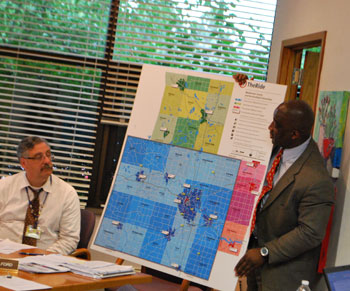
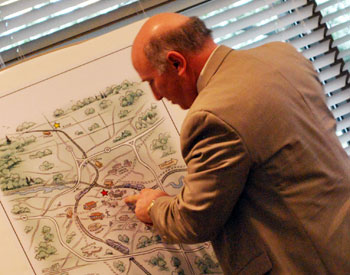
At right: Michael Ford, CEO of the AATA, shows the board a map depicting locations of meetings he's had and meetings that are scheduled in connection with development of the transportation master plan. (Photos by the writer.)

The AATA will be taking advantage of the videotaping facilities at the library. Moving the meeting location is part of an effort to make the board and the organization more accessible as the AATA begins engaging the community about developing a transportation master plan (TMP).

A presentation on the countywide TMP from the AATA’s consultant and its own staff who are working on the project was a highlight of the board meeting. Board members focused on the need to have a vision of what the community would like in 30 years, and to start taking the short-term steps to get there, instead of dismissing a 30-year vision as impossible because there is no funding available now. The completed TMP document is expected by early 2011.

One of those short-term steps – which won’t necessarily wait for the development of the completed TMP document – could be improved service between Ann Arbor and Ypsilanti. During a media roundtable held before the board meeting, Michael Ford, CEO of the AATA, indicated that Ypsilanti will be part of the focus of a board retreat, which will take place on July 19 at Weber’s Inn. [July 6 update: The retreat has been canceled, possibly to be rescheduled in early August.]

Mary Stasiak, AATA’s manager of community relations, said at the roundtable the AATA supported the millage proposal that will be put before Ypsilanti voters in the fall. [The proposal will also appear on the primary ballot, but the state attorney general has ruled that a millage proposal must be authorized at a general election.]

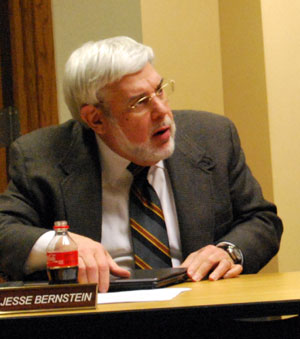
The board marked a transition to its new composition by honoring Ted Annis and Paul Ajegba, who were recently replaced on the AATA board by Roger Kerson and Anya Dale. The board also elected new officers to replace Ajegba and Annis as chair and treasurer of the board, respectively. Sue McCormick was elected treasurer. The board will be led by its new chair, Jesse Bernstein. [Full Story]

Transit Connector Study: Initial Analysis

Last summer, the final piece was put in place for a four-way partnership to fund a transportation feasibility study of the corridor from Plymouth Road down to South State Street. The Ann Arbor Transportation Authority board gave approval for its $320,000 share of the study’s $640,00 price tag.

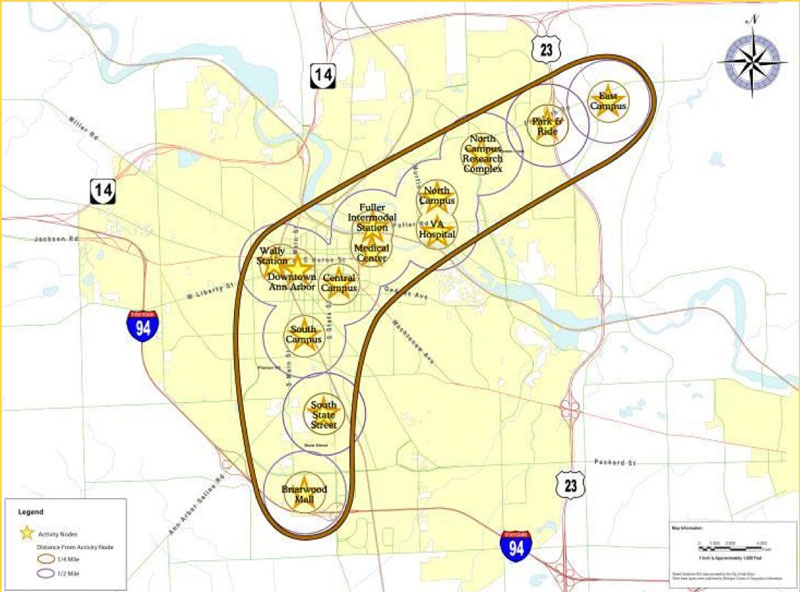
The "boomerang map" showing the Ann Arbor corridors being studied for higher quality transit options like bus rapid transit, streetcars, and monorail. (Image links to higher resolution file.)

Some early results of the “Ann Arbor Connector Feasibility Study” were presented last Tuesday evening at the Ann Arbor District Library in an open-house style format with boards and easels, complemented by a presentation from the consultant hired to perform the study, project manager Rick Nau of URS Corporation.

Nau reported that the study is currently in the needs analysis phase – traffic congestion was a phrase Nau sprinkled through his remarks during the evening. The initial needs analysis shows that the majority of the travel demand in the Plymouth-State corridors is accounted for by trips between different parts of the University of Michigan campus.

The study has not reached the point of drawing lines on maps for possible transportation routes. Instead, the representation of the area of study is a “boomerang map” stretching from US-23 near Plymouth Road to Briarwood Mall. The boomerang includes two of four “signature transit corridors” identified in the city of Ann Arbor’s Transportation Plan Update – Plymouth/Fuller roads and State Street.

Prompted by an audience question, Nau made clear that the study has not yet reached the dollars-and-cents analysis phase that will eventually come. The study is expected to be completed by December 2010 with the preliminary recommendations to be publicly presented in the fall.

Nau’s presentation focused on establishing the need for higher quality transit along the corridor and the range of technology choices available to meet that need. Those technology choices range from larger buses running along the regular roadway to elevated monorail trains. [Full Story]

DDA Gives 3-Year Grant to getDowntown

Ann Arbor Downtown Development Authority board meeting (June 2, 2010): At its regular monthly meeting, the DDA board voted to approve three years worth of funding for the getDowntown program and the go!pass bus passes, which getDowntown administers for downtown employees.

russ-reaches-for-the-stars

Before the meeting of the DDA board: Russ Collins and Keith Orr. Collins is not demonstrating to Orr how to snag a foul ball at a baseball game. (Photo by the writer.)

The program is currently in a transition year as the four-way partnership that supports it was reduced to three partners when the Ann Arbor Area Chamber of Commerce dropped out last year, citing financial pressures. That leaves the city of Ann Arbor, the Ann Arbor Transportation Authority, and the Ann Arbor DDA as getDowntown funding partners.

In other business, the board approved the application of LEED certification for its underground parking garage on South Fifth Avenue, currently under construction.

The board began a discussion on a payment-in-lieu program for required onsite parking (PILOP) for downtown developments.

The board also heard a pitch from Tamara Real for additional support for a web portal currently under development by the Arts Alliance. [Full Story]

AATA Hires Architect for Transit Center

Ann Arbor Transportation Authority board meeting (May 12, 2010): With the expiration of two board members’ terms on May 1, and no replacement finalized for either, an absence further reduced the now five-member AATA board to four at its regular monthly meeting on Wednesday.

mailbox-aata

The mailbox at the AATA headquarters on South Industrial. There's no particular connection between the mailbox and this meeting report – it's here for pure aesthetics. (Photo by the writer.)

The meeting had been rescheduled from its usual slot on the second-to-last Wednesday of the month to avoid additional absences.

The four board members who were present listened to a glowing review of the AATA from McCollom Management Consulting, which had been hired to perform an organizational audit.

The only business transacted by the board was to approve a contract for architectural and engineering services to design a replacement of the downtown Blake Transit Center. The $343,439 contract was awarded to DLZ Michigan Inc., which had three representatives on hand at the meeting to field any questions. [The Ann Arbor Downtown Development Authority may eventually provide a grant to the AATA for foundation work related to the newly constructed transit center.]

Before the meeting, the trio from DLZ clustered in conversation in the board room and noticed the missing members in the set of official framed board member photos hanging on the board room wall – “Where’s Paul?” one asked. [Full Story]

Pleas for Human, Safety Services at Council

Ann Arbor City Council meeting (May 3, 2010): Several speakers addressed the city council at its Monday meeting asking for continued funding for human services and to avoid layoffs in the city’s police and fire departments.

Fire fighters informational picket

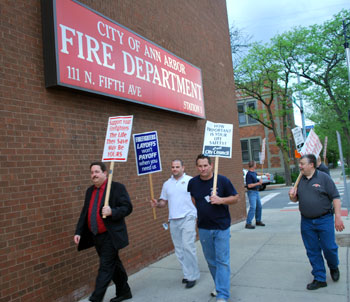
Firefighters held an informational demonstration Monday afternoon before the city council's meeting at Station 1, which is located across the street from city hall. Firefighters from Flint, Dearborn, Dearborn Heights, Ann Arbor Township, Ypsilanti, Battle Creek and Ann Arbor took part in the demonstration. (Photos by the writer.)

And Margie Teall (Ward 4), who faces two challengers in the August Democratic primary, announced a planned amendment to the city’s proposed budget that would maintain human services funding at FY 2010 levels. The amendment, which will be brought forward at the council’s May 17 meeting, would also avert as many layoffs in the police and fire departments as possible, she said.

The previous evening at the council’s Sunday night caucus, Mike Anglin (Ward 5) and Sabra Briere (Ward 1) had already indicated they would support using part of a possible $2 million payment from the Downtown Development Authority to avoid police and firefighter layoffs.

The council’s plan for funding the amendment, reported Teall, is to use a $2 million payment from the Downtown Development Authority that it hopes the DDA board will approve at its May 5 board meeting. Even if the DDA board approves the payment, which is very likely but not certain, not all safety services layoffs in the city administrator’s proposed budget could be covered. Averting the elimination of 35 positions across police and fire departments combined would require $3.6 million. The restoration of human services funding would require another $260,000. And that would still result in the city tapping its general fund reserves for $1.5 million.

In its business for the evening, the council passed a resolution added late Monday to the council agenda, which strikes an agreement between the city and the Michigan Dept. of Natural Resources and Environment for the future of the embankment along Argo Dam. It will allow the headrace to be re-opened by the end of this week.

The council also approved on first reading a revision to the city’s sidewalk occupancy permit system to include sandwich board signs. And the residential development now called Heritage Row – proposed along Fifth Avenue south of William Street – was approved at the council’s first reading with no discussion, but with dissent from Mike Anglin. Both of those measures will need to come back before the council for a second reading to gain approval.

The council also approved received the mayor’s nomination of the appointment of Anya Dale to the AATA board, replacing Paul Ajegba, whose term expired on May 1. Ajegba had been elected by his colleagues last fall to chair the board. Dale is a Washtenaw County planner. Her appointment will be presented for confirmation at the council’s May 17, 2010 meeting.

The council also approved some additional road closures for the June 6 Dexter-Ann Arbor Run. [Full Story]

AATA Gets Its Fill of Fuller Road Station

Ann Arbor Transportation Authority board meeting (April 21, 2010): On Wednesday, Eli Cooper, the city of Ann Arbor’s transportation program manager, gave the AATA board an update on Phase One of Fuller Road Station – a city-university collaboration to build a combined parking structure, bus station and bicycle amenity south of Fuller Road, abutting the University of Michigan medical campus. The project envisions eventual integration of a train station for east-west commuter rail, if service along the Detroit-Ann Arbor corridor can be established.

Eli Cooper Ann Arbor Transportation Manager

Eli Cooper, the city of Ann Arbor's transportation program manager, sets up his visual aids for the Fuller Road Station. (Photos by the writer.)

Confronted with skepticism from board member David Nacht, who expressed his doubts that the rail service would ever become a reality, Cooper urged a “glass as half full” view of the project. Cooper was buoyed in part by a recent phone call he’d received from the Michigan Dept. of Transportation about another round of funding that the Federal Railroad Administration will be making available.

AATA board member Sue McCormick also gave some shape to the city’s funding strategy for its share of the Fuller Road Station project: Once the environmental impact study is completed, that will make it possible for the local transit agency – in this case, the AATA – to apply for federal funds for the project. That’s consistent with the message thus far from city officials, who have said that whatever the funding strategy will be, it won’t involve city general fund money.

In its main business items of the meeting, the board approved a contract worth $399,805.32 with a consultant, Steer Davies Gleave, to head up the formulation of a transportation master plan (TMP), which will underpin the AATA’s effort to expand its service countywide. The board also approved an allocation of $350,000 for a period ending March 31, 2012, that will allow the AATA to task one of three public relations firms for work, depending on the nature of the project: The Rossman Group, Ilium Associates, and re:group.

Both resolutions passed, with dissent from the board’s treasurer, Ted Annis.

The board made a decision at its March board meeting to change its meeting time and location to Thursdays at the downtown Ann Arbor District Library. Although it was discussed then that the new time and location would begin in two months, board discussion on Wednesday suggested that the target for changing the new time is now August 2010. [Full Story]

AATA on Chelsea Bus: Cut Fares, Add Wifi

Ann Arbor Transportation Authority board meeting (March 24, 2010): The transportation news out of this month’s AATA board meeting was that the twice-daily Chelsea-Ann Arbor express bus service will continue, despite low ridership. It will be moved in-house using AATA buses. The $125 monthly fare will be reduced to $99. Up to now, the pilot program has been operated by Indian Trails.

 Ted Annis public commentary AATA board

Ted Annis distributes copies of his treasurer's report during public commentary at the start of Wednesday's AATA board meeting. (Photos by the writer.)

A representative from Indian Trails addressed the board during public commentary at the start of the meeting, in part to convey disappointment, but primarily to thank board members for the opportunity to work on that private-public partnership.

Public commentary also included remarks from Ted Annis, the board’s treasurer, who signed up for a public comment slot, and used it to deliver his treasurer’s report. The report had not been given a slot on the agenda by the board’s governance committee – after reviewing it, the committee decided it did not fit the parameters of the treasurer’s report specified in the board’s bylaws.

The wrangling over the treasurer’s report thus continued from last month’s board meeting, when fellow board members expressed the view that Annis’ monthly reports, which he has submitted since taking over the treasurership last fall, do not include the material specified in their bylaws. Instead, they said, the reports are effectively the expression of an individual board member’s dissent on board policy.

The board voted to establish a bylaws committee to be chaired by David Nacht to examine the matter in more detail.

Board members also voted to change their meeting venue and day, starting in two months. In May, the board will begin meeting at the downtown Ann Arbor District Library on the third Thursday evening of the month at 6:30 p.m. The library board room location, also used by the Ann Arbor Public Schools and AADL for their board meetings, offers more space for attendees, as well as video recording facilities. [Full Story]

AATA Board Treasurer: Where’s My Report?

Ann Arbor Transportation Authority board meeting (Feb. 17, 2010): Although little business was transacted by the board during Wednesday’s meeting, members engaged in what David Nacht called a “healthy conversation” on the subject of the treasurer’s report. At issue was whether the agenda should contain a slot for the report.

Ted Annis Jesse Bernstein

At left: Ted Annis, AATA board treasurer, and board member Jesse Bernstein, right. (Photos by the writer.)

The discussion began with a gentle ribbing of the board’s treasurer, Ted Annis, who was asked: “Have your feelings been hurt?” It ended, however, with a serious philosophical discussion about the difference between a body consisting of appointed board members compared to one composed of elected officials.

Over the next few months, the board will begin a conversation in earnest to change its meeting location to the Ann Arbor District Library and its time to Thursday evenings.

A development not explicitly discussed at the board meeting, but nonetheless connected to it, is the fact that the AATA will begin providing board packets in their native digital text – until now, the documents have been available in electronic form, but only as image scans. [Full Story]

Fleshing Out Fuller Road Station

At left: Architect John Mouat, a member of the Fuller Road Station design team, talks with Eli Cooper, the city's transportation manager, before the start of the Feb. 10 citizen participation forum. Moaut is a partner in the Ann Arbor firm of Mitchell and Mouat. (Photos by the writer.)

At left: Architect John Mouat, a member of the Fuller Road Station design team, talks with Eli Cooper, the city's transportation program manager, before the start of the Feb. 10 citizen participation forum. Mouat is a partner in the Ann Arbor firm of Mitchell and Mouat. (Photos by the writer.)

For Eli Cooper, the city of Ann Arbor’s transportation program manager, a project like the proposed Fuller Road Station happens “once in a lifetime” – an opportunity for the city, he says, to take a vision and make it reality in a fairly short time.

What it will take to reach that reality was the topic of a Feb. 10 public meeting on the Fuller Road Station, a joint University of Michigan/city of Ann Arbor project. Its first phase entails a parking structure with about 1,000 spaces – nearly 80% of them earmarked for UM use.

But much of the presentation by city staff and members of the design team focused on the broader goals for that site, which they hope will eventually include a train station for commuter rail. [Full Story]

Council Talks Transportation, Budget

Ann Arbor City Council meeting (Feb. 1, 2010) Part I: Transportation was a major theme woven throughout Monday’s city council meeting – in part due to a presentation the council heard from SEMCOG’s Carmine Polombo about the Detroit-Ann Arbor commuter rail project. Trains are supposed to begin rolling toward the end of 2010, but Polombo’s presentation made clear that early service would be very limited – day trips and special events – and there are a huge number of unknowns.

Ann Arbor municipal airport

Sol Castell was asked to the podium by Stephen Kunselman (Ward 3) to give an alternate view on the need for a runway extension at the Ann Arbor municipal airport. The topic came up during discussion of the city's capital improvements plan, which wound up being postponed. (Photos by the writer.)

But trains weren’t the only transit-related thread. The city’s bicycle ordinances were updated after having been postponed for a couple of meetings, and a revision to the city’s bicycle registration procedure was tabled and now appears to be on indefinite hold.

The council also approved on first reading a revision to its taxicab ordinance, designed to enforce expectations of larger cab companies.

Also related to transportation was discussion of an item in the capital improvements plan (CIP) for a runway extension at the Ann Arbor municipal airport. After Stephen Kunselman (Ward 3) got his colleagues’ support to amend the CIP to delete the item, the council then voted, with some grumbles of dissent, to postpone consideration of the CIP.

Times and dates for upcoming meetings on the budget were also reviewed, with city administrator Roger Fraser telling councilmembers that the list of possible areas for cuts that city staff had generated were not the only items that could be considered. He challenged councilmembers to come up with their own ideas as well. The council received specific recommendations for budget strategies for the senior center and Mack Pool.

In Part I of the report, we restrict our focus to transportation and budget issues. In Part II, we’ll cover land use issues – including the resolution on 415 W. Washington, which we previewed in our report on the Sunday night caucus, plus a postponement on a greenbelt acquisition. [Full Story]

DDA Floats Idea for Fourth Avenue

Typically on the last Wednesday morning of the month, two committees of the Ann Arbor Downtown Development Authority meet back to back – transportation and operations. This past Wednesday was no different.

Fourth Avenue Ann Arbor

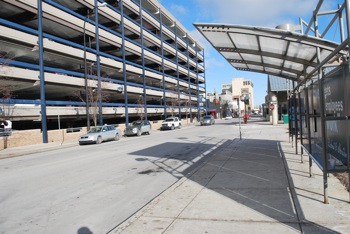
At Fourth & William streets in downtown Ann Arbor. The view is looking to the north. At right is an AATA bus shelter – further in the background on the same side of the street is the Blake Transit Center. Opposite the AATA facilities is a parking deck. (Photos by the writer.)

At the transportation committee meeting, Susan Pollay, the DDA’s executive director, floated an idea for partnering with the Ann Arbor Transportation Authority on improvements to the South Fourth Avenue corridor, between William and Liberty streets. The partnership would include a grant to the AATA in connection with the reconstruction of the Blake Transit Center. No numbers are yet attached to the concept, which Pollay described as a possible “transit mall” – she was checking with the committee for their basic reaction to the idea. That reaction could fairly be described as warm, with some caution expressed by DDA board member Leah Gunn, when she arrived for the operations committee meeting.

Starting last month, the last half hour of the  transportation committee’s meeting has been configured to overlap with the operations committee’s meeting, so that the two groups can meet jointly to discuss a directive from the city council to the DDA to deliver a parking plan to the council by April. A preliminary outline of that plan was discussed on Wednesday. [Full Story]

AATA on County Transit: READY, Aim, Fire

Ann Arbor Transportation Authority board meeting (Jan. 20, 2010): Board member Jesse Bernstein outlined a process Wednesday night for moving towards an expanded countywide transit service, which he characterized as “ready, aim, fire” – with a heavy emphasis on “ready.” A resolution passed by the board on Wednesday establishes a timeframe that would not begin the implementation phase of a plan until the beginning of 2011.

Jesse Bernstein

Jesse Bernstein, who chairs the AATA board's performance monitoring and external relations committee, outlined a plan for expanding service that sees the next six months devoted to making the organization more transparent and gathering information from the community. (Photos by the writer.)

The emphasis on community engagement and listening to the needs and wants of the people who might use an expanded service – before trying to design the specifics of the service – would not be something confined to this particular initiative. Said Bernstein: “This is not a one-shot campaign; this is how we’re going to behave going forward.”

The board adopted a resolution to advance their plan for the future of public transportation in the county.

The board also heard a presentation on the results of a survey of voter attitudes towards a possible transit millage in Washtenaw County. The survey measured support of a millage at 51% – with 17% and 34% of voters saying they’d definitely or probably vote yes, respectively.

In other business, the board adopted its capital and categorical grant program, approved a contract to replace some doors and windows at AATA headquarters, authorized an application to the Michigan Department of Transportation and approved a 21-month purchase-of-service agreement with the city of Ypsilanti. [Full Story]

AATA Board: Get Bids to Rebuild Blake

Ann Arbor Transportation Authority board meeting (Dec. 16, 2009): At its regular meeting Wednesday night, the AATA board gave authorization to staff to solicit bids for the demolition, design and construction of a replacement for the Blake Transit Center, located in downtown Ann Arbor on Fourth Avenue.

AATA temporary board room

At its headquarters on South Industrial Avenue, the AATA board tried out a makeshift venue for its Wednesday board meeting, because it offered an additional 12 seats for audience members, compared to the actual boardroom. Conceptual plans for the new Blake Transit transit center downtown include a boardroom. (Photos by the writer.)

The conceptual design calls for the new center to be constructed on the same footprint as the old center, with flexibility to expand, if abutting property were to become available.

The hope for flexibility on the Blake Transit Center design had also surfaced earlier in the day, at the Downtown Development Authority‘s transportation committee meeting. There, the concept of Fourth Avenue as a transit corridor had been floated by DDA executive director Susan Pollay.

In other business, the board kept the discussion going on the question of how to proceed in expanding its service to include more of Washtenaw County. But they did not consider any resolutions related to formation of a new, expanded public transit authority. As part of the effort to expand, a general board consensus emerged that the public needed to be educated about what public transit is, and how the AATA worked.

Related to the need to educate the public about what the AATA does was the treasurer’s report, submitted by Ted Annis, which recommended greater financial transparency through posting various financial data on the AATA website. The specific suggestion to post employee salaries was not embraced by all on the board, but the suggestions were remanded to the performance monitoring and external relations committee (PMER).

And a response by staff to the November treasurer’s report highlighted a potential point of contention in estimating revenues available for funding an expanded service. Specifically, how much revenue could be expected from fares in an expanded service? [Full Story]

AATA Gets Advice on Countywide Transit

Ann Arbor Transportation Authority special board meeting (Dec. 8, 2009): Late Tuesday afternoon at a special meeting, the AATA board heard from two consulting attorneys, as well as heads of three other Michigan transit authorities, on the subject of expanding the geographic scope of AATA service.

Jeff Ammons donut and layer cake

Jeff Ammons, a Grand Rapids area attorney who's been consulting for the Ann Arbor Transportation Authority, explains legal options for establishing an entity that could expand the geographic reach of AATA service. Millage options use the metaphor of "donut" (upper left) and "layer cake" (middle right). (Photo by the writer.)

The meeting of the full board, with their five guests, came on the heels of a planning and development committee meeting. At that committee meeting Chris White, AATA’s manager of service development, gave highlights from a recently completed survey of Washtenaw County voters on their attitudes towards a possible countywide transportation tax.

Those who said they would “definitely” or “probably” vote yes on a 1 mill countywide millage eked out a 51% majority countywide.

However, Bob Foy, general manager of Flint’s Mass Transit Authority, repeatedly reminded the full board at their meeting: To get a millage passed, you need a product you can sell. In Flint, which is a countywide authority, Foy reported that the last millage was approved with 68% of the vote.

What the expanded transportation product might look like for Washtenaw County is not yet clear. At the planning and development meeting, AATA CEO Michael Ford indicated that AATA would be bringing in a consultant to address that issue.

The message sent at the board meeting by the two consulting attorneys – Jerry Lax and Jeff Ammons – was that there’s a difference between (i) deciding on the legal authority to be formed, and (ii) deciding on the desired service that AATA wanted to offer. When the board knew what countywide service it wanted to provide and how it wanted to fund that service, they said, at that point it would make sense to decide on the legal mechanism for establishing an expanded authority.

That authority could be established legally under either of the state’s enabling acts: Act 55 or Act 196. [Full Story]

AATA Adopts Vision: Countywide Service

Ann Arbor Transportation Authority board meeting (Nov. 18, 2009): At its Wednesday meeting, the AATA board took the first of the steps that CEO Michael Ford had recommended at their meeting on Oct. 29: adopt a vision statement and start developing a plan for a countywide system. The board will continue to address Ford’s recommendations by holding  a special meeting on Dec. 8, at 5:30 p.m. at AATA headquarters to discuss formation of an Act 196 authority.

two men standing, one seated, papers getting passed out

Michael Ford, left, had extra copies made of the treasurer's report and distributed them to audience members. (Photo by the writer.)

The board’s resolutions were complemented by a treasurer’s report from Ted Annis that laid out a possible budget within which the countywide system could be designed. Presentation of that report revealed some conceptual differences among board members in their preferred approach to engaging an outside consultant to do the countywide system design: (i) Here’s a budget, now design the system; or  (ii) Design us a system, then tell us how much it would cost.

Key to the budget that Annis proposed was the assumed elimination of Ann Arbor’s transportation millage – on Annis’ assumption, Ann Arbor residents would pay the same countywide millage as other county residents if such a millage were approved.

In other business, the board approved service changes to Route #2 in northeast Ann Arbor.

Also generating discussion was the plan to repair, refurbish or reconstruct the Blake Transit Center in downtown Ann Arbor, which was described as “dilapidated.”

The board also received an explanation for the decreased ridership compared to last year, and a report on the move to different office space by the getDowntown program. [Full Story]

DDA Buys Shelter Beds; New Life for LINK?

two men standing facing each other

DDA board chair John Splitt (left) and Michael Ortlieb (right) of Carl Walker – the design firm that's handling the new Fifth Avenue underground parking structure. (Photo by the writer.)

Downtown Development Authority board meeting (Nov. 4, 2009): Measured in raw dollars, the major news coming out of the DDA‘s regular Wednesday meeting was the selection of The Christman Company as the construction manager for the Fifth Avenue underground parking garage.

Because the firm had already been awarded the pre-construction services contract, with the construction management contract to be contingent on performance during pre-construction, Christman’s probable selection was well known. The  dollar amount of Christman’s guaranteed maximum price is now also known to an exact figure: $44,381,573.

In other significant business, the board passed a resolution authorizing support of an initiative to increase the number of shelter spots for the homeless in the face of the coming winter – $20,000 for additional beds, to be paid for out of the DDA’s housing fund.

The board also passed a resolution that might resuscitate the LINK – the downtown circulator bus that did not resume service this fall after its usual summer hiatus. The resolution calls for a partnership with the Ann Arbor Transportation Authority to sort out what that service should look like. Michael Ford, AATA’s CEO, had alluded to these efforts in a side-remark during his presentation to the AATA board last week.  This resolution reflected those efforts. [Full Story]

AATA Plans for Countywide System

Charles Griffith and Michael Ford, two men standing together

Charles Griffith, AATA board member (left), and Michael Ford, CEO of the AATA, talk about Ford's presentation and the board's subsequent discussion after an Oct. 29 meeting. (Photo by the writer.)

Ann Arbor Transportation Authority board meeting (Oct. 29, 2009): At a special meeting of the AATA board held before dinner at Weber’s Inn, recently hired CEO Michael Ford gave board members a presentation that hammered home one basic point: The AATA needs to expand its current vision and mission by establishing a countywide transportation authority.

The AATA is currently funded by a millage levied at a rate of a little over 2 mill just in the city of Ann Arbor, with service to additional municipalities funded through purchase of service agreements (POSAs).

Board members were generally receptive to Ford’s presentation – David Nacht’s remarks reflected that this was essentially what they’d hired him to do. And to get things rolling towards an expanded, countywide mission for the AATA, Ford asked the board to adopt four specific resolutions in the coming few months. But when those resolutions are adopted, it’s not going to have an immediate impact on bus riders’ lives. As Nacht put it Thursday night, that’s simply “when the real work begins.”

And board member Rich Robben allowed that there were issues that he did not yet “feel that warm and fuzzy feeling about,” noting that ultimately the move to a countywide authority would need the support of the voting public.

After the jump, we take a look at the four specific steps Ford is asking the board to take, and summarize the board’s discussion on his proposal. [Full Story]

AATA Sets Meeting on Regional Authority

man giving plaque to woman

New AATA board chair Paul Ajegba presents a plaque of appreciation to Dawn Gabay, deputy CEO, who served for two years as interim director of the authority until Michael Ford was hired as CEO this past summer. In the background at left is board member Jesse Bernstein. To the right, opening a box containing his ceremonial gavel, is outgoing board chair, David Nacht. (Photo by the writer.)

Ann Arbor Transportation Authority board meeting (Oct 21, 2009): Some news of significance announced at the AATA‘s board meeting last Wednesday received relatively brief mention and discussion: There will be a special meeting of the AATA board at Weber’s Inn, on Thursday, Oct. 29, 2009 at 5 p.m. in the Varsity Room.

The topic of the meeting will be the possibility of reorganizing as a regional authority under Act 196. That meeting will be a precursor for the conversation about countywide service – and a countywide millage.

As far as the board’s business as reflected on Wednesday’s agenda, the item receiving by far the most discussion was one authorizing a contract for $171,704 for facility camera upgrades. Board member Rich Robben got an animated conversation rolling when he pointedly asked, “Was the bid spec written around a product line??” The board wound up authorizing the contract, with dissent from Robben and fellow board member David Nacht.

Putting a punctuation mark on the past year’s activity was the board’s new chair, Paul Ajegba, who presented the former chair, David Nacht, with a ceremonial gavel in appreciation of his service. Ajegba also presented deputy CEO Dawn Gabay with a plaque in appreciation for her service as interim director of the agency. [Full Story]

Gubernatorial Candidates Outline Agendas

Pamphlets for gubernatorial candidates Alma Wheeler Smith and Rick Snyder, on the table a Wednesday's Morning Edition meeting hosted by the Ann Arbor Area Chamber of Commerce. Smith, a Democrat, and Snyder, a Republican, were both speakers at the event.

Pamphlets for gubernatorial candidates Alma Wheeler Smith and Rick Snyder, on the table at Wednesday's Morning Edition breakfast hosted by the Ann Arbor Area Chamber of Commerce. Smith, a Democrat, and Snyder, a Republican, were both speakers at the event.

Running was a common theme for speakers at Wednesday’s Morning Edition, a breakfast meeting hosted by the Ann Arbor Area Chamber of Commerce at Weber’s Inn.

Alma Wheeler Smith and Rick Snyder are both running for governor, in the Democratic and Republican primaries, respectively. Michael Ford, the new CEO for the Ann Arbor Transportation Authority, keeps the buses running, while Keith Hafner runs a local karate business. And Kevin Borseth, the University of Michigan women’s basketball coach who makes his team run drills, almost ran for cover when Russ Collins, the event’s MC, brought up an infamous YouTube video that Borseth might well want to forget.

Collins, who’s also executive director of the Michigan Theater, kept the speakers running on schedule – after the jump, we’ll give a summary of their remarks, presented in the order in which they spoke. [Full Story]

Buses for Ypsi and a Budget for AATA

WALLY poster on the wall of the AATA board room (Photo by the writer.)

WALLY poster on the wall of the AATA board room. (Photo by the writer.)

Ann Arbor Transportation Authority board meeting (Sept. 23, 2009): At its Wednesday afternoon meeting, the AATA board approved a recommendation from its planning and development committee to use $220,000 in  federal stimulus funds to maintain bus service to the city of Ypsilanti and Ypsilanti Township. It’s a temporary measure, with the expectation that by fall 2010, a longer-term funding mechanism will be found for Ypsi buses.

The board also approved a roughly $25 million budget for its 2010 fiscal year, which runs from Oct. 1, 2009 to Sept. 20, 2010. It was about $1 million more than board member Ted Annis wanted to see – he dissented both from the planning and development committee’s budget recommendation as well as from the board’s vote to adopt it.

The longer-term solution to funding Ypsi buses, as well as Annis’ dissent on the budget, were partly reflected in the physical surroundings of the AATA board room. Sometime in the last month, two framed posters have been hung on the wall there – one shows the proposed WALLY north-south rail route that extends through northern Washtenaw County into Livingston County, and the other is a map of Washtenaw County. Both show regions broader than the current AATA millage area.

It’s a voter-approved countywide millage that offers one possibility of funding Ypsilanti buses. And Annis contended at the board’s meeting that in order to sell voters on such a millage, the agency’s operating costs needed to be reduced from the $102 per service hour that the adopted budget reflects. [Full Story]

Federal Money May Save Bus #5 for Ypsi

Clipping from April 3, 1973 Ann Arbor News newspaper

A clipping from the April 3, 1973 Ann Arbor News newspaper. Headline was: "Bus System Linking City With Ypsilanti Gets Push"

At a meeting of the Ann Arbor Transportation Authority’s planning and development committee on Wednesday evening – attended by some members of Ypsilanti’s city council, plus the mayor – the possible elimination of Ypsilanti’s bus Route #5 became far less likely.

The committee recommended that federal stimulus money be used to cover a shortfall between the amount that Ypsilanti’s city council allocated to transportation, and the cost of the city’s purchase of service agreement (POSA) with the AATA through June 2011. If the recommendation to use federal dollars is approved by the full AATA board at its Sept.23 meeting, the elimination of Route #5, plus reductions in service on Routes #10 and #11, would not be necessary.

On Sept. 8, Ypsilanti’s city council had voted 5-1 (with dissent from Mayor Paul Schreiber) to propose the service reductions – chosen from a “menu” of options provided by the AATA. The Ypsilanti council resolution also included a request that the POSA rate not increase, and that about $100,000 in federal stimulus dollars – part of a $6.45 million grant to the AATA – be used to make up the remaining difference.

The willingness of the AATA’s planning and development committee to increase the federal dollars allotted to around $200,000 was based on a key condition, which is actually built into the language of the Ypsilanti council resolution: either there will be progress towards a dedicated countywide funding mechanism for mass transportation, or else the city of Ypsilanti will put a millage proposal (a Headlee override) on the November 2010 ballot. [Full Story]

AATA to Focus on Ypsi Cost Cuts

Ted Annis AATA Board member

AATA board members Ted Annis, left, and Charles Griffith. (Photo by the writer.)

Ann Arbor Transportation Authority board meeting (August 19, 2009): Looming on a six-week horizon for Ypsilanti is the renewal of its Purchase of Service Agreement with the AATA – at a price slated for 10% higher each year over the next three years to make the agreement match actual costs. That’s the context in which three out of seven Ypsilanti city councilmembers appeared at the AATA board meeting on Wednesday.

Their collective message: Recognize the fiscal constraints on Ypsilanti, focus on the 30 years of a positive AATA-Ypsilanti partnership, and find ways to cut costs of the service without cutting service levels. Their message resonated with AATA board members, who seemed more inclined to find creative ways to cut costs than to use federal stimulus dollars to simply make up the gap. Part of that creative approach could include closing the Ypsilanti Transit Station.

The longer-term solution of supporting the AATA bus service through a dedicated countywide funding source was a theme that ran through the comments made by Ypsilanti councilmembers, as well as others at the meeting.

In other business, the board approved the construction contract for the Plymouth Road and US-23 park-and-ride, and formally discontinued the LINK service – a decision that came as no surprise given that the other two funding partners – the University of Michigan and the Ann Arbor Downtown Development Authority – had discontinued their funding for the downtown circulator bus. [Full Story]

Green Light: North-South Connector Study

Michael Ford AATA CEO sitting at table with Rich Robben

At right is Michael Ford on Day Two of his work as CEO of the Ann Arbor Transportation Authority. At left is board member Rich Robben. (Photo by the writer.)

Ann Arbor Transportation Authority board (July 21): The AATA board’s monthly meeting schedule usually skips the month of July. But there was some unfinished business from June’s meeting on the approval of funding for the north-south connector feasibility study. And a looming expiration date of July 31, 2009 on the M-Ride agreement with the University of Michigan had led to the suggestion from board chair David Nacht of a one-year extension to that agreement.

Mainly in order to address those two items, the board decided to call a special meeting for Tuesday, July 21. It was properly noticed and publicized as required by the Open Meetings Act.

In addition to approving the two items on the agenda that had prompted the board’s special meeting, it was also an occasion for the board to welcome the recently hired CEO, Michael Ford, who did not take up much time with his few remarks: “Day Two,” he declared, “And I look forward to many more!” [Full Story]

AATA to Arborland: We Could Pay You Rent!

Ann Arbor Transportation Authority board meeting (June 17, 2009): The AATA board led off its monthly meeting by going into an executive session to discuss terms of the contract they’re negotiating with the future CEO of the organization, Michael Ford, and emerged with a resolution to make a written offer.

Other positive news coming out of the meeting was scant, compared to three disappointments. First, Arborland management seems committed to not allowing AATA to use a bus stop located on its property inside the shopping plaza. Second, the LINK downtown circulator bus, which the Downtown Development Authority recently elected not to fund in the fall, won’t be supported by the University of Michigan, either. Finally, the north-south connector feasibility study, which appeared finally to  have all four partners on board with their funding, was postponed by the AATA board when questions were raised about the price tag on AATA’s share – $320,000. [Full Story]

On the Bus to Chelsea, Ypsi, Arborland

Ann Arbor Transportation Authority board meeting (May 20, 2009): On an evening when board chair David Nacht rode his bicycle to the meeting, he acknowledged the board’s agenda was “rather sparse.” Still, the discussion by the board – and conversation elicited through public commentary  – gave some insight into the future of transportation service into three areas.

First, a significant chunk of time was invested in discussing the relative lack of success of the A2Chelsea Express, a commuter express bus service between Chelsea and Ann Arbor, plus the intent to begin offering a similar service for Canton. Nacht concluded the discussion on the Ann Arbor-to-Chelsea express bus by saying that he continued to be a “faith-based believer in commuter bus service, but I hope at some point to have some data to support my theology.”

Secondly, Nacht gave his assurance a couple of different times during the meeting that it was not the intent of the AATA board to discontinue service to Ypsilanti. And finally, Dawn Gabay, interim director of the AATA, indicated that efforts were being made “behind the scenes” in conversations with the management of Arborland to preserve the AATA bus stops on that shopping center’s property – Arborland management has indicated a preference to have the bus stops removed.

Gabay might not have to serve in the capacity of interim director much longer, as the board got an update that negotiations were proceeding apace with Michael Ford, the one final candidate for the CEO position. [Full Story]

AATA Interviews Two; Re-Interview to Follow

Michael Ford AATA Ann Arbor interview

Michael Ford's interview by the full AATA board. From left to right: Ted Annis, Charles Griffith, Jesse Bernstein, Michael Ford, David Nacht, Paul Ajegba, Sue McCormick, Rich Robben.

The board of the Ann Arbor Transportation Authority met at AATA headquarters on South Industrial Wednesday morning to conduct public interviews of the two finalists for the executive directorship of the organization. The field had been narrowed down to two candidates after interviews of five finalists two weeks ago: Carl Jackson, currently general manager and CEO of the Macon Transit Authority in Macon, Georgia; and Michael Ford, currently with MG Ford Consulting in Camas, Washington, and formerly assistant general manager and COO of the San Joaquin Regional Transit District.

No decision has been made to make an offer based on the interviews. Ford is to be re-interviewed either in Ann Arbor,  by video conference, or some other means with a timetable as yet undetermined.

The Chronicle was able to observe the hour-long session with Ford, which started around 8 a.m., but due to other commitments could not stay for Jackson’s interview. Touching base with board member Jesse Bernstein later in the day, he said the questions put to both candidates were the same. Various follow-up questions asked of Ford may not necessarily have been asked of Jackson. In all cases, the phrasing of the questions reflects a paraphrase by The Chronicle, not necessarily an exact quote. The questioning proceeded from right-to-left (audience perspective) around the board table: [Full Story]

Bus Fares Will Increase

Ann Arbor Transportation Authority board meeting (March 19, 2009): At its monthly meeting on Wednesday night, the AATA board approved fare changes, which starting May 3 will increase the basic cash fare to ride a bus in Ann Arbor from $1 to $1.25. The change authorized by the board includes a second increase in May 2010, from $1.25 to $1.50. [approved fare changes]

Although the fare increase was one focus of the meeting, the upcoming public interviews (March 25) of the two final candidates for the AATA’s executive directorship also occupied board members’ attention. The upcoming hire had an impact on planned consideration of the organization’s vision statement, which the board had been scheduled to work through as a full group Wednesday evening. That item was tabled in the interest of receiving the input of the new executive director, when he is hired. [Full Story]

AATA Announces Two Finalists

Left to right: Sue McCormick, Jesse Bernstein (speaker phone), Paul Agjegba, Rich Robben.

Left to right: AATA board members Sue McCormick, Jesse Bernstein (speaker phone), Paul Ajegba, Rich Robben. They met Friday morning as the search committee for AATA's executive director.

“Good morning, everybody!” came the voice over the speakerphone. Executive assistant Karen Wheeler, of the Ann Arbor Transportation Authority, had just dialed up board member Jesse Bernstein so that he could participate in the executive director search committee meeting Friday morning at AATA headquarters on South Industrial.

Bernstein, along with other committee members Sue McCormick, Paul Ajegba and Rich Robben, met to formally vote on forwarding to the full board the names of two final candidates for the executive directorship of the AATA. The Chronicle previously reported that the number of candidates has been winnowed down to five. That position has been open since Greg Cook’s resignation in early 2007. [Full Story]

AATA: What’s Our Vision?

Ann Arbor Transportation Authority board meeting (Feb. 18, 2009 ): At its regular monthly meeting on Wednesday, the AATA board postponed a vote on its vision statement until its March meeting, when the board as a whole will thrash through the statement. A bit of news relevant to the board’s vision of the future was the announcement that the number of candidates for the executive directorship has been winnowed down to five. That position has been open since Greg Cook’s resignation in early 2007. Speaking briefly to the board at the meeting on the topic of its search for an executive director and the issue of countywide service was the mayor of Ypsilanti, Paul Schreiber. [Full Story]