Stories indexed with the term ‘affordable housing’

County OKs Matching Funds for $3M Grant

At its Jan. 18, 2012 meeting, the Washtenaw county board of commissioners formally approved the acceptance of a three-year, $3 million grant recently awarded by the U.S. Dept. of Housing and Urban Development (HUD). The approval included authorizing $65,000 in matching funds from the county’s housing contingency fund, and the hiring of a full-time management analyst.

HUD’s Community Challenge Planning Grant grant was awarded to support the Washtenaw County Sustainable Community project, which focuses on the Washtenaw Avenue corridor spanning Ann Arbor, Ypsilanti, Pittsfield Township and Ypsilanti Township. County administrator Verna McDaniel had announced news of the grant award at a Nov. 17, 2011 working session of the county board.

According to the grant application, the project focuses on “removing barriers to create a coordinated approach … [Full Story]

Ann Arbor Housing Commission to Expand?

The Ann Arbor housing commission board’s last meeting of 2011 was the first one attended by Jennifer L. Hall in her new role as executive director of the commission. Hall – who previously served as housing manager for the Washtenaw County/city of Ann Arbor office of community development – was selected by the board in October to replace Marge Novak, who had resigned in July.

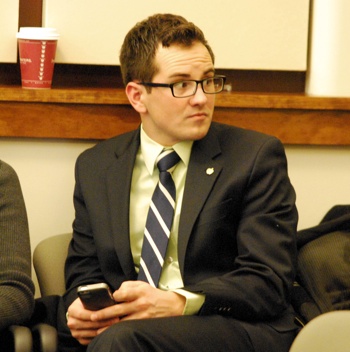
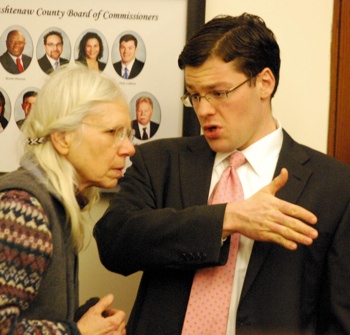
Jennifer L. Hall, Andy LaBarre

Jennifer L. Hall, the new Ann Arbor housing commission executive director, talks with commission board member Andy LaBarre before the board's Dec. 21, 2011 meeting. (Photos by the writer.)

Most of the Dec. 21 meeting focused on a presentation by Hall. She gave an overview of local affordable housing demand, and looked at how the housing commission’s operations might address some of those needs. In part, her talk set the stage for possible land acquisition. Later in the meeting, the commission entered into closed session to discuss two potential properties it might buy to add to the city’s public housing stock.

On one of the properties Hall suggested constructing a rental project consisting of 22-37 detached single-family units and duplexes, ranging between 1-5 bedrooms. For the other property, she proposed building a 15-unit complex of detached 2-4 bedroom condos and duplexes, which would eventually be sold to low-income homeowners for $140,000 each. Funding for these projects would come from a variety of sources, including state and federal grants and loans.

The locations of the properties weren’t disclosed in open session. But Hall said she was looking for direction from the board on pursuing the two projects. If the projects move forward, more details would be discussed in the public portion of upcoming meetings.

Hall also floated the idea of changing the format of board meetings and of the information that commissioners receive in their meeting packets. She proposed cutting back on staff reports, presenting them quarterly instead of monthly. That way, more of the board’s meeting time would be freed to focus on strategic planning issues, she said.

Hall also suggested changing the way that meeting minutes are written up. Instead of including a detailed description of the board’s discussions, she said, the minutes could provide a summary of the discussion and a note about the outcome, if a vote is taken. Some commissioners expressed concerns about truncating the minutes dramatically. Board president Marta Manildi said the AAHC board would like a richer level of detail than what’s provided in Ann Arbor city council minutes, which she described as too terse.

During the time available for public commentary, two residents of Miller Manor – an AAHC apartment complex on Miller Avenue – raised concerns about security issues in the building. Manildi told them that their comments would be forwarded to a working group of staff that’s addressing security problems at all AAHC properties. [Full Story]

DDA Gives More Time To Near North

Ann Arbor Downtown Development Authority board meeting (Sept. 7, 2011): In the main business of its September meeting, the DDA board voted to renew a $500,000 grant previously awarded to Avalon Housing for its Near North affordable housing project on North Main Street. The project is planned to include 39 units of affordable housing on the site where eight now-vacant houses stand.

Russ Collins Gary Boren

Russ Collins (left) shakes hands with former board member Gary Boren, who was recognized for his service at the DDA's Sept. 7, 2011 board meeting. (Photos by the writer.)

The Near North decision came over the objection of three board members, who expressed concern over unanswered questions about the project’s timeline. Avalon had also requested that the intent of the resolution be expressed in the form of a contractual agreement and that the period of the grant be two and a half years, instead of the maximum two years normally attached to DDA grants. The additional time is needed in order to cover a sufficient period to achieve LEED certification.

Representatives of the construction trades, who objected to the selection of the Grand Rapids-based Rockford Construction as the general contractor for the Near North project, as well as a resident spoke against the DDA’s grant award during the time allowed for public participation.

The three votes against the grant renewal came from Newcombe Clark, Roger Hewitt and Russ Collins. With the absence of board members Keith Orr and Bob Guenzel, the 12-member board still achieved the minimum seven votes it needed for approval of the grant.

Despite his absence from Wednesday’s meeting, Guenzel was voted as the new chair of the DDA board, filling a vacancy in that position left when the recently elected chair, Gary Boren, was not nominated for reappointment to the board when his term expired on July 31. Boren was on hand to accept a resolution of appreciation for his service on the board.

In connection to the officer election timing issue, Clark asked for a review of the board’s bylaws by the board’s executive committee. Clark has raised the issue during the July officer elections for the last two years. Because the mayor has been reticent about his intended appointments, DDA board members have elected their officers for the coming year without knowing if all board members with expiring terms will be reappointed. Clark asked that the bylaws possibly be changed so that board officers are elected after appointments are made, so that it’s clear who will be serving on the board.

In other business, the board unanimously passed a resolution of support for the RiverUp! program amid some discussion of the appropriateness of the resolution – in light of the fact that the Huron River does not flow through the DDA tax district.

The board also passed a resolution encouraging the Washtenaw County board of commissioners to enact an economic development tax on county residents. About half of the tax proceeds would go to Ann Arbor SPARK. The resolution came at the request of DDA board member Leah Gunn, who also serves on the Washtenaw County board. The Ann Arbor city council had previously passed a resolution encouraging the county board to enact the tax. The county board gave initial approval to the tax later that evening.

As part of the reports from various board committees, Roger Hewitt stressed that the parking rates and hours of enforcement discussed at the previous week’s operations committee meeting were merely the start of the discussion. The DDA is currently discussing what kind of proposal it will present to the city council at a November joint work session on parking. Under its new contract with the city to manage the public parking system, the DDA’s authority to set rates and hours of enforcement comes with specific requirements on public input.

The city council also has directed the DDA to explore alternate uses for some of the city-owned surface parking lots in the downtown. Board members got an update on the status of the DDA’s effort to plan how to implement that directive.  [Full Story]

Council OKs Affordable Housing Lien Policy

At its June 20, 2011 meeting, the Ann Arbor city council established a policy under which liens can be subordinated and city loans forgiven, in the interest of perserving affordable housing.

Key elements of the policy: at least one city or county lien will be maintained on the property; liens with federal affordability restrictions will be in the highest lien position possible; liens that do not have federal affordability restrictions will be discharged if needed to facilitate reinvestment of outside funding; the city administrator is authorized to approve lien subordinations and lien discharges.

The city council had discussed a specific case related to the forgiveness of loans and subordination of liens at its May 16, 2011 meeting. The context there was the appropriation of funds for the demolition of houses to prepare for construction of the Near North affordable housing project, located on the east side of North Main Street between Kingsley and Summit.

This brief was filed from the city council’s chambers on the second floor of city hall, located at 301 E. Huron. A more detailed report will follow: [link] [Full Story]

Ann Arbor Adopts Loan Forgiveness Policy

At its April 19, 2011 meeting, the Ann Arbor city council approved a policy that grants to the city administrator the authority to forgive certain loans made by the city on affordable housing units that have affordable housing covenants. The city administrator would need to determine that loan forgiveness is necessary to protect the long-term affordability of the housing, and that loan forgiveness would facilitate the transfer of ownership to other income-qualified purchasers.

The request to have such a policy came from the office of community development. It arose from two recent foreclosures on properties in Stone School Townhomes, one of three housing developments where the city currently has affordable housing covenants. The other two are Ashley Mews and Northside Glen.

When a property is foreclosed, the affordable housing covenant automatically terminates.

This brief was filed from the city council’s chambers on the second floor of city hall, located at 301 E. Huron. A more detailed report will follow: [link] [Full Story]

Council Absences Delay Some Business

Ann Arbor city council meeting (Feb. 22, 2011): In a meeting that wrapped up in less than two hours, the council handled several agenda items, including: an affordable housing site plan from Avalon Housing at 1500 Pauline; authorization of increased golf fees; reappointment of the golf task force; an appointment to the environmental commission; and the purchase of new police cars.

Sandi Smith Dennis Hayes Ann Arbor Medical Marijuana

Before the Feb. 22 council meeting, Sandi Smith (Ward 1) chatted with Dennis Hayes about the medical marijuana licensing ordinance. The council delayed taking action on the ordinance. (Photos by the writer.)

However the council chose to delay some of its business due to the absences of four members – Carsten Hohnke (Ward 5), Marcia Higgins (Ward 4), Christopher Taylor (Ward 3) and Stephen Rapundalo (Ward 2). By way of explanation for the four absences, mayor John Hieftje offered the fact that it’s vacation week for the Ann Arbor Public Schools.

The delayed business included a set of proposed licensing rules for medical marijuana businesses. The council heard from advocates of medical marijuana during public commentary at the start of the meeting, but when they reached the item on their agenda, the seven councilmembers who attended the meeting decided to postpone their vote on the issue without deliberating on or amending the licensing proposal. It marks the fifth time the council has decided not to take an initial vote on the licensing, dating back to Dec. 6, 2010. The council must take two votes on any new ordinance.

Also delayed were two easements – one for pedestrian access and one for public utilities – from Glacier Hills Inc., a retirement community. Under the city charter, eight votes are required for approval of such easements. Rather than have the easements fail on a 7-0 vote, the council chose instead to postpone action.

During his communications, city administrator Roger Fraser gave the council a broad-strokes overview of potential impacts that Gov. Rick Snyder’s proposed state budget could have on the city of Ann Arbor. In a roughly $80 million general fund city budget, the $2.4 million projected shortfall – on which current reduction targets are based – could increase by $0.5 million (to $2.9 million) or by $1.7 million (to $4.1 million), depending on how state revenue sharing and state fire protection grants are handled in the state budget. The state’s fiscal year begins on Oct. 1, but the city of Ann Arbor must finalize its own budget in May, for a fiscal year starting July 1.

During public commentary, the council heard a suggestion that Ann Arbor follow the example of Ypsilanti and add parking lots to its snow-clearing ordinance. And during its communications time, the council scrutinized the city’s snow removal performance in connection with a recent storm. Snow began falling the previous Sunday afternoon, accumulating to at least six inches – and more, in many areas – by early Monday morning, when the snow stopped. Highlights from city administrator Roger Fraser’s report on the snow removal effort included the fact that two of the city’s 14 large plowing vehicles were down for maintenance and the fact that forecasted amounts of snow were much lower than what actually fell.

During public commentary, the city also heard from Douglas Smith regarding a Freedom of Information Act appeal that involved redaction of police reports. Over the last several months, Smith has addressed the University of Michigan regents and the Washtenaw County board of commissioners on a range of specific cases that all relate to the general issue of civilian oversight of police power. [Full Story]

Urban County: Nonprofit Funding Update

Washtenaw Urban County executive committee meeting (Jan. 25, 2011): Urban County members – a group representing 11 municipalities in Washtenaw County – got an update on a new effort to coordinate the funding of local nonprofits.

Damon Thompson, Teresa Gillotti

Damon Thompson, operations manager for the Washtenaw County/city of Ann Arbor office of community development, talks with Ypsilanti city planner Teresa Gillotti after the Jan. 25 Urban County meeting.

Nonprofits are vying for funds from the city of Ann Arbor, Washtenaw County, the Urban County, and Washtenaw United Way. Nearly 60 nonprofits applied to the first phase of the process, in which they were asked to supply basic financial and governance documents. Of that group, 51 were qualified to respond to a request for proposals (RFP) that was issued Jan. 28.

It’s still unclear how much funding will be available, but it could be less than the nearly $5 million that was awarded from these groups last year. Budgets for Ann Arbor and the Urban County haven’t been finalized, and the 2011 county budget is facing about $1 million in as-yet-undetermined cuts.

At last week’s meeting, three members of the Urban County’s executive committee – Pittsfield Township deputy supervisor Barb Fuller, Ypsilanti mayor Paul Schreiber and Ann Arbor city councilmember Margie Teal – were appointed to review applications for the coordinated funding process. All governing boards of the four entities involved in this cycle’s funding will appoint members to a review committee. The fifth partner – the Ann Arbor Area Community Foundation – will fund capacity-building grants to nonprofits identified as needing help with internal operations, like infrastructure and staff development.

Also at last week’s meeting, Urban County members got an update on an annual plan being developed for the U.S. Dept. of Housing & Urban Development (HUD), which provides funding for low-income housing and neighborhood projects. The plan will include a list of proposed projects located within the Urban County area that would be eligible for HUD funding. To gather more input, a needs assessment public hearing is set for the Feb. 22 meetings of both the Ann Arbor city council and the Urban County.

Two people spoke during public commentary, both criticizing Avalon Housing for its handling of two low-income housing projects: 1500 Pauline, and Near North. The nonprofit was defended by Leah Gunn, who chairs the Urban County executive committee – she called Avalon one of the “stars of community development.” [Full Story]

Site Plan OK’d for Avalon Housing Project

Ann Arbor planning commission meeting (Jan. 20, 2011): After a public hearing that included comments by some residents of 1500 Pauline, planning commissioners unanimously approved the site plan for an affordable housing project at that location, proposed by the nonprofit Avalon Housing.

Painting of blue houses

This painting of blue houses is not in Avalon Housing's site plan for its affordable housing proposal at 1500 Pauline. It's part of a display by fifth grade students in the lower level of the downtown Ann Arbor District Library, where the Jan. 20 planning commission meeting was held.

The project will include demolishing the existing structure and constructing five one- and two-story buildings and a community center. Though commissioners supported the project, some raised concerns over the relocation of current residents and the fact that the new complex, when completed, will have fewer units – 32, compared to the current 47 apartments. Of those, there will also be far fewer one-bedroom units – six, compared to the current 21.

Representatives from Avalon told commissioners that the lower number was sustainable – 35% of the units will be set aside for residents who’ll receive supportive services. They also said the location was more suited for families, and that there’s more need for two- and three-bedroom affordable housing units in the city.

Another project on the agenda – a site plan and special exception use for 630 Oxford – was postponed, as recommended by city planning staff. The Phi Kappa Psi fraternity wants to turn an existing rental duplex into their chapter’s permanent home, housing up to 24 residents. The housing director and some board members for the neighboring Delta Gamma sorority came to Thursday’s meeting to object to the plan, saying they did not want fraternity culture to disrupt their quiet neighborhood.

Commissioners also unanimously recommended approval of the annexation of 1575 Alexandra Blvd., a vacant 0.82-acre lot now in Ann Arbor Township. The lot is surrounded by the city’s Riverwood Nature Area – its owner plans to build a single-family home on the site.

Also at Thursday’s meeting, Wendy Rampson of the city’s planning staff reminded commissioners of a public meeting on Wednesday, Jan. 26 to get community feedback on draft recommendations for R4C and R2A residential zoning district ordinance revisions. The meeting runs from 6-8 p.m. at the lower level of the downtown Ann Arbor District Library, 343 S. Fifth Ave. [Full Story]

Urban County Finalizes Funding Model

Washtenaw Urban County executive committee meeting (Nov. 16, 2010): The final piece of a coordinated funding model that’s been in the works for more than a year fell into place on Tuesday, when the Washtenaw Urban County’s executive committee voted unanimously to join the effort.

Mary Jo Callan

At the Nov. 16 meeting of the Urban County, Mary Jo Callan, director of the city of Ann Arbor/Washtenaw County office of community development, reviewed key points of the coordinated model for funding human services. (Photo by the writer.)

Two people – Steve Dobson, past chair of the local United Way board, and community activist Lily Au – spoke to the group during public commentary, taking opposite sides of the issue. But there was little discussion among committee members before the vote. Mary Jo Callan, head of the county/city of Ann Arbor office of community development, briefly recapped a detailed presentation she’d given in September, outlining how Ann Arbor, Washtenaw County and the Urban County would join with the Ann Arbor Area Community Foundation and Washtenaw United Way to coordinate their funding to local nonprofits.

The coordinated funding, managed by Callan’s staff, will give priority to programs and services addressing six key areas: housing/homelessness, aging, school-aged youth, children from birth to six, “safety net” health and food/hunger relief. In total, the five funding entities provide about $5 million annually for local human services nonprofits. The Urban County – a consortium of 11 local governments – contributes roughly $350,000 of that amount.

The committee also voted on three items related to affordable housing efforts: 1) implementing “green” construction standards for builders funded with federal HUD dollars, 2) approving a draft budget and annual request for proposals (RFP) for developers of affordable houses funded through the Urban County, and 3) making changes to the budget tracking for the Urban County’s homebuyer program. All votes were unanimous. [Full Story]

Investments: Housing, Bridges, Transit

Ann Arbor City Council meeting (April 19, 2010) Part 2: In Part 1 of this meeting report, we focused on the city’s budget process, parking issues and the University of Michigan commencement exercises.

In Part 2, we wrap up other topics of the meeting. One common theme was capital investments in the community’s physical infrastructure of various kinds.

Michael Nearing city of Ann Arbor engineer

Michael Nearing, city of Ann Arbor engineer, was available for any city council questions on the East Stadium bridge project. (Photo by the writer.)

The council allocated a total of $313,000 for three different permanent affordable housing projects in Ann Arbor.

The city’s East Stadium bridge replacement project received discussion in the form of a resolution that authorized the city to go after state funding for the third time in the last three years. The anticipated construction start for fall of this year has been postponed until spring 2011 – the earlier date had been tied to the city’s application for federal funding, which was rejected this February.

The ongoing construction of the police/courts building, directly adjacent to city hall (the Larcom Building), received some tangential discussion in the form of an explanation from Roger Fraser about the recent closure of city hall due to elevated carbon monoxide levels. The police/courts building was also the subject of public commentary that prompted some extended remarks from the mayor – which were covered in Part 1 of this report.

Another construction project that will likely factor into the upcoming primary election campaigns is Fuller Road Station. The city-university collaboration to build a combined parking deck and bus station, which might eventually serve as a commuter rail station, was taken up during the council’s communications time. Christopher Taylor (Ward 3) and mayor John Hieftje both responded to some cautionary remarks made by Mike Anglin (Ward 5), which he made based on a recent park advisory commission meeting.

In business related to ethics and rules, the council voted on two occasions to excuse the participation of Taylor in a vote, because of a conflict of interest posed by his employment with the law firm Butzel Long. They also satisfied the requirement of a recent lawsuit settlement that they formally consider a rule about their use of government email accounts – by voting to remand consideration of the issue to council’s rules committee. [Full Story]

Six-Vote Majority Leaves The Moravian Short

Ann Arbor City Council meeting (April 5, 2010) Part 1: In a six-to-four vote on Monday night, the Ann Arbor city council did not give The Moravian development the required 8-vote super-majority it needed for approval. A petition signed by greater than 20% of adjoining property owners meant that the project needed eight instead of the six votes it actually received to win the council’s endorsement.

The pen of Tom Luczak

On an architect's scale model of the neighborhood, Tom Luczak points to a house on Fourth Avenue, next to the proposed project, The Moravian. The view is roughly from the northwest. Luczak spoke in opposition to the project. (Photos by the writer.)

The five-story, 62-unit building proposed for the section of East Madison Street between Fourth and Fifth avenues near downtown Ann Arbor had come before the council with the recommendation of the city’s planning staff and a 7-1 vote recommendation from the city’s planning commission.

The public hearing on The Moravian included remarks from around 90 people on both sides of the issue. The Moravian alone – counting the public hearing, plus the deliberations by the council – took up over four hours of the meeting, which lasted well past 1 a.m.

Besides The Moravian, the council’s business included an item that would have reconsidered its recent decision to replace the entire Ann Arbor housing commission board. The motion for reconsideration was voted down, with no support, not even from its two sponsors – Stephen Kunselman (Ward 3) and Mike Anglin (Ward 5). Kunselman cited the late hour as part of the reason for his lack of enthusiasm for pursuing the matter.

The council also tabled a proposed city ordinance that would ban cell phone use while driving. The council had postponed the measure to a specific date a few times previously. The tabling means that the ordinance can be brought back for consideration by the council, but by council rule it will die unless it is brought back within six months.

Also receiving brief discussion was a possible council rule on email that the council is now forced to  consider publicly at its next meeting under terms of a recent lawsuit settlement.

In Part 1 of this report, we focus exclusively on The Moravian. [Full Story]

“Urban County” Allocates Housing Funds

At their March 23 meeting, members of the Washtenaw Urban County – a consortium of 11 local municipalities that handles federal grants for low-income housing and other projects – approved over $2.6 million in allocations for the Ann Arbor/Ypsilanti area.

Margie Teall, Leah Gunn, Mary Jo Callan, Damon Thompson

Mary Jo Callan, director of the Office of Community Development, discusses proposed funding for housing projects at the Washtenaw Urban County meeting on Tuesday. At left are Ann Arbor city councilmember Margie Teall and county commissioner Leah Gunn, who chairs the Urban County executive committee. At right is Damon Thompson, OCD's operations manager. (Photos by the writer.)

The group also had a frank discussion about problems with struggling Gateway Apartments in Ypsilanti Township – the complex is operating at a loss and is putting strains on the nonprofit Avalon Housing, which took over management from the nearly-defunct Washtenaw Affordable Housing Corp.

In addition, Urban County members reallocated federal funds that had previously been earmarked to support a county land bank. The county’s board of commissioners voted to dissolve the land bank earlier this month.

Also approved during Tuesday’s meeting was the draft of an annual plan for July 1, 2010 through June 30, 2011. The plan outlines projects and a nearly $4 million budget from two federal programs for low-income neighborhoods. Avalon Housing’s Near North apartment complex, the Delonis Center homeless shelter, and an owner-occupied housing rehab program are among the projects being funded.

Staff of the Office of Community Development, a joint county/city of Ann Arbor department which among other things manages the Urban County projects, also reported on efforts to recruit more local governments to join the Urban County. OCD director Mary Jo Callan joked that there were two perception problems in marketing the Urban County: urban and county. [Full Story]

City Council’s Directive: 3% Cut for Workers

Ann Arbor City Council meeting (March 1, 2010) Part 1: Having postponed a resolution at its last meeting – which directed the city administrator to reduce wages of non-union workers by 3% – on Monday the council passed a revised version of it.

Tony Derezinski talking on a cell phone

Tony Derezinski (Ward 2), who co-sponsored a new ordinance banning use of cell phones while driving or bicycling. The ban does not apply to driving one's council chair before the meeting starts. (Photos by the writer.)

But it was approved without the support of the measure’s two sponsors, Marcia Higgins (Ward 4) and Stephen Rapundalo (Ward 2). The version adopted by council specified a 3% minimum cut in compensation packages, taken over the aggregate of non-union workers. By the time the resolution was passed, it had also shed a “whereas” clause that Christopher Taylor (Ward 3) called “self-laudatory.”

In development news, The Moravian – a planned unit development (PUD) proposed on East Madison Street – received unanimous council support at its first reading. Approval at two readings is required for final approval. But Stephen Kunselman (Ward 3) responded to a resident request made at the previous night’s caucus to give some clue at the first reading as to how councilmembers were thinking about the project: “I’ll be voting against it at second reading – so there’s no question in the community’s mind.”

Based on the Sunday caucus, The Moravian will face a protest petition, which raises the bar for approval from six to eight votes.

The council also wrangled through a proposed ban on cell phone use while driving and bicycling – at a level of detail unusual for a first reading. The measure had undergone enough revisions since it was approved at the council’s previous meeting that its status Monday was reset to a first reading. Dissent on the ban came from Sandi Smith (Ward 1), who questioned whether it should be undertaken at the local level – as opposed to the state. Marcia Higgins (Ward 4) also dissented, pointing to the fact that the ban did not include hands-free phones.

The council also transacted a variety of other business, including a repeal of the city’s bicycle registration program, which is to be replaced with a new system after further consultation with stakeholders. The bicycle registration program, as well as other business and announcements, will be wrapped up in Part 2 of this report. [Full Story]

Water Main Project Set for Bryant Area

Jerry Hancock

Jerry Hancock, Ann Arbor's stormwater and floodplain programs coordinator, explains how soil composition in the Bryant neighborhood factors in the area's water problems. (Photos by the writer.)

A major project to replace water mains and resurface roads in the Bryant neighborhood will get under way this spring, part of a broader plan to address the area’s chronic drainage problems and other issues.

At a Jan. 14 neighborhood meeting, Ann Arbor city staff gave an overview of the project, which included an historical look at the subdivision off  Stone School Road, just south of I-94.

The meeting at the Bryant Community Center – organized by the nonprofit Community Action Network and attended by residents, city and county elected officials and staff, among others – is the latest in a series of efforts to deal with a wide range of challenges to one of the city’s predominantly low-income neighborhoods.

At the end of Thursday’s two-hour session, a question raised by one of the residents – “Is there a happy ending to all of this?” – might best be summarized by the answer, “It depends.” [Full Story]

Housing Commission Reorganizes

Ann Arbor City Council work session (Jan. 11, 2010): Ann Arbor city councilmembers were presented on Monday evening with an outline for the reorganization of the city’s housing commission, a plan that has in large part already been adopted by the commission and needs no further city council approval.

The housing commission is responsible for 355 public housing units spread over 18 sites – or around 50% of the affordable housing stock in the city – plus 1,300 Section 8 vouchers for a three-county area.

computer screen with housing commission slide show

Kerry Laycock, the consultant who gave the city council a presentation on the reorganization of the housing commission, gave a slide presentation from the podium using this laptop computer. (Photos by the writer.)

Keys to the reorganization are beefing up the Section 8 program with a dedicated financial analyst and a program manager, and redefining roles of the executive director and deputy director, as well as outsourcing maintenance of the housing units.

Outsourcing maintenance will reduce the housing commission staff by six people – two temporary employees plus four union workers.

Alan Levy, who chairs the housing commission board, told councilmembers that the reorganization had already been approved by a 3-2 vote of the housing commission’s board at a special meeting held on Jan. 6, 2010. [Full Story]

DDA Ponies Up: Parking, Pipes, Planning

Downtown Development Authority board meeting (Jan. 6, 2010): The DDA authorized money for a range of different projects at its regular monthly board meeting on Wednesday.

Peter Allen

During public commentary, local developer Peter Allen addressed the DDA board on the topic of the Library Lot consultancy. Visible in the background is mayor John Hieftje. (Photos by the writer.)

Biggest on the list of one-time expenditures was $2.28 million spread over three years for 150 additional multi-space pay stations to replace on-street parking meters. Twenty-five such pay stations were already installed over the summer.

Next-largest was $600,000 for water main replacement, timed to coincide with the Fifth and Division street improvements. That was followed by as much as $500,000 for the Near North affordable housing project. Near North has won site plan approval from the city council and now faces the challenge of obtaining tax-credit financing.

Smallest on the list of authorized one-time money was up to $50,000 for consultant support for the Library Lot RFP review process.

Also in the mix was the authorization to redirect revenue from the 350 S. Fifth Ave. (former YMCA) surface parking lot to the city of Ann Arbor. On Dec. 21, 2009 the city council voted to request the DDA take that action. What the DDA board actually authorized is a payment to the city per year of whichever amount is greater: (i) $100,000 or (ii) the net revenue from the lot, after installation and operational costs are recovered by the DDA.

The meeting also included the precursors of some eventual conversation about the role of the DDA’s executive committee and its ability to act on behalf of the whole board. That recalled a related issue still left over from last summer: Can the mayoral line of succession be invoked to fill the mayor’s spot at a DDA board meeting?  [Full Story]

Moravian Moves Forward, Despite Protests

Ann Arbor Planning Commission meeting (Jan. 5, 2010): During a four-hour meeting that ended with some residents shouting in anger, the Ann Arbor planning commission approved the site plan and special zoning for The Moravian, a proposed housing complex at East Madison, between Fourth and Fifth avenues.

Developer Jeff Helminski speaks to Ann Arbor planning commissioners about his project, The Moravian. In the background are commissioners Wendy Woods and Diane Giannola. (Photos by the writer.)

Developer Jeff Helminski speaks to Ann Arbor planning commissioners about his project, The Moravian. In the background are commissioners Wendy Woods and Diane Giannola. (Photos by the writer.)

About two dozen residents attended the meeting. All but one of the 16 people who spoke during time for public commentary opposed the project, some vehemently.

Opponents’ main concern is that the five-story, 62-unit building is out of scale and out of character with the neighborhood, which has older homes, but is not protected by an historic district. [The neighborhood also is on the edge of an industrial area – The Moravian is planned on a lot across the street from the Fingerle Lumber complex.]

But in approving the requested planned unit development (PUD) zoning, commissioners cited a range of public benefits, including the 12 units of affordable housing within the building – a benefit that neighbors dispute. The project will now be considered by city council at an upcoming meeting.

Residents vow to continue fighting it. “We’re going to redouble our efforts,” Beverly Strassmann, president of the Germantown Neighborhood Association, told commissioners after their vote.

Separately, planning commissioners approved a rezoning request for a gas station on Packard Road, with some stipulations. [Full Story]

Council Acts on Greenbelt, Housing

Ann Arbor City Council meeting (Dec. 7, 2009) Part II: In Part I of the council report, The Chronicle covered a resolution regarding the Huron River and Impoundment Management Plan (HRIMP), the Percent for Art program, and budget issues, including a possible 3% across-the-board wage cut and firefighter layoffs.

Christopher Taylor

Christopher Taylor (Ward 3) at the start of the meeting, clearly thinking outside the box. (Photos by the writer.)

Councilmembers spent considerable time on those topics, during a meeting that lasted until nearly midnight. But they also acted on a range of other items – Part II of this council report will focus on that remaining part of the agenda.

Two items were postponed – the appointment of council members to various committees, and a resolution to buy new parking meters for Wall Street. The council, with no discussion, also sent the area, height and placement (AHP) project back to the planning commission for further consideration.

Several funding requests were approved, including the purchase of new accounting software, two greenbelt acquisitions and funds for remodeling the city’s 911 dispatch center to accommodate co-location with Washtenaw County’s dispatch center. Council also signed off on additional funds for a Buhr Park ice rink project.

Affordable housing issues came up in two different ways. Councilmembers approved a resolution exempting eligible nonprofit housing providers, such as Avalon Housing, from paying property taxes for up to two years. Council also passed a resolution supporting the efforts of the University of Michigan’s Inter-Cooperative Council to secure federal funding.

At the end of the meeting, council went into closed session to discuss a pending lawsuit the city faces over the underground parking garage next to the Library Lot. When they emerged, they authorized action recommended by the city attorney.

Finally, long-time Pioneer track coach Don Sleeman was honored – over the years, his work has touched the lives of several people connected to city hall. [Full Story]

Near North, City Place Approved

Two men stand together at a podium at the Ann Arbor city council

At the podium, Bill Godfrey of Three Oaks Group and Tom Fitzsimmons of the North Central Property Owners Association both express their support of the Near North housing project on North Main. In the background, Christopher Taylor (Ward 3). (Photo by the writer.)

Ann Arbor City Council meeting (Sept. 21, 2009): Ann Arbor’s city council approved both major development projects on its agenda, one of them enthusiastically, the other only reluctantly.

Although there was a smattering of opposition expressed to the Near North affordable housing development during the public hearing on the matter, the 39-unit project on North Main Street ultimately won the support of its closest neighbors. That support was reflected symbolically when developer Bill Godfrey and neighbor Tom Fitzsimmons stood side-by-side at the podium as they each addressed the council, which gave the project its unanimous approval.

The “matter of right” City Place project proposed for the block of South Fifth Avenue just south of William was also unanimously approved by the council, but councilmembers took turns criticizing both the project and the developer, Alex de Parry. The council had previously established a historic district study committee and enacted an associated moratorium on demolition and work in the area where the proposed project is located. Carsten Hohnke (Ward 5) compared de Parry’s decision to bring the project forward despite the moratorium to “stamping feet, being upset you didn’t get what you wanted.”

Many members of the audience held yellow 8×11 paper signs calling on councilmembers to support a resolution that would have released council emails sent during their meetings dating back to 2002. However, council rejected that resolution except for a resolved clause that would in the future provide the public with copies of electronic communications among councilmembers during its meetings – by appending them to the official minutes of the meeting that are eventually posted on the city’s website.

The council also put looming financial issues on the radar by passing a resolution that opposes a recent Michigan budget proposal that would cut state shared revenues to the city of Ann Arbor by about $1.2 million. At the council’s budget and labor committee meeting that was held Monday – before the regular council meeting – Tom Crawford, the city’s chief financial officer, floated some possible ideas for meeting that shortfall. [Full Story]

Planning Commission: 5-2 for Near North

A little more than four hours after the Ann Arbor city planning commission meeting had started, planning commissioners voted – to extend their deliberations past 11 p.m.  And a bit before midnight, the body voted on the Near North planned unit development project proposed for North Main Street. Although the vote was 5-2 to recommend approval to the city council, that outcome counted as a “technical denial.” At least six votes are required in order for planning commission to make a recommendation to council.

After the meeting, developer Bill Godfrey told The Chronicle that he intended to bring the project forward to the city council despite the technical denial, pointing out that two of the commission’s members had been absent for that evening’s vote – Craig Borum and Tony Derezinski. Derezinski (Ward 2) is the city council’s representative on the planning commission.

The meeting marked the final planning commission meeting for Ethel Potts, who has served two 3-year terms on the body.  [Full Story]

DDA Discusses Payments to City

Downtown Development Authority board meeting (March 4, 2009): At Wednesday’s monthly board meeting of the Downtown Development Authority, Rene Greff asked the rhetorical question: “Do you want to hook that cart to a controversial horse?” And she was not talking about a new transportation option for downtown. But the “cart” was the idea of transportation demand management. The “horse” was city council’s recent request that the DDA increase its revenues to assure adequate reserve fund balances. [Full Story]

Parking Rate Hikes Delayed Slightly

The more you near your destination the more you slip sliding away,

The DDA board heard from the public on the topic of snow removal downtown, including the person attached to this foot, whose holiday gifts included some pullover gadgets with non-slip metal coils.

Downtown Development Authority Board (Jan. 7, 2009) The Main Street Area Association had hoped for a year-long delay in the parking rate increases that were approved by the DDA board at its Nov. 5 meeting. But after discussing that possibility – and the borrowing of $3.65 million from the TIF fund that the year’s delay would require – the board left their original proposal intact. However, it will not be put before city council for final approval on Jan. 20, as originally planned.

Instead, the rate hike, which is part of the same packet of materials as the Fifth Avenue underground parking garage project, will be placed on the agenda for the second council meeting in February. The board settled on this delay when mayor of the city of Ann Arbor, John Hieftje (who serves on the DDA board in that capacity) announced that the council’s budget and finance committee had indicated a preference to see that packet delayed until February. Hieftje warned that if it were placed on the Jan. 20 agenda, it would simply be postponed by city council. [Full Story]

The Madison Redux

Carsten Hohnke, who represents Ward 5 on Ann Arbor city council, attended Tuesday

Carsten Hohnke, who represents Ward 5 on Ann Arbor city council, attended Tuesday evening's meeting about The Madison. In the background is Laurie Blakeney, owner of the Ann Arbor School of Yoga and the mother of Newcombe Clark, who's a partner in The Madison project.

Many of the 15 or so people gathered in the downtown Ann Arbor library on Tuesday night were clearly neighbors. There were handshakes, waves, nods of greetings and, in at least one case, the delivery of a Christmas gift. And as the meeting unfolded, it also became clear that these people had another common bond: Opposition, or at least strong skepticism, to a revived apartment project called The Madison.

Developer Jeff Helminski and Newcombe Clark of Bluestone Realty plan to resubmit a scaled-down version of The Madison to the city on Dec. 29, and were holding this meeting to tell neighbors about their new plans and to get feedback on the project. Located on East Madison between South Fourth and Fifth avenues, the original proposal called for a 14-story building with 161 units. This new one has four stories, with 60 units.

That’s still too large for some. [Full Story]

The 100 Units of Affordable Housing

Sites A, B, C, identified as possible locations to build affordable housing units. The image is linked to a higher resolution file in which dimensions are legible.

Ann Arbor City Council Working Session (Dec. 8, 2008) At a council working session on Monday evening, attended by all councilmembers including the mayor, one option (consisting of three different sites) was presented for how to replace the 100 units of affordable housing previously provided by the YMCA building at Fifth and William streets.

The three sites that were offered by city staff to council for consideration have some different constraints, but the proposed construction on each site is similar. All three sites are located along a roughly one-block long stretch of Fourth Avenue from the south side of Ann Street to the north side of Catherine Street.

Based on official council action to date, this set of three sites can be fairly seen as one option of three still under conceptual consideration for a replacement location for the 100 affordable units: (i) the old YMCA site, (ii) an alternate downtown location, and (iii) a location outside of downtown.

We begin with some brief background of the history of these 100 units before December 2007, trace the interaction between council and the Housing and Human Services Advisory Board between December 2007 and May 2008, and finally summarize the presentation and council discussion from the council’s working session on Monday in customary Chronicle meeting-watch style. [Full Story]

Meeting Watch: City Council (22 Sept 2008)

Public Commentary

Tom Partridge. Partridge makes clear who he’s talking to: “Members of the public at large, representatives of the media, I am Tom Partridge.” Media. That’s us, The Chronicle. When people speak directly to us, we listen. Partridge stressed the importance of electing Democrats in November, saying, “We need to support candidates who stand for progress – true progress.”

John Floyd. Floyd did not coin the phrase Charm Zone – he heard it at a recent planning commission working session – but he has embraced this term for the part of Ann Arbor built before World War II. He contends it’s what makes Ann Arbor different from Royal Oak or Novi and what gives Ann Arbor … [Full Story]