Stories indexed with the term ‘Ann Arbor Downtown Development Authority’

Column: Video Replay Review for City Council

When the University of Michigan Wolverines play Big Ten opponents in football, the video record of some plays can be reviewed by game officials – under conditions set forth by the conference. One kind of reviewable play is the completion of a forward pass: Did that player actually receive the ball from the quarterback in a way that, under the rules of American football, constitutes a completed pass than can be carried forward on the field of play?

city council audio tape

Audio tape recording of the Feb. 17, 2009 Ann Arbor city council meeting – even though the Community Television Network video has gone missing, it's still possible to review what was said at the meeting. The Ann Arbor city clerk's office makes audio recordings of council meetings to ensure the accuracy of minutes. (Photo illustration by The Chronicle.)

For its proceedings, the Ann Arbor city council does not have a video replay rule.

But if it did, here’s the kind of play that might be reviewable: Did a city council-appointed board receive advice from the city’s financial quarterback in a way that, under ordinary rules of plain American English discourse, constitutes a recommendation that should be carried forward in a future board policy?

At issue is whether two seasons ago, back in February 2009, city of Ann Arbor CFO Tom Crawford recommended to the Ann Arbor Downtown Development Authority that the DDA have a policy to maintain a minimum fund balance as a reserve, and specifically, whether a minimum reserve amount was specified.

The question was important over the last two years in the course of negotiations between the DDA and the city about the contract under which the DDA manages Ann Arbor’s public parking system.

The remarks made by Crawford – which everyone seems to recall (albeit differently) – took place in plain view on the public field of play, at the Feb. 17, 2009 city council meeting.

What made the public conversation remarkable in the waning stages of contract negotiations, was that it was based on what the different players (including Crawford) recalled Crawford saying. Why not just take an approach familiar to the Big Ten college football conference, and review the tape to find out exactly what Crawford said? [Full Story]

AADL Hears from “Library Green” Advocates

Ann Arbor District Library board meeting (Aug. 15, 2011): A brief library board meeting on Monday night included a relatively rare occurrence – multiple people spoke during the time allotted for public commentary.

Mary Hathaway

Mary Hathaway spoke to the Ann Arbor District Library board about efforts to create a public gathering place atop the underground parking structure adjacent to the downtown library. (Photo by the writer.)

The commentary focused on what’s now being called the “Library Green” – an effort to create a public park atop the underground parking structure that’s being built on South Fifth Avenue, adjacent to the downtown library building. Advocates for the park conveyed that they’ve taken to heart the concerns of the library, and hope to partner with AADL to develop an area that benefits the public and helps the library to thrive.

The board began its meeting with a closed session, in part for the purpose of getting advice from AADL’s legal counsel. In her written report to the board, AADL director Josie Parker noted that the library is considering the legal and financial implications of the Ann Arbor Downtown Development Authority’s decision regarding “excess” taxes captured in the DDA’s tax increment finance (TIF) district.

Board members did not discuss this issue, but voted to schedule another closed session at their Sept. 19 meeting again to hear advice from legal counsel. [Full Story]

Boren Not Reappointed to DDA Board

At the Aug. 15, 2011 Ann Arbor city council meeting, mayor John Hieftje placed nominations before the city council for appointments to the Ann Arbor Downtown Development Authority board. John Mouat and Joan Lowenstein were nominated for reappointment, but Gary Boren, who was elected this July by his colleagues as chair of the DDA board for the coming year, was not reappointed. Nominated to replace Boren is Nader Nassif.

In an email to The Chronicle, Boren wrote that Hieftje had met with him a few weeks ago and at that meeting the mayor had told him he was not inclined to reappoint Boren. Boren acknowledged that he and the mayor had philosophical differences about the role of the DDA. About … [Full Story]

Library Weighs DDA Excess Tax Decision

During her written director’s report for the Ann Arbor District Library’s Aug. 15, 2011 board meeting, AADL director Josie Parker noted that the library is considering the legal and financial implications of the Ann Arbor Downtown Development Authority’s decision regarding “excess” taxes captured in the DDA’s tax increment finance (TIF) district. The AADL board began its meeting with a closed session to discuss the opinion of its legal counsel, as well as for labor negotiations. The board did not discuss the issue during the public portion of its meeting, but scheduled another closed session to hear the opinion of legal counsel at its Sept. 19 meeting.

At issue is the interpretation of a city ordinance about TIF capture in the DDA’s downtown district, … [Full Story]

DDA Letter: “No funds should be returned…”

On request from The Chronicle, the Ann Arbor Downtown Development Authority has provided the text of a letter sent by its executive director, Susan Pollay, to the taxing authorities in its tax increment finance (TIF) district, explaining the DDA’s position on the issue of redistributing TIF revenue. From the letter text: “There can be no doubt that as long as the DDA is spending its TIF monies according to its plan, no funds should be returned to the taxing units. All of the DDA TIF is now committed to debt service for the existing downtown development projects and the administration ofthose projects.”

Earlier this year, in May – after city of Ann Arbor staff pointed out a provision in Chapter 7 … [Full Story]

Ann Arbor DDA: No Redistribution Required

Ann Arbor Downtown Development Authority special board meeting (July 27, 2011): At a special meeting, the Ann Arbor Downtown Development Authority board passed a resolution stating that it was accepting the general guidance of its legal counsel, Jerry Lax: The DDA does not believe that any redistribution of captured taxes to relevant taxing authorities is required.

At issue is the interpretation of a city ordinance about tax increment finance (TIF) capture in the DDA’s downtown district.

The decision at the special meeting, which was unanimously approved by the nine board members present, came after a closed session with Lax that lasted nearly an hour. The language of the resolution is somewhat vague, citing the city’s ordinance only in general terms and stating that “no redistribution to relevant taxing authorities is required.”

In separate phone interviews with The Chronicle following the meeting, three board members confirmed that the DDA’s position, as expressed in the resolution, is that the city’s ordinance does not require the DDA to redistribute TIF money to other taxing authorities. The DDA’s interpretation would render moot any argument about the method used in calculating that redistribution.

Earlier this year, the DDA had calculated that the city of Ann Arbor – as one of the taxing authorities – was owed $711,767, but the city waived payment of that amount. The DDA did return a total of $473,000 to Washtenaw County, Washtenaw Community College, and the Ann Arbor District Library. The resolution passed at Wednesday’s special meeting is consistent with the DDA’s position that the return of that money was not actually required.

Executives from the library and WCC, in phone interviews with The Chronicle following Wednesday’s meeting, indicated that they’ll be following up with a response to the DDA board’s decision. [Full Story]

DDA: No TIF Recalculation

At a special meeting held on July 27, 2011, the Ann Arbor Downtown Development Authority board passed a resolution stating that it was accepting the general guidance of its legal counsel, Jerry Lax: The DDA will not be changing the calculations on which it based the return (earlier this year) of excess taxes captured through its tax increment finance (TIF) district. The decision came after a closed session with Lax that lasted nearly an hour. The language of the resolution is somewhat vague, stating that “no redistribution to relevant taxing authorities is required.”

Some background: At its May 2, 2011 meeting, as it was poised to ratify a new contract with the city of Ann Arbor, under which it … [Full Story]

Column: Tax Capture Is a Varsity Sport

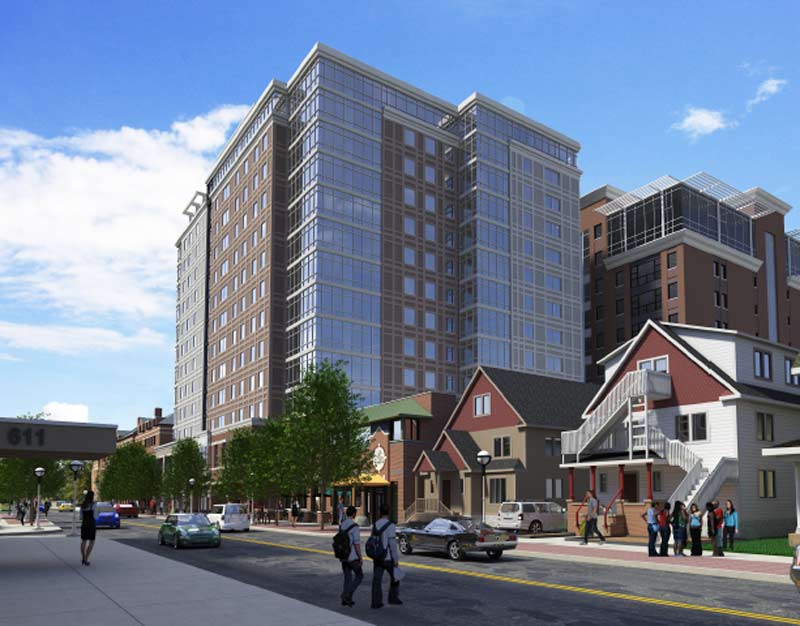
On July 7, 2011 at the Michigan League on the University of Michigan campus, representatives of “The Varsity at Ann Arbor” hosted a gathering of citizens to introduce them to the planned 13-story building. The project is proposed for Washington Street, between the 411 Lofts building and the First Baptist Church, and will be purpose-built to house 418 students in 173 rental units.

Graph on a football

When you drop the ball, even if it's shaped more like a rugby ball than a football, you still have a chance to recover the fumble.

To me, the highlight of that meeting had nothing to do with the site plan or the building design – which has evolved somewhat since The Varsity’s review on June 22 by the city’s newly created design review board.

Instead, I think the most exciting play of the citizen participation game was a kind of Hail Mary forward pass flung down the field by John Floyd, a former candidate for city council. The ball was snagged out of the air, just before it hit the turf, by Tom Heywood, executive director of the State Street Area Association.

I don’t think Floyd and Heywood play for the same team – nobody was wearing numbered jerseys at the meeting – so that might count as an interception, not a completed forward pass.

Floyd’s Hail Mary was this question: What is the benefit to Ann Arbor’s bottom line, if the new taxable value from The Varsity is subject to “capture” through the Ann Arbor Downtown Development Authority’s TIF district? [Full Story]

Downtown Planning Poised to … Pause

The July 13 partnerships committee meeting of the Ann Arbor Downtown Development Authority drew an audience of around 35 people, many of them prominent community members.

Kit McCullough, Peter Allen, Mary Hathaway, Vivienne Armentrout

Before the start of the July 13 DDA partnerships committee meeting. Back row: Kit McCullough, Peter Allen. Front row: Vivienne Armentrout (partially obscured), Mary Hathaway. (Photo by the writer)

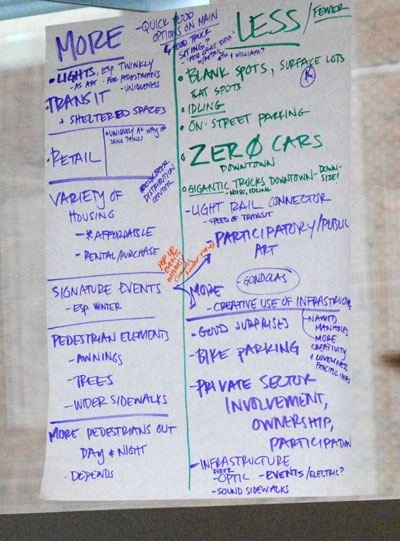
Based on the committee’s May and June meetings, many in the audience expected the committee to come up with some kind of recommendation for a public engagement process that would ultimately lead to alternate uses of some downtown city-owned parcels. The parcels currently serve as part of the public parking system. The context of the DDA’s planning for the public engagement effort is a city council resolution, approved on April 4, 2011, that outlined a detailed plan for the DDA to lead the process.

The so-called parcel-by-parcel plan emerged in late 2010 as part of “mutually beneficial” committee meetings that handled negotiations lasting over a year between the city of Ann Arbor and the DDA on a new parking contract. Under the new contract, which the two bodies finally ratified in May 2011, the DDA will continue to operate the city’s public parking system for the next 11 years.

The city council’s approval of the parcel-by-parcel plan in April and DDA partnerships committee meetings in May and June – the three months prior to Wednesday’s meeting – had provided some momentum towards translating the city council resolution into an actual timeline with action steps.

In fact, two attendees of Wednesday’s meeting had pitched their professional services to the DDA to lead that public engagement process, with events tied to tentative calendar dates. Doug Kelbaugh, former dean of the University of Michigan’s college of architecture and urban planning, and Kit McCullough, a lecturer at the college, had provided a detailed timeline of meetings they could host during the fall, with delivery of a concept plan in January 2012, which could then be used to craft requests for proposals from developers.

If the process would not be led by Kelbaugh and McCullough, the committee was expected by many in attendance at its Wednesday meeting to chart some other path forward. But that’s not where the conversation led. DDA board member John Mouat described it as a “far-reaching, vague conversation,” which he had expected it would be. At one point, committee members even expressed uncertainty about whether the DDA or the city council would lead the process.

Typically, DDA executive director Susan Pollay gleans specific direction from the vaguest of conversations by her board’s committees. But when asked by Mouat at the conclusion of the meeting if she had clear direction, Pollay allowed only that she felt like she had more direction than before the meeting.

Based on the conversation at the meeting, part of that direction is that some kind of timeline for the process – which committee members thought would take at least a year – should, if possible, be included in an October 2011 city council working session.

In a follow-up phone interview, Pollay told The Chronicle that having the October 2011 working session as a target for a proposed plan would allow the committee and the full board to use their meetings over the next two months to work on the content of that presentation to the council. Checking in with the council on the public process before settling on it, she said, was important to the board. [Full Story]

DDA Elects Officers, Gets More Parking Data

Ann Arbor Downtown Development Authority board meeting and annual meeting (July 6, 2011): Other than the ritual cancellation of its monthly meeting for August, the DDA board did not have any items on its agenda for July that required a board vote.

Bag of Rocks

To honor her past year of service as chair of the Ann Arbor Downtown Development Authority board, Joan Lowenstein was presented with a plastic bag full of gravel. (That was only part of the token of appreciation.) To Lowenstein's left is Gary Boren, who was elected chair for the next year. (Photos by the writer.)

But during the meeting, parking issues were a focus, as they usually are.

First, board member Roger Hewitt reported to the board that additional data on usage of the city’s public parking system will now be available from Republic Parking. The DDA manages the city’s public parking system under a contract with the city of Ann Arbor – the DDA subcontracts out the day-to-day operations to Republic Parking. The new kind of data measures the number of total parking hours used by parkers against the total number of parking hours that are available in the system. Based on that measure, the parking system has seen a 1.72% increase in usage over the first five months of 2011, compared with the same five months of 2010.

Second, one of the major allocations of public parking revenue the DDA makes is to the getDowntown program, a partnership among the DDA, the Ann Arbor Transportation Authority and the city of Ann Arbor. As part of a three-year funding plan for the getDowntown program approved in June 2010 for fiscal years 2011-13, the program will receive roughly $500,000 from the DDA for FY 2012 and FY 2013, the bulk of which is to subsidize the cost of rides for holders of a go!pass. The go!pass is a card that allows employees of downtown businesses to board AATA buses on an unlimited basis without paying a fare.

The getDowntown program employs two people, including director Nancy Shore. At Wednesday’s meeting, Shore gave the full board the same presentation she’d given the board’s transportation committee earlier in the month. Part of the board discussion involved which of the three funding partners – the DDA, the city of Ann Arbor or the AATA – would employ the two getDowntown staffers in the future. One possibility, which based on Wednesday’s meeting seemed likely, would be for the DDA to add the two getDowntown staffers to its administrative payroll.

At its annual meeting, convened just after the monthly board meeting, the board elected new officers for the coming year, all with unanimous consent: Gary Boren, chair; Bob Guenzel, vice chair; Keith Orr, secretary; and Roger Hewitt, treasurer.

In recognition of her service, outgoing chair Joan Lowenstein was presented with a token of appreciation by the DDA staff: a plastic bag of gravel, and a necklace featuring a lump of gravel as its centerpiece.

The connection to gravel in Lowenstein’s gift was the underground parking structure on Fifth Avenue, which is currently under construction. The board got its regular update on the status of that project, as well as commentary from the owners of two immediately adjacent restaurants – Jerusalem Garden and Earthen Jar – which have seen their business drop by 30-50% during the construction.  [Full Story]

Ann Arbor DDA Elects Board Officers

At its annual meeting on July 6, 2011, held immediately following its regular monthly meeting, the Ann Arbor Downtown Development Authority board elected its officers for the next year: chair, Gary Boren; vice chair, Bob Guenzel; secretary, Keith Orr; treasurer; Roger Hewitt.

Outgoing chair Joan Lowenstein’s term on the board ends on July 31, 2011, as does Gary Boren’s and John Mouat’s. Their possible reappointment was not discussed at the meeting, except for the question asked by board member Newcombe Clark: Will Boren’s term be renewed? Lowenstein simply stated that it was not known. Mayor John Hieftje – who sits on the DDA board and also makes the nominations to the board, which are confirmed by the city council – … [Full Story]

Ann Arbor Parking Data Gets Finer-Grained

At its regular monthly meeting on July 6, 2011, the Ann Arbor Downtown Development Authority board had no resolutions on its agenda requiring votes, except for the cancellation of its August meeting. (Cancellation of that meeting is an annual ritual.)

However, the meeting did include the regular monthly parking report – a comparison of the most recent month’s available data, compared with the same month a year ago. That regular parking report may be somewhat more detailed in the future. For the July board meeting, however, the board received its standard report.

Total public parking revenues for May 2011 were $1,218,442, based on permit holder fees plus fees paid by 170,471 hourly parkers in structures. That’s an increase from May 2010, which had $1,145,740 in total revenues and 169,466 hourly parkers.

Percentage-wise that’s a 6.35% increase in revenue and a 0.59% increase in the number of hourly parkers, with a total system parking space inventory of 19 additional spaces: 7,149 in May 2011 compared with 7,130 in May 2010.

The board has recognized for some time that this kind of measure for parking demand is somewhat coarse. The number of hourly parkers gives some insight, as does the total revenue, but these data do not provide a direct measure of how much of the system’s capacity is being used.

At the DDA board’s bricks and money committee meeting on Wednesday, June 29, Joe Morehouse – deputy director of the DDA – presented committee members with data showing the percentage of total parking hours sold for parking structures, with 100% corresponding to the (practically impossible) scenario of every spot in every space filled with a car 24/6 (structures are free on Sunday) and no time lost when one car pulls out and another pulls in. Like the standard parking report, the comparison for May 2011 against May 2011 using that metric also showed an increase in demand: 33.22% in May 2010 compared to 34.94% in May 2011. [Ann Arbor public parking efficiency chart]

This brief was filed from the DDA offices at 150 S. Fifth Ave., where the DDA board meets. A more detail report of the meeting will follow: [link] [Full Story]

Ann Arbor DDA Continues Planning Prep

At its regular partnerships committee meeting on June 8, 2011, members of the Ann Arbor Downtown Development Authority board continued their discussion, begun a month earlier, about how to implement the city council “parcel-by-parcel” resolution passed on April 4, 2011. That resolution gives the DDA responsibility for leading a process to explore alternative uses for downtown city-owned parcels: the Library Lot, old YMCA Lot, Palio Lot, Kline’s Lot, and the Fourth & William parking structure.

Doug Kelbough, Kit McCullough

Doug Kelbaugh and Kit McCullough at the June 8 partnerships meeting of the Ann Arbor Downtown Development Authority.

The parcels are currently used for parking – except for the Library Lot. It’s the construction site for an underground garage that, when completed, will offer around 640 parking spaces. The structure is engineered to bear the weight of a building on top of it that’s as tall as 180 feet.

The main event of the June partnerships meeting was a formal proposal to lead a public engagement process that would take place starting this fall. The proposal came from Doug Kelbaugh, former dean of the University of Michigan’s college of architecture and urban planning, and Kit McCullough, who teaches at the college.

The two had attended the May partnerships meeting and given a more conversational, informal version of the proposal. As laid out by Kelbaugh and McCullough this month, the process would include three phases: (1) a data gathering phase; (2) a public meeting phase – one in October to solicit input, and one in November to present two or three concepts for the public’s response; and (3) a presentational phase – in January 2012, they’d consolidate feedback into a final concept plan, which would describe massing, ground floor uses, public/civic uses and pre-schematic site design.

Before Kelbaugh and McCullough presented their proposal, the conversation among committee members and other attendees ranged across several topics – the nature of suburban versus urban, the conceptual compared to the real, and the contrast between consensus and unanimity. The attendees, both at the table and in the audience, were a formidable group. They included local developer Peter Allen, who with his brother Lane presented a more elaborate version of the “four corners” concept that Allen had briefly sketched for the DDA board at their June 1 meeting. Those corners are the Allen Creek greenway (Ann Arbor downtown); the riverfront of the Huron River; the proposed Fuller Road Station near the University of Michigan’s medical complex; and the university’s central campus.

Also in attendance was Albert Berriz, CEO of McKinley Inc., a real estate development and property management firm. When asked for his advice, Berriz emphasized dealing with real people who had real capital and real ideas. He pointed to the McKinley Towne Centre renovation at Liberty and Division streets as an example of the kind of capital and commitment that’s required. Now eight years into that project, Berriz said, it’s really only just beginning. He anticipated it would take 20 years altogether to bring the project to full fruition.

Jesse Bernstein – chair of the Ann Arbor Transportation Authority board, and former head of the Ann Arbor Area Chamber of Commerce (now the Ypsilanti-Ann Arbor Regional Chamber) – drew on the AATA’s experience over the last year or more in transit master planning. That had included a significant investment in educating the public as well as the AATA board, he said, simply in terms of what transit options are available. He also stressed that for him, “consensus is a special word.” It’s not about unanimity, he said, but rather about what you can live with.

DDA board member Russ Collins, executive director of the Michigan Theater, revisited a theme he’s highlighted before at DDA board meetings over at least the last year: Suburban versus urban development. The U.S. has seen 70 years of investment in suburban development, he said, and part of the idea of a downtown development authority is to direct at least a trickle of reinvestment in the existing infrastructure of urban centers.

Collins summed up his view of a path forward, based on the morning’s discussion, by saying, “We need to facilitate, educate and get real.” Susan Pollay, executive director of the DDA, suggested that the next partnerships meeting in July should be treated more like a retreat. The committee could settle in and figure out exactly how the DDA would meet the city council’s directive to facilitate a public engagement process to find alternate uses for downtown city-owned property. [Full Story]

Column: Taxing Math Needs a Closer Look

A bit more than a month ago, the Ann Arbor Downtown Development Authority board was poised to ratify a new contract with the city of Ann Arbor, under which it would continue to manage the city’s public parking system. But at noon on May 2, when board members met, they were greeted with some news that caused them to postpone their vote on that 11-year deal, which called for 17% of gross parking revenues to be transfered to the city of Ann Arbor.

Excess TIF Capture

Blue bars represent the "optimistic" projections of the increment valuation in the Ann Arbor DDA's TIF plan. The red line represents actual valuation of the increment on which taxes have been captured. For 2013-2014, the valuation is based on estimates in the DDA's 10-year planning document.

That news had been conveyed to DDA staff by the city of Ann Arbor’s finance department just that morning: Some of the taxes captured in the DDA’s tax increment finance (TIF) district since 2003 might be owed to local taxing units, including the city. With an uncertain financial obligation to return TIF monies that had already been captured from taxing units in the district, the DDA board understandably balked at approving the new parking contract on May 2.

The postponement of the DDA’s vote on that contract ultimately led to a delay in the Ann Arbor city council’s adoption of the city’s fiscal year 2012 budget – as the council stretched its May 16 meeting to May 23 and then on to May 31. But by the end of May, the issue of excess TIF capture had been settled to the DDA board’s satisfaction, and the parking contract was ratified – first by the DDA, and then by the city council.

The Ann Arbor city council was also content with the DDA’s proposed solution to the excess TIF capture. That solution included returning a total of roughly $473,000 to the Ann Arbor District Library, the Washtenaw Community College and Washtenaw County. The city of Ann Arbor chose to waive its $712,000 share of the calculated excess.

Those three other taxing units no doubt welcomed the news that their budgets would get an unexpected boost. But the governing bodies of those taxing units should take a closer look at how the excess TIF was calculated. If they do, they will discover that the amount actually due to be returned to them (and divided proportionately as required under the city’s of Ann Arbor’s DDA ordinance) may not be $473,000, but more than twice that: $1.27 million. In ballpark numbers, for the Ann Arbor District Library that translates to the difference between about $75,000 and $200,000. For Washtenaw County, it’s the difference between $242,000 and $648,000. And for Washtenaw Community College, it’s the difference between $157,000 and $419,000. [Full Story]

Ann Arbor Budget Marathon Ends

Ann Arbor city council meeting (May 31 session of May 16, 2011 meeting): The Ann Arbor city council finally adopted its fiscal year 2012 budget near midnight on the last day of May. The meeting had begun on May 16, was then recessed until May 23, immediately recessed again, and finally ended on May 31.

Sandi Smith, Sabra Briere

Councilmember Sabra Briere (Ward 1) makes a point during budget discussions at the Ann Arbor city council's May 31, 2011 session. In the background is Sandi Smith (Ward 1). (Photos by the writer.)

An amendment to extend funding for four police officer positions for an additional three months failed on a 5-6 vote. That means that 20 total full-time positions in the police and fire departments will now be eliminated. In terms of sworn officer positions, that translates into a loss of six police (four through layoffs) and seven firefighters (three through layoffs).

Successful amendments to the budget included: (1) use of $85,600 in general fund reserves to add to human services funding; (2) use of $90,804 in general fund reserves to add to the parks allocation; (3) use of $7,000 in general fund reserves to cover the cost of an additional city council primary election (as proposed, the FY 2012 budget anticipated primaries in only two of the city’s five wards); and (4) acknowledgment of an additional $87,452 from the Ann Arbor Downtown Development Authority’s parking fund to the city’s general fund, resulting from a newly ratified parking contract. A proposed amendment to reduce allocations to the public art program failed.

In other business related to the city’s budget, the council ratified a new contract with the DDA for management of the city’s public parking system. It’s a contract that runs for 11 years and will transfer nearly $3 million of public parking revenue to the city every year. The council rejected on a 2-9 vote a proposed amendment that would give the city council veto power on the DDA’s authority to set parking rates.

The council also approved a resolution to waive the city’s share of excess TIF (tax increment finance) capture in the DDA’s district – that amounts to $712,000 that won’t be paid to the city. [Full Story]

Regular Budget Maintenance for DDA

Ann Arbor Downtown Development Authority board meeting (June 1, 2011): At its regular monthly meeting, the DDA board performed the annual exercise of revising its budget to match actual expenditures for the fiscal year, which ends June 30. It was the only item on the agenda requiring a vote, which was unanimous. The DDA’s FY 2011 budget showed $23,038,310 in expenses against $19,111,321 in total income.

Roger Hewitt, John Hieftje, Leah Gunn

Left to right: Roger Hewitt, mayor John Hieftje, Leah Gunn. Hewitt, a DDA board member, had just handed over a check for $1 million to the mayor. It was the second half of a payment the DDA had agreed to make last year, which had not been required as part of the DDA's parking contract with the city. (Photos by the writer.)

At Wednesday’s meeting, the board also recapped the previous night’s session of the Ann Arbor city council, which had been a continuation of the meeting that began on May 16. At that meeting, the council had finally ratified its side of a new contract under which the DDA would continue to manage the city’s public parking system.

Key elements of that contract include a transfer to the city of Ann Arbor of 17% of annual gross parking revenues, reporting requirements by the city to the DDA about parking enforcement and street repair, and the ability of the DDA to set parking rates and hours without a city council veto.

The DDA board will likely schedule an extended board meeting in September to prepare for a contractually-required joint working session with the city council, which will include a discussion of parking rates and hours of enforcement.

Included in the usual range of the DDA’s reports from its committees was a review of a recent partnerships committee meeting, when DDA board members began to consider how they would handle the responsibility to plan future uses of city-owned surface parking lots downtown. The DDA was given that responsibility in a city council resolution passed at the council’s April 4, 2011 meeting. [Full Story]

DDA Does Routine Budget Maintenance

At its June 1, 2011 meeting, the board of the Ann Arbor Downtown Development Authority approved revisions to its current fiscal year’s budget in order to square it up with recent decisions it’s made, including the ratification of a new contract with the city of Ann Arbor, under which it would continue to manage the city’s parking system. The DDA board ratified its side of the contract on May 27. The city council voted to ratify it on May 31.

The regular rectifying of the approved budget with the actual expenditures takes place every year. It included a host of other adjustments not directly related to the new parking contract.

This brief was filed from the DDA offices located at … [Full Story]

City Accepts Prior Payment for Excess TIF

At the May 31, 2011 session of its meeting that had begun two week before, on May 16, resumed briefly on May 23, only to be immediately recessed, the Ann Arbor city council agreed to accept prior contributions of the Ann Arbor Downtown Development Authority toward city of Ann Arbor projects as payment for the city’s share of excess tax increment finance (TIF) capture that the DDA has received since 2003.

At a special meeting on Friday, May 20, the DDA had calculated that a total of $1,185,132 should be returned to taxing authorities that levy property taxes in the downtown district. The city’s share of that is $711,767. The council’s resolution states that the acceptance of prior contributions to city … [Full Story]

Council Ratifies Parking Contract, Backstop

At the May 31, 2011 session of its meeting that had begun two weeks before, on May 16, the Ann Arbor city council voted to ratify its side of a contract with the Ann Arbor Downtown Development Authority to continue to manage the city’s public parking system. The contract would transfer 17% of the parking system’s gross revenues to the city. An amendment offered by Sabra Briere (Ward 1) to retain a veto for the city council on parking rates failed on a 2-9 vote, getting support only from Briere and Stephen Kunselman (Ward 3).

The vote on the contract was unanimous.

The DDA had ratified its side of the deal at a special meeting convened last Friday, May 27. The contract, which has now been ratified by both the city and the DDA, would give the DDA the sole authority to set parking rates. Under the old contract, the DDA proposed rate changes, which were then automatically enacted unless the city council acted to veto them. The new contract requires consultation by the DDA with the city on parking rate changes.

As part of the contract, the city council also approved an “underwriting” or “backstopping” clause to the contract, which is to run over an initial 11-year term, with one 11-year renewal option. Key features of that clause include: (1) it’s applicable only through 2016; (2) it’s triggered if combined the DDA fund balance falls below $1 million; (3) the trigger is evaluated based on the annual audit of DDA books in September or October, for the previous fiscal year; (4) if underwriting were triggered, it would take the form of reducing existing payments that the DDA makes to the city; (5) the city’s liability is limited to $1 million annually and $2 million cumulatively; and (6) any money the city is deprived of through this underwriting would be restored to the city, at whatever point the DDA’s cumulative fund balance reaches $4 million.

During the parking contract discussion, Kunselman did not offer a planned resolution that would have amended the city’s fiscal year 2012 budget by transferring the balance in the DDA’s parking fund to the city, eliminating two DDA employees, and using the proceeds of that move to fund police officer positions.

This brief was filed from the city council’s chambers on the second floor of city hall. located at 301 E. Huron. A more detailed report will follow: [link] [Full Story]

DDA Finalizes Its Side of Parking Deal

Ann Arbor Downtown Development Authority special board meeting (May 27, 2011): At a special DDA board meeting held at noon on Friday, board members voted to give final approval to a contract under which the DDA would continue to manage the city’s public parking system. The vote was unanimous among the 10 board members who attended. Absent were Gary Boren and Newcombe Clark.

Roger Hewitt John Hieftje Leah Gunn

(Left to right): DDA board members Roger Hewitt, mayor John Hieftje, and Leah Gunn at the special May 27 DDA board meeting. (Photos by the writer.)

The financial part of the contract calls for the city to receive 17% of gross revenues from the public parking system, and would have an initial term of 11 years, with one renewal option for another 11 years. That would end the contract in 2033, which coincides with the DDA’s currently established endpoint.

The contract includes a new underwriting clause for the DDA’s fund balance. Key features of that clause are: (1) it’s applicable only through 2016; (2) it’s triggered if combined DDA fund balance fall below $1 million; (3) the trigger is evaluated based on the annual audit of DDA books in September or October, for the previous fiscal year; (4) if underwriting were triggered, it would take the form of reducing existing payments that the DDA makes to the city; (5) the city’s liability is limited to $1 million annually and $2 million cumulatively; and (6) any money the city is deprived of through this underwriting would be restored to the city, at whatever point the DDA’s cumulative fund balance reaches $4 million.

After brief deliberations, the DDA board voted unanimously to ratify the contract, which now includes the underwriting clause. [.pdf of ratified draft contract]

With that vote, the DDA board also approved a new contract clause that specifies how the DDA board and city council will handle a contractually required consultation between the two groups, in conjunction with parking rate changes. The consultation by the DDA will now be a required agenda item at annual joint working sessions between the DDA board and the city council. Currently, the DDA proposes rate changes, which are automatically enacted, unless the city council vetoes them. The new contract stipulates that the DDA would have sole authority to set rates.

The city council may now ratify the parking contract on Monday, May 31, which would help settle part of the city’s revenue issues in its fiscal year 2012 budget. It would allow the council to finalize its budget on that same evening. [For additional background, see Chronicle coverage: "Ann Arbor Council Defers Action Again"]

Councilmembers Sabra Briere (Ward 1) and Stephen Kunselman (Ward 3) sat in the audience of the DDA’s May 27 meeting. On May 31, the contract could face stiff opposition from at least those two, and possibly other councilmembers. After the DDA’s May 27 board meeting, Kunselman characterized the underwriting clause to The Chronicle as a “no-layoff clause for the DDA.”

Another lingering DDA issue that could result in discussion not just by the Ann Arbor city council – but also by the Washtenaw Community College board of trustees, the Washtenaw County board of commissioners, and the Ann Arbor District Library board – is the return of excess TIF capture by the DDA. [Full Story]

Ann Arbor DDA Ratifies Parking Contract

At a special board meeting of the Ann Arbor Downtown Development Authority, held at noon on May 27, 2011, the DDA board voted to give final ratification to a contract under which the DDA would continue to manage the city’s public parking system. The vote was unanimous among the 10 board members who attended. Absent were Gary Boren and Newcombe Clark.

At a special meeting held last week on May 20, the DDA board had initially ratified the contract, with a contingency that the city of Ann Arbor would provide an amendment that adequately underwrites DDA fund balances. Then at a Wednesday, May 25 meeting of two “mutually beneficial” committees – one from the city council and one from the … [Full Story]

Another Special Meeting for Ann Arbor DDA

At a Wednesday, May 25, 2011 joint meeting of the “mutually beneficial” committees – one from the Ann Arbor city council and the other consisting of Ann Arbor Downtown Development Authority board members – committee members agreed on language that would serve to “underwrite” the DDA’s combined fund balances for the next five years. A special DDA board meeting has been set for Friday, May 27 to ratify the agreement.

The underwriting was a necessary condition of the DDA’s ratification of a new contract with the city, under which the DDA would continue to operate the city’s public parking system. At a special meeting last Friday, May 20, the full DDA board had approved a contract that would transfer 17% … [Full Story]

Ann Arbor Council Defers Action Again

Ann Arbor city council meeting (May 23, 2011 session of May 16 meeting): At a continued session from its May 16 meeting, the Ann Arbor city council was expected to wrap up outstanding issues related to the Ann Arbor Downtown Development Authority. Those issues include: (1) ratification of a new contract under which the Ann Arbor Downtown Development Authority would continue to manage the city’s public parking system; and (2) acceptance of prior contributions by the DDA to city projects, as payment for excess tax increment finance (TIF) revenues that have been captured in the DDA’s TIF district since 2003.

Hohnke, Taylor, Teall, Higgins, Briere

Members of the city council's "mutually beneficial" committee, who are tasked with negotiating terms of a parking contract with the DDA (left to right): Carsten Hohnke (Ward 5), Christopher Taylor (Ward 3), Margie Teall (Ward 4). In the right of the frame are Marcia Higgins (Ward 4) and Sabra Briere (Ward 1). The five were conferring after the May 23 council session had recessed.

Settling those issues, which were crystallized at a special meeting of the DDA board on Friday, May 20, would allow the council to make final decisions on the fiscal year 2012 budget. While the fiscal year starts on July 1, the council is required by the city charter to adopt the budget, with any amendments, no later than its second meeting in May. If the council fails to act by then, the budget proposed by the city administrator in April is considered to be adopted. That budget currently calls for eliminating a total of 20 positions in the police and fire departments. Several firefighters attended Monday’s meeting.

After a few introductory remarks from mayor John Hieftje, instead of settling the outstanding DDA issues, the council voted immediately to recess the meeting – again – to be continued on May 31 at 7 p.m. The twice-paused meeting counts as the same meeting that began on May 16.

Hieftje’s introductory comments alluded in part to some remarks made at the council’s May 16 session about a “rainy day fund,” which had prompted the mayor to ask the city attorney’s office to draft a response. As part of his introductory comments, Hieftje also explained that he and Christopher Taylor (Ward 3) had worked on drafting language that would provide some assurance to the DDA that the city would “backstop” the DDA’s fund balances, but said they were not ready to offer a resolution to the council that evening.

The immediate vote to recess the meeting again prevented Stephen Kunselman (Ward 3) from introducing a resolution that calls for moving responsibility for the public parking system back to the city of Ann Arbor from the DDA, and reducing the number of DDA staff from four to two.  The resolution would almost certainly not have passed as drafted – but there could be some interest on the council, as well as on the DDA board, for establishing an oversight body for the parking system that would not be the DDA.

Following city council’s inaction, a joint meeting of the two “mutually beneficial” committees – one from the DDA board, another from council – has been scheduled for Wednesday, May 25 at 7:30 a.m. at the DDA’s offices at 150 S. Fifth Ave. The committees have been negotiating the parking contract for more than a year. [Full Story]

To Be Continued: Ann Arbor Council

The gathering of Ann Arbor city council members tonight – May 23 – counts not as a separate meeting, but rather as a continuation of the same meeting the council began on May 16. Because of issues that could remain unresolved, councilmembers are likely to recess tonight’s meeting as well, to be continued on Tuesday, May 31 – after the Memorial Day holiday.

This is a preview of the council’s continued meeting, which starts at 7 p.m. in council chambers at city hall. Topics that council might address include excess TIF (tax increment finance) capture in the Ann Arbor Downtown Development Authority district, a new parking contract with the DDA, and possible amendments to the FY 2012 budget. Factors that might play a role in council’s deliberations include alternative calculations of the excess TIF capture, and issues of control regarding components of the proposed parking contract – such as giving the DDA sole authority to set parking rates. [Full Story]

DDA: Parking, Excess Taxes Still Not Done

Ann Arbor Downtown Development Authority special board meeting (May 20, 2011): A special meeting held by the board of the DDA on Friday was meant to give some final resolution to the DDA’s side of a new contract under which it would continue to operate the city’s public parking system.

Bob Guenzel, John Mouat, Sandi Smith, Russ Collins, DDA special board meeting

Left to right: DDA board members Bob Guenzel, John Mouat, Sandi Smith, and Russ Collins at the May 20 DDA special board meeting. Obscured from view between Guenzel and Mouat is John Hieftje. They were distributing the paper handouts with calculations of excess TIF revenues. (Photos by the writer.)

It was also intended to settle the matter of excess capture of TIF (tax increment finance) revenue in the DDA district – an issue raised by the city of Ann Arbor just before the DDA board had originally planned to vote on the new parking contract on May 2.

The board did vote on Friday to affirm a calculation by DDA staff that roughly $473,000 of excess TIF capture since 2004 would be divided among the following taxing authorities, which have a portion of their tax revenues captured in the DDA TIF district: Washtenaw County; Washtenaw Community College; and the Ann Arbor District Library.

Based on a representation at the special meeting by mayor John Hieftje – who has a statutory seat on the DDA board – the city of Ann Arbor is likely to agree to “forgive” the $711,767 in excess TIF capture that would be due to the city. More than that amount has effectively already been returned to the city, in the form of a roughly $0.5 million annual grant to the city to help make bond payments on its new municipal center, and a $1 million expenditure to demolish the old YMCA building, as well as other grants. In total, around $7.5 million has gone to the city, according to the DDA.

At Friday’s special meeting, the DDA board also voted to ratify its side of a new contract under which it would continue to operate the city’s public parking system. Among other features, the new contract would obligate the city of Ann Arbor to report regularly on how it is using public parking system revenues for street repair in the downtown, and how it is enforcing parking regulations downtown.

More controversially, the new contract would allow the DDA to set parking rates. Currently, the DDA forwards proposed rate changes to the city council, which can then veto the DDA’s proposal if it acts within 60 days. If the council does not act to block the rate change, the change is enacted. Although Hieftje said at the DDA board meeting he felt there was adequate support on the council to approve such a contract, there are currently at least five likely no votes on the 11-member council.

Also controversial is the exact percentage of gross revenues the city would receive from the public parking system. Before the issue of the excess TIF capture arose, the DDA board was poised to ratify a parking contract that would transfer 17% of gross parking revenues to the city of Ann Arbor’s general fund. At Friday’s special meeting, the resolution before the board dropped that number to 16%. Hieftje proposed an amendment to raise the figure to 17%. That amendment was attached to a contingency that the city council would provide a plan amendable to the DDA in which the city would “underwrite” the DDA’s fund balances. It was the 17% with a contingency that the DDA board passed.

So the special DDA board meeting did not settle with finality either the issue of the excess TIF capture or the DDA’s side of the parking contract. For the TIF capture issue, the relevant taxing authorities – especially the city of Ann Arbor – will need to affirm the solution that the DDA board approved.

For the parking contract issue, the DDA’s contingency means that the city council’s Monday, May 23 meeting – which is a continuation of its May 16 meeting, when it was supposed to approve the FY 2012 budget – will likely be recessed and continued again on May 31.

One possibility for how events would unfold is this: (1) May 23 – the city council ratifies the city’s side of the parking contract and provides the plan for underwriting DDA fund balances; city council also deliberates and amends FY 2012 budget but does not take a final vote on it; (2) May 24-27 – DDA schedules a special meeting to accept the parking contract contingency; and (3) May 31 – city council resumes the meeting started May 16 and previously continued on May 23, and approves FY 2012 budget. [.pdf of draft parking contract] [Full Story]

Ann Arbor DDA to Return $473K in Taxes

At a special meeting held at noon on Friday, May 20, the board of the Ann Arbor Downtown Development Authority voted to return $473,365 in taxes previously captured as part of the DDA’s tax increment finance (TIF) district. The money will be divided among three taxing authorities: Washtenaw County ($242,179); Washtenaw Community College ($156,520); and the Ann Arbor District Library ($74,666).

The decision was prompted by questions raised on Friday, April 29 by the city of Ann Arbor about the implementation of the city’s ordinance governing TIF capture for the DDA district. The ordinance includes a clause stipulating that if the growth rate in the TIF capture exceeds what is anticipated in the formal TIF plan, at least half of the excess must be divided proportionately among the taxing authorities that had some of their taxes captured in the TIF district.

The total amount of excess TIF capture that has accumulated since 2004 in the Ann Arbor DDA district is $1,185,132. The difference between that total and the combined $473,365 to be paid to Washtenaw County, WCC and AADL is $711,767. That difference is the proportionate share that would be due to the city of Ann Arbor (including the Ann Arbor Transportation Authority), which also has some of its taxes captured in the DDA TIF district. In fact, around 60% of the taxes captured in the TIF district are due to city of Ann Arbor millages.

However, Friday’s resolution included a “whereas” clause indicating that the city of Ann Arbor is likely to recognize that the $711,767 in excess TIF capture has effectively already been returned to the city, in the form of (1) a roughly $0.5 million annual grant to the city to help make bond payments on its new municipal center, and (2) a $1 million expenditure to demolish the old YMCA building, as well as other grants.

The determination of the excess was based on: (1) the “optimistic” projections in the TIF plan; (2) the combined real and personal property valuations in the district; and (3) excess growth calculated by comparing the actual growth rate between successive years against the forecast growth rate in the TIF plan between those years.

The payments to the other three taxing entities are planned to be made before June 30, making them a part of the 2011 fiscal year, which ends June 30. That will require the board to amend the FY 2011 budget.

The financial impact of the payments on the DDA led the board on Friday to review the financial component to the new contract currently being negotiated with the city under which the DDA operates Ann Arbor’s public parking system.

Before the excess TIF issue came to light, the DDA board had been prepared on May 2 to agree to a contract that would have transferred 17% of gross parking revenues to the city each year. Gross parking revenues are projected to be around $16 million in the next year.

At Friday’s meeting, the DDA board ratified its side of an agreement that would transfer 17% of gross parking revenues to the city, but added a contingency that would require the city of Ann Arbor to formalize a plan proposed by mayor John Hieftje to backstop fund balances for the DDA.

The contingency means that the city council’s May 16 budget meeting, which is continuing on May 23, will likely continue past that Monday to resume again on Tuesday, May 31. Hieftje, who also sits on the DDA board, said he felt there would be sufficient support on the council on May 23 to ratify the parking contract and formalize the backstopping plan.

The DDA will need to schedule another special meeting the week of May 23 after the council meets to resolve the contingency. The council would then be able to finalize its budget on May 31.

This brief was filed from the DDA’s offices at 150 S. Fifth Ave., where the special meeting took place. A more detailed report will follow: [link] [Full Story]

DDA Preps Downtown Ann Arbor Process

At its regular partnerships committee meeting on May 11, 2011, the Ann Arbor Downtown Development Authority board began discussing how to implement the city council “parcel-by-parcel” resolution passed on April 4, 2011. That resolution gives the DDA responsibility for leading a process to explore alternative uses for downtown parcels: the Library Lot, old Y Lot, Palio Lot, Kline’s Lot and the Fourth and William parking structure.

Area of focus for DDA-led development process

Light pink areas are all city-owned land. The red outlined area is the DDA tax district. The green rectangle is the smaller area of focus for which the DDA has been given responsibility to lead a process to explore alternative uses of city-owned surface parking lots. The green rectangle is bounded by Ashley, Division, Liberty and William streets. (Links to higher resolution image. Map data is available on the city's website at a2gov.org/data)

The parcels are currently used as surface parking lots – except for the Library Lot, which is the construction site for an underground parking garage that, when completed, will offer around 640 parking spaces. It was previously a 192-space surface parking lot.

The committee meeting included a presentation on the city’s sewer system from Cresson Slotten, a manager with the city of Ann Arbor’s systems planning unit.  The agenda also included a conversation with Doug Kelbaugh, former dean of the University of Michigan’s college of architecture and urban planning, and Kit McCullough, who teaches at the school. The two are interested in helping facilitate the public process stipulated in the city council parcel-by-parcel resolution. Also interested in sharing information he’s gathering from downtown property owners is Peter Allen, a local developer who attended the partnerships meeting.

One major theme that emerged during the committee’s discussion is the idea that a public space can be successful if it is programmed, used and supported by the community, even if its design is lacking.

The parcel-by-parcel resolution was passed at the same meeting that the council voted to terminate the review process for proposals the city had solicited for use of the top of the underground parking structure.

The termination of that RFP review process came just before the council was supposed to consider formally signing a letter of intent to hammer out a development agreement for the finalist project – a hotel/conference center proposed by Valiant Partners. [Chronicle coverage: "Ann Arbor Council Focuses on Downtown"] [Full Story]

DDA Delays Parking Vote Amid TIF Questions

Ann Arbor Downtown Development Authority board meeting (May 2, 2011): At its Monday meeting, the DDA board was expected to ratify its side of a new contract under which the DDA would continue to operate the city of Ann Arbor’s public parking system.

John Hieftje Roger Hewitt

Mayor John Hieftje (left) and DDA board member Roger Hewitt (right) head to their seats to start the DDA's board meeting. (Photos by the writer.)

Instead, the board received this news from the chair of its bricks and money committee: The city has raised the possibility that the DDA might need to return money to various taxing entities – including the city of Ann Arbor – from the taxes captured through the DDA’s tax increment finance district. The city communicated its concern to the DDA on Monday morning, the day of the noon meeting.

The issue concerns the DDA’s TIF plan, which was renewed in 2003, and language in the city’s ordinance establishing the DDA under the state’s enabling legislation. The TIF plan contains projections for the growth in taxable value of property (both real and personal) in the district. The city’s ordinance stipulates that if the actual “captured assessed valuation” grows at a rate faster than the expectation expressed in the TIF plan, then at least 50% of the additional amount must be returned proportionately to the taxing authorities from which the taxes were captured.

The vagueness of the ordinance language leaves several open questions that will require further review by the city attorney’s office and the DDA’s own legal counsel, as well as the financial staff from both organizations.

Those questions include: (1) What’s the relevant time period? (2) Which set of TIF plan estimates are applicable – the one labeled pessimistic, optimistic or realistic? (3) Who is the responsible party for adherence to the ordinance? (4) Does the ordinance language refer to real property only or also to personal property? (5) Do payments already made by the DDA to the city of Ann Arbor out of the TIF for the new municipal center count towards any sum that might need to be returned?

After hearing the news, the board decided to table the resolution on its agenda that would have ratified the DDA’s side of a new parking contract under which it would continue to manage the city’s parking system. [Previous Chronicle coverage: "Column: Ann Arbor Parking – Share THIS!"]

Board members recognized that it would likely be necessary to convene a special meeting of the board, given the city’s need to approve its budget on May 16. Later the same day, on the evening of May 2, the city council struck from its agenda the item that would have ratified the city’s side of the new parking contract. The city council has not yet weighed in on the text of the contract, but did express its view on the financial terms at its April 19 meeting.

As DDA board members absorbed the news about the TIF question, they heard their usual set of reports from their committees and wrapped up the meeting is less than an hour – they had no further business to transact. Board member Russ Collins, who was prepared to call in to the meeting from Detroit, where he’d been summoned for federal jury duty, did not need to do that.  [Full Story]

Balancing Ann Arbor, Detroit – and a Vision

By

[Editor's Note: HD, a.k.a. Dave Askins, editor of The Ann Arbor Chronicle, is also publisher of an online series of interviews on a teeter totter. Introductions to new Teeter Talks, like this one, also appear on The Chronicle's website.]

Dante Chinne Patchwork Nation

Dante Chinni, co-athor of "Our Patchwork Nation." That's a Tigers cap he's wearing, and it's not accidental.

“I don’t want to be another city. I resent the fact that we are compared to other cities when projects are being proposed.”

That was Ali Ramlawi, owner of the Jerusalem Garden on South Fifth Avenue in downtown Ann Arbor, addressing the April 4, 2011 meeting of the Ann Arbor city council. He was criticizing the Ann Arbor Downtown Development Authority, and advocating against a proposed conference center and hotel project on the Library Lot – the council voted the project down later that evening.

“Ann Arbor will change … but it won’t become Detroit.”

That was Dante Chinni, while riding the the teeter totter on my front porch last Thursday afternoon. Chinni has made it part of his job to compare communities like Ann Arbor – Washtenaw County, actually – to other places in the country.

Who is Dante Chinni? And why should Ann Arbor care what he thinks?

On his website, Chinni describes himself as a “a card-carrying member of the East Coast Media Industrial Complex.” The part of his job that lets him compare one place to another – in a statistically sophisticated way – is a project Chinni conceived called Patchwork Nation. It’s funded by the Knight Foundation. The effort has already produced a book, which he co-authored with James Gimpel: “Our Patchwork Nation: The Surprising Truth about the ‘Real’ America.”

Washtenaw County is featured in the chapter that introduces readers to the concept of a “Campus and Careers” community type. The classification, as well as a read through Dante’s Talk, confirm that mostly what defines Ann Arbor – at least for people on the outside looking in – is its place as the home of the University of Michigan. And certainly for people on the inside, it’s difficult to argue that UM isn’t currently the single most important institution in the community.

But some insiders – and by this I mean not just people who live, work and play here, but actual Ann Arbor insiders – are starting to float the question of what else Ann Arbor might aspire to be besides home to “the most profound educational institution in the Midwest.” [Full Story]

City, DDA Continue to Talk Parking, Taxes

Ann Arbor Downtown Development Authority board meeting (April 6, 2011): Since June 2010, the city of Ann Arbor and the Ann Arbor DDA have been negotiating a new contract under which the DDA would continue to operate the city’s public parking system.

While the city and the DDA have achieved much agreement on the non-monetary details of the arrangement, Wednesday’s board meeting left the financial piece still unclear.

Keith Orr DDA Ann Arbor

Keith Orr pores over the figures under various scenarios for the new contract under which the DDA would operate the public parking system. (Photos by the writer.)

The board discussion included a focus on the contrast between the combined fund reserve of the DDA – which includes those funds it collects as a tax-increment finance authority – and the reserves of just the public parking fund. Sandi Smith, who’s a DDA board member and an Ann Arbor city councilmember, stressed throughout the conversation that it’s not just the overall fund balance, but the public parking fund balance itself that needs to be monitored.

Last week, the board had come to a consensus that the public parking system could absorb a payment to the city equal to 16% of gross parking revenues in every year of a 10-year contract, which represented a revision upward from its previous position of 14% in the first two years, followed by 15% in subsequent years.

After lengthy back-and-forth, the only consensus reached by DDA board members was that they were not prepared to revise their position upward (again) to meet the city’s request that the city be paid 16% of the public parking gross revenues in the first two years of the contract, but 17.5% in remaining years. Mayor John Hieftje, who serves on the DDA board, was the lone voice of support for that position.

The mayor also found himself somewhat isolated on another issue in front of the board at its Wednesday meeting – the only action item on the agenda. The board voted to sign a new, more favorable lease agreement for its roughly 3,000 feet of office space at 150 S. Fifth Ave. for a term of five years.

Although the mayor voted with the rest of the board in authorizing the lease agreement, he had announced at the city council’s Monday, April 4 meeting that he would be asking his fellow DDA members to consider moving into space that’s currently being renovated in the city hall building. Two days later, at Wednesday’s DDA board meeting, the mayor appeared to understand that there was little enthusiasm on the board for the move, based partly on the fact that it would cost the DDA more in the short term.

At the meeting, the board also heard its usual range of reports and communications, including an update from DTE on the addition of a new substation near the Broadway bridge, to meet increased demand for electricity. [Full Story]