Stories indexed with the term ‘Ann Arbor Greenbelt Advisory Commission’

Greenbelt Commission Seeks New Members

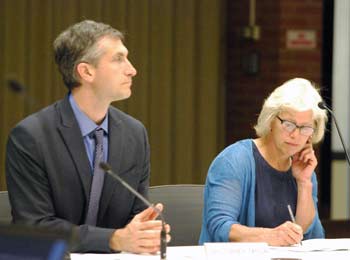
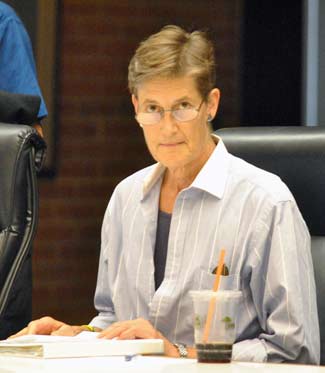
Ann Arbor greenbelt advisory commission meeting (May 2, 2013): This month’s GAC meeting was highlighted by remarks from a likely new member – Stephanie Buttrey, an engineer and retired Chrysler executive. She’s being nominated to serve out the remainder of Liz Rother’s term through June 30, 2014, and is expected to be confirmed by the city council on May 6.

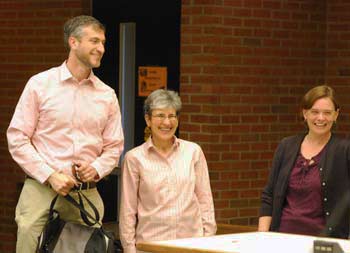
Christopher Taylor, Stephanie Buttrey, Ginny Trocchio, Ann Arbor greenbelt advisory commission, The Ann Arbor Chronicle

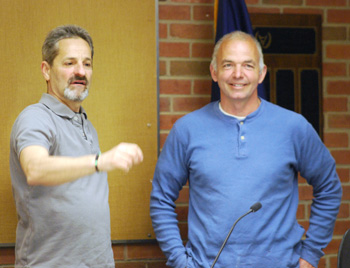
From left: Ann Arbor city councilmember Christopher Taylor, Stephanie Buttrey and Ginny Trocchio, who provides staff support for the Ann Arbor greenbelt advisory commission. Taylor serves on GAC, and Buttrey is being nominated to the commission. When asked by GAC chair Dan Ezekiel, Taylor and Buttrey reported that they did not coordinate their choice of pink shirts. (Photos by the writer.)

Buttrey told commissioners that she’s a 50-year Ann Arbor resident and University of Michigan graduate who’s interested in land preservation. Dan Ezekiel – GAC’s chair – said she’ll bring common sense, business acumen and knowledge to the commission.

Ezekiel also noted that there are other vacancies that need to be filled. GAC’s June 6 meeting will be the last one for him and two other term-limited commissioners – Tom Bloomer and Laura Rubin. “So all of you people watching us breathlessly on TV, please send in your applications,” he said. [.pdf of application form for city boards and commissions]

GAC’s May 2 meeting was also attended by Barry Lonik, a land conservation consultant who is representing Ann Arbor Township in a possible greenbelt deal. He was invited into the commission’s closed session to share communications about the property.

When commissioners emerged from the closed session, they unanimously voted to recommend that the city council pursue the purchase of development rights for two properties, including one in Ann Arbor Township. Before appearing on the city council’s agenda, details of proposed greenbelt acquisitions are not made public. Parcels are identified only by their application number.

At the end of the meeting, Ezekiel marked the recent death of Charles Braun, describing him as a very influential leader in the local farm community. Braun’s property – a 286-acre farm in Ann Arbor Township – has been preserved as part of the Ann Arbor greenbelt program. [Full Story]

Commissioners OK Greenbelt Strategic Plan

Ann Arbor greenbelt advisory commission meeting (April 4, 2013): An updated strategic plan for the city’s greenbelt program received unanimous approval at this month’s GAC meeting. The plan included only minor changes since the draft was reviewed in September of 2012.

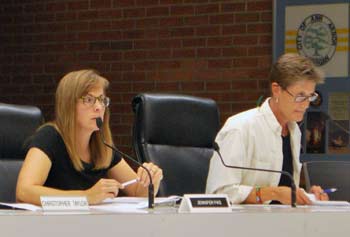
Jennifer Fike, Huron River Watershed Council, Ann Arbor greenbelt advisory commission, The Ann Arbor Chronicle

Jennifer Fike, finance director of the Huron River Watershed Council, is interested in joining the greenbelt advisory commission. If nominated and confirmed by the city council, she would replace Laura Rubin, HRWC’s executive director, whose term on the commission ends in June. (Photos by the writer.)

The plan lays out a broad range of goals for the preservation of farmland and open space within the greenbelt boundaries. There are no significant changes from the last version approved in 2009, although the plan does include a new section on education and outreach.

The plan also includes the goal of establishing a greenbelt registry program, to formalize relationships with landowners who aren’t yet part of the greenbelt program, but who are committed to the program’s principles of land preservation. “It’s creating a pipeline of projects for the future,” said Dan Ezekiel, GAC’s chair. Three commissioners – Peter Allen, Shannon Brines and Archer Christian – agreed to work with Ginny Trocchio, who manages the greenbelt program, to develop a proposal for the full commission to consider.

Also at the April 4 meeting, Jennifer Fike – finance director for the Huron River Watershed Council – was introduced as a possible replacement on the commission for Laura Rubin. Rubin, who serves as HRWC’s executive director, fills a position on GAC that’s designated for an environmental organization. Her term ends on June 30. Because she is term-limited, she can’t be re-appointed.

Ezekiel noted that there are other vacancies as well, and that anyone who’s interested in applying should contact their city council representative. [.pdf of application form for city boards and commissions] Meetings for the commission are scheduled monthly, although the April meeting was only GAC’s second one in 2013. Both the January and March meetings were canceled. [Full Story]

Special Public Art Meeting Set; Others Canceled

A special meeting of the Ann Arbor public art commission has been called for Thursday, March 7 starting at 4:30 p.m. in the fifth floor conference room at city hall, 301 E. Huron. The possibility of a special meeting had been discussed at AAPAC’s regular meeting on Feb. 27, 2013. The main agenda item will likely be a possible memorial to Coleman Jewett – a bronze Adirondack chair at the Ann Arbor farmers market. Although a donor has come forward with funding for the project, it has not yet been formally accepted by AAPAC.

Separately, two meetings related to the city of Ann Arbor’s parks and open space programs were canceled this week. A subcommittee of the park advisory commission … [Full Story]

Greenbelt Group Praises Year-End Efforts

Ann Arbor greenbelt advisory commission meeting (Feb. 7, 2013): At their first meeting of 2013 – because the January session had been canceled – commissioners formally thanked individuals who’d made an extra effort on end-of-year land deals for the greenbelt program.

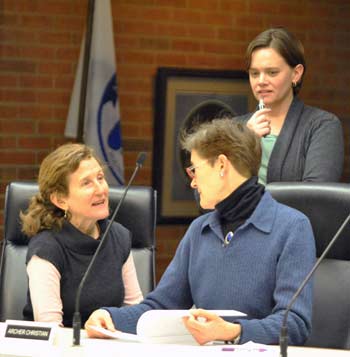
Ann Arbor greenbelt advisory commission, Laura Rubin, Archer Christian, Ginny Trocchio, The Ann Arbor Chronicle

From left: Ann Arbor greenbelt advisory commissioners Laura Rubin and Archer Christian, and Ginny Trocchio (standing) of The Conservation Fund, who provides staff support for the greenbelt program. (Photos by the writer.)

A resolution of recognition was presented to Mary Fales, senior assistant attorney for the city of Ann Arbor; Matt Keir, vice president of Liberty Title; Rosanne Bloomer, a lending officer for Greenstone Farm Credit Services – and wife of GAC commissioner Tom Bloomer; and Ginny Trocchio of The Conservation Fund, who provides staff support for the greenbelt program.

GAC chair Dan Ezekiel praised their work, noting that certain factors – including a change in tax law – had added pressure to complete the deals before Dec. 31. The transactions protected a total of about 320 acres in Webster, Salem and Superior townships.

Trocchio also reported that the purchase of development rights for part of the Donald Drake farm – 124 acres of farmland in Lodi Township – had closed earlier this year, making it the first deal of 2013. More than 4,200 acres have now been protected under the greenbelt program, she noted.

Another topic highlighted at the Feb. 7 meeting was the need to recruit new members for the commission. Liz Rother resigned earlier this year, though her term runs through June 30, 2014. Ezekiel also pointed out that he and two other commissioners – Laura Rubin and Tom Bloomer – will be leaving the commission this summer, when their terms expire. All three are term-limited. He urged members of the public to consider applying.

The meeting ended with commissioners voting to approve recommendations for additional land preservation deals. Two of those items – seeking approval to apply for grants from the U.S. Department of Agriculture’s Farm and Ranchland Protection Program (FRPP) – are now on the agenda for the Ann Arbor city council’s Feb. 19, 2013 meeting. The properties are both in Lodi Township: (1) another part of the Drake farm – 72 acres along Waters Road; and (2) the Carol Schumacher farm – about 100 acres along Pleasant Lake Road. [Full Story]

Greenbelt Commission Wraps Up 2012

Ann Arbor greenbelt advisory commission meeting (Dec. 6, 2012): Commissioners ended the year with a relatively brief meeting, which included a vote to smooth the way for land preservation in 2013.

Christopher Taylor, Ann Arbor greenbelt advisory commission, Ann Arbor city council, The Ann Arbor Chronicle

Christopher Taylor, a Ward 3 Ann Arbor city councilmember, was recently appointed to the city’s greenbelt advisory commission and attended his first meeting on Dec. 6. (Photos by the writer.)

GAC members authorized staff to proceed with property appraisals, as needed, to prepare for possible grant applications to the U.S. Department of Agriculture’s Farm and Ranchland Protection Program (FRPP). There’s some uncertainty about how much grant funding will be available, but Ginny Trocchio – who provides staff support for the greenbelt program – anticipates the deadline to apply will be in early March. She is seeking landowners who might be willing to sell their property’s development rights in deals that would be eligible for FRPP grants.

Trocchio also noted that the city hopes to close on five pending deals by the end of 2012. If that happens, it would bring the total amount of land protected through the greenbelt to about 4,200 acres. The program is funded by a 30-year millage approved by Ann Arbor voters in 2003, and organizers at that time hoped to preserve between 3,500 to 4,500 over the life of the millage. Land prices have fallen since that time because of the economic downturn, allowing the program to protect more land than originally anticipated. The land is protected primarily through the purchase of development rights.

The Dec. 6 meeting also included some housekeeping tasks: the election of officers, and approval of GAC’s 2013 calendar. Current officers were re-elected – Dan Ezekiel as chair, and Catherine Riseng as vice chair. Ezekiel noted that his term ends in mid-2013 and he’ll be term-limited at that point, so a new chair will be needed then. Laura Rubin will also be cycling off GAC next summer . She and Ezekiel are the last of the original commissioners who were appointed in 2004, when the greenbelt program was formed.

The meeting was the first for Ann Arbor city councilmember Christopher Taylor (Ward 3), who was appointed to GAC at the council’s Dec. 3 meeting. Taylor also serves as one of the council representatives on the city’s park advisory commission. Ezekiel noted that it will be good to have a “direct pipeline” between the two groups. At least a couple of greenbelt commissioners also commented to Taylor that they were glad to have a city councilmember again on GAC. The previous city council appointee, Carsten Hohnke, attended only one GAC meeting in 2012. Hohnke did not run for re-election to the council and ended his council service in early November. [Full Story]

Greenbelt, Park Commissions Strategize

Ann Arbor greenbelt advisory commission and park advisory commission’s land acquisition committee – joint meeting (Nov. 1, 2012): Two city advisory groups – for parks and the greenbelt – have a common link, in addition to their land-related focus: Both oversee programs funded by a 30-year millage that voters approved in 2003.

Ann Arbor greenbelt advisory commission, Ann Arbor park advisory commission, The Ann Arbor Chronicle

Staff and members of the Ann Arbor greenbelt and park advisory commissions at a joint meeting on Nov. 1, 2012. From left: Colin Smith, Shannon Brines, Archer Christian, Peter Allen, Tim Doyle, Laura Rubin, Alan Jackson.  (Photos by the writer.)

Earlier this month, members from both commissions met in a joint session to get a financial update from staff and learn more about the roles and priorities of the greenbelt and parks.

The greenbelt program uses about two-thirds of the millage proceeds. By the end of 2012, about 4,200 acres will have been protected around the outskirts of Ann Arbor. When the program began, the expectation was that it would fund protection for between 3,500 to 4,500 over the life of the 30-year millage. But because the economic downturn has lowered the cost of land, the program has protected more land – primarily through the purchase of development rights – than originally anticipated. Land that previously was valued at about $16,000 per acre is now closer to $4,000, with the likelihood of even lower costs in the coming year.

The last joint meeting of these groups was held in June of 2011, but membership on the groups has changed over the last year and a half. The park advisory commission in particular has seen considerable turnover since then. Earlier this year PAC members Gwen Nystuen, David Barrett, Sam Offen and Doug Chapman left the commission, either because they were term-limited or did not seek re-appointment. New members are Ingrid Ault, Bob Galardi, Alan Jackson and Missy Stults. New to GAC this year is Archer Christian, replacing long-time member Mike Garfield, who was term-limited. Both Garfield and Christian are executives at the nonprofit Ecology Center.

The Nov. 1 discussion among commissioners was wide-ranging. Among the topics covered were the need to provide connections between existing parks, potential for recreational use of greenbelt-protected land, farming trends, and protections for both greenbelt property and parkland. For this report, the conversations are summarized and grouped thematically. The meeting began with a staff update – and that’s where this report begins, too. [Full Story]

Greenbelt Group Briefed on Strategic Plan

Ann Arbor greenbelt advisory commission meeting (Sept. 6, 2012): Commissioners were briefed on two items at this month’s meeting – the greenbelt program’s strategic plan, and a design for the program’s logo.

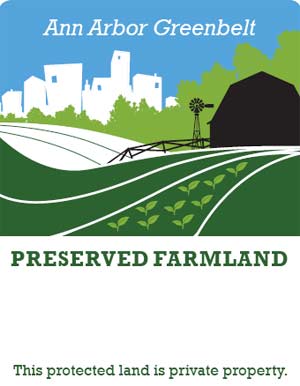
Ann Arbor greenbelt logo

The proposed new Ann Arbor greenbelt logo.

It’s been three years since the strategic plan was last updated. In this latest version, no major changes are being made to the program’s existing priorities: protecting large blocks of farmland as well as natural areas in the Huron River watershed, and building partnerships to leverage other funding sources.

In addition to those, a new priority is being added: Educating Ann Arbor residents about the program’s efforts, and reaching out to landowners in the greenbelt to ensure that the flow of applications continues. [.pdf of revised strategic plan]

Commissioners gave additional feedback at their meeting, and the plan will be sent to funding partners for their input too. The greenbelt advisory commission is expected to vote on the final plan at its Oct. 4 meeting.

The group also weighed in on designs for a new logo to help brand Ann Arbor’s greenbelt program. The design is intended to show the connection to the city, as well as images representing both farmland and natural area preservation. There’s space for logos of partner entities, and text that indicates what kind of land is being preserved and whether the land is private or public. The intent is to use this image on signs at the properties that are protected by the greenbelt program, and on brochures and other materials.

In updates to the commission, Ginny Trocchio – who is the program’s support staff – highlighted plans to hold another bus tour of greenbelt properties on Saturday, Sept. 22. The trip will focus on the eastern portion of the greenbelt, and its connection to the Superior Greenway. She also noted plans to participate in the Sept. 8 HomeGrown Festival, an event showcasing local food.

In their main action item, commissioners voted to recommend that the city council partner with Washtenaw County and Webster Township, contributing 25.5% toward the purchase of a parcel identified as application number 2005-08. (The first four numbers signify the year in which the application was made.) Tom Bloomer abstained from the vote. He owns Bur Oaks Farm in Webster Township, and serves on the township’s farmland and open space board. He did not indicate his reason for abstaining.

Two days earlier, the city council had approved two purchase-of-development-rights (PDR) deals that GAC had previously recommended: the 90-acre Alexander farm in Webster Township, and a 136-acre property owned by Robert H. Schultz in Superior Township. Jane Lumm (Ward 2) voted against both deals, citing concern that no local partners contributed to the land preservation efforts. Both deals include federal grants to cover a significant portion of the costs. [Full Story]

Greenbelt Group Briefed on Land Link Idea

Ann Arbor greenbelt advisory commission meeting (Aug. 2, 2012): The main presentation at this month’s meeting focused on land link programs – efforts to connect potential farmers with landowners who want to sell their farms.

Archer Christian

Archer Christian is the newest member of the Ann Arbor greenbelt advisory commission. She is also development director for the Ann Arbor-based Ecology Center. (Photos by the writer.)

Bridget Callahan, an intern with the Food System Economic Partnership (FSEP) and a University of Michigan community-based research fellow, gave the report, describing how a land link program might relate to the city’s farmland preservation efforts. Callahan’s research included surveys of farmers statewide, and a focus group with eight people involved in the Tilian Farm Development Center in Ann Arbor Township.

Also during the Aug. 2 meeting, GAC chair Dan Ezekiel noted that the current contract with The Conservation Fund, which manages the greenbelt program under contract with the city, ends on Dec. 31. Catherine Riseng volunteered to work with city staff in developing a request for proposals (RFP) for a new contract. The Conservation Fund, which has been awarded contracts for this work since the greenbelt program was created, is expected to bid on it again. Ginny Trocchio is the nonprofit’s local staff member.

In updates during the meeting, Trocchio reported that a Sept. 22 greenbelt bus tour will focus on the eastern portion of the greenbelt, and its connection to the Superior Greenway. And Ezekiel told commissioners that he’ll be a guest on the Aug. 22 Issues of the Environment, a talk show broadcast on WEMU.

Commissioners absent from the August meeting included the city council representative to GAC, Carsten Hohnke (Ward 5). The only meeting he has attended this year was in April. As he did not run for re-election to the city council, there are only three remaining GAC meetings – in September, October and November – before Hohnke leaves the council and the commission. [Full Story]

Greenbelt Group Briefed on Regional Transit

Ann Arbor greenbelt advisory commission meeting (July 5, 2012): When Dan Ezekiel called the July meeting to order by noting that it was “a hot, steamy day in Tree Town,” only five of the nine commissioners were on hand. Although it was hoped that a sixth member might show up eventually, no one did.

Dan Ezekiel, Michael Ford

From left: Dan Ezekiel, chair of the Ann Arbor greenbelt advisory commission, talks with Michael Ford, CEO of the Ann Arbor Transportation Authority. (Photos by the writer.)

That meant GAC did not have the six members required by the Michigan Open Meetings Act to enter into a closed session to discuss potential land acquisition, so Thursday’s meeting was much shorter than it would have otherwise been.

The main portion of the meeting included a presentation by Michael Ford, CEO of the Ann Arbor Transportation Authority. At GAC’s request, he briefed commissioners about the AATA’s efforts to develop a countywide public transit system, giving an overview similar to one he has delivered to many other government entities and community groups. The Ann Arbor greenbelt program preserves land in rural areas outside of the city limits, so commissioners were interested in hearing about how public transportation might expand there.

The meeting also included staff updates and news that two greenbelt properties have received funding from a federal grant program totaling nearly $400,000. [Full Story]

Environmental, Planning, Greenbelt Appts. OK’d

Four nominations to three different commissions were confirmed by the Ann Arbor city council at its July 2, 2012 meeting. Ken Clein and Kirk Westphal were confirmed for the city planning commission. John German was confirmed for the city’s environmental commission. And Archer Christian was confirmed for the greenbelt advisory commission. All appointments were made on unanimous votes by the council, which is typical.

The nominations for all four appointments were made at the council’s previous meeting, on June 21, 2012. The city planning commission nominations are made by the mayor, which is the case for the vast majority of board and commission appointments. Nominations to the environmental commission and the greenbelt advisory commission are made by the council as … [Full Story]

Archer Christian Tapped for Greenbelt Group

At its June 18, 2012 meeting, Archer Christian was nominated by the Ann Arbor city council to replace Mike Garfield on the city’s greenbelt advisory commission. Garfield is director of the Ecology Center, a nonprofit based in Ann Arbor, and Ms. Christian is the center’s development director.  The council will vote on the nomination at its July 2 meeting.

The greenbelt advisory commission oversees the proceeds generated by two-thirds of the city’s open space and parkland preservation millage, which is levied at a rate of 0.5 mills.

Garfield is term-limited as a GAC member, having served two consecutive three-year terms. The spot vacated by Garfield is not designated for a representative of the Ecology Center. However, the 9-member commission includes two slots for representatives of environmental … [Full Story]

Greenbelt Group Updated on County Efforts

Ann Arbor greenbelt advisory commission meeting (June 7, 2012): Collaboration was a theme that tied together several items at the most recent GAC meeting, starting with a review of farmland preservation efforts by Washtenaw County.
Liz Rother, Mike Garfield

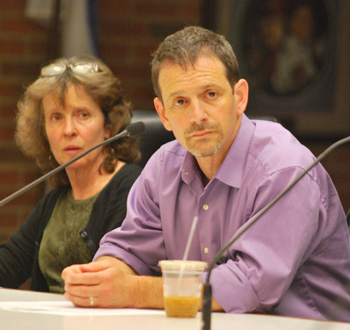
Greenbelt advisory commissioners Liz Rother and Mike Garfield. The June 7 meeting was the last one for Garfield, whose term is ending this month. He is director of the Ecology Center, a nonprofit based in Ann Arbor. (Photos by the writer.)

The county parks and recreation commission is moving toward a decision on the first farm properties to include in its land preservation program. It has about $1.6 million to work with, using a portion of proceeds from the countywide natural area preservation millage, which was renewed by voters in November of 2010. That 10-year, 0.25-mill tax also funds the county’s acquisition of natural areas and land preserves.

Susan Lackey, executive director of the Legacy Land Conservancy, briefed the greenbelt commissioners on the first round of deals. The Ann Arbor-based nonprofit is under contract to help manage the county program. Out of 57 applications, seven properties are moving forward for appraisals and final consideration, potentially covering 1,100 acres.

Though the county’s efforts at protecting farmland are relatively new, the greenbelt program has focused on farmland preservation since Ann Arbor voters approved a 30-year 0.5 mill tax in 2003. Lackey described the county’s efforts as complementary to the greenbelt program, noting that there’s more work to be done than any single entity can do.

Later in the meeting – during an discussion about efforts to update the greenbelt program’s strategic plan – Mike Garfield suggested that it might be time to shift more of the greenbelt’s efforts to natural areas or recreational projects like the Border-to-Border trail or RiverUp, and scale back the amount of farmland preservation.

One difficulty in this shift relates to matching funds. Ginny Trocchio, who serves as support staff for the greenbelt program, told commissioners that while the greenbelt has been very successful in securing grants through the federal Farm and Ranch Lands Preservation Program (FRPP), there are far fewer options for non-farmland properties. Partnerships with other local entities, like the county parks and recreation department, is one of the main ways that non-farmland land preservation dollars can be leveraged.

Another general challenge for all types of land preservation was cited by Lackey: A mild resurgence of development pressure as the economy improves, which is starting to drive up land values. She urged all groups to get as much preservation work done as possible in the next three to five years.

This month’s meeting was the last one for Garfield, who was instrumental in helping pass the city’s open space and parkland preservation millage, which funds the greenbelt program. He is term-limited. His potential replacement, Archer Christian, was introduced at the meeting. She is development director at the Ann Arbor-based Ecology Center, where Garfield serves as director.

At the end of the meeting, commissioners held a closed session to discuss potential land acquisitions. When they emerged, they voted unanimously to recommend action by city council on the purchase of development rights for four parcels within the greenbelt boundaries, if FRPP grants can be secured. [Full Story]

Council OKs Greenbelt Reappointments

At its May 21, 2012 meeting, the Ann Arbor city council unanimously approved the reappointment of Peter Allen and Catherine Riseng to the city’s greenbelt advisory commission. The group is responsible for overseeing the use of the city’s open space and parkland preservation millage.

The greenbelt advisory commission is one of the few boards and commissions for which the nominations to serve come from the city council as a body, not from the mayor. The item had been on the council’s agenda at its May 7 meeting – but only inadvertently. It had been intended only as a communication item. The council voted to postpone consideration of the reappointment until the May 21 meeting.

The commission’s membership is defined in terms of … [Full Story]

Webster Gives Ground for Civil War Days

At a special meeting held on April 24, 2012, the Webster Township board of trustees voted unanimously to approve a festival permit for the Dexter Area Historical Society’s Civil Wars Days to be held this year at historic Gordon Hall on June 8-10.

Webster greenbelt properties

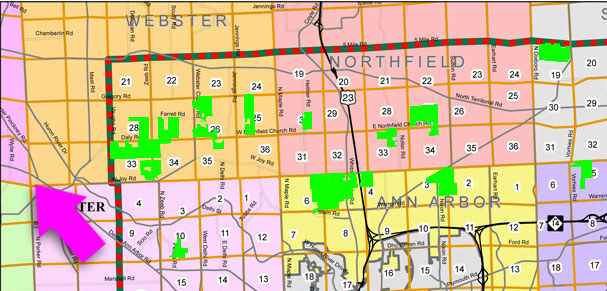
The pink arrow marks the location of the Gordon Hall property, where Civil War Days will be held on June 8-10, 2012. Green blocks are properties protected in part through the city of Ann Arbor's greenbelt program. The green line with red dots is the Ann Arbor greenbelt program boundary for eligible properties. As the map shows, several protected properties lie within Webster Township. (Image links to higher resolution file.)

Host for the re-enactor units will be the 4th Michigan Regiment, Company A, led by captain Russ Paul. Also expected at Gordon Hall for Civil War Days this year are the following units: 17th Michigan, Company E; 21st Michigan, Company H; U.S.S. Michigan Marine Guard Battery B; 1st Michigan Light Artillery; and the Confederate Bledsoe’s Battery.

The decision to grant a festival permit came after the board had turned down the permit at its previous meeting on April 17 by a 4-3 vote. The resolutions considered by the board at its two recent meetings differed in a significant way. The resolution rejected at the April 17 meeting stated that the festival would be granted “… with egress and ingress over Webster Township grounds and conservation easement with no parking on Webster Township grounds only Scio Township.”

The resolution ultimately approved by the board stepped back from trying to describe how parking on and crossing of the property would be handled, and instead simply stipulated that the DAHS had to comply with the conservation easement on the property.

Dan Ezekiel, chair of Ann Arbor’s greenbelt advisory commission, attended the April 24 meeting and addressed the township board on the commission’s behalf. Although the Gordon Hall property lies outside the Ann Arbor greenbelt boundaries, the city of Ann Arbor and Webster Township have partnered on a number of other conservation easements in their collaborative effort to preserve open space. He wanted to encourage the board to defend the easement on the Gordon Hall property and not set a precedent that violating a conservation easement is acceptable.

After the meeting, Ezekiel indicated in conversation that he was, in fact, a history buff and was hoping to attend the Civil War Days – he hoped not as a picketer.  [Full Story]

Greenbelt Commission Briefed on Food Hub

Ann Arbor greenbelt advisory commission meeting (April 5, 2012): The main item on this month’s GAC agenda was a presentation by local farmer and food activist Richard Andres, who updated commissioners on the Washtenaw Food Hub, a new venture he’s leading that aims to shore up local farmers and build community.

Dan Ezekiel, Richard Andres

From left: Dan Ezekiel, chair of the Ann Arbor greenbelt advisory commission, points out other GAC members to Richard Andres, who gave a presentation on the Washtenaw Food Hub. (Photos by the writer.)

Located on 16 acres in Ann Arbor Township, the food hub is envisioned to provide support for farmers to distribute and sell their produce, and for residents to buy food, attend workshops and create meaningful relationships with those who are part of the local food network. The project is still in its formative stages, but has potential to develop a food economy based on a human scale, Andres said, not a Wall Street scale.

GAC chair Dan Ezekiel noted that the hub is an example of the next phase of this region’s local food movement, which he said has “grown like an heirloom tomato” since the greenbelt program launched nearly a decade ago.

Commissioners also got a mid-year financial update on the greenbelt program at this month’s meeting, and heard about potential deep cuts to a federal farmland preservation program that has supported the greenbelt with more than $6 million in grants. The city has recently applied for $1,037,198 in additional grants that would help preserve 519 acres. Ginny Trocchio, support staff for the greenbelt program, also reported that over the next month there will likely be several closings on property within the greenbelt totaling another 300 acres.

Also at the April 5 meeting, Peter Allen – a local developer and GAC commissioner – proposed forming a strategic planning subcommittee to evaluate the greenbelt program so far and to look at what they’d like to accomplish in the future. It’s likely that the commission will formally consider his proposal at their May 3 meeting.

As it typically does, the meeting included a closed session to discuss land acquisitions. When commissioners emerged, they voted on three items – recommending that the city council approve the purchase of development rights on two properties, and to partner with Washtenaw County on a third acquisition. Ezekiel noted that the third item extends an existing county preserve on land that would provide public access and recreational opportunities.

At the end of the meeting, Ezekiel reported that a position on the commission will be opening up this summer. He urged anyone who’s interested to apply and “join the fun.” [Full Story]

Greenbelt Grows by 170+ Acres in December

Ann Arbor greenbelt advisory commission meeting (Jan. 5, 2012): At Wednesday’s GAC meeting – the first of the new year – commissioners got an update from staff on three deals in December that added more than 170 acres of protected land within the city’s greenbelt boundaries.

Tom Bloomer, Mike Garfield

From left: Greenbelt advisory commission members Tom Bloomer and Mike Garfield. (Photos by the writer.)

The properties include 32 acres in Northfield Township along US-23, 30 acres in Scio Township near Wagner and Scio Church roads, and 111 acres in Lodi Township along Pleasant Lake Road. By year’s end, the new additions brought the total of property protected by the city’s greenbelt program to 3,430 acres since its inception in 2007.

Most of Wednesday’s meeting was spent in closed session to discuss possible future land acquisitions, but the main action item involved land that’s not part of the city’s greenbelt program. Commissioners unanimously passed a resolution urging Webster Township to strictly enforce all of its conservation easements – the resolution will be forwarded to township officials as they weigh a request from the Dexter Area Historical Society to amend an easement that would loosen restrictions on parking.

The society wants permission to allow spectator parking for Civil War re-enactments on a site where the historic Gordon Hall is located. Land preservation activists are concerned that parking would damage the land, and that amending the easement would set a bad precedent, calling into question the trustworthiness of regional land preservation efforts. The resolution was brought forward by Tom Bloomer, a GAC member who also serves on Webster Township’s land preservation board. [Full Story]

Greenbelt Group Weighs Gordon Hall Issue

Ann Arbor greenbelt advisory commission meeting (Dec. 14, 2011): The main discussion at December’s GAC meeting focused on land falling outside of Ann Arbor’s greenbelt boundaries – but with possible broader implications for all regional land preservation efforts.

Dan Ezekiel, Tom Bloomer

From left: Dan Ezekiel, chair of the Ann Arbor greenbelt advisory commission, talks with commissioner Tom Bloomer. (Photos by the writer.)

The land in question, outside the greenbelt boundaries, is owned by The Dexter Area Historical Society. The society is seeking a change to the conservation easement for a parcel that includes the historic Gordon Hall – a change that would allow parking for several hundred vehicles on the land for spectators of Civil War re-enactments that the society intends to hold. Webster Township trustees will ultimately vote on the request, but the township’s land preservation board – which includes Tom Bloomer, who also serves on GAC – has recommended denying it.

Bloomer told GAC commissioners that altering the agreement in this way would set a bad precedent, and call into question the trustworthiness of regional land preservation efforts. Bloomer asked for GAC to weigh in with support for the land preservation board’s position, prior to the trustees’ vote. GAC will likely take up the issue again at its Jan. 5 meeting.

Other action at GAC’s Dec. 14 meeting included passing a resolution of appreciation for Tom Freeman, deputy director of Washtenaw County parks & recreation, who is retiring at the end of the year. GAC chair Dan Ezekiel said Freeman has been “absolutely indispensable” to land preservation efforts in the county, including deals in which Ann Arbor’s greenbelt program has participated.

Ezekiel also presented a letter to the editor that he drafted, in response to misinformation expressed by commenters on AnnArbor.com articles regarding the greenbelt boundary expansion. He plans to send the letter sometime next week, pending feedback from other commissioners. [.pdf of draft letter to the editor]

During Wednesday’s meeting, commissioners also welcomed the newest commissioner, Shannon Brines, to his first meeting of GAC. Brines, who’s active in the local food movement, was appointed by the city council at its Nov. 21 meeting. [Full Story]
Greenbelt Group Recommends Land Deal

At a special meeting called for Nov. 30, 2011, the Ann Arbor greenbelt advisory commission spent most of the 30 minutes in a closed session to discuss possible land acquisition. When commissioners moved back into the public portion of their meeting, commissioners unanimously passed a resolution recommending that the city partner with the Southeast Michigan Land Conservancy and Washtenaw County to preserve a parcel of land within the greenbelt.

The property was identified only by application number – #2005-27. The location of the properties and their owners aren’t revealed until resolutions are voted on by the Ann Arbor city council. However, the property discussed by GAC at its Nov. 30 meeting was likely part of an initiative mentioned briefly at GAC’s … [Full Story]

Ann Arbor Greenbelt Eyes Future Land Deals

Ann Arbor greenbelt advisory commission meeting (Nov. 9, 2011): Skyline High School students on class assignment outnumbered commissioners at Wednesday’s meeting. More students might have attended, but some learned of a meeting of the city’s medical marijuana advisory board scheduled for the same time, and were drawn to that instead.

Skyline High students, Dan Ezekiel

Skyline High students get their attendance sheets signed by Dan Ezekiel, chair of the greenbelt advisory commission. Some students recognized Ezekiel from his other job – a science teacher at Forsythe Middle School.

Those who did stay witnessed a brief meeting that included a recess to wait until a sixth commissioner arrived – GAC requires six members to hold a closed session, which they needed in order to discuss possible land acquisition.

Briefly participating in that closed session was Jack Smiley, former executive director of the Southeast Michigan Land Conservancy. The conservancy hopes to partner with Ann Arbor’s greenbelt program on property in the Superior Greenway – land between Ann Arbor and Detroit that’s protected from development.

In other business, commissioners briefly discussed ways to communicate better about the greenbelt program with the public, building on what they viewed as a successful bus tour of protected greenbelt land in October. One possibility is a forum this winter at the Ann Arbor District Library, where the public could meet with landowners whose property is part of the greenbelt.

The one action item at Wednesday’s meeting was a vote to pre-authorize staff of The Conservation Fund, which manages the greenbelt program under contract with the city, to conduct appraisals for potential land acquisitions through Dec. 31.

Typically, GAC votes to authorize appraisals on specific parcels, as part of the application process that landowners make for being part of the greenbelt. But the city council is expected to vote on a possible expansion of greenbelt boundaries in December, after GAC’s meeting that month. GAC voted to recommend the expansion at its September 2011 meeting. It’s expected that some landowners within the expanded boundaries might want to apply for the greenbelt, and a February deadline to seek matching federal dollars makes the timeline for getting appraisals shorter than usual. Pre-authorization gives staff flexibility to move forward with the process.

Commissioners are also awaiting finalization of Shannon Brines’ appointment to GAC. The city council was expected to vote on his appointment at its Nov. 10 meeting. But the council postponed the vote to Nov. 21 – due to a procedural issue, not any substantive concern about his appointment. [Full Story]

Local Food Activist May Join Greenbelt Group

Ann Arbor greenbelt advisory commission meeting (Oct. 12, 2011): Local farmer and food activist Shannon Brines could become the next member of the city’s greenbelt oversight group, if Ann Arbor city council acts on a recommendation made on Wednesday.

Catherine Riseng, Liz Rother

From left: Greenbelt advisory commissioners Catherine Riseng and Liz Rother. (Photo by the writer.)

The greenbelt advisory commission (GAC) voted unanimously to recommend Brines for the appointment, which would fill the one open position, an at-large seat. Brines owns Brines Farm in Dexter but lives in Ann Arbor’s Fifth Ward – which GAC member Carsten Hohnke represents on city council. Hohnke, who did not attend Wednesday’s meeting, will likely be the councilmember to put forward Brines’ nomination to council.

Brines also works for the University of Michigan School of Natural Resources and Environment (SNRE), as does GAC vice chair Catherine Riseng. At Wednesday’s meeting, Riseng told commissioners that she’s been appointed to an advisory committee for the county’s natural areas preservation program, and hopes to serve as a liaison between the two groups.

In other action, the commission voted to write a letter of support for continued funding of a federal program for farmland preservation. As Congress hammers out the 2012 farm bill, funds for the program could be at risk. The city received nearly $2.8 million in federal dollars for greenbelt properties during the last fiscal year.

At Wednesday’s meeting the commission also discussed forming a committee to develop a communications plan for the greenbelt program. The intent is to get the word out about the program’s achievements in a consistent, coordinated way.

One of the program’s ongoing efforts at communication is coming up later this month. On Saturday, Oct. 22, a two-hour bus tour will highlight some of the farmland and other properties that are being preserved by the greenbelt program. The tour runs from 11 a.m.-1 p.m. and starts from the Ann Arbor farmers market. Boxed lunches are included in the $15 fee. [Full Story]

Brines Recommended for Greenbelt Group

At its Oct. 12, 2011 meeting, the Ann Arbor greenbelt advisory commission voted unanimously to recommend that Shannon Brines be appointed to fill a vacancy on the commission.

Brines is an Ann Arbor resident and owner of Brines Farm in Dexter. He is a lecturer and manager of the environmental spatial analysis (ESA) lab at the University of Michigan School of Natural Resources and Environment. Since 2007 Brines also has served on the city’s public market advisory commission, which handles issues related to the farmers market. His current term on that commission ends in 2014.

Two vacancies opened on GAC earlier this year. Liz Rother was appointed by the city council in June to replace term-limited Jennifer Santi Hall. The remaining vacancy is an at-large … [Full Story]

Greenbelt Boundary Expansion in the Works

Ann Arbor greenbelt advisory commission meeting (Sept. 14, 2011): Boundaries of Ann Arbor’s greenbelt program will expand in Lodi and Salem townships, if the city council approves a recommendation passed by the greenbelt advisory commission at its most recent meeting.

Ginny Trocchio

Ginny Trocchio of The Conservation Fund, which has a contract with the city to manage the greenbelt program. She's showing the greenbelt advisory commission a map of proposed boundary changes. (Photos by the writer.)

The recommendation also calls for allowing the city to acquire development rights on property adjacent to (but outside of) the greenbelt boundary, if it’s under the same ownership as an inside-the-boundary property that’s being considered for the program.

The recommended “bump-outs” in Lodi and Salem townships – in the southwest and northeast corners of the greenbelt, respectively – reflect increased support for the program from those townships. The Salem Township board, for example, recently voted to earmark $200,000 annually for land preservation.

A separate resolution was voted down, with support only from the commission’s chair, Dan Ezekiel. It would have recommended that the council consider properties adjacent to the greenbelt for acquisition, and create a one-mile buffer surrounding the current boundary. Properties within that buffer would have been considered for acquisition with greenbelt funds, but with stricter selection criteria.

Several commissioners were reluctant to increase the boundaries with a mile-wide buffer zone, citing concerns that land in that area is too far from Ann Arbor, and noting that opportunities for land preservation are still available within the existing greenbelt boundaries.

In other business, the commission got a review of the greenbelt program’s finances and activities for the 2011 fiscal year. A 30-year open space and parkland preservation millage, which voters approved in 2003, funds both the greenbelt program as well as land acquisition for parks. During the year, the greenbelt program spent $8.3 million on 12 deals – by far the most transactions since the greenbelt’s inception.

Those 12 deals protect 1,472 acres of farmland from future development. In total, more than 3,200 acres are now part of the greenbelt. To put that into perspective, Ezekiel noted that those 3,200 acres are roughly equivalent to 80 parks the size of Veterans Memorial Park in Ann Arbor.

Three more greenbelt acquisitions were recommended by commissioners at the end of their meeting. The properties were identified only by application number  – the location of the properties and their owners aren’t revealed until the resolutions are voted on by the city council. [Full Story]

Greenbelt Commission Endorses Expansion

At its Sept. 14, 2011 meeting, the Ann Arbor greenbelt advisory commission voted unanimously to recommend that the city council expand the boundaries of the greenbelt in Lodi and Salem townships. In addition, the commission recommended that council allow for the acquisition of property adjacent to – but outside of – the greenbelt boundary, if it is under the same ownership as property within the greenbelt that’s being considered for the program. This change addresses the situation of a property owner holding land on both sides of a road – one parcel within the greenbelt boundary, the other outside of it.

The recommendations will be forwarded to city council for consideration. [.pdf map of existing greenbelt district] The greenbelt program is funded by … [Full Story]

Greenbelt Group Briefed on Pittsfield Plan

Ann Arbor greenbelt advisory commission meeting (Aug. 10, 2011): Possible partnerships with other local communities – including Pittsfield and Salem townships – were the focus of this month’s greenbelt advisory commission (GAC) meeting.

Paul Montagno, Anissa Bowden

Pittsfield Township planner Paul Montagno helps Anissa Bowden of the Ann Arbor city clerk's staff set up his presentation for the greenbelt advisory commission at its Aug. 10, 2011 meeting. (Photos by the writer.)

Township planner Paul Montagno briefed commissioners on Pittsfield Township’s updated master plan, which the township board approved late last month. Specifically, he focused on the section concerning open space, natural features and agricultural land use. He described efforts to balance denser development along corridors like State Road and Michigan Avenue while protecting more rural land, especially in the central and southern parts of the township.

Pittsfield Township has partnered with Ann Arbor’s greenbelt program on just one property – the Hilton farm, near the township’s large Pittsfield Preserve nature area. However, Montagno indicated that township officials are open to future land preservation deals with the greenbelt.

Also during the Aug. 10 meeting, Ginny Trocchio of The Conservation Fund, which manages Ann Arbor’s greenbelt program, reported that the previous day, the Salem Township board had approved an ordinance that created a purchase of development rights (PDR) program, and allocated $200,000 annually for land preservation. GAC is considering possible expansion of the greenbelt boundaries, including an expansion in Salem Township. The boundary proposal was discussed at the commission’s July meeting, and will be on the agenda again in September.

The commission took one formal vote on Wednesday, after emerging from a closed session to discuss land acquisition. Commissioners unanimously approved a resolution recommending that city council move forward with application 2010-09 if at least 50% matching funds are secured. Properties are identified only by application number at this stage, and the resolution did not indicate what type of land acquisition this would entail. Typically, greenbelt monies are spent on the purchase of development rights (PDR).

There is currently one vacancy on GAC. Shannon Brines, owner of Brines Farm and a member of the city’s public market advisory commission, attended Wednesday’s meeting and expressed interest in applying for the seat. Nominations to GAC are made and approved by the city council. [Full Story]

Proposal Would Expand Greenbelt Boundaries

Ann Arbor greenbelt advisory commission meeting (July 13, 2011): After discussing several options to expand the boundaries of Ann Arbor’s greenbelt program, members of the greenbelt advisory commission (GAC) ultimately voted to postpone action until their next meeting. Several commissioners expressed a desire to give the proposal more thought. One issue raised was whether extending the boundaries would cause Ann Arbor taxpayers to feel that their dollars are being spent to preserve land too far away from the city.

Liz Rother

Liz Rother attended her first meeting as an Ann Arbor greenbelt advisory commissioner on July 13. Her appointment was approved by the city council in June – she replaced Jennifer S. Hall, whose term had expired and who was term limited.

A subcommittee of GAC has been evaluating a potential greenbelt boundary change since November 2010. Options included expanding in Salem Township and Lodi Township to “square” off the boundaries, and allowing properties adjacent to the greenbelt to be eligible for the program. Another option would be to create a one-mile “buffer” around the existing boundaries, and include properties within that buffer if they met stricter criteria. Whatever recommendation GAC eventually makes would require Ann Arbor city council approval.

Also at July’s meeting, commissioners got an update on Scio Township’s land preservation efforts from Barry Lonik (a consultant who works with the township) and Bruce Manny (a member of the township’s land preservation commission). Lonik noted that the township’s 10-year, half-mill land preservation millage expires in 2014. The land preservation commission would like to get a renewal on the November 2012 ballot, to coincide with higher voter turnout for the presidential election.

It was the first meeting for GAC’s newest commissioner, Liz Rother, who was appointed by the city council in June to replace term-limited Jennifer Santi Hall. Another position, held by former GAC member Gil Omenn, remains vacant. Dan Ezekiel – who was elected GAC’s chair at the meeting – urged anyone who’s interested in serving on the commission to contact their city councilmember.

During his communications to fellow commissioners, Ezekiel noted the recent death of “Grandpa” Don Botsford, calling him a real pioneer and champion of land preservation in this area. Botsford was man who lived in poverty rather than sell his land to developers, Ezekiel said. He eventually sold part of his property’s development rights to Scio Township, in partnership with Ann Arbor’s greenbelt program – it’s now known as the Botsford Recreational Preserve, near M-14 and Miller Road. Botsford introduced thousands of people to the natural environment, Ezekiel said, so it was fitting to note his contribution and his passing. [Full Story]

Ann Arbor Adds Lodi Farm to Greenbelt

At its July 18, 2011 meeting, the Ann Arbor city council authorized the purchase of development rights for a 110-acre property along Pleasant Lake Road in Lodi Township – the Lindemann-Weidmayer property. The city’s cost for the PDR will be $387,372. The total budget for the project is $699,992, including contributions from other funding sources.

On Feb. 7, 2011 the council had already approved a grant application to the federal Farm and Ranch Land Protection Program for the purchase of development rights on the property. And on June 6, 2011 the council approved the acceptance of $312,620 from the USDA for the purchase. The deal had been recommended by the city’s greenbelt advisory commission, after discussion in a closed session at its Feb. 9, 2011 meeting.

This brief was filed from the city council’s chambers on the second floor of city hall, located at 301 E. Huron. A more detailed report will follow: [link] [Full Story]

Park, Greenbelt Advisory Groups Share Goals

Joint working session of the Ann Arbor park and greenbelt advisory commissions (June 7, 2011): Even with a fan blowing, the meeting room at Gallup Park was hot and stuffy. But members of the city’s greenbelt and park advisory commissions toughed it out for about 90 minutes to hold their second-ever joint working session earlier this month.

Peter Allen, Julie Grand, Ella and Jennifer Santi Hall, Dan Ezekiel

From left: Peter Allen, Julie Grand, Ella and Jennifer Santi Hall, Dan Ezekiel. Grand is chair of the park advisory commission. Allen, Hall and Ezekiel are greenbelt advisory commissioners. Jennifer Hall has served as GAC chair, but her term is ending on the commission – this was her last meeting. Ella Hall also had attended the first GAC meeting with her mother seven years ago – she was three weeks old at the time. (Photo by the writer.)

They covered many of the same topics that they’d discussed at their first joint meeting in April 2010 – funding issues, land preservation and acquisition strategies, as well as specific projects like the Allen Creek greenway and support for small farms.

Ginny Trocchio of The Conservation Fund, which has a contract to manage the greenbelt and park land acquisition programs, gave commissioners an overview of finances, projects and goals. Both programs are funded by a 30-year, 0.5 mill tax for land acquisition, called the open space and parkland preservation millage, which Ann Arbor voters approved in 2003. Two-thirds of the millage proceeds are used for the greenbelt program, and one-third is allotted to park land acquisition. To get money upfront for land acquisition, the city took out a $20 million bond in fiscal 2006 that’s being paid back with revenue from the millage. Current combined fund balances for the two programs total nearly $9 million.

Trocchio also highlighted an upcoming event to celebrate the greenbelt program. On Thursday, June 16, an open house will be hosted at the Braun farm – one of the program’s protected properties in Ann Arbor Township. The event is free and open to the public, and starts at 5:30 p.m. – parking is available at 4175 Whitmore Lake Road.

At the end of the June 7 meeting, commissioners congratulated two GAC members for their service – it was the final meeting for Gil Omenn and Jennifer Santi Hall, who has served as chair. Their terms expire June 30, and it’s not clear when appointments to replace them will be made. [Full Story]

Greenbelt Commission Terms Revised

Ann Arbor greenbelt advisory commission meeting (May 11, 2011): Wednesday was the last regular meeting for two greenbelt commissioners – terms end on June 30 for chair Jennifer S. Hall and Gil Omenn, who were both active in efforts to launch the program. Both have reached the term limits for serving on GAC.

Jennifer S. Hall

Jennifer S. Hall, chair of the Ann Arbor greenbelt advisory commission, presided over her last regular meeting on May 11. Her term ends on June 30; GAC's June meeting will be a joint session with the city's park advisory commission.

Instead of holding their regular meetings in June, the greenbelt and park advisory commissions have scheduled a joint working session to discuss common goals and priorities – they last met jointly in April 2010.

Term limits were raised in another context during Wednesday’s meeting, when commissioners were asked to recommend that city council restate current GAC membership terms. Mary Fales of the city attorney’s office has been working on the revisions, after inconsistencies were discovered for current appointments. For example, a term for Ecology Center director Mike Garfield ended on June 30, 2009. Though he continued to serve, he was not officially reappointed to another three-year term until Sept. 21, 2010. Under the resolution recommended by GAC, all terms would end on June 30, over staggered years.

Also at Wednesday’s meeting, commissioners got an update about Michigan budget-related legislation that would cut tax credits for farmers. They were also briefed by staff about changes to the federal Farm and Ranchland Protection Program – the city has received millions of dollars worth of FRPP grants over the years to offset the cost of development rights purchased in the greenbelt.

Ginny Trocchio, support staff for the greenbelt program, told commissioners that June 16 is the date for a greenbelt celebration, starting at 5:30 p.m. at the Braun farm in Ann Arbor Township, which was added to the greenbelt in 2010. The event will be open to the public, and will include a presentation to highlight the program’s accomplishments.

Dan Ezekiel, GAC’s vice chair, reported that the subcommittee he’s leading to look at possible changes in the greenbelt boundary will be making a proposal at the commission’s July 13 meeting.

And in its final action of the meeting, commissioners emerged from a closed session and voted to recommend that Ann Arbor city council make a $127,200 offer for the purchase of development rights on a property within the greenbelt. Before appearing on the city council’s agenda, details of these greenbelt acquisitions are not made public – parcels are identified only by their application number. [Full Story]

Greenbelt, County Look to Partner on Farms

Ann Arbor greenbelt advisory commission meeting (March 9, 2011): Changes to Washtenaw County’s natural areas preservation program (NAPP) now allow the county to buy development rights for farmland – a land preservation strategy also pursued by Ann Arbor’s greenbelt program.

Ginny Trocchio, Tom Freeman

Tom Freeman, deputy director of Washtenaw County parks & recreation, and Ginny Trocchio of The Conservation Fund distribute handouts to the Ann Arbor greenbelt advisory commission at GAC's March 9, 2011 meeting. (Photos by the writer.)

Tom Freeman, deputy director for the county’s parks & recreation department, gave commissioners an update on this new aspect of NAPP, which is funded by a 10-year millage that voters renewed in November 2010. He discussed with commissioners areas of overlap between the two programs, and the potential for future partnerships as NAPP’s farmland protection efforts ramp up.

Prompted by a question from GAC chair Jennifer S. Hall, Freeman also updated commissioners about the county’s plans to apply for a grant from the Michigan Dept. of Natural Resources Trust Fund. The grant would help the county buy a parcel in Ann Arbor Township now owned by a subsidiary of Domino’s Farms. The land, which has water and sewer hookups that make it prime for development, is near three other parcels of already preserved property: the county’s Goodrich Preserve; the University of Michigan’s Horner-McLaughlin Woods; and the city-owned Marshall Nature Area. Freeman explained some complicating factors in the acquisition, including two widely divergent appraisals – for $1.9 million and $3.25 million – and the fact that the land is at the center of ongoing litigation between the township and the landowner.

When Hall floated the idea that the greenbelt commission could send a letter of support for the county’s application, Carsten Hohnke cautioned against it. Hohnke, who serves on both GAC and city council, said the city also plans to apply to the trust fund for two projects. [He didn't identify the projects during the meeting. In a follow-up email to The Chronicle, Colin Smith, the city's parks & recreation manager, reported that the applications would be for a skatepark and upgrades to the Gallup canoe livery and park.]

Hohnke felt the county’s application could dilute the city’s chances for success, though it was pointed out to him that the county and city would be applying to two separate pools of funding – the county plans to ask for a grant available for land acquisitions, while the city’s projects are in the category of project development grants. Ultimately, commissioners voted to recommend that the city council consider sending a letter of support for the county’s application. Councilmembers would need to act at their next regular meeting on March 21 – the deadline to apply is April 1.

Also at GAC’s March 9 meeting, commissioner Tom Bloomer – who owns Bur Oaks Farm in Webster Township – reported on a plan to eliminate state tax credits for farmers. It’s part of a broader budget proposal by Gov. Rick Snyder to cut many of the tax incentives currently offered by the state – the most high profile of which is for the film industry. Eliminating the credits for farming could make it unprofitable to farm in this area, Bloomer said. [Full Story]

Greenbelt Gets Mid-Year Financial Review

Ann Arbor Greenbelt Advisory Commission meeting (Feb. 9, 2011): The main event of the commission’s Wednesday meeting was a review of the second-quarter financial picture. The review was presented  by Ginny Trocchio, who works for The Conservation Fund, a consultant the city employs to assist with administering the greenbelt millage. Highlights of the presentation included the calculation of administrative overhead costs – including The Conservation Fund’s work – which are well below the legal maximum of 6%.

Ann Arbor Greenbelt Map, boundaries and property

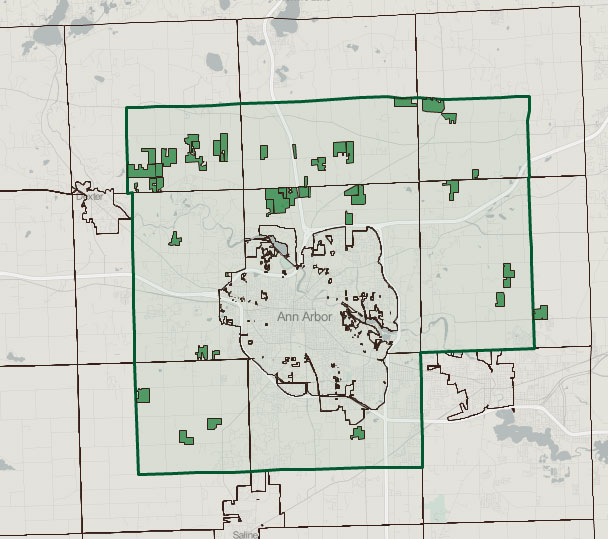
Blobs inside the squarish boundaries represent properties or development rights acquired with greenbelt millage funds. The darker squarish area is the original area where millage funds could be spent. The lighter strips to the east, south, and west were added in 2007. (Image links to higher resolution file.)

Though not included explicitly in the millage language, the city approaches the administration of the millage as a one-third/two-thirds split between a portion for parks and a portion for the greenbelt program. So as part of the financial review, commissioners also looked at current fund balances as analyzed based on the one-third/two-third split between parks and greenbelt projects. Noting that the greenbelt fund balance might be on track to be drawn down before the parks portion is exhausted, commissioners seemed to agree that now is a good time to begin mulling what should happen if that scenario played out. The group discussed holding a joint meeting between the park and greenbelt advisory commissions – their last joint session was held in April 2010.

Also discussed on Wednesday was the scheduling of a first meeting of a commission subcommittee that will look at the question of changing greenbelt boundaries. The boundaries define the region where land or development rights on land might be acquired by the greenbelt program. Any change to those boundaries would ultimately require approval from the Ann Arbor city council. [Full Story]