Stories indexed with the term ‘baseball’

Column: Detroit Fans Might Party Like It’s 1935

John U. Bacon

John U. Bacon

Once in a while something happens that is so unusual, even those who don’t normally pay attention have to stop and take notice.

Halley’s Comet, for example, only comes along once every 75 years. Man has landed on the moon just six times in the entire history of the universe. And Lindsay Lohan goes to jail – no, wait, that happens almost every week.

Well, this week, Detroit sports fans got Halley’s Comet, a moon landing, and a clean and sober Lindsay Lohan all wrapped up into one: The Tigers clinched the American League Central Division, and even more shockingly, the Lions won their first three games.

That’s right: It’s September 30, and both the Tigers and the Lions are in first place. Go find a newspaper – if your town still has one – pull out the standings, and get them laminated. This might not happen again in our lifetimes. [Full Story]

Column: Take Me Out to the Minor Leagues

John U. Bacon

John U. Bacon

If you’re sick of the big leagues, but not baseball, check out your backyard.

Here in Michigan you can watch the Beach Bums in Traverse City, the Lugnuts in Lansing, the West Michigan Whitecaps near Grand Rapids, the Great Lake Loons in Midland, and the Kings in Kalamazoo. Michigan fans can see six minor league teams if you count the Toledo Mud Hens – and seven if the Tigers start slumping again. Michigan baseball fans haven’t had it this good in decades.

In 1949, the U.S. boasted almost 500 minor league teams, supported by 42 million fans. But their ranks shriveled when major league baseball expanded, TV blossomed and air conditioning made staying at home much cooler. In just three years, attendance dropped almost 80%.

But when major league baseball turned its back on its fans with strikes and lockouts, the minor leagues aggressively courted them. Almost every fan-friendly custom you see at major league stadiums today they stole from the minors, including fancy food, daily promotions, pop music and endless stunts to keep the fans coming back, win or lose. As a result, the minors have grown back to a robust 176 teams nationwide.

Visit one, and you understand why. [Full Story]

Column: A Pitch for Absentee Voting

Primary elections in Michigan fall on Tuesday, Aug. 3 this year. That’s also the day the Detroit Tigers start a three-game series with the Chicago White Sox at Comerica Park. Here’s a suggestion for Ann Arbor city voters: Don’t plan to go the polls. Instead, plan to take the whole day off and go to the ball game. You can still vote, vote, vote for your home team – you’ll just need do it with an absentee ballot.
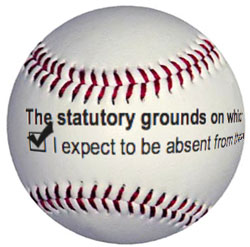
Absentee voter applications are not printed on baseballs. This is just someone's execution of the concept that "Every article should have art!"

Now, you don’t have to go to the game in order to qualify for an absentee ballot. But just to be clear, if you do plan to make a whole day event out of your visit to Detroit to watch the game, that will absolutely qualify you for an absentee ballot. If you expect to be out of town, that’s a legally valid reason for voting absentee.

Maybe some of you would even like to make the short drive in to the ballpark after a Monday night stay at the Westin Book Cadillac – from what I understand, it’s a pleasant place to spend the night, even if you’re not a Washtenaw Communty College trustee.

What about you Chronicle readers who aren’t baseball fans? If you want to vote absentee, the current election law specifies a limited set of other reasons you can use, which include being older than 60, being in jail, or having religious beliefs that prevent attending the polls.

The topic came up a bit more than a week ago, when the Ann Arbor city Democrats hosted a forum for candidates contesting the Democratic primaries for Michigan’s 52nd and 53rd district state House seats. Jeff Irwin, who along with Ned Staebler is running for the 53rd District seat, threw out an idea for a tweak in Michigan’s election laws.

Irwin said he’d like to see “on-demand absentee” voting – citizens would be able to obtain an absentee ballot and avoid the lines at the polls for any or no reason at all. It’s not some new screwball idea – it’s been around a while and enjoys a lot of support, from Washtenaw County clerk Larry Kestenbaum, among others.

For the time being, though, the application for an absentee ballot requires that voters commit, you know, really commit – just like the guy on the mound has to commit to delivering the ball to the plate after starting in that direction – to at least one of the allowable reasons under the state statute. Through June 17, according to the first Absent Voter report sent out last week via email by the city clerk, over 1,800 Ann Arborites have already committed to one of those reasons. [Full Story]

Column: Better than Perfect

John U. Bacon

John U. Bacon

I’d just finished writing my commentary Wednesday night, when a friend tipped me off that I should be watching the Tigers game. He didn’t say why, because there’s a code in baseball against jinxing a pitcher who’s throwing a great game. I turned on the TV, and saw the Tigers were beating Cleveland, 1-0, in the eighth inning. Then I finally realized Detroit pitcher Armando Galarraga wasn’t just working on a no-hitter, but a perfect game.

What’s the difference? A no-hitter means just that: A pitcher can’t give up any hits. But he can still let a runner get to first base on a walk or an error, and keep his no-hitter. But to throw a perfect game, the pitcher can’t let a single batter reach first base for any reason. He’s got to get 27 straight outs.

How rare is that? In the 135-year history of Major League Baseball, only twenty pitchers have done it. Twenty. It’s ten times rarer than a no-hitter – so rare, in over a century of Tiger baseball, not one pitcher had ever thrown a perfect game. Ever.

But there he was, Armando Galarraga from Venezuela, pitching a perfect game. [Full Story]

Column: Against All Odds

John U. Bacon

John U. Bacon

Michigan first baseman Mike Dufek stepped up to the plate in the tenth inning. The bases were empty, which in this game was rare.

Northwestern had shot out to an early 14-0 lead. We’re not talking football here, folks, but baseball. Then, incredibly, the Wolverines clawed back, run by run, until they tied the game with a two-run homer in the bottom of the ninth. That brought Dufek up in the tenth inning, with the game in his hands.

That Dufek had even gotten that far was a story in itself. [Full Story]

Column: God Bless You, Mr. Harwell

John U. Bacon

John U. Bacon

Editor’s note: Ernie Harwell died on Tuesday after fighting cancer for nearly a year. He was 92. Portions of this column were published in John U. Bacon’s September 2009 tribute to Harwell.

This past September, the Detroit Tigers’ beloved broadcaster, Ernie Harwell, announced that he had contracted an incurable form of cancer, and would not seek treatment.

For everybody who knew him, or felt like they did – which, really, is just about all of us – it hit hard. We were losing our baseball buddy, our grandfather, our friend.

The only person who didn’t seem shaken by the news was Ernie Harwell. He said, “Whatever’s in store, I’m ready for a new adventure. That’s the way I look at it.”

Harwell was a deeply religious man, but he never wore it on his sleeve. He simply lived it. He was, truly, at peace.

But I was not. Like just about every sports writer who knew him, I felt compelled to write about him. [Full Story]

Column: Your Tax Dollars at Play

John U. Bacon

John U. Bacon

With tax day just past, it’s a good time to ask where our money should go – and where it shouldn’t. I don’t have all the answers, of course – but I’m convinced one expenditure should end immediately: stadium subsidies.

Two years ago, the New York Yankees signed third baseman Alex Rodriguez to a contract that will pay him $275 million dollars in exchange for 10 years of catching, throwing and hitting a baseball. That puts him ahead of his teammate, Derek Jeter, who has to get by on a mere $189 million for his decade of duty. Sucker.

Whenever teams sign contracts like that, the player’s agent always justifies it by saying, “Well, that’s what the market will bear.”

If that were true, it would still be insane, but at least there would be a logic to it. After all, if any team is dumb enough to pay someone that kind of money, and if a family of four wants to pay $200 to see that guy play – well, then, so be it. That’s how free markets work.

But the free market doesn’t come close to paying these guys’ salaries. Who picks up the gap? You do – every time you pay your taxes. [Full Story]

Column: Honoring Robinson and Rickey

John U. Bacon

John U. Bacon

The first quarter of this year has been filled with endless sports stories about salaries and steroids and sex – and pretty much everything but sports. So I welcome a look back at a time the stakes were real, and the men were equal to the moment.

Well, we’re in luck, because this week marks the anniversary of the most important day in sports: April 15, 1947, when Jackie Robinson made his major league debut.

Even people who don’t know about sports know about Jackie Robinson – and they should. Martin Luther King, Jr. once said, “Jackie Robinson made it possible for me in the first place. Without him, I would never have been able to do what I did.”

But, without a much less famous man named Branch Rickey, the Brooklyn Dodgers’ president and a University of Michigan law school graduate, Robinson might never have gotten his chance. [Full Story]

Column: Loyalty for Lakeland

John U. Bacon

John U. Bacon

Almost all of the major league baseball’s 30 teams have moved their spring training camps in the past three decades, and fully half of them now play in Arizona. Stay-at-home stalwarts like the Cincinnati Reds trained in Tampa for 52 years before moving to Plant City in 1988, then to Sarasota a decade later, then finally to Goodyear, Arizona, last year.

Even the Los Angeles Dodgers, who created Dodgertown 62 years ago in Vero Beach to provide a safe haven for Jackie Robinson and other black players, also bolted for Arizona last year.

Baseball teams have been city-swapping their spring training sites like swingers in a – well, a bad movie about swingers, I guess.

In this permissive environment, the Detroit Tigers stand as a pillar of fidelity. Except for three years during World War II, the Tigers have trained in Lakeland, Florida every year since 1934. That’s 74 seasons, by far the longest marriage in the major leagues. [Full Story]

Column: Mark McGwire’s “Confession”

John U. Bacon

John U. Bacon

On Monday, former home run hitter Mark McGwire talked to sports broadcaster Bob Costas in an attempt to restore his good name.

He had a lot of restoring to do.

McGwire was one of those super-sized sluggers who were knocking out home runs at a record rate in the ’90s. And, like his peers – Barry Bonds and Sammy Sosa – McGwire was widely rumored to be taking steroids.

In fact, the FBI gave the commissioner of baseball a list of 70 players they discovered were taking steroids, including McGwire – two decades ago. The commissioner, of course, promptly did absolutely nothing, because he was too hooked on the home runs that were saving baseball from itself after he had canceled the 1994 World Series.

And the hits just kept on coming. In 1998, McGwire broke one of the game’s most revered records when he shattered Roger Maris’s old mark of 61 home runs in a season by smashing 70. He was a national hero. [Full Story]

Column: For Better and Worse

John U. Bacon

John U. Bacon

And so, it’s done. The Detroit Tigers’ once promising season ended Tuesday in a cataclysmic collapse.

In the American League’s Central Division, Sports Illustrated had picked the Tigers to finish next to last. But by September, they had built a seemingly insurmountable seven-game lead. The team was a tonic for a troubled town in a troubled time. Some pundits even claimed the Tigers season was a metaphor for a Motown renaissance. They started comparing this team to the 1968 Tigers, and the role they played in healing a city that had been torn apart the summer before.

On July 23, 1967, the long-simmering tensions between the police and the people finally boiled over into a full-blown race rebellion – or riot, depending on whom you ask – that lasted five days, the worst in American history.

Enter the 1968 Tigers. [Full Story]

Column: A True Hall of Famer

John U. Bacon

John U. Bacon

If you grew up in Michigan in the ’70s, as I did, Bob Seger sang the soundtrack to your summers, and Ernie Harwell provided the voiceover.

When I think about our family trips up north, they’re always accompanied by Harwell’s comfortable cadences filling the car. He didn’t simply broadcast baseball games. He turned them into stories. In Harwell’s world, a batter didn’t merely strike out. He was “called out for excessive window shopping,” or “caught standing there like the house by the side of the road.”

Unlike today’s announcers, who prattle on with mindless patter and pointless stats, Harwell treated his listeners to healthy doses of “companionable silences,” something Zen masters refer to as the delicious “space between the notes.” Harwell said the quiet allowed the listeners to enjoy the sounds of the ballpark itself, which he felt was richer than his own voice. [Full Story]

West Park Improvements Discussed

By the time the presentation was in full swing, close to 40 people had streamed into a ground-floor meeting room at Miller Manor to hear city of Ann Arbor park planner Amy Kuras, plus a supporting cast of consultants, sketch out options for improvements at West Park and listen to reaction from residents. Residents and planners alike might have disagreed on the specifics, but there seemed to be a consensus on at least one point: the future of West Park should be filled with activity. [Full Story]