Stories indexed with the term ‘board meeting’

AATA Receives Unqualified Audit

Ann Arbor Transportation Authority board meeting (March 15, 2012): After waiting out a tornado warning in the basement of the downtown Ann Arbor District Library building, the AATA board made relatively quick work of its monthly meeting.

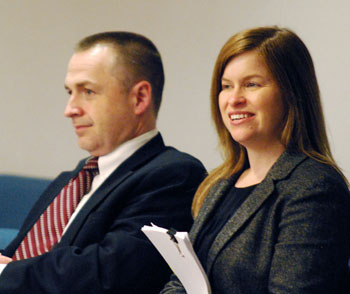
Auditors David Helisek and Pam Hill of Plante Moran PLLC.

Auditors David Helisek and Pam Hill of Plante Moran. (Photos by the writer.)

Still, the board transacted two pieces of business. The first was to approve the report of its auditor, Plante Moran. The overall opinion was “unqualified,” which is the highest rating that can be given. Still, the audit revealed some issues that need to be addressed, one of which was dealt with as part of the audit – the recording of revenue from the tax levy in the year it’s received. That actually increased the amount of AATA net assets by $7 million, but is an accounting change, not an actual change. The auditors found one case of a contract that should have been subjected to Davis-Bacon compliance requirements but was not.

Another issue identified by the auditor involves the AATA’s practice of investing in fuel futures as a hedge against the volatility of diesel prices – the advice was to review the practice with legal counsel. Plante Moran also flagged an issue involving the shelf-life of federal grants – but the AATA and auditors see that issue differently.

The second business item was approval of revisions to the AATA management personnel handbook – it was part of a periodic review and revision. Among myriad other changes, the amended document adds “sexual orientation” to the list of protected classes. [Full Story]

UM Students Lobby Regents to Take Action

University of Michigan board of regents meeting (March 15, 2012): About 100 people – most of them students advocating for tuition reform or changes to the University of Michigan’s childcare subsidy – packed this month’s venue for the regents meeting: The Michigan Union’s cavernous Pendleton Room.

Genevieve Urbain

Genevieve Urbain awaits her turn to speak during public commentary at the March 15, 2012 UM board of regents meeting. She was one of three people who spoke on the topic of Willis Ward, urging regents to find a way to honor the African-American athlete who played football for UM in the 1930s. (Photos by the writer.)

With minimal discussion, regents dispatched a variety of action items during the meeting, including several related to health education, facilities and athletics. They authorized a $50 million new building for the School of Nursing, as well as $20.5 million in renovations at the Taubman Health Care Center. In athletics-related items, regents approved renaming the Crisler Arena to Crisler Center, reflecting the broader uses there, as it has expanded in recent years. The board also authorized a $2 million increase in the budget for renovations at Yost Ice Arena, bringing that project to $16 million.

Ron Zernicke, dean of the School of Kinesiology, gave the meeting’s only presentation. He described the school’s facilities and academic programs, and the pressures of its increasing student enrollments. For undergraduates, kinesiology is the fourth largest school at UM’s Ann Arbor campus, with 877 students.

As part of her opening remarks, UM president Mary Sue Coleman reported that Fred White – a retired university auditor –has been hired as project manager to implement recommendations from an internal audit. The audit relates to an incident last year involving child pornography allegedly viewed on a UM health system computer. White will also serve as a liaison for an external review ordered by the board at its February meeting.

Several reports were received during the meeting as items of information, including the regular report on internal audits, and a summary of ongoing construction activities. Tim Slottow, UM’s chief financial officer, noted that the Fuller Road Station has been removed from the construction project list. He told regents that the university and city of Ann Arbor couldn’t agree on a memorandum of understanding on the joint project, but that he thinks it’s still a good aspiration. [See Chronicle coverage: "UM, Ann Arbor Halt Fuller Road Project"]

As it did at last month’s meeting, public commentary focused on better access to a childcare subsidy available to parents who are UM students – an issue being negotiated by the Graduate Employees’ Organization (GEO) – and equity for students who are charged out-of-state tuition because they are undocumented immigrants. Students urged regents to support both issues.

The meeting ended with three speakers – including eight-year-old Genevieve Urbain – asking regents to honor Willis Ward, an athlete at UM during the 1930s who faced discrimination because of his race. Regent Martin Taylor, who said Ward had been a friend and fraternity brother, got consensus from regents to seek recommendations on how Ward might be appropriately recognized. [Full Story]

AADL Hears from “Library Green” Advocates

Ann Arbor District Library board meeting (Aug. 15, 2011): A brief library board meeting on Monday night included a relatively rare occurrence – multiple people spoke during the time allotted for public commentary.

Mary Hathaway

Mary Hathaway spoke to the Ann Arbor District Library board about efforts to create a public gathering place atop the underground parking structure adjacent to the downtown library. (Photo by the writer.)

The commentary focused on what’s now being called the “Library Green” – an effort to create a public park atop the underground parking structure that’s being built on South Fifth Avenue, adjacent to the downtown library building. Advocates for the park conveyed that they’ve taken to heart the concerns of the library, and hope to partner with AADL to develop an area that benefits the public and helps the library to thrive.

The board began its meeting with a closed session, in part for the purpose of getting advice from AADL’s legal counsel. In her written report to the board, AADL director Josie Parker noted that the library is considering the legal and financial implications of the Ann Arbor Downtown Development Authority’s decision regarding “excess” taxes captured in the DDA’s tax increment finance (TIF) district.

Board members did not discuss this issue, but voted to schedule another closed session at their Sept. 19 meeting again to hear advice from legal counsel. [Full Story]

Ann Arbor Library Gets Its Game On

Ann Arbor District Library board meeting (June 20, 2011): On Monday, AADL board members learned that they each earned 200 points toward the library’s online summer game – just by attending the meeting.

Screen shot of the Ann Arbor District Library website

Screen shot of the Ann Arbor District Library summer game website. (Image links to play.aadl.org)

Eli Neiburger, AADL’s associate director of IT and product development, gave a brief presentation on the library’s new online component of its standard summer reading program. In addition to earning points for traditional activities like reading a book, the game includes tasks that are done online, like tagging an item in AADL’s catalog or commenting on a blog post. After July 5, points can be traded in for merchandise that will be available at AADL’s soon-to-be-launched online store.

The online aspect is another way to engage more people with the library, Neiburger said, while not demanding an intensive amount of staff time.

Also during the 30-minute meeting, AADL director Josie Parker updated the board on several issues. She’s been invited by the Ann Arbor city council to address that group at its July 5 meeting, to talk about the library’s needs in the context of plans to develop city-owned parcels. That development might include the top of the underground parking structure – known as the Library Lot – that’s under construction adjacent to AADL’s downtown building.

Parker also noted that AADL’s attorney is reviewing a recent decision by the Ann Arbor Downtown Development Authority board to repay the AADL $74,666 in excess tax increment finance (TIF) funds. There’s a question about whether additional funds are owed to the library and other taxing entities.

At the end of her report, Parker briefed the board about her trip to the UNESCO World Forum on Culture and Cultural Industries, held in Monza, Italy earlier this month – the three-day event focused on the future of the written word. She’d been invited to participate in a panel discussion on the topic of the library as a public service. There was acknowledgement among the attendees – librarians, publishing executives, academics, authors and others – that the digital production of material will prevail during the next decade or so, Parker said, but there was no real consensus about what that will actually mean.

In addition to hearing staff reports, the board also approved minor adjustments to wrap up AADL’s FY 2010-2011 budget, which ends June 30. Board members had approved next year’s budget at their May 16 meeting. [Full Story]

Monthly Milestone: A Different Beast

Editor’s note: The monthly milestone column, which appears on the second day of each month – the anniversary of The Ann Arbor Chronicle’s Sept. 2, 2008 launch – is an opportunity for either the publisher or the editor of The Chronicle to touch base with readers on topics related to this publication.

It’s also a time that we highlight, with gratitude, our local advertisers, and ask readers to consider subscribing voluntarily to The Chronicle to support our work.

The May meeting of the University of Michigan board of regents was remarkable for a rare display of discord. It’s the only time I can recall that this particular board has publicly voiced disagreement with the administration. It’s the only time I can remember some unscripted debate unfolding among regents on a substantive issue – the issue was a resolution recognizing the right of graduate student research assistants to unionize.

Bezonki

Bezonki, like The Chronicle, is a different kind of beast – he's sometimes surprised by what he reads in the newspaper. This is a preview panel from the upcoming June edition of The Chronicle's comic – a monthly nod to the time-honored tradition of the Sunday funnies. Bezonki is created by local artist Alvey Jones. (Image links to Bezonki archive.)

After the meeting, I happened to be leaving at the same time as UM president Mary Sue Coleman. As we walked down the hall together, I told her that despite the tension and clearly deep disagreement on this issue, I had found it refreshing to see an actual public debate at the meeting. It simply never happens.

Whatever disagreements exist among regents – or between regents and the administration – seem to be aired privately. When tuition rates are set, some regents will read statements of polite disagreement, before casting their votes of dissent. But most action items are approved unanimously, with little if any comment. I told Coleman that I realized the meeting had been at times uncomfortable, but that I appreciated the debate.

She gave me a withering look. “I’m sure you do,” she said, crisply.

Her pointed disdain took me aback – though I should have seen it coming. From her perspective, she’d been delivered a very public defeat on an issue she is passionate about, grounded in her personal experience. She seemed weary. But her comment also revealed a view of the media that’s more prevalent and more justified than I like to admit. It’s a view of reporters as hungering for headline-grabbing, website-traffic-sucking stories – and if the facts don’t quite deliver the juice, well, there are ways to spice up reality. There’s a reason why news gathering is sometimes called “feeding the beast.”

From that perspective, Coleman perhaps heard my remarks as the comments of someone who was hungry for more drama of regents mixing it up in front of the plebeians. Ouch.

So on my drive home from UM’s Dearborn campus – where the regents meeting was held – I thought about why the exchange had touched a nerve for me. For one, I’m dismayed that elected officials and other civic leaders are so often reluctant to hold difficult discussions in public. The board of regents is not the only body that does its business like a tightly choreographed kabuki dance. But as a journalist, I’m angered when irresponsible actions by those who earn a livelihood as part of the news media give public bodies a cheap excuse to be even more closed-off. [Full Story]

School Board Calls Extra Session on Budget

Ann Arbor Public Schools board of education meeting (May 25, 2011): The May 25 meeting of the AAPS board of education opened on a somber note, with board president Deb Mexicotte requesting a moment of silence to honor Huron High School junior Seth Harsch, who died Tuesday after stepping in front of a train. Mexicotte noted that crisis counselors have been on hand at Huron to offer support to students and staff, who are dealing with the loss to their community.

A handful of residents addressed the board during a public hearing on the proposed 2011-12 AAPS budget. The board will hold an additional study session on the budget on Fri., June 3 at 3:30 p.m. in the main conference room of the Balas administration building, and the public is invited.

The session will focus on prioritizing objectives, in case the finalization of the state budget leads to greater revenue for the district than initially expected. If revenue projections increase, the board may choose to restore high school busing, decrease class sizes, or make other amendments to the currently proposed budget. A final vote on the budget is scheduled for June 8.

Public commentary on the Haisley Elementary School parking lot continued. Although many of the speakers requested additional changes to the design, the board approved the proposal as it had been presented at the board’s first briefing, along with a host of other facilities improvement projects. Trustees also approved the purchase of a new standardized assessment tool, the Northwest Evaluation Association Assessment (NWEA), primarily for use in grades K-5.

Late in the meeting, which lasted over seven hours, the board engaged in a frank discussion regarding the Washtenaw Intermediate School District’s (WISD’s) budget as it relates to state reimbursement of special education services as well as local tax levies. Though trustees eventually passed a proposal in support of the budget, some board members registered strong concerns.

Finally, the board heard first briefings on a number of other items, including the 2011 millage resolution that will accompany the final budget vote, and updates on both the AAPS strategic plan and a set of board policies. [Full Story]

AAPS Board: No Principal Sharing in 2011-12

Ann Arbor Public Schools (AAPS) board of education meeting (May 11, 2011): After hearing significant public commentary on the matter, and following a spirited discussion, the AAPS board voted 5-2 to eliminate a plan to share principals among elementary schools from the proposed 2011-12 AAPS budget. A public hearing on the budget will be held as part of the next regular board meeting at 7 p.m. on May 25.

Public commentary was also rich with concerns regarding a proposed expansion of the parking lot at Haisley Elementary, which was discussed by the board at length as a first briefing item. It will come up for a vote at the May 25 meeting.

At the May 11 meeting, which lasted past 1:30 a.m., the board also approved upgrades to the district’s PowerSchool communication system, SISS assistive technology, and the elementary math curriculum. They also heard a first briefing on a proposal to purchase a new standardized assessment tool to complement the Michigan Educational Assessment Program (MEAP), and were updated on the progress of the Widening Advancement for Youth (WAY) Washtenaw program. [Full Story]

Ann Arbor Library Frames Tech Issues

Ann Arbor District Library board meeting (March 21, 2011): Monday’s meeting of the AADL board included an animated discussion about how digital books are transforming the publishing industry, and the impact those changes are having on public libraries.

Eli Neiburger's avatar

Eli Neiburger's avatar – or click the photo to see how he looks in real life. Neiburger has been named by Library Journal as one of its 2011 Movers & Shakers.

The topic stemmed from a report by AADL director Josie Parker, who described her experience at a recent working group meeting for the Digital Public Library of America. At that invitation-only event, Parker framed the discussion among industry leaders regarding the future of public access to information, from the perspective of public libraries.

It’s an issue highlighted by the decision of two major publishers – Macmillan and Simon & Schuster – not to sell eBooks to public libraries, making more than 25% of the eBook market unavailable to library patrons. More recently, HarperCollins announced restrictions on how libraries can circulate eBooks that it publishes.

Eli Neiburger, AADL’s associate director of IT and product development, gave a talk on the impact of eBooks at a national summit last fall called “ebooks: Libraries at the Tipping Point” – his presentation can be viewed online. At Monday’s meeting, Parker congratulated him for being named by Library Journal as one of its 2011 Movers & Shakers, in the category of tech leaders.

In another technology-related update, Parker told the board she’s been invited to serve on the Bill & Melinda Gates Foundation‘s public access technology benchmarks program. That workgroup will be developing benchmarks that libraries can use to determine the kind of technology infrastructure they need to deliver services to their communities.

Parker also briefed the board on new standards imposed by the Library of Michigan, which changed how public libraries qualify for state aid. Those standards – originally proposed as rules – are the subject of a lawsuit against the state library, filed by the Herrick District Library in Holland. The AADL has filed an amicus curiae – or “friend of the court” – brief in support of the Herrick library’s position, which charges that the state library has no authority to set these rules, and is taking away local control from district libraries.

Aside from updates made by Parker, the board dispatched with the rest of its business quickly. No one spoke during the time available for public commentary. [Full Story]

AAPS Board Gets Briefed on Budget

Ann Arbor Public Schools board of education regular meeting (March 16, 2011): The highlight of last week’s meeting was a presentation from interim superintendent Robert Allen on the many budget and funding issues the district faces in the coming years.

Allen told board members that the district faces a $15 million shortfall in the next fiscal year, which begins July 1. That figure assumes the special education millage, on the ballot for May 3, will be renewed. If voters don’t approve the millage renewal, the deficit could grow to nearly $21 million.

During the meeting, board members criticized Gov. Rick Snyder’s proposed state budget, which calls for cuts to K-12 education. They cautioned that his focus on business tax cuts would undermine the quality of public education in the state. “I don’t think most people want education ravaged in order to fund a huge business tax cut,” trustee Glenn Nelson said. “We need to shout this story from the rooftops.”

Allen will be giving an expanded report on the budget situation to the public from 6:30-8 p.m. on Monday, March 21 at the Pioneer High School cafeteria annex. The board also discussed setting up a time to meet with state legislators, to discuss their concerns about the state budget proposals.

Also during Wednesday’s meeting, board president Deb Mexicotte reported that the district is close to wrapping up contract negotiations with Patricia Green, the board’s choice to become the district’s next superintendent. She hoped to provide additional details soon, including a potential start date. [Full Story]

UM Research Highlighted at Regents Meeting

University of Michigan board of regents meeting (Jan. 20, 2011): The university’s top research administrator, along with a faculty member who has successfully straddled the academic and entrepreneurial worlds, addressed regents at their January meeting about how university research is aiding economic development.

Stephen Forrest, David Lampe

Stephen Forrest, left, talks with David Lampe before the start of the Jan. 19, 2011 University of Michigan board of regents meeting. Forrest, UM's vice president for research, gave a presentation on the university's research efforts. Lampe is vice president for communications. (Photos by the writer.)

Stephen Forrest, UM’s vice president for research and chair of the board for economic development agency Ann Arbor SPARK, described the concept of an “innovation pipeline,” with the input of funding and ideas yielding an output of jobs, prosperity and expanded opportunities for faculty and students. The process has leaks and clogs, he noted, but the university has strategically applied patches – citing as an example the Venture Accelerator program that launched this month.

And Jim Baker, director of the Michigan Nanotechnology Institute for Medicine and Biological Sciences, was on hand to embody the efforts of faculty who successfully translate research into economic development. Baker’s talk focused on the rewards of creating new businesses – he observed that one reason why students come to UM is to enhance their economic prospects and improve their lives. Baker talked about the importance of keeping those graduates in Michigan to aid in the state’s economic recovery – and doing that requires jobs. He noted that the four companies he has helped launch in Ann Arbor have brought in $160 million in investments and created 45 new jobs so far.

Regents took action on several items during the meeting, including approval of two projects related to the athletics department: A $52 million renovation and expansion of Crisler Arena – the second phase of a major overhaul of that facility, which was built in 1968; and a $20 million project to install video scoreboards at Michigan Stadium, Crisler Arena and Yost Ice Arena. David Brandon, UM’s athletic director, made a brief appearance at the meeting but did not address the regents publicly. And this month’s biggest athletic-related news at UM – that Brady Hoke was hired as head football coach – received only a mention as part of president Mary Sue Coleman’s opening remarks. He did not attend the meeting.

Seven people spoke during public commentary on a variety of topics. Among them were: (1) a call to reassess Fuller Road Station, a proposed parking structure and possible train station near UM’s medical campus; ( 2) questions about the medical leave of Ken Magee, executive director of UM’s Department of Public Safety (DPS); (3) thanks from the leader of the Ann Arbor Summer Festival for the university’s support of that annual event; (4) criticism of the use of live animals to train survival flight nurses; and (5) a plea for financial support for The Loyal Opposition to the Status Quo (LOSQ), a nonprofit launched to address disparities between African-Americans and Caucasians. [Full Story]

Ann Arbor Library Board Starts New Year

Ann Arbor District Library annual board meeting (Jan. 17, 2011): The library board’s first meeting of 2011 served as the board’s “annual meeting.” It kicked off with a swearing-in for four board members – including three incumbents – who won their elections on Nov. 2. The ceremony was officiated by Judge Elizabeth “Libby” Hines of the 15th District Court.

Barbara Murphy, Ed Surovell, Nancy Kaplan, Jan Barney Newman

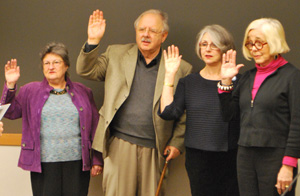
From left: Barbara Murphy, Ed Surovell, Nancy Kaplan and Jan Barney Newman were sworn in as Ann Arbor District Library board members at Monday's meeting. Elizabeth Hines, a judge in the 15th District Court, officiated the ceremony. (Photos by the writer.)

The seven-member board also elected new officers – there were no competing nominations, and all votes were unanimous. Margaret Leary, who has previously served as president, was again elected to that office, replacing trustee Rebecca Head. In her final remarks as president before new officers were elected, Head gave an overview of the past 18 months, citing both challenges and accomplishments during that period.

The board also heard some details about AADL director Josie Parker’s involvement in the Digital Public Library of America initiative. Parker has been invited to be part of a small working group that will help launch the project, which is spearheaded by Harvard University’s Berkman Center for Internet and Society. Paul Courant, dean of libraries for the University of Michigan, is also involved. [Full Story]

Ann Arbor Library Weighs In On Lawsuit

Ann Arbor District Library board meeting (Dec. 20, 2010): The AADL board spent much of their December meeting focused on a statewide issue with local implications: New rules issued by the Library of Michigan are being challenged in court. The board ultimately voted to file an amicus curiae – or “friend of the court” – brief in support of the Herrick District Library in Holland, which filed suit against the state library. At stake are broader issues of local control, which officials at local public libraries believe would be eroded if the new rules are allowed. The new rules change how libraries qualify for state aid.

The board also got brief updates on plans to deal with the downtown library building and with the parking deal being negotiated between the city of Ann Arbor and the Ann Arbor Downtown Development Authority.

Monday’s meeting wrapped up with a farewell to Carola Stearns, the outgoing board member whose term concludes at the end of the year. [Full Story]

AAPS Pursues Tenure Charges Against Two

Ann Arbor Public Schools board of education meeting (Dec. 15, 2010): At Wednesday’s meeting, the AAPS board of education voted unanimously to pursue tenure charges against two teachers – high school orchestra teacher Christopher Mark and elementary classroom teacher William Harris.

Chris Mark conducts a rehearsal Monday afternoon of the Huron High symphony orchestra.

This early 2009 Chronicle file photo shows Christopher Mark as he conducts a rehearsal of the Huron High symphony orchestra. (Photo links to Jan. 12, 2009 Chronicle article about a visit from lead violinist for the Guarneri String Quartet, Arnold Steinhardt.)

In neither case did the board explain its reasoning or share any details of their investigation. However, public commentary about Mark’s case revealed the board’s concern that Mark had engaged in a possibly inappropriate relationship with a woman when she was a student at Huron High School five years ago. Mark and the woman are currently dating.

Also at the meeting, AAPS interim superintendent Robert Allen presented a draft of proposed changes to the district’s strategic plan. Three of the eight original action teams for the plan, each centered on a core strategy, have been asked to reconvene from January to March of 2011 to clarify the focus of their work in light of the proposed changes. Finalized updates to the strategic plan will be presented in April 2011 for board approval.

A number of additional actions were taken by the board at the meeting, including adoption of a set of principles to be used in drafting education reform legislation. The principles will now be shared with other local districts in the hopes of presenting a unified set of suggestions to legislative representatives early in 2011. [Full Story]

Balanced Calendar on Hold for AAPS

Ann Arbor Public Schools board of education meeting (Dec. 8, 2010): At last Wednesday’s board meeting, trustees got an update on a partnership between the University of Michigan (UM) and Ann Arbor Public Schools (AAPS) on a developing program involving UM, Mitchell Elementary School and Scarlett Middle School.

One component of this initiative, formerly known as the lab school, is a “balanced calendar,” which features a shorter summer break, and includes optional intersessions – one or two-week long academic or enrichment activities held during breaks in regular instruction. At Wednesday’s meeting, Mitchell principal Kathy Scarnecchia reported that implementation of the balanced calendar will be delayed until 2012-13.  The delay comes primarily in response to concerns about different children in the same family ending up on different schedules, since the balanced calendar was planned to be implemented at Mitchell and Scarlett, but not at other AAPS schools.

The partnership’s planning committee is now considering other options, including moving all of Scarlett’s feeder schools to a balanced calendar, or allowing families to opt-in or opt-out of the partnership entirely. The board was uniformly in support of the balanced calendar, with multiple board members suggesting that it be expanded to the entire district.

Also at last Wednesday’s meeting, the board briefly discussed the process it would use to conduct interviews of the final candidates for the superintendent position, and the timeline for the remaining aspects of the search process. The board also got a first-quarter financial update with news that the state had restored nearly $4.3 million of the $20 million of funding cut during the last school year. [Full Story]

AATA Continues Push for Master Plan Input

Ann Arbor Transportation Authority board meeting (Oct. 21, 2010): The Ann Arbor Transportation Authority has several major projects in the works, including remodeling the downtown transportation terminal – the Blake Transit Center – and developing a countywide master plan that calls for a series of community forums.

One of those community forums was held on Thursday, an hour prior to the AATA’s monthly board meeting. But no one from the public showed up to that particular event – several other meetings are scheduled. The board meeting that followed was over within an hour. In addition to the master plan, the board discussed the most recent quarter’s on-time trip performance, which board member David Nacht described as “abysmal.” [Full Story]

County Commissioner Expenses Debated

Washtenaw County Board of Commissioners meeting (Oct. 20, 2010): A strong undercurrent of both the upcoming Nov. 2 elections and the looming county budget deficit erupted at times during Wednesday’s board meeting – the last board meeting prior to the elections.

Mark Ouimet, Leah Gunn

County commissioners Mark Ouimet and Leah Gunn talk prior to the start of the Oct. 20 Washtenaw County board of commissioners meeting. During the meeting Gunn, a Democrat, defended Ouimet, who has come under attack by some Democrats for excessive and inappropriate per-diem claims. (Photos by the writer.)

At the center of public commentary and commissioner discussion – which at times grew heated – was the issue of whether commissioners are appropriately claiming reimbursements for mileage and per diem. The controversy first emerged at the board’s last meeting on Oct. 6, when Democrat Tom Wieder spoke during public commentary to call for an investigation into per diem spending by commissioner Mark Ouimet. That same Oct. 6 meeting included discussion of a projected two-year budget deficit for 2012 and 2013 that could exceed $20 million.

Ouimet, a Republican who’s running for state representative in District 52 against Democrat Christine Green, was defended on Wednesday during public commentary by the county’s top two GOP officials, Mark Boonstra and Wyckham Seelig, who accused the Democratic board majority of partisan politics. They said they’ve launched their own investigation into commissioner spending, specifically citing out-of-state travel by Kristin Judge. Judge has been a vocal critic of Ouimet’s spending, during the meeting noting that the board rules are clear and that Ouimet failed to abide by them at times.

Ouimet was also defended at Wednesday’s meeting by several Democrats who serve with him on the board and who said they had nothing to do with the recent criticism of him. Leah Gunn recalled that Ouimet had been her Ward 4 Ann Arbor city councilmember some 20 years ago, and that she’s always found him to be upstanding and gracious. Ken Schwartz criticized the “Lansing politics” that were being brought to the county. He noted that the board has a track record of working together without divisive partisan politics, and that they’d all been surprised by the recent controversy.

County clerk Larry Kestenbaum also weighed in, commenting on a report that his office had released earlier in the day that analyzed per-diem and mileage expenses for all commissioners, dating back to 2005. Ouimet claimed the most expenses by far during that period – $32,804. Of Ouimet’s claims, $10,564 was analyzed as ineligible, and another $6,055 was “uncertain,” indicating a gray area where reimbursement rules aren’t clear. That means that about half of Ouimet’s claims don’t fall into the clearly acceptable category. Kestenbaum spoke during public commentary, saying that he considered all the commissioners to be his friends and great public servants – the report was not intended to be an attack, he said.

Ouimet offered to put the disputed amount in escrow until all of the claims have been reviewed. [The Chronicle converted the county clerk's Excel workbook with multiple tabs, one for each commissioner, to a single .pdf file. Commissioner Ronnie Peterson has not claimed mileage and per-diem expenses, and is not included in the report.]

The issue of commissioner expenses came up earlier in the meeting in another context. Judge introduced a resolution that would have eliminated retirement pensions and health care for commissioners, saying that the change would save the county more than $25,000 annually. She noted that she had circulated the resolution to commissioners prior to the meeting, though it was not on the agenda. No one seconded the motion, and it died without further discussion.

Also related to budget issues, the board gave initial approval to levy an economic development tax of 0.043 mills. Known as the Act 88 millage, it is expected to generate roughly $611,266 annually and would cost homeowners $4.30 for every $100,000 of a home’s taxable value. Because Act 88 predates the state’s Headlee Amendment, it can be approved by the board without a voter referendum. Three commissioners – Judge, Ouimet and Wes Prater – voted against the measure, and Jessica Ping abstained, citing the fact that a recipient of the funds, Ann Arbor SPARK, is a client of hers.

Another millage – one that, unlike Act 88, will be on the ballot – would support the Ypsilanti District Library. Linda Gurka, a member of the library’s board of trustees, spoke during public commentary to drum up support for the millage increase that will be on the ballot for Ypsilanti District Library voters. Also during public commentary, Todd Clark, co-chair of this year’s United Way of Washtenaw County‘s fundraising campaign, spoke in support of a proposed coordinated funding model for local nonprofits. [Full Story]

Ann Arbor Library Board Gives Kudos

Ann Arbor District Library board meeting (Oct. 18, 2010): The bulk of Monday’s 20-minute library board meeting was devoted to accolades: A clean audit for the Friends of the Ann Arbor District Library, praise from representatives of people with disabilities, and a five-star ranking for the AADL, making it among the top libraries in the country.

Shannon Owen

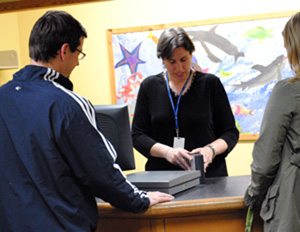
Shannon Owen, circulation clerk at the Ann Arbor District Library's downtown branch, checks out materials for patrons on Monday night. (Photos by the writer.)

In addition, during public commentary the board heard from Alan Haber, a community activist who’s advocating for a greenspace commons to be located atop an underground parking structure being built adjacent to the downtown library on Fifth Avenue. Haber presented architectural renderings of the proposal, designed by Stephan Trendov, and asked the board to allow him to give a more detailed presentation at an upcoming meeting.

In his financial report, AADL associate director Ken Nieman told the board that while most costs are expected to be in line with budgeted amounts during the current fiscal year, that might not be the case for employee benefits. It was an issue that arose during the board’s September meeting as well, when library officials reported that they were changing the insurance options for non-union employees to address increased expenses. On Monday, Nieman also said they’d just received word that the employer contribution rate to the Michigan Public School Employees Retirement System (MPSERS) was going to increase again – it had already been bumped up to 19.4% on Oct. 1, and would rise to 20.5% on Nov. 1. [Full Story]

AATA Approves Budget, UM Agreement

Ann Arbor Transportation Authority board meeting (Sept. 16, 2010): After failing to achieve a quorum last month, this month the AATA board hit enough of the right figurative buttons to transact successfully the month’s business.

David Nacht with microphone.

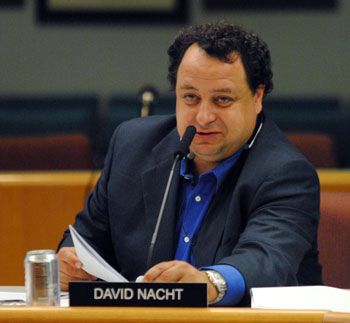
AATA board member David Nacht presses his microphone button. (Photos by the writer.)

That business included the approval of its fiscal year 2011 budget, which starts Oct. 1, 2010 and goes through Sept. 30, 2011. The FY 2011 budget calls for a total of $27,030,407 in expenses, among them a provision for a 2% merit-based increase in non-union staff compensation, with an additional 1% bonus pool for the organization’s top performers.

The board also approved another five-year MRide agreement with the University of Michigan to provide transportation for UM faculty, students and staff. Under the agreement, which runs from 2010-2015, UM affiliates will continue to board without paying a fare, with UM paying the AATA $1 per boarding.

When added to the per-boarding payment, $800,000-$900,000 of federal funds – received by UM and included as part of the MRide deal – will result in an estimated $2.37 million payment by UM to the AATA in FY 2011, the first year of the new agreement.

The board also voted to award a three-year contract to RideConnect – a partnership of WATS, Washtenaw County, WAVE and People’s Express – valued at $200,000 per year. The contract will be paid by federal and state funds designated specifically to aid the coordination between public transit and human services transportation needs.

The board’s meeting also included, for the first time, literal buttons. The board convened a meeting for the first time at its new meeting location – the Ann Arbor District Library’s board room – which is equipped with video recording equipment, including buttons used by meeting participants to turn their microphones on and off.

And some remarks by a public speaker pushed the wrong button for David Nacht, who responded to the speaker’s remarks by saying that attitudes reflecting age-based discrimination were not appropriate. [Full Story]

Library Board: Invest in Current Building?

Ann Arbor District Library board meeting (Sept. 20, 2010): A request to replace an aging chiller – the piece of equipment that acts as an air-conditioner for the downtown library – led to a broader discussion among library board members on Monday night about how much they should invest in a building that not long ago they planned to demolish.

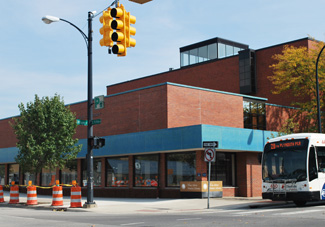
Ann Arbor District Library building at Fifth & William

The Ann Arbor District Library building, on the northeast corner of Fifth & William. (Photos by the writer.)

They ultimately approved replacing the chiller for $108,555 – but also agreed to plan a retreat where they’ll discuss the issue of the downtown building in depth. The retreat will be scheduled sometime after the Nov. 2 election, when seven candidates will vie for four seats. In addition to the four incumbents running – Jan Barney Newman, Barbara Murphy, Carola Stearns and Ed Surovell – two other candidates attended Monday’s meeting in the audience: Vivienne Armentrout and Lyn Powrie Davidge. Nancy Kaplan is also running for a board seat.

The board heard a report that employee benefits are over budget, primarily due to increased health insurance costs. The administration has addressed that issue by changing the insurance options for its non-union employees, a move that’s expected to bring the expense back to its budgeted amount by the end of the fiscal year.

Also during Monday’s meeting, the board and staff heard a presentation by Stearns, a geologist, who described the effects of glaciers on this region’s topography, in part by looking at the layers of earth exposed during excavation for the underground parking garage being built adjacent to the downtown library building. [Full Story]

UM Regents Updated: Research, Renovations

University of Michigan Board of Regents meeting (Sept. 16, 2010): This month’s public meeting of the regents lasted just over an hour and included some unusual elements, along with the usual fare.

Royster Harper, Kelly Cunningham, Chris Armstrong

Chris Armstrong, right, president of the Michigan Student Assembly, talks with Royster Harper and Kelly Cunningham before the Sept. 16 UM Board of Regents meeting. Harper is vice president for student affairs. Cunningham is director of UM's Office of Public Affairs. (Photos by the writer)

Board chair Julia Darlow read a brief statement near the start of the meeting, stating support for anyone in the university community who comes under attack for their identity – an oblique reference to what’s been characterized as the cyber-bullying of Chris Armstrong, the Michigan Student Assembly president. Armstrong, who is gay, is the target of  the “Chris Armstrong Watch” blog, maintained by Andrew Shirvell, a state assistant attorney general.

Later in the meeting during his regular report on MSA activities, Armstrong criticized the Ann Arbor city council for its recent proposal to ban porch couches, noting that although he planned to meet with some councilmembers later that day, they had not consulted students before taking action on the issue. At their Sept. 20 meeting, council is expected to vote on an ordinance amendment to ban upholstered furniture on porches.

Also during Thursday’s meeting, regents approved renovations and upgrades for several facilities on campus. The vote for a high-profile project to add permanent night lighting at Michigan Stadium passed without comment, while a seemingly innocuous elevator replacement at South Quad yielded an uncharacteristic, albeit relatively brief, discussion about long-term planning for the renovation of that dorm.

Regents heard a presentation about the research work being done at UM’s Institute for Social Research, given by ISR’s director, James Jackson. They also heard from Stephen Forrest, UM’s vice president for research, that the university had for a second year passed the $1 billion mark in research expenditures for fiscal 2009-10, increasing 12% over the previous year.

Not faring as well are donations to the university. Jerry May, vice president for development, reported that contributions dropped 4% to $254 million during 2009-10, which ended June. 30. However, there was an uptick in the last half of that fiscal year and the first two months of this year, which May described as “very healthy.”

The meeting concluded with one speaker during public commentary. Douglas Smith criticized regents Andrew Richner and Andrea Fischer Newman for, among other things, failing to deliver on a campaign promise to hold tuition increases to the rate of inflation. Noting that the two Republicans were running for re-election, he urged the public to vote against them in November. After his remarks, three of the Democrats on the board came to the two Republicans’ defense. [Full Story]

AAPS Special Meeting Time Changed

An Ann Arbor Public Schools special board meeting previously scheduled for Tuesday, Aug. 24 has been changed to tonight, Monday, Aug. 23, at 6:30 p.m. The meeting will take place at the Balas administration building main conference room, 2555 S. State St.

The purpose of the meeting is to discuss a draft of a request for proposals (RFP) for search firms to assist with the hiring of a new superintendent to replace Todd Roberts, who recently announced his resignation. In November, Roberts is moving back to his hometown of Durham, N.C. to become chancellor of the North Carolina School for Science and Math. [Full Story]

DDA Approves Grant for Zingerman’s

Ann Arbor Downtown Development Authority board meeting (July 7, 2010): In the main business at its regular monthly meeting, the DDA board approved a grant of up to $407,000 in support of a brownfield application by Zingerman’s Deli, which the deli is making to the state of Michigan. The board’s deliberations focused on the public improvements to sidewalks, curb ramps and signage as contrasted with the funding for LEED certification costs – a question of public versus private benefit.

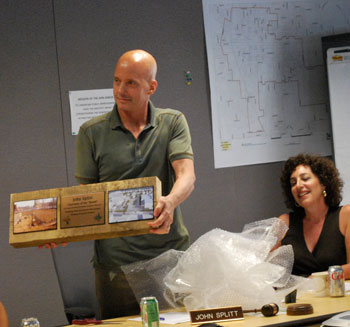
John Splitt Ann Arbor Downtown Development Authority

At his last meeting as chair of the Ann Arbor Downtown Development Authority board, John Splitt shows off the tchotchke of appreciation he was given by executive director Susan Pollay. The board is a piece of the kind of lumber currently being used for the earth retention system in construction of the Fifth Avenue underground parking garage. To the right of the frame is Joan Lowenstein, who was elected chair of the board for the coming year. (Photo by the writer.)

The board also approved a recommendation for details of a payment-in-lieu-of-parking (PILOP) program that allows developers to build fewer parking spaces than otherwise prescribed by the zoning code. The program recommended by the DDA allows for developers to replace required on-site spaces with monthly permits – plus a 25% surcharge – in parking structures managed by the DDA.

The DDA made the recommendation to the city’s planning department because the department had requested the DDA’s input on PILOP after the city’s new rezoning of downtown A2D2 was approved last year by city council.

The board also approved revisions to the FY 2010 budget so that expenditures do not exceed budgeted amounts.

Immediately following the regular monthly meeting, the board held its annual meeting, during which executive director Susan Pollay ticked through the significant accomplishments of the board over the last year. Officers elected for the next year are: chair, Joan Lowenstein; vice chair, Gary Boren; treasurer, Roger Hewitt; secretary, Russ Collins.

Board member Newcombe Clark pointedly abstained from each of the four officer votes. [Full Story]

County Board Moves Ahead on Land Bank

Washtenaw County board of commissioners meeting (July 7, 2010): Commissioners spent most of their July meeting on two contentious issues: re-establishing a land bank, and a possible expansion of the county road commission.

Jeff Irwin, Leah Gunn

Washtenaw County commissioners Jeff Irwin (District 11) and Leah Gunn (District 9) confer before the July 7 board meeting. (Photos by the writer.)

After more than an hour of discussion, a majority of commissioners approved a step toward bringing back the land bank, which they’d voted to dissolve in March. Several commissioners raised concerns over funding for the land bank and the expense of property maintenance and rehab, though most said they supported the entity in concept.

A land bank allows the government – through a separate land bank authority – to take temporary ownership of tax- or mortgage-foreclosed land while the county works to put it back into productive use. Commissioner Ronnie Peterson, whose district in Ypsilanti and parts of Ypsilanti Township has been hit hard by foreclosures, has been an advocate for the land bank for several months, and expressed his impatience and frustration during the meeting. A motion to rescind the dissolution of the land bank was not considered at the July 7 meeting, but might be brought forward next month.

The board also held a public hearing on expanding the road commission from three members to five – three residents spoke at the hearing, all opposing the expansion. An animated discussion with a somewhat unclear outcome followed the hearing – with Wes Prater moving to stop the process of expansion, and getting support from the majority of the board. Calling that move “symbolic,” Jeff Irwin said he plans to bring a resolution to the Aug. 4 board meeting that will officially propose the expansion.

Several other items related to financial matters. The board approved an initiative to put more government information online, especially regarding budget and finance. They discussed and authorized re-funding bonds requested by Dexter Township, and noted with some concern that Dexter Township isn’t alone in its struggle to meet bond payments. And county administrator Verna McDaniel signaled her intent to hire Kelly Belknap as the county’s new finance director, replacing Peter Ballios, a 38-year veteran of the county who retired at the end of 2009.

The board also approved a brownfield plan for a project in downtown Ypsilanti, and set public hearings for Aug. 4 regarding two additional brownfield plans – the Near North housing project and Zingerman’s Deli expansion, both in Ann Arbor. The board is also expected to vote on those plans at the Aug. 4 meeting. [Full Story]

Library Feels Impact of Construction Project

Ann Arbor District Library board meeting (June 21, 2010): Construction in the area surrounding the downtown library came up in a couple of ways during the library board’s June meeting held this week.

Construction along Fifth Avenue in Ann Arbor

The view from the entrance of the downtown Ann Arbor District Library, looking west. In the foreground is construction from the Fifth Avenue streetscape project. Across the street is a city-owned surface lot that will be closed when the AATA rebuilds the Blake Transit Center, seen to the right.

Vibrations from work on the Fifth Avenue underground parking structure, just to the north of the library building, have caused problems with the building’s HVAC system – the library temporarily lost air-conditioning as a result. In a related move, the library board voted to award a contract for HVAC maintenance and repair to Pace Mechanical, despite arguments that it should go to a local company.

And in her director’s report, Josie Parker noted that a public parking lot used by library patrons will close as early as next spring, due to the rebuilding of the AATA’s Blake Transit Center. The city-owned surface lot is located at the northwest corner of Fifth and William, directly across from the library.

The Chronicle followed up with the Ann Arbor Downtown Development Authority, which oversees management of the surface lot for the city, for more details on possible contingencies for patron parking, as well as other access issues that could arise when Fifth Avenue along that block is closed for at least a year, starting Aug. 1.
[Full Story]

AAPS: Which Bus Route to Take?

Ann Arbor Public Schools Board of Education meeting (June 4, 2010): At an extra, regular meeting on Friday evening, the school board heard an updated presentation on the details of a proposed consolidation of school transportation services with the Washtenaw Intermediate School District (WISD). The board’s second briefing on the consolidation and its vote, will come Wednesday, June 9.

baskett-susan-transportation

AAPS trustee Susan Baskett and deputy superintendent for operations Robert Allen listen to the transportation consolidation proposal. (Photos by the writer.)

Brian Marcel, assistant superintendent of business services for WISD, walked board members through the proposal, and went through an extensive list of questions and answers about the plan. A few bus drivers from AAPS, as well as some from Lincoln Consolidated Schools, attended the meeting – one of them, Richard Miller, spoke during public commentary.

The only other business conducted at the meeting was to approve a set of minutes, and to schedule an executive session before the next regular meeting on Wednesday, June 9. [Full Story]

UM Regents: Housing Rates Up, Tuition Next

University of Michigan Board of Regents meeting (May 20, 2010): This month, regents met at the UM-Dearborn campus – this is their second month away from Ann Arbor, after holding their April meeting in Grand Rapids. They’ll be back at their regular location in the Fleming administration building next month, when they’ll be voting on the budget for 2010-11, including tuition rates.

Big Ten championship ring on the hand of a UM gynmast

Championship ring on the hand of a UM men's gymnast at the May 20, 2010 board of regents meeting in Dearborn. (Photos by the writer.)

During the May 20 meeting, regents approved a 3% average rate increase for room and board during the 2010-11 academic year in campus residence halls. A double room will increase from $8,924 to $9,192 – an increase of $268. The most expensive room – a single with a private bath – will cost $12,166, up $354. Rates for the Northwood apartment complex on UM’s north campus were also raised an average of 1%.

Three construction projects – including a $17.7 million expansion to the University Hospital emergency department and a new $2.5 million indoor golf practice facility – were approved, with no discussion.

A large part of the meeting consisted of presentations, including an update on how the university’s health system might be affected by recent national health care reform, and a report on the non-traditional education programs task force, which generated some comments from regents.

Several sporting achievements were highlighted at the start of the meeting, as has been the case in other recent months. Most prominently, the men’s gymnastics team attended and were congratulated for their recent NCAA championship win. The celebration included a cake, and regents were given caps – which some wore during the meeting – commemorating the achievement.

Sports-related news not mentioned during the May 20 meeting was the university’s response to allegations that its football program violated NCAA rules – the university announced that response a few days later. [Full Story]

Library Board Adopts 2010-11 Budget

Ann Arbor District Library board meeting (May 17, 2010): At its May meeting, the AADL board adopted a budget for the 2010-11 fiscal year – keeping the millage rate at 1.55 mills. Though the tentative budget discussed at the board’s April meeting had projected a $200,000 shortfall, the library staff is now anticipating less of a drop in tax revenues for the coming fiscal year. That increased optimism on the revenue front means that the approved budget does not require tapping the library’s fund balance.

Board members also discussed awarding a contract for HVAC work, and heard from the representative of a company that’s not being recommended for the contract. The board revised the library district’s boundaries in the Northfield Township area, and approved new legal compliance and conflict of interest policies. [Full Story]

New Trustee, AAPS Board Weigh Budget

Ann Arbor Public Schools Board of Education meeting (May 12, 2010): Last month, Andy Thomas made a report to the board as a member of the Parent Teacher Organization Council. Now, the PTOC will make those reports to a board that includes Thomas.

Andy Thomas AAPS school board member

Andy Thomas, being sworn-in as the newest trustee of the Ann Arbor Public Schools board of education at its May 12 meeting. (Photos by the writer.)

Thomas replaces long-time member Randy Friedman, who resigned in April.  The selection of Thomas to the board during last Wednesday’s meeting marks the third change in board membership in the past six months. Thomas’ current term will end at the end of the year, and he – along with trustees Simone Lightfoot, Christine Stead, Deb Mexicotte, and Susan Baskett – will need to be re-elected in November to remain on the board.

Also at the meeting, the district’s achievement gap between white and minority students was addressed from multiple perspectives. The proposed Washtenaw Intermediate School District budget was reviewed, and the board was briefed on the district’s finances, sinking fund summer projects, policy updates, and human resources. [Full Story]

AAPS Custodial, Maintenance Kept Public

Ann Arbor Public Schools Board of Education meeting (April 28, 2010): The most recent regular school board meeting of the Ann Arbor Public Schools (AAPS) ended the debate over privatization of the district’s custodial and maintenance workers – it’s not happening.

The board’s ratification of an agreement between AAPS and local members of the American Federation of State, County, and Municipal Employees (AFSCME) union retains the 164 workers and their seven supervisors as AAPS employees. In return, custodial and maintenance workers agreed to lower wages, less vacation time, and almost double the cost of health insurance premiums.

Also at this meeting, an initiative to consolidate the busing services of at least five of the ten school districts in Washtenaw County was introduced to the board as a first briefing item. The consolidation plan is still under development, but as currently formulated, it would save the district $2.1 million in transportation costs, and would require only around 60% of the total number of bus drivers and monitors currently employed by participating districts. Bus drivers hired as part of the consolidated service plan would become employees of the Washtenaw Intermediate School District (WISD), maintaining their pensions as part of the state retirement system.

Many community members were on hand to support the numerous award recipients honored during the course of the board’s meeting. But the meeting drew no public commentary, and no one spoke at the embedded public hearing on sexual health curricular materials. Large-scale facilities projects, a personal curriculum option, and policy updates were also approved.

A large, roughly three-hour chunk of the meeting was devoted to a detailed presentation of the district’s current achievement data, and a discussion of the “achievement gap” between students of different races. This topic may be addressed by The Chronicle in a separate article, and is thus mentioned only briefly in this meeting report. [Full Story]

AAPS Budget Would Cut Positions, Add Fees

Ann Arbor Public Schools Board of Education meeting (March 24, 2010): Todd Roberts, superintendent of Ann Arbor Public Schools (AAPS), unveiled his administration’s 2010-11 budget recommendations to the board of education on Wednesday night. To counter a potentially $20 million shortfall, the proposed budget eliminates 80.6 positions across the district, while restructuring programs, adding fees, and bringing 200 new students to the district.

Todd Roberts AAPS school board

AAPS Superintendent Todd Roberts, flanked by members of his staff, begins presenting his administration's proposed 2010-11 district budget. Behind him, from left to right, are two members of his cabinet: Robert Allen and Randy Trent, and the three administrators of instructional services: Lee Ann Dickinson-Kelley, Larry Simpson, and Joyce Hunter. (Photos by the writer.)

However, multiple budget factors are still unknown: the state has not yet set the per-pupil funding amounts for next year; contract negotiations between AAPS and its teachers, bus drivers, and custodial/maintenance workers unions are still ongoing; and a possible countywide transportation consolidation plan is in the works, but has not yet been solidified. Depending on these outcomes, an additional 39 teaching and three administrative positions could be eliminated, and support services could still be outsourced. If layoffs are made, teachers will be notified by the end of April.

Though the board will hear an update on the proposed budget from the administration on April 14, board president Deb Mexicotte described that second briefing as a time when the board is “looking to have a general consent that this is the direction we are going, with the idea that we have legal obligations related to the budget that we are approving in June.” Two public forums are set for April 12 and 13, and a public hearing on the budget will be held before the board in late May. The district’s fiscal year begins July 1, 2010.

Wednesday’s meeting also covered a variety of other business: the second quarter financial report; a discussion regarding the necessity of maintaining the district’s fund balance; unanimous approval by the six trustees present to welcome “schools of choice” students to the district; and a special briefing which expedited the district’s ability to lease antenna space on the top of three district buildings to a wireless broadband Internet service provider. [Full Story]