The Ann Arbor Chronicle masthead
it's like being there

Stories indexed with the term ‘book reviews’

Column: Book Fare

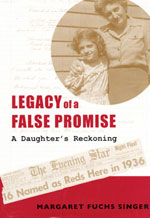
Book cover for Margaret Fuchs Singer's "Legacy of a False Promise"

Cover for Margaret Fuchs Singer's memoir.

When a member of my book group recommended Margaret Fuchs Singer’s recently published “Legacy of a False Promise: A Daughter’s Reckoning,” I assumed the longtime Ann Arbor resident’s contribution to the literature of America’s red-diaper babies would be another account of growing up with a parent who joined the Communist Party in the 1930s, became disillusioned but still refused to inform on former comrades – and suffered for it.

I got it wrong.

Singer’s father, Herbert Fuchs, cooperated with the House Un-American Activities Committee. He informed. He named names. He told the whole truth – about a profound commitment and a profound mistake – and suffered for it.

His family, of course, suffered for it, too. [Full Story]

Column: Book Fare

Domenica Trevor

Domenica Trevor

Start with some quick history: Josef Stalin’s campaign in the late 1930s to consolidate his control of the Communist Party spun into a terror that counted both old Bolsheviks and a new generation of party faithful among its victims. The leadership of the Red Army was decimated. Intellectuals were seized and interrogated and, like so many others under torture, falsely denounced others.

Inevitably, the masses caught on to the madness; pointing the finger at a neighbor could suddenly open up that three-room apartment next door. By the time the rampage was reined in, some 1.5 million people had been arrested and imprisoned; half again as many were executed or perished in the gulag.

Fast forward to the present: You’re a 29-year-old with an MFA, in Moscow to do research for your first novel. Lev Mendelevich Gurvich, himself caught up in the purges, has welcomed you into his apartment and has agreed to tell you his story. Gurvich, in his 90s but still with a sharp mind, had in the 1930s been editor of the literary magazine of the Komsomol, the Communist youth movement of the U.S.S.R. He was arrested, interrogated, sent to a labor camp.

You tell him about your novel, the story of a disgraced teacher of literature who now works as an “archivist” at Moscow’s infamous Lubyanka prison. Pavel Dubrov’s guilt and sorrow threaten to deaden him into numbness until a brief, official encounter with the prisoner Isaac Babel stirs him to rescue the condemned writer’s last manuscript from the prison’s furnace. Pavel smuggles it out of Lubyanka under his coat.

I met Babel, this survivor of the gulag tells you. I was at Stalin’s rallies; yes, I heard Stalin speak. But at one point the old man stops to ask, pointedly if not unkindly: Who are you to write this book?

“I wasn’t insulted,” Travis Holland says. “It was a question I asked myself.”

A more than fair question. But Holland’s answer, “The Archivist’s Story,” proved that his audacity was matched by his gifts. [Full Story]

Column: Book Fare

Domenica Trevor

Domenica Trevor

Once upon a time there lived a pretty lady named Jiselle who was always a bridesmaid and never a bride. But one night she is swept off her feet by a handsome pilot with green eyes and a tragic past. He proposes! She says yes!

But the “happily ever after” part snags on a few complications. Her new husband spends way more time in flight than he does at home. He has three motherless kids, one of them a middle-schooler with the mother of all attitudes. Jiselle’s own mother has an attitude of her own, marked by a particular contempt for unreliable charmers and her own daughter’s pathetic naïveté.

Oh – and a deadly plague is sweeping the land.

“In A Perfect World” is a dystopian fairy tale by Chelsea novelist and poet Laura Kasischke, set in an America whose citizens have become global pariahs – shunned, quarantined and loathed as potential carriers of the gruesomely fatal Phoenix flu. A distant war drags on vaguely. The power grid fails for hours and then days, and then for good. The mysterious plague kills the rich and famous along with everybody else. [Full Story]

Column: Mysterious Musings

Robin Agnew

Robin Agnew

[Editor's note: Robin Agnew and her husband Jamie own Aunt Agatha's mystery bookstore in Ann Arbor. She also helps run the annual Kerrytown BookFest.] 

“Shanghaied” by Eric Stone (Bleak House Books: hardcover $24.95; paperback $14.95)

“I love Chinese food. But sometimes China doesn’t do much for my appetite.” – Ray Sharp

Though this novel might at the beginning be categorized along with books by writers like Barry Eisler, Brent Ghelfi and maybe even Lee Child, halfway through Eric Stone turns his action story on its ear in an entirely unexpected way.

This is the fourth book in a series featuring detective Ray Sharp, a Hong Kong-based investigator who does “due diligence” investigations with his partner, the Chinese-Mexican dwarf Wen Lei Yue. As the story opens Ray and Lei are looking into a missing monk. What they can’t decide is if the monk is just having a little illicit fun or if the monk is the money man for his well-endowed monastery, in which case his disappearance is more worrisome. [Full Story]

Column: Mysterious Musings

Robin Agnew

Robin Agnew

[Editor's note: Robin Agnew and her husband Jamie own Aunt Agatha's mystery bookstore in Ann Arbor. She also helps run the annual Kerrytown BookFest.]

“The Second Death of Goodluck Tinubu” by Michael Stanley (Harper, $24.99)

As everyone knows, there is a very famous series of books set in Botswana, by Alexander McCall-Smith. McCall-Smith’s delicate prose is matched by the charm of his main character, Precious Ramotswe. Now there is a new series set in Botswana, with a slightly darker take, though the main character, Detective Kubu, would surely be friendly with Precious were they to meet.

Detective Kubu (the Botswana word for “Hippo”) is hugely fat and hugely smart. If Precious is the African Miss Marple, then Kubu is the African Nero Wolfe. Kubu and Wolfe both share a deep appreciation for the pleasures of the table, and both of them have brains that work best with their eyes closed. [Full Story]

Column: Mysterious Musings

Robin Agnew

Robin Agnew

[Editor's note: Robin Agnew and her husband Jamie own Aunt Agatha's mystery bookstore in Ann Arbor. She also helps run the annual Kerrytown BookFest.] 

“The Last Child” by John Hart (Minotaur Books, $24.95)

Recently one of the VPs at St. Martin’s, Matthew Baldacci, asked if he could swing by the store with author John Hart. I had enjoyed Hart’s first book, “King of Lies,” and enthusiastically agreed – just as enthusiastically, Mathew offered to FedEx me copies of Hart’s new book, “The Last Child.” The book arrived on a Wednesday afternoon for a Thursday visit – I trundled into the store to pick it up, hoping I might get at last halfway through before Hart stopped in – and I couldn’t put it down. I was finished with the book Thursday morning, eager to have a chance to discuss it with the author. [Full Story]

Column: Mysterious Musings

Robin Agnew

Robin Agnew

[Editor's note: Robin Agnew and her husband Jamie own Aunt Agatha's mystery bookstore in Ann Arbor. She also helps run the annual Kerrytown BookFest.]

“Liars Anonymous” by Louise Ure (St. Martin’s Minotaur, $25.95)

“When had I crossed that weathered threshold that divided the world between citizens and survivors? Between what could be and what we are in our darkest hours.”

I know I’ve really enjoyed an ARC (Advance Reading Copy) of a novel when I look back and see how many pages I’ve dog-eared, for one reason or another. In the case of Louise Ure, it’s for her use of language, which is both precise and original. Sentences like “I missed my friend Catherine like she was a country I could no longer visit,” and “Her teeth had click-clacked with nervous energy while she filled out the paperwork, like a sleeping rabbit dreaming of carrots” are so evocative, and so vivid, they stay with you. It’s not often this kind of clarity is found in a hard-boiled mystery novel, but here it is. Maybe the beauty of the language is meant to carry the reader through the story of Jessie Dancing, which is one of the darker books I’ve read in a long while. [Full Story]

Column: Mysterious Musings

Robin Agnew

Robin Agnew

[Editor's note: Robin Agnew and her husband Jamie own Aunt Agatha's mystery bookstore in Ann Arbor. She also helps run the annual Kerrytown BookFest.]

“Next of Kin,” by John Boyne (Thomas Dunne Books, $15.95)

Every good book has a secret somewhere in the story – in a mystery, the secret of course is usually the identity of the killer. In John Boyne’s historical mystery, the secret is not the killer’s identity, but the killer’s very personality, his motives, and the extent of his moral depravity. This stand-alone novel is set in 1936 Britain, where one of the central issues of the day is the relationship between Edward VIII and Wallis Simpson. Of course, we know how that turns out, but Boyne offers a possible behind-the-scenes scenario that’s very interesting. [Full Story]

Column: “Wearing Nothing But A Smile”

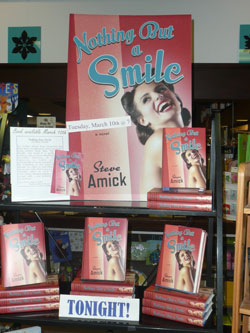
A display of Steve Amicks new book at Nicolas Books in the Westgate Shopping Center.

A display of Steve Amick's new book at Nicola's Books in the Westgate Shopping Center. Amick held a book-signing there on Tuesday.

Don’ t avoid the obvious: there is a half-naked woman on the cover of Steve Amick’s new book – wearing “nothing but a smile,” which appropriately is the title of the book (wink-wink). She made quite the impression on you when you walked into Nicola’s Books, where Amick was doing a book signing Tuesday night.

How she got there is quite an innocent story. The book, “Wearing Nothing But a Smile,” deftly balances the innocence of WWII pin-up girls with the harsh realities of the war back home.

Amick admits to stumbling on the idea of a book with the pin-up industry central to the plot. [Full Story]

Column: Mysterious Musings

Robin Agnew

Robin Agnew

[Editor's note: Robin Agnew and her husband Jamie own Aunt Agatha's mystery bookstore in Ann Arbor.  She also helps run the annual Kerrytown BookFest, along with eight other book lovers. Versions of these book reviews first appeared in her store's newsletter.]

“A Rule Against Murder,” by Louise Penny (Minotaur Books, $24.95)

This may be the most traditional of Canadian writer Louise Penny’s now four novels, though she has been labeled from the beginning as a “traditional” mystery writer. And indeed, she does write in the same tradition that Margery Allingham, Josephine Tey and Agatha Christie were following (and helped create), but she has managed to make this old form her own. She has an exceptional gift with prose, and the character development she brings to her writing is very modern. In each book, Penny has manages to slightly change up her formula to make each story feel fresh, and this one is no exception. [Full Story]

» Text size:

larger text default text smaller text

Skyclock