The Ann Arbor Chronicle masthead
it's like being there

Stories indexed with the term ‘budget deficit’

Column: Time to Take Down a Tree

Last week, city workers sawed down the last large street tree on our block – an old, rotting maple. I was unduly fond of it. I’ll miss its shade.

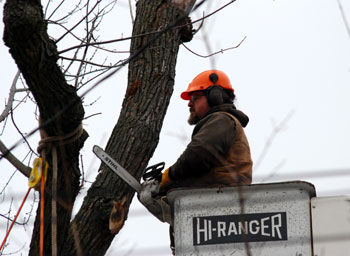
Chainsaw Guy

Chainsaw Guy

But it was time for that tree to come down.

The work took just a few hours – it seemed like a well-drilled crew. And because the tree is across the street from our home, I was able to watch.

I’ve written a lot of articles over the past year littered with words like “cut” or some unimaginative variation of it – “trimming costs” or “chopping expenses.” So I couldn’t help but see the dismemberment of this tree as a metaphor for what our local governments – our cities, the county, the schools – are going through.

It’s time for some trees to come down. [Full Story]

Ann Arbor Schools Seek Input on Budget

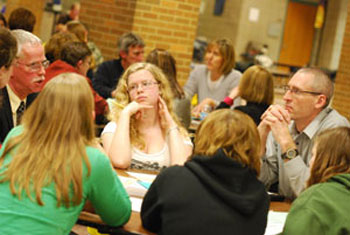
A group of people sitting around a table

One of the tables at the Jan. 7 Ann Arbor Public Schools budget forum, where participants discussed options for cutting expenses and raising revenues. (Photos by the writer.)

Todd Roberts, superintendent of the Ann Arbor Public Schools, didn’t have much good news to deliver at Thursday’s budget forum, the first of four that the district is holding this month. Heavily reliant on declining state funding, AAPS faces as much as a $20.9 million deficit by fiscal 2010-11.

And after voters rejected a countywide schools millage in November that would have brought some financial relief, school officials are faced with difficult decisions as they work to close the funding gap between revenues and expenses.

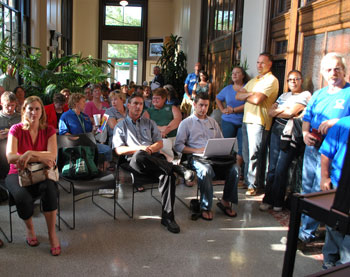
Despite the season’s first significant snowfall, more than 100 people attended the Jan. 7 forum at Huron High School’s cafeteria, a gathering that included parents, teachers, administrative staff, some school board members, students and others in the community. Leaders of groups that supported the November schools millage proposal, as well as those who successfully led efforts to defeat it, also attended the meeting.

Roberts told the crowd that it’s unlikely the state will see a turnaround anytime soon, and their biggest hope is that revenues for schools at least remain flat. “But that’s certainly not a foregone conclusion,” he added. [Full Story]

Revenue Bump in School Budget Draft

At the first of four budget forums held by the Ann Arbor Public Schools (AAPS) on Thursday night, the 2010-2011 draft budget plan circulated to attendees included over $16 million in proposed cuts, to deal with the district’s projected $20.9 million deficit. But it also included more than $1 million in additional revenue.

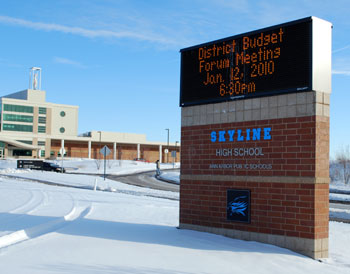
Information sign outside Skyline High School Ann Arbor Michigan

The second AAPS district budget forum will be held at Skyline High School on Tuesday, Jan. 12, starting at 6:30 p.m. (Photo by The Chronicle)

Several participants at the forum urged district administrators to look even more aggressively at how to generate additional revenue, whether through philanthropy, partnering with businesses, or other approaches.

So how does AAPS hope to generate extra dollars?

The line items in the budget draft list an additional 150 students in the Targeted Schools of Choice program plus an increase in Options Magnet enrollment of 20 students. Those 170 additional students would generate an additional $1.23 million in revenue, through the per-student allocation to school districts by the state.

At the AAPS Board of Education (BOE) meeting held the night before Thursday’s budget forum, several ways to increase school funding were discussed. Strategies include bringing out-of-district students into AAPS, as well as increasing the number of in-district students who are not currently enrolled in AAPS. BOE trustees heard a presentation Wednesday night on the Options Magnet program as part of that strategy.

Other strategies to increase revenue that were discussed at Wednesday’s board meeting include new partnerships with local community-based organizations, plus a statewide effort to compete for additional federal funding through the Race to the Top program.

Here, The Chronicle takes a closer look at these revenue-generating options outlined at the board’s Wednesday meeting. [Full Story]

Board Tables Economic Development Tax

Washtenaw County Board of Commissioners meeting (Oct. 21, 2009): Action on a tax expected to raise around $600,000 a year for economic development and agriculture-related activities was postponed Wednesday after a move to let county board members vote on separate pieces of the plan – rather than a single package – led to confusion and some consternation.

Commissioner Mark Ouimet asked to have the vote broken into two parts. A Republican representing more rural areas of the county, Ouimet wanted:

  • one vote on money to fund 4-H, horticulture/MSU Extension, an agricultural innovation effort and the Food Systems Economic Partnership;
  • a second vote to fund the economic development agency Ann Arbor SPARK, SPARK East, the Eastern Leaders Group and a new county office, the Economic Development and Energy Department, to be led by Tony VanDerworp.

But Ouimet’s colleagues on the board were unprepared for the change. A number struggled to follow his plan for unbundling items in the single resolution in front of them and what the potential defeat of any portion of the plan would mean. [Full Story]

Column: Limited Edition

In my favorite movie “Animal House,” John Belushi delivers a classic line: “Over? Nothing is over until we say it is. Was it over when the Germans bombed Pearl Harbor? Hell, no, and it ain’t over now!”

With the same level of determination and a lot more smarts, 700 members of AFSCME Local 2733 and members of six other smaller bargaining units gave back contract benefits totaling about $6.6 million to help reduce Washtenaw County’s projected 2010-11 budget deficit. I have lived in Ann Arbor 49 years and do not recall a similar circumstance. Were county services over? Were the jobs of up to 150 union members over? The Locals said “Hell, no.”

It was a big deal. [Full Story]

Near North, City Place Approved

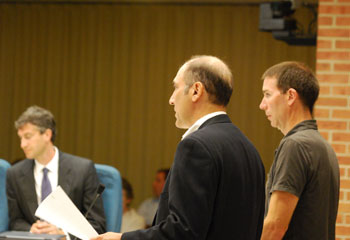
Two men stand together at a podium at the Ann Arbor city council

At the podium, Bill Godfrey of Three Oaks Group and Tom Fitzsimmons of the North Central Property Owners Association both express their support of the Near North housing project on North Main. In the background, Christopher Taylor (Ward 3). (Photo by the writer.)

Ann Arbor City Council meeting (Sept. 21, 2009): Ann Arbor’s city council approved both major development projects on its agenda, one of them enthusiastically, the other only reluctantly.

Although there was a smattering of opposition expressed to the Near North affordable housing development during the public hearing on the matter, the 39-unit project on North Main Street ultimately won the support of its closest neighbors. That support was reflected symbolically when developer Bill Godfrey and neighbor Tom Fitzsimmons stood side-by-side at the podium as they each addressed the council, which gave the project its unanimous approval.

The “matter of right” City Place project proposed for the block of South Fifth Avenue just south of William was also unanimously approved by the council, but councilmembers took turns criticizing both the project and the developer, Alex de Parry. The council had previously established a historic district study committee and enacted an associated moratorium on demolition and work in the area where the proposed project is located. Carsten Hohnke (Ward 5) compared de Parry’s decision to bring the project forward despite the moratorium to “stamping feet, being upset you didn’t get what you wanted.”

Many members of the audience held yellow 8×11 paper signs calling on councilmembers to support a resolution that would have released council emails sent during their meetings dating back to 2002. However, council rejected that resolution except for a resolved clause that would in the future provide the public with copies of electronic communications among councilmembers during its meetings – by appending them to the official minutes of the meeting that are eventually posted on the city’s website.

The council also put looming financial issues on the radar by passing a resolution that opposes a recent Michigan budget proposal that would cut state shared revenues to the city of Ann Arbor by about $1.2 million. At the council’s budget and labor committee meeting that was held Monday – before the regular council meeting – Tom Crawford, the city’s chief financial officer, floated some possible ideas for meeting that shortfall. [Full Story]

Nonprofits to County: “Don’t Cut Funding!”

Mimi Harris, left, and Randi Friedman came to Wednesdays county board meeting to support funding for human services. They are board members for the Interfaith Hospitality Network, which runs Alpha House, a homeless shelter for families.

Wearing stickers that say "Protect Our Safety Net," Mimi Harris, left, and Randi Friedman came to Wednesday's county board meeting to support funding for human services. The paper plate was one of over 1,100 with messages written by people who receive aid from local nonprofits that are supported by the county. Harris and Friedman are board members for the Interfaith Hospitality Network. (Photo by the writer.)

Washtenaw County Board of Commissioners (Sept. 16, 2009): Leaders of local nonprofits and people who’ve been helped by their services packed the boardroom Wednesday night, urging Washtenaw County commissioners to continue support for the area’s most vulnerable residents.

The meeting marked the first time that county administrator Bob Guenzel made his official budget recommendations to the board, which include cuts aimed at closing a projected $30 million deficit over the next two years. The county funds a range of local nonprofits – this year, a total of $1.7 million was awarded to agencies like Food Gatherers, the Shelter Association, Interfaith Hospitality Network and SafeHouse, among others. The proposed budget calls for 20% cuts in funding for human services nonprofits in 2010 and another 20% in 2011.

Proposed cuts to these nonprofits were the most difficult part of his budget recommendations, Guenzel told the board. “Those dollars have been well spent – they are the safety net.” Yet he didn’t feel he could ask for concessions from employees and squeeze the county’s mandated services without including cuts to nonprofits as well. He reminded commissioners that when he was hired as administrator 15 years ago, the county spent $300,000 to fund local nonprofits. Even with the proposed cuts, he said by 2011 the county will still be awarding about $1 million to these groups.

Commissioners responded to both the emotional public comment session and to the proposed budget recommendations, which they’ll have two months to review before adopting a final budget in November. Several commissioners cited their support for a human services millage. And commissioner Kristin Judge – saying that there were more creative ways to cut expenses – turned in her county-paid cell phone. [Full Story]

County Proposes Cutting At Least 21 Jobs

Several variables affecting the county budget are still unknown – including how much, if anything, the county’s labor unions will concede on wages and benefits. In that context,  Washtenaw County administrator Bob Guenzel is recommending another 21 job cuts to help balance the 2010 and 2011 budgets. The county faced a projected $30 million deficit over those two years. The job cuts are coupled with several efforts to slash expenses and increase revenues, including a proposed economic development millage that would not require voter approval.

Guenzel will formally submit his recommendations to commissioners at their board meeting next Wednesday, Sept. 16. This is the second phase of cuts. Earlier this year, commissioners approved the elimination of 26 jobs and almost $14 million in expense reductions.

In a memo to the Board of Commissioners posted Friday on the county website, Guenzel made clear that there will be additional, difficult decisions to make – and more jobs could be on the line. He described ongoing labor discussions as cooperative, but said that if no deals are struck by Oct. 16, he’ll need to make additional cuts in other areas. More than 80% of the county’s 1,350 employees are represented by 17 different bargaining units, which have contracts in place through at least 2010.

Further ahead, the county is projecting deficits of $27.5 million over two years in 2012-13, with revenues from property taxes continuing to fall and a huge question of whether the state will re-institute a revenue-sharing commitment in 2013. By 2013, general fund revenues are expected to drop to $90 million, compared to $99 million projected for 2010.

We provide a detailed look at the budget recommendations after the break. [Full Story]

County Millage for Human Services?

Five of Washtenaw County’s top elected officials – the sheriff, prosecuting attorney, clerk, treasurer and water resources commissioner – sent a letter to the Board of Commissioners Thursday morning asking the board to consider putting a countywide millage on the ballot in 2010. The millage is aimed at raising money to fund human services programs.

But their main message was this: The county’s basic mandated services – those that are required by law – can’t endure additional funding cuts.

The letter comes at a crucial moment in the county’s budget process, as officials battle a projected $30 million general fund deficit over the next two years. At their Sept. 16 board meeting, county administrator Bob Guenzel will be presenting budget recommendations, which will likely include job cuts. Commissioners – who are also elected – will spend the next two months deliberating, with the goal of adopting a 2010/2011 budget at their Nov. 18 meeting. County administration has tentatively set a public hearing devoted to the budget on Oct. 22. [Full Story]

County’s Budget Crisis Gets Emotional

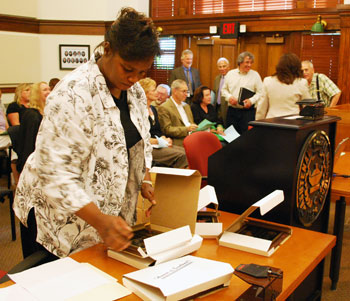
Nina Johnson, Washtenaw County's human resources manager, prepares awards that were given out to employees during Wednesdays board of commissioners meeting. (Photo by the writer.)

Nina Johnson, Washtenaw County's human resources manager, prepares awards that were given out to employees during Wednesday's board of commissioners meeting. (Photo by the writer.)

Washtenaw County Board of Commissioners (Sept. 2, 2009): Emotions ran high during parts of Wednesday night’s county board meeting, as residents made impassioned pleas for continued funding of programs for the developmentally disabled. Commissioners responded, some with equal passion, with Leah Gunn saying this is the worst year she’s ever faced in her career as a commissioner, and Jeff Irwin breaking down as he described his reaction to hearing constituents’ stories. The county faces a projected $30 million budget deficit over the next two years in its $102 million general fund, and is working on ways to cut expenses.

Commissioners also heard budget presentations from leaders of two departments – Public Health, and Community Support and Treatment Services – and got a brief budget update from county administrator Bob Guenzel, who said that their 2009 general fund projections are on target.

The board also voted unanimously – and with no discussion – to approve a $1.375 million deal that would settle two lawsuits related to the 2006 death of Clifton Lee Jr., who died after a struggle with Washtenaw County sheriff’s deputies in the Ypsilanti Township of West Willow. [Full Story]

Column: Limited Edition

Washtenaw County administrator Bob Guenzel has done about as much as he can do. He has presented and updated the county’s projected 2010-2011 deficit over and over the last six months – best case scenario, worst case scenario, and everything in between. So what are the options? There are few. [Full Story]

Demolition Moratorium for Two-Block Area

Ann Arbor City Council meeting (Aug. 6, 2009): Two kinds of moratoria were on council’s agenda for Thursday’s meeting – which had been rescheduled to accommodate the Aug. 4 Democratic primary elections in Wards 3 and 5. The first was a moratorium on new development in districts zoned with the classification of R4C (multi-family residential) or R2A (two-family residential). The second was a moratorium on demolition, attached to the creation of a study committee for a possible historic district in a two-block area just south of William Street on Fourth and Fifth avenues.

Council voted down the more general prohibition on new development in R4C/R2A residential districts, but approved the historic district study committee with its attached moratorium on demolition. It’s a case where the vote tally alone doesn’t tell the whole story – or even an accurate one: Counter to what one might expect, Mike Anglin (Ward 5) voted against the R4C/R2A moratorium, while Leigh Greden (Ward 3) voted for it.

A third major agenda item facing council was also related to new development: the Near North planned unit development (PUD) proposed for North Main Street just south of Summit Street, which is an affordable housing project that includes the nonprofit Avalon Housing as a partner. The council voted to move Near North on to a second reading, when a final decision will be made.

But probably the most important matter considered by council on Thursday appeared on the agenda as an “introduction” by the city’s chief financial officer, Tom Crawford, who spent around a half hour telling the city council why the city’s projected financial condition is worse now than it had been when the FY 2010 budget was adopted in the spring. Crawford’s presentation was characterized during commentary from the public later in the meeting as the “first salvo in a PR campaign” for a city income tax.

A bit of breaking news from Crawford’s report: bonds for the Fifth Avenue underground parking garage were issued on Aug. 5. [Full Story]

4-H Fans, Others Lobby County for Funds

The overflow crowd in the lobby of the county administration building arrived too late for a seat in the boardroom.

An overflow crowd in the lobby of the county administration building arrived too late for a seat in the boardroom, and watched Wednesday's Washtenaw County Board of Commissioners meeting on TV. (Photo by the writer.)

Washtenaw County Board of Commissioners meeting (Aug. 5, 2009): As Washtenaw County grapples with a staggering budget deficit, 4-H supporters – including local farmers, teens and club leaders – packed Wednesday’s county Board of Commissioners meeting, urging commissioners not to cut funding for that program. They were joined by many others who use master gardening, financial counseling and other services of the county’s MSU Extension program, which could see dramatic funding cuts as the county tries to balance its budget.

As The Chronicle previously reported, the county faces a $30 million deficit over the next two years. Last week, county administrator Bob Guenzel released a list of options for cutting another $12 million out of the budget, and eliminating up to 181 jobs. Those options – which he stressed are not his recommendations at this point – target non-mandated services, ranging from Head Start to a variety of mental health programs. On Wednesday, Guenzel gave a formal presentation about the options to commissioners, who will be the final arbiters of any budget decisions. The discussion following Guenzel’s presentation could aptly be summarized by this statement from commissioner Conan Smith: “It sucks.” [Full Story]

County Considers $12 Million More in Cuts

Nearly $12 million in potential cuts over the next two years – affecting up to 181 employees and services to hundreds of residents – are being considered as Washtenaw County leaders struggle to deal with a two-year budget deficit that’s grown to $30 million for 2010 and 2011. Details of the cost-cutting options were released Thursday. County administrator Bob Guenzel will formally present the options at an Aug. 5 board of commissioners meeting – a meeting that’s expected to draw a crowd of county staff and union members.

Hardest hit in this latest round could be mental health services – one option is to cut that part of the general fund budget by $2.4 million and eliminate 91 jobs.

At a July 29 briefing for commissioners, Guenzel stressed that the options he’ll present next week aren’t his final recommendations. No decisions have been made, he said. The extent of the cuts, which commissioners will vote on as part of the overall budget, ultimately will depend on the outcome of ongoing negotiations with union leaders.

The county is talking with most of the 17 bargaining units that represent about 1,000 of the county’s 1,350 workers, asking for concessions – even though union contracts are set through at least 2010. Guenzel plans to update commissioners on the progress of union talks at a closed executive session during their Aug. 5 board meeting. The closed session for union contract negotiations is an exception allowed under the Open Meetings Act.

This is the second phase of budget cuts. Phase 1, approved by the board in July, included $13.69 million in cuts and a reduction of 26 jobs, about half of them already vacant. Guenzel’s final 2010-2011 budget recommendations are expected to go before the board at its Sept. 16 meeting.

After the jump, we’ll provide details for the budget options being considered next week. [Full Story]

Pizza, Payroll and Budget Pain

At a pre-board meeting rally held by

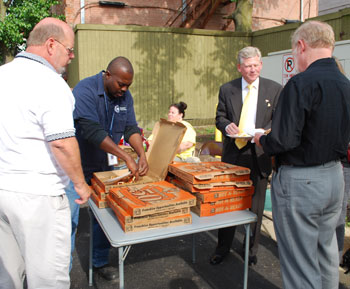
Pizza was served at Wednesday's pre-board meeting rally held by AFSCME Local 2733 in the parking lot next to the county administration building, at the southwest corner of Catherine and Fourth. The union wanted its members to turn out as the county Board of Commissioners considered cuts to the 2010-2011 budget.

Washtenaw County Board of Commissioners meeting (June 3, 2009): Before commissioners met on Wednesday, about 50 people gathered in the parking lot next to the county administration building for a rally organized by AFSCME Local 2733, the largest of the unions for county workers, representing about 700 employees. This wasn’t a marching-while-carrying-picket-signs rally, however. It was more of a eating-pizza-and-talking event, designed to get members to attend the 6:30 p.m. board meeting as a show of support for the unions.

Union workers mingled with commissioners and other county staff to talk about how to deal with a projected $26 million deficit in the county’s budget over the next two years – a topic that was the main item on Wednesday’s agenda for the board of commissioners.

Recommendations made during the meeting by county administrator, Bob Guenzel – which were aimed at balancing the $102 million general fund budget – included cuts to many departments and to funding for local nonprofits, the elimination of 26 positions (including 12 that are already vacant) and a caution that there’ll be more cuts to come.

Discussion of those recommendations by commissioners during the Ways & Means Committee portion of their meeting resulted in approval of four budget-related resolutions. Those resolutions will receive a final vote from commissioners during their regular board meeting on July 8. Meanwhile, the administration hopes to negotiate concessions from the 17 unions that represent roughly 1,000 of the county’s 1,350 work force. All parties agree that the outcome of those negotiations will be crucial. [Full Story]

Opening Up the County Budget

boxes

Boxes containing the informational packets (spiral-bound paper copies) for the June 3 county Board of Commissioners meeting, which includes recommendations for budget cuts in 2010 and 2011. Each packet weighs about two pounds.

Walking into the county administration office last week, The Chronicle spotted several hefty unopened boxes stacked on a table. It turns out those boxes contained some of the information we were there to discuss with county administrator Bob Guenzel – proposals for cuts in the 2010 and 2011 budget, which will be formally presented to the county Board of Commissioners at its June 3 meeting.

At that meeting, Guenzel will be recommending an array of cuts – plus more limited ways to increase revenues – aimed at balancing the county’s $102 million annual general fund budget, which faces a $26 million deficit over the two-year period from Jan. 1, 2010 through Dec. 31, 2011. That includes eliminating at least 26 positions (about half of which are already vacant), a proposed price increase in the controversial police services contract, 20% funding cuts to nearly 20 local nonprofits, and the elimination of funding for the proposed north/south commuter rail, among other things.

If approved, some of the cuts could be implemented this year, rather than waiting until 2010. Revenues for 2009 have come in lower than expected and the county also faces a $3.3 million deficit in the current fiscal year, which ends Dec. 31.

The deficit is linked to dramatically falling revenues caused by plummeting property values. The county gets the majority of its general fund revenue from property taxes – the rate of taxation is restricted by state law, and can’t be increased without voter approval.

This is the first phase of an ongoing process to tackle the deficit. The administration plans to propose long-term structural changes as well, which are being developed and will be presented for approval by commissioners later this year. The current recommendations come in four broad categories: employee compensation, organizational changes, departmental reductions and revenue growth. [Full Story]

County Commissioners Review Priorities

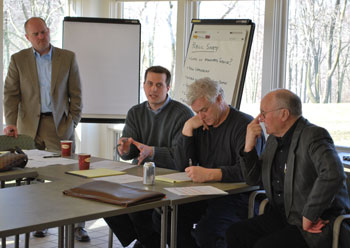
Saline schools superintendent Scott Graden, left, served as facilitator during Saturdays retreat. County commissioners, from left: Jeff Irwin, Ken Schwartz, Wes Prater.

Saline schools superintendent Scot Graden, standing, served as facilitator during Saturday's retreat at Rolling Hills County Park. County commissioners, from left: Jeff Irwin, Ken Schwartz, Wes Prater.

No decisions about budget cuts were made at Saturday’s retreat of the Washtenaw County Board of Commissioners – since organizing it a few weeks ago, they’ve said all along that wasn’t the purpose. Rather, the group of 11 commissioners spent three hours talking through their priorities for the county, a discussion that some commissioners hope will lay a foundation for where to cut expenses as the county deals with a projected $26 million deficit in 2010-11.

The half-day retreat at Rolling Hills County Park was also attended by other elected officials – including sheriff Jerry Clayton, water resources commissioner Janis Bobrin and county prosecutor Brian Mackie – as well as leaders of a few of the 17 unions representing county employees, some county staff and the media. Though some of these people commented during the meeting, for the most part the event was focused on commissioners sharing their thoughts about refining county priorities. The discussion was led by Scot Graden, superintendent of Saline Area Schools and a lifelong Washtenaw County resident.

One piece of news did emerge: county administrator Bob Guenzel, in response to a query from commissioner Wes Prater, said the 2009 equalization report had just been completed and showed that the county’s taxable value was down less than expected. They’d projected a drop of 3%, but the decline in taxable value came in at 2.29%. Though they’d make some adjustments, Guenzel said, “2009 is not our problem.”

Board chair Rolland Sizemore Jr. kicked off the retreat with, “Let’s get it on so I can go home and wash windows.” [Full Story]

It’s All About The Money

Washtenaw County Board of Commissioners (March 4, 2009): County commissioners spent the bulk of their Wednesday night board meeting on two topics, both dealing with finances: 1) Details about $3 million in federal funds coming to Washtenaw County to rehab or demolish foreclosed properties in targeted areas, and 2) an update from county administrator Bob Guenzel about ongoing efforts to deal with a projected budget deficit.

Neither topic is new to commissioners or Chronicle readers: The federal foreclosure funds were discussed at last week’s administrative briefing, and the budget crisis has been on the table since the board’s Feb. 4 meeting. So commissioners were prepared to ask pointed questions on both issues, and they did. [Full Story]

Ann Arbor Schools Tackle Looming Deficit

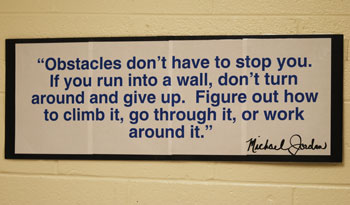
This sign in a hallway at Scarlett Middle School could apply to the Ann Arbor Public Schools budget.

This sign in a hallway at Scarlett Middle School, quoting basketball legend Michael Jordan, could apply to dealing with the Ann Arbor Public Schools budget. Superintendent Todd Roberts and other AAPS officials held a public forum on the budget Tuesday night at Scarlett.

Students outnumbered parents at Tuesday night’s budget forum for the Ann Arbor Public Schools, but only (we suspect) because it fulfilled a civics class requirement. At any rate, the 20 or so people who showed up at the Scarlett Middle School media center all got a lesson in the intricacies of public school funding, and a look at how AAPS plans to deal with an anticipated $6 million deficit in its next fiscal year, with the deficit projected to grow to $12 million by 2011-12.

Approaches include possibly floating a countywide millage as early as this fall, increasing student enrollment through online offerings, and lobbying state legislators for additional dollars and to reform the way schools are funded. [Full Story]

Deep Deficits Projected for Washtenaw County

County administrator Bob Guenzel is interviewed by WEMU reporter Andrew Cluley during a break at Wednesday night's board of commissioners meeting.

County administrator Bob Guenzel is interviewed by WEMU reporter Andrew Cluley during a break at Wednesday night's board of commissioners meeting.

Washtenaw County Board of Commissioners (Feb. 4, 2009): Faced with sharply lower revenues in the coming years, Washtenaw County government will be dealing with staggering budget deficits and must start making some tough decisions about where to cut costs. At their Wednesday night board meeting, county commissioners heard that grim report from county administrator Bob Guenzel, who estimates the budget deficit in 2010-11 could reach $28 million under a worst-case scenario. And it likely won’t end there. “We don’t know when we’re going to hit bottom,” he said. “It’s just too hard to predict that.”

Guenzel called the financial situation the worst he’s seen in his 36 years with the county, but noted that this was a nationwide crisis. Falling property values and a sluggish housing market have eroded tax revenues – property taxes and fees related to building inspections, real estate transfers and other housing-related services account for roughly 75% of the county’s general fund, he said. [Full Story]

» Text size:

larger text default text smaller text

Skyclock