Stories indexed with the term ‘budget’

Budget Deliberations Focus on Small Items

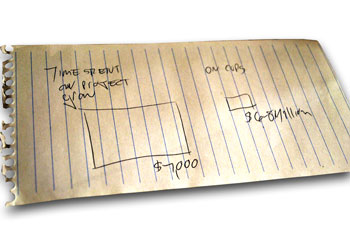
Doodle showing comparison of Project Grow versus Police Discussion

Doodle by city council meeting audience member showing comparison of Project Grow versus police discussion. "Time spent on Project Grow – $7,000; On cops – $6.8 million."

Ann Arbor City Council Meeting (May 18, 2009): Ann Arbor’s city council approved the budget for fiscal year 2010 at its Monday meeting, spending little time discussing a separate resolution key to that budget, which approved an early-retirement inducement for police officers involving a one-time payment of around $6 million – depending on how many officers take advantage of the incentive.

The fact of the lengthy discussion over much smaller items was acknowledged around the council table, with councilmember Sandi Smith (Ward 1) making a note of it when she made an unsuccessful bid to eliminate or delay the introduction of parking meters into near-downtown residential neighborhoods. Smith was comparing the relatively short discussion of parking meters (involving potential additional revenues of $380,000) to the previous deliberations on Project Grow’s funding. And in the course of the more than 45-minute deliberations on Project Grow’s $7,000 grant, Sabra Briere (Ward 1) noted: “The least expensive ones are the ones we fight the hardest over.” Briere lost her fight for the community gardening nonprofit.

The approved budget did include amendments to allocate funds for the Leslie Science and Nature Center. Also related to the budget, the two resolutions to approve fee adjustments for the community services and public services areas were approved with no deliberations by council, leaving the issues raised at the previous night’s caucus by the chair of the market commission undiscussed publicly.

In other budget business, city council passed a resolution to create a taskforce to study options for the Ann Arbor Senior Center, which is slated for closure under the FY 2011 budget plan (i.e., not the budget approved by council at this meeting).

Council also approved an extension to the purchase-option agreement with Village Green for the First and Washington parcel, gave final approval to a completely new liquor ordinance, approved increased water/sewer rates, approved grant applications for multiple properties under the greenbelt program, and asked planning commission to review the C3 zoning regulations regarding the kind of temporary outdoor sales conducted in previous years at the Westgate farmers market.

The funding of the north-south connector study was again postponed, pending coordination with the Downtown Development Authority. [Full Story]

Ann Arbor Library Board OKs Budget

Ann Arbor District Library board meeting (May 18, 2009): A new budget, a new agreement with the Friends of the Ann Arbor District Library, an upcoming documentary on the building of the Traverwood branch and a broken freight elevator were all items of discussion at Monday’s AADL board meeting. As discussed at their April meeting, the board voted to lower the tax rate that the library levies, citing the struggling economy and a desire to keep taxes as low as possible. Economic conditions were also the reason for keeping AADL director Josie Parker’s salary unchanged, though the board commended her performance as part of her annual review. [Full Story]

Washtenaw Commissioners Discuss Cuts

Washtenaw County Board of Commissioners administrative briefing (May 13, 2009): Commissioners attending Wednesday’s meeting were briefed on several items coming up on their May 20 agenda, including some related to Head Start funding, community development and approval of the county’s operating millage, which will remain unchanged from the current year. But for much of the hour-long briefing, they discussed a resolution proposing cuts to the $600,000 allotted annually for commissioners  – a resolution that stands a good chance of being amended, tabled or withdrawn from the agenda completely. [Full Story]

City Budget: Some Cuts Sooner Than 2011?

At Monday night’s city council work session, councilmembers heard news from their Lansing lobbying team that had a $260,000 negative impact on the Ann Arbor city budget for FY 2010, which they are expected to adopt next Monday, May 18. The quarter-million dollar shortfall against the city’s own budget planning estimates for state shared revenue led to discussion of the possibility of accelerating an already-planned reduction in the number of Ann Arbor firefighters. A reduction of 14 positions in the fire department could be implemented in early 2010, instead of sometime during FY 2011, which was originally planned.

At the work session, city administrator Roger Fraser and the city’s chief financial officer, Tom Crawford, indicated that their preferred strategy was not to build any firefighter layoffs into the FY 2010 budget – they wanted to see if they could squeeze the $260,000 out of the budget in the course the first part of the FY 2010, which for the city begins July 2009. There’s uncertainty still, said Fraser, about how many police officers will take advantage of the early retirement offer – a move the city is making to avoid laying off 27 officers for FY 2010. Officers have until mid-June to make a decision. That uncertainty factors into decisions on the FY 2010 budget that council will make on  May 18.

Councilmembers took turns calling city staff to the podium to clarify questions on other topics of interest. That included parking meters – their possible installation in residential areas, as well as the feasibility of maintaining current levels of ticket revenues without as many community standards enforcement officers dedicated specifically to ticketing. Other topics included the Local Development Finance Authority (questions about angels), historic district consultant (likely to be cut in FY 2010, instead of waiting until FY 2011), Project Grow (fund balance seen as too high) and the civic band (has not requested funding). The East Stadium bridges question came up, too (no money from state, but possibly from feds).

No formal decisions were made at the work session. [Full Story]

Budget, Bridge, Ball Fields, Booze, Bugs

a plastic owl sitting on a porch bannister

A five-year-old child who's been exposed to the Leslie Science and Nature Center will be able to identify the type of bird, and explain its sleeping habits – though perhaps not recognize that this one is made of plastic.

Ann Arbor City Council Meeting, Part I (May 4, 2009): Despite assurances from Mayor John Hieftje that he’d be surprised if Mack pool and Leslie Science Center weren’t funded, city council heard from several advocates of those facilities Monday night, along with supporters of Project Grow and the senior center.

Audible through the expressions of support for programs facing cuts was also a call for the council to focus attention on bigger ticket items. One of those bigger ticket items was a mediator-mandated agreement with the Ann Arbor Police Officers Association union, which council was constrained by state law to approve – an agreement that will cost the city about $650,000 more than it had anticipated. Another was approval of the early retirement option for police officers as a part of the employees retirement system, which the city is offering instead of mandatory layoffs.

Still another big ticket item surfaced in the form of the approval of an application for funding of the East Stadium bridge reconstruction – though it’s likely to be paid by federal tax dollars. The bridge fit into the general theme of transportation at the meeting, which showed up in the form of an agenda item authorizing a study for a north-south intra-city connector (which was postponed), as well as a lengthy discussion on the Ann Arbor transportation plan update, which was ultimately adopted, despite some sentiment for postponing it. [These items are reported in detail in Part II of our meeting coverage here.]

In other business, council approved two agreements with the public schools for operation of recreation facilities, gave initial approval to a revamped liquor licensing code for the city, and approved an amendment to the partnership agreement between the city and the Leslie Science and Nature Center. [This last accounts for the last word in the headline.] [Full Story]

County’s No. 2 Administrator Resigns

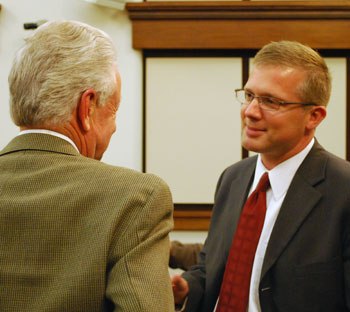
David Behen, right, talks with Gene DeRossett before Thursdays working session of the Washtenaw County Board of Commissioners.

David Behen, right, talks with Gene DeRossett before Thursday's working session of the Washtenaw County Board of Commissioners.

David Behen, one of Washtenaw County’s two deputy county administrators, has resigned and will leave his job at the end of May. Washtenaw County commissioners and department heads were informed of the decision in an email sent Thursday morning from county administrator Bob Guenzel. In that email, Guenzel stated that he does not plan to fill the position after Behen’s departure.

The county is struggling to balance its budget in the wake of declining revenues and a projected $26 million deficit over the next two years. Behen’s salary is $144,000 – the total compensation for that position, including benefits, is roughly $200,000.

Behen told The Chronicle that it was his decision to leave and that he has other opportunities. “Maybe by me leaving, I save someone else’s job,” he said. He said he’s been contemplating the decision for a while. [Full Story]

DDA to City on Meters: We’re Skeptical

Downtown Development Authority board meeting (May 6, 2009): At its regular Wednesday meeting, the DDA board passed a resolution expressing skepticism about a new city plan aimed to generate an additional $380,000 in parking revenue. The plan, which was introduced to the board by Mike Bergren and Pat Cawley of the city, would achieve the additional revenue by installing more parking meters in residential areas adjoining downtown.

The resolution was amended in a way that, for the time being, headed off a direct confrontation between the DDA and the city over control of DDA dollars.

Another theme running through multiple parts of the meeting – including a discussion among interested parties afterward – was the issue of access to data, and the use of technology to share information.

In other business, the board heard a presentation on a city pilot plan to install automated trash cans in the downtown area, plus heard the usual reports from its subcommittees, including one from the operations committee that portrayed the DDA’s finances still in good order, despite the gloomy economy. [Full Story]

County Plans Public Outreach on Budget

Washtenaw County Board of Commissioners administrative briefing (April 29, 2009): A light agenda for next Wednesday’s board meeting meant a short briefing this week, with some non-agenda discussion related to outreach during the budget process.

Commissioners Conan Smith and Kristin Judge – chair and co-chair, respectively, of the board’s Ways & Means Committee – presented an outline of public forums and other outreach that the county will do in the coming weeks, as the administration and board prepare to tackle an anticipated $26 million deficit over the next two years. Three forums have been scheduled so far, with others in the works. The outreach includes the possibility of contacting local blogs, such as Arbor Update, to help get the word out about the budget process, Judge said. [Full Story]

Library Plans to Lower Millage

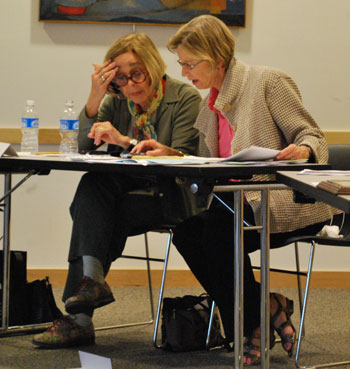
Jan Barney Newman and Prue Rosenthal

Library board members Jan Barney Newman and Prue Rosenthal confer before Monday's board meeting at the Malletts Creek branch.

Ann Arbor District Library board meeting (April 27, 2009): The proposed 2009-10 budget for the Ann Arbor District Library would lower the tax rate that the library levies – a decision that’s in response to the stressed economy, board members said during their monthly meeting on Monday. The board will vote on the budget at its May 18 meeting.

The budget proposes levying 1.55 mills for the fiscal year, which begins July 1, 2009. Currently, the library levies 1.92 mills. (One mill equals $1 for every $1,000 of a property’s state equalized value, or SEV.) The library projects its fund balance will be $6.6 million at the end of this fiscal year (June 30, 2009) and that it will remain at that level next year – at about 52% of AADL’s $12.7 million operating budget.

Prue Rosenthal, the board’s treasurer, characterized the budget as “very conservative,” citing the economy and a concern for keeping taxes as low as possible while maintaining the library’s services. That means the library won’t be putting money into its capital building fund or fund balance, she said, “but we all believe that is the appropriate and right thing to do.” [Full Story]

Ann Arbor Allocates Human Services Funding

red ribbon closed loop

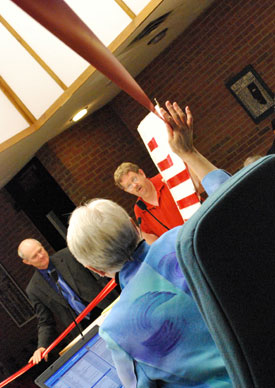
Marcia Higgins (Ward 4) holds a red ribbon representing the general fund dollars in the Ann Arbor city budget. In the background are Mayor John Hieftje and Jim Mogensen, who gave a presentation during public commentary.

Ann Arbor City Council Meeting (April 20, 2009): At its Monday night meeting, Ann Arbor city councilmembers approved around $1.3 million in human services funding (after a “red-ribbon” presentation during public commentary on that subject).

They also heard the 2008 annual report from the chair of the local development finance authority (who was closely questioned by councilmember Marcia Higgins), allowed Tios an early exit to its lease, accommodated the University of Michigan’s request for a lane closure in connection with the football stadium renovation, and rejected the planning commission’s adopted downtown plan (which was expected) – which bumps the final decision on A2D2 zoning to early July.

During public commentary, council again heard support for  public art, a critique of the proposed early-out option for police officers as a part of the proposed budget, a suggestion to remove the East Stadium bridge, as well as Jim Mogensen’s “red ribbon” presentation.

Roger Fraser also gave the official presentation of the city’s budget, which had been presented twice previously last week – at a working session and also at a town hall meeting. [Full Story]

City Council Caucus, Plus Other Questions

A little less than a week after hearing a presentation from city administrator Roger Fraser on his recommended budget for fiscal year 2010 and a plan for 2011, mayor pro tem Marcia Higgins canceled council’s regularly scheduled Sunday night caucus (April 19). No explanation was provided on the city’s website for the cancellation, which was posted on Friday. At least one citizen was alerted to the canceled meeting by reading a sign on city hall’s door at 7 p.m. Sunday evening.

Council must act to amend the recommended budget by its second meeting in May – or the administrator’s recommended budget is automatically adopted, a provision of Ann Arbor’s city charter. There are thus possibly two more caucus meetings before council makes its decision on the recommended budget, which contains a number of proposed cuts.

One of the possible functions of council’s caucus is to assemble “caucus questions” – questions from council to city staff about issues they are going to be considering. Some council members have contended that electronic mail is a far more efficient method of communication, and that caucus is not an efficient use of their time.

Recognizing  that the work that would otherwise be accomplished at caucus can achieved via electronic mail, The Chronicle asked all councilmembers and the mayor to forward their caucus questions to us, in an effort to move the more mundane and tedious work of council more squarely into public view. We report below the responses we received, plus the questions The Chronicle has identified in connection with the city’s budget – some of which have already been answered. [Full Story]

Town Hall Begins Budget Conversation

Roger Fraser on the left and a camera man on the right.

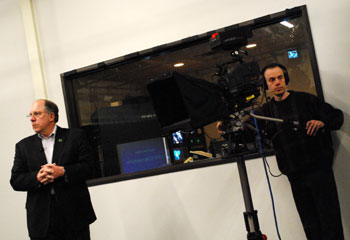
City administrator Roger Fraser and a CTN cameraman before the town hall meeting began.

In CTN studios on Tuesday night, the rain was  falling audibly on the roof as the city administrator for Ann Arbor, Roger Fraser,  used a town hall meeting format to present to the public his recommended budget for fiscal year 2010.

It included a plan for 2011, as well as the overall economic context for the budget. The presentation was essentially the same one he’d given to city council the previous evening, with the key difference being that he fielded questions from the public, instead of city councilmembers – several of whom were also on hand.

Fraser, accompanied also by Mayor John Hieftje,  responded to a flood of questions ranging from the strictly clarificational (Why is there a significant increase in the city clerk’s budget from 2010 to 2011?), to requests for Fraser to talk about what the city was doing to curb costs in specific areas (Have you considered changing the city’s health care provider?), to criticism of particular cuts (This town can’t support a senior center?). [Full Story]

County Commissioners Review Priorities

Saline schools superintendent Scott Graden, left, served as facilitator during Saturdays retreat. County commissioners, from left: Jeff Irwin, Ken Schwartz, Wes Prater.

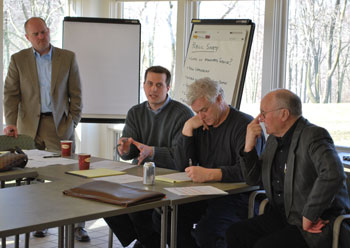
Saline schools superintendent Scot Graden, standing, served as facilitator during Saturday's retreat at Rolling Hills County Park. County commissioners, from left: Jeff Irwin, Ken Schwartz, Wes Prater.

No decisions about budget cuts were made at Saturday’s retreat of the Washtenaw County Board of Commissioners – since organizing it a few weeks ago, they’ve said all along that wasn’t the purpose. Rather, the group of 11 commissioners spent three hours talking through their priorities for the county, a discussion that some commissioners hope will lay a foundation for where to cut expenses as the county deals with a projected $26 million deficit in 2010-11.

The half-day retreat at Rolling Hills County Park was also attended by other elected officials – including sheriff Jerry Clayton, water resources commissioner Janis Bobrin and county prosecutor Brian Mackie – as well as leaders of a few of the 17 unions representing county employees, some county staff and the media. Though some of these people commented during the meeting, for the most part the event was focused on commissioners sharing their thoughts about refining county priorities. The discussion was led by Scot Graden, superintendent of Saline Area Schools and a lifelong Washtenaw County resident.

One piece of news did emerge: county administrator Bob Guenzel, in response to a query from commissioner Wes Prater, said the 2009 equalization report had just been completed and showed that the county’s taxable value was down less than expected. They’d projected a drop of 3%, but the decline in taxable value came in at 2.29%. Though they’d make some adjustments, Guenzel said, “2009 is not our problem.”

Board chair Rolland Sizemore Jr. kicked off the retreat with, “Let’s get it on so I can go home and wash windows.” [Full Story]

County Gets Stimulus Funds for Worker Aid

Washtenaw County Board of Commissioners Administrative Briefing (April 8, 2009): Hefty funding from the federal stimulus package means as many as 1,000 local youth will get summer jobs and hundreds of adults will get job training and employment services, county commissioners were told at their Wednesday administrative briefing. Of the $3.6 million awarded to Washtenaw County, $1.95 million will be used to fund jobs for low-income youth between the ages of 14 to 24. The county now needs to find employers with suitable job openings, said Verna McDaniel, deputy county administrator.

Commissioners also discussed their plan for this Saturday’s retreat, which will focus on setting budget priorities. [Full Story]

Awards, Audits and An Executive Session

Washtenaw County Board of Commissioners (April 1, 2009): A light agenda for the public part of Wednesday night’s board meeting was followed by nearly 90 minutes in executive session discussing labor relations related to budget talks. Before that, the meeting included the presentation of several awards for historic preservation and recognition of the University of Michigan chapter of Alpha Phi Alpha, an African-American fraternity celebrating its 100th anniversary. [Full Story]

County, City Get Funds for Foreclosure Rehab

Administrative briefing, County Board of Commissioners (Feb. 25, 2009): Washtenaw County is receiving a $3 million federal grant to buy and rehab foreclosed homes, destroy blighted buildings and redevelop demolished or vacant buildings. The funds would be used in Ypsilanti, Ypsilanti Township and Superior Township, which are areas designated as high priorities by the U.S. Department of Housing & Urban Development (HUD). Separately, the city of Ann Arbor was awarded $850,000 under the same program.

News of the county grant came during an informal administrative briefing for county commissioners on Wednesday, a gathering that also featured an exploding pen and a word that one commissioner described as sounding like a sexually transmitted disease. [Full Story]

County Board: Plan For Worst, Hope For Best

Washtenaw County Board of Commissioners (Feb. 18, 2009): Commissioners got another cold blast of economic reality at their most recent board meeting, as county staff laid out revenue projections for 2010-11 and asked for feedback about how cautious they should be in planning for the future. Pretty darn cautious was the general consensus among commissioners, saying it would be easier to deal with the budget if their projections proved too pessimistic than if they planned for higher revenue that never materialized.

County administrator Bob Guenzel and his staff also presented various scenarios for increasing revenues, as points of discussion, not recommendations. Those included a couple of options to raise or reapportion taxes that would require voter approval and appeared to have little traction among commissioners at this point. [Full Story]

Column: Survey Says, “Help Us Design One”

By

The second mailing of the National Research Center

The second mailing of the National Research Center's city of Ann Arbor 2008 Citizen Survey.

The Chronicle was among 3,000 Ann Arbor households that have received three pieces of mail over the last couple of weeks sent on behalf of the city of Ann Arbor by the National Research Center in Boulder, Colorado. First to arrive was a post card alerting us to the fact that our household had been “selected at random to participate in an anonymous citizen survey about the city of Ann Arbor,” and that we should watch the following week’s mail for the survey and instructions. [Full Story]

Meeting Watch: County Board (1 Oct 2008)

With barely a vacant seat in the audience at their Wednesday evening meeting, Washtenaw County Commissioners debated how to fund veterans services, while most of the public comment focused on concerns over the transfer of the county’s Library for the Blind and Physically Disabled to the Ann Arbor District Library. [Full Story]

Meeting Watch: AATA (17 Sept 2008)

It was hard to find any bad news at the AATA board meeting held Wednesday night – unless it was the misfortune of board chair, David Nacht, being forced to call time on Tom Partridge’s public speaking turn just as Partridge was favorably comparing Nacht’s education and intellect to that of Governor Granholm’s. Even though with each agenda item, Nacht probed for signs of trouble, he was met time and again with positive reports: on ridership, on the fiscal year 2009 operating budget, on the fuel budget, and on his fellow board members’ willingness to take a small step towards helping make WALLY (Washtenaw and Livingston Line) a reality. [Full Story]