Stories indexed with the term ‘city attorney’

Tension Grows in Medical Marijuana Debate

Ann Arbor city council meeting (April 2, 2012) Part 1: At a meeting that lasted until midnight, the Ann Arbor city council dealt with a full agenda, including several medical marijuana issues.

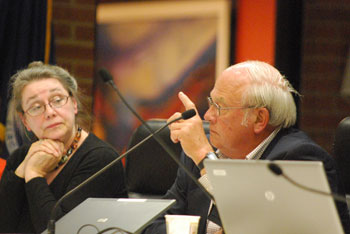
Sabra Briere (Ward 1) Tony Derezinski (Ward 2)

Ann Arbor city councilmembers Sabra Briere (Ward 1) and Tony Derezinski (Ward 2). (Photo by the writer.)

Part 1 of this meeting report focuses just on the medical marijuana-related items. In a separate article, The Chronicle has analyzed some of the key issues at stake: “Ann Arbor Marijuana Licenses: Who Decides?

In front of the council for its consideration were three separate agenda items involving medical marijuana: (1) revisions to the city’s medical marijuana licensing ordinance as recommended by the licensing board; (2) direction to the city planning commission to make a recommendation on revisions to the city’s medical marijuana zoning ordinance; and (3) direction to the city attorney to delay enforcement action against dispensaries.

The council unanimously postponed consideration of the licensing ordinance revisions until June 18 – the council’s second meeting that month. During deliberations on the licensing ordinance, several councilmembers expressed concerns about the board-recommended revisions, in particular one that would allow the city council to waive requirements of the licensing ordinance for a dispensary.  In postponing, councilmembers wanted to give the planning commission enough time to act on its direction to review the medical marijuana zoning ordinance and give a recommendation to the city council. The intent is to bring forward any changes to the licensing and zoning at the same time.

The direction to the planning commission passed on a 9-1 vote, with dissent from the Tony Derezinski (Ward 2), who is the city council’s representative to the planning commission. [Marcia Higgins (Ward 4) was absent, leaving the 11-member council with 10 members present.]

The council tabled the resolution directing the city attorney to delay enforcement activities. The tabling was achieved on a 6-4 vote. Voting against the tabling were mayor John Hieftje, Sabra Briere (Ward 1), Margie Teall (Ward 4) and Mike Anglin (Ward 5). A tabled resolution will demise if it’s not brought back for consideration in six months.

The medical marijuana licensing board made recommendations on the award of licenses to 10 dispensaries at its  Jan. 31, 2012 meeting. Given remarks made at the council’s April 2 meeting by Sandi Smith (Ward 1), Carsten Hohnke (Ward 5) and Stephen Kunselman (Ward 3), there’s some sentiment in support of having the council go ahead and vote on those recommendations – before the council considers ordinance revisions in June. But it’s not clear whether the city attorney’s office would be prepared before June to provide advice on the license awards.

This report includes coverage of public commentary and council deliberations on the medical marijuana items, presented in detail. Other agenda items from the April 2 meeting will be included in a separate forthcoming report. [Full Story]

Ann Arbor Marijuana Licenses: Who Decides?

At an April 2 meeting that lasted until midnight, the Ann Arbor city council handled several agenda items that could affect continued patient access to medical marijuana in Ann Arbor. The meeting also featured extensive public commentary on the topic of medical marijuana. In advance of publishing the full meeting report, The Chronicle offers this analysis of some of the medical marijuana-related issues that were discussed.

Most notably, the meeting featured remarks from city attorney Stephen Postema indicating that he believes medical marijuana dispensaries should not be in business now because they lack licenses: “… [dispensaries] can’t operate right now, they’re not allowed to operate at all – without a license.”

That contradicts the city’s ordinance, which allows dispensaries to operate while their license applications are still pending. (The city is still in the process of issuing its first licenses for dispensaries.) From the ordinance: “The medical marijuana dispensary may continue to operate pending final action on the application unless the Building Official determines that it must be closed for safety reasons.” When The Chronicle sent Postema an emailed query questioning the accuracy of his statement, he responded by insisting his statement was accurate. However, Postema declined to provide any foundation for his feeling that dispensaries lacking a license – even those with applications pending – are not allowed to operate by dint of having no license.

If dispensaries are assumed to be operating in violation of the Michigan Medical Marijuana Act, then they would not be allowed to operate – whether they had a license or not. However, at the April 2 meeting Postema did not identify a basis for such an assumption. He stopped short of describing an interpretation of a recent Michigan court of appeals ruling (the McQueen case) as banning all dispensaries, but said the ruling presented “severe difficulties” for dispensaries.

The council’s deliberations on Monday night can be understood in the context of a struggle between the city attorney’s office on the one hand, and some members of council and the medical marijuana licensing board. The struggle relates to who has the decision-making authority for awarding licenses, and when those licensing awards should be decided. From a formal, procedural point of view, it’s not an open question: The licensing board makes recommendations to the city council, which has the ultimate decision-making authority. The board has already recommended that licenses be awarded to 10 different dispensaries.

However, from a practical point of view, the council will act only under the advice of the city attorney’s office. Since the licensing and zoning ordinances were enacted by the city council last year, Postema has proceeded in a way that reserves a role for city staff in the licensing process that has an uncertain basis in the actual ordinances approved by the council. Revisions to those ordinances, meant in part to address some of those uncertainties, were part of the council’s April 2 agenda.

Here’s a summary of the outcome on medical marijuana issues at the April 2 meeting: (1) the council unanimously postponed consideration of licensing ordinance revisions until June 18 – the council’s second meeting that month; (2) on a 9-1 vote, the council approved giving direction to the city planning commission to review the zoning ordinance; and (3) on a 6-4 vote, the council tabled a resolution directing the city attorney to delay enforcement activities against dispensaries. A tabled resolution will demise if it’s not brought back off the table in six months.

Deliberations suggested in sum that the current arrangement in Ann Arbor, under which patients are still able to get medical marijuana from dispensaries, will persist at least until the city council votes on licenses. But the timing of that vote appears fairly uncertain, given the mixed signals currently being sent by the city attorney.

Provided in this article is analysis of some of the local issues related to medical marijuana licensing and zoning. The analysis culminates by showing how the interpretation of a single requirement in the city’s zoning ordinance – that dispensaries adhere to the Michigan Medical Marijuana Act – makes a significant difference in who makes the practical decision on whether dispensaries receive a license and can legally operate, and where the burden of proof lies for MMMA conformance. [Full Story]

Ann Arbor Council: Legal Opinion? No Thanks

At its April 2, 2012 meeting, the Ann Arbor city council rejected a resolution on a 3-7 vote that would have directed the city attorney to provide a written legal opinion on the transfer of funds from the dedicated street millage fund for use in the city’s public art program. The city’s Percent for Art ordinance stipulates that 1% of all capital project budgets be allocated for public art, up to a limit of $250,000 per project. The legal basis for the program, which relies on taking monies from dedicated millages and fees to serve the purpose of public art, has been sharply questioned.

Since being hired as city attorney, Stephen Postema has circumvented Ann Arbor’s city charter requirement that written legal opinions … [Full Story]

Ann Arbor Pauses on Marijuana Issues

At its April 2, 2012 meeting, the Ann Arbor city council considered three separate agenda items involving medical marijuana: (1) revisions to the city’s medical marijuana licensing ordinance; (2) direction to the city planning commission to make a recommendation on revisions to the city’s medical marijuana zoning ordinance; and (3) direction to the city attorney to delay enforcement action against those dispensaries for which the city’s medical marijuana licensing board has recommended licenses.

The council unanimously postponed consideration of the licensing ordinance revisions until the council’s second meeting in June – June 18.

The council approved the  resolution that gives direction to the planning commission to review the medical marijuana zoning ordinance, on a 9-1 vote.

The council tabled the resolution directing the … [Full Story]

Ann Arbor Delays Again on Medical Marijuana

At its March 19, 2012 meeting, the Ann Arbor city delayed for a second time a resolution that would direct the city attorney, Stephen Postema, to “delay all enforcement activities against medical marijuana dispensaries and cultivation facilities except for claims that they violate Section 5:50.1(3) of the City Code [zoning regulations], until the Council amends or rejects amendments to the zoning and licensing ordinances for medical marijuana.”

The part of the city code called out for continued enforcement in the resolution, Section 5:50.1(3), specifies the zones in the city where medical marijuana businesses may be located. From the code: “Medical marijuana dispensaries shall only be located in a district classified pursuant to this chapter as D, C, or M, or in … [Full Story]

City Council Delays Direction on Marijuana

At its March 5, 2012 meeting, the Ann Arbor city council postponed a resolution that would direct the city attorney, Stephen Postema, to “delay all enforcement activities against medical marijuana dispensaries and cultivation facilities except for claims that they violate Section 5:50.1(3) of the City Code [zoning regulations], until the Council amends or rejects amendments to the zoning and licensing ordinances for medical marijuana.”

The council did not reach the item on its agenda until around 12:30 a.m. and decided to postpone it, due to the late hour, without further deliberation.

The resolution reflects an ongoing tension between the city’s medical marijuana licensing board and the city attorney’s office.

That tension between the board and the city attorney’s office is reflected in a … [Full Story]

Ann Arbor Adds Flashers, Alters Traffic Law

Ann Arbor city council meeting (Dec. 19, 2011): At its last meeting of the year, the council ended the current round of discussion on the city’s pedestrian safety ordinance by finalizing changes that clarified conditions under which vehicles are required to stop for people who are trying to cross the street.

Jane Lumm crosswalk ordinance approaching air quotes

Jane Lumm (Ward 2) made air quotes around the word "approaching" as the council discussed the city's ordinance on crosswalks. (Photos by the writer.)

The current ordinance amendment maintains an existing requirement that motorists accommodate not just pedestrians who are “within” a crosswalk, but also those who are verging on entering a crosswalk. What’s different is the way the concept is expressed. In July 2010, the council chose to describe pedestrians who are about to enter a crosswalk as “approaching” the crosswalk. The version of the ordinance finalized on Dec. 19 requires motorists to accommodate “… a pedestrian stopped at the curb, curb line or ramp leading to a crosswalk and to every pedestrian within a crosswalk …”

As part of the previous amendments made in 2010, the council also had removed language that specified a half of the roadway where drivers needed to accommodate pedestrians. This time around, the council restored similar language, which reads, “… when the pedestrian is on the half of the roadway on which the vehicle is traveling or when the pedestrian is approaching so closely from the opposite half of the roadway as to be in danger.”

In other crosswalk-related business, the council approved an expenditure of $81,000 to install five rectangular rapid flashing beacons (RRFB) on existing pedestrian islands in the city. Four of the locations are along Plymouth Road, at Georgetown, Traver Village, Beal and Bishop. The fifth location is at Seventh and Washington.

Also at the Dec. 19 meeting, the council ended a long process of review by the city and negotiation with neighbors by approving a change to the zoning of the Hoover Mansion property on Washtenaw Avenue, which University Bank uses as its headquarters. The change will allow University Bank to build 13 new parking spaces on the east side – behind the main building, allowing the bank in accommodate expanded employment.

Towards the end of the council’s meeting, a relatively rare debate unfolded about a mayoral nomination to a city board. At issue was the nomination of a city employee – transportation program manager Eli Cooper – to the board of the Ann Arbor Transportation Authority. He’s replacing another city employee on the board, public services area administrator Sue McCormick, who left her position with the city in mid-December. In the end, Cooper’s nomination was confirmed with dissent from two councilmembers. A separate vote on a general policy opposing nominations of city employees to boards and commissions received only four votes of support.

The council considered two compensation-related issues – one for its city attorney, Stephen Postema, and another for election workers who staff the polls. After a closed session to discuss Postema’s performance review, the council voted with dissent from one councilmember to award Postema the ability to cash out 250 hours of banked time. The council delayed its vote on pay increases for election workers, on the possibility that their pay could be increased more than what’s proposed, to match the amount specified in the city’s living wage ordinance.

In other business, the council approved a bond re-funding, authorized reimbursement for a broken electromagnet at the materials recovery facility, accepted additional federal money for solar projects, and heard about a possible strategy for addressing vacant and dilapidated properties. [Full Story]

Postema Mulling Run for Circuit Court Judge?

In an email sent to The Ann Arbor Chronicle, city attorney Stephen Postema stated that he has not yet decided whether to seek the judgeship that will be open on Michigan’s 22nd Circuit Court when Melinda Morris leaves the bench. Her term ends in January 2013 and she will be retiring.

From Postema’s statement: “Finally, as to my future plans … [m]any persons have asked whether I will seek this position you mentioned or suggested that I run, but, for your information, I have made no decision on this.”

Terms for circuit court judges are six years. They’re chosen in non-partisan elections. Eligibility includes residing in the judicial circuit, being licensed to practice law for at least five years, and being … [Full Story]

Licensing or Zoning for Medical Marijuana?

At the Aug. 5, 2010 meeting of the Ann Arbor city council, councilmembers considered a resolution originally drafted by city attorney Stephen Postema to impose a temporary moratorium on the dispensing and growing of medical marijuana. The city council ultimately passed a modified version of the moratorium, with exemptions for patients and caregivers, a grandfathering-in of existing facilities in the city and a reduction in the length of the moratorium from 180 to 120 days. The moratorium ends Dec. 3.

Ann Arbor ordinance review committee

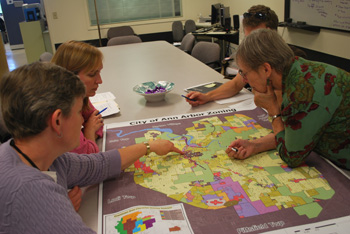
Ann Arbor planning staff and members of the planning commission's ordinance revisions committee discuss existing zoning areas and implications of ordinance changes at their Sept. 13 meeting. Clockwise from left: Wendy Rampson, Jill Thacher, Kirk Westphal, Jean Carlberg. (Photo by the writer.)

The resolution passed by the council also directed the city staff and planning commission to look at possible zoning ordinance changes, with the intent of regulating medical marijuana in Ann Arbor. The resolution does not mention other regulatory approaches, such as licensing.

Since then, the city’s planning staff and the ordinance revisions committee of the planning commission have been developing recommendations to change the city’s zoning code. The changes would regulate medical marijuana dispensaries as well as marijuana grown by registered caregivers as a “home occupation.”

At a Monday, Sept. 13 meeting of the ordinance revisions committee, the group mentioned a parallel track that’s being pursued by the city attorney’s office: licensing of medical marijuana dispensaries. Wendy Rampson, head of the city’s planning department, said that Postema has also been working with the Michigan Association of Municipal Attorneys regarding an approach to licensing medical marijuana. Postema is president of that group. [Full Story]

Column: Getting Smarter About City Charter

Recently the committee charged with reviewing the responses to the city’s RFP for development of the Library Lot met to discuss two days’ worth of public interviews with proposers. The “news” out of that meeting was that the committee set aside three of the five proposals, leaving just two – both of which are concepts for a hotel/conference center.

Nearly escaping notice at that meeting was an exchange between Stephen Rapundalo, who chairs the committee, and senior assistant city attorney Kevin McDonald. The brief interaction came towards the end of the meeting’s work, as the next set of tasks for specific committee members was formulated. Rapundalo asked that McDonald provide a legal opinion. McDonald replied politely, but pointedly, that he’d provide advice, not an opinion.

Why does McDonald care about the difference between providing advice versus an opinion?

McDonald’s concern is based on a fundamental misunderstanding on the part of the city attorney’s office, led by Stephen Postema, about what Ann Arbor’s city charter requires of its city attorney.  [Full Story]

Election 2008 Photos: View from the Backseat

First contact with Stephen Postema on Election Day standing outside Slauson Middle School.

Alert from someone in line who observed Stephen Postema inside on Election Day as I was standing outside Slauson Middle School.

City attorney Stephen Postema visited around 25 different polling places on Election Day in his capacity as election commissioner. First off, I’d like to thank Stephen for allowing me to tag along with him all day as he checked in on various polling places. One point we had addressed the previous day when discussing logistics was what kind of access I’d be afforded at the various precincts: I would at all times avail myself of exactly the privileges afforded the general public. Every polling place has a public viewing area.

From those public viewing spots there’d be no talking to people waiting in line, no photography, nothing to disrupt the ritual of democracy. (I don’t think lending my pen to Dave Boutette, who asked me for it to fill out his voter application, broke the spirit of the rules.)

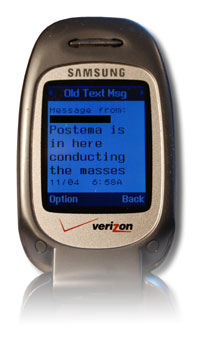
Postema and I had agreed to meet at Slauson Middle School to start the day. I wasn’t sure where exactly he’d meant, and figured it would not be smart to just barge into the polls asking, “Anybody seen Stephen Postema?” At 6:58 a.m., two minutes before the polls opened, I received a text message clarifying the situation: “Postema is in here conducting the masses.” [Full Story]