Stories indexed with the term ‘city-DDA relations’

Ann Arbor District Library Gets Clean Audit

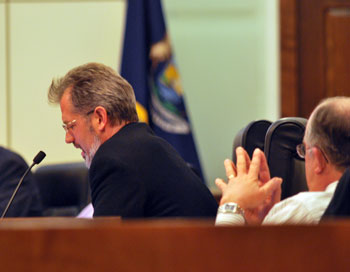
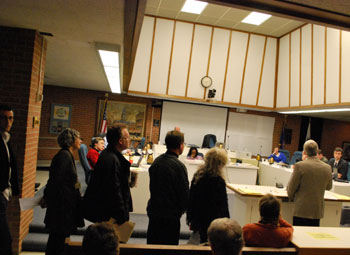
Ann Arbor District Library board meeting (Nov. 15, 2010): Two financial issues drew much of the focus at Monday’s AADL board meeting.

Dave Fisher

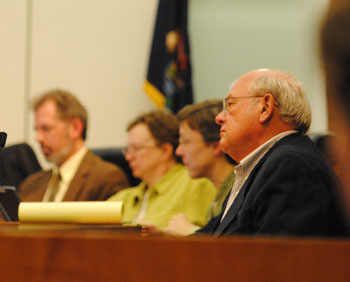
Dave Fisher of the accounting firm Rehmann Robson delivered highlights of the Ann Arbor District Library's financial audit at the AADL board's Nov. 15 meeting. (Photo by the writer.)

Dave Fisher of the accounting firm Rehmann Robson was on hand to review the district’s financial audit for the fiscal year that ended June 30, 2010. He described the library as in solid financial shape, especially in relationship to other entities in Michigan that rely on property tax revenues. The library has no long-term debt and its fund balance is strong, he said. But he added a cautionary note that like other taxpayer-funded entities, the library would likely be grappling with a continued drop in property tax revenues in future years.

Property tax revenues emerged again in a discussion during the director’s report. AADL director Josie Parker drew attention to a Nov. 15 column published in The Ann Arbor Chronicle regarding the ongoing negotiations between the city of Ann Arbor and the Downtown Development Authority. The column pointed out an issue that Parker has been tracking as well: the potential for tax increment financing funds captured by the DDA from public entities, including the AADL, to be used to offset a parking fund deficit caused by striking a new parking deal with the city. The board ultimately passed a resolution at Monday’s meeting, directing Parker to seek legal counsel on the issue.

Board member Ed Surovell said he wanted to make sure the board was defending their right to collect taxes, and that they’re being as responsible as possible to the citizens of the district. “I think this is dead serious business,” he said. “The appropriation and misappropriation of tax revenues is the lifeblood not just of this library, but of a democracy.”

Also during her director’s report, Parker described the results of a site review by staff of the Michigan Commission for the Blind, which manages the federal program that the Washtenaw Library for the Blind and Physically Disabled @ AADL is part of. The review, conducted every two years, is the first one since the AADL took over management of the WLBPD from the county, a transition that occurred in early 2009. AADL received several commendations for its approach to providing WLBPD services.

At the end of the meeting, outgoing board member Carola Stearns – who lost her seat in the Nov. 2 election to challenger Nancy Kaplan – gave a poignant speech, thanking the library staff and her colleagues on the board. In connection with a possible downtown building project, she urged the board to explore alternative funding sources, beyond paying for the project solely with taxpayer funds. [Full Story]

Column: Impact of DDA-City Parking Deal

Just before their Thursday post-election meeting on Nov. 4, Ann Arbor city councilmembers heard a work session presentation from the Ann Arbor Downtown Development Authority. The hour-long work session covered the DDA’s proposal for a process to develop city-owned downtown surface parking lots. It’s a process in which the DDA would play a leading role. The DDA’s proposal has evolved in the course of ongoing discussions between the city and the DDA since early summer.

The DDA will make  another work session presentation before the city council’s meeting on Monday, Nov. 15 – this one about the parking contract under which the DDA uses city-owned assets like decks, lots, and streets to manage the city’s parking system. The current $10-million contract runs through 2015. But the DDA has already paid the city $12 million on that contract, and the city wants an even better deal. Although it won’t be part of the parking contract language, the DDA sees the ability to take more leadership in the development of city-owned surface lots as part of the benefit it would get from a renegotiated parking deal with the city.

For the city, the parking deal is crucial for its budget planning for FY 2012. Already at its mid-October meeting, some city councilmembers began to raise questions about projections for FY 2012. The council must approve the FY 2012 budget this coming May. [The city's fiscal year begins on July 1 each year – the current budget year is FY 2011.] This past May, the city’s projected budget deficit for FY 2012 was $5 million, which already assumed an additional $2 million payment from the DDA.

There are likely enough votes on the 12-member DDA board to approve the new deal. And based on the most recent city-DDA discussions, the new arrangement is likely to take the form of a percentage-of-gross arrangement – 17.5% of gross parking revenues would be paid to the city.

But here’s a different way to describe the arrangement: The city of Ann Arbor would impose a 17.5% parking tax on downtown motorists. That is, downtown parking patrons will pay exactly 17.5% more to park than is actually required for the public parking system to sustain itself, in order that general fund revenues for the city of Ann Arbor can be supplemented.

And to derive support for the city of Ann Arbor general fund from the parking system, the DDA’s parking fund will operate at a greater deficit for the next few years than it would if the city honored the current parking contract. During that period, the DDA’s tax increment finance revenues – the amount it captures from other taxing authorities besides the city of Ann Arbor – will need to remain uninvested on behalf of the broader community. The unspent TIF fund balance will be able to offset the parking fund deficit, leaving the DDA still solvent, but barely so.

Two important questions have been ignored in the course of the city-DDA negotiations: (1) Is it appropriate to use non-city TIF funds – from the county, Ann Arbor District Library, Washtenaw Community College and Ann Arbor Transportation Authority – to offset the parking fund deficit caused by striking a new parking deal with the city? and (2) If the city’s public parking system generates more revenue than is required to operate and maintain it, what investment of that excess revenue would yield the greatest and best return for the community? [Full Story]

DDA: Dogged Enough for Development?

At a three-hour retreat Wednesday morning, the Ann Arbor Downtown Development Authority board met to discuss ongoing negotiations about the city-DDA parking agreement. The DDA manages the city’s parking system under an agreement last amended in 2005, which provides for a total payment of $10 million in rent through 2015. This May, the DDA agreed to make an additional $2 million not required by that contract.

smithcoloring

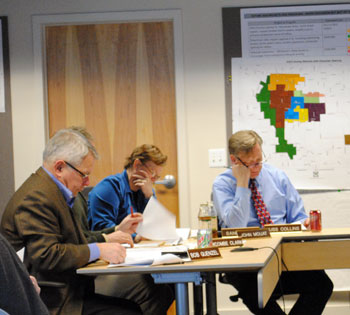
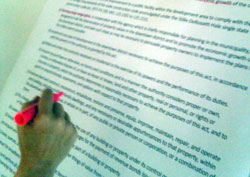
During the retreat, DDA board members marked up a poster-sized version of the DDA enabling legislation using a pink highlighter, undeniably a funky color. (Photo by the writer.)

Wednesday morning’s retreat was meant to focus on the role of the DDA in future development of the downtown area and the role of the DDA in parking enforcement.

The outcome of the retreat was essentially that the DDA is interested in cleaning up various aspects of the parking agreement language, but not in pursuing a role for the DDA in the enforcement of parking regulations. Further, greater support was expressed for the DDA as a facilitator of process, rather than as a driver of development through land acquisition and sale. [Full Story]

DDA Parking Enforcement Prospects Dim

The “mutually beneficial” committees of the city and the Ann Arbor Downtown Development Authority met on Monday for the second time this month. The committees are charged with re-negotiating the contract under which the DDA manages the city’s parking system.

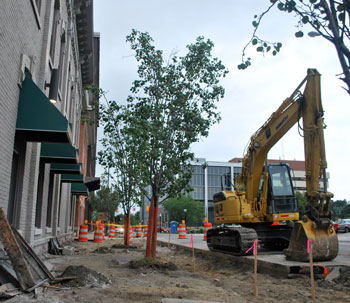
Fifth Avenue looking north

What's the relationship of the Ann Arbor Downtown Development Authority to the city of Ann Arbor? Ann Arbor DDA offices on Fifth Avenue are on the left. The new city hall building is visible behind the backhoe one block to the north. The construction work is part of the DDA's streetscape improvements for Fifth and Division streets.

At the meeting, the committees focused on the question of how the DDA might take on responsibility for enforcement of parking regulations. The DDA would like the ability to manage parking enforcement, so that it can implement an approach to enforcement that complements a demand management pricing strategy and a customer-service approach to downtown. However, the city has identified a number of ways in which it believes the DDA would be constrained in its ability to enforce parking regulations.

At Monday’s meeting, those constraints had accumulated to the point where it became a fair question: Would the DDA still find parking enforcement an attractive proposition, given the constraints? The meeting did not settle the question, with some hope maintained on the DDA side – by Sandi Smith, specifically – that the DDA might play some role in enforcement.

However, if parking enforcement is not something the DDA takes on, it’s not clear what the basis will be for the additional payments the city would like the DDA to make, beyond what is required by the current parking contract. That contract was renewed in 2005. It required a $1 million per year payment by the DDA to the city, with the provision that the city could request $2 million in any given year, and that the total amount did not exceed $10 million from 2005-2015. The city requested $2 million for the first five years, and the DDA agreed unilaterally this past May to make an additional $2 million payment to the city.

When the discussion at Monday’s meeting moved from parking enforcement – which seemed like it had been pushed to the edge, if not completely off the table – to the calculation of a formula for a DDA payment to the city, Susan Pollay, executive director of the DDA, questioned on three separate occasions: Where is the benefit to the downtown in this?

Also at the meeting, the committees got a preview of an outline sketch regarding how the DDA might play an active role in the development of city-owned downtown surface parking lots.

The committees are scheduled to meet next on Sept. 13. Their twice-monthly meeting schedule was adopted starting in July, when it became apparent that the target date of Oct. 31 for a new contract ratified by the respective bodies would not be achieved with a once-monthly schedule. [Full Story]

City-DDA Parking Talks Gain Tempo

The Ann Arbor Downtown Development Authority manages the city’s parking system under a contract last revised in 2005 to extend through 2015.

In early summer 2010, committees from the DDA board and the Ann Arbor city council set out a schedule of monthly meetings to renegotiate that contractual parking agreement.

Susan Pollay at table with timeline on whiteboard in the background.

Susan Pollay, executive director of the Downtown Development Authority, takes notes at the end of the table an hour and a half into the July 12 meeting of committees from the city council and the DDA. On the white board behind her is the timeline worked out by the committees that led to the scheduling of additional meetings. (Photo by the writer.)

Faced with a target of Oct. 31, 2010 for a completed contract, the two groups – known as the mutually beneficial committees – have now increased the frequency of their meetings to twice-monthly. At the June 14 meeting, it was agreed that staff members from both the city and the DDA would attend future committee meetings, and that staff would prepare a matrix of policy points related to the parking system.

But at the July 12 meeting of the two committees, the matrix of policy points had not yet been prepared and no city staff were present. Susan Pollay, executive director of the DDA, attended the July 12 meeting as the DDA staff representative. And Pollay led the committees through a calculation backward from the Oct. 31, 2010 target date, which showed that an outline of the agreement needed to be ready by the very next monthly meeting – then scheduled for Aug. 9.

When committee members apparently teetered on the edge of abandoning the Oct. 31 target, Pollay gave them a nudge, tilting them back to terra firma. She was prepared to work with a sense of urgency, if that is a priority, Pollay told them – but if they already wanted to push past the deadline, then she was content to take it easy, too.

Committee members responded by deciding to add extra meetings to the schedule. Besides scheduling issues, the July 12 meeting also focused on: (i) contractual aspects of the current parking agreement that had possibly been overlooked in recent city council decision-making; and (ii) the appropriate length of the term and monetary consideration in the new contract.

On July 26, the two committees held an extra meeting, this time joined by Sue McCormick, the city’s public services area administrator. The task of creating the parking policy matrix had been taken on by Pollay, who had then worked with McCormick to produce a chart that included the city’s recommendations along with DDA suggestions.

The next regular meeting – the second Monday of the month – falls on Aug. 9, with an additional meeting planned for Aug. 23. [Full Story]

Parking Deal Talks Open Between City, DDA

Almost a year ago, the city council appointed members to a committee that was to talk with a corresponding committee of the Ann Arbor Downtown Development Authority board about amending the contract under which the DDA manages the city’s parking system.

The two groups are known as the “mutually beneficial” committees, reflecting the language of a January 2009 city council resolution that called upon the DDA to begin a conversation about revising the parking contract in a “mutually beneficial” way.

On Monday morning, for the first time in public view, members of the DDA board and the city council met to discuss the contract.

MBC-June14-2010

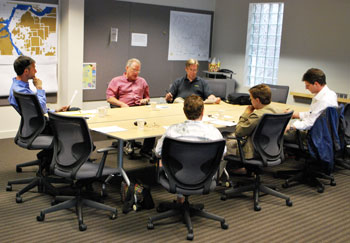
The two mutually beneficial committees (starting at the far right of the frame, proceeding clockwise around the table): Carsten Hohnke, Margie Teall – both city councilmembers; Sandi Smith, city councilmember, but representing the DDA; Christopher Taylor, city councilmember; Roger Hewitt and Russ Collins, both on the DDA board. (Photo by the writer.)

The basis of these further discussions was a term sheet that had been produced in late April by some members of the city council and the DDA working outside of either body’s committee structure.

That term sheet had been the good faith basis on which the DDA board, on a 7-4 vote in May, voted to amend the parking contract. That unilateral amendment amounted to a payment from the DDA to the city of an additional $2 million that had not been required under the existing contract.

The specific outcomes of Monday’s meeting between the two committees were: (i) staff for the DDA and the city would be asked to develop a list of policy points that would need to be addressed in order for the DDA to assume responsibility of enforcing parking rules, but not other codes; and (ii) the DDA would be asked to develop a detailed plan by Sept. 13, 2010 describing the role of the DDA in the development of city-owned surface parking lots within the DDA district.

The planned schedule for meetings between the two committees will be the second Monday morning of each month at 8:30 a.m. at the DDA offices on Fifth Avenue. Members of the council’s committee are Margie Teall (Ward 4), Christopher Taylor (Ward 3) and Carsten Hohnke (Ward 5). Representing the DDA are Sandi Smith, Russ Collins, Roger Hewitt and Gary Boren. [Full Story]

Ann Arbor DDA: Let’s Do Development

Friday morning before the Memorial Day weekend marked the first public meeting of the city council’s so-called “mutually beneficial” committee – first created and appointed back in July 2009.

wiping-off-code-enforcement Ann Arbor DDA

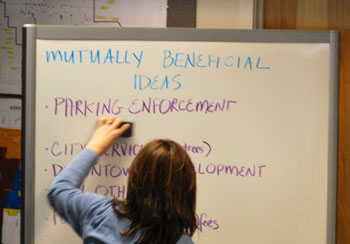
Susan Pollay, executive director of the Ann Arbor Downtown Development Authority, erases "code enforcement" from the list of term sheet items the DDA wants to see discussed further. (Photos by the writer.)

And later in the afternoon, the board of the Ann Arbor Downtown Development Authority met for a retreat to give direction to its own “mutually beneficial” committee.

The two committees are charged with the task of redefining the agreement between the city and the DDA that allows the DDA to manage the city’s parking system.

From the city councilmembers’ perspective, the ball was in the DDA’s court. They were hoping that the DDA’s retreat later in the day would reduce the items on the term sheet that is supposed to underpin the city-DDA conversation.

At their retreat, the DDA board did eliminate an item on the term sheet – code enforcement, other than parking regulations, was not something for which they wanted to assume responsibility. The remaining three term sheet items – parking enforcement, provision of services, and development of city-owned property – stayed on the white board. The clearest consensus among board members seemed to be around the idea that the DDA should focus on development.

But a couple of additional items were added into the mix – issues related to Village Green’s City Apartments project. That project, located at First and Washington, has previously seen its site plan approval option to purchase extended through June 30, 2010. City council action would be required in the next month, if it’s to be extended again.

Downtown police beat patrols were also left on the board as an additional item of discussion.

At Friday’s retreat, the board heard the same message from Susan Pollay, the DDA’s executive director, that she’d conveyed at a partnerships committee meeting two weeks earlier – the reason for the DDA’s existence was to spur private investment in the downtown.

But as a group, there was an uneven embrace of that message. Some board members preferred to identify “development” as meaning something broader than building new infrastructure, suggesting that a more general “economic development” approach might also be appropriate for the DDA.

And one other idea was thrown up on the white board, but did not stick: altering the DDA district boundaries. [Full Story]

City Accepts $2 Million, DDA to “Retreat”

At its May 5 board meeting, the Ann Arbor Downtown Development Authority approved a $2 million payment to the city of Ann Arbor. And about two weeks later, at its May 17 meeting, the city council used the additional revenue in the city’s FY 2011 budget to help reduce the number of planned layoffs in its police and fire departments from 35 to 5.

The $2 million payment was based on a term sheet that a “working group” of councilmembers and DDA board members had put together out of public view over the first four months of the year. The term sheet was adequate to convince a 7-member majority of the 12-member DDA board that the $2 million should be paid by the DDA to the city in advance of a long-term revision to the city-DDA contract, under which the DDA manages the city’s parking system.

The parking contract was most recently renegotiated in 2005 and provided for a maximum payment by the DDA to the city of $10 million over the period from 2005 to 2015. The city drew $10 million in the first five years and had requested in January 2009 that the DDA open discussions to renegotiate the contract.

With the term sheet now out in the open, it’s clear that its content is problematic for councilmembers and DDA board members who were not part of the working group that produced it. Several councilmembers and DDA board members alike have expressed strong opposition to one of the key ideas in the term sheet – that the DDA would assume responsibility for parking violations and other code enforcement.

But based on the term sheet discussion at the May 12 meeting of  DDA’s partnerships committee, the piece of the term sheet of most interest to DDA board members is one that is also the most politically controversial: The DDA would be acknowledged as the engine for developing city-owned land in the DDA district.

The DDA partnerships committee conversation on May 12 came against the backdrop of recent questions raised by the mayor and the city council about what kind of legal authority a DDA has in the context of the city’s system of governance.

And the outcome of the partnerships committee meeting was a decision to hold another full board retreat, this one on May 28 at 2 p.m. at the DDA board room. The general topic of the retreat, which is open to the public, will be the term sheet. The DDA already held its semi-annual retreat about two months ago, on March 16. [Full Story]

City’s Budget Takes Backseat to DDA Issues

Ann Arbor City Council meeting (May 17, 2010): By its second meeting in May, the city of Ann Arbor’s charter stipulates that the city council must adopt a budget for the coming fiscal year, which starts on July 1.

horning-crawford

A folding table was set up for use by the city's financial services staff in council chambers as they tracked the impact on the budget of various amendments made by councilmembers. From foreground to background: Matthew Horning, the city's treasurer; Tom Crawford, CFO; Karen Lancaster, accounting services manager. (Photos by the writer.)

On Monday night, the council unanimously adopted its roughly $78 million general fund budget – as amended to reflect new revenue items. Those new revenue items allowed the council to eliminate five firefighter positions and no police jobs. As originally proposed, the budget would have eliminated 35 fire and police positions combined.

Next year’s work will not be any easier. CFO Tom Crawford said at the meeting that he’s projecting a $5 million deficit in FY 2012.

Deliberations on the budget did not begin until late in the evening. Occupying more of the council’s time than the city’s FY 2011 budget were two issues related to the Ann Arbor Downtown Development Authority. One of those issues was a sidewalk occupancy ordinance applicable only within the DDA district. The ordinance, which legalizes the use of sandwich board signs, passed after a failed attempt by Marcia Higgins (Ward 4) to get it postponed.

The second DDA issue on the agenda involved a $2 million payment from the DDA to the city, which helped the council to amend its budget to reduce layoffs of fire and police. In approving the $2 million payment, the DDA board had included in its resolution a requirement to have a future public process for continued conversations between the city and the DDA about renegotiating a parking agreement between the two entities. From January through April of this year, conversations on that topic between the city and the DDA took place out of public view.

On Monday, the council considered a resolution thanking the DDA for the money and providing a commitment to public process for conversations about the parking agreement – parallel to the public process explicated in the DDA’s resolution. The council resolution passed – stripped of its language about open and transparent process on the grounds that it was redundant – after a brief attempt by Carsten Hohnke (Ward 5) to get the resolution tabled.

In other significant business, mayor John Hieftje nominated a replacement for Ted Annis on the Ann Arbor Transportation Authority board: Roger Kerson, who in 2008 contemplated a run for a Ward 5 council seat, but decided against it.

Anya Dale had been nominated by the mayor to replace Paul Ajegba on the AATA board at the council’s previous meeting. On Monday, confirmation of her appointment included one hitch – Sabra Briere (Ward 1) cast a vote against it. [Full Story]

Extra City Revenue Based on Optimism

Ann Arbor City Council Sunday caucus (May 16, 2010): On Monday night, the city council will deliberate on several amendments to the proposed city administrator’s budget that, if approved, would significantly alter the assumed revenue picture for that proposed budget. [Chronicle coverage: "Ann Arbor Budget Deliberations Preview"]

Ann Arbor city council caucus

From left to right: mayor John Hieftje, Sabra Briere (Ward 1) and Stephen Kunselman (Ward 3). Briere looked up various facts in the FY 2011 budget book during the course of the caucus. (Photo by the writer.)

The city council’s regular Sunday night caucus, which again enjoyed only sparse attendance – from four out of eleven councilmembers – gave a glimpse into how part of the city council is thinking of the possible changes in revenue items. One of those changes to revenue items is certain – the DDA agreed at its May 3 meeting to pay the city $2 million to help cover general expenses at the city.

Two other revenue changes are based on projections, not payments – an additional $625,000 in parking fine revenues, plus almost $1 million in statutory state shared revenues. The additional state shared revenue is an amount that the city administrator assumed for his budget would not be forthcoming from the state.

During the Sunday caucus, mayor John Hieftje attributed the difference in outlook on state shared revenues to a difference in political perspective. He said that Roger Fraser, the city administrator, is “not as plugged in” to the political considerations in Lansing as he and the rest of the city council are.

Questions were raised among residents about the certainty of the extra $625,000 in parking fine revenues. Those questions were raised in the context of the DDA’s interest – as expressed in the term sheet produced recently by a “working group” of city councilmembers and DDA board members – in moving towards a parking enforcement system managed by the DDA and designed to reduce the number of parking tickets.

The revenue items are key to budget amendments that would result in eliminating five firefighter positions – instead of the 20 firefighters and 15 police officers that the city administrator’s budget calls for.

At the caucus, Stephen Kunselman (Ward 3) gave some insight into an amendment he’ll be bringing forward to reduce the tax administration fee from 1% to .81%. When the fee was increased from .81% to 1% in 2007 for the FY 2008 budget, explained Kunselman, it had not come as a request in the administrator’s budget. The increase, he concluded, had not been made in order cover costs of administering the property tax – they were already covered.

Councilmembers at caucus had no information on the possibility of moving maintenance costs for Argo Dam out of the city’s water fund. Indications from city official on multiple occasions through the fall of 2009 and winter of 2010 were that those maintenance costs would be moved from the water fund to the parks fund. [Full Story]

DDA OKs $2 Million Over Strong Dissent

Ann Arbor Downtown Development Authority board meeting (May 5, 2010): During the DDA board’s monthly meeting, mayor John Hieftje and city councilmember Sandi Smith found themselves briefly sidelined from the board on which they sit.

renee_greff_john_hieftje

As mayor John Hieftje looks on, Rene Greff addresses the DDA board at the beginning of Wednesdsay's meeting, asking them not to approve the transfer of $2 million to the city of Ann Arbor. Greff is a former DDA board member, but addressed the board as a downtown business owner – of Arbor Brewing Company. (Photos by the writer.)

They were at the table, however, for the final vote on whether to pay $2 million to the city, which the DDA is not obligated to pay under terms of its existing parking system agreement.

The 7-4 outcome of that vote on the 12-member body, of which 11 were present, was enough to write a $2 million check to the city. Voices of opposition to the fund transfer came not only from inside the board itself, but also from the business community during public commentary. Two former DDA board members were in the audience.

An initial opinion given at the meeting by DDA legal counsel Jerry Lax was that Hieftje and Smith could participate in the deliberations. But when an amendment was proposed, which had a side-effect of removing the basis for Lax’s earlier advice, Smith recused herself. As it became apparent that Hieftje intended to remain at the table, board member Jennifer Hall raised the point of order again, and Lax indicated Smith’s recusal was appropriate and that Hieftje should follow suit. Finally, Hieftje accepted the opinion of the DDA’s legal counsel and took a seat in the audience, but contended that he’d been given different advice from the city attorney’s office. When the amendment failed, Smith and Hieftje were back at the table.

Another board resolution that generated animated discussion, but was ultimately tabled, involved a systematic re-allocation of funds, in $60,000 increments, to a reserve to pay for the restoration of downtown police beat patrols. The re-allocation would have come from monies previously slated to fund the Howell-Ann Arbor commuter rail project (Washtenaw Livingston Rail Line – WALLY).

The committee reports to the board did not involve the kind of blunt talk that emerged during discussions of the two resolutions. But two topics reported out from the board’s transportation committee can be expected to receive wider visibility in the coming months: (i) Where will the two employees of the getDowntown program be housed? and (ii) Can there be an express Ann Arbor-Ypsilanti bus?

In this meeting report, we focus exclusively on the $2 million transfer from the DDA to the city of Ann Arbor. [Full Story]

Ann Arbor Budget: Formal Commencement

Ann Arbor City Council meeting (April 19, 2010) Part 1: In the main business of the meeting, city administrator Roger Fraser delivered to Ann Arbor’s city council a presentation required by the city charter, which contained his proposed budget for FY 2011. That marks the formal start of councilmembers’ opportunity to modify the budget proposal.

Hieftje Higgins Fraser

From left to right: Mayor John Hieftje, Marcia Higgins (Ward 4) and city administrator Roger Fraser. The trio were basking in the blue glow of the slide projector before the start of the council meeting, which began with Fraser's budget presentation. (Photos by the writer.)

The council must adopt amendments to the budget by their second meeting in May – May 17 this year – or else see the administrator’s unamended budget enacted by default, as stipulated by a city charter provision.

The council also heard a summary of the parking plan that they had commissioned the Ann Arbor Downtown Development Authority to produce.

Related to the city budget and the DDA board – but not reported during communications time at the council meeting – members of the DDA board and city council held a closed-door meeting last Friday afternoon with city administrator Roger Fraser to discuss a $2 million payment by the DDA to the city this year.

At Monday evening’s meeting, the council postponed a vote on a schedule of fine increases for parking violations. The estimated $635,000 in additional revenues that the increases would bring, said CFO Tom Crawford at the meeting, was not part of the FY 2011 budget assumptions.

The topic of the University of Michigan’s upcoming graduation exercises on May 1, which will feature an address by President Barack Obama, found its way into deliberations at various points in the meeting. The city approved road closures around the football stadium in conjunction with the UM commencement. Residents who live near Elbel Field will contend with floodlights and loudspeakers as early as 4 a.m. on commencement morning. And during public commentary, one resident expressed concern over the city’s denial of a permit to demonstrate – organizers of “Fulfilling the Dream” expect to draw hundreds on May 1, but as yet have nowhere to gather.

The city administrator’s report to the council featured an explanation of parking citations handed out during the previous Saturday’s UM spring football game, as well as an explanation of the closure of city hall last week due to elevated levels of carbon monoxide.

Public commentary was weighted towards an agenda item that allocated $313,000 from the Ann Arbor Housing Trust Fund for three different permanent housing projects. The council approved the allocation.

The council also satisfied an obligation it had under the settlement terms of a recent lawsuit by voting to remand consideration of an email rule to its rules committee.

In Part 1 of this report, we focus on the budget, parking and UM’s commencement. [Full Story]

Ann Arbor Caucus: Fires, Fines, Fuller

Ann Arbor City Council Sunday night caucus (April 18, 2010): Access to city hall for the caucus on Sunday evening required a manual unlocking of doors with assistance from the Ann Arbor police department. But after gaining lawful entry, about a half-dozen residents discussed a range of topics with the three councilmembers who attended – mayor John Hieftje, Sabra Briere (Ward 1) and Stephen Kunselman (Ward 3).

Bob Snyder couch fire

Bob Snyder reads aloud from the preliminary report of the Ann Arbor fire department, which summarizes the events of a recent nighttime house fire that killed one resident.

A recent fire on South State Street, which killed a resident of the house that burned, prompted a call to revisit a 2004 proposal to ban from porches the use of indoor furniture, like couches. That measure was ultimately tabled by the council six years ago, left to demise without any action.

A couple of residents expressed some disappointment that the councilmembers would not be discussing the budget that evening, but budgetary topics did make their way into the conversation. Chief among them were the relationship of the new parking fine schedule – which is expected to generate an extra $635,000 for the FY 2011 budget – to the parking plan that’s scheduled to be presented on Monday night to the council by the Ann Arbor Downtown Development Authority.

Questions about the planned Fuller Road Station were also raised, including the plan for financing the project. That project is not on Monday night’s agenda. But a different major capital project does have an associated Monday agenda item: the East Stadium bridge replacement. The item involves authorization for the city to apply for funds from the state’s local bridge fund – the city’s most recent application was denied. Caucus attendees heard Hieftje explain that the city would delay the start of replacement construction from fall 2010 to spring 2011, to allow for another round of funding applications.

The council also got an update on one resident’s ongoing efforts to move a mid-block crosswalk in front of King Elementary School to an intersection where cars already stop. [Full Story]

Parking Report Portends DDA-City Tension

Ann Arbor Downtown Development Authority board meeting (April 7, 2010): At its regular Wednesday meeting, the full board of the DDA endorsed a draft of the parking report it has been asked to submit to the city council by April 19, when the council next meets. Before it’s sent to the city council, the report will possibly undergo some minor tweaking at the DDA’s partnerships committee meeting next Wednesday, April 14.

Granger Construction Company

David Olson, vice president of Granger Construction Co., delivered a letter to the DDA board during public commentary, which questioned the way concrete bids were handled for the DDA's underground parking garage. The garage is currently under construction along Fifth Avenue. (Photos by the writer.)

Though not addressed by the board as business items, two areas of controversy emerged during public commentary.

One involves the award of a bid as part of the DDA’s construction of the underground parking garage along Fifth Avenue. The contract for construction management for the entire project was awarded to The Christman Co. However, under the terms of the contract, Christman must bid out various components of the project, like the concrete work – even though Christman has the capability of doing that work itself.

The low bid for the concrete work was submitted by Granger Construction Co., at $21.5 million. But Christman awarded the contract to Christman Constructors Inc., which had submitted a bid of $22 million. Christman’s selection as construction manager of the project had been finalized at the DDA board’s Nov. 4, 2009 meeting with a guaranteed maximum price of $44,381,573. Representatives of Christman and Granger aired their differing points of view on the concrete bid at Wednesday’s meeting, with DDA board chair John Splitt concluding that he was satisfied the process had been fair.

The other point of controversy arising during public commentary is the probable $2 million payment this year by the DDA to the city of Ann Arbor – which it has no obligation to make under its current parking agreement with the city. The city’s budget book for FY 2011, released on Monday, does not factor in a payment from the DDA. Instead, it shows a $1.5 million shortfall for the year. The DDA’s parking report to the city council hints at the possibility that the DDA would take responsibility for the ticketing of parking violations. That change in enforcement could be included in the renegotiation of the parking agreement.

Other business transacted by the board on Wednesday included a resolution calling on the city council to revise its sign ordinance so that downtown merchants could use sandwich board signs legally. A recent attempt to revise the ordinance by the council was voted down at its Feb. 16, 2010 meeting. [Full Story]

DDA Amends Bylaws, OKs Management Fee

Ann Arbor Downtown Development Authority board meeting (Feb. 3, 2010): The DDA board passed two resolutions at its Wednesday meeting. The first authorized a $45,000 discretionary part of the management fee in Republic Parking’s contract.

The Big Drill

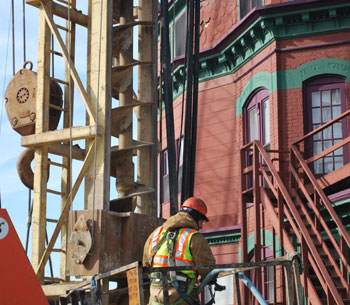
The view from Division Street to the Library Lot work site, where the Christman Company is managing the construction of the underground parking garage. The drilling is part of the earth retention work. (Photos by the writer.)

The second resolution amended the DDA bylaws. The change eliminates the ability of the executive committee to act on behalf of the board between regular board meetings, and clarifies the role of the executive director in relationship with the board. Efforts to change the bylaws have accumulated over two years worth of history, and still need the approval of the Ann Arbor city council to take effect.

Another main theme of Wednesday’s meeting was finances – from parking revenues to tax increment finance (TIF) capture, to the housing fund.

And in a nod to the Bill Murray film “Groundhog Day,” we note that The Chronicle’s report of the DDA board’s February meeting from last year also featured a big drill as lead art. Both drills are related to the construction of the underground parking garage along Fifth Avenue. The board received updates on that and other construction projects, as well as on planning and development downtown. [Full Story]

Council: Art Key to Ann Arbor’s Identity

Ann Arbor City Council meeting (Dec. 21, 2009) Part I: Ann Arbor’s city council meeting lasted past midnight, as the council concluded the evening with a closed session on labor negotiations. The apparent focus of that closed session was the possibility that an agreement could yet be struck with the firefighter’s union that would prevent the layoff of firefighters who’ve already received letters of termination that would end their service to the city on Jan. 4, 2010.

public art line up for public hearings

Members of the public line up for the public hearing on the Percent for Art program. (Photos by the writer)

What pushed the council meeting into the wee hours, however, were the topics of art and parking.

Several members of council backed off their previous support for a reduction in public art funding. The Percent for Art program was left at its full funding level. The council also approved a contract for management services for the Dreiseitl art project to be installed as a part of the new municipal center – amid legal concerns raised by Stephen Kunselman (Ward 3).

Also, the council ultimately approved a heavily amended version of a resolution on parking that Sandi Smith (Ward 1) had added to the agenda on the previous Friday, which left the intent of two key “Resolved” clauses largely intact: (i) the city will get revenues from a surface parking lot, and (ii) the city’s plan to install its own meters has been braked indefinitely. A third clause that would have extended downtown meter enforcement to 10 p.m. was swapped out in favor of one that is less specific.

The council attended to a variety of other matters, including its new committee organization, authorization of purchases connected to single stream recycling, and acceptance of an energy grant. Councilmembers and the city administrator also made robust use of the communications section of the agenda to provide status updates on their recent work.

In Part I of our council report, we focus on art and parking. [Full Story]

City-DDA Parking Deal Possible

At the Dec. 16 meeting of the Ann Arbor Downtown Development Authority’s operations committee, DDA board member Sandi Smith previewed a city council resolution on parking she said she expected would be on the Dec. 21 city council agenda. Smith also serves on the city council.

Ann Arbor parking meter

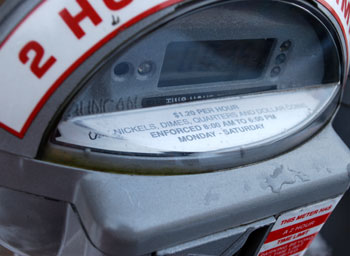
Ann Arbor parking meters are currently enforced from 8 a.m. to 6 p.m., Monday-Saturday. (Photo by the writer.)

Key elements of the draft resolution that Smith shared with fellow DDA board members included: (i) net revenues from the Fifth and William (old YMCA) lot would go into city rather than DDA coffers, (ii) downtown parking meters would operate and be enforced until 10 p.m., which is later than their current cutoff of 6 p.m., and (iii) the city would discontinue its plan to install its own parking meters in neighborhoods near the downtown.

The city’s plan to install its own parking meters in neighborhoods near downtown was formulated as part of the city’s FY 2010 budget (the current fiscal year), but implementation was not immediate. Reference to the city’s installation of “its own meters” alludes to the fact that the DDA manages the public parking system via an agreement with the city – the new meters would not fall under that agreement.

Although the specific wording of the draft differed in parts from the resolution that was added to council’s agenda on Friday, the key points remained.

Within hours of its appearance on the agenda, the Ann Arbor Area Chamber of Commerce had sent a memo to city councilmembers asking for postponement of the resolution.

Smith’s resolution puts one question that’s been simmering for nearly a year closer to the front burner: Will the parking agreement between the city and the DDA be renegotiated as part of the FY 2011 budget? [Full Story]

Two Library Lot Proposals Eliminated

Dahlmannopenspace

This rendering shows a proposal by Dahlmann Apartments Ltd. for a project called Ann Arbor Town Square. It was one of two proposals for the development of Library Lot that have been eliminated from further consideration.

Two of the six proposals to develop the top of the Fifth Avenue underground parking structure – known as Library Lot – have been eliminated from further consideration.

At a Friday morning meeting, members of a committee that’s overseeing the Library Lot development cited insufficient financial benefit to the city as the reason for taking Ann Arbor Town Square and Ann Arbor Community Commons out of play. Both of those projects would put primarily open space on the 1.2-acre lot. Three of the other proposals include a hotel, with the fourth focusing on housing for senior citizens.

Developers of the four remaining proposals will be scheduled for interviews throughout the day on Wednesday, Jan. 20. It’s possible that the field will be thinned even further before then, depending on how developers respond to a list of questions that committee members have formulated about each specific proposal.

The Jan. 20 meetings will be open to the public. The city also plans to hold an evening open house on Jan. 20 for the public to meet with developers and give feedback on the proposals.

In addition, the committee on Friday discussed the possibility of the Ann Arbor Downtown Development Authority paying for a consultant to help evaluate the remaining proposals. [Full Story]

DDA Invites City to Discuss Parking Fines

Ann Arbor Downtown Development Authority board meeting (Dec. 2, 2009): In a meeting dominated by status reports for ongoing DDA initiatives, a glimmer of a possibility emerged that a discussion about the parking system could begin between the DDA and the city of Ann Arbor.

librarylotview2

View from the southwest. The Library Lot (construction crane) is immediately to the north of the Ann Arbor District Library (red brick with blue trim). In the foreground is the awning for the Blake Transit Center (bus turning in). (Photo by the writer links to higher resolution image).

That discussion would be focused on parking fines – a topic the Ann Arbor city council was briefed on at its Nov. 9 work session by city financial services staff. That session did not include the DDA, which manages the Ann Arbor’s parking system under a contract with the city. Republic Parking is the company contracted by the DDA for operation of the system. [See Chronicle coverage: "Parking Fines to Increase in Ann Arbor?"]

In the only board resolution considered at the meeting, executive director Susan Pollay was authorized to negotiate easements with property owners adjoining the construction site for the underground parking garage, which is now starting construction. [Full Story]

Parking Fines to Increase in Ann Arbor?

Ann Arbor city council work session (Nov. 9, 2009): At its work session on Monday, the council heard two presentations: (i) the financial impact of raising parking violation fines, and (ii) the use of social media by city staff in parks and recreation.

The parking presentation was given by Matthew Horning, the city’s treasurer. It included comparative data from other cities, and an analysis of the impact on total revenues that would result from raising fines. His presentation also looked at the impact of providing incentives for early payment across the 34 different categories of violations. For the expired meter fine, which accounts for 65% of all tickets issues, Horning’s analysis assumed a recommended increase from $15 to $20. The schedule of fines presented by Horning is projected to increase annual revenues by $875,287.

The social media presentation was given by Kim Mortson, who works in public relations for community services at the city. She described how she’d used social media like Twitter and Facebook to complement more traditional approaches to promote parks and recreation programs.

In our report, we focus exclusively on the parking violation fines. [Full Story]

Split DDA Board Agrees on Splitt

Downtown Development Authority board meeting (July 1, 2009): The Ann Arbor DDA wound up its current fiscal year with a frank and transparent disagreement about its future governance as a body, both in terms of its officers and its appointments. The disagreement was also reflected in connection with the specific substantive issue of raising parking fees at the 415 W. Washington lot.

An expected controversy over variable parking fees elsewhere was avoided when a scheduled resolution to introduce new variable-rate on-street parking fees – which would have increased parking rates and generated around $250,000 in extra revenue – was postponed until September, the board’s next scheduled meeting.

September is also when the question of who will be the board’s treasurer will be decided, with the board unable to choose between Sandi Smith and Roger Hewitt for that position during board elections. The board did arrive at selections for its new chair (John Splitt), vice-chair (Joan Lowenstein) and secretary (Keith Orr).

In other business, the board granted nearly $400,000 to the getDowntown program for the go!pass, extended a $50,000 arts grant re-directing the money towards performing arts organizations, authorized $25,000 for additional recycling containers to be placed downtown, approved $16,000 in grants to merchant associations to encourage attractive window displays, and authorized sponsorship for travel to the International Downtown Association Conference.

In the course of the meeting, city councilmember Leigh Greden’s attendance and vote in place of Mayor John Hieftje, who is a member of the DDA board, generated discussion of interest to specialists in civics. [Full Story]

Merchants Say Bring Back the Beat Cops

Discussion of the role of the Downtown Development Authority morphed into venting about panhandlers at Thursday morning’s meeting of the Main Street Area Association. Saying that customers are complaining, several merchants are concerned about panhandlers becoming more aggressive since the city pulled its beat cops from the street earlier this week.

The topic came up after a presentation by DDA executive director Susan Pollay, who was filling in for Rene Greff, a DDA board member and co-owner of Arbor Brewing Company and Corner Brewery. Greff had been scheduled to give the same talk she gave at a DDA retreat in May, outlining the organization’s history, how it works and what it has accomplished. 

So how did panhandling usurp parking as the most-discussed topic related to the DDA? Why aren’t beat cops patrolling downtown? What do merchants think about “Arthur,” one of the regulars who asks passers-by for change along Main Street? It all comes down to money. [Full Story]

City Place Delayed, Downtown Plan OKed

Ann Arbor City Council meeting (June 15, 2009): The council covered a lot of ground at its Monday night meeting, much of it related to streets and transportation. Besides dealing with a raft of garden-variety street closings that generated some unexpected “controversy,” the council put in place a plan to delay the installation of some parking meters in near downtown neighborhoods, launched a safety campaign, and funded a bike path, pedestrian amenities and the city’s portion of a north-south connector feasibility study.

But it wasn’t the bike path that drew more than 20 people to speak at a public hearing. That turnout was for the adoption of the Downtown Plan. It was ultimately adopted as amended by the city’s planning commission so that the D2 buffer in the South University area is a small area in the southeast corner.

The expected vote on the City Place project along Fifth Avenue was delayed again after additional technical errors by planning staff were discovered related to the planning commission’s April meeting. That project will now start over with the planning commission public hearing.

Audience members who waited until the end of the long meeting heard Mayor John Hieftje appoint a subcommittee of councilmembers to meet with the DDA’s “mutually beneficial” committee to discuss the parking agreement between the city and the DDA.  In the discussion after the jump, we provide a record produced in the preliminary response to a Chronicle FOIA, which dates the renegotiation of the parking agreement to as early as September 2008 and connects it to discussions between the mayor and a candidate for the DDA board, Keith Orr, who was eventually appointed to the board.  The record shows that his appointment was not contingent on a commitment to a particular vote on the parking agreement. [Full Story]

DDA: No Funding for LINK Bus…for Now

Map of the LINK connector service in downtown Ann Arbor

Map of the previous LINK connector service in downtown Ann Arbor

Downtown Development Authority board meeting (June 3, 2009): The start to Wednesday’s DDA board meeting paralleled the beginning of its recent retreat two weeks ago – the board met in closed session with their legal counsel to discuss pending litigation over the Fifth Avenue underground parking garage. Board chair Jennifer Hall recused herself from the session, as she had at the retreat’s closed session.

Later in the meeting, she removed herself from the DDA’s “mutually beneficial” committee, appointing board member Russ Collins to take her place. More on that after the jump.

In other board business, the theme of the balance between university and city funding responsibilities was reflected in board consideration of two transportation-related issues: (i) a feasibility study for a north-south connector service along the Plymouth-State Street corridor, and (ii) the LINK circulator buses – familiar to some downtown visitors as simply “the purple buses.”  The board approved an $80,000 contribution for the north-south connector, but did not renew the grant – last year around $70,000 – that funds the LINK. The LINK is ordinarily suspended during summer months, but the lack of DDA grant renewal likely means that in the fall the purple buses will re-appear only on their eastern UM loop.

Further, a $12,000 evaluation of the getDowntown program was approved, budget amendments were made to reflect allocations already approved, and a resolution was passed approving final recommendations to city council for the A2D2 rezoning package. The board also heard updates on the DDA’s website and data policy, the Fifth & Division streetscape improvements project, the underground parking garage, and the valet parking service. The valet service has been suspended for the summer after the pilot showed less-than-successful results through the first five months of the year. [Full Story]

DDA Retreat: Who’s on The Committee?

organ in foreground stage of Michigan Theater in background with people sitting on it

When Russ Collins, executive director of the Michigan Theater and a DDA board member, described downtown areas as "organic beings – they're either growing or dying," this is not what he meant by organ-ic.

During the most recent regular monthly meeting of the Downtown Development Authority board, its treasurer, Rene Greff had asked Mayor John Hieftje, “When are you seating the committee?” At that regular board meeting, a clear answer was not forthcoming.

But at the board’s mid-year retreat, held on Wednesday morning from 10 a.m. to 2 p.m. on the Michigan Theater stage, Hieftje was more candid about why city council has not yet formed a committee.

What committee were Greff and Hieftje talking about?

The committee in question is a city council ad hoc committee that would  begin discussions with its already-formed counterpart from the DDA board. The discussions between the two bodies would focus on establishing “a mutually beneficial” financial arrangement – one that is already reflected in the DDA’s recently adopted budget as a $2 million contingency.

The DDA board voted to place that contingency in its budget in response to a city of Ann Arbor FY 2011 budget plan that assumes a $2 million payment from the DDA to the city – a payment that the DDA is not (yet) contractually obligated to make.

In the course of the retreat, Hieftje explained that the city council’s delay in seating a committee of its own was partly related to pending litigation – a topic addressed during a nearly 50-minute long closed session that began the board’s retreat.   [Full Story]

DDA to City on Meters: We’re Skeptical

Downtown Development Authority board meeting (May 6, 2009): At its regular Wednesday meeting, the DDA board passed a resolution expressing skepticism about a new city plan aimed to generate an additional $380,000 in parking revenue. The plan, which was introduced to the board by Mike Bergren and Pat Cawley of the city, would achieve the additional revenue by installing more parking meters in residential areas adjoining downtown.

The resolution was amended in a way that, for the time being, headed off a direct confrontation between the DDA and the city over control of DDA dollars.

Another theme running through multiple parts of the meeting – including a discussion among interested parties afterward – was the issue of access to data, and the use of technology to share information.

In other business, the board heard a presentation on a city pilot plan to install automated trash cans in the downtown area, plus heard the usual reports from its subcommittees, including one from the operations committee that portrayed the DDA’s finances still in good order, despite the gloomy economy. [Full Story]

DDA: No Character-District Zoning, Please

DDA cameras Ann Arbor

The board met at its usual location in the DDA offices, but this time it was recorded by three new wall-mounted video cameras. There's no schedule yet for the airing of the video material on CTN.

Downtown Development Authority board meeting (April 1, 2009): The board of the Ann Arbor Downtown Development Authority held its regular monthly meeting on Wednesday and passed  a resolution – with some dissent – recommending that city council eliminate the character districts from the A2D2 zoning proposal.

The board also authorized spending around $75,000 to help start a business district in the Main Street area – an idea mentioned in our report on the board’s December 2008 meeting.

Additional spending, totaling around $25,000, was authorized for bicycle parking – some of it on-street.

The board also heard a report from its ad hoc committee on the discussion of the parking agreement with the city of Ann Arbor. Initial indications are that there was clear (but not unanimous) sentiment on the committee against renegotiating the existing agreement, but for exploring other alternatives.

Accessibility was a theme that came up in the form of DDA meeting material as well as real-time parking data. [Full Story]

Is DDA District a Disproportionate Burden?

Six-million-dollar oval.

The bottom line according to a 2005 city of Ann arbor analysis of DDA costs versus payments. (The circle means "negative") The DDA sees it differently.

On Monday evening, March 23, several Ann Arbor residents took advantage of an entire city council session devoted to public comment on the recent A2D2 zoning revisions. The  zoning revisions apply to an area that  coincides almost exactly with the Downtown Development Authority district. We thus take the opportunity to focus on this district, and how taxes are collected in this geographic area, in light of recent community discussion on the topic.

The Chronicle has previously reported a remark by made by Mayor John Hieftje at a recent Sunday night caucus, in which he stated that the parking agreement between the DDA and the city was renegotiated in 2005 due in part to the fact that the DDA area represented a disproportionately greater burden on city services. Also previously reported, Kyle Mazurek, vice president of government affairs for the Ann Arbor Area Chamber of Commerce, posed several questions to the DDA board at its meeting on March 4, including one about the possibility of disproportionate use of city services in the DDA district: [Full Story]

DDA Discusses Payments to City

Downtown Development Authority board meeting (March 4, 2009): At Wednesday’s monthly board meeting of the Downtown Development Authority, Rene Greff asked the rhetorical question: “Do you want to hook that cart to a controversial horse?” And she was not talking about a new transportation option for downtown. But the “cart” was the idea of transportation demand management. The “horse” was city council’s recent request that the DDA increase its revenues to assure adequate reserve fund balances. [Full Story]