Environmental Indicators: Trees
Editor’s Note: This is the fourth in a series of Chronicle pieces on the environmental indicators used by the city of Ann Arbor in its State of Our Environment Report. The report is developed by the city’s Environmental Commission and designed as a citizen’s reference tool on environmental issues and as an atlas of the management strategies underway that are intended to conserve and protect our environment. The report is organized around 10 Environmental Goals developed by the Environmental Commission and adopted by city council in 2007.
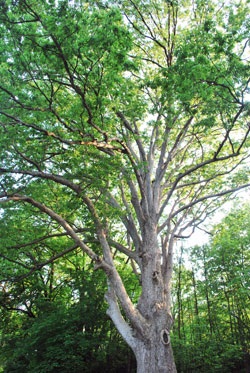
This is one of Ann Arbor's more significant trees. Some readers will undoubtedly recognize it and will know its location, type, and age – which they're invited to leave in the comment section.
This month’s report is also an invitation to all readers to participate in the development of Ann Arbor’s first comprehensive Urban Forest Management Plan. A public workshop to help kick off the planning effort is being held on June 1, 2010 from 7-9 p.m. at Forsythe Middle School, 1655 Newport Road.
This spring has been exceptional with both beautiful weather and ample rain. The trees seemed to have noticed, with their early bud break in April and full canopies by mid-May. While we worried for those tender emerging leaves when the temperature dipped below freezing, the trees handled the dips in temperatures just fine and are now flourishing.
That’s good news because the city receives exceptional benefits from our trees. A recent analysis of the publicly managed trees (i.e., trees along streets and mowed areas of parks) estimated that they provide $4.6 million in benefits each year. When you factor in the cost for management, the city receives $2.68 in benefits for every $1 it spends on the municipal forestry program. We think that’s a pretty good rate of return.
What are these benefits and how were they calculated? [Full Story]