Stories indexed with the term ‘conflict of interest’

UM Conflict-of-Interest Items OK’d

At its May 17, 2012 meeting, the University of Michigan board of regents authorized 16 items that required disclosure under the state’s Conflict of Interest statute. The law requires that regents vote on potential conflict-of-interest disclosures related to university staff, faculty or students.

One conflict-of-interest item that had originally been on the agenda for approval – involving a contract with Ann Arbor-based NanoBio for consulting services – was pulled. Regent Larry Deitch recused himself from the vote on that item, and there were not enough remaining regents to vote on it. Of the eight regents, Martin Taylor and Libby Maynard were absent. Regent Kathy White participated by speaker phone.

According to a staff memo, the university plans to contract with NanoBio for consulting services in … [Full Story]

UM Regents OK 11 Conflict-of-Interest Items

At its April 18, 2012 meeting, the University of Michigan board of regents authorized 11 items that required disclosure under the state’s Conflict of Interest statute. The law requires that regents vote on potential conflict-of-interest disclosures related to university staff, faculty or students.

The items often involve technology licensing agreements or leases. This month, the items related to the following businesses: Ambiq Micro Inc.; Milcom Inc.; QE Tools; SwirlTech; RBL Group; Arbor Research Collaborative for Health; Arbor Ultrasound Technologies; ImBio; JV BioLabs; PicoCal Inc.; and SB10 Inc.

This brief was filed from the Michigan Union’s Rogel ballroom, where the board held its April meeting.

UM Regents OK 10 Conflict-of-Interest Items

At its March 15, 2012 meeting, the University of Michigan board of regents authorized 10 items that required disclosure under the state’s Conflict of Interest statute. The law requires that regents vote on potential conflict-of-interest disclosures related to university staff, faculty or students.

The items often involve technology licensing agreements, research agreements or leases. This month, companies involved are Avicenna Medical Systems Inc., Peacock Holdings, 3D Biomatrix LLC, Atterocor Inc., Brio Device LLC, Evigia Systems Inc., HistoSonics LLC, Michigan Aerospace Corp., Mozaic Solutions LLC, and Situmbra Inc.

This brief was filed from the Michigan Union’s Pendleton Room on UM’s Ann Arbor campus, where regents held their March meeting. A more detailed report will follow: [link]

UM Regents OK Conflict-of-Interest Items

At its Feb. 16, 2012 meeting, the University of Michigan board of regents authorized five items that required disclosure under the state’s Conflict of Interest statute. The law requires that regents vote on potential conflict-of-interest disclosures related to university staff, faculty or students.

The items often involve technology licensing agreements or leases. This month, the items related to the following businesses: Structured Microsystems LLC, H3D Inc., ImBio LLC, OncoMed Pharmaceuticals Inc., and OcuSciences Inc.

This brief was filed from the boardroom of the Fleming administration building on UM’s central campus, where the regents’ meeting is held. A more detailed report will follow: [link]

UM Conflict-of-Interest Disclosures OK’d

At its Jan. 19, 2012 meeting, the University of Michigan board of regents authorized five items that required disclosure under the state’s Conflict of Interest statute. The law requires that regents vote on potential conflict-of-interest disclosures related to university staff, faculty or students.

The items often involve technology licensing agreements or leases. This month, companies involved are Edington Associates LLC, ArborMetrix, Valley View Farms, FlexDex LLC and Diapin Therapeutics LLC.

The brief was filed from the colloquium room at UM’s Stephen M. Ross School of Business, where the regents meeting was held this month. A more detailed report will follow.

Ann Arbor Adds Flashers, Alters Traffic Law

Ann Arbor city council meeting (Dec. 19, 2011): At its last meeting of the year, the council ended the current round of discussion on the city’s pedestrian safety ordinance by finalizing changes that clarified conditions under which vehicles are required to stop for people who are trying to cross the street.
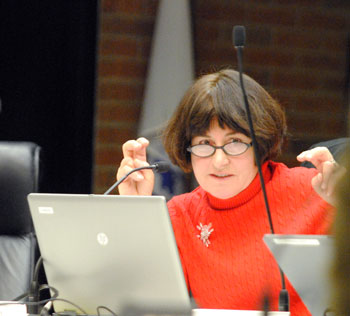
Jane Lumm crosswalk ordinance approaching air quotes

Jane Lumm (Ward 2) made air quotes around the word "approaching" as the council discussed the city's ordinance on crosswalks. (Photos by the writer.)

The current ordinance amendment maintains an existing requirement that motorists accommodate not just pedestrians who are “within” a crosswalk, but also those who are verging on entering a crosswalk. What’s different is the way the concept is expressed. In July 2010, the council chose to describe pedestrians who are about to enter a crosswalk as “approaching” the crosswalk. The version of the ordinance finalized on Dec. 19 requires motorists to accommodate “… a pedestrian stopped at the curb, curb line or ramp leading to a crosswalk and to every pedestrian within a crosswalk …”

As part of the previous amendments made in 2010, the council also had removed language that specified a half of the roadway where drivers needed to accommodate pedestrians. This time around, the council restored similar language, which reads, “… when the pedestrian is on the half of the roadway on which the vehicle is traveling or when the pedestrian is approaching so closely from the opposite half of the roadway as to be in danger.”

In other crosswalk-related business, the council approved an expenditure of $81,000 to install five rectangular rapid flashing beacons (RRFB) on existing pedestrian islands in the city. Four of the locations are along Plymouth Road, at Georgetown, Traver Village, Beal and Bishop. The fifth location is at Seventh and Washington.

Also at the Dec. 19 meeting, the council ended a long process of review by the city and negotiation with neighbors by approving a change to the zoning of the Hoover Mansion property on Washtenaw Avenue, which University Bank uses as its headquarters. The change will allow University Bank to build 13 new parking spaces on the east side – behind the main building, allowing the bank in accommodate expanded employment.

Towards the end of the council’s meeting, a relatively rare debate unfolded about a mayoral nomination to a city board. At issue was the nomination of a city employee – transportation program manager Eli Cooper – to the board of the Ann Arbor Transportation Authority. He’s replacing another city employee on the board, public services area administrator Sue McCormick, who left her position with the city in mid-December. In the end, Cooper’s nomination was confirmed with dissent from two councilmembers. A separate vote on a general policy opposing nominations of city employees to boards and commissions received only four votes of support.

The council considered two compensation-related issues – one for its city attorney, Stephen Postema, and another for election workers who staff the polls. After a closed session to discuss Postema’s performance review, the council voted with dissent from one councilmember to award Postema the ability to cash out 250 hours of banked time. The council delayed its vote on pay increases for election workers, on the possibility that their pay could be increased more than what’s proposed, to match the amount specified in the city’s living wage ordinance.

In other business, the council approved a bond re-funding, authorized reimbursement for a broken electromagnet at the materials recovery facility, accepted additional federal money for solar projects, and heard about a possible strategy for addressing vacant and dilapidated properties. [Full Story]

Conflict-of-Interest Items Get Regental OK

At its Dec. 15, 2011 meeting, the University of Michigan board of regents authorized eight items that required disclosure under the state’s Conflict of Interest statute. The law requires that regents vote on potential conflict-of-interest disclosures related to university staff, faculty or students.

The items often involve technology licensing agreements or leases. This month, the items included four research agreements, one subcontract agreement, one licensing agreement, one licensing option agreement, and one business transaction. Companies involved are: ONL Therapeutics; Emerging Micro Systems Inc.; CytoPherx Inc.; CSquared Innovations; Arbor Ultrasound Technologies; ISSYS Inc.; and Red Poppy Floral Design.

This brief was filed from the boardroom of the Fleming administration building on the UM campus in Ann Arbor. A more detailed report will follow: [... [Full Story]

Council Agenda Item: Mayoral Nominations

The Ann Arbor city council’s Dec. 19, 2011 meeting agenda, published online on Dec. 14, includes a resolution that expresses opposition to mayoral nominations of city of Ann Arbor employees to serve on boards and commissions. The resolution is sponsored by Stephen Kunselman (Ward 3), Mike Anglin (Ward 5) and Jane Lumm (Ward 2).

The “resolved” clause, as it currently appears on the agenda, simply records the view that those voting in the affirmative are opposed to such appointments: “RESOLVED, Those council members voting in the affirmative to this resolution oppose Mayoral nominations of City of Ann Arbor employees to office appointments.”

Update: As of Friday, Dec. 16, the resolved clause has been revised to read: “Therefore be it resolved, That Council … [Full Story]

UM Conflict-of-Interest Items Approved

At its Nov. 17, 2011 meeting, the University of Michigan board of regents authorized eight items that required disclosure under the state’s Conflict of Interest statute. The law requires that regents vote on potential conflict-of-interest disclosures related to university staff, faculty or students. Often, the items involve technology licensing agreements or leases. This month, the items included three lease agreements, three research option agreements and one licensing agreement.

Also authorized was a collaboration between The Ark, a downtown Ann Arbor concert venue, and the University Unions Arts and Programs. The event – an Oct. 7 concert by  Vienna Teng at UM’s Power Center – triggered the conflict-of-interest issue because The Ark’s board chair, Kathryn Huss, works for UM as deputy director and … [Full Story]

UM Conflict-of-Interest Items Authorized

At its Sept. 15, 2011 meeting, the University of Michigan board of regents signed off on 14 items that required disclosure under the state’s Conflict of Interest statute. The law requires that regents vote on potential conflict-of-interest disclosures related to university staff, faculty or students. Often, the items involve technology licensing agreements or leases.

This month, the items related to the following businesses: Cornell Farms; Civionics Inc.; NeuroNexus Technologies Inc.; Inmatech Inc.; Vortex Hydro Energy; Rolith Inc.; Lean Therapeutics; Electric Field Solutions Inc.; Diapin Therapeutics; Arbor Research Collaborative for Health; Absolute Nano Inc.; and Michigan Critical Care Consultants Inc.

This brief was filed from the boardroom of the Fleming administration building, on UM’s Ann Arbor campus. A more detailed report will follow: [link]

UM Regents Briefed on Depression Center

University of Michigan board of regents meeting (July 21, 2011): Ten years after the 2001 board of regents authorized its formation, the UM Depression Center has become a national leader in breaking the stigma and improving the treatment of this common, debilitating illness.

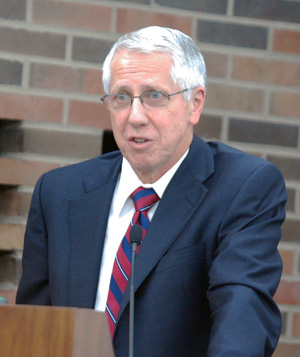
John Greden

John Greden, director of the University of Michigan Depression Center, briefed regents at their July 21, 2011 board meeting. (Photos by the writer.)

That message was delivered by the center’s director, John Greden – the man whose vision was instrumental in creating it a decade ago. Greden briefed regents on the center’s progress so far, describing its research and outreach efforts, including its leadership in developing a national network of depression centers that he said is strengthening the fight against the illness. He also indicated the center will be launching a fundraising campaign in the near future, to raise more resources in the face of overwhelming demand for services.

In addition to Greden’s report, regents voted on a range of items. The most significant in terms of a financial commitment was approval of a $116 million “deep” renovation of East Quad, a large dorm on East University Avenue. It’s also the home to UM’s Residential College. At the board’s May 19, 2011 meeting, philosophy professor Carl Cohen had raised concerns about the impact of the renovations as initially designed, saying the RC would be pushed into smaller, inadequate space and would “atrophy and fade away.” A schematic design hasn’t yet been presented to the board for approval.

Among other actions, regents also approved a new joint master’s degree program in entrepreneurship to be offered by the College of Engineering and the Ross School of Business. They authorized renaming the department of geological sciences – it will be called the department of earth and environmental sciences. Regents also approved a $698,364 purchase of land at 417 S. Division, next to the UM Institute for Social Research. Within the past year, that’s the third property – all with apartment buildings – that the university has bought to accommodate ISR’s expansion project. Regents approved that project last year.

In the context of board committee assignments, regent Martin Taylor alerted his colleagues that he’d talked with the university’s general counsel about possible conflict of interest issues that might arise for him in the future. The board’s health affairs committee will likely be involving all regents in overseeing a strategic plan for the UM health system – Martin also serves as a director of Blue Cross Blue Shield of Michigan.

Only one person spoke during public commentary. Dan Benefiel, a leader of the Willow Run Tea Party Caucus, sharply criticized the university’s support of globalism and its relationship with China, a country that he accused of stealing intellectual property and trade secrets from the U.S. The “Trojan Horse of China” must be stopped from “unleashing its unsavory minions” on America, he said. [Full Story]

UM Regents OK Conflict of Interest Disclosures

At its July 21, 2011 meeting, the University of Michigan board of regents signed off on 10 items that required disclosure under the state’s Conflict of Interest statute. The law requires that regents vote on potential conflict-of-interest disclosures related to university staff, faculty or students. Often, the items involve technology licensing agreements or leases.

This month, the items included purchase-of-service, research and licensing agreements, among other items. The disclosures related to the following companies and individuals: Monkey Shavers Productions, Arbor Research Collaborative for Health, Melisa Schuster, Sakti3 Inc., Reveal Design Automation Inc., 3D Biomatrix, Edington Associates, and NanoBio Corp.

This brief was filed from the regents meeting in the boardroom of the Fleming administration building on UM’s Ann Arbor campus. A more … [Full Story]

Regents OK Conflict-of-Interest Items

At its May 19, 2011 meeting, the University of Michigan board of regents authorized 17 items that required disclosure under the state’s Conflict of Interest statute. The law requires that regents vote on potential conflict-of-interest disclosures related to university staff, faculty or students. Often, the items involve technology licensing agreements or leases.

This month, the items included six lease agreements, 11 licensing agreements and three research agreements with various companies, including several based in Ann Arbor.

This brief was filed from the regents meeting at the Fairlane Center on UM’s Dearborn campus. A more detailed report will follow: [link]

UM Regents Applaud $56M Taubman Gift

University of Michigan board of regents meeting (April 21, 2011): Other business at Thursday’s regents meeting was upstaged by a late addition to the agenda – news that billionaire Al Taubman was giving another $56 million to the university.

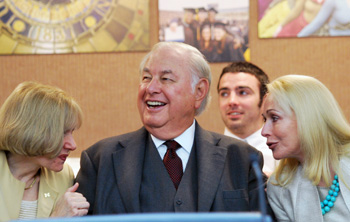
Eva Feldman, Al Taubman, Judy Taubman

Al Taubman, who recently donated $56 million to fund medical research at UM, is flanked by his wife Judy Taubman, right, and Eva Feldman, a UM neurology professor and director of the Taubman Medical Research Institute. Seated behind them is Kellen Russell, who won a national championship in wrestling and was also recognized by regents at their April 21, 2011 meeting. (Photos by the writer.)

The donation – to fund work at UM’s Taubman Medical Research Institute – brought his total gifts for that institute to $100 million, and his total overall UM contributions to more than $141 million. He is the largest individual donor to the university.

In conjunction with this latest gift, regents approved the renaming of the Biomedical Science Research Building – where the institute is housed – in honor of Taubman.

In thanking Taubman, board chair Julia Darlow called his gift transformative, and noted that his name has been “stamped” on the university in many ways – at the Taubman College of Architecture & Urban Planning, the Taubman Gallery at the UM Museum of Art, Taubman Health Care Center, Taubman Health Sciences Library, and the Taubman Scholars program, among others. Though he did not complete a degree, Taubman did study architecture at UM and has been involved with the institution for decades.

The real estate developer, who’s widely credited with popularizing the modern shopping mall, is not without controversy. Taubman maintains his innocence, but the former owner of Sotheby’s auction house served about nine months in federal prison in 2002 for an anti-trust conviction related to a price-fixing scheme with Christie’s, a major competitor. At the time, university officials stood by him in the face of calls to remove his name from UM buildings.

In addition to announcing Taubman’s most recent gift, the regents handled a variety of other items during their April meeting. They unanimously approved an extension of the maximum allowable tenure probationary period to 10 years, and before voting heard from several UM faculty members on both sides of the issue. Regents also approved several million dollars in infrastructure projects, as well as a new degree program in health informatics.

Chris Armstrong, who made national news after being harrassed by a former state assistant attorney general, gave his last report as outgoing student government president and was thanked by university executives for his leadership. Regent Libby Maynard told Armstrong he’d helped all of them grow during the year.

And during the time set aside for public commentary, students and staff raised several issues, including negotiations with the nurses union, campus sustainability efforts, and a proposal to partner with an Israeli university for study abroad. [Full Story]

UM Regents: Report on Space Use

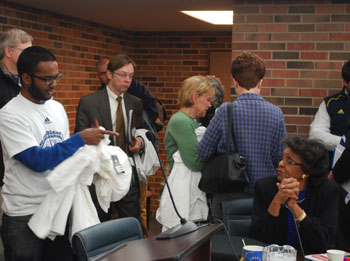
Michigan Student Assembly leaders distribute T-shirts to UM regents and administrators

Michigan Student Assembly president Abhishek Mahanti, far left, points to Royster Harper, UM's vice president for student affairs. MSA leaders distributed "Go Blue – Beat OSU" T-shirts to UM regents and administrators at the Nov. 19 regents meeting. The T-shirts were not effective in ensuring a Michigan victory on Saturday. (Photo by the writer.)

University of Michigan Board of Regents (Nov. 19, 2009): Some media outlets that attended the Nov. 19 regents meeting didn’t get what they came for – namely, comments from UM president Mary Sue Coleman regarding the ongoing NCAA investigation of the university’s football program.

What they heard instead was a report on a five-year initiative to use UM’s physical space more efficiently, including its classrooms and labs. The meeting also included a brief report on the outlook for state funding, discussion of renovations to house the Museum of Zoology’s extensive specimen collection, a question about the band Jazz Pie Music. [Full Story]

City Place Delayed, Downtown Plan OKed

Ann Arbor City Council meeting (June 15, 2009): The council covered a lot of ground at its Monday night meeting, much of it related to streets and transportation. Besides dealing with a raft of garden-variety street closings that generated some unexpected “controversy,” the council put in place a plan to delay the installation of some parking meters in near downtown neighborhoods, launched a safety campaign, and funded a bike path, pedestrian amenities and the city’s portion of a north-south connector feasibility study.

But it wasn’t the bike path that drew more than 20 people to speak at a public hearing. That turnout was for the adoption of the Downtown Plan. It was ultimately adopted as amended by the city’s planning commission so that the D2 buffer in the South University area is a small area in the southeast corner.

The expected vote on the City Place project along Fifth Avenue was delayed again after additional technical errors by planning staff were discovered related to the planning commission’s April meeting. That project will now start over with the planning commission public hearing.

Audience members who waited until the end of the long meeting heard Mayor John Hieftje appoint a subcommittee of councilmembers to meet with the DDA’s “mutually beneficial” committee to discuss the parking agreement between the city and the DDA.  In the discussion after the jump, we provide a record produced in the preliminary response to a Chronicle FOIA, which dates the renegotiation of the parking agreement to as early as September 2008 and connects it to discussions between the mayor and a candidate for the DDA board, Keith Orr, who was eventually appointed to the board.  The record shows that his appointment was not contingent on a commitment to a particular vote on the parking agreement. [Full Story]