


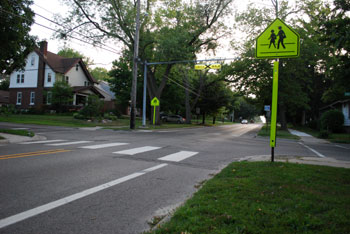
8:10 p.m. I press the button for the HAWK signal and when the Voice tells me to walk, I do. As I finish crossing the street (with 10 seconds or so to spare) I hear the cars behind me start moving. Not for the first time. And I wonder: Is the HAWK sign like a stop SIGN, where a car waiting for the person to cross and then going is the right thing to do? Or is it like a stop LIGHT, where it’s not?
Stories indexed with the term ‘crosswalk’
Fourth & Catherine
Couple makes it across mid-block crosswalk with cars stopping, only to come up against high snow mound.
Ypsi Township on Bus, DDA TIF Settled
Ann Arbor city council meeting (Nov. 18, 2013): The first meeting of the post-election council stretched 6 hours and 45 minutes past its scheduled start time of 7 p.m. It was not until after 1 a.m. that the council considered an agreement to sell a city-owned property north of William Street between Fourth and Fifth avenues in downtown Ann Arbor – to hotelier Dennis Dahlmann for $5.25 million. The council deliberated for about 10 minutes on that issue before taking a unanimous vote to sell.
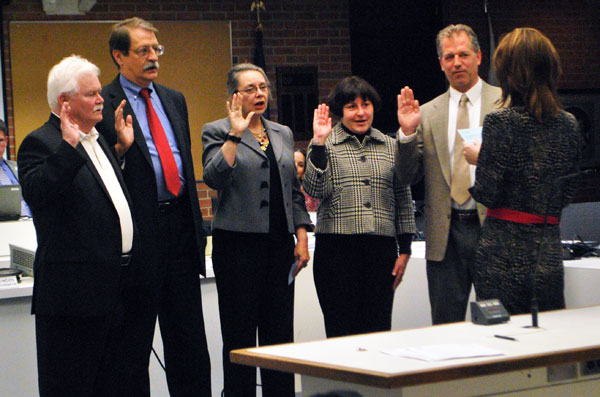
Swearing in of the councilmembers who won election on Nov. 5, 2013. From left: Mike Anglin (Ward 5), Jack Eaton (Ward 4), Sabra Briere (Ward 1), Jane Lumm (Ward 2) and Stephen Kunselman (Ward 3). Administering the oath was city clerk Jackie Beaudry. (Photos by the writer.)
Earlier in the evening, an hour-long chunk of the meeting was taken up by deliberations on the admission of Ypsilanti Township as a member of the Ann Arbor Area Transportation Authority. After an hour of discussion and questioning, the council voted unanimously to approve the addition of the township as a member of the AAATA. The council’s action brought the number of AAATA member jurisdictions to three: the city of Ann Arbor, the city of Ypsilanti, and Ypsilanti Township.
The council also deliberated for almost an hour before giving initial approval to a repeal of the city’s crosswalk law – so that vehicles would have the option of slowing (in addition to stopping) to yield to pedestrians. The repeal also eliminates the explicit need for motorists to yield to pedestrians who are standing at the curb – making motorists responsible for yielding only to those pedestrians who are “within a crosswalk.” The repeal passed on a 9-2 vote, but will need a second vote at a future meeting to be enacted. Back-channel discussion of some kind of compromise approach has unfolded since the meeting, but it’s not clear what, if any, impact that might have.
On an issue related to the crosswalk ordinance change, 40 minutes was spent on council discussion on a pedestrian safety task force – which had been postponed from its Nov. 7 meeting. Ultimately the council voted to establish a nine-person pedestrian safety task force with a charge of delivering a report with recommendations by February 2015. Applications from interested citizens should be turned in to the mayor’s office by Dec. 2, 2013, with the task force members to be appointed on Dec. 16. [.pdf of standard city board and commission task force application]
The council also spent about a half hour deliberating on final approval to a change to the ordinance that regulates the tax increment finance (TIF) capture of the Ann Arbor Downtown Development Authority. The change replaced the restriction in the ordinance originally enacted in 1982 with one that in the next few years will result in about $2 million in additional TIF revenue annually, compared to the amount the DDA would have received under strict enforcement of the 1982 language. Dissenting on that vote were Christopher Taylor (Ward 3) and Margie Teall (Ward 4).
Near the start of the meeting, Teall was selected as mayor pro tem, on a 6-5 vote. The council left its other organizational business – adoption of rules and assignment to committees – until Dec. 2.
The members of the rules committee will have a fresh assignment based on other action of the council on Nov. 18. The council passed a resolution that in part directs the rules committee to develop a set of standards for the conduct of councilmembers, based on “applicable statutes, regulations, existing city policies, and best practices such as Section and 2a of Public Act 196 of 1973 and the Ethics Handbook for Michigan Municipalities.”
Other business handled by the council included the final approval of a revision to the city’s ordinance on park use fees – to allow for a waiver for groups using a public park for the charitable distribution of goods to address basic human needs. Council chambers were filled with supporters of that resolution.
The council also formally adopted an update to the city’s non-motorized transportation plan, after having postponed the item on Nov. 7. And as a part of its consent agenda, the council approved various street closings associated with New Year’s festivities – The Puck Drops Here in downtown Ann Arbor and the National Hockey League’s Winter Classic at Michigan Stadium. [Full Story]
Crosswalk Ordinance Repeal Gets Initial OK
A repeal of the city’s crosswalk ordinance has been given initial approval by the Ann Arbor city council. Action came at the council’s Nov. 18, 2013 meeting on an 8-3 vote. Dissenting were Christopher Taylor (Ward 3), Margie Teall (Ward 4) and mayor John Hieftje. The council will need to vote at a subsequent meeting to give the change final approval.
The city’s ordinance, enacted in 2010 and then revised in 2011, differs from the state’s Uniform Traffic Code (UTC) in two respects: (1) requiring motorists to stop for pedestrians, not just to slow as to yield; and (2) requiring motorists explicitly to take action to accommodate pedestrians standing at the curb at a crosswalk, not just those pedestrians who have … [Full Story]
Nov. 18, 2013 Ann Arbor Council: Live
Editor’s note: This “Live Updates” coverage of the Ann Arbor city council’s Nov. 18, 2013 meeting includes all the material from an earlier preview article. We think that will facilitate easier navigation from live-update material to background material already in the file.
The Nov. 18, 2013 meeting of the Ann Arbor city council is the first one with the new post-election composition of the 11-member council. The one new member of the council is Jack Eaton (Ward 4), who prevailed in the August Democratic primary contested with Marcia Higgins. She concluded 14 years of council service at her final meeting on Nov. 7.
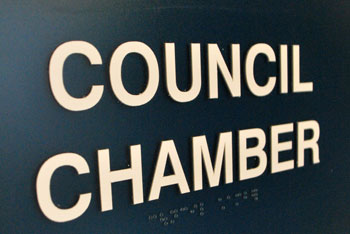
The sign on the door to the Ann Arbor city council chamber, installed in the summer of 2013, includes Braille.
The Nov. 18 meeting will include ceremonial swearing in of all councilmembers who won election on Nov. 5 – including Eaton, Sabra Briere (Ward 1), Jane Lumm (Ward 2), Stephen Kunselman (Ward 3) and Mike Anglin (Ward 5).
Three other items internal to the council organizational configuration appear on the agenda: approval of the 2014 city council rules; appointment of the 2014 city council committees; and election of mayor pro tem, as well as establishing the order of succession for acting mayor.
In recent years, the rules and the committee appointments have been put off until the first meeting in December, with only the election of mayor pro tem taking place at the second meeting in November. Higgins had served as mayor pro tem since 2008.
Speculation among some council sources indicate that Lumm could have sufficient support on the council to win election as mayor pro tem. Mayor pro tem fulfills the duties of mayor when the mayor is out of town or unable to perform those duties. The mayor pro tem’s salary is the same as other councilmembers, which is $15,913. Customarily, the order of mayoral succession has followed seniority on the council, with councilmembers who were elected in the same year sorted alphabetically.
A substantial portion of the council’s Nov. 18 agenda consists of items the council has seen at least once before – some through postponement and others by the nature of the standard approval process. In the standard-process category, the council will be asked to confirm a handful of appointments to boards and commissions that were nominated on Nov. 7.
The council will also consider giving final approval to two ordinance revisions that received initial approval at the council’s Nov. 7 meeting. One of those ordinance revisions involves changing the permitting requirements for use of public parks – so that fees would be waived for organizations that use parks to distribute goods to meet basic human needs.
A second ordinance revision that will be up for final approval on Nov. 18 is a change to the ordinance regulating the Ann Arbor Downtown Development Authority’s tax increment finance capture and board governance.
Although it’s not yet on the online agenda, the council would expect to see a sales agreement for the former Y lot presented for consideration. The council had directed the city administrator to negotiate with Dennis Dahlmann for the sale of the land, based on his $5.25 million offer, and to present a sales agreement for approval on Nov. 18. [See 4:17 p.m. update below]
Several items on the Nov. 18 agenda were postponed from previous meetings. One of those was first seen on Nov. 7 – a resolution sponsored by Sally Petersen (Ward 2), which would direct an educational effort for local officials and the public on conflict of interest and ethics issues.
Several other items postponed from previous meetings are tied together by a transportation theme. The city council will be considering for a second time a revision to the articles of incorporation of the Ann Arbor Area Transportation Authority to admit Ypsilanti Township as a member and to increase the board membership from 9 to 10 members so that the township can appoint a member.
Postponed at the Nov. 7 meeting was the adoption of an update to the city’s non-motorized transportation plan, so the council will have a second look at that plan on Nov. 18.
Also postponed at the Nov. 7 meeting was a resolution to establish a pedestrian safety task force. It’s unclear if that task force will have sufficient traction to be appointed – because it was postponed amid concerns about the budget needed to support the task force’s work. The task force sponsors, Chuck Warpehoski (Ward 5) and Sabra Briere (Ward 1), have indicated their intent is not to make the task force an alternative to repealing the city’s mid-block crosswalk ordinance. [See 3:45 p.m. update below]
The repeal of language in the crosswalk ordinance will get its first reading at the council’s Nov. 18 meeting. The ordinance could be altered so that slowing (not necessarily stopping) would be a legal way to yield to pedestrians within crosswalks. The ordinance would be further changed so that only pedestrians within crosswalks (not those standing at the curb) would need to be accommodated by motorists.
Also related to streets are two resolutions authorizing the closing of streets in connection with New Year’s celebrations – on New Year’s Eve for the Puck Drops Here in downtown Ann Arbor, and on New Year’s Day for the NHL’s Winter Classic hockey game at Michigan Stadium.
The agenda features a few separate resolutions on standard easements and some rezoning requests. One of those rezoning requests is not standard – and was recommended by the planning commission for denial. That’s a request for rezoning a parcel on Packard Road from single-family to two-family.
The council will also be asked to authorize the city’s participation in the Michigan Economic Development Corporation’s Redevelopment Ready Communities Certification Program.
This article includes a more detailed preview of many of these agenda items. More details on other meeting agenda items are available on the city’s online Legistar system. Readers can also follow the live meeting proceedings Monday evening on Channel 16, streamed online by Community Television Network.
The Chronicle will be filing live updates from city council chambers during the meeting, published in this article below the preview material. Click here to skip the preview section and go directly to the live updates. The meeting is scheduled to start at 7 p.m. [Full Story]
Nov. 18, 2013 Ann Arbor City Council: Preview
The Nov. 18, 2013 meeting of the Ann Arbor city council is the first one with the new post-election composition of the 11-member council. The one new member of the council is Jack Eaton (Ward 4), who prevailed in the August Democratic primary contested with Marcia Higgins. She concluded 14 years of council service at her final meeting on Nov. 7.
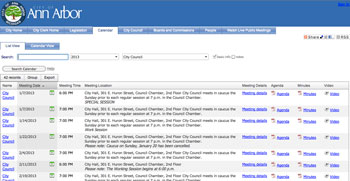
Screenshot of Legistar – the city of Ann Arbor online agenda management system. Image links to the Nov. 18 meeting agenda.
The Nov. 18 meeting will include ceremonial swearing in of all councilmembers who won election on Nov. 5 – including Eaton, Sabra Briere (Ward 1), Jane Lumm (Ward 2), Stephen Kunselman (Ward 3) and Mike Anglin (Ward 5).
Three other items internal to the council organizational configuration appear on the agenda: approval of the 2014 city council rules; appointment of the 2014 city council committees; and election of mayor pro tem, as well as establishing the order of succession for acting mayor.
In recent years, the rules and the committee appointments have been put off until the first meeting in December, with only the election of mayor pro tem taking place at the second meeting in November. Higgins had served as mayor pro tem since 2008.
Speculation among some council sources indicate that Lumm could have sufficient support on the council to win election as mayor pro tem. Mayor pro tem fulfills the duties of mayor when the mayor is out of town or unable to perform those duties. The mayor pro tem’s salary is the same as other councilmembers, which is $15,913. Customarily, the order of mayoral succession has followed seniority on the council, with councilmembers who were elected in the same year sorted alphabetically.
A substantial portion of the council’s Nov. 18 agenda consists of items the council has seen at least once before – some through postponement and others by the nature of the standard approval process. In the standard-process category, the council will be asked to confirm a handful of appointments to boards and commissions that were nominated on Nov. 7.
The council will also consider giving final approval to two ordinance revisions that received initial approval at the council’s Nov. 7 meeting. One of those ordinance revisions involves changing the permitting requirements for use of public parks – so that fees would be waived for organizations that use parks to distribute goods to meet basic human needs.
A second ordinance revision that will be up for final approval on Nov. 18 is a change to the ordinance regulating the Ann Arbor Downtown Development Authority’s tax increment finance capture and board governance.
Although it’s not yet on the online agenda, the council would expect to see a sales agreement for the former Y lot presented for consideration. The council had directed the city administrator to negotiate with Dennis Dahlmann for the sale of the land, based on his $5.25 million offer, and to present a sales agreement for approval on Nov. 18.
Several items on the Nov. 18 agenda were postponed from previous meetings. One of those was first seen on Nov. 7 – a resolution sponsored by Sally Petersen (Ward 2), which would direct an educational effort for local officials and the public on conflict of interest and ethics issues.
Several other items postponed from previous meetings are tied together by a transportation theme. The city council will be considering for a second time a revision to the articles of incorporation of the Ann Arbor Area Transportation Authority to admit Ypsilanti Township as a member and to increase the board membership from 9 to 10 members so that the township can appoint a member.
Postponed at the Nov. 7 meeting was the adoption of an update to the city’s non-motorized transportation plan, so the council will have a second look at that plan on Nov. 18.
Also postponed at the Nov. 7 meeting was a resolution to establish a pedestrian safety task force. It’s unclear if that task force will have sufficient traction to be appointed – because it was postponed amid concerns about the budget needed to support the task force’s work. The task force sponsors, Chuck Warpehoski (Ward 5) and Sabra Briere (Ward 1), have indicated their intent is not to make the task force an alternative to repealing the city’s mid-block crosswalk ordinance.
The repeal of language in the crosswalk ordinance will get its first reading at the council’s Nov. 18 meeting. The ordinance could be altered so that slowing (not necessarily stopping) would be a legal way to yield to pedestrians within crosswalks. The ordinance would be further changed so that only pedestrians within crosswalks (not those standing at the curb) would need to be accommodated by motorists.
Also related to streets are two resolutions authorizing the closing of streets in connection with New Year’s celebrations – on New Year’s Eve for the Puck Drops Here in downtown Ann Arbor, and on New Year’s Day for the NHL’s Winter Classic hockey game at Michigan Stadium.
The agenda features a few separate resolutions on standard easements and some rezoning requests. One of those rezoning requests is not standard – and was recommended by the planning commission for denial. That’s a request for rezoning a parcel on Packard Road from single-family to two-family.
The council will also be asked to authorize the city’s participation in the Michigan Economic Development Corporation’s Redevelopment Ready Communities Certification Program.
This article includes a more detailed preview of many of these agenda items. More details on other agenda items are available on the city’s online Legistar system. The meeting proceedings can be followed Monday evening live on Channel 16, streamed online by Community Television Network. [Full Story]
Council Delays on Ped Safety Task Force
A resolution that would establish a pedestrian safety task force has been postponed by the Ann Arbor city council in action taken on Nov. 7, 2013. The council will take up the issue again at its Nov. 18 meeting.
Leading to the decision to postpone were concerns about the budget that would need to be approved in order to provide the necessary staff support for the task force. The vote to postpone was unanimous.
The pedestrian safety and access task force would consist of nine residents, including “representatives from organizations that address the needs of school-aged youth, senior citizens, pedestrian safety, and people with mobility impairments.” Applications from interested citizens should be turned in to the mayor’s office by Nov. 22, 2013. … [Full Story]
Nov. 7, 2013 City Council: Live Updates
Editor’s note: This “Live Updates” coverage of the Ann Arbor city council’s Nov. 7, 2013 meeting includes all the material from an earlier preview article. We think that will facilitate easier navigation from live-update material to background material already in the file.
The sign on the door to the Ann Arbor city council chamber, installed in the summer of 2013, includes Braille.
The Thursday meeting, shifted from its usual Monday slot due to the Tuesday elections, is the last one with the current composition of the 11-member council. The outcome of Tuesday’s elections left all incumbents in place except for Marcia Higgins (Ward 4), whose departure was decided in the August Democratic primary. Ward 4 primary winner Jack Eaton will be the single new face on the council at its Nov. 18 meeting. At the Nov. 7 meeting, Higgins will likely receive a customary parting gift from her colleagues, to acknowledge her 14 years of service on the council.
The agenda is relatively heavy, featuring at least 34 voting items. This preview includes a more detailed explanation of several of those items, but first provides a thematic overview.
The city’s downtown factors prominently on the agenda in at least three ways. The city council will be asked to consider passing a resolution to direct the city administrator to negotiate a sales agreement for the city-owned property along William Street between Fourth and Fifth avenues, known as the old Y lot. The council will also be considering a revision to the city ordinance regulating the tax increment finance (TIF) capture of the Ann Arbor Downtown Development Authority. That’s been on the agenda since February, but now a committee of councilmembers and DDA board members has put forth a competing recommendation, which will also be on the Nov. 7 agenda.
Also related to downtown, the council will be formally accepting a report completed by the city’s park advisory commission with recommendations related to downtown parks.
Non-motorized issues also factor prominently as a theme of the Nov. 7 agenda. In addition to an update of the city’s non-motorized transportation plan, the council will consider establishing a pedestrian safety task force. The council’s agenda also includes the first of a series of resolutions for two separate sidewalk projects – one on Stone School Road and another on Scio Church Road. The council’s resolutions for those projects, directing the design work and detailed cost estimates, are the first actions necessary for some of the funding of the sidewalks to be special assessed to the adjacent property owners.
An additional project related to non-motorized issues, but not obviously so, is a contract with the Michigan Dept. of Transportation to resurface a portion of Huron Street from Main Street westward as Huron becomes Jackson Avenue on to I-94, as well as a section of South Maple. The intent is to re-stripe the roadway, reducing the lanes from four to three and adding bicycle lanes.
The sidewalk and street projects are among several capital improvement-related items on the agenda, including one that would help stabilize the earthen berm adjacent to Barton Dam. The council will also be considering a half dozen resolutions that will authorize applying for state grants that could fund capital asset projects for the city.
In addition to the items related to the city’s physical infrastructure, the council has several items that could be described as relating to the city’s social infrastructure. Those items relate to grants from the state and federal government to the 15th District Court for several of its specialty courts that focus on drug offenses, domestic violence, and veterans issues. The council will also be asked to approve a modified continuation of its coordinated funding approach to human services.
The agenda includes some council initiatives announced at the council’s previous meeting on Oct. 21. One of those is a resolution requesting that the University of Michigan decommission a recently constructed digital billboard near the football stadium.
Another one is a resolution directing the education of city officials on professional conduct. Related tangentially to those ethical considerations are the approvals of new bylaws for two of the city’s boards and commissions – the planning commission and the design review board.
This article includes a more detailed preview of many of these agenda items. More details on other meeting agenda items are available on the city’s online Legistar system. Readers can also follow the live meeting proceedings Thursday evening on Channel 16, streamed online by Community Television Network.
The Chronicle will be filing live updates from city council chambers during the meeting, published in this article below the preview material. Click here to skip the preview section and go directly to the live updates. The meeting is scheduled to start at 7 p.m. [Full Story]
Nov. 7, 2013 Ann Arbor City Council: Preview
The Nov. 7, 2013 meeting of the Ann Arbor city council is the last one with the current composition of the 11-member council. The agenda is relatively heavy, featuring at least 34 voting items. This preview includes a more detailed explanation of several of those items, but first provides a thematic overview.
Screenshot of Legistar – the city of Ann Arbor online agenda management system. Image links to the Nov. 7 meeting agenda.
The city’s downtown factors prominently on the agenda in at least three ways. The city council will be asked to consider passing a resolution to direct the city administrator to negotiate a sales agreement for the city-owned property on William Street between Fourth and Fifth avenues, known as the old Y lot. The council will also be considering a revision to the city ordinance regulating the tax increment finance (TIF) capture of the Ann Arbor Downtown Development Authority. That’s been under consideration by the council since February, but now a committee of councilmembers and DDA board members has put forward a competing recommendation, which will also be on the Nov. 7 agenda.
Also related to downtown, the council will be formally accepting a report completed by the city’s park advisory commission with recommendations on downtown parks.
Non-motorized issues also factor prominently as a theme of the Nov. 7 agenda. In addition to an update of the city’s non-motorized transportation plan, the council will consider establishing a pedestrian safety task force. The council’s agenda also includes the first of a series of resolutions for two separate sidewalk projects – one on Stone School Road and another on Scio Church Road. The council’s resolutions for those projects, directing the design work and detailed cost estimates, are the first actions necessary for some of the funding of the sidewalks to be special assessed to the adjacent property owners.
An additional project related to non-motorized issues, but not obviously so, is a contract with the Michigan Dept. of Transportation to resurface a portion of Huron Street from Main Street westward as Huron becomes Jackson Avenue on to I-94, as well as a section of South Maple. The intent is to re-stripe the roadway, reducing the lanes from four to three and adding bicycle lanes.
The sidewalk and street projects are among several capital improvement-related items on the agenda, including one that would help stabilize the earthen berm adjacent to Barton Dam. The council will also be considering a half dozen resolutions that will authorize applying for state grants that could fund capital asset projects for the city.
In addition to the items related to the city’s physical infrastructure, the council has several items that could be described as relating to the city’s social infrastructure. Those items relate to grants from the state and federal government to the 15th District Court for several of its specialty courts that focus on drug offenses, domestic violence, and veterans issues. The council will also be asked to approve a modified continuation of its coordinated funding approach to human services.
The agenda includes some council initiatives announced at the council’s previous meeting on Oct. 21. One of those is a resolution requesting that the University of Michigan decommission a recently constructed digital billboard near the football stadium.
Another one is a resolution directing the education of city officials on professional conduct. Related tangentially to those ethical considerations are the approvals of new bylaws for two of the city’s boards and commissions – the planning commission and the design review board.
This article includes a more detailed preview of many of these agenda items. More details on other meeting agenda items are available on the city’s online Legistar system. The meeting proceedings can be followed live Thursday evening on Channel 16, streamed online by Community Television Network. [Full Story]
Design Budget for Sidewalk near King School OK’d
A $10,000 design budget for a sidewalk – to fill in a gap from the northeast corner of Penberton Court and Waldenwood northward – to connect to a path leading the rest of the way to the King Elementary School has received approval. The Ann Arbor city council took the action at its Aug. 8, 2013 meeting.
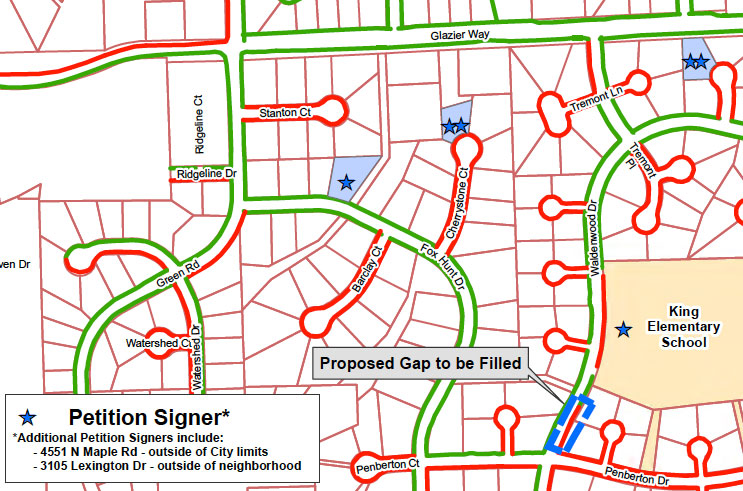 Waldenwood sidewalk gap. Green … [Full Story]
Washtenaw & Platt
Finally installing a traffic signal near the crosswalk where I saw a three-car accident yesterday.
Main Street
City attorney taking down license of car that almost hit him in zebra crossing on Main Street.
Ann Arbor Adds Flashers, Alters Traffic Law
Ann Arbor city council meeting (Dec. 19, 2011): At its last meeting of the year, the council ended the current round of discussion on the city’s pedestrian safety ordinance by finalizing changes that clarified conditions under which vehicles are required to stop for people who are trying to cross the street.
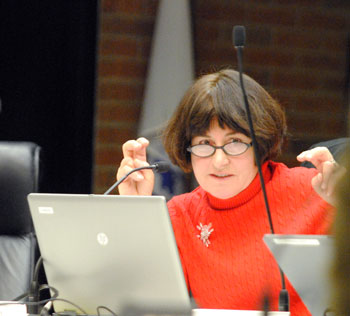
Jane Lumm (Ward 2) made air quotes around the word "approaching" as the council discussed the city's ordinance on crosswalks. (Photos by the writer.)
The current ordinance amendment maintains an existing requirement that motorists accommodate not just pedestrians who are “within” a crosswalk, but also those who are verging on entering a crosswalk. What’s different is the way the concept is expressed. In July 2010, the council chose to describe pedestrians who are about to enter a crosswalk as “approaching” the crosswalk. The version of the ordinance finalized on Dec. 19 requires motorists to accommodate “… a pedestrian stopped at the curb, curb line or ramp leading to a crosswalk and to every pedestrian within a crosswalk …”
As part of the previous amendments made in 2010, the council also had removed language that specified a half of the roadway where drivers needed to accommodate pedestrians. This time around, the council restored similar language, which reads, “… when the pedestrian is on the half of the roadway on which the vehicle is traveling or when the pedestrian is approaching so closely from the opposite half of the roadway as to be in danger.”
In other crosswalk-related business, the council approved an expenditure of $81,000 to install five rectangular rapid flashing beacons (RRFB) on existing pedestrian islands in the city. Four of the locations are along Plymouth Road, at Georgetown, Traver Village, Beal and Bishop. The fifth location is at Seventh and Washington.
Also at the Dec. 19 meeting, the council ended a long process of review by the city and negotiation with neighbors by approving a change to the zoning of the Hoover Mansion property on Washtenaw Avenue, which University Bank uses as its headquarters. The change will allow University Bank to build 13 new parking spaces on the east side – behind the main building, allowing the bank in accommodate expanded employment.
Towards the end of the council’s meeting, a relatively rare debate unfolded about a mayoral nomination to a city board. At issue was the nomination of a city employee – transportation program manager Eli Cooper – to the board of the Ann Arbor Transportation Authority. He’s replacing another city employee on the board, public services area administrator Sue McCormick, who left her position with the city in mid-December. In the end, Cooper’s nomination was confirmed with dissent from two councilmembers. A separate vote on a general policy opposing nominations of city employees to boards and commissions received only four votes of support.
The council considered two compensation-related issues – one for its city attorney, Stephen Postema, and another for election workers who staff the polls. After a closed session to discuss Postema’s performance review, the council voted with dissent from one councilmember to award Postema the ability to cash out 250 hours of banked time. The council delayed its vote on pay increases for election workers, on the possibility that their pay could be increased more than what’s proposed, to match the amount specified in the city’s living wage ordinance.
In other business, the council approved a bond re-funding, authorized reimbursement for a broken electromagnet at the materials recovery facility, accepted additional federal money for solar projects, and heard about a possible strategy for addressing vacant and dilapidated properties. [Full Story]
DDA Wraps Up Parking Rate Hearing, Audit
Ann Arbor Downtown Development Authority board meeting (Dec. 7, 2011): At its last monthly meeting of the year, the DDA board continued a public hearing on proposed parking rate changes that it had begun at its November meeting. Only two people appeared for the continued hearing on Wednesday – nine people had addressed the board for its Nov. 2, 2011 meeting.

Front to back: Ann Arbor Downtown Development Authority board members Nader Nassif, Leah Gunn, John Hieftje. (Photos by the writer.)
The board will not vote on the rate increases until its Jan. 4, 2012 meeting. Some of the rate changes are scheduled for implementation in February 2012, but the increases affecting most downtown Ann Arbor parkers would not be implemented until September 2012. The September changes include an increase from $1.40 to $1.50 per hour for on-street metered spaces and an increase from $1.10 to $1.20 per hour for spaces in parking structures.
Some insight into the DDA’s interest in raising parking rates can be found in the DDA’s finances, as reflected in its annual audit. Acceptance of its annual audit report was the one action item on the agenda for Wednesday’s meeting. The board voted to accept its audit report done by the firm Abraham & Gaffney, P.C. for the fiscal year ending June 30, 2011.
Auditor Alan Panter had presented the report to a subset of DDA board members at a Nov. 30 meeting of the DDA’s operations committee.
The report notes an instance of expenditures exceeding the amount of funds appropriated that is inconsistent with Michigan’s Uniform Budgeting and Accounting Act (UBAA) of 1968. At Wednesday’s meeting, DDA board members characterized it as a “technical violation.” At the operations committee meeting, the $337,478 overage was attributed by DDA staff to the submission of a bill forwarded to the DDA in June by its construction management consultant (Park Avenue Consultants Inc.) – connected to the underground parking garage and streetscape improvement projects currently under construction.
For the fiscal year 2011, the DDA showed $18,806,765 in revenues against $20,796,665 in expenses, drawing $1,989,900 from the fund balance reserve. The planned draw on fund balance is related to the underground parking garage construction payments as well as a new contract, signed this year, under which the DDA operates the city’s public parking system. That contract assigns 17% of gross parking revenues to the city of Ann Arbor. At the Nov. 30 committee meeting, DDA board member Newcombe Clark was keen to confirm the inclusion of the new contract as a note in the audit.
In his presentation to the operations committee on Nov. 30, Panter highlighted the fund balance reserve for the parking fund as a concern, saying that the fund was near deficit – it shows a fund balance reserve of less than 1% of operating expenses. A recommended fund balance level, said Panter, is 15-20%.
Another still outstanding issue for the DDA’s finances is the correct interpretation of the city’s ordinance (Chapter 7) specifying how the DDA tax increment finance (TIF) capture works. At Wednesday’s meeting, the board held its third closed session on the topic since July, to discuss the written opinion of its legal counsel on the issue. Taxing authorities that have their taxes captured under the Ann Arbor DDA TIF district have questioned the DDA’s legal position – the DDA contends that Chapter 7 does not place limits on its TIF capture. Depending on how the issue is resolved, it could mean as much as $600,000 less per year in TIF capture, compared with the budget planning the DDA is currently doing.
Also at the Dec. 7 meeting, during the opportunity for public commentary, the DDA board heard from Jim Kosteva –University of Michigan director of community relations – about a request to eliminate two on-street parking spaces on Monroe Street. With the imminent opening of the newly constructed South Hall, on the south side of Monroe, it’s anticipated that students will attempt to cross mid-block. The elimination of the parking spaces would be intended to make students who are crossing mid-block more visible to motorists. Based on the verbal exchange with Kosteva at the podium, it appears possible, but not guaranteed, that some kind of arrangement could be reached before the start of the next semester. [Full Story]
Council Takes Step to Alter Pedestrian Law
Ann Arbor city council meeting (Nov. 10, 2011): A further revision to the city’s pedestrian safety ordinance took up most of the council’s time at Thursday’s meeting.
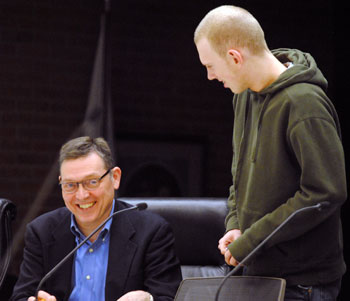
Stephen Rapundalo (Ward 2) was first to arrive at the council’s meeting and was rewarded by a dozen or so requests from high school students who needed a signature to attest to their attendance for a class assignment. It was Rapundalo’s last meeting, having lost the Ward 2 election on Tuesday, Nov. 8, to Jane Lumm. (Photos by the writer.)
The council had made several revisions to the law in 2010, including a requirement that motorists accommodate not only pedestrians who are “within” a crosswalk, but also those who are “approaching” a crosswalk. Thursday’s initial revision amended out the “approaching” language in favor of the following wording: “… the driver of a vehicle shall stop before entering a crosswalk and yield the right-of-way to a pedestrian stopped at the curb or ramp leading to a crosswalk and to every pedestrian within a crosswalk.”
The second and final vote on the pedestrian ordinance change is expected to come after a council working session in December, and after a public hearing at the council meeting when the final vote is taken. Based on deliberations on the change at Thursday’s meeting, the outcome of that vote is not a foregone conclusion, and further revisions might be possible.
The council also took action at the Nov. 10 meeting that will allow two downtown residential projects to start construction. The council approved the site plan for The Varsity Ann Arbor, a “planned project” consisting of a 13-story apartment building with 181 units at 425 E. Washington, between 411 Lofts and the First Baptist Church.
And the final deal was approved with Village Green to purchase the city-owned parcel at First and Washington. On that site Village Green will build a 244-space parking deck as the first two stories of a 9-story building with 156 dwelling units – City Apartments.
The council gave final approval to a change in its taxicab ordinance, spelling out conditions under which licenses can be revoked or suspended.
The council also gave final approval to two ordinances that make retiree health care and pension benefits for two of the city’s larger unions parallel to benefits for non-union employees. The approvals gave Stephen Rapundalo (Ward 2) an opportunity to comment on the labor issues that had been a centerpiece of his re-election campaign, which concluded unsuccessfully on Tuesday.
It was due to the election held on Tuesday that the council’s meeting was shifted from its regular Monday meeting slot to Thursday. The shift is stipulated in the city charter. All council incumbents won their races except for Rapundalo, a Democrat defeated by Jane Lumm, who was running as an independent. Rapundalo began his final meeting by signing multiple attendance sheets for high school students who were attending the meeting on a class assignment, and ended it by hearing praise from his colleagues around the table. [Full Story]
Pleas for Human, Safety Services at Council
Ann Arbor City Council meeting (May 3, 2010): Several speakers addressed the city council at its Monday meeting asking for continued funding for human services and to avoid layoffs in the city’s police and fire departments.
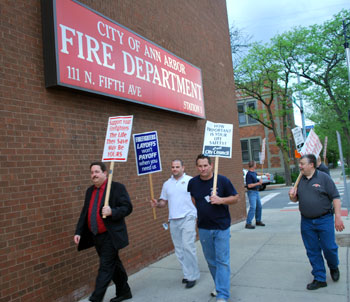
Firefighters held an informational demonstration Monday afternoon before the city council's meeting at Station 1, which is located across the street from city hall. Firefighters from Flint, Dearborn, Dearborn Heights, Ann Arbor Township, Ypsilanti, Battle Creek and Ann Arbor took part in the demonstration. (Photos by the writer.)
And Margie Teall (Ward 4), who faces two challengers in the August Democratic primary, announced a planned amendment to the city’s proposed budget that would maintain human services funding at FY 2010 levels. The amendment, which will be brought forward at the council’s May 17 meeting, would also avert as many layoffs in the police and fire departments as possible, she said.
The previous evening at the council’s Sunday night caucus, Mike Anglin (Ward 5) and Sabra Briere (Ward 1) had already indicated they would support using part of a possible $2 million payment from the Downtown Development Authority to avoid police and firefighter layoffs.
The council’s plan for funding the amendment, reported Teall, is to use a $2 million payment from the Downtown Development Authority that it hopes the DDA board will approve at its May 5 board meeting. Even if the DDA board approves the payment, which is very likely but not certain, not all safety services layoffs in the city administrator’s proposed budget could be covered. Averting the elimination of 35 positions across police and fire departments combined would require $3.6 million. The restoration of human services funding would require another $260,000. And that would still result in the city tapping its general fund reserves for $1.5 million.
In its business for the evening, the council passed a resolution added late Monday to the council agenda, which strikes an agreement between the city and the Michigan Dept. of Natural Resources and Environment for the future of the embankment along Argo Dam. It will allow the headrace to be re-opened by the end of this week.
The council also approved on first reading a revision to the city’s sidewalk occupancy permit system to include sandwich board signs. And the residential development now called Heritage Row – proposed along Fifth Avenue south of William Street – was approved at the council’s first reading with no discussion, but with dissent from Mike Anglin. Both of those measures will need to come back before the council for a second reading to gain approval.
The council also approved received the mayor’s nomination of the appointment of Anya Dale to the AATA board, replacing Paul Ajegba, whose term expired on May 1. Ajegba had been elected by his colleagues last fall to chair the board. Dale is a Washtenaw County planner. Her appointment will be presented for confirmation at the council’s May 17, 2010 meeting.
The council also approved some additional road closures for the June 6 Dexter-Ann Arbor Run. [Full Story]
Investments: Housing, Bridges, Transit
Ann Arbor City Council meeting (April 19, 2010) Part 2: In Part 1 of this meeting report, we focused on the city’s budget process, parking issues and the University of Michigan commencement exercises.
In Part 2, we wrap up other topics of the meeting. One common theme was capital investments in the community’s physical infrastructure of various kinds.
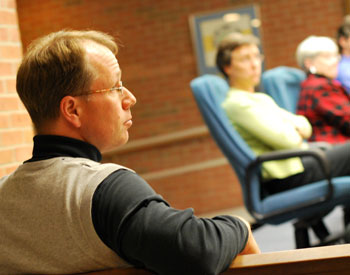
Michael Nearing, city of Ann Arbor engineer, was available for any city council questions on the East Stadium bridge project. (Photo by the writer.)
The council allocated a total of $313,000 for three different permanent affordable housing projects in Ann Arbor.
The city’s East Stadium bridge replacement project received discussion in the form of a resolution that authorized the city to go after state funding for the third time in the last three years. The anticipated construction start for fall of this year has been postponed until spring 2011 – the earlier date had been tied to the city’s application for federal funding, which was rejected this February.
The ongoing construction of the police/courts building, directly adjacent to city hall (the Larcom Building), received some tangential discussion in the form of an explanation from Roger Fraser about the recent closure of city hall due to elevated carbon monoxide levels. The police/courts building was also the subject of public commentary that prompted some extended remarks from the mayor – which were covered in Part 1 of this report.
Another construction project that will likely factor into the upcoming primary election campaigns is Fuller Road Station. The city-university collaboration to build a combined parking deck and bus station, which might eventually serve as a commuter rail station, was taken up during the council’s communications time. Christopher Taylor (Ward 3) and mayor John Hieftje both responded to some cautionary remarks made by Mike Anglin (Ward 5), which he made based on a recent park advisory commission meeting.
In business related to ethics and rules, the council voted on two occasions to excuse the participation of Taylor in a vote, because of a conflict of interest posed by his employment with the law firm Butzel Long. They also satisfied the requirement of a recent lawsuit settlement that they formally consider a rule about their use of government email accounts – by voting to remand consideration of the issue to council’s rules committee. [Full Story]
Council and Caucus: Pedestrian Agenda
The crosswalk on Liberty Street, looking west at Crest. (Photo by the writer.)
Ann Arbor City Council Sunday caucus (Aug. 16, 2009): Sunday evening’s lightly attended city council caucus reflected a light agenda for Monday. But light as that agenda is, it had not been published in the newspaper – as one caucus attendee pointed out to the three councilmembers present: Mayor John Hieftje, Sabra Briere (Ward 1) and Mike Anglin (Ward 5).
Even though the agenda itself is dominated with items like perfunctory rezoning – pedestrian in the sense of “ordinary” – there’s a presentation to be made at the start of the meeting by Sue McCormick, director of public services for the city, that should draw some community interest. She’ll be giving council an update on the East Stadium Bridge situation. The bridge needs to be repaired or replaced.
At caucus, then, residents and councilmembers were free to focus on some items not on Monday’s schedule. And one common theme cutting across two different resident concerns as well as council discussion were pedestrian issues – pedestrian in the sense of folks on foot.
In other brief discussion, councilmembers indicated, in response to a question, that they had not contemplated re-voting the issuance of bonds that would fund the underground parking garage. The legality of the council’s February vote authorizing the bonds has been challenged by a lawsuit filed last week, which contends that the council violated Michigan’s Open Meetings Act on the evening it approved the bonds.
Also at caucus, councilmembers gave a public indication that they were contemplating possible council rules changes that would affect how email communications are handled during council meetings. [Full Story]