Stories indexed with the term ‘density’

No Consensus on Residential Zoning Changes

A committee that’s worked for a year and a half to develop recommendations for zoning changes in Ann Arbor’s near-downtown residential neighborhoods has been unable to reach agreement. So it’s now likely that the city’s planning commission will weigh in on the controversial issue. The outcome of changes – if approved by the city council – could affect the density of residential development in the city.

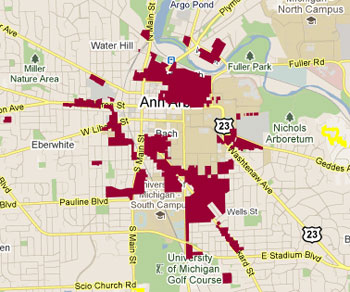
R4C City of Ann Arbor Zoning

The dark red areas are those areas zoned R4C in the city of Ann Arbor. (Image links to Google Map)

At a recent working session, planning commissioners were briefed on a draft report from the R4C/R2A advisory committee, which has been meeting since December 2009. Both kinds of zoning district were established in the 1960s: R4C allows for multiple-family residential dwellings, such as apartment buildings, while R2A zoning limits density to two-family residential structures. The committee was unable to reach consensus on its recommendations, nearly all of which relate to the R4C districts.

At the June 14 planning commission working session, two commissioners who serve on the committee – Jean Carlberg and Tony Derezinski – expressed frustration at the outcome. The draft recommendations don’t provide any guidance about where the city might encourage greater density, Carlberg said.

Derezinski, who is the city council’s representative to the planning commission, added that many committee members worked hard, but were interested in protecting what they’re used to, especially concerning density and parking in their neighborhoods. As it stands, he said, the report won’t be helpful to the city council. Derezinski supported the idea of having the planning commission study the issue and make its own recommendations.

Commissioner Evan Pratt suggested that the first question to ask is whether there should be greater density, and where – the answer to that would guide the recommendations.

In a follow-up phone interview with The Chronicle, Wendy Rampson – the city’s planning manager, who also attended the working session – said there are several possibilities that planning commissioners might pursue. They could discuss the report at one of their regular meetings and make their own recommendations or comments about it. Those recommendations and comments could be made either informally – communicated to the council via Derezinski – or through a formal resolution or memorandum.

Another option would be for the commission’s ordinance revisions committee to tackle it first, developing specific ordinance language that the full commission could then review and possibly recommend to the city council. Or commissioners could ask to hold a joint session with the council, she said, to talk through these issues directly.

Regardless of how the planning commission proceeds, Carlberg will no longer be at the table. The June 14 working session was her last meeting as a commissioner. Her term ends on June 30, and she did not seek reappointment. The former city councilmember served 16 years on the planning commission, overlapping with her 12 years (1994-2006) as a Democrat representing Ward 3 on the council. Eleanore Adenekan was nominated during the council’s June 20 meeting as a replacement for Carlberg – her nomination is expected to be confirmed at the council’s July 5 meeting. [Full Story]

Approval Postponed on Arbor Hills Crossing

Ann Arbor planning commission meeting (June 7, 2011): The main action item on the planning commission’s agenda was a resolution to approve the site plan for Arbor Hills Crossing, a proposed retail and office complex at Platt and Washtenaw.

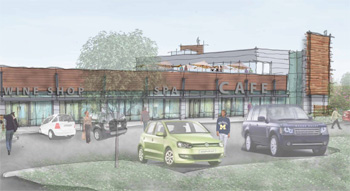
A rendering of Arbor Hills Crossing at Platt and Washtenaw

A rendering of one of four buildings planned at Arbor Hills Crossing, located on the southeast corner of Platt and Washtenaw. This view is looking northwest from the center of the site. (Image by ReFORM Studios)

The project involves tearing down several vacant structures and putting up four one- and two-story buildings throughout the 7.45-acre site – a total of 90,700-square-feet of space for retail stores and offices. Three of the buildings would face Washtenaw Avenue, across the street from the retail complex where Whole Foods grocery is located. The site is also directly north of the new location for Summers-Knoll School. Planning commissioners had approved the Summers-Knoll project at their May 17 meeting.

Comments from commissioners about Arbor Hills Crossing ranged from disappointment in the lack of density to concerns about pedestrian safety. Commissioners generally expressed the sense that they were glad to see the site developed.

Citing some outstanding issues, planning staff recommended postponing action on the plan. Several commissioners raised other issues they’d like to see addressed before the site plans come back to the commission for approval. Among those issues: future plans for bike lanes along Washtenaw Avenue, as identified in the city’s non-motorized transportation plan; and possible pedestrian access to a wetland area. The vote to pospone was unanimous.

Later in the meeting, planning manager Wendy Rampson got feedback on a draft memo to Pittsfield Township, providing input from the commission on the township’s draft master plan. In part, the memo states an objection to the township’s description of itself as “providing an Ann Arbor mailing address while placing a much lower tax burden on businesses.” The memo points out that the plan could be improved by emphasizing regional cooperation. [Full Story]

AHP Zoning Revisions Go to City Council

Ann Arbor Planning Commission meeting (July 8, 2010):  The 4th of July holiday caused some reshuffling of city meeting times and locations, and sent planning commissioners to the Ann Arbor District Library on Thursday night to conduct their business.

Wendy Rampson, Eric Mahler

Wendy Rampson, head of the city's planning staff, and Eric Mahler, newly elected chair of the Ann Arbor planning commission, at the commission's July 8, 2010 meeting. (Photos by the writer.)

That business included approval of revised area, height and placement (AHP) standards that have been under review for more than two years. The revisions have pulled back from some of the original proposals – for example, there’s no longer an uncapped building height in certain districts. It’s the first significant overhaul of these standards in roughly 50 years, with the goal of reflecting prevailing community values. The recommendations will now be forwarded to city council for final approval.

The planning commission also voted to postpone action on a project at the Kroger on South Maple. The grocery is adding a drive-thru pharmacy, and needs city approval to reconfigure its parking lot to accommodate the drive-thru lane. A few unresolved issues led commissioners to push back consideration until their July 20 meeting.

And the commission elected a new slate of officers, with local attorney Eric Mahler replacing architect Bonnie Bona as chair. [Full Story]

Moving Ahead on Zaragon Place 2

Ann Arbor Planning Commission meeting (June 15, 2010): With only minor suggestions from planning commissioners, the 14-story Zaragon Place 2 apartment complex was unanimously approved by the commission, and will next be considered by the city council, likely at one of their August meetings.

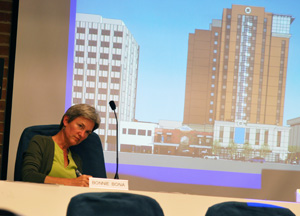
Bonnie Bona

Bonnie Bona, chair of Ann Arbor's city planning commission, listens to a presentation about Zaragon Place 2. A rendering of the proposed project is on the screen in the background, viewed from the William Street perspective. (Photos by the writer.)

The project – to be located at the southeast corner of William and Thompson, next to Cottage Inn restaurant – drew support from two representatives of neighboring businesses, who said they were eager for new residents to arrive as potential customers. The site has been vacant and considered blighted for more than a decade.

Unlike recent proposals for two other residential developments – Heritage Row and The Moravian – Zaragon Place 2 does not require special zoning and has not faced opposition from neighborhood groups.

Some of the discussion by commissioners centered on the 40 parking spaces to be provided within the structure, as well as 40 spaces for bikes in a secured storage room. The ground level will include retail space fronting William. Also as part of the project, the city’s parks unit is asking the developer for $48,000 to help pay for new parks in the area, or to enhance existing parks.

In other business, the commission approved a special exemption use for Big Shot Fireworks to set up a tent in front of the Quarter Bistro, in the Westgate Shopping Center. Commissioners were schooled in fireworks-related legislation – anything that spins, explodes or leaves the ground can’t be sold in Michigan to the general public.

And a rezoning of a previously unzoned parcel on Jackson Avenue – site of the former Barnard Plating factory, next to Hillside Terrace Retirement Center – passed without discussion.

Finally, the commission discussed and passed a resolution that more formally outlines their plan to work with the city’s environmental and energy commissions toward the goal of building a sustainable Ann Arbor. It’s the outgrowth of a joint meeting the three commissions held in April, and was characterized by planning commission chair Bonnie Bona as the beginning of a community conversation about sustainability. [Full Story]

Six-Vote Majority Leaves The Moravian Short

Ann Arbor City Council meeting (April 5, 2010) Part 1: In a six-to-four vote on Monday night, the Ann Arbor city council did not give The Moravian development the required 8-vote super-majority it needed for approval. A petition signed by greater than 20% of adjoining property owners meant that the project needed eight instead of the six votes it actually received to win the council’s endorsement.

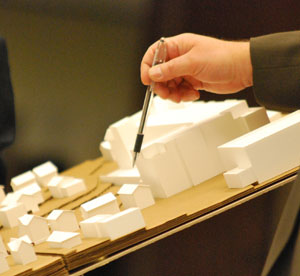
The pen of Tom Luczak

On an architect's scale model of the neighborhood, Tom Luczak points to a house on Fourth Avenue, next to the proposed project, The Moravian. The view is roughly from the northwest. Luczak spoke in opposition to the project. (Photos by the writer.)

The five-story, 62-unit building proposed for the section of East Madison Street between Fourth and Fifth avenues near downtown Ann Arbor had come before the council with the recommendation of the city’s planning staff and a 7-1 vote recommendation from the city’s planning commission.

The public hearing on The Moravian included remarks from around 90 people on both sides of the issue. The Moravian alone – counting the public hearing, plus the deliberations by the council – took up over four hours of the meeting, which lasted well past 1 a.m.

Besides The Moravian, the council’s business included an item that would have reconsidered its recent decision to replace the entire Ann Arbor housing commission board. The motion for reconsideration was voted down, with no support, not even from its two sponsors – Stephen Kunselman (Ward 3) and Mike Anglin (Ward 5). Kunselman cited the late hour as part of the reason for his lack of enthusiasm for pursuing the matter.

The council also tabled a proposed city ordinance that would ban cell phone use while driving. The council had postponed the measure to a specific date a few times previously. The tabling means that the ordinance can be brought back for consideration by the council, but by council rule it will die unless it is brought back within six months.

Also receiving brief discussion was a possible council rule on email that the council is now forced to  consider publicly at its next meeting under terms of a recent lawsuit settlement.

In Part 1 of this report, we focus exclusively on The Moravian. [Full Story]

Packing Pyramids: UM and Ann Arbor

Ann Arbor is home to the University of Michigan, which makes it different from other similar-sized Midwestern cities lacking a world-class research institution. You can’t swing a dead Greek philosopher without hitting someone in this town who can tell you how significant the connection is between Ann Arbor and UM.

Elizabeth Chen

Elizabeth Chen assembles a tetrahedron from connectors and straws. (Photos by the writer.)

In that way, at least, Ann Arbor is densely packed.

This is a story about that town-gown connection. It’s a story that connects a recent UM mathematics PhD thesis defense to the Ann Arbor planning commission – and takes a continuous path though topics like Klingons, grocery bags, affordable housing, yard waste collection and Valentine’s Day.

We begin with Elizabeth Chen, who successfully defended her PhD dissertation last Friday in East Hall on the UM campus. Her presentation included several hands-on assignments for those in the audience of around 30 people – several of whom assured The Chronicle that hers was an “unconventional” thesis defense.

Chen exhorted the assembled mathematicians to paste together plastic pyramid shapes with gummi putty to help them get an intuitive feel for the shapes: “It’s not so scary!” she admonished them. After half an hour, one member of her thesis committee prodded her to get to the mathematics part – he really had “better things to do.” The Chronicle, however, did not. [Full Story]

Hotel/Conference Center Ideas Go Forward

On Thursday evening, the city of Ann Arbor’s committee reviewing proposals for the Library Lot decided to continue consideration of only two of the five proposals remaining. A sixth proposer had formally withdrawn before the interviews.

Sam Offen Margie Teall

Sam Offen makes an argument for bringing along Dahlmann's park proposal to the next phase of consideration – he was not successful in convincing his colleagues to do so. At right is Ward 4 councilmember, Margie Teall. (Photos by the writer.)

After the meeting, eight people crammed into an elevator on the sixth floor of city hall, where the committee had met. The eight included The Chronicle, two councilmembers on the committee (Stephen Rapundalo and Margie Teall), along with Alan Haber – who had helped put forward the Community Commons, one of the proposals eliminated by the committee.

As the elevator doors closed us in for the trip down to the lobby, Haber mused that here in the elevator, we had, for a brief moment, a commons.

The committee’s decision had come after two days of public interviews earlier in the week when each proposer was given 30 minutes for a presentation, 30 minutes to respond to questions from the committee, and 30 minutes to respond to questions from the public. The interviews took place on Jan. 19-20 and were followed by a public open house on the evening of Jan. 20.

At the Thursday evening committee meeting, Stephen Rapundalo, the committee’s chair, reported that the request for qualifications sent out by the city to provide consulting services on the remaining proposals – the hotel/conference center proposals by Acquest and Valiant – had resulted in seven responses. The next meeting of the committee will take place on Feb. 16 from 10 a.m.- noon. Letters will be sent to the three proposers whose projects will not be given further consideration by the committee. [Full Story]