The Ann Arbor Chronicle masthead
it's like being there

Stories indexed with the term ‘economic development’

County EDC: Money to Loan, But No Deals

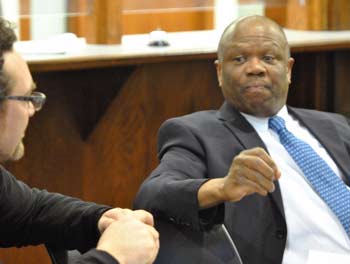
Washtenaw County Economic Development Corporation board meeting (March 15, 2010): On Monday, the EDC board met for just the second time since 2005. On the agenda: A discussion about the availability of federal bonds that have been allocated to Washtenaw County, but not used, for projects by private firms.

Though federal legislation expanded the types of businesses that can use the bonds, a national credit crunch has essentially slowed potential deals to a halt. “We await the projects,” said John Axe, the EDC’s bond counsel. Unless extended by Congress, the program expires at the end of 2010. [Full Story]

Transit Forum Critiques Fuller Road Station

Chris Leinberger was blunt in his assessment of the proposed Fuller Road Station: If the parking structure is built as proposed, in 20 years it will be torn down.

Fuller Road parking lot

The city-owned Fuller Road parking lot, site of the proposed Fuller Road Station. To the south of the lot is the University of Michigan medical complex. (Photos by the writer.)

Speaking at a forum on transit-oriented development, Leinberger – a University of Michigan professor of practice in urban planning – said current plans for the joint UM/city of Ann Arbor project do a good job of incorporating different kinds of transit, from bikes and buses to perhaps, eventually, commuter rail.

But Leinberger criticized the project for taking some of Ann Arbor’s most valuable land and turning it into something that won’t generate revenue for the city. He told Eli Cooper, the city’s transportation program manager, that “whoever’s in your position 20 years from now will tear it down.”

Monday’s forum, held at the UM Art & Architecture building on north campus, was organized by members of the WALLY Coalition and the 208 Group, among others, to focus on local transit-oriented development efforts. Moderated by local developer Peter Allen, the event included presentations by Cooper, Richard Murphy of the city of Ypsilanti and Shea Charles, Howell’s city manager. [Full Story]

Column: Balanced Offense for Local Economy

A little over 13 years ago, I started work as a business reporter at The Ann Arbor News. And exactly 13 years ago today, as I hoisted myself out of a warm bed at four o’clock in the morning, I was beginning to grasp why the other business reporters might have welcomed me so warmly.

Best Buy

Best Buy on Lohr Road at 4:08 a.m. on Nov. 27, 2009. Doors opened at 5 a.m. (Photo not by the writer – she's not required to cover Black Friday morning stories at The Chronicle.)

They knew that as the newest hire, I’d be the one assigned to the morning-after-Thanksgiving Black Friday shopping story. Later that dark, frigid morning, I watched as a stream of cars disgorged expectant, even festive shoppers to stand in line waiting for the doors at Walmart to open.

My initial reaction: These people are slightly nuts.

Then: Downtown retailers would kill for this kind of crowd.

The dichotomy of large and small businesses is perhaps most visible on days like Black Friday, when more customers on a single morning might flow through Walmart than would shop at a Main Street merchant all year. But the tension between large and small is also reflected in our local public policy priorities for economic development. [Full Story]

County Reorganizes 911 Dispatch

Ken Weber

Ken Weber of Weber's Restaurant & Hotel, foreground, sits next to Kevin Gudejko of Main Street Ventures at the Nov. 4 county board of commissioners meeting. They were among the restaurateurs who spoke at a public hearing and questioned the need for a proposed food safety training program. (Photo by the writer.)

Washtenaw County Board of Commissioners (Nov. 4, 2009): After removing a major item from their agenda – the 2010/2011 budget – county commissioners spent the bulk of their Nov. 4 meeting listening to presentations, reports, and a public hearing. Commissioners also voted and approved a new tax to raise roughly $603,000 annually for economic development. The 0.04 mills will be collected on the December 2009 tax bill.

Sheriff Jerry Clayton spoke about plans to reorganize the county’s central dispatch and emergency services operation. Changes include co-location of the county and the city of Ann Arbor’s central dispatch, which will both be housed in Ann Arbor.

Dick Fleece, director of the county’s Public Health/Environmental Health department, gave an update on the H1N1 outbreak and vaccination clinics in Washtenaw County. [On Monday, Nov. 9, the county announced a new clinic for mass immunization of people in expanded priority categories. That clinic will be held on Saturday, Nov. 14 from 9 a.m. to 4 p.m. at Pioneer High School in Ann Arbor.]

Commissioners also heard concerns from local restaurant owners and managers – including Ken Weber of Weber’s Restaurant & Hotel, and Rick Strutz of Zingerman’s Deli – during a public hearing on a proposed new food safety training program. [Full Story]

Making Jobs for Former Prisoners

Larry Voigt stood in front of a crowd of social workers, nonprofit leaders, and members of the faith community on Friday afternoon, folded his arms, and declared, “No!” The president of Catholic Social Services of Washtenaw County was playfully addressing attendees of a jobs creation summit by illustrating the opposite of what they were there to do: Say yes.

man with arms folded, saying no

Larry Voigt, president of Catholic Social Services of Washtenaw County, demonstrates the classic arms-folded posture of saying no. The job creation summit held last Friday was partly about getting people to say yes. (Photo by the writer)

Say yes to what?

They were there to say yes to the idea of economic development through creation of self-sustaining businesses that would employ former prisoners making the transition to society. The jobs creation summit was sponsored by MPRI – the Michigan Prisoner ReEntry Initiative.

The first part of the program, which ran through the morning, lunch and the early afternoon, was dedicated to hearing from four panelists representing three organizations in other parts of the country that have successfully launched a variety of businesses that employ former prisoners and substance abusers.

Then, after hearing pitches for close to a dozen different business ideas, participants winnowed them down to three basic concepts for small group focus: a building weatherization business, a green cleaning enterprise, and an urban farming venture.

The working summit was meant simply to kick things off in a directed way, said Mary King, who’s the community coordinator for Michigan Prisoner ReEntry Initiative of Washtenaw County. The summit allowed some of the specific challenges to crystallize that are faced by business startups, especially those that say yes to the idea of employing former prisoners. [Full Story]

How to Sustain a Local Economy

Panelists at the Sept. 23 Michigan Peaceworks forum on the local economy, from the left: Tom Weisskopf, University of Michigan economics professor; Ellen Clement, Corner Health Center executive director; Jeff McCabe, People's Food Co-Op board member; Lisa Dugdale, Transition Ann Arbor; Michael Appel, Avalon Housing executive director; John Hieftje, mayor of Ann Arbor.

Panelists at the Sept. 23 Michigan Peaceworks forum on the local economy, from the left: Tom Weisskopf, University of Michigan economics professor; Ellen Clement, Corner Health Center executive director; Jeff McCabe, People's Food Co-Op board member; Lisa Dugdale, Transition Ann Arbor; Michael Appel, Avalon Housing executive director; John Hieftje, mayor of Ann Arbor. (Photo by the writer.)

When The Chronicle entered the lower level meeting room of the downtown Ann Arbor library, the first things we noticed were three large trays of peanut butter and jelly sandwiches, cut into bite-sized wedges. As public forums go, this was an offbeat gnoshing choice.

It turned out that the sandwiches – and apples, soft drinks, potato chips and other food – were all sourced from Michigan, in keeping with the theme of Wednesday night’s event. The panel discussion focused on the state’s economic crisis, and how the community can respond to it.  Buying local products is one example.

Starting a local currency is another possibility – the Ann Arbor Downtown Development Authority is funding a study to look into that. Generating  electricity locally is also an opportunity – Mayor John Hieftje told the group that he didn’t think the dam at Argo Pond would be removed, in part because it might be used for hydropower in the future.

The forum – “Michigan’s Economic Situation: Crisis or Opportunity?” – was hosted by Ann Arbor-based Michigan Peaceworks and Washtenaw Voice, a coalition of local nonprofits that are working together to increase voter turnout and bolster the community in other ways. Michigan Peaceworks is the lead agency in this effort, part of the broader Michigan Voice initiative.

State and national issues were part of the discussion, but most of the six panelists focused on how the local community can take action in specific areas, including food, health care, housing and the environment. [Full Story]

4-H Fans, Others Lobby County for Funds

The overflow crowd in the lobby of the county administration building arrived too late for a seat in the boardroom.

An overflow crowd in the lobby of the county administration building arrived too late for a seat in the boardroom, and watched Wednesday's Washtenaw County Board of Commissioners meeting on TV. (Photo by the writer.)

Washtenaw County Board of Commissioners meeting (Aug. 5, 2009): As Washtenaw County grapples with a staggering budget deficit, 4-H supporters – including local farmers, teens and club leaders – packed Wednesday’s county Board of Commissioners meeting, urging commissioners not to cut funding for that program. They were joined by many others who use master gardening, financial counseling and other services of the county’s MSU Extension program, which could see dramatic funding cuts as the county tries to balance its budget.

As The Chronicle previously reported, the county faces a $30 million deficit over the next two years. Last week, county administrator Bob Guenzel released a list of options for cutting another $12 million out of the budget, and eliminating up to 181 jobs. Those options – which he stressed are not his recommendations at this point – target non-mandated services, ranging from Head Start to a variety of mental health programs. On Wednesday, Guenzel gave a formal presentation about the options to commissioners, who will be the final arbiters of any budget decisions. The discussion following Guenzel’s presentation could aptly be summarized by this statement from commissioner Conan Smith: “It sucks.” [Full Story]

Bernstein to Leave Ann Arbor Chamber

Jesse Bernstein, Ann Arbor Area Chamber of Commerce president

Jesse Bernstein, Ann Arbor Area Chamber of Commerce president, has resigned his post. His last day in that job is June 30.

On a downtown street corner recently, The Chronicle had occasion to witness an informal idea pitch from Hal Davis to Jesse Bernstein,  president of the Ann Arbor Area Chamber of Commerce: Busker Week for downtown Ann Arbor – where independent musicians would explicitly be invited to come perform in Ann Arbor’s downtown. Bernstein’s reaction can fairly be described as positive.

But if Bernstein helps Busker Week to join Sonic Lunch on downtown Ann Arbor’s summer musical calendar, it won’t be as president of the chamber. Bernstein told staff at 4 p.m. Tuesday that his last day leading the organization will be June 30, 2009. It ends three year’s of Bernstein’s leadership of the area business organization. [Full Story]

Column: Limited Edition

Here we go again. After spending years trying to unsuccessfully prop up two stagnant automobile companies using various tactics, corrective action by the U.S. Bankruptcy Court has now sent Gov. Granholm and her economic team scurrying off on a new and different project.

Earlier this month, the politicos did a groundbreaking for the $44 million I-94/Westnedge Avenue road widening project. Vice President Joe Biden espoused the view that “we are quite literally paving the road to recovery right here in Kalamazoo.” From one lifelong Democrat to another: Say it ain’t so, Joe! $44 million won’t do it, and this project – while offering temporary construction jobs – is just another “plug the dike” tactic as Michigan searches for political leadership that will offer a sound long-term strategy for economic growth in Michigan. [Full Story]

Targeted Cuts for Washtenaw County Budget

A page of notes taken during Tuesdays county budget forum.

A page of notes taken by Andy Brush, the county's knowledge manager, during Tuesday's budget forum.

The handful of business people who attended a Washtenaw County budget forum on Tuesday morning stressed the importance of local investment, and heard a preview of areas targeted for cuts as the county grapples with falling revenues and a potential $26 million deficit over the two-year period beginning in 2010.

County administrator Bob Guenzel gave the small group, which also included several elected officials and department directors, a preview of budget recommendations that will be released later this week and formally presented to the board of commissioners at their June 3 meeting. Though he didn’t provide details Tuesday morning, he said the recommendations will include layoffs and a change in compensation for non-union employees. Meanwhile, union leaders from 17 different bargaining units are being asked to renegotiate contracts in talks that will continue through July. The county employs about 1,300 people – roughly 80% are union employees.

Guenzel outlined four general areas identified to close the $26 million budget deficit: 1) revenue generation, $3 million to $5 million; 2) department reductions, $7 million to $10 million; 3) employee compensation and benefits, $12 million to $14 million, and 4) structural changes, $3 million to $7 million.

He also laid out a wide range of possible cuts, including selling county-owned facilities – he noted that the Zeeb Road building was only half occupied, for example – and even the possibility of not opening the jail expansion when it’s completed in 2010. That expansion, which would provide an additional 112 beds, would cost at least $1 million extra per year to staff. He said that though governments in general are good at finding one-time solutions, “what we need going forward is primarily structural savings.”

Guenzel cited the Wall Street Journal in characterizing the economic crisis as the worst since the 1930s, with no end yet in sight. He said that though this area had the lowest unemployment rate in the state, the magnitude of the problem was dire. “We haven’t hit bottom,” he said. [Full Story]

UM Hosts Senate Hearing on Higher Ed

The room at the Michigan League

The Vandenberg Room at the Michigan League was packed for a state legislative hearing on funding for higher education.

The three presidents of institutions in Michigan’s University Research Corridor – backed by students and economic development leaders from each region – testified at a state Senate Higher Education Subcommittee hearing on Friday held in Ann Arbor, making a plea for additional state funding. But while legislators at the hearing acknowledged the importance of higher education, they also gave a bleak outlook for Michigan’s financial health, with one senator describing state revenues as “almost in a freefall.”

State Sen. Jim Barcia, a Democrat from Bay City, told the 50 or so people gathered at the Michigan League that a revenue estimate released earlier in the day was “worse news than anticipated.” The Senate Fiscal Agency estimated that revenues could be $2.1 billion lower than projected for the coming fiscal year, which begins Oct. 1. Even in the current fiscal year, the state faces a $1.3 billion deficit that has prompted another round of cuts. Despite that, Barcia said the students who testified on Friday – including a recent University of Michigan graduate who has launched a new company – gave him reason for optimism. [Full Story]

Innovating out of an Economic Hole

Maria Thompson, General Manager, A123Systems Advanced Research

Maria Thompson, general manager of the advanced research and government solutions group for A123Systems in Ann Arbor. She was one of several panelists from the local business community at Monday's UM economic development forum.

More than 250 people from academia, business, government and nonprofits packed the auditorium Monday afternoon at the Partnership for an Innovation Economy forum, hosted by the University of Michigan at its newly renovated art museum.

Throughout the two-hour event, The Chronicle learned, among other things: 1) which former Pfizer executive is a rugby referee, 2) which local power couples have relied on each other for advice, 3) who hosts one of the best holiday parties in Ann Arbor.

Of course, there was also much talk of UM’s role in economic development. [Full Story]

“Obama Bucks” Boost Eastern Washtenaw

Layers of history are preserved on the wall of Spark East in downtown Ypsilanti.

Layers of history are preserved on the wall of SPARK East in downtown Ypsilanti.

On Friday, May 8, the renovated Ypsilanti storefront that houses SPARK East will be open to the public for a look at the business services offered there. The event is part of a larger economic development effort on Washtenaw County’s east side, an effort that’s getting a boost from federal stimulus funding – or what one county official called “Obama bucks.”

Last Thursday, about 40 members of the Eastern Leaders Group got an overview of the 2009 Recovery and Reinvestment Rapid Response Strategy Business Plan, which had been approved by the ELG executive committee in mid-April. Held at the brick-walled SPARK East office on Michigan Avenue, the meeting covered a lot of ground, from neighborhood revitalization efforts to a plan for microloans to businesses.

The Chronicle dropped by to hear about the plan too. Though the meeting was decidedly forward looking, there was an element of history at SPARK East as well – more on that later. We’ll start with a look at the three main topics covered on Thursday: 1) business development and employee training, 2) microloan programs, and 3) community revitalization and stabilization plans. [Full Story]

Column: A Voice from the Past Calls Out

Bob Dascola

Bob Dascola of Dascola Barbers on South State.

In the old days, downtown was divided into three parts: Main Street (called Downtown), State Street (called Uptown), and South University (called Campus). Each area was different, but all were part of downtown Ann Arbor.

During my early days while attending Angell School on South University, I remember my mother giving me money so I could go have lunch at the Dugout restaurant on South U, owned by the Klepac family (their daughter was in my class), then pick up some ice cream at Miller’s before returning to school. As I grew up I used to hang out at Beaver’s Bike and Hobby on Church Street (owned by Fred Beaver), learning how to repair bicycles from Bill Loy (now owner of the Student Bike Shop).

I remember when the students left at the end of the school year in April, the local business owners wanted more people to come into the campus area during the summer, so Joan Beaver and a couple of her art friends invented the “Art Fair.” Wow, that really worked. Just look what everyone else in town has done with it! [Full Story]

County Commissioners Debate Aerotropolis

Washtenaw County Board of Commissioners administrative briefing (March 11, 2009): During their informal administrative briefing, county commissioners engaged in a spirited debate on Wednesday about the value of joining a regional economic development effort focused on a corridor of airports. The item is on the agenda for the March 18 Ways & Means Committee, which consists of all commissioners and meets immediately prior to the regular board meeting.

The Aerotropolis Development Corp. is an economic development project targeting growth in the corridor between Willow Run Airport on the county’s east side and Detroit Metro Airport. In early November 2008, Wayne County executive Bob Ficano made a presentation at a board working session about the project, but the proposal never was brought up for a vote. At the time, several commissioners expressed concern at the cost of joining – a $150,000 annual fee.

Since then, the fee has been lowered to $50,000 for the county, and two local governments – Ypsilanti city council and the Ypsilanti Township board of trustees – have voted to join the project independently. The cost for those municipalities is $25,000 per year. [Full Story]

Column: A Small Slice of ArbCamp 2008

On Thursday evening, the second floor of Cottage Inn Pizza on William Street in downtown Ann Arbor was cram-packed with geeks and non-geeks alike. But it seemed like mostly geeks – propeller heads, techies, code-freaks, whatever term of endearment you prefer. They were there for ArbCamp 2008, a gathering meant to stimulate discussions around topics mutually agreed upon, on the fly at the event, and to promote connections in the tech community that might prove constructive. If the breaking news of the day – UM’s purchase of the old Pfizer site to establish a medical research hub – represents a big box approach to economic development, then ArbCamp 2008 is a grass-roots approach. [Full Story]

» Text size:

larger text default text smaller text

Skyclock