Stories indexed with the term ‘economic development’

Targeted Cuts for Washtenaw County Budget

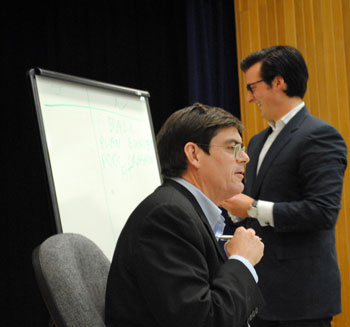
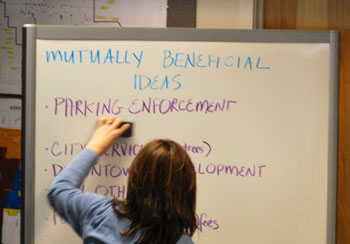
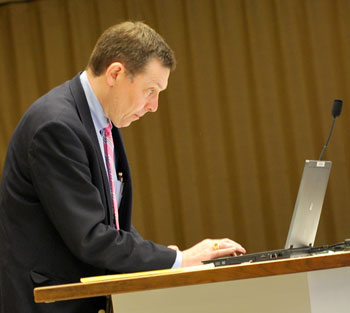
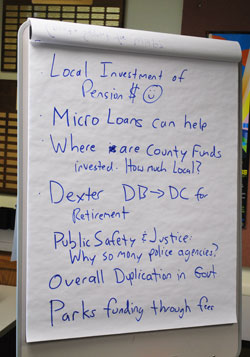
A page of notes taken during Tuesdays county budget forum.

A page of notes taken by Andy Brush, the county's knowledge manager, during Tuesday's budget forum.

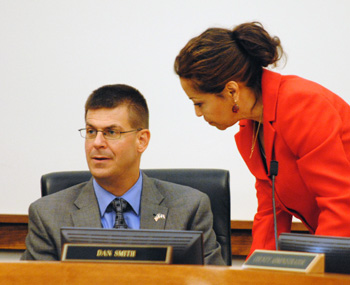
The handful of business people who attended a Washtenaw County budget forum on Tuesday morning stressed the importance of local investment, and heard a preview of areas targeted for cuts as the county grapples with falling revenues and a potential $26 million deficit over the two-year period beginning in 2010.

County administrator Bob Guenzel gave the small group, which also included several elected officials and department directors, a preview of budget recommendations that will be released later this week and formally presented to the board of commissioners at their June 3 meeting. Though he didn’t provide details Tuesday morning, he said the recommendations will include layoffs and a change in compensation for non-union employees. Meanwhile, union leaders from 17 different bargaining units are being asked to renegotiate contracts in talks that will continue through July. The county employs about 1,300 people – roughly 80% are union employees.

Guenzel outlined four general areas identified to close the $26 million budget deficit: 1) revenue generation, $3 million to $5 million; 2) department reductions, $7 million to $10 million; 3) employee compensation and benefits, $12 million to $14 million, and 4) structural changes, $3 million to $7 million.

He also laid out a wide range of possible cuts, including selling county-owned facilities – he noted that the Zeeb Road building was only half occupied, for example – and even the possibility of not opening the jail expansion when it’s completed in 2010. That expansion, which would provide an additional 112 beds, would cost at least $1 million extra per year to staff. He said that though governments in general are good at finding one-time solutions, “what we need going forward is primarily structural savings.”

Guenzel cited the Wall Street Journal in characterizing the economic crisis as the worst since the 1930s, with no end yet in sight. He said that though this area had the lowest unemployment rate in the state, the magnitude of the problem was dire. “We haven’t hit bottom,” he said. [Full Story]

UM Hosts Senate Hearing on Higher Ed

The room at the Michigan League

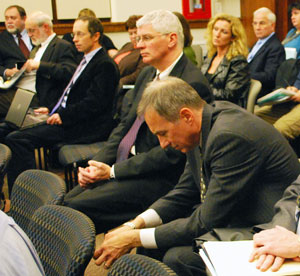
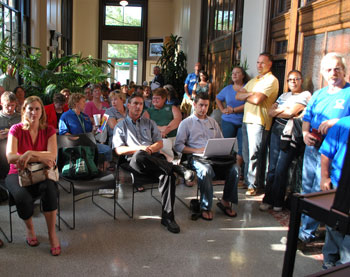
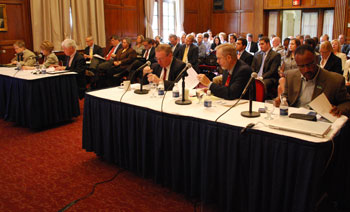
The Vandenberg Room at the Michigan League was packed for a state legislative hearing on funding for higher education.

The three presidents of institutions in Michigan’s University Research Corridor – backed by students and economic development leaders from each region – testified at a state Senate Higher Education Subcommittee hearing on Friday held in Ann Arbor, making a plea for additional state funding. But while legislators at the hearing acknowledged the importance of higher education, they also gave a bleak outlook for Michigan’s financial health, with one senator describing state revenues as “almost in a freefall.”

State Sen. Jim Barcia, a Democrat from Bay City, told the 50 or so people gathered at the Michigan League that a revenue estimate released earlier in the day was “worse news than anticipated.” The Senate Fiscal Agency estimated that revenues could be $2.1 billion lower than projected for the coming fiscal year, which begins Oct. 1. Even in the current fiscal year, the state faces a $1.3 billion deficit that has prompted another round of cuts. Despite that, Barcia said the students who testified on Friday – including a recent University of Michigan graduate who has launched a new company – gave him reason for optimism. [Full Story]

Innovating out of an Economic Hole

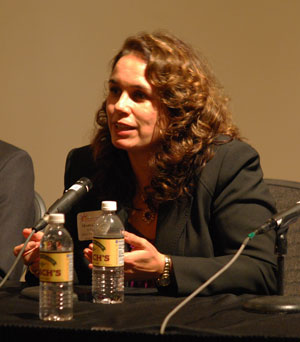
Maria Thompson, General Manager, A123Systems Advanced Research

Maria Thompson, general manager of the advanced research and government solutions group for A123Systems in Ann Arbor. She was one of several panelists from the local business community at Monday's UM economic development forum.

More than 250 people from academia, business, government and nonprofits packed the auditorium Monday afternoon at the Partnership for an Innovation Economy forum, hosted by the University of Michigan at its newly renovated art museum.

Throughout the two-hour event, The Chronicle learned, among other things: 1) which former Pfizer executive is a rugby referee, 2) which local power couples have relied on each other for advice, 3) who hosts one of the best holiday parties in Ann Arbor.

Of course, there was also much talk of UM’s role in economic development. [Full Story]

“Obama Bucks” Boost Eastern Washtenaw

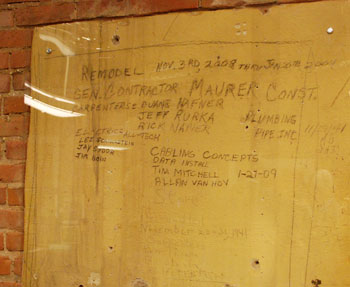
Layers of history are preserved on the wall of Spark East in downtown Ypsilanti.

Layers of history are preserved on the wall of SPARK East in downtown Ypsilanti.

On Friday, May 8, the renovated Ypsilanti storefront that houses SPARK East will be open to the public for a look at the business services offered there. The event is part of a larger economic development effort on Washtenaw County’s east side, an effort that’s getting a boost from federal stimulus funding – or what one county official called “Obama bucks.”

Last Thursday, about 40 members of the Eastern Leaders Group got an overview of the 2009 Recovery and Reinvestment Rapid Response Strategy Business Plan, which had been approved by the ELG executive committee in mid-April. Held at the brick-walled SPARK East office on Michigan Avenue, the meeting covered a lot of ground, from neighborhood revitalization efforts to a plan for microloans to businesses.

The Chronicle dropped by to hear about the plan too. Though the meeting was decidedly forward looking, there was an element of history at SPARK East as well – more on that later. We’ll start with a look at the three main topics covered on Thursday: 1) business development and employee training, 2) microloan programs, and 3) community revitalization and stabilization plans. [Full Story]

Column: A Voice from the Past Calls Out

Bob Dascola

Bob Dascola of Dascola Barbers on South State.

In the old days, downtown was divided into three parts: Main Street (called Downtown), State Street (called Uptown), and South University (called Campus). Each area was different, but all were part of downtown Ann Arbor.

During my early days while attending Angell School on South University, I remember my mother giving me money so I could go have lunch at the Dugout restaurant on South U, owned by the Klepac family (their daughter was in my class), then pick up some ice cream at Miller’s before returning to school. As I grew up I used to hang out at Beaver’s Bike and Hobby on Church Street (owned by Fred Beaver), learning how to repair bicycles from Bill Loy (now owner of the Student Bike Shop).

I remember when the students left at the end of the school year in April, the local business owners wanted more people to come into the campus area during the summer, so Joan Beaver and a couple of her art friends invented the “Art Fair.” Wow, that really worked. Just look what everyone else in town has done with it! [Full Story]

County Commissioners Debate Aerotropolis

Washtenaw County Board of Commissioners administrative briefing (March 11, 2009): During their informal administrative briefing, county commissioners engaged in a spirited debate on Wednesday about the value of joining a regional economic development effort focused on a corridor of airports. The item is on the agenda for the March 18 Ways & Means Committee, which consists of all commissioners and meets immediately prior to the regular board meeting.

The Aerotropolis Development Corp. is an economic development project targeting growth in the corridor between Willow Run Airport on the county’s east side and Detroit Metro Airport. In early November 2008, Wayne County executive Bob Ficano made a presentation at a board working session about the project, but the proposal never was brought up for a vote. At the time, several commissioners expressed concern at the cost of joining – a $150,000 annual fee.

Since then, the fee has been lowered to $50,000 for the county, and two local governments – Ypsilanti city council and the Ypsilanti Township board of trustees – have voted to join the project independently. The cost for those municipalities is $25,000 per year. [Full Story]

Column: A Small Slice of ArbCamp 2008

By

On Thursday evening, the second floor of Cottage Inn Pizza on William Street in downtown Ann Arbor was cram-packed with geeks and non-geeks alike. But it seemed like mostly geeks – propeller heads, techies, code-freaks, whatever term of endearment you prefer. They were there for ArbCamp 2008, a gathering meant to stimulate discussions around topics mutually agreed upon, on the fly at the event, and to promote connections in the tech community that might prove constructive. If the breaking news of the day – UM’s purchase of the old Pfizer site to establish a medical research hub – represents a big box approach to economic development, then ArbCamp 2008 is a grass-roots approach. [Full Story]