The Ann Arbor Chronicle masthead
it's like being there

Stories indexed with the term ‘email’

Column: When’s an Open Meeting Open?

At its Sept. 21 meeting, the Ann Arbor city council voted to attach to the official meeting minutes any emails sent to and from its members during its future meetings. The rationale for this move – as reflected in the whereas clause of the resolution – was to “help the public monitor compliance with the amended rules.”

What amended rules? At its previous meeting on Sept. 8, the council had amended its rules to restrict emails sent by its members during meetings to two kinds: (i) messages to city staff, and (ii) messages to other councilmembers that propose language for resolutions or amendments to resolutions. No restrictions were put in place on reading emails received during city council meetings.

In adopting the Sept. 21 resolution – but at the same time rejecting a proposal to release council meeting emails dating back to 2002 – councilmembers emphasized the need to look to the future and not dwell on the past.

However, the rule changes, together with the resolution passed on Sept. 21, suggest that Ann Arbor’s city council has fundamentally failed to give adequate thought to the future of open government in Ann Arbor. Instead, we appear to be moving into the future in a way that formally ensconces a flawed understanding of the letter and spirit of the Open Meetings Act. [Full Story]

Near North, City Place Approved

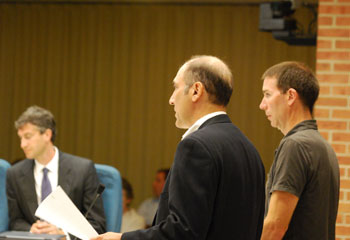
Two men stand together at a podium at the Ann Arbor city council

At the podium, Bill Godfrey of Three Oaks Group and Tom Fitzsimmons of the North Central Property Owners Association both express their support of the Near North housing project on North Main. In the background, Christopher Taylor (Ward 3). (Photo by the writer.)

Ann Arbor City Council meeting (Sept. 21, 2009): Ann Arbor’s city council approved both major development projects on its agenda, one of them enthusiastically, the other only reluctantly.

Although there was a smattering of opposition expressed to the Near North affordable housing development during the public hearing on the matter, the 39-unit project on North Main Street ultimately won the support of its closest neighbors. That support was reflected symbolically when developer Bill Godfrey and neighbor Tom Fitzsimmons stood side-by-side at the podium as they each addressed the council, which gave the project its unanimous approval.

The “matter of right” City Place project proposed for the block of South Fifth Avenue just south of William was also unanimously approved by the council, but councilmembers took turns criticizing both the project and the developer, Alex de Parry. The council had previously established a historic district study committee and enacted an associated moratorium on demolition and work in the area where the proposed project is located. Carsten Hohnke (Ward 5) compared de Parry’s decision to bring the project forward despite the moratorium to “stamping feet, being upset you didn’t get what you wanted.”

Many members of the audience held yellow 8×11 paper signs calling on councilmembers to support a resolution that would have released council emails sent during their meetings dating back to 2002. However, council rejected that resolution except for a resolved clause that would in the future provide the public with copies of electronic communications among councilmembers during its meetings – by appending them to the official minutes of the meeting that are eventually posted on the city’s website.

The council also put looming financial issues on the radar by passing a resolution that opposes a recent Michigan budget proposal that would cut state shared revenues to the city of Ann Arbor by about $1.2 million. At the council’s budget and labor committee meeting that was held Monday – before the regular council meeting – Tom Crawford, the city’s chief financial officer, floated some possible ideas for meeting that shortfall. [Full Story]

Council Preview: Development, Email

Ann Arbor City Council Sunday caucus (Sept. 20, 2009): It’s a caucus worth attending when the editor of The Ann Arbor Observer gives the assembly a personal glimpse into a recent spate of  break-ins on the northwest side of the city: burglars of a neighboring property left something interesting behind in his backyard.

But the city council’s Sunday night caucus again found Mayor John Hieftje offering what’s become a customary explanation to the public for the absence of the majority of council members: many of them have family obligations, and it’s not a required meeting of council.

So along with Hieftje, it was only Sabra Briere (Ward 1) and Mike Anglin (Ward 2 Ward 5) who heard brief remarks from residents and the development team on the subject of the Near North affordable housing development on North Main Street. The City Place development team – which is bringing its “matter of right” proposal for housing on South Fifth Avenue back to council – also made themselves available for questions from councilmembers.

Council received an update from Alan Haber, who reported that a group of citizens had met and resolved to respond to the city’s request for proposals for development on top of the underground parking structure to be built along Fifth Avenue.

Finally, the council had no further updates on the communication the city clerk has received from her counterpart with the county, to the effect that revisions to the charter amendment ballot language they approved at their last meeting could not be accommodated – they missed the Aug. 25 deadline. [Full Story]

City Council Begins Transition

Ann Arbor City Council meeting (Sept. 8, 2009): It did not look like a lot was going to happen at Ann Arbor’s city council meeting on Tuesday.

Sandi Smith (Ward 1) indicated early in the meeting that action on the Near North development would be postponed. A speaker during public commentary noted that a controversial resolution affecting the municipal airport had been yanked from the meeting’s agenda. And Mike Anglin (Ward 5) announced a delay in his intention to bring a resolution that would make publicly available numerous city council emails dating to the early 2000s. Council did not contemplate any resolutions in connection with the Argo Dam. [The Chronicle will report separately on the work session held immediately prior to the council meeting, which focused on Argo Dam.]

But as it turned out, on Tuesday night a lot happened: Ann Arbor’s city council began a transition – to what will perhaps be a different way of doing business and to a new set of leaders. [Full Story]

Column: Email and Open Meetings

As we reported more than a month ago, a Freedom of Information Act request made by the Great Lakes Environmental Law Center – in connection with a possible environmental lawsuit against the city of Ann Arbor – yielded records of email correspondence between Ann Arbor city councilmembers made during some of their regular council meetings.

In that article, we indicated that the “the content seems to fall into two categories: (i) adolescent humor, and (ii) apparent ‘backchannel’ discussion of issues before the council, which raises more serious concerns.” The content of some of those emails has now been published in various forms in other media outlets.

We begin our own treatment of this episode in city politics by providing historical context for the Ann Arbor community’s concern about city council email exchanges during council meetings – one that predates the FOIA requests by GLELC.

In that context, we’d like to consider one of the email exchanges in more detail and use it to illuminate ethical issues surrounding the use of electronic communications during official meetings. And on that basis, we’ll explore some possibilities for the use of technology to push information to the public, instead of using it to screen decision-making processes from the public. In addition to the ethical and informational issues, there are legal questions that arise from these FOIA-ed materials. Those legal questions relate to possible  violation of the Michigan Open Meetings Act, as well as the city’s preparedness to meet the requirements of FOIA when electronic records are requested. [Full Story]

Seventh Monthly Milestone Message

I used this canvas bag to deliver the morning paper in Columbus, Indiana, from 1974 to 1980.

I used this canvas bag to deliver the morning paper in Columbus, Indiana, from 1974 to 1980. The circulation area for the Louisville Courier-Journal extended only as far north as Columbus. More people in Columbus subscribed to the Indianapolis Star, or else the local afternoon paper, The Republic. But some people subscribed to all three.

It’s my turn to write the monthly milestone – an update about The Chronicle. Here’s a nuts-and-bolts outline, with a longer version after the break.

  • Events: List them yourself on The Chronicle by registering for an account on Upcoming and creating the event listings there. Let us know when you’ve done that, and we’ll add them to our “watch list,” which will make them appear on The Chronicle’s event listing. It’s free.
  • Emailed updates: Shoot us an email saying you’d like to receive weekly story summaries, and we’ll send them to you – with links to the complete story.
  • Advertising crew: As part of our ongoing effort to increase revenues to support expanded coverage in The Chronicle, there’ll be some folks out there in the community earning commissions by convincing advertisers to place ads in The Chronicle. If you think you’ve got what it takes to sell ads into The Chronicle, let us know.
  • Print and thoughts on newspapers: Printing off a page from The Chronicle should look a bit better than it used to. Regarding the contrast between news on-screen versus printed on paper, Del Dunbar’s column that we ran back in September 2008, our first month of publication, is a better read than ever. [Link to Del Dunbar's column.]

[Full Story]

» Text size:

larger text default text smaller text

Skyclock