Stories indexed with the term ‘employee benefits’

Library Board OKs Labor Agreements

Ann Arbor District Library board special meeting (Dec. 8, 2011): A 10-minute meeting wrapped up more than 18 months of negotiations, as the AADL board unanimously approved contracts with its two labor bargaining units.

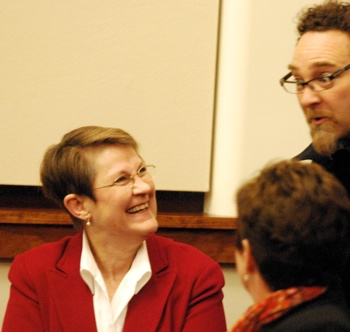
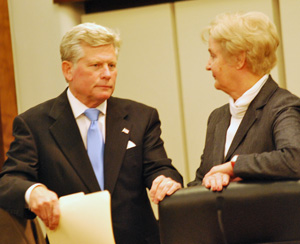
Margaret Leary, Josie Parker

Josie Parker, right, director of the Ann Arbor District Library, talks with AADL board chair Margaret Leary at the board's Dec. 8 special meeting. (Photo by the writer.)

The board had called a special meeting for Thursday to vote on these contracts, which run from Jan. 1, 2012 through June 30, 2015. The agreements are with the Ann Arbor District Library Staff Associates, which represents 30 employees, and the Ann Arbor District Librarians Association, which represents 14 AADL librarians. All but two of these 44 workers are full-time employees with benefits. The library employs a staff of nearly 200 at its five location throughout the district, including about 100 full-time workers.

The previous contracts expired on June 30, 2010. The main difference between the old and new contracts relates to a change in health insurance providers, plans and employee contributions, according to AADL director Josie Parker. She said she appreciated the hard work that both sides of the negotiations had done to reach an agreement.

The two AADL bargaining units are part of the Michigan Education Association, dating back to the years prior to 1996 when the library was still part of the Ann Arbor public schools system. Paul Morrison, executive director of the Ann Arbor Education Association – the local MEA unit – participated in negotiations and described the outcome as “not great for labor” but reasonable, given the economic circumstances.

The board took two other actions at its meeting on Thursday: (1) a vote to cancel its Dec. 15 meeting, because there are no pressing agenda items; and (2) a vote to call an executive session for its Jan. 16, 2012 meeting, to discuss the written opinion of its legal counsel. [Full Story]

County Enacts 80/20 Health Cost Rule

At its Dec. 7, 2011 meeting, the Washtenaw County board of commissioners gave final approval to a resolution stating that the county will comply with Section 4 of the state’s Public Act 152 of 2011, also known as the “80/20″ rule regarding health care costs. Initial approval was given at the board’s Nov. 16 meeting.

On Jan. 1, 2012, public employers like Washtenaw County will be prohibited from paying more than $5,500 for health benefits annually for a single employee, $11,000 for an employee plus spouse, or $15,000 for family coverage. However, the law allows a public employer, by a majority vote of its governing body, to choose another option: to pay not more than 80% of the total annual costs … [Full Story]

County Board Supports Same-Sex Benefits

The Washtenaw County board of commissioners passed a resolution at its Dec. 7, 2011 meeting that urges state lawmakers to reject HB 4770, HB 4771 and “any legislation that codifies discrimination.” The proposed state legislation – which has been passed by the House, and was passed by the Senate earlier in the day – would remove the ability to extend benefits to same-sex partners. Currently, Washtenaw County offers benefits to same-sex partners of its employees. The legislation will be sent back to the House for ratification, then forwarded for Gov. Rick Snyder to sign into law.

The resolution was brought forward by Washtenaw County commissioner Yousef Rabhi (D-District 11). [.pdf of resolution] Rabhi described the situation as an issue … [Full Story]

County Board Briefed on Labor Issues

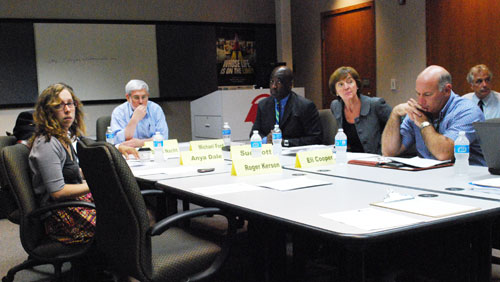
Washtenaw County board of commissioners working session (Feb. 17, 2011): County commissioners got an update last week on the county’s labor issues, as the county prepares for union contract negotiations later this year.

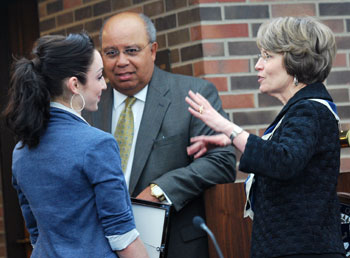
Diane Heidt

At right: Diane Heidt, Washtenaw County's human resources and labor relations director, talks with Caryette Fenner, president of AFSCME Local 2733, the county government's largest union. (Photos by the writer.)

The briefing was delivered by Diane Heidt, the county’s human resources and labor relations director. She told the board that they’d be discussing specific negotiation strategies at their March 3 working session – those talks will be held in a closed session, however. Heidt’s presentation last Thursday was meant to set the stage for commissioners, and to answer any general questions they had as the county prepares to negotiate with its 17 bargaining units.

Leaders of two unions attended Thursday’s working session, though they did not address the board during the meeting: Caryette Fenner, president of AFSCME Local 2733, the county government’s largest union, which represents 621 workers within its five units; and Nancy Heine, president of AFSCME Local 3052, with 56 members.

The county faces a two-year, $20.9 million deficit for its 2012 and 2013 budget years. In a “State of the County” report given to the board earlier this year, county administrator Verna McDaniel targeted $8.5 million in cuts to employee compensation and benefits as part of their strategy for tackling the projected shortfall. [Full Story]

County Commissioner Expenses Debated

Washtenaw County Board of Commissioners meeting (Oct. 20, 2010): A strong undercurrent of both the upcoming Nov. 2 elections and the looming county budget deficit erupted at times during Wednesday’s board meeting – the last board meeting prior to the elections.

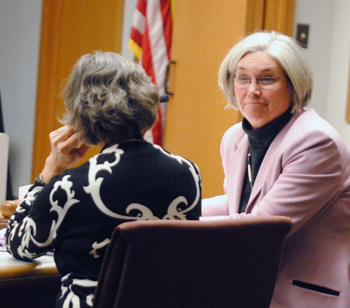
Mark Ouimet, Leah Gunn

County commissioners Mark Ouimet and Leah Gunn talk prior to the start of the Oct. 20 Washtenaw County board of commissioners meeting. During the meeting Gunn, a Democrat, defended Ouimet, who has come under attack by some Democrats for excessive and inappropriate per-diem claims. (Photos by the writer.)

At the center of public commentary and commissioner discussion – which at times grew heated – was the issue of whether commissioners are appropriately claiming reimbursements for mileage and per diem. The controversy first emerged at the board’s last meeting on Oct. 6, when Democrat Tom Wieder spoke during public commentary to call for an investigation into per diem spending by commissioner Mark Ouimet. That same Oct. 6 meeting included discussion of a projected two-year budget deficit for 2012 and 2013 that could exceed $20 million.

Ouimet, a Republican who’s running for state representative in District 52 against Democrat Christine Green, was defended on Wednesday during public commentary by the county’s top two GOP officials, Mark Boonstra and Wyckham Seelig, who accused the Democratic board majority of partisan politics. They said they’ve launched their own investigation into commissioner spending, specifically citing out-of-state travel by Kristin Judge. Judge has been a vocal critic of Ouimet’s spending, during the meeting noting that the board rules are clear and that Ouimet failed to abide by them at times.

Ouimet was also defended at Wednesday’s meeting by several Democrats who serve with him on the board and who said they had nothing to do with the recent criticism of him. Leah Gunn recalled that Ouimet had been her Ward 4 Ann Arbor city councilmember some 20 years ago, and that she’s always found him to be upstanding and gracious. Ken Schwartz criticized the “Lansing politics” that were being brought to the county. He noted that the board has a track record of working together without divisive partisan politics, and that they’d all been surprised by the recent controversy.

County clerk Larry Kestenbaum also weighed in, commenting on a report that his office had released earlier in the day that analyzed per-diem and mileage expenses for all commissioners, dating back to 2005. Ouimet claimed the most expenses by far during that period – $32,804. Of Ouimet’s claims, $10,564 was analyzed as ineligible, and another $6,055 was “uncertain,” indicating a gray area where reimbursement rules aren’t clear. That means that about half of Ouimet’s claims don’t fall into the clearly acceptable category. Kestenbaum spoke during public commentary, saying that he considered all the commissioners to be his friends and great public servants – the report was not intended to be an attack, he said.

Ouimet offered to put the disputed amount in escrow until all of the claims have been reviewed. [The Chronicle converted the county clerk's Excel workbook with multiple tabs, one for each commissioner, to a single .pdf file. Commissioner Ronnie Peterson has not claimed mileage and per-diem expenses, and is not included in the report.]

The issue of commissioner expenses came up earlier in the meeting in another context. Judge introduced a resolution that would have eliminated retirement pensions and health care for commissioners, saying that the change would save the county more than $25,000 annually. She noted that she had circulated the resolution to commissioners prior to the meeting, though it was not on the agenda. No one seconded the motion, and it died without further discussion.

Also related to budget issues, the board gave initial approval to levy an economic development tax of 0.043 mills. Known as the Act 88 millage, it is expected to generate roughly $611,266 annually and would cost homeowners $4.30 for every $100,000 of a home’s taxable value. Because Act 88 predates the state’s Headlee Amendment, it can be approved by the board without a voter referendum. Three commissioners – Judge, Ouimet and Wes Prater – voted against the measure, and Jessica Ping abstained, citing the fact that a recipient of the funds, Ann Arbor SPARK, is a client of hers.

Another millage – one that, unlike Act 88, will be on the ballot – would support the Ypsilanti District Library. Linda Gurka, a member of the library’s board of trustees, spoke during public commentary to drum up support for the millage increase that will be on the ballot for Ypsilanti District Library voters. Also during public commentary, Todd Clark, co-chair of this year’s United Way of Washtenaw County‘s fundraising campaign, spoke in support of a proposed coordinated funding model for local nonprofits. [Full Story]

Health Care Impacts County’s Bottom Line

Health care benefit costs for Washtenaw County employees have increased 33% since 2005, according to an update given to the county board of commissioners at their Aug. 5 working session. Diane Heidt, the county’s human resources and labor relations director, also briefed commissioners on the anticipated impact of recent federal health care reforms. It’s not yet clear how much the county might save from the reforms – and it’s possible that in some cases, the changes could cost the organization more money.

The working session also included a presentation by executives of the Southeast Michigan Council of Governments (SEMCOG) and a brief update on the progress of the jail expansion. This report focuses on the health benefits presentation. [Full Story]

UM Regents Skate Through Agenda

University of Michigan Board of Regents meeting (March 18, 2010): Thursday’s meeting was a routine, relatively brief session – punctuated rather dramatically by the arrival of four Olympic ice dancers, who turned the regents, as one of them observed, into “total groupies.”

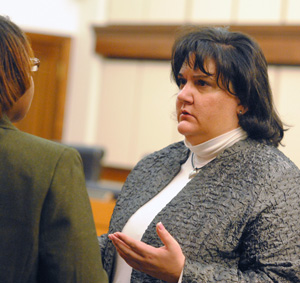
Meryl Davis, Martin Taylor, Mary Sue Coleman

UM president Mary Sue Coleman, right, talks with Olympic silver medalist Meryl Davis, left, while regent Martin Taylor looks on. Davis is one of four ice dancers who attend UM and who competed in the winter Olympics. (Photos by the writer)

During the less rambunctious portions of the meeting, regents approved two building renovations – at the Duderstadt Center and Lorch Hall – totaling $3.8 million. They also authorized the awarding of six honorary degrees at the May 1 commencement ceremony, including one to the keynote speaker, President Barack Obama.

The main presentation of the afternoon came from Laurita Thomas, associate vice president for human resources, who updated regents on the status of employee benefits.

At the end of the meeting, one person spoke during public commentary. Ann Arbor resident Rita Mitchell urged regents not to proceed with the Fuller Road Station project, a joint UM/city of Ann Arbor parking structure and transit center planned on city-owned land near the university’s medical campus. She argued that the project violated both the spirit and intent of a city charter amendment passed in 2008, which requires voters to approve the sale of city parkland.

Thursday’s meeting was in its usual location – the boardroom in the Fleming administration building, on Thompson Street. UM president Mary Sue Coleman reminded regents that next month’s meeting will be held in a different venue: the city of Grand Rapids. [Full Story]

Non-Union County Employees Face Pay Cut

Washtenaw County Board of Commissioners administrative briefing (May 27, 2009): At Wednesday’s briefing, commissioners heard more details about the county administration’s plan to cut expenses – a plan that will be formally introduced at the board’s June 3 meeting. Also, commissioners appeared to reach consensus on a proposal to cut their own expenses for 2010 and 2011. And a proposed economic development millage was taken off the June 3 agenda.

County administrator Bob Guenzel has proposed that the county’s nearly 300 non-union employees receive pay cuts of 3% and 2% in 2010 and 2011, respectively. In addition, two previously scheduled 1.5% raises in 2010 would be rescinded, and all pay-for-performance incentives would be canceled for 2009 through 2011. Health insurance benefits would also be affected – changes include instituting a $50 medical premium sharing per month, beginning in January 2011.

Guenzel told commissioners that these steps, which require board approval, would save the county roughly $2.3 million. The cuts are part of a broader effort to deal with a projected $26 million deficit over the next two years.  [Full Story]

UM Employees to Pay More Health Care Costs

Saying that “our health care costs will paralyze the university unless we take action,” University of Michigan president Mary Sue Coleman said that employees and retirees will be asked to pay a greater share of their health care costs starting in 2010. She gave no other details about the plan, saying that the leadership of various employee groups were being informed today, with information to be released to faculty and staff on Friday morning. Coleman made the announcement during opening remarks at Thursday’s Board of Regents meeting.

The cost-sharing changes – which will be available in detail on UM’s Benefits Stewardship website Friday – will also be discussed at a series of forums to be held later this month, Coleman said. No changes in benefits are planned. [Full Story]