Ann Arbor city council meeting (March 4, 2013): The council had five items on its agenda related geographically to downtown Ann Arbor – but delayed voting on two of them.

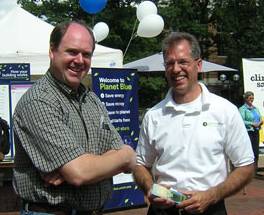
Architect Brad Moore (left) talks with resident Ray Detter. Moore is architect for two projects that were on the council’s March 4 agenda – Blue Heron Pond and 624 Church St. The council’s approval of both projects indicates the governing body is not contemplating a Moore-atorium on site plans. (Photos by the writer.)
On one of those items, the council voted to postpone its initial consideration of changes to Chapter 7 of the city code, which governs the way the tax increment finance (TIF) capture is calculated for Ann Arbor’s downtown development authority. The revisions to Chapter 7 would also affect the composition of the DDA board, excluding elected officials from service.
The council also postponed until its next meeting, on March 18, a possible moratorium on site plan review for projects in the downtown. The possible moratorium previously had been postponed from the council’s Feb. 19 meeting. After hearing extensive public commentary on the topic on March 4 – from residents and representatives of the developer of a proposed 14-story residential project at 413 E. Huron – the council went into closed session.
On emerging from the closed session, the council voted, without deliberation, to postpone the item. The wording in the resolution provides an exemption from the moratorium for site plans that already have a recommendation for approval from the city planning commission. If enacted, the moratorium as worded would still apply to the 413 E. Huron project, because the planning commission’s 5-3 vote for approval fell short of the six it needed for a positive recommendation. The 413 E. Huron site plan is now expected to be on the same March 18 meeting agenda when the moratorium will be re-visited.
Eluding the impact of the proposed moratorium’s wording was another downtown project, which appeared on the March 4 meeting agenda. The site plan for a 14-story apartment building at 624 Church St. was approved at the council’s meeting – but that project would not have been impacted by the moratorium as it’s currently proposed. That’s because it had received a recommendation of approval from the city planning commission.
The council also voted to reconstitute a task force to re-evaluate the downtown design guidelines, which supplement the city’s zoning regulations.
In the final downtown-related item, the council voted to direct the city administrator to issue a request for proposals for brokerage services to possibly sell the city-owned parcel at Fifth and William streets – the location of the former Y building. It’s currently used as a surface parking lot in the city’s public parking system.
While the city is contemplating the sale of that site, which it purchased for $3.5 million, the council voted to buy a much less expensive parcel outside the downtown, near the Bluffs Nature Area. The council approved a purchase price of $115,000 for the parcel, which is located off Orkney Street.
The council also approved two other site plans for projects not in the downtown – although the four-unit project at 515 N. Fifth is near the downtown. The council also approved the Blue Heron Pond development, a 64-unit project on the western side of town, located at Liberty and Maple.
In other business, the council approved receipt of a federal grant to demolish two of the buildings on the city-owned property at 721 N. Main. The buildings are in the floodway. A third building, in the flood fringe, is being studied by the city for possible reuse.
The property at 721 N. Main is a former maintenance yard. So none of the 44 vehicles authorized for purchase by the council at the March 4 meeting will be maintained there. Total cost of the vehicles was $928,499.
None of the vehicles authorized for purchase was a plug-in electric vehicle. However, the council passed a resolution in support of preparing city infrastructure for plug-in vehicles. Two-other energy-related agenda items included one supporting the city’s participation in Earth Hour, and another one supporting use of the city’s energy fund for energy improvements in connection with community projects.
An item that drew considerable discussion before approval related to street closings associated with the June 9, 2013 Ann Arbor marathon. [Full Story]