Stories indexed with the term ‘environmental cleanup’

DEQ Sets April 10 Public Meeting for MichCon Site

The Michigan Dept. of Environmental Quality is holding a public meeting on Tuesday, April 10, to discuss remediation of the MichCon property on Broadway Street, adjacent to the Huron River. The  meeting begins at 6 p.m. at  Cobblestone Farm, 2781 Packard Road in Ann Arbor.

MDEQ is also accepting written public comment on the remediation plan through April 30, 2012. A copy of the plan can be viewed online at ftp://ftp.deq.state.mi.us/deq-outgoing/ with the user ID deq-public-ftp and the password Jumbl355#.

A copy of the construction permit application can be viewed online by searching for the file #11810066, then clicking on the folder icon for details. Copies of the plan and permit application also can be viewed at the downtown Ann Arbor District … [Full Story]

Park Commission Briefed on Millage Renewal

Ann Arbor park advisory commission meeting (March 20, 2012): At their monthly meeting, park advisory commissioners were briefed on two millages that help fund Ann Arbor’s park system, including one that will likely be on the November ballot for renewal.

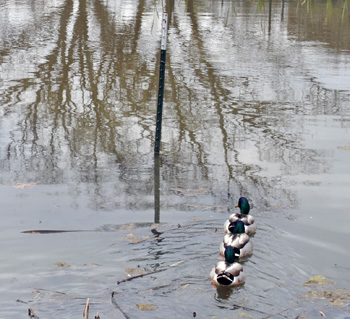
Ducks in West Park

Creatures in West Park will not be able to participate in the November millage vote, even though they apparently can get their ducks in a row. A parks millage that's up for renewal helped pay for some of the recent renovations to the park, including the boardwalk, bandshell plaza and entry stairs. (Photos by the writer.)

The park maintenance and capital improvements millage, a six-year tax, brings in about $5 million annually and accounts for about 45% of the parks budget – including the entire funding for the natural areas preservation (NAP) program. Voters will likely be asked to renew it at 1.1 mills from 2013-2018, assuming the city council votes to put the millage on the Nov. 6 ballot at that rate. PAC chair Julie Grand – who has served on a working group to strategize about the renewal – said concerns about the economic climate are a major reason why an increase isn’t being recommended.

During the millage discussion, city councilmember Mike Anglin said he supports the millage but has concerns about Fuller Park, noting that talks regarding Fuller Road Station aren’t over. Parks manager Colin Smith pointed out that no millage funds have been or would be spent on Fuller Road Station. Grand cautioned against connecting the millage renewal to Fuller Road Station, saying it’s important to inform the public clearly about what the renewal means.

To provide that information, the city plans to hold four public forums in April, and a public hearing on the millage will be scheduled for PAC’s April 17 meeting. The city also plans to launch a website in early April with more information about the millage.

Also at the March 20 meeting, commissioners got a mid-year update about the open space and parkland preservation millage, which funds the greenbelt program and park acquisitions. Fuller Road Station was a backdrop to this discussion too, when commissioner Gwen Nystuen asked about protections that are afforded land acquired through this millage.

Land acquisition also came up in two other contexts during the meeting. The future of property owned by MichCon – located north of Broadway Street, between the Huron River and the railroad tracks – was part of the discussion during an update on environmental cleanup at the site. A DTE Energy representative indicated that senior management sees the potential for redevelopment there, but no plans are finalized. It’s expected that DTE Energy, which owns the property through its MichCon subsidiary, will eventually sell the site.

And speaking during public commentary, Ann Arbor resident Larry Baird advocated for the city to acquire land to fill gaps in the Border-to-Border Trail, which roughly follows the Huron River. Specifically, he characterized a connection between Bandemer Park and Barton Nature Area as the top priority, and urged the city to focus more on this project than on high-speed rail.

In the agenda’s one action item, commissioners recommended awarding a $79,980 contract to Michigan Recreational Construction Inc. to handle renovations at Placid Way Park. The resolution also recommends an additional 10% contingency of $7,998 for a total project cost of $87,978. The 1.32-acre neighborhood park is located on the city’s north side near the larger Dhu Varren Woods Nature Area and Foxfire South Park. The project would be funded from the park maintenance and capital improvements millage. [Full Story]

Planning Group Revisits Huron River Report

Ann Arbor master plan revisions committee meeting (March 8, 2012): At the request of planning commissioner Kirk Westphal, a committee charged with reviewing changes to the city’s master plan is looking at a recommendation related to land near the Huron River.

Ann Arbor master plan revisions committee

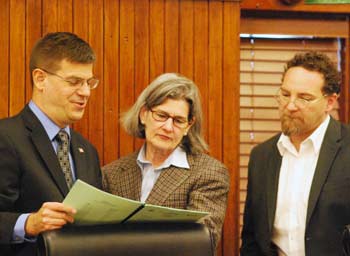
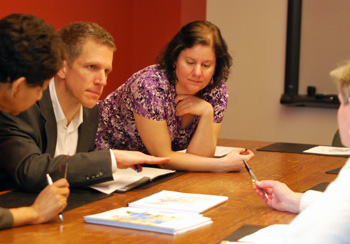
Members of the Ann Arbor planning commission, from left: Eleanore Adenekan, Kirk Westphal and Diane Giannola. At the right is Wendy Rampson, head of the city's planning staff. Commissioners were attending the March 8, 2012 meeting of the master plan revisions committee. (Photos by the writer.)

The Huron River and Impoundment Management Plan, known as HRIMP, was completed in 2009. But in large part because of controversy related to Argo Dam – centered on whether or not the dam should be removed – none of the 30 other recommendations were implemented.

Only one of the HRIMP recommendations relates to land use, and is therefore in the purview of the planning commission. That recommendation calls for limited commercial development – such as a restaurant or other publicly-used entity – in the Broadway bridge/Argo area.

Much of the discussion at the March 8 committee meeting centered on the property now owned by MichCon, a subsidiary of DTE Energy, located north of Broadway Street, between the Huron River and the railroad tracks that run past the Amtrak station. A state-supervised cleanup effort is underway at that site, but its future use – including the possibility that it could be acquired by the city and turned into a park – is unclear.

Remediation of the MichCon site was also a topic at the March 12, 2012 Ann Arbor city council work session, where the property’s potential future use was discussed. That presentation also included an update on a whitewater river feature that DTE Energy is paying for. The whitewater section to be built in the Huron River was originally part of the same project as the city’s Argo Dam bypass reconstruction. The bypass, which has been recently named the Argo Cascades, is nearly complete.

This article includes a summary of the council working session related to the MichCon cleanup, as well as a report on the master plan revisions committee meeting. Based on discussions at that committee meeting, it seems likely that a proposal will be forwarded to the full planning commission to add the HRIMP recommendation to the city’s master plan. Any changes to the master plan would also require city council approval. [Full Story]

Hearing Set for Pall Dioxane Cleanup

New documents related to the cleanup of a 1,4 dioxane groundwater plume in the Ann Arbor area, resulting from contamination by the former Scio Township manufacturing site of Gelman Sciences (now owned by Pall Corp.), have been posted on the Michigan Dept. of Environmental Quality website. Specifically, on Oct. 26, 2011, Pall filed a petition with the court stating that “if it is required to install additional compliance monitoring wells it will dispute the location of such wells.” In a response filed Nov. 7, the state argued that a consent judgement issued by the court doesn’t prohibit the installation of additional monitoring wells for the purpose of monitoring compliance with court-ordered cleanup. The state further argues that Pall’s proposed monitoring-well network is … [Full Story]

Bioremediation Possible for Southeast Park

Matt Naud, the city’s environmental coordinator, solicited a recommendation from the Ann Arbor park advisory commission at its Oct. 18, 2011 meeting regarding whether to pursue a bioremediation pilot test in a section of Southeast Area Park, a 26.5-acre city park at Ellsworth and Platt roads. The test would determine if technology to remove an existing vinyl chloride plume is effective.

The plume resulted from vinyl chloride being released from the now-closed city landfill into groundwater on the south side of Ellsworth Road. Currently, extraction wells are used to pull the groundwater and contaminants back to the extraction wells where the water is discharged to the sanitary sewer for treatment.

The pilot project would test a different type of remedial process called bioremediation, … [Full Story]

Packard Square Brownfield Project Debated

Washtenaw County board of commissioners working session (May 5, 2011): Continuing a debate that began at their regular board meeting the previous day, county commissioners spent part of their most recent working session getting more information about a brownfield proposal for the Packard Square project in Ann Arbor.

Tony VanDerworp, Conan Smith, Dan Smith

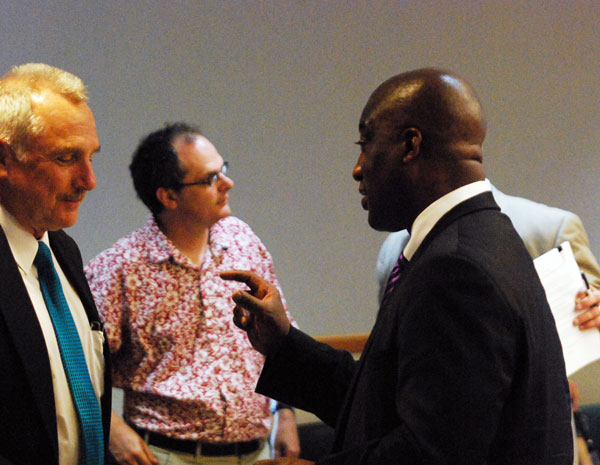
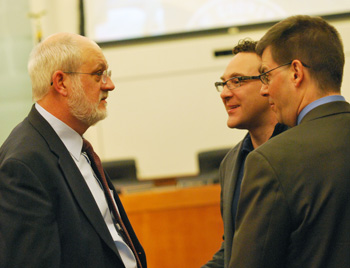
Tony VanDerworp, left, talks with Washtenaw County commissioners Conan Smith and Dan Smith before a May 5, 2011 working session. VanDerworp is director of the economic development & energy department, which manages the county's brownfield program.

The board had been asked at its May 4 meeting to give initial approval of a $1 million grant application and $1 million loan from the Michigan Dept. of Natural Resources and Environment, for brownfield cleanup at the proposed Packard Square development. The board was also asked to authorize designation of the county’s full faith and credit as a guarantee for any loan that might be awarded, up to $1 million.

It was that guarantee that raised concerns among some commissioners, who were uncomfortable putting the county potentially on the hook for a private developer – especially as the county faces a $17.5 million deficit over the next two years.

Also was a concern that the developer – Bloomfield Hills-based Harbor Companies – had not paid off back taxes owed on the site.

Commissioners discussed having county staff talk with representatives of the city of Ann Arbor, to ask whether the city would be willing to back the loan, rather than the county. The site plan and brownfield plan for Packard Square had been approved by the Ann Arbor city council on Monday, May 2.

Subsequent to the May 5 working session, the county board announced that it will hold a special working session on Tuesday, May 17 to continue discussion of the Packard Square project and a possible change to the county’s full faith and credit policy. That meeting is set to begin at 6:30 p.m. at the Washtenaw County administration building, 220 N. Main St. in Ann Arbor.

In addition, the Packard Square grant and loan application, along with the project’s brownfield plan, is on the agenda for initial approval at the board’s May 18 meeting. A public hearing on the brownfield plan is also scheduled that night. [Full Story]

Residents Frustrated by Dioxane Decision

About 50 residents gathered at Ann Arbor’s Abbott Elementary School late last month to get an update – and raise concerns – over a new consent judgment that changes the cleanup requirements of 1,4 dioxane contamination caused by the former Gelman Sciences manufacturing plant in Scio Township.

Matt Naud

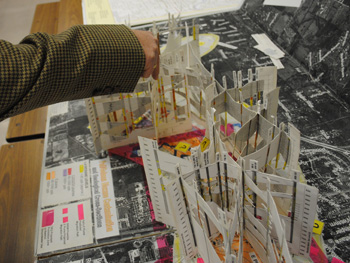
Matt Naud, the city of Ann Arbor's environmental coordinator, points to his home on a 3D map of the Pall-Gelman 1,4 dioxane plume. The map was constructed by Roger Rayle, a leader of Scio Residents for Safe Water, who brought it to the March 30 public meeting about a new consent judgment related to the plume. (Photos by the writer.)

Mitch Adelman, a supervisor with the Michigan Dept. of Environmental Quality’s remediation division, began the March 30 meeting by acknowledging the crowd’s reaction to the new agreement, which was issued earlier in the month without opportunity for public input. “I don’t expect anything I say or do tonight to alleviate your anger or frustration,” he said.

But Adelman noted that if a company like Pall – which owns the former Gelman Sciences site – proposes a remediation plan that complies with state law, “we’re obligated to accept it.”

For nearly three hours, Adelman and Sybil Kolon, MDEQ’s project manager for the Pall site, gave an update and answered questions about the new consent judgment, the history of the cleanup, and what residents might expect in the coming years. They were challenged throughout the evening by people who’ve been following this situation closely – most notably by Roger Rayle, a leader of Scio Residents for Safe Water and member of the county’s Coalition for Action on Remediation of Dioxane (CARD). Rayle has been tracking the dioxane plume for many years, and presented his own graphical renderings of data to the group.

The meeting was attended by several elected officials: Ann Arbor city councilmembers Stephen Rapundalo (Ward 2) and Mike Anglin (Ward 5); Ann Arbor Township supervisor Mike Moran; county commissioner Yousef Rabhi (District 11); and Sarah Curmi, chief of staff for state Sen. Rebekah Warren, whose district covers a large portion of Washtenaw County, including Ann Arbor and Scio Township, where the plume is concentrated. [Full Story]

Concerns Raised over Dioxane Cleanup

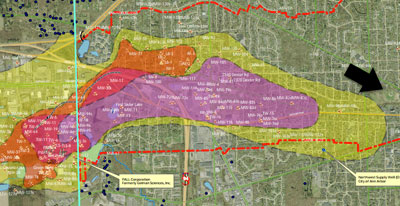
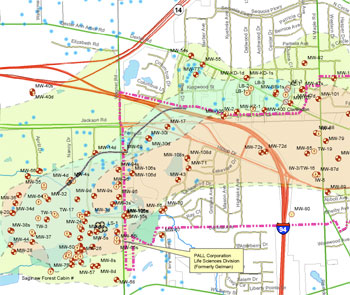
A section from a map showing the Pall Life Sciences 1,4 dioxane plume. The red dots indicate monitoring wells.

A section from a map showing the Pall Life Sciences 1,4 dioxane plume. The red dots indicate monitoring wells. (Image links to a .PDF file of the full map.)

An effort to change the cleanup of contaminated groundwater has come under fire by local residents and government officials who’ve been keeping an eye on the issue for more than 20 years.

At Wednesday’s annual meeting of the Coalition for Action on Remediation of Dioxane, residents said that requested changes filed by Pall Life Sciences earlier this month with the Michigan Department of Environmental Quality would allow higher amounts of the contaminant, 1,4-dioxane, in the groundwater. As a result, they said, the 1,4-dioxane, a presumed carcinogen, could flow northward and reach Ann Arbor’s primary drinking water supply at Barton Pond. [Full Story]