Stories indexed with the term ‘farmland’

County Working on Farmland Preservation

As the Washtenaw County parks and recreation commission moves closer to making its first decisions about farm properties to include in its land preservation program, the county board of commissioners got an update on the process at its April 5 working session.

Susan Lackey

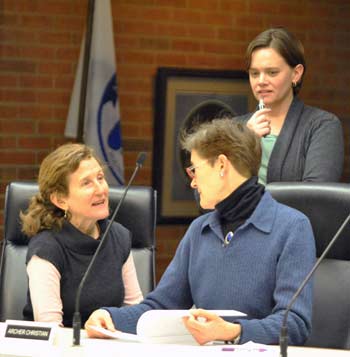
Susan Lackey, executive director of the Legacy Land Conservancy, updated commissioners about Washtenaw County's farmland preservation efforts at an April 5, 2012 working session. (Photos by the writer.)

Susan Lackey, executive director of the Legacy Land Conservancy – an Ann Arbor-based nonprofit that’s under contract to help manage the program – told commissioners that about $1.6 million is available to preserve farmland, using a portion of proceeds from the natural area preservation millage renewed by voters in November of 2010. That 10-year, 0.25-mill countywide tax also funds the acquisition of natural areas and land preserves.

Prior to 2010, the natural areas ordinance allowed for outright acquisition of land, but not for the purchase of development rights (PDR). PDR is a common mechanism for protecting farmland, letting landowners keep their property for farming but preventing – via a conservation easement – its development. In May of 2010, the county board approved an ordinance revision that incorporated farmland into the county’s natural areas preservation program and clarified the use of PDR for that purpose.

The county received 57 applications for its first round of potential deals, Lackey reported. That list has been narrowed down to seven parcels for final consideration, covering 1,100 acres. The locations of the parcels won’t be released until a final vote by the parks and rec commission. That vote will be taken when the deals are ready to close. That’s likely to happen later this year.

Yousef Rabhi was among the commissioners who praised the program, noting how it ties in with the food policy council that the county board recently created, as well as the food-related business incubator and job training program – called Seeds for Change – focused on the eastern part of the county. Rabhi serves on the Agricultural Lands Preservation Advisory Committee (ALPAC), which makes recommendations to the parks and rec commission about farmland deals.

The April 5 working session also included a briefing on the county’s community corrections unit. This report focuses just on the farmland preservation update. [Full Story]

Greenbelt Commission Terms Revised

Ann Arbor greenbelt advisory commission meeting (May 11, 2011): Wednesday was the last regular meeting for two greenbelt commissioners – terms end on June 30 for chair Jennifer S. Hall and Gil Omenn, who were both active in efforts to launch the program. Both have reached the term limits for serving on GAC.

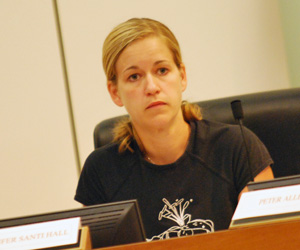
Jennifer S. Hall

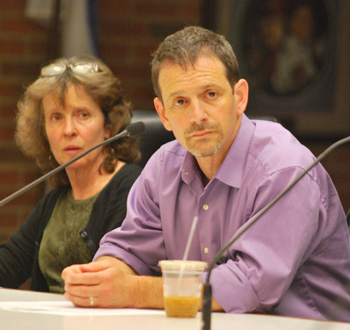
Jennifer S. Hall, chair of the Ann Arbor greenbelt advisory commission, presided over her last regular meeting on May 11. Her term ends on June 30; GAC's June meeting will be a joint session with the city's park advisory commission.

Instead of holding their regular meetings in June, the greenbelt and park advisory commissions have scheduled a joint working session to discuss common goals and priorities – they last met jointly in April 2010.

Term limits were raised in another context during Wednesday’s meeting, when commissioners were asked to recommend that city council restate current GAC membership terms. Mary Fales of the city attorney’s office has been working on the revisions, after inconsistencies were discovered for current appointments. For example, a term for Ecology Center director Mike Garfield ended on June 30, 2009. Though he continued to serve, he was not officially reappointed to another three-year term until Sept. 21, 2010. Under the resolution recommended by GAC, all terms would end on June 30, over staggered years.

Also at Wednesday’s meeting, commissioners got an update about Michigan budget-related legislation that would cut tax credits for farmers. They were also briefed by staff about changes to the federal Farm and Ranchland Protection Program – the city has received millions of dollars worth of FRPP grants over the years to offset the cost of development rights purchased in the greenbelt.

Ginny Trocchio, support staff for the greenbelt program, told commissioners that June 16 is the date for a greenbelt celebration, starting at 5:30 p.m. at the Braun farm in Ann Arbor Township, which was added to the greenbelt in 2010. The event will be open to the public, and will include a presentation to highlight the program’s accomplishments.

Dan Ezekiel, GAC’s vice chair, reported that the subcommittee he’s leading to look at possible changes in the greenbelt boundary will be making a proposal at the commission’s July 13 meeting.

And in its final action of the meeting, commissioners emerged from a closed session and voted to recommend that Ann Arbor city council make a $127,200 offer for the purchase of development rights on a property within the greenbelt. Before appearing on the city council’s agenda, details of these greenbelt acquisitions are not made public – parcels are identified only by their application number. [Full Story]

Ann Arbor Applies for Greenbelt Matches

At its Feb. 7, 2011 meeting, the Ann Arbor city council voted to approve applications to the U.S. Dept. of Agriculture’s Farm and Ranch Lands Protection Program (FRLPP) for matching grant funds for the purchase of development rights on two properties: 110 acres on the Lindemann-Weidmayer farm in Lodi Township, and 92 acres on the Grosshans farm in Superior Township.

The city’s cost would be paid out of the greenbelt millage funds. The federal match would be up to 50% of the appraised fair market value of the development rights, up to a maximum of $5,000 per acre. The greenbelt advisory commission recommended at its Dec. 8, 2010 meeting that the city make the applications to the FRLPP.

This brief was filed from the boardroom in the Washtenaw County administration building, where the council is meeting due to renovations in the city hall building. A more detailed report will follow: [link] [Full Story]

Leveling the Field for Small Farms

Ann Arbor Greenbelt Advisory Commission meeting (July 14, 2010): Small farms and local food production again was a focus of the greenbelt advisory commission (GAC), as they considered revisions to easement language and scoring criteria for the greenbelt program.

Jennifer S. Hall

Jennifer Santi Hall was elected chair of the city's greenbelt advisory commission at their July meeting, replacing Laura Rubin in that role. (Photos by the writer.)

The discussion prompted one commissioner, Dan Ezekiel, to underscore that they weren’t trying to favor small farms – they were simply trying to offset the advantages that the program has previously afforded to larger farms.

A review of revisions to the greenbelt program’s scoring criteria included a robust discussion about the meaning of “local food economy.” One of the proposed revisions would award points to farms that produce local food and contribute to the local food economy.

Commissioner Tom Bloomer, a Webster Township farmer, argued that all farms in Washtenaw County contribute to the local food economy, either directly or indirectly. Jennifer Santi Hall, who had proposed the change, agreed to withdraw the item from the scoring criteria so that they could refine the language. But she noted that it was important to find some way of including criteria for local food production, to align the scoring of applications with the greenbelt program’s strategic plan, which includes a section on the local food economy.

Later in the meeting, after nearly an hour in closed session to discuss land acquisition, the commission recommended allocating nearly $3 million in five separate deals, the majority of them for the purchase of development rights of local farms. Those recommendations will be forwarded to city council for final approval. [Full Story]

Greenbelt: How Best to Support Small Farms?

Ann Arbor Greenbelt Advisory Commission meeting (June 9, 2010): Under typical agreements crafted for the city’s greenbelt program, only 2% of land protected by a greenbelt conservation easement is allowed to be covered by an impervious surface – a house, for example, or roads.

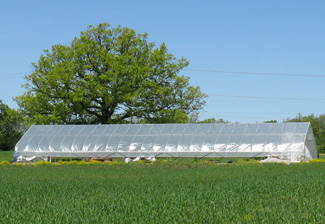
A hoop house at Sunseed Farm

A hoop house at Sunseed Farm, northwest of Ann Arbor. (Photo by Marianne Rzepka.)

To date, that hasn’t been an issue for most parcels in the program, which are fairly large – more than 40 acres. But as the greenbelt advisory commission (GAC) considers ways to support small farms – in the 15-20 acre range – some challenges have emerged. A farm of that size with hoop houses, for example, might easily result in covering more than 2% of the land.

During the public portion of this month’s GAC meeting, commissioners discussed how to address this and other issues that might require modifying the language in conservation easements for the city’s greenbelt program. Also addressed were strategies to ensure that the land stays in agriculture for future generations.

No action was taken at the June 9 meeting, and comments from commissioners indicate there’s also no clear consensus yet for how to handle this relatively new greenbelt focus. [Full Story]

Column: The 10% Local Food Challenge

Eating Thin Mints recently got me thinking about locally produced food.

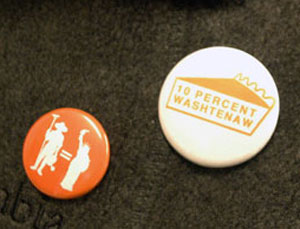
Two buttons supporting locally grown food

Many participants in the March 2 Homegrown Food Summit wore buttons like these, supporting locally grown food. (Photos by the writer.)

It’s Girl Scout cookie season, and on Saturday – after swinging through the Ann Arbor Farmers Market – I encountered a Brownie and her dad set up at the corner of Main and Liberty, their table loaded with boxes of Thin Mints, Samoas, Tagalongs and an assortment of other cookies that I remember selling too, back in the day. I bought three boxes.

At $3.50 per box, the cookies aren’t outrageously priced – though the boxes seem to get smaller every year. But later, in doing a quick calculation of all the food I’d bought that day, I realized that in buying those cookies, I’d failed to meet a challenge I’d heard earlier in the week: Spend 10% of your food budget on locally produced food.

The “10% Washtenaw” challenge was issued at the Homegrown Local Food Summit, a day-long event on March 2 that drew over 200 people to the Dana Building on the University of Michigan campus. Many of the people at the summit already surpass that goal in a fairly dramatic way. The real challenge, organizers acknowledge, is how to convince the rest of us to do the same. [Full Story]

Greenbelt Commission Backs County Tax

Ann Arbor Greenbelt Advisory Commission meeting (Feb. 10, 2010): Citing benefits to the city’s own greenbelt program, members of the greenbelt commission at their Wednesday meeting voiced support for a county land preservation millage, which is up for renewal this year.

The commission passed a resolution urging the city council formally to endorse the millage, though it’s up to the Washtenaw County Board of Commissioners to decide whether to put the millage on the ballot. It’s not yet clear the board will do that.

Greenbelt commissioners also discussed the implications of new, lower appraisals that had just been received on the Braun and Gould properties in Ann Arbor Township. The city already has binding purchase agreements with the owners based on older, higher appraised values, but recently learned that new appraisals will result in fewer federal matching funds for the acquisitions. The city could be on the hook for more money than was anticipated to close these deals.

Related to that, some commissioners raised concerns over information they’d received last month from the city attorney’s office, which appeared to be in conflict with what they were being told by staff at Wednesday’s meeting. [Full Story]

Dispute over Superior Township Settlement

There’s broad consensus on open space and farmland preservation among Superior Township’s roughly 13,000 residents.

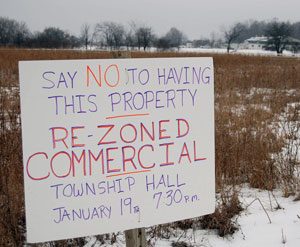
A sign opposing property rezoning in Superior Township

A sign opposing property rezoning in Superior Township. (Photos by the writer.)

It’s evident in words like those on a banner in the township hall touting a commitment to preservation. It’s evident in actions like voter approval of a special tax to defend the community’s growth-management plan.

But for all the agreement, there’s discord over the means to that end.

Rather than fighting a lawsuit they say they expected to win, township officials have struck a deal with a development group that sued after a zoning change was denied.

Disappointed residents say the settlement bails out the developers, and is a retreat from a strategy of enacting and defending a strong master plan and zoning. Township officials say buying land and development rights – as the $400,000 settlement deal will do – is the only sure way to end the battle for good.

The real goal isn’t a legal victory, but the conservation of the community’s rural character, says township supervisor Bill McFarlane. “I feel we would have won the lawsuit this time, but land values will eventually go up again and we could be fighting this again in a year, or two years or five years.” [Full Story]

Frederick Farm in Line to Join Greenbelt

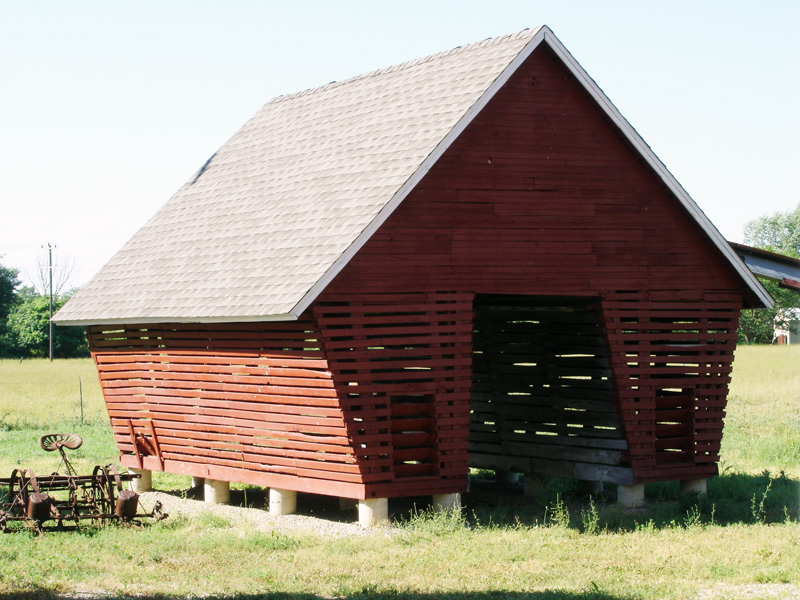
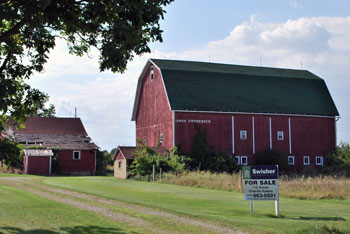
The distinctive red barn at Frederick Farm on Wagner Road.

The distinctive red barn at Frederick Farm on Wagner Road. (Photo by the writer.)

Not many people attended the September meeting of the Ann Arbor Greenbelt Advisory Commission, so it was easy to figure out who was there, and why. Scott Rosencrans, for example, came to introduce himself to the commission – he’s the new chair of the city’s Park Advisory Commission. He said he hoped the two groups could find ways to work together, given their common interests.

Others attending had a more specific goal in mind: To see whether GAC would approve the purchase of development rights to the Frederick Farm.

The commission did approve the PDR, sending it on to Ann Arbor’s city council for a vote to authorize the deal – it might be on the council’s agenda as early as November. If approved, it would be the first time the city’s greenbelt program has undertaken an agricultural project without federal funding, and the first time they’ve made a purchase in Lodi Township. If the Legacy Land Conservancy joins in on the deal as expected, it also would mark that nonprofit’s first participation in the city’s greenbelt initiative. [Full Story]