Stories indexed with the term ‘fees’

Ann Arbor Council Sets PACE Fees

At its Jan. 9, 2012 meeting, the Ann Arbor city council set fees associated with the property assessed clean energy (PACE) program: (1) the review fee for Phase I will be $300; (2) the title search fee will be the actual cost as billed by the title search company, estimated to be $230; (3) the fee for recording the assessment with the county clerk’s office will be $23 – $14 for the first page and $3 for each subsequent page of a four-page document; and (4) the administrative fee will be $13.45 for paper ($0.10), envelope ($0.25), postage ($0.42) assessment set-up ($11.72) and payment receipting ($0.96).

Through its PACE program, the city of Ann Arbor will help commercial property owners finance energy improvements through voluntary special assessments. By establishing a loan loss pool, the city can reduce interest rates for participating property owners by covering a portion of delinquent or defaulted payments. [Some previous Chronicle coverage of PACE: "Special District Might Fund Energy Program"]

At its March 7, 2011 meeting, the council had voted to set up a $432,800 loan loss reserve fund to support the city’s planned PACE program. The money for the fund comes from an Energy Efficiency and Conservation Block Grant (EECBG) awarded to the city by the U.S. Department of Energy.

This brief was filed from the city council’s chambers on the second floor of city hall, located at 301 E. Huron. A more detailed report will follow: [link] [Full Story]

Ann Arbor Sets Medical Marijuana App Fees

At its Aug. 15, 2011 meeting, the Ann Arbor city council voted to establish an application fee of $600 for licenses to operate a medical marijuana dispensary in the city. The fee covers a total of approximately nine hours of work by staff in the city clerk’s office, police department, planning department, and the attorney’s office.

The licenses for which businesses may apply were established by a city ordinance given its final approval at the council’s June 20, 2011 meeting. The ordinance distinguishes between an “application fee” and a “license fee.” The license fee, according to the city’s ordinance, is to be reviewed by a licensing board, which members are to be appointed by the mayor.

The five-member body is to consist of one member of the city council, one physician, and three other Ann Arbor residents. Nominations to the licensing board were also made at the Aug. 15 meeting: Patricia O’Rorke, James Kenyon and John McKenna Rosevear. Sabra Briere was nominated as the city council representative. Still needed is a physician to serve on the board.

The ordinance becomes effective Aug. 24, which is 60 days after its date of legal publication, on June 23. Applicants who were already in business before the city council enacted its Aug. 5, 2010 moratorium have 60 days after the effective date to apply for a license.

The city’s communications to this point with prospective applicants has not been perfectly smooth. A letter sent out by Wendy Rampson, head of planning for the city, was met with objections because of the city’s insistence that “proof” be provided that a business was in operation before Aug. 5, 2010 – beyond an affidavit attesting to that effect. The city’s ordinance appears to empower the licensing board, not staff in the city attorney’s office or the planning department, with evaluating the merits of license applications.

This brief was filed from the city council’s chambers on the second floor of city hall, located at 301 E. Huron. A more detailed report will follow: [link] [Full Story]

County Board Seeks Details on Consolidation

Washtenaw County board of commissioners meeting (July 6, 2011): Much of the discussion at this month’s county board meeting focused on the proposed merger of three departments, creating a new office of community & economic development.

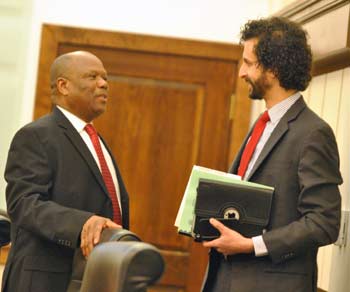
Mary Jo Callan, Tony Van Derworp

Mary Jo Callan talks with Tony Van Derworp before the start of the July 6, 2011 Washtenaw County board of commissioners meeting. Callan is overseeing the consolidation of three county departments, including the economic development and energy department, which Van Derworp leads.

In the works for over a year, the consolidation would combine the office of community development, the economic development & energy department, and the employment training and community services (ETCS) department. The goal, according to county managers, is to cut costs by eliminating duplicated services in the face of declining revenues, while finding ways to deliver those services more efficiently to residents in need. The number of full-time employees in the merged departments would drop from 40 to 32, though most of those displaced workers will likely be moved to other county jobs. In total, about $500,000 in annual savings is expected from the merger.

While generally supportive of the change, several commissioners asked for additional details, and expressed frustration that they were provided new information – including a business plan – just hours before the meeting began. The proposal was originally on the agendas for initial approval at the Ways & Means committee meeting and final approval at the regular board meeting that same night, but commissioners decided to remove it from the board meeting agenda. They’ll likely consider it for a final vote at their Aug. 3 meeting. The consolidation will also be one of the topics at the July 11 Ann Arbor city council working session – the office of community development is a joint city/county unit.

Two other items that have received considerable – often contentious – discussion at previous meetings were passed with virtually no comment. Both relate to police services that are provided under contract to local municipalities by the sheriff’s office. On the first item, the county board approved the recommendation of a court-ordered facilitator in a lawsuit filed against the county in 2006 over the cost of police services. The recommendation states that Ypsilanti Township and Augusta Township should pay the county $749,427 for police services provided in 2006. The boards of those townships are expected to vote on the recommendation this week. If approved, it could lead to the closure of that legal battle.

On the second related item, the county board gave final approval to the price that municipalities will pay for a contract sheriff’s deputy through 2015. The price in 2012 – $150,594 – is unchanged from this year, but will rise in subsequent years by about 1% annually. The complex, politically-charged process of arriving at those figures involved more than a year of discussion between the sheriff’s office, other county officials and leaders of local municipalities that contract for these services.

Several other budget-related issues were addressed during the July 6 meeting, including initial approval to an agreement with the Michigan Nurses Association – Unit I, the union that represents 13 public health nurses and nurse coordinators in the county’s health services department. It’s the first of 15 union agreements being negotiated as part of the 2012 and 2013 budget cycle, and is expected to achieve an annual savings of $132,000. In total, the county hopes to see about $8 million in labor concessions for the two-year budget cycle, to help address a projected $17.5 million deficit.

Commissioners also voted to raise the fee for waiving the statutory three-day marriage license waiting period, increasing it from $5 to $50. County clerk Larry Kestenbaum, whose office processes marriage licenses, assured the board that the vast majority of applications are willing to wait the three days, and won’t incur this additional cost for expediting the process. Conan Smith joked that he had hoped Kestenbaum would come forward with a package discount deal – for marriage licenses and concealed weapons permits. [Full Story]

Fee Hike OK’d for Expedited Marriage Licenses

At its July 6, 2011 meeting, the Washtenaw County board of commissioners approved the adoption of a $50 fee for waiving the statutory three-day marriage license waiting period. According to a staff memo, the current waiver fee of $5 does not cover the costs of the Washtenaw County Clerk and Register of Deeds in “interrupting other services to immediately fulfill a marriage license waiver request.”

This brief was filed from the boardroom of the county administration building at 220 N. Main St. in Ann Arbor. A more detailed report will follow: [link]

Ann Arbor Council Approves Fee Changes

At the May 31, 2011 session of its meeting that had begun two week before, on May 16, resumed briefly on May 23, only to be immediately recessed, the Ann Arbor city council approved a raft of fee changes in the community services and public services area. They included items in parks and recreation services like bumping daily admission at public swimming pools from $4 to $5. Fee changes also included items like increasing fees for removal of utility poles in the right-of-way from $70 to $72.50 – the charge for each additional pole increased from $27 to $28.75. [.pdf of all fee changes as proposed]

An attempt was made to eliminate a new $45 monthly fee for downtown trash … [Full Story]

Park Commission Recommends Fee Bumps

At its April 26, 2011 meeting, the Ann Arbor park advisory commission voted unanimously to recommend a set of fee increases and new program fees for park facilities as a part of the city’s fiscal year 2012 budget. The fees require final approval by the Ann Arbor city council. The FY 2012 budget, which begins July 1, 2011, will be considered and approved by the council on May 16. Fee increases would be effective July 1, 2011. [.pdf of recommended fee increases]

Examples from the set of fee increases include an increase in daily swimming pool admission fees for adults from $4 to $5, and for youth and seniors from $3.50 to $4. The increase in daily swimming pool admission fees is expected to generate an additional $40,000 in revenue for the city.

Alcohol permit fees for residents would be increased from $12 to $25, which is expected to increase revenue by $4,925.

Fees are also proposed for new activities that previously did not exist. Among the new fees would be one for renting inner tubes. The city does not currently rent them out, but expects to be able to do some business with the tubes in connection with the construction of the Argo Dam bypass channel – which is projected to be completed at the end of this season. It would cost $10 to rent a tube. The city is projecting 1,000 such rentals for April-June 2012, for an additional $10,000 in revenue for the FY 2012 budget.

Another fee for a new activity would be for the pilot night market program on Wednesday evenings – the stall charge would be $20, which is expected to generate $10,000 for the city. [Previous Chronicle coverage: "Idea for Night Farmers Market Floated"]

This brief was filed from the Washtenaw County boardroom at 220 N. Main St. A more detailed report of the meeting will follow: [link] [Full Story]

Fee Increase Suggested for Athletic Fields

Ann Arbor Park Advisory Commission (Jan. 19, 2010): As part of a project to upgrade the athletic fields at Fuller and Olson parks, members of the city’s Park Advisory Commission approved an increase in fees to use those fields. One commissioner described the fields, which had previously been in serious disrepair, as “a thing of beauty.”

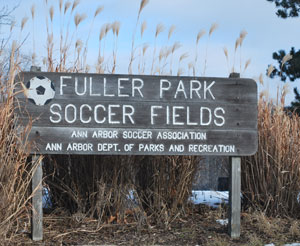
Sign at the entrance to the Fuller Park soccer fields, next to Fuller Pool.

Sign at the entrance to the Fuller Park soccer fields, next to Fuller Pool. (Photos by the writer.)

Three speakers during public commentary, all representing groups that use the fields heavily, said they didn’t have a problem with the fee hike, but hoped that the change could be phased in over three years, rather than implemented this season. The recommendation for an increase, along with changes in how the fields are used, will be forwarded to city council.

Commissioners also approved recommendations from the task forces that are working to raise revenues and cut costs for Mack Pool and the Ann Arbor Senior Center. Commissioner Tim Berla clarified that the PAC resolution was primarily an “atta boy!” for the work of the staff and task forces, and support of the direction they’re headed. The recommendations – which aim to keep those operations open – will be presented to city council at their Feb. 8 meeting.

And finally, as a bonus for readers who stick with this report until the end: One commissioner is championing an urban dog park, and has identified a potential location within the city. [Full Story]