Stories indexed with the term ‘Fuller Road Station’

Art Commission Acts on Dreiseitl Proposal

Ann Arbor Public Art Commission (July 13, 2010): A significant increase in cost and several design issues resulted in rejection by AAPAC of one art installation proposed by German artist Herbert Dreiseitl, and the postponement of another. The votes followed an animated discussion on the proposals.

A drawing that shows the proposed art installation by Herbert Dreiseitl for the lobby of the new police/courts building on Fifth and Huron.

A drawing that shows the proposed art installation by Herbert Dreiseitl for the lobby of the new police/courts building on Fifth and Huron. The piece includes etched blue glass panels, on the right, and blue glass bulbs hanging from the ceiling, in the left corner of this drawing. Commissioners voted to postpone action on this work, with plans to ask Dreiseitl to cap the cost at $75,000.

Commissioners voted to postpone a proposal for artwork in the lobby of the city’s new municipal center – the artwork has a budget of $141,218. They plan to ask Dreiseitl to cap the project at $75,000. With dissent from chair Margaret Parker, they rejected a work proposed for the center’s atrium, with a budget of $73,806, citing concerns over the cost, design and durability of the material.

In other business, the group got an update on their involvement in the proposed Fuller Road Station, with commissioner Cathy Gendron reporting that the project architects have already selected the location, materials and theme for public art on the parking structure and transit facility. “I had no idea that things were so far along at this project,” she said.

And a vote to allocate funds for repair of the Sun Dragon Sculpture at Fuller Pool prompted a broader discussion on how to handle maintenance costs for public art.

Some organizational changes are in the works, too. Commissioner Jim Curtis announced plans to step down at the end of 2010, to devote more time as a board member for the startup Ann Arbor Main Street Business Improvement Zone (BIZ). AAPAC will be recruiting a replacement for him. And Katherine Talcott, who has served as the part-time public art administrator, has signed a new one-year contract with the city – in the role of an art project manager. She’ll be handling the Dreiseitl project, Fuller Road Station and other projects that are assigned to her by Sue McCormick, the city’s public services administrator. The job of public art administrator is being restructured, and has not yet been filled. [Full Story]
Land Uses Expand; Plan Regs Relaxed

Ann Arbor City Council meeting (July 6, 2010) Part 2: The two main events of the council’s Tuesday meeting were consideration of a historic district on Fourth and Fifth avenues and a resolution opposing Arizona’s recently passed law requiring local law enforcement officers to follow up on possibly undocumented immigrants.

huron-river-days-eunice-burns

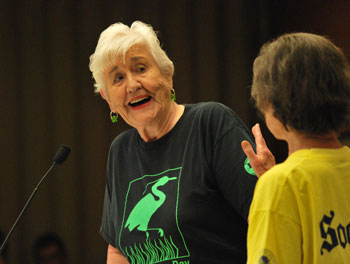
Eunice Burns and Shirley Axon, co-founders of Huron River Day, were at the podium to receive a proclamation honoring the event to be held July 11. (Photos by the writer.)

Public commentary and deliberations on those two issues sent the council’s meeting well past midnight. [Chronicle coverage of those issues is included in Part 1 of this meeting report: "Unscripted: Historic District, Immigration"]

The council transacted a lot of other business as well. Councilmembers approved a change to the zoning code that modifies the list of allowable uses for public land so that the planned Fuller Road Station can be accommodated. Also passed was a change to the site plan approval process, which relaxes the requirement that up-to-date site plans be accessible to the public on a 24/7 basis.

Parks were front and center, and not just because of the public hearing and council action on allowable uses of public land. At the start of the meeting, a proclamation was made for Huron River Day, which takes place at Gallup Park on Sunday, July 11. And the council continued its pattern at the first meeting of the month of recognizing volunteers who help maintain the city’s parks through the Adopt-a-Park program.

In other action, the council approved the $2.5 million purchase of development rights for the 286-acre Braun farm in Ann Arbor Township, as recommended by the city’s greenbelt advisory commission, and established a residential parking permit program for the South University area. [Full Story]
Park Commission Asks for Transparency

Ann Arbor Park Advisory Commission meeting (June 15, 2010): A temporary venue change led more than two dozen people to the Community Television Network studios for this month’s PAC meeting.

Colin Smith, Tim Doyle

Colin Smith, left, the city's parks and recreation manager, talks with Tim Doyle, who was attending his first meeting as a new park advisory commissioner. Doyle replaced the position formerly occupied by Scott Rosencrans, who did not seek reappointment. (Photos by the writer.)

The main agenda item was consideration of two resolutions regarding Fuller Road Station, and many people who attended the meeting were there to address commissioners on that topic – most of them protesting the use of city parkland for what will, at least initially, be a large parking structure and bus depot, built in partnership with the University of Michigan.

Park commissioners have expressed concerns about the project, and resolutions were crafted to address those issues, including a possible financial loss to the parks system and a lack of transparency in the process.

At several points during deliberations, Christopher Taylor – a city councilmember and ex-officio member of PAC – defended the process, indicating that while it was a misstep that PAC wasn’t formally asked for input, there had been many opportunities for public participation.

PAC ultimately approved a resolution that asks city council to make available a complete plan of Fuller Road Station – including any significant proposed agreements, such as what the university will pay the city for use of the structure – allowing sufficient time for a presentation at a televised PAC meeting before council votes on the project. The resolution also asks that staff and council ensure the project results in a net revenue gain for the parks system.

Several other speakers during public commentary addressed the issue of Huron Hills Golf Course, and expressed concerns that the city would seek to privatize it. During his manager’s report, Colin Smith told commissioners that a draft request for proposals (RFP) regarding Huron Hills won’t be finished until August at the earliest, and will be brought to PAC for review before being issued by the city.

The meeting also included a presentation by Molly Notarianni, the city’s market manager, with an update on the farmers market and public market activities.

Tuesday’s meeting was also the first for PAC’s newest commissioner, Tim Doyle. Doyle was recently appointed by city council to replace Scott Rosencrans, who did not seek reappointment. In welcoming him, PAC chair Julie Grand joked: “You picked a good one to start.” [Full Story]

PAC Softens Stance on Fuller Road Station

Ann Arbor Park Advisory Commission working session (June 1, 2010): Members of the Ann Arbor Park Advisory Commission took another crack at drafting a resolution regarding the proposed Fuller Road Station, softening some of the language that had previously called for city council to abandon the project. The station includes a large parking structure, bus depot and possible train station for commuter rail, to be built in partnership with the University of Michigan near the UM medical complex.

The changes are in response to a plea for unity by mayor John Hieftje, who had attended PAC’s May 18 meeting where he spoke with commissioners for an hour about their concerns. He told commissioners that the city has a better chance of getting federal funding for the project if they show a united front.

PAC members have been concerned that if the project moves forward, the city would receive less revenue from UM for parking than it currently gets from the surface lots it leases to the university on Fuller Road. Those revenues support the city’s park operations. Among other issues, some commissioners are also troubled that the structure is to be built on land that’s designated as parkland, and that there’s been limited opportunity for public input.

Immediately following a June 1 meeting of PAC’s land acquisition committee, which includes all members of the commission, PAC members stayed for a working session on the Fuller Road Station. Chair Julie Grand brought a revised resolution to consider, and the group thrashed through issues and language to come up with a draft that will be discussed at PAC’s June 15 regular meeting.

In addition, commissioner Tim Berla plans to propose an alternative resolution, which he emailed to other PAC members on Monday. His resolution focuses on process – asking that the city council and staff be fully transparent in providing details about the agreement to the public. [Full Story]

Hieftje Urges Unity on Fuller Road Station

Ann Arbor Park Advisory Commission meeting (May 18, 2010): During an hour-long presentation and Q&A, Ann Arbor mayor John Hieftje urged park commissioners to support the proposed Fuller Road Station, saying he’d like the city to present a unified front as they pursue federal funding for the $46 million project – a large parking structure, bus depot and possible train station for commuter rail.

Amy Kuras, Jim Kosteva

Jim Kosteva, right, talks with Ann Arbor parks planner Amy Kuras during Tuesday's meeting of the Ann Arbor park advisory commission. Kosteva, director of community relations for the University of Michigan, was on hand for a discussion of the Fuller Road Station, though he did not address the commission. (Photos by the writer.)

Heiftje’s presentation had not been on the agenda, but the commission was set to discuss a resolution that called for city council to stop the project, or at the least negotiate better terms with its partner, the University of Michigan. Several commissioners have expressed concerns about the project, which would be on city-owned property designated as parkland. Under proposed terms – which Hieftje said are not finalized – the city would receive less revenue from UM for parking than it currently gets from the surface lots it leases to the university on Fuller Road. Those revenues support the city’s parks operations.

Another public meeting on the project is set for Wednesday, June 2, from 7-9 p.m. at city council chambers, 100 N. Fifth Ave.

Also at Tuesday’s meeting, commissioners got a brief update on the urban forestry management plan – the first of two public meetings is set for Thursday at Tappan Middle School from 7-9 p.m. to get input on developing a plan to manage the city’s trees.

The artist selected for a public art project at West Park – Traven Pelletier of Lotus Gardenscapes – spoke briefly about his design. And in a third-quarter financial update for parks and recreation, commissioner Sam Offen reported that they’re in better shape than expected, needing less general fund support than they had originally budgeted for the current fiscal year. [Full Story]

Better Deal Desired for Fuller Road Station

Two city commissions on Tuesday addressed two very different actions related to Fuller Road Station, a joint city of Ann Arbor/University of Michigan project that initially will entail a large parking structure and bus station, with possibly a train station for commuter rail years down the road.

Gwen Nystuen, David Barrett, Doug Chapman

Park advisory commissioners Gwen Nystuen, David Barrett and Doug Chapman at Tuesday's meeting of PAC's land acquisition committee, held at Cobblestone Farm. Nystuen has been pushing for more input into the Fuller Road Station project. (Photos by the writer.)

Spurred by concerns that Ann Arbor parks are being shortchanged, members of the city’s park advisory commission (PAC) discussed a resolution on Tuesday that would urge city council not to proceed with plans for Fuller Road Station at its proposed site on city-owned land that’s designated as parkland.

The draft resolution also states that if the city council does continue with the project, the city should renegotiate the deal to get additional revenues from the University of Michigan, with those funds being allocated to city parks. The resolution calls for an annual payment of $127,500 from the university – under the current agreement, UM would pay $19,379 per year, starting in 2012.

Park commissioners didn’t take any action, and plan to discuss the draft resolution further at their May 18 meeting.

But Tuesday evening, the city’s planning commission did take action related to Fuller Road Station. They voted unanimously to amend the list of permitted principal uses of public land – specifically, changing a “municipal airports” use to “transportation facilities.” During a public hearing on the issue, several speakers – including park commissioner Gwen Nystuen – objected to the change.

It’s expected that the project – located on the south side of Fuller Road, just east of East Medical Center Drive – will be submitted by the design team on May 17 for review by planning staff. It will likely come before the planning commission at its first meeting in July. A public meeting on the project is set for Thursday, May 6 at 7 p.m. in the second-floor city council chambers, 100 N. Fifth Ave. [Full Story]

Pleas for Human, Safety Services at Council

Ann Arbor City Council meeting (May 3, 2010): Several speakers addressed the city council at its Monday meeting asking for continued funding for human services and to avoid layoffs in the city’s police and fire departments.

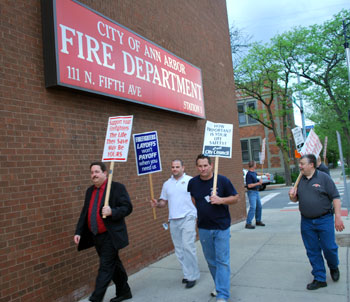
Fire fighters informational picket

Firefighters held an informational demonstration Monday afternoon before the city council's meeting at Station 1, which is located across the street from city hall. Firefighters from Flint, Dearborn, Dearborn Heights, Ann Arbor Township, Ypsilanti, Battle Creek and Ann Arbor took part in the demonstration. (Photos by the writer.)

And Margie Teall (Ward 4), who faces two challengers in the August Democratic primary, announced a planned amendment to the city’s proposed budget that would maintain human services funding at FY 2010 levels. The amendment, which will be brought forward at the council’s May 17 meeting, would also avert as many layoffs in the police and fire departments as possible, she said.

The previous evening at the council’s Sunday night caucus, Mike Anglin (Ward 5) and Sabra Briere (Ward 1) had already indicated they would support using part of a possible $2 million payment from the Downtown Development Authority to avoid police and firefighter layoffs.

The council’s plan for funding the amendment, reported Teall, is to use a $2 million payment from the Downtown Development Authority that it hopes the DDA board will approve at its May 5 board meeting. Even if the DDA board approves the payment, which is very likely but not certain, not all safety services layoffs in the city administrator’s proposed budget could be covered. Averting the elimination of 35 positions across police and fire departments combined would require $3.6 million. The restoration of human services funding would require another $260,000. And that would still result in the city tapping its general fund reserves for $1.5 million.

In its business for the evening, the council passed a resolution added late Monday to the council agenda, which strikes an agreement between the city and the Michigan Dept. of Natural Resources and Environment for the future of the embankment along Argo Dam. It will allow the headrace to be re-opened by the end of this week.

The council also approved on first reading a revision to the city’s sidewalk occupancy permit system to include sandwich board signs. And the residential development now called Heritage Row – proposed along Fifth Avenue south of William Street – was approved at the council’s first reading with no discussion, but with dissent from Mike Anglin. Both of those measures will need to come back before the council for a second reading to gain approval.

The council also approved received the mayor’s nomination of the appointment of Anya Dale to the AATA board, replacing Paul Ajegba, whose term expired on May 1. Ajegba had been elected by his colleagues last fall to chair the board. Dale is a Washtenaw County planner. Her appointment will be presented for confirmation at the council’s May 17, 2010 meeting.

The council also approved some additional road closures for the June 6 Dexter-Ann Arbor Run. [Full Story]

Transportation Talk at City Council Caucus

Ann Arbor City Council Sunday night caucus (May 2, 2010): Transportation was one of the main focuses of conversation at last night’s city council caucus, which is held on the Sunday before the council’s regular meeting.

Hieftje Briere Kunselman

Sabra Briere (Ward 1) and Stephen Kunselman (Ward 3) listen to a presentation from the Committee for the Preservation of Community Quality at the city council's Sunday night caucus. (Photo by the writer.)

The Committee for the Preservation of Community Quality gave a presentation of their response to the recently conducted environmental assessment of a possible runway extension at the Ann Arbor municipal airport. And residents expressed concerns about the proposed Fuller Road Station and its location on city-owned land designated as a park in the city’s PROS (Parks and Recreation Open Space) Plan.

By the time questions about the possible upcoming budget amendments were raised, the number of councilmembers attending the caucus had dwindled from four to two. Mayor John Hieftje, Sabra Briere (Ward 1), Stephen Kunselman (Ward 3), and Mike Anglin (Ward 5) were there through most of the meeting, but it concluded with just Briere and Anglin.

And at the tail end of the gathering, the residents who attended weighed in on the nature of caucus itself. They offered their perceptions of the value of discussions among councilmembers at the caucus versus their own remarks. They’d prefer to see councilmembers in action and would be willing to trade some of their own time for watching the work of council. [Full Story]

Investments: Housing, Bridges, Transit

Ann Arbor City Council meeting (April 19, 2010) Part 2: In Part 1 of this meeting report, we focused on the city’s budget process, parking issues and the University of Michigan commencement exercises.

In Part 2, we wrap up other topics of the meeting. One common theme was capital investments in the community’s physical infrastructure of various kinds.

Michael Nearing city of Ann Arbor engineer

Michael Nearing, city of Ann Arbor engineer, was available for any city council questions on the East Stadium bridge project. (Photo by the writer.)

The council allocated a total of $313,000 for three different permanent affordable housing projects in Ann Arbor.

The city’s East Stadium bridge replacement project received discussion in the form of a resolution that authorized the city to go after state funding for the third time in the last three years. The anticipated construction start for fall of this year has been postponed until spring 2011 – the earlier date had been tied to the city’s application for federal funding, which was rejected this February.

The ongoing construction of the police/courts building, directly adjacent to city hall (the Larcom Building), received some tangential discussion in the form of an explanation from Roger Fraser about the recent closure of city hall due to elevated carbon monoxide levels. The police/courts building was also the subject of public commentary that prompted some extended remarks from the mayor – which were covered in Part 1 of this report.

Another construction project that will likely factor into the upcoming primary election campaigns is Fuller Road Station. The city-university collaboration to build a combined parking deck and bus station, which might eventually serve as a commuter rail station, was taken up during the council’s communications time. Christopher Taylor (Ward 3) and mayor John Hieftje both responded to some cautionary remarks made by Mike Anglin (Ward 5), which he made based on a recent park advisory commission meeting.

In business related to ethics and rules, the council voted on two occasions to excuse the participation of Taylor in a vote, because of a conflict of interest posed by his employment with the law firm Butzel Long. They also satisfied the requirement of a recent lawsuit settlement that they formally consider a rule about their use of government email accounts – by voting to remand consideration of the issue to council’s rules committee. [Full Story]

AATA Gets Its Fill of Fuller Road Station

Ann Arbor Transportation Authority board meeting (April 21, 2010): On Wednesday, Eli Cooper, the city of Ann Arbor’s transportation program manager, gave the AATA board an update on Phase One of Fuller Road Station – a city-university collaboration to build a combined parking structure, bus station and bicycle amenity south of Fuller Road, abutting the University of Michigan medical campus. The project envisions eventual integration of a train station for east-west commuter rail, if service along the Detroit-Ann Arbor corridor can be established.

Eli Cooper Ann Arbor Transportation Manager

Eli Cooper, the city of Ann Arbor's transportation program manager, sets up his visual aids for the Fuller Road Station. (Photos by the writer.)

Confronted with skepticism from board member David Nacht, who expressed his doubts that the rail service would ever become a reality, Cooper urged a “glass as half full” view of the project. Cooper was buoyed in part by a recent phone call he’d received from the Michigan Dept. of Transportation about another round of funding that the Federal Railroad Administration will be making available.

AATA board member Sue McCormick also gave some shape to the city’s funding strategy for its share of the Fuller Road Station project: Once the environmental impact study is completed, that will make it possible for the local transit agency – in this case, the AATA – to apply for federal funds for the project. That’s consistent with the message thus far from city officials, who have said that whatever the funding strategy will be, it won’t involve city general fund money.

In its main business items of the meeting, the board approved a contract worth $399,805.32 with a consultant, Steer Davies Gleave, to head up the formulation of a transportation master plan (TMP), which will underpin the AATA’s effort to expand its service countywide. The board also approved an allocation of $350,000 for a period ending March 31, 2012, that will allow the AATA to task one of three public relations firms for work, depending on the nature of the project: The Rossman Group, Ilium Associates, and re:group.

Both resolutions passed, with dissent from the board’s treasurer, Ted Annis.

The board made a decision at its March board meeting to change its meeting time and location to Thursdays at the downtown Ann Arbor District Library. Although it was discussed then that the new time and location would begin in two months, board discussion on Wednesday suggested that the target for changing the new time is now August 2010. [Full Story]

Park Commission OKs Fee Increases, Budget

Ann Arbor Park Advisory Commission meeting (April 20, 2010): At Tuesday’s meeting, park commissioners gave their blessing to proposed fee increases and the parks budget for FY 2011, recommending that city council approve both items.

Karen Levin, Gwen Nystuen, David Barrett

Gwen Nystuen, center, passes out copies of a draft resolution to Karen Levin and David Barrett, her colleagues on the Ann Arbor park advisory commission. Nystuen is proposing that PAC form a subcommittee to review the impact of the Fuller Road Station. (Photos by the writer)

The proposed budget would keep all of the city’s 157 parks open, but would cut back maintenance – mowing and snow removal – on 17 parks. The budget also proposes keeping open Mack Pool and the Ann Arbor Senior Center, which had previously been slated to close. A handful of supporters for those two groups who attended Tuesday’s meeting applauded when commissioners approved the budget.

Only one commissioner – Gwen Nystuen – voted against recommending the budget, citing objections to a proposed rollback of funds for the city’s Natural Area Preservation (NAP) program.

Nystuen also floated a proposal to form a subcommittee that would review the impact of the Fuller Road Station. That project, which is jointly funded by the city and the University of Michigan, would initially include a large parking structure and bus station on city-owned land that’s designated as parkland. Nystuen has been vocal about her concerns over setting a precedent with this project, and frustrated that PAC hasn’t taken a more active role on the issue.

Commissioners also got a brief update on the status of an RFP being drafted by city staff for the possible privatization of the Huron Hills Golf Course, and heard from an organizer of the Ann Arbor skatepark during public commentary, who invited commissioners to an April 25 design workshop. [Full Story]

Ann Arbor Caucus: Fires, Fines, Fuller

Ann Arbor City Council Sunday night caucus (April 18, 2010): Access to city hall for the caucus on Sunday evening required a manual unlocking of doors with assistance from the Ann Arbor police department. But after gaining lawful entry, about a half-dozen residents discussed a range of topics with the three councilmembers who attended – mayor John Hieftje, Sabra Briere (Ward 1) and Stephen Kunselman (Ward 3).

Bob Snyder couch fire

Bob Snyder reads aloud from the preliminary report of the Ann Arbor fire department, which summarizes the events of a recent nighttime house fire that killed one resident.

A recent fire on South State Street, which killed a resident of the house that burned, prompted a call to revisit a 2004 proposal to ban from porches the use of indoor furniture, like couches. That measure was ultimately tabled by the council six years ago, left to demise without any action.

A couple of residents expressed some disappointment that the councilmembers would not be discussing the budget that evening, but budgetary topics did make their way into the conversation. Chief among them were the relationship of the new parking fine schedule – which is expected to generate an extra $635,000 for the FY 2011 budget – to the parking plan that’s scheduled to be presented on Monday night to the council by the Ann Arbor Downtown Development Authority.

Questions about the planned Fuller Road Station were also raised, including the plan for financing the project. That project is not on Monday night’s agenda. But a different major capital project does have an associated Monday agenda item: the East Stadium bridge replacement. The item involves authorization for the city to apply for funds from the state’s local bridge fund – the city’s most recent application was denied. Caucus attendees heard Hieftje explain that the city would delay the start of replacement construction from fall 2010 to spring 2011, to allow for another round of funding applications.

The council also got an update on one resident’s ongoing efforts to move a mid-block crosswalk in front of King Elementary School to an intersection where cars already stop. [Full Story]

Indefinite Busy Signal for Cell Phone Ban

Ann Arbor City Council meeting (April 5, 2010) Part 2: The greatest part of the council’s meeting last week – covered in Part 1 of our report – was taken up with the public hearing and deliberations on The Moravian project, which failed to get the 8-vote super majority it needed for approval. However, the council handled other business besides The Moravian.

Kirk Westphal

Kirk Westphal addressed the city council as a private citizen on the issue of the cell phone ordinance – he serves on the city's planning commission. He encouraged councilmembers to pursue the ordinance. (Photos by the writer.)

Among that business was a proposed local ordinance banning cell phone use while driving or bicycling. The council decided not to repeat a postponement to a particular date for its consideration of the cell phone ban. Instead, the council tabled the ordinance. Tabling means that the ordinance can be brought back for consideration by the council, but by council rule it will die unless it is brought back within six months.

The council’s business included an item that would have reconsidered its recent decision to replace the entire Ann Arbor housing commission board. The motion for reconsideration was voted down, with no support, not even from its two sponsors – Stephen Kunselman (Ward 3) and Mike Anglin (Ward 5). Kunselman cited the late hour as part of the reason for his lack of enthusiasm for pursuing the matter. Two people had spoken during public commentary on the issue, including one of the ousted board members.

Also receiving brief discussion was a possible council rule on email that the council must consider publicly at its next meeting under terms of a recent lawsuit settlement. Two proclamations were also made, one to declare April as Parkinson’s Disease Awareness Month and the other as part of a recent move by the council to honor parks volunteers once a month. [Full Story]

Concerns Voiced Over Fuller Road Station

Ann Arbor Park Advisory Commission meeting (March 16, 2010): Fuller Road Station was the focus of this month’s PAC meeting, including a presentation by Eli Cooper and others on the project’s team. Five people spoke on the topic during public commentary as well – all of them concerned about the proposed parking structure and transit center.

Greta Brunschwyler, Sam Offen, Jason Frenzel

From left: Greta Brunschwyler, the new executive director at the Leslie Science & Nature Center, talks with park advisory commissioner Sam Offen and Jason Frenzel, volunteer and outreach coordinator for the city's Natural Area Preservation program, prior to the March 16 PAC meeting. (Photo by the writer.)

Several commissioners had pointed questions for Cooper. Sam Offen pressed him on the issue of revenues, noting that when the parking structure is built, the university might have no need for the spaces it leases from the city on the opposite side of Fuller Road – resulting in a loss of about $38,000 per year to the city.

Also attending the meeting was Greta Brunschwyler, the new executive director at the Leslie Science and Nature Center, who started the job on March 4 and came to introduce herself to park commissioners and staff.

Leslie Science and Nature Center is where Jason Frenzel’s office is located. Frenzel, volunteer and outreach coordinator for the city’s Natural Area Preservation program, gave a brief presentation about volunteer opportunities.

Scott Rosencrans, PAC’s chair, wasn’t able to attend the meeting, which was led in his absence by vice chair John Lawter. Lawter announced that Rosencrans has decided not to seek reappointment to PAC when his term ends in mid-April. So not only will PAC need to elect a new chair, Lawter said, there will also be an opening on the commission. [Full Story]

UM Regents Skate Through Agenda

University of Michigan Board of Regents meeting (March 18, 2010): Thursday’s meeting was a routine, relatively brief session – punctuated rather dramatically by the arrival of four Olympic ice dancers, who turned the regents, as one of them observed, into “total groupies.”

Meryl Davis, Martin Taylor, Mary Sue Coleman

UM president Mary Sue Coleman, right, talks with Olympic silver medalist Meryl Davis, left, while regent Martin Taylor looks on. Davis is one of four ice dancers who attend UM and who competed in the winter Olympics. (Photos by the writer)

During the less rambunctious portions of the meeting, regents approved two building renovations – at the Duderstadt Center and Lorch Hall – totaling $3.8 million. They also authorized the awarding of six honorary degrees at the May 1 commencement ceremony, including one to the keynote speaker, President Barack Obama.

The main presentation of the afternoon came from Laurita Thomas, associate vice president for human resources, who updated regents on the status of employee benefits.

At the end of the meeting, one person spoke during public commentary. Ann Arbor resident Rita Mitchell urged regents not to proceed with the Fuller Road Station project, a joint UM/city of Ann Arbor parking structure and transit center planned on city-owned land near the university’s medical campus. She argued that the project violated both the spirit and intent of a city charter amendment passed in 2008, which requires voters to approve the sale of city parkland.

Thursday’s meeting was in its usual location – the boardroom in the Fleming administration building, on Thompson Street. UM president Mary Sue Coleman reminded regents that next month’s meeting will be held in a different venue: the city of Grand Rapids. [Full Story]

To Do: Bicycle Registry, Transit Station

Ann Arbor City Council meeting (March 1, 2010) Part 2: Editor’s note: The major themes of the council meeting – the 3% budget directive, a ban on use of cell phones while driving, and a planned unit development called The Moravian – are covered in Part 1 of the March 1, 2010 meeting meeting report.

Larry Deck WBWC

Larry Deck, board member of the Washtenaw Bicycling and Walking Coalition, addressed the council during the public hearing on the repeal of the city's bicycle registration system. (Photos by the writer.)

The council scrapped the city’s existing bicycle registration program at its Monday night meeting, but gave an assurance to a representative of the Washtenaw Bicycling and Walking Coalition that it would soon be replaced with something better.

Mayor John Hieftje used his communications time to rebut criticism of the planned Fuller Road Station – both with respect to its funding and its siting. While he assured critics that funding for the project would not come from the general fund, he allowed that he did not know how the project would be paid for.

And Christopher Taylor (Ward 3) reiterated enthusiasm for Ann Arbor’s response to a request for information by Google about a local fiber-optic network. He had also introduced the topic at a recent council meeting focusing on the budget.

The city administrator’s report to the council included updates on construction projects.

The city also continued a monthly recognition of its parks volunteers with a mayoral proclamation honoring Praveena and Madhan Ramaswami for their efforts to improve Bromley Park by organizing biannual events to remove invasive plants, plant flowers, and clean up the park. [Full Story]

Transit Forum Critiques Fuller Road Station

Chris Leinberger was blunt in his assessment of the proposed Fuller Road Station: If the parking structure is built as proposed, in 20 years it will be torn down.

Fuller Road parking lot

The city-owned Fuller Road parking lot, site of the proposed Fuller Road Station. To the south of the lot is the University of Michigan medical complex. (Photos by the writer.)

Speaking at a forum on transit-oriented development, Leinberger – a University of Michigan professor of practice in urban planning – said current plans for the joint UM/city of Ann Arbor project do a good job of incorporating different kinds of transit, from bikes and buses to perhaps, eventually, commuter rail.

But Leinberger criticized the project for taking some of Ann Arbor’s most valuable land and turning it into something that won’t generate revenue for the city. He told Eli Cooper, the city’s transportation program manager, that “whoever’s in your position 20 years from now will tear it down.”

Monday’s forum, held at the UM Art & Architecture building on north campus, was organized by members of the WALLY Coalition and the 208 Group, among others, to focus on local transit-oriented development efforts. Moderated by local developer Peter Allen, the event included presentations by Cooper, Richard Murphy of the city of Ypsilanti and Shea Charles, Howell’s city manager. [Full Story]

Fleshing Out Fuller Road Station

At left: Architect John Mouat, a member of the Fuller Road Station design team, talks with Eli Cooper, the city's transportation manager, before the start of the Feb. 10 citizen participation forum. Moaut is a partner in the Ann Arbor firm of Mitchell and Mouat. (Photos by the writer.)

At left: Architect John Mouat, a member of the Fuller Road Station design team, talks with Eli Cooper, the city's transportation program manager, before the start of the Feb. 10 citizen participation forum. Mouat is a partner in the Ann Arbor firm of Mitchell and Mouat. (Photos by the writer.)

For Eli Cooper, the city of Ann Arbor’s transportation program manager, a project like the proposed Fuller Road Station happens “once in a lifetime” – an opportunity for the city, he says, to take a vision and make it reality in a fairly short time.

What it will take to reach that reality was the topic of a Feb. 10 public meeting on the Fuller Road Station, a joint University of Michigan/city of Ann Arbor project. Its first phase entails a parking structure with about 1,000 spaces – nearly 80% of them earmarked for UM use.

But much of the presentation by city staff and members of the design team focused on the broader goals for that site, which they hope will eventually include a train station for commuter rail. [Full Story]

AATA Board: Get Bids to Rebuild Blake

Ann Arbor Transportation Authority board meeting (Dec. 16, 2009): At its regular meeting Wednesday night, the AATA board gave authorization to staff to solicit bids for the demolition, design and construction of a replacement for the Blake Transit Center, located in downtown Ann Arbor on Fourth Avenue.

AATA temporary board room

At its headquarters on South Industrial Avenue, the AATA board tried out a makeshift venue for its Wednesday board meeting, because it offered an additional 12 seats for audience members, compared to the actual boardroom. Conceptual plans for the new Blake Transit transit center downtown include a boardroom. (Photos by the writer.)

The conceptual design calls for the new center to be constructed on the same footprint as the old center, with flexibility to expand, if abutting property were to become available.

The hope for flexibility on the Blake Transit Center design had also surfaced earlier in the day, at the Downtown Development Authority‘s transportation committee meeting. There, the concept of Fourth Avenue as a transit corridor had been floated by DDA executive director Susan Pollay.

In other business, the board kept the discussion going on the question of how to proceed in expanding its service to include more of Washtenaw County. But they did not consider any resolutions related to formation of a new, expanded public transit authority. As part of the effort to expand, a general board consensus emerged that the public needed to be educated about what public transit is, and how the AATA worked.

Related to the need to educate the public about what the AATA does was the treasurer’s report, submitted by Ted Annis, which recommended greater financial transparency through posting various financial data on the AATA website. The specific suggestion to post employee salaries was not embraced by all on the board, but the suggestions were remanded to the performance monitoring and external relations committee (PMER).

And a response by staff to the November treasurer’s report highlighted a potential point of contention in estimating revenues available for funding an expanded service. Specifically, how much revenue could be expected from fares in an expanded service? [Full Story]

Council OKs Recycling, Transit, Shelter

people standing in a semi-circle

Left to right: Brian Nord and Caleb Poirier (back to camera), who are both advocates for Camp Take Notice, a self-governed encampment of homeless people. Also Sabra Briere (Ward 1) and Mayor John Hieftje. (Photo by the writer.)

Ann Arbor City Council meeting (Nov. 5, 2009): Meeting on Thursday due to the elections, instead of in its usual Monday slot, Ann Arbor’s city council moved ahead on two major initiatives that will eventually have a significant impact on Ann Arbor residents.

The council approved a memorandum of understanding with the University of Michigan to move forward on joint development of the Fuller Road Station, which offers the university an alternative to construction of a parking deck on Wall Street. The first phase of the project is anticipated to be completed in mid-June 2012.

Also given a green light was a conversion to single-stream recycling – a single cart will be distributed to residents to replace the twin totes currently used for curbside pickup. The new carts will be rolled out in June 2010.

A more immediate impact will be made by a council decision to allocate a combined $159,500 to the Shelter Association of Washtenaw County and the Interfaith Hospitality Network – the funds will increase the sheltering capacity by 50 spots for individuals through the winter, starting Dec. 1, and provide housing vouchers for eight families for a year. [Full Story]

Work Session: Trains, Trash and Taxes

slide showing in red highlight the area of Main Street Ann Arbor that would be included in a business improvement zone

The proposed business improvement zone would include Ann Arbor's Main Street from William Street in the south to Huron Street in the north.

Ann Arbor City Council work session (Oct. 12, 2009): It’s a world where you can throw your newspapers, glass bottles and plastic tubs into one single recyclables cart and set it out for morning collection.

It’s a world where you can then board a bus that drops you off at the train station for your morning commute to Detroit.

It’s a world where during the work day you watch a foot of snow fall, but on your return home to Ann Arbor, you see that the snow hasn’t just been plowed on Main Street – it’s been completely removed – along with those handbills you’d noticed plastered on the lightpost.

It’s a world where later at home, you roll your empty recycling cart back to its place. Then you log on to the internet and see you’ve earned $250 worth of points tallied by the weight of the recyclables that the truck has been recording and crediting for the last year.

At its Monday night work session, Ann Arbor’s city council heard presentations on all the discrete elements of that world, which Ann Arbor could start to resemble in a couple of years. [Full Story]

City Seeks Feedback on Transit Center

At Tuesdays meeting of the Ann Arbor Park Advisory Commission, Eli Cooper shows a conceptual design for a proposed transit center on Fuller Road

At Tuesday's meeting of the Ann Arbor Park Advisory Commission, Eli Cooper shows the original conceptual design for a proposed transit center on Fuller Road. A newer version (see below) includes two buildings and a possible roundabout at Fuller and Maiden Lane. (Photo by the writer.)

Tim Berla of the Ann Arbor Park Advisory Commission has a suggestion to liven up the proposed Fuller Road transit center: Add a pub. You can bet that people who use the nearby city athletic fields would grab a post-game beer there, he told Eli Cooper at Tuesday’s PAC meeting.

Cooper, the city’s transportation program manager, was soliciting feedback from PAC members and giving them an update on the project known as FITS – the Fuller Intermodal Transportation Station. FITS is  a joint venture by the University of Michigan and the city of Ann Arbor that would include 900 parking spaces in a multi-level structure.

Cooper made clear that the two partners are hoping to get more input from the general public, too. To that end, on Thursday, Sept. 17, the city will host two public forums at city hall, from 3-5 p.m. and 6-8 p.m. After incorporating feedback from a variety of stakeholders, Cooper said the city hoped to present the facility’s conceptual design for approval at the city council’s Oct. 19 meeting.

Meanwhile, at Tuesday’s meeting several PAC commissioners had questions about the project, including a query about the designation of the city-owned land being used: In the city’s master plan, it’s designated as parkland – which didn’t originally mean a place to park cars. For zoning purposes, however, parkland is under the broader designation of “public land” – which can include transportation uses. [Full Story]

Council Gets Update on Stadium Bridges

Jim Kosteva and Sue McCormick at Ann Arbor City Council Meeting

Jim Kosteva, UM director of community relations, and Sue McCormick, director of public services for the city of Ann Arbor. Council agendas like the one Kosteva is holding are always printed that color – i.e., there was no pandering to the university reflected in the use of maize-colored paper. (Photo by the writer.)

Ann Arbor City Council meeting (Aug. 17, 2009): When Jim Kosteva appears at an Ann Arbor city council meeting, it usually means that there’s a city-university issue before the body – Kosteva is the university’s director of community relations.

Was it the report from city staff on the status of the East Stadium Boulevard Bridge replacement that had brought Kosteva to council’s chambers? There’ll be easements required from the university to complete that $22 million project.

But no, Kosteva was not there to hand over a giant fake check symbolizing a university contribution to reconstruction of the bridges.

However, he was there to affirm the university’s support for a different project – called FITS. University support will come to the tune of $327,733 out of a total project budget of $541,717 – for the site investigation, project definition and development of conceptual plans for the Fuller Intermodal Transportation Station (FITS). The station will be nestled between Fuller Road and East Medical Center Drive, just east of Fuller & Maiden Lane, near the university’s massive medical campus.

In other business, the city council put a charter amendment on the November ballot that would relax current charter requirements regarding publication of ordinances passed by the council. The Chronicle’s coverage of that charter amendment takes the form of a column published earlier this week.

The council also revisited a resolution it had passed at its previous meeting to establish a historic district study committee, along with a moratorium on demolition within the district. That moratorium was expanded Monday night to include all “work.”

And finally, as had been suggested at the council’s Aug. 16 Sunday caucus, councilmembers indicated that they’d be considering rules changes at their Sept. 8 meeting. In connection with that discussion, Mike Anglin (Ward 5) indicated he’d be calling for the city to make available all city council emails dating back to the year 2000. [Full Story]

City Staffers Brief Wall Street Neighbors

Ann Arbor University of Michigan

Eli Cooper, transportation program manager with the city of Ann Arbor, discusses the possible location of a transit center nestled between Fuller Road and East Medical Center Drive, just east of Fuller & Maiden Lane.

On Tuesday evening, way after hours at Northside Grill, a collection of city staff and city councilmembers met with around 40 residents to discuss the relationship of the University of Michigan with the city of Ann Arbor – both generally and with specific regard to the proposed UM expansion along Wall Street.

That construction is currently proposed to include an office building, parking structure and transit center. It was not news to neighbors that UM plays by a different set of rules (its own). What could have been a revelation were the general mechanisms by which city staff work in an environment where they can attempt to nudge UM to adhere to the vision outlined in the city’s planning documents – documents that were created with participation of UM staff.

So there were no magic bullets offered that could kill the parking structure component of the current UM Wall Street expansion. But the vision of a possible transit station along Fuller Road, which would include a substantial number of parking spaces serving a variety of needs, was held out as a possibility that could attract the university away from building more parking along Wall Street. That potential transit station would be nestled between Fuller Road and East Medical Center Drive, just east of Fuller & Maiden Lane.  [Full Story]