Editor’s note: This “Live Updates” coverage of the Ann Arbor city council’s Feb. 18, 2014 meeting includes all the material from an earlier preview article published last week. We think that will facilitate easier navigation from the live updates section to background material already in the file.
The council’s Feb. 18, 2014 agenda is highlighted by public art policy issues leftover from its previous meeting, as well as several items related to acquiring various pieces of basic equipment – from a garbage truck to a wood chipper.
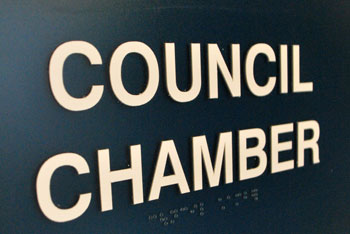
The sign on the door to the Ann Arbor city council chamber, installed in the summer of 2013, includes Braille.
The possible acquisition of land is also on the agenda, in the form of a resolution postponed from an earlier meeting. The resolution would exercise the city’s right of first refusal to purchase the 16.7-acre Edwards Brothers Malloy property on South State Street. This process began when the University of Michigan offered to buy the property. An item authorizing the $12.8 million purchase is on the Feb. 20 UM board of regents agenda, based on the assumption that the city won’t exercise its right of first refusal earlier in the week.
In other action, the council will consider an amendment to the city’s public art ordinance for a second and final vote on Feb. 18, having given initial approval to the item on Feb. 3. The ordinance amendment would allow the council to transfer money that accumulated in the public art fund through the (now demised) Percent for Art funding mechanism in previous years. The money would be transferred back to the funds from which it was originally drawn – but that transfer would require a separate council action. To be approved, the ordinance change will need a six-vote majority on the 11-member council. The enactment of an ordinance can be vetoed by the mayor, but a veto can be overridden by an eight-vote majority.
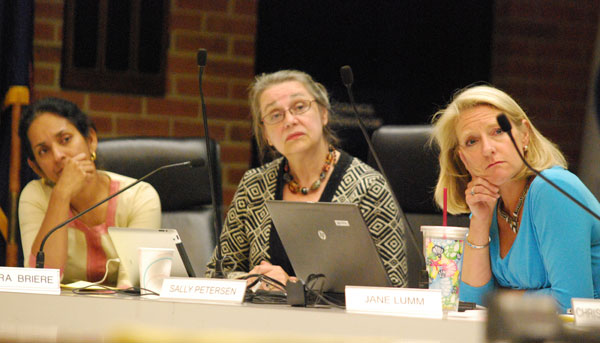
Dependent on the public art ordinance amendment are two competing resolutions that would return money from the public art fund to the funds from which that money was drawn. That includes funds like the sanitary sewer fund and the street millage fund. Based on the Feb. 3 council deliberations, the debate on such a resolution would likely center on the amount to be returned to funds of origin, not the question of returning at least some of the money. And that point of possible disagreement is reflected in the amounts specified in the two resolutions. A resolution sponsored by Jane Lumm (Ward 2), Jack Eaton (Ward 4) and Sumi Kailasapathy (Ward 1) would transfer $819,005 back to the funds of origin.
A resolution added later to the agenda is sponsored by Sabra Briere (Ward 1). Briere’s proposal would eliminate funding for the stalled Argo Cascades art project and would return $957,140 to the funds of origin. Briere’s resolution also directs the city administrator to establish a budget for public art administration for both the 2015 and 2016 fiscal years. [An initial list of requests from department heads for FY 2015, released by the city on Feb. 10, shows an $80,000 request for arts administration, which includes funds for a full-time art administrator.]
Either of the two proposed resolutions related to public art funds would require eight votes to pass.
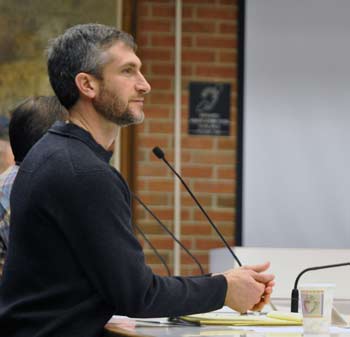
Also expected back from the Feb. 3 agenda is a resolution that was defeated at that meeting – to extend the contract for the part-time public art administrator by six months and to appropriate funds to cover that $18,500 contract. It would need eight votes to pass. The result of the Feb. 3 council vote was that public art administrator Aaron Seagraves cannot currently be paid. The contract is supposed to be back on Feb. 18 for reconsideration – as part of the political bargain among councilmembers on the overall question of how the Percent for Art money that accumulated in the public art fund will be handled.
The council’s Feb. 18 agenda also features several pieces of equipment essential to core services. One of those core services is the repair of water main breaks, which have increased in frequency in recent weeks as the ground moves due to deeper and deeper penetration of frost. The council will be asked to approve the $441,535 purchase of a combination sewer truck, which is outfitted with a vacuum device – often used to control water in an excavation during the repair of a water main break. Also deployed when repairing water main breaks is a hydraulic excavator. So the council will be asked to approve the purchase of one for $176,472. Both of those authorizations are replacements of existing city equipment.
The council will also be asked to approve the purchase of a new garbage truck for $93,800. The purchase of two vans for a total of $50,320 is also on the council’s Feb. 18 agenda. The vans will be used by the parks and recreation staff to shuttle passengers when they start a river trip at one of the cities liveries on the Huron River. Rounding out equipment purchases is a $83,208 wood chipper.
Another piece of equipment shows up on the agenda in the form of a grant application the council is being asked to approve. The $334,140 grant application is being made to the 2013 Assistance to Firefighters Grant (AFG) program of the U.S. Department of Homeland Security – to acquire a mobile training facility to train firefighters. The 48-foot-long unit will allow live fire and tactical simulations.
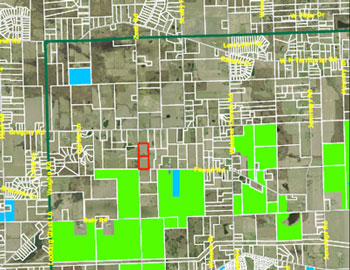
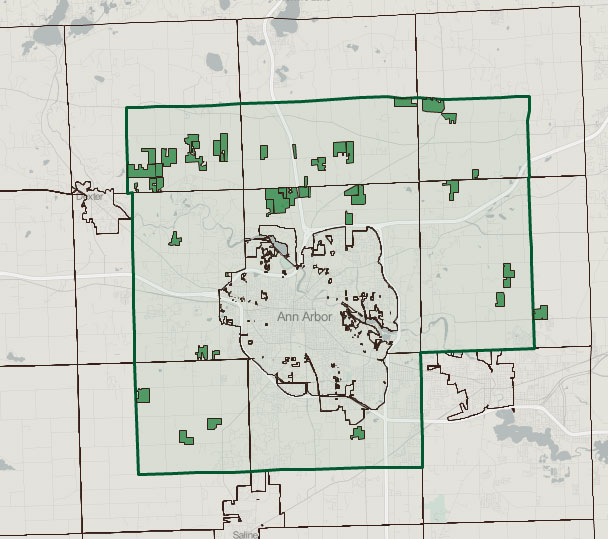
In addition to the Edwards Brothers deal, several other real estate matters are on the Feb. 18 agenda. The council will be asked to approve the acquisition of development rights for two properties, using funds from the greenbelt millage. The first is a 24-acre parcel just north of the Huron River in Scio Township. The city of Ann Arbor will be contributing $25,200 to the total $84,000 cost of purchasing development rights, with the township contributing the difference. The second greenbelt property on the agenda is a 64-acre property on Zeeb Road, also in Scio Township. For that deal, the city is contributing $39,000 to the total purchase price of $130,335.
Related to land use, council will also be asked to give final approval to the zoning of the Hofmann property on South State Street – to C1 (local business district). The property houses Biercamp Artisan Sausage and Jerky.
On the consent agenda is a contract with MDOT for reimbursement to the city for a portion of the cost to install rectangular rapid flashing beacons at three locations: on Geddes Road at Gallup Park; Fuller Road 400 feet east of Cedar Bend Drive; and on South University Avenue at Tappan Avenue. The city’s cost for the $47,971 project would be $14,179.
This article includes a more detailed preview of many of these agenda items for the Feb. 18 meeting, which was shifted to Tuesday because of the Presidents Day holiday on Monday. More details on other agenda items are available on the city’s online Legistar system. The meeting proceedings can be followed Tuesday evening live on Channel 16, streamed online by Community Television Network.
The Chronicle will be filing live updates from city council chambers during the meeting, published in this article below the preview material. Click here to skip the preview section and go directly to the live updates. The meeting is scheduled to start at 7 p.m. [Full Story]






![… [Full Story]](../../wp-content/uploads/2014/02/moore-property-large.jpg)