Stories indexed with the term ‘Huron River Watershed Council’

Sustaining Ann Arbor’s Environmental Quality

Ann Arbor city staff and others involved in resource management – water, solid waste, the urban forest and natural areas – spoke to a crowd of about 100 people on Jan. 12 to highlight work being done to make the region more environmentally sustainable.

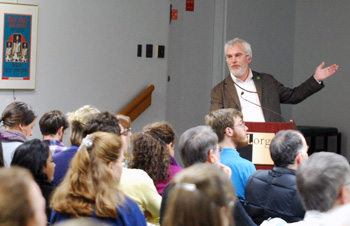
Matt Naud

Matt Naud, Ann Arbor's environmental coordinator, moderated a panel discussion on resource management – the topic of the first in a series of four sustainability forums, all to be held at the Ann Arbor District Library. (Photos by the writer.)

It was the first of four public forums, and part of a broader sustainability initiative that started informally nearly two years ago, with a joint meeting of the city’s planning, environmental and energy commissions. The idea is to help shape decisions by looking at a triple bottom line: environmental quality, economic vitality, and social equity.

In early 2011, the city received a $95,000 grant from the Home Depot Foundation to fund a formal sustainability project. The project’s main goal is to review the city’s existing plans and organize them into a framework of goals, objectives and indicators that can guide future planning and policy. Other goals include improving access to the city’s plans and to the sustainability components of each plan, and to incorporate the concept of sustainability into city planning and future city plans.

In addition to city staff, this work has been guided by volunteers who serve on four city advisory commissions: Park, planning, energy and environmental. Many of those members attended the Jan. 12 forum, which was held at the downtown Ann Arbor District Library.

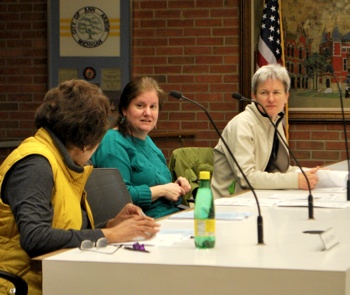
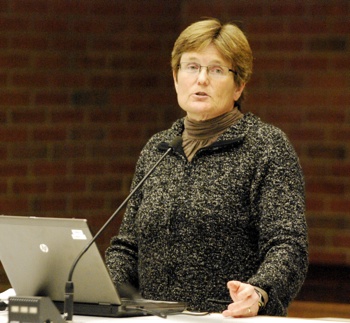
The topics of the forums reflect four general themes that have been identified to shape the sustainability framework: Resource management; land use and access; climate and energy; and community. The Jan. 12 panel on resource management was moderated by Matt Naud, the city’s environmental coordinator. Panelists included Laura Rubin, executive director of the Huron River Watershed Council (and a member of the city’s greenbelt advisory commission); Kerry Gray, the city’s urban forest and natural resource planning coordinator; Jason Tallant of the city’s natural area preservation program; Tom McMurtrie, Ann Arbor’s solid waste coordinator, who oversees the city’s recycling program; and Chris Graham, chair of the city’s environmental commission.

Dick Norton, chair of the University of Michigan urban and regional planning program, also participated by giving an overview of sustainability issues and challenges that local governments face. [The university has its own sustainability initiative, including broad goals announced by president Mary Sue Coleman last fall.]

The Jan. 12 forum also included opportunities for questions and comments from the audience. That commentary covered a wide range of topics, from concerns over Fuller Road Station and potential uses for the Library Lot, to suggestions for improving the city’s recycling and composting programs. Even the issue of Argo Dam was raised. The controversy over whether to remove the dam spiked in 2010, but abated after the city council didn’t vote on the question, thereby making a de facto decision to keep the dam in place.

Naud said he’s often joked that the only sure way to get 100 people to come to a meeting is to say the topic is a dam – but this forum had proven him wrong. The city is interested in hearing from residents, he said: What sustainability issues are important? How would people like to be engaged in these community discussions?

The forum was videotaped by AADL staff and will be posted on the library’s website. Additional background on the Ann Arbor sustainability initiative is on the city’s website. See also Chronicle coverage: “Building a Sustainable Ann Arbor,” and an update on the project given at the November 2011 park advisory commission meeting. [Full Story]

RiverUp! Focuses on Revitalizing Huron River

Ann Arbor park advisory commission (July 19, 2011): A new project to shore up the ecological health and recreational infrastructure of the Huron River – and to strengthen the economies of river communities like Ann Arbor and Ypsilanti – is getting ready for its public debut in mid-August. Park commissioners were briefed on the RiverUp! effort at their July meeting, and were invited to an Aug. 16 bus tour of sites that will be given initial attention in the Ann Arbor and Ypsilanti area.

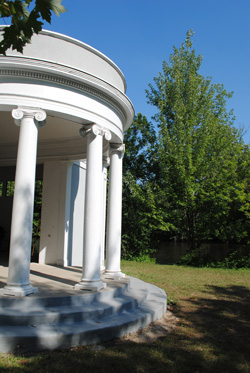
Greek Revival shelter at Ann Arbor's Island Park

Greek Revival shelter at Ann Arbor's Island Park, where an event to launch the RiverUp! project will be held on Aug. 16. (Photos by the writer)

Elizabeth Riggs of the Huron River Watershed Council, which is coordinating the project, told PAC members that RiverUp! is spearheaded by a conservancy group called the Wolfpack. Co-founded by attorney and former Clinton advisor Paul Dimond and retired Ford executive Ray Pittman, Wolfpack members – mostly from the Ann Arbor area – have been previously focused on state issues. Now, Riggs said, they are turning their attention to a 104-mile stretch of the Huron River, starting from the north at Milford through Ann Arbor and Ypsilanti, and downstream to Flat Rock.

Also at their July meeting, commissioners got an update about efforts to build an Ann Arbor skatepark. They also reviewed tentative FY 2011 budget results for the parks system – finals numbers will be presented to the commission in August.

Several other topics were discussed or mentioned during the meeting, in the form of communications from staff or commissioners: (1) an update on work at Argo dam; (2) concerns over the proposed Fuller Road Station and the site design’s consideration of the Border-to-Border Trail; (3) a roughly $100,000 donation from the Henrietta Feldman trust; (4) news of the resignation of Greta Brunschwyler, executive director of the Leslie Science & Nature Center; and (5) a preview of an August agenda item regarding dog parks.

Other news regarding the Argo dam project – a $1.17 million effort to build a bypass channel in the Argo dam headrace, and to add whitewater features – emerged the week after PAC’s July 19 meeting.

A July 25 memo from city staff reports that the city was recently notified by DTE officials of upcoming remediation work that DTE plans to do in 2012 adjacent to DTE’s property on the south side of the Huron River, between Allen Creek Drain and the Broadway Bridge. The remediation is being required by the Michigan Dept. of Environmental Quality.

DTE is offering to pay for the whitewater feature of the Argo dam project, if the city agrees to hold off on construction of that piece until after DTE completes its remediation. Details of the offer haven’t been finalized. [Full Story]

Finally a Dam Decision on Argo?

Ann Arbor City Council Sunday night caucus (Oct. 18, 2009): At its Sunday night caucus, Ann Arbor city council members heard from only a couple of residents who actually spoke in favor of keeping Argo Dam in place.

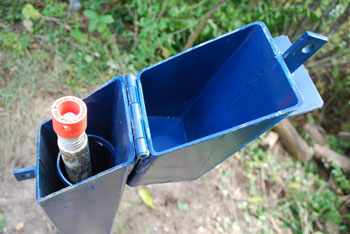
Piezometer installed in mid-September along the earthen berm separating the Argo Dam headrace from the river. (Photo by the writer)

But those speakers were supported by the presence of almost two dozen others who attended the regular Sunday evening affair, to make clear that they also supported a resolution on the dam – which was added to Monday’s Oct. 19 agenda on Friday, Oct. 16.

Monday’s resolution, which is sponsored by Stephen Rapundalo (Ward 2), Marcia Higgins (Ward 4), and Sandi Smith (Ward 1), expresses the intent of city council to keep the dam in place. [Text of the resolution]

At caucus, one of the voices of dissent on the resolution belonged to Laura Rubin, executive director of the Huron River Watershed Council. She told the three councilmembers present – Stephen Rapundalo (Ward 2), Sabra Briere (Ward 1), and Mike Anglin (Ward 5) – that there’d been an expectation that the city council would follow the example of the city’s Park Advisory Commission and the Environmental Commission by holding a formal public hearing on the vote.

The resolution on Monday’s agenda does not include a public hearing.

After the caucus concluded, Rubin told The Chronicle that the expectation of a city council public hearing was based on a hearing that had been planned for July 6, 2009, but that was canceled when the council decided to ask the Michigan Department of Environmental Quality for more time to decide. We had a look at The Chronicle archives to verify that contention.

Other caucus topics addressed by residents included a crosswalk to be installed at the intersection of Waldenwood and Penberton drives and a request for an update on the East Stadium bridges. Council will consider a resolution on Monday to follow the advice of an outside engineering consultant to proceed with removal of bridge beams supporting the southern lanes, which are currently closed to traffic. [Full Story]

Runoff Lemonade, Poop in the Watershed

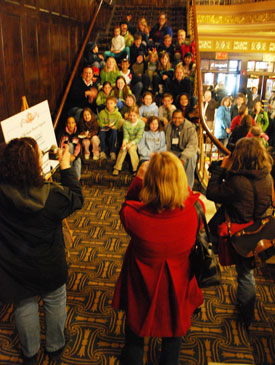
Students and teachers from Northside Elementary. Two classes had entries in the Millers Creek Film Festival.

A photo op for students and teachers from Northside Elementary at the Michigan Theater. These fourth and fifth grade students had entries in the Millers Creek Film Festival.

It’s not an image you see on the big screen every day: Close-up shots of dogs pooping, and then of their turds being plopped into an otherwise clear glass of water.

Funny, memorable and making a point – this is what happens (albeit less graphically) when you don’t pick up your dog’s excrement and it finds its way into the Huron River watershed. And by making the point this way, Nani Wolf, a fifth grader at Emerson School, won an award at the 2009 Millers Creek Film Festival.

About 350 people gathered on Friday afternoon, March 13, to see the festival entries at the Michigan Theater. (If you missed it, the winners will eventually be posted on YouTube. Here’s a link to last year’s winners.)

The event, now in its fourth year, is a way for the nonprofit Huron River Watershed Council to promote the importance of stewardship to the river and its tributaries, including Millers Creek. The festival’s three categories are short films (less than five minutes) from adult filmmakers, short films from school-age filmmakers, and 30-second public service announcements. [Full Story]