Stories indexed with the term ‘LDFA’

Work Session: Snow Plows, Buses, LDFA, Peds

The relatively heavy agenda of the Ann Arbor city council’s Dec. 12 work session includes: (1) a demonstration of the city’s new automatic vehicle location (AVL) snow plow tracking system; (2) the annual report of the local development finance authority (LDFA); (3) a presentation on countywide transit from the Ann Arbor Transportation Authority; and (4) a review of pedestrian safety issues at crosswalks.

The AVL snow plow tracking system is supposed to provide residents with real-time information on the status of plowing activity, through GPS devices mounted on the trucks. The devices monitor not only a vehicle’s location, but also whether the plow is deployed, along with other vehicle performance information. The city’s snow plow status page currently requires … [Full Story]

Staebler Appointed to Development Authority

At its Oct. 17, 2011 meeting, the Ann Arbor city council voted to appoint Ned Staebler to fill an open four-year term on the local development finance authority (LDFA) board. The term will end June 30, 2015. The position previously was held by Michael Korybalski. That term expired on June 30, 2011 but had not yet been filled.

The LDFA is funded through TIF (tax increment financing) capture in a geographic district comprising the Ann Arbor Downtown Development Authority and the Ypsilanti Downtown Development Authority districts. However, TIF revenue for the LDFA is generated only in the Ann Arbor DDA district. The principal activity of the LDFA is a business accelerator. The LDFA contracts with Ann Arbor SPARK to manage the accelerator.

Staebler took a position starting in the summer of 2011 as vice president of economic development for Wayne State University, after previously serving with the Michigan Economic Development Corp.

Staebler currently serves on the city’s Housing and Human Services Advisory Board, which was established in 2007 to replace two other bodies: the Community Development Block Grant (CDBG) executive committee and the city’s housing policy board. The function of the HHSAB is to make recommendations on policies and programs to address the needs of low-income residents, to monitor the implementation of Ann Arbor’s housing policy and the creation of a city housing coordinator.

Staebler lost a close Democratic primary race for District 53 state representative against Jeff Irwin, who was elected to that position in November 2010.

This brief was filed from the city council’s chambers on the second floor of city hall, located at 301 E. Huron. A more detailed report will follow: [link] [Full Story]

Recycling, Yes for Now; Public Art, Postponed

Ann Arbor city council meeting (Sept. 19, 2011): The council’s agenda contained a raft of significant items, which could have easily pushed the meeting past midnight. But councilmembers maintained a brisk pace, postponing a few key issues that allowed them to wrap up the meeting in around four hours.

Christopher Taylor, Marcia Higgins, Stephen Kunselman

Christopher Taylor (Ward 3), Marcia Higgins (Ward 4), and Stephen Kunselman (Ward 3) before the city council's Sept. 19 meeting. (Photos by the writer.)

Public commentary was dominated by the theme of public art, with several people weighing in against a proposed change to the city ordinance setting aside 1% of all capital improvement projects for public art. One of the changes would exclude the use of funds generated by the street/sidewalk repair tax from inclusion in the public art program. Those taxes are on the Nov. 8 ballot.

The deliberations on the public art ordinance provoked some overt politicking at the table between Carsten Hohnke (Ward 5) and Stephen Kunselman (Ward 3), which concluded with Kunselman challenging his council colleagues to direct the city attorney to write a formal legal opinion justifying the legal basis for the public art program.

The proposed changes to the public art ordinance were motivated in part by a desire to assure voters that their street/sidewalk repair millage would not instead be spent on public art. However, the council postponed the public art ordinance revision until its second meeting in November – after the vote on the millage. That’s also well after the planned dedication ceremony for the Dreiseitl water sculpture on Oct. 4 – a project paid for with public art funds.

At its Monday meeting, the council also postponed a vote on a resolution of intent expressing the council’s plan for spending the sidewalk/millage money.

The council also considered a proposal to cancel a 10-year contract signed last year with RecycleBank, a company that provides a coupon-based incentive program for city residents to participate in the city’s recycling program. The data from the first year of the contract was not convincing to councilmembers that the RecycleBank program was having a positive impact.

However, councilmembers voted instead to direct city staff to negotiate towards a revised contract that RecycleBank had offered, which reduces RecycleBank’s fee by one-third.

The council approved a settlement with its police union, retroactively to 2009. The new contract is similar to those that other city unions have also settled on – including no wage increases, and pension and health care plans that require a greater contribution from employees than in the past. The city still has two unions (firefighters and police command officers) with contracts yet to be settled. Contracts with those unions will now have to conform to the requirements of new state legislation, effective Sept. 15, that limits the amount that the city can contribute to the health care costs of its employees.

Also related to police staffing, the council authorized the use of federal money to hire five police officers, if the city is awarded a grant for which it has applied.

In another employment-related issue, the council gave final approval to a revision to its retirement system, which lengthens the vesting period to 10 years and computes the final average compensation (FAC) based on five years instead of three.

Land use and property rights were a recurring theme throughout the meeting. Those items included: approval of the sale of a strip of city-owned downtown land to the Ann Arbor Transportation Authority; postponement of a request from a medical marijuana business for rezoning a parcel on South State Street; authorization of city staff to begin with the systematic annexation of township islands located within the city boundaries; and initiation of the process to levy a special assessment of Dexter Avenue property owners to fill in sidewalk gaps.

Items fitting the general category of economic development included a tax abatement for Picometrix, the setting of a tax abatement public hearing for Arbor Networks, and the expression of the council’s intent to establish a property assessed clean energy (PACE) district. The PACE program is a way for the city to offer loans to commercial property owners for the purpose of making energy improvements.

Among other items on the agenda, the council also passed a resolution calling on Gov. Rick Snyder not to sign legislation that would eliminate same-sex domestic partner benefits for public employees.  [Full Story]

Budget Round 5: Economic Development

Last Monday night, the Ann Arbor city council held its fifth and possibly final meeting devoted exclusively to the city’s financial planning, before it adopts the city’s FY 2011 budget on May 17, 2010. The budget will be formally presented to the city council by city administrator Roger Fraser at its Monday, April 19 meeting.

Stephen Rapundalo (Ward 2) sets up his presentation on the LDFA.

Stephen Rapundalo (Ward 2) sets up his presentation on the Local Development Finance Authority (LDFA) before the start of the April 12 council budget meeting. Rapundalo sits on the LDFA board as the Ann Arbor city council's representative, and currently chairs the board.

At the April 12 budget meeting, the council heard presentations on two related entities: the Local Development Finance Authority (LDFA) and Ann Arbor SPARK. The LDFA contracts with Ann Arbor SPARK for various business development services.

The two key themes that emerged from the LDFA presentation were consistent with the overall topic of the city’s budget: (i) Where does the LDFA get its money? and (ii) What does the LDFA spend its money on?

Part of the LDFA’s revenue goes towards economic development activities – a business accelerator – for which it contracts with Ann Arbor SPARK. The presentation to the council from SPARK’s CEO, Michael Finney, was followed by testimonials of companies who said they had benefited from SPARK’s efforts.

Development activities are just one kind of investment that the LDFA could make under its TIF (tax-increment financing) plan. It could also make investments in physical infrastructure. During question time, Sandi Smith (Ward 1) drew out from Stephen Rapundalo (Ward 2) the possibility that the LDFA could contemplate an investment in a fiber-optic network. Rapundalo, who serves on the LDFA board, indicated that such an LDFA investment might be possible, even if Google does not select Ann Arbor as a test community for its current fiber-optic initiative.

The council also heard from the economic development community about how the name “Ann Arbor” is perceived in the rest of the world.

The part of the council’s meeting dedicated to deliberations on its own budget was comparatively brief. Councilmembers were keen to portray in a positive light a couple of different issues, among them a potential increase in the city’s debt load resulting from a failure to complete a $3 million sale of property at First & Washington, as well as proposed increases in water rates. [Full Story]

More to Meeting than Downtown Planning

Ann Arbor City Council Meeting (Nov. 16, 2009) Part II: The length of Monday’s city council meeting, which did not adjourn until nearly 1 a.m., might be blamed on the lengthy public commentary and deliberations on downtown zoning and design guidelines.

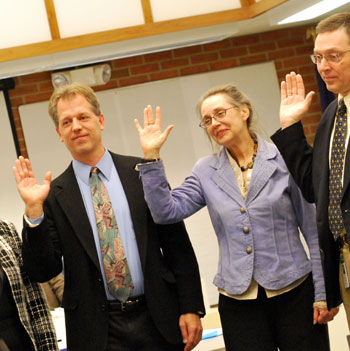
people standing taking the oath of office

Left to right: Stephen Kunselman (Ward 3), Sabra Briere (Ward 1) and Stephen Rapundalo (Ward 2) getting ceremonially sworn in at the start of council's Nov. 16, 2009 meeting. Standing to the left out of frame are Marcia Higgins (Ward 4) and Mike Anglin (Ward 5). (Photo by the writer.)

But it would have been a long meeting even without the downtown planning content, which we’ve summarized in a separate report: “Downtown Planning Process Forges Ahead.”

Before postponing the acceptance of the Huron River and Impoundment Management Plan (HRIMP), the council got a detailed update on how things stand on the city’s dispute with the Michigan Department of Environmental Quality (MDEQ) over Argo Dam.

An agenda item authorizing capital improvements in West Park prompted a lengthy discussion of how the Percent for Art program works.

Some public commentary calling abstractly for greater support for inventors and entrepreneurs was followed later in the meeting by an appropriation from the city’s LDFA to Ann Arbor SPARK to fund more business acceleration services.

A consent agenda item on the purchase of parking meters was pulled out and postponed.

The council also heard a detailed report from the city administrator, which covered emergency response time to a recent house fire, ADA-compliant sidewalk ramps, responses to the library lot Request for Proposals, updates on the task forces for Mack Pool and Ann Arbor’s senior center, staff reductions in planning and development, the East Stadium bridges, as well as the upcoming budget retreat on Dec. 5.

Stephen Kunselman’s (Ward 3) use of attachments to the agenda to document questions for city staff received some critique.

Also worth noting, the five winners of recent council elections were sworn in, and Marcia Higgins (Ward 4) was elected as mayor pro tem. Those topics in more detail below. [Full Story]

City Budget: Some Cuts Sooner Than 2011?

At Monday night’s city council work session, councilmembers heard news from their Lansing lobbying team that had a $260,000 negative impact on the Ann Arbor city budget for FY 2010, which they are expected to adopt next Monday, May 18. The quarter-million dollar shortfall against the city’s own budget planning estimates for state shared revenue led to discussion of the possibility of accelerating an already-planned reduction in the number of Ann Arbor firefighters. A reduction of 14 positions in the fire department could be implemented in early 2010, instead of sometime during FY 2011, which was originally planned.

At the work session, city administrator Roger Fraser and the city’s chief financial officer, Tom Crawford, indicated that their preferred strategy was not to build any firefighter layoffs into the FY 2010 budget – they wanted to see if they could squeeze the $260,000 out of the budget in the course the first part of the FY 2010, which for the city begins July 2009. There’s uncertainty still, said Fraser, about how many police officers will take advantage of the early retirement offer – a move the city is making to avoid laying off 27 officers for FY 2010. Officers have until mid-June to make a decision. That uncertainty factors into decisions on the FY 2010 budget that council will make on  May 18.

Councilmembers took turns calling city staff to the podium to clarify questions on other topics of interest. That included parking meters – their possible installation in residential areas, as well as the feasibility of maintaining current levels of ticket revenues without as many community standards enforcement officers dedicated specifically to ticketing. Other topics included the Local Development Finance Authority (questions about angels), historic district consultant (likely to be cut in FY 2010, instead of waiting until FY 2011), Project Grow (fund balance seen as too high) and the civic band (has not requested funding). The East Stadium bridges question came up, too (no money from state, but possibly from feds).

No formal decisions were made at the work session. [Full Story]

Ann Arbor Allocates Human Services Funding

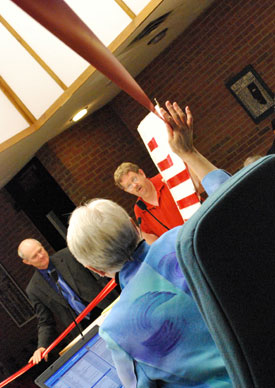
red ribbon closed loop

Marcia Higgins (Ward 4) holds a red ribbon representing the general fund dollars in the Ann Arbor city budget. In the background are Mayor John Hieftje and Jim Mogensen, who gave a presentation during public commentary.

Ann Arbor City Council Meeting (April 20, 2009): At its Monday night meeting, Ann Arbor city councilmembers approved around $1.3 million in human services funding (after a “red-ribbon” presentation during public commentary on that subject).

They also heard the 2008 annual report from the chair of the local development finance authority (who was closely questioned by councilmember Marcia Higgins), allowed Tios an early exit to its lease, accommodated the University of Michigan’s request for a lane closure in connection with the football stadium renovation, and rejected the planning commission’s adopted downtown plan (which was expected) – which bumps the final decision on A2D2 zoning to early July.

During public commentary, council again heard support for  public art, a critique of the proposed early-out option for police officers as a part of the proposed budget, a suggestion to remove the East Stadium bridge, as well as Jim Mogensen’s “red ribbon” presentation.

Roger Fraser also gave the official presentation of the city’s budget, which had been presented twice previously last week – at a working session and also at a town hall meeting. [Full Story]