The Ann Arbor Chronicle masthead
it's like being there

Stories indexed with the term ‘local authors’

Book Fare: My Dirty Little Secret

“There is a marvelous peace in not publishing. It’s peaceful. Still. Publishing is a terrible invasion of my privacy.” – J.D. Salinger

Book cover of "Wild Bells, Wild Sky"

Book cover of "Wild Bells to the Wild Sky" – not written by J.D. Salinger or the author of this column.

He can say that again.

Or not, because he died last month. But Jerome (whom, I should make clear, I never met) and I do have that in common. We both spared ourselves the haunting, humiliating spectacle of publication, although he had to learn the hard way and produce an American classic first.

I, on the other hand, wrote a romance novel so bad as to be unfit for print.

Let’s understand one thing. Everybody loves some kind of trash sometime. Tabloid gossip is, of course, the biggie. In a class I’m taking on probate law at Eastern Michigan University, the professor brought up Michael Jackson’s kids to illustrate how the rights of the surviving parent to custody are ironclad unless those rights have been terminated by a court. “The minute he died,” we were told, “she could have pulled up to Neverland and grabbed those kids. She – heck, I don’t even remember that woman’s na–”

“Debbie Rowe!!” volunteered way too many of my classmates.

Trash, trash, irresistible trash. [Full Story]

Column: Book Fare

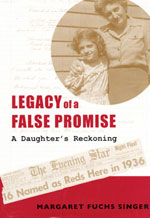
Book cover for Margaret Fuchs Singer's "Legacy of a False Promise"

Cover for Margaret Fuchs Singer's memoir.

When a member of my book group recommended Margaret Fuchs Singer’s recently published “Legacy of a False Promise: A Daughter’s Reckoning,” I assumed the longtime Ann Arbor resident’s contribution to the literature of America’s red-diaper babies would be another account of growing up with a parent who joined the Communist Party in the 1930s, became disillusioned but still refused to inform on former comrades – and suffered for it.

I got it wrong.

Singer’s father, Herbert Fuchs, cooperated with the House Un-American Activities Committee. He informed. He named names. He told the whole truth – about a profound commitment and a profound mistake – and suffered for it.

His family, of course, suffered for it, too. [Full Story]

Column: Book Fare

Domenica Trevor

Domenica Trevor

Start with some quick history: Josef Stalin’s campaign in the late 1930s to consolidate his control of the Communist Party spun into a terror that counted both old Bolsheviks and a new generation of party faithful among its victims. The leadership of the Red Army was decimated. Intellectuals were seized and interrogated and, like so many others under torture, falsely denounced others.

Inevitably, the masses caught on to the madness; pointing the finger at a neighbor could suddenly open up that three-room apartment next door. By the time the rampage was reined in, some 1.5 million people had been arrested and imprisoned; half again as many were executed or perished in the gulag.

Fast forward to the present: You’re a 29-year-old with an MFA, in Moscow to do research for your first novel. Lev Mendelevich Gurvich, himself caught up in the purges, has welcomed you into his apartment and has agreed to tell you his story. Gurvich, in his 90s but still with a sharp mind, had in the 1930s been editor of the literary magazine of the Komsomol, the Communist youth movement of the U.S.S.R. He was arrested, interrogated, sent to a labor camp.

You tell him about your novel, the story of a disgraced teacher of literature who now works as an “archivist” at Moscow’s infamous Lubyanka prison. Pavel Dubrov’s guilt and sorrow threaten to deaden him into numbness until a brief, official encounter with the prisoner Isaac Babel stirs him to rescue the condemned writer’s last manuscript from the prison’s furnace. Pavel smuggles it out of Lubyanka under his coat.

I met Babel, this survivor of the gulag tells you. I was at Stalin’s rallies; yes, I heard Stalin speak. But at one point the old man stops to ask, pointedly if not unkindly: Who are you to write this book?

“I wasn’t insulted,” Travis Holland says. “It was a question I asked myself.”

A more than fair question. But Holland’s answer, “The Archivist’s Story,” proved that his audacity was matched by his gifts. [Full Story]

Teaching French By the Book

Jo Mathis

Jo Mathis

There’s nothing worse than facing a room of 25 college kids – and boring them, says University of Michigan French instructor Jenni Gordon.

In Paris years ago, the Ann Arbor resident discovered the power of storytelling in the classroom. Recently, in an attempt to help her UM students grasp the difficult concept of imparfait (imperfect past tense), Gordon wrote and illustrated a bilingual children’s story to share with them.

It worked.

The story of a little girl named Mathilde stirred within the students so many memories of childhood. “Suddenly, lots of people had a story to tell in the past tense!” said Gordon.

Now Press Lorentz/littleBeast Books in Ann Arbor has published Gordon’s story of Mathilde, a little girl with mixed feelings about her new baby brother. It’s titled both “Les Problemes de Mathilde” and – on the flip side – “One day, I had enough!”

The story is already a hit with the 20-ish crowd. [Full Story]

Column: Book Fare

Domenica Trevor

Domenica Trevor

Once upon a time there lived a pretty lady named Jiselle who was always a bridesmaid and never a bride. But one night she is swept off her feet by a handsome pilot with green eyes and a tragic past. He proposes! She says yes!

But the “happily ever after” part snags on a few complications. Her new husband spends way more time in flight than he does at home. He has three motherless kids, one of them a middle-schooler with the mother of all attitudes. Jiselle’s own mother has an attitude of her own, marked by a particular contempt for unreliable charmers and her own daughter’s pathetic naïveté.

Oh – and a deadly plague is sweeping the land.

“In A Perfect World” is a dystopian fairy tale by Chelsea novelist and poet Laura Kasischke, set in an America whose citizens have become global pariahs – shunned, quarantined and loathed as potential carriers of the gruesomely fatal Phoenix flu. A distant war drags on vaguely. The power grid fails for hours and then days, and then for good. The mysterious plague kills the rich and famous along with everybody else. [Full Story]

Column: “Wearing Nothing But A Smile”

A display of Steve Amicks new book at Nicolas Books in the Westgate Shopping Center.

A display of Steve Amick's new book at Nicola's Books in the Westgate Shopping Center. Amick held a book-signing there on Tuesday.

Don’ t avoid the obvious: there is a half-naked woman on the cover of Steve Amick’s new book – wearing “nothing but a smile,” which appropriately is the title of the book (wink-wink). She made quite the impression on you when you walked into Nicola’s Books, where Amick was doing a book signing Tuesday night.

How she got there is quite an innocent story. The book, “Wearing Nothing But a Smile,” deftly balances the innocence of WWII pin-up girls with the harsh realities of the war back home.

Amick admits to stumbling on the idea of a book with the pin-up industry central to the plot. [Full Story]

» Text size:

larger text default text smaller text

Skyclock