Stories indexed with the term ‘local business’

Column: Balanced Offense for Local Economy

A little over 13 years ago, I started work as a business reporter at The Ann Arbor News. And exactly 13 years ago today, as I hoisted myself out of a warm bed at four o’clock in the morning, I was beginning to grasp why the other business reporters might have welcomed me so warmly.

Best Buy

Best Buy on Lohr Road at 4:08 a.m. on Nov. 27, 2009. Doors opened at 5 a.m. (Photo not by the writer – she's not required to cover Black Friday morning stories at The Chronicle.)

They knew that as the newest hire, I’d be the one assigned to the morning-after-Thanksgiving Black Friday shopping story. Later that dark, frigid morning, I watched as a stream of cars disgorged expectant, even festive shoppers to stand in line waiting for the doors at Walmart to open.

My initial reaction: These people are slightly nuts.

Then: Downtown retailers would kill for this kind of crowd.

The dichotomy of large and small businesses is perhaps most visible on days like Black Friday, when more customers on a single morning might flow through Walmart than would shop at a Main Street merchant all year. But the tension between large and small is also reflected in our local public policy priorities for economic development. [Full Story]

Paul Saginaw: We Want to Change the World

Paul Saginaw, co-founder of Zingerman's, spoke about building a local "living economy" at Monday night's Think Local First annual meeting. (Photo by the writer.)

Paul Saginaw, co-founder of Zingerman's, spoke about building a local "living economy" at Monday night's Think Local First annual meeting. (Photo by the writer.)

Paul Saginaw joked that during his senior year of high school, he was voted Least Likely to Have a Positive Impact on Society. The remark drew a laugh from the crowd of more than 100 people attending Think Local First’s annual meeting on Monday night – most of them know the Zingerman’s co-founder is an advocate for socially responsible business, as well as a driving force behind the nonprofit Food Gatherers, which launched 21 years ago this week.

For many years, that high school description was “so true,” Saginaw said. “But for the second half of my life, I’ve been trying to prove them wrong.”

Saginaw, the evening’s featured speaker, talked passionately about the need for local economies built around “human-scale” enterprises, with businesses as a positive force for social change. He described several ways that the Business Alliance for Local Living Economies, a national group, is supporting the efforts of small, independent businesses. The goal? “What we want to do is change the world,” he said. [Full Story]

Fresh Seasons Market to Close

Fresh Seasons Market, which announced plans to relocate earlier this month, is closing. The owners of the West Liberty grocery told their staff on Thursday afternoon, and are preparing for a going-out-of-business sale that begins on Saturday.

Jan DeMunnik, Fresh Seasons general manager, spoke with The Chronicle in early October about the planned move. Reached on Friday at the store, she said that at the time she couldn’t disclose the pending sale of the business. Lynda and Ben Stahl, who’ve owned Fresh Seasons for 15 years, were working on a deal to sell the grocery, she said, and the new owners had planned to relocate it. That deal fell through, however. [Full Story]

Gubernatorial Candidates Outline Agendas

Pamphlets for gubernatorial candidates Alma Wheeler Smith and Rick Snyder, on the table a Wednesday's Morning Edition meeting hosted by the Ann Arbor Area Chamber of Commerce. Smith, a Democrat, and Snyder, a Republican, were both speakers at the event.

Pamphlets for gubernatorial candidates Alma Wheeler Smith and Rick Snyder, on the table at Wednesday's Morning Edition breakfast hosted by the Ann Arbor Area Chamber of Commerce. Smith, a Democrat, and Snyder, a Republican, were both speakers at the event.

Running was a common theme for speakers at Wednesday’s Morning Edition, a breakfast meeting hosted by the Ann Arbor Area Chamber of Commerce at Weber’s Inn.

Alma Wheeler Smith and Rick Snyder are both running for governor, in the Democratic and Republican primaries, respectively. Michael Ford, the new CEO for the Ann Arbor Transportation Authority, keeps the buses running, while Keith Hafner runs a local karate business. And Kevin Borseth, the University of Michigan women’s basketball coach who makes his team run drills, almost ran for cover when Russ Collins, the event’s MC, brought up an infamous YouTube video that Borseth might well want to forget.

Collins, who’s also executive director of the Michigan Theater, kept the speakers running on schedule – after the jump, we’ll give a summary of their remarks, presented in the order in which they spoke. [Full Story]

Work Session: Trains, Trash and Taxes

slide showing in red highlight the area of Main Street Ann Arbor that would be included in a business improvement zone

The proposed business improvement zone would include Ann Arbor's Main Street from William Street in the south to Huron Street in the north.

Ann Arbor City Council work session (Oct. 12, 2009): It’s a world where you can throw your newspapers, glass bottles and plastic tubs into one single recyclables cart and set it out for morning collection.

It’s a world where you can then board a bus that drops you off at the train station for your morning commute to Detroit.

It’s a world where during the work day you watch a foot of snow fall, but on your return home to Ann Arbor, you see that the snow hasn’t just been plowed on Main Street – it’s been completely removed – along with those handbills you’d noticed plastered on the lightpost.

It’s a world where later at home, you roll your empty recycling cart back to its place. Then you log on to the internet and see you’ve earned $250 worth of points tallied by the weight of the recyclables that the truck has been recording and crediting for the last year.

At its Monday night work session, Ann Arbor’s city council heard presentations on all the discrete elements of that world, which Ann Arbor could start to resemble in a couple of years. [Full Story]

Fresh Seasons Market Plans to Move

Sign at Fresh Seasons Market on West Liberty

Sign at Fresh Seasons Market on West Liberty. (Photo by the writer.)

It’s hard to keep something under wraps when your landlord’s real estate agent puts a “For Lease” ad on the front page of the local newspaper. That ad ran last Thursday to solicit a new tenant for the building at 2281 W. Liberty, where Fresh Seasons Market has been located for about 20 years. And it prompted the grocery’s customers to ask: What’s up?

“We’re not signed, sealed and delivered yet,” said Fresh Seasons general manager Jan DeMunnik, referring to their new, undisclosed location, which she characterized as “very close” to the current store. They hadn’t planned to announce the move just yet, she said, but the real estate advertisement forced their hand.

Since then they’ve put a notice about the move on the sign outside their business, and are passing out flyers to customers that explain the situation – and to make sure people know that they are not closing. [Full Story]

Liberty Street Video to Close

The storefront of Liberty Street Video at 119 E. Liberty in Ann Arbor.

The storefront of Liberty Street Video at 119 E. Liberty in Ann Arbor.

When the economy soured last year, Dave Kozlowski still felt optimistic about the prospects for his business, Liberty Street Video. After buying the store in 2007 and investing in new inventory, sales were growing 10-15% each month, and he had finally stopped losing money.

But in January, he says business took a turn for the worse. Since then, sales at the East Liberty store have dropped around 5-8% each month, with no sign of improving. So with his lease up for renewal at the end of the year, Kozlowski has decided to close the last independent video store in Ann Arbor.

Sunday will be the last day of the store’s regular hours. It will be closed on Monday and Tuesday, then reopen on Wednesday with truncated hours: from 2-8 p.m. weekdays, and noon-8 p.m. on weekends. The goal is to sell off all inventory, including DVDs for $5 and $2 for VHS tapes. Kozlowski says he’s hoping to recoup some of his roughly $200,000 investment and pay down $40,000 in debt, including the $10,000 in back rent he owes the landlord, Ali Amiri.

“It’s been fun,” Kozlowski told The Chronicle. “I love it. I love the town.” [Full Story]

Making Jobs for Former Prisoners

Larry Voigt stood in front of a crowd of social workers, nonprofit leaders, and members of the faith community on Friday afternoon, folded his arms, and declared, “No!” The president of Catholic Social Services of Washtenaw County was playfully addressing attendees of a jobs creation summit by illustrating the opposite of what they were there to do: Say yes.

man with arms folded, saying no

Larry Voigt, president of Catholic Social Services of Washtenaw County, demonstrates the classic arms-folded posture of saying no. The job creation summit held last Friday was partly about getting people to say yes. (Photo by the writer)

Say yes to what?

They were there to say yes to the idea of economic development through creation of self-sustaining businesses that would employ former prisoners making the transition to society. The jobs creation summit was sponsored by MPRI – the Michigan Prisoner ReEntry Initiative.

The first part of the program, which ran through the morning, lunch and the early afternoon, was dedicated to hearing from four panelists representing three organizations in other parts of the country that have successfully launched a variety of businesses that employ former prisoners and substance abusers.

Then, after hearing pitches for close to a dozen different business ideas, participants winnowed them down to three basic concepts for small group focus: a building weatherization business, a green cleaning enterprise, and an urban farming venture.

The working summit was meant simply to kick things off in a directed way, said Mary King, who’s the community coordinator for Michigan Prisoner ReEntry Initiative of Washtenaw County. The summit allowed some of the specific challenges to crystallize that are faced by business startups, especially those that say yes to the idea of employing former prisoners. [Full Story]

How to Sustain a Local Economy

Panelists at the Sept. 23 Michigan Peaceworks forum on the local economy, from the left: Tom Weisskopf, University of Michigan economics professor; Ellen Clement, Corner Health Center executive director; Jeff McCabe, People's Food Co-Op board member; Lisa Dugdale, Transition Ann Arbor; Michael Appel, Avalon Housing executive director; John Hieftje, mayor of Ann Arbor.

Panelists at the Sept. 23 Michigan Peaceworks forum on the local economy, from the left: Tom Weisskopf, University of Michigan economics professor; Ellen Clement, Corner Health Center executive director; Jeff McCabe, People's Food Co-Op board member; Lisa Dugdale, Transition Ann Arbor; Michael Appel, Avalon Housing executive director; John Hieftje, mayor of Ann Arbor. (Photo by the writer.)

When The Chronicle entered the lower level meeting room of the downtown Ann Arbor library, the first things we noticed were three large trays of peanut butter and jelly sandwiches, cut into bite-sized wedges. As public forums go, this was an offbeat gnoshing choice.

It turned out that the sandwiches – and apples, soft drinks, potato chips and other food – were all sourced from Michigan, in keeping with the theme of Wednesday night’s event. The panel discussion focused on the state’s economic crisis, and how the community can respond to it.  Buying local products is one example.

Starting a local currency is another possibility – the Ann Arbor Downtown Development Authority is funding a study to look into that. Generating  electricity locally is also an opportunity – Mayor John Hieftje told the group that he didn’t think the dam at Argo Pond would be removed, in part because it might be used for hydropower in the future.

The forum – “Michigan’s Economic Situation: Crisis or Opportunity?” – was hosted by Ann Arbor-based Michigan Peaceworks and Washtenaw Voice, a coalition of local nonprofits that are working together to increase voter turnout and bolster the community in other ways. Michigan Peaceworks is the lead agency in this effort, part of the broader Michigan Voice initiative.

State and national issues were part of the discussion, but most of the six panelists focused on how the local community can take action in specific areas, including food, health care, housing and the environment. [Full Story]

“What Did You Say?”

Software

An Accent Reduction DVD shows a close-up of a speaker pronouncing the word "job." At the bottom of the screen, the word is spelled phonetically.

When Ann Arbor educator and entrepreneur Judy Ravin claims she can say, “What? What did you say?” in at least five different languages, she is not bragging about her multilingual prowess. She hears those phrases too often as she travels abroad. Just because she speaks the languages does not necessarily mean she is easily understood in all of them.

“And that doesn’t feel good,” she says. “None of us like that.”

It was mutual frustration (between speaker and the spoken-to) during her trips abroad that led her to think about how that must feel to immigrants in the United States as they attempt to set up their careers here.

And out of that frustration was the idea that eventually led to the Accent Reduction Institute, based in the Godfrey Building on North Fourth Avenue in Ann Arbor’s Kerrytown district. With a faculty of 18 contractors and three full-time directors, Ravin’s institute has been smoothing out the rough spots for immigrant speakers for about four years. The innovation behind the business is what is officially trademarked as the “Ravin Method,” which Ravin humbly says she feels “kind of silly about.” [Full Story]

Transitioning the Ann Arbor Chamber

John Hansen talks to the media  in this case, both The Chronicle in the room and Paula Gardner of AnnArbor.com on the phone.

John Hansen talks to the media – in this case, both The Chronicle (in the room) and Paula Gardner of AnnArbor.com (on the phone).

John Hansen’s title on his business card is “Transitionist” – and he isn’t kidding. Hansen has been on the job only a few days as interim president of the Ann Arbor Area Chamber of Commerce, but he’ll be shepherding what could be a significant physical transition too: A possible move out of the business group’s third-floor offices at 115 W. Huron St.

On Monday, the chamber announced plans to sublet all or part of its 6,300-square-foot warren of offices. There’s too much space for the 10 or so people who work there, Hansen said, and they’re paying too much for it. He declined to say how much, noting only that “it’s very expensive” – the biggest cost after payroll in a roughly $1 million budget.

The Chronicle talked to Hansen on Monday about both transitions: The possible move, and the process of choosing a new leader for the 1,200-member group. Along the way, we learned a few things about what it’s like to be a state legislator and school superintendent, too. [Full Story]

Firefly Club Closed, Assets Seized

A sign at the entrance to the Firefly Club apologizes for the closing.

A handwritten sign at the entrance to the Firefly Club apologizes for the closing. (Photo by the writer.)

The Firefly Club, a jazz and blues nightclub at 637 S. Main, was closed down by the state last night and its assets seized for unpaid sales taxes. Owner Susan Chastain told The Chronicle that her bank account and other assets have been frozen as well, because she was unable to make full payments to the state over the past two months on a debt of $120,000 – an amount in arrears for assessed sales tax dating back several years.

“We’ve always struggled,” Chastain said. It’s historically been difficult for blues and jazz clubs, she added, but the economic downturn has made it even more difficult to keep up.

Chastain opened the Firefly nine years ago at 209 S. Ashley, where the Bird of Paradise, a now defunct jazz club, had been located. Recordkeeping problems – dating back to the club’s opening – caused the state to assess the Firefly’s sales tax, plus penalites and interest, at about $160,000 several years ago. Chastain said that about three years ago her current accountant negotiated a payment plan, and she started sending the state $2,000 each month to put toward the unpaid sales tax. [Full Story]

Inside the Box: The Mail Shoppe

MailShoppe Proprietor

Carolyn Hough, proprietor of The Mail Shoppe, peers out from behind some UPS packages that are ready to be sent out.

When customers call Carolyn Hough asking for directions to her store, she always tells them the same thing:  Look for the big yellow mailbox. Hough, owner of The Mail Shoppe in downtown Ann Arbor, says the decorative mailbox has marked the store’s location since it first opened 26 years ago.

For Hough, owning her own mailroom wasn’t something she dreamed of as a child. Originally hailing from Rhode Island, she spent most of her career as a medical librarian, a vocation she says was “very different” from her job now. What did that entail? It was a research position – before there were computerized databases. So responding to research requests from nurses and doctors – say on the latest known effective treatment for a particular disease – entailed manually poring through indexes and literature.

Hough purchased the business in 1983 from Doug Barnett after the hospital she was working for went bankrupt. “I love it – it’s so much more fun than working at the hospital,” she said. Readers who think that packaging a bear’s head sounds more fun than rummaging through medical literature might agree with her. [Full Story]

Game: It’s Not Really Art, It’s Not Even Real

iPhone mutliplayer game Phonagle; two guys holding iPhones

Jeremy Canfield and Sergio Mendez of the tech start-up Phonagle study their iPhones as they search for virtual game pieces in Ingalls Mall during the art fairs on Thursday. (Photo by the writer.)

Sergio Mendez was meandering through the art fairs crowd in downtown Ann Arbor. Walking down Washington toward Main Street, Mendez saw something worth picking up. It was the left arm – just the left arm – belonging to a guy he knows, Eric Garcia. So Mendez  grabbed it and put it in his backpack.

That left arm wasn’t some sculpture in the art fair. But no worries, it also wasn’t Garcia’s literal left arm. It was a virtual arm, part of a multi-player iPhone game that Mendez and Garcia are developing, along with their colleagues at Phonagle, Jeremy Canfield and Ben Malley.

Phonagle LLC is a tech start-up. This week they’re using the art fairs as the setting to test out the game they’re developing. The object of this game: Find and collect virtual objects set up around the city – this version included their own virtual body parts. [Full Story]

Behind the Counter of a Local Jeweler

Abracadabra is located across from the federal building and post office, between Chelsea Flower and Sams

Abracadabra is located on East Liberty across from the federal building and post office, between Chelsea Flower Shop and Sam's Clothing.

Steven Lesse has some stories to tell – making a necklace out of a gall stone is just one of them.

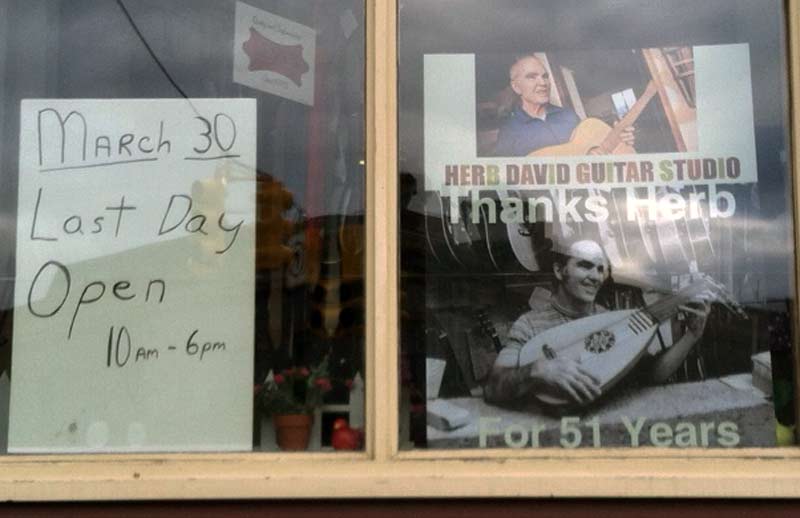
The co-owner of Abracadabra Jewelry and Gem Gallery has seen a lot since opening his downtown Ann Arbor shop in 1974. Originally located in the building that now houses Herb David Guitar Studio, Abracadabra moved to its current location at 205 E. Liberty in 1976 and has remained there ever since. Lesse, who co-owns the business with his wife Katherine, fell in love with Ann Arbor when he set up a booth at the art fair during the summer of 1973.

“I was tired of the gypsy lifestyle – it was like being in a rock band,” Lesse said. “You were always traveling around city to city, art fair to art fair. It was a fun lifestyle when you’re not attached and you don’t have own a house.” Soon after he visited, Lesse rented his first building in Ann Arbor and opened his first gallery, which also became his apartment. [Full Story]

Possible Farmers Market at Liberty Lofts

The commercial space next to Liberty Lofts.

Commercial space, in the foreground, abuts Liberty Lofts condominiums in the background. This shot is taken from West Liberty Street, looking south. (Photo by the writer.)

The cavernous commercial space next to the Liberty Lofts condo complex isn’t always empty –  as recently as May, The Chronicle documented a temporary architectural exhibit there. Mostly, though, passers-by can look through the floor-to-ceiling windows and see roughly 18,000 square feet of emptiness at the corner of Liberty and First.

But on Wednesday, July 8, the former factory space will have another temporary occupant: Karen Myers and Archie Welch are holding an open house from 3:30-7 p.m., hoping to garner support for a European-style indoor farmers market. [Full Story]

Subterranean Start-ups

graffiti on a door

The TechArb offices are accessible via a graffiti covered door in the alley next to the Michigan Theater. (Photo by the writer.)

Behind a graffiti-covered door, at the end of the alley next to the Michigan Theater and one floor below street level, a handful of entrepreneurs are working at all hours in some pretty unusual office space.

Under the umbrella of TechArb, a coworking space for University of Michigan students, 10 start-up technology companies have set up shop in 30,000 square feet of commercial basement space that has been vacant for years. With 18-foot ceilings, imposing columns and no natural light, there is feeling of total isolation from the hubbub of Liberty Street, just one story up. The seclusion allows the 30 entrepreneurs to focus intensely on building their businesses.

They’re hard at work because the clock is ticking. They’ve got the rent-free space for this summer, and this summer only. [Full Story]

Common Language Speaks Out

Martin and Keith Orr

Martin Contreras and Keith Orr, co-owners of Common Language Bookshore, also own the aut BAR, located next door. (Photo by the writer.)

Less than two weeks after Shaman Drum Bookshop announced plans to close, the owners of another independent Ann Arbor bookstore are saying they could be next.

On Friday, Keith Orr – co-owner of Common Language Bookstore – sent an email to customers laying out the situation that his business faces: “There is no easy way to say this,” he wrote. “Common Language is not making enough sales to support itself. Its very existence is in peril.”

After a Chronicle reader forwarded the email to us on Monday, we went over to the store in Kerrytown’s Braun Court to talk with Orr. Sitting in the shaded courtyard in front of the shop he owns with partner Martin Contreras, Orr spoke about why they decided to reach out for help, and how he hopes the community will respond.

Contreras and Orr have been subsidizing the store with their personal savings and with money from another business they own, the \aut\ BAR, which is located in an adjacent building. They can’t continue that indefinitely – sales have to increase to support the store. Though there is a sense of crisis, Orr says, they aren’t planning to shut their doors next week or even next month. Yet they wanted to alert the community that they are struggling, and if they can’t find a way to make the bookstore financially sustainable, they’ll have to close. [Full Story]

Don’t Despair – Blimpy’s Still There

Two large handwritten signs in the window say CLOSED

Two large handwritten signs in the window say CLOSED, but Krazy Jim's Blimby Burger will reopen on Monday. (Photo by the writer.)

When The Chronicle sees a Tweet wondering if a local business has closed, that sometimes sends us off on a quest – and Sunday evening, the business in question was Krazy Jim’s Blimpy Burger. Since we’d covered the mystery closing of another landmark eatery in January, we braced for bad news.

And seeing large CLOSED signs in the windows as we approached, plus a yellow cord strung across the front steps, it wasn’t looking good. But as we got closer, we saw – written much more faintly and in much smaller lettering – ”til Monday.” Then, ignoring the cord, we climbed the stairs and encountered a much more detailed sign on the front door: Blimpy’s was only temporarily closed for renovations. Whew. [Full Story]

Behind the Counter of a Vacuum Repairman

Dick Sampier, in his epymonious vacuum sales and repair shop.

Dick Sampier behind the counter at his vacuum sales and repair shop at 2165 W. Stadium Blvd. in Ann Arbor.

Boxes upon boxes filled with vacuum parts and accessories pack Dick Sampier’s small shop behind Stadium Hardware, a shop so off the beaten path that it might go unnoticed unless you were looking for it. But customers find it because they are looking for it – Dick Sampier Vacuum Sales and Repair is one of the last remaining vacuum repair stores in the Ann Arbor area.

Sampier, who opened the business in 1985 and is the sole employee, can often be found in the back of the store, either answering customers’ questions or working on one of the 10 or so vacuums he fixes each day. Sampier says he considers himself more of an artist than a mechanic, and he’s earned a reputation as someone who can fix even the most tricky mechanical problems.

So how does someone end up starting a vacuum repair business, and then stick with it for nearly 25 years? [Full Story]

Shaman Drum Bookshop to Close June 30

Karl Pohrt, who opened Shaman Drum Bookshop nearly 30 years ago, has decided to close the business on June 30. He plans to continue efforts to obtain nonprofit status for a separate venture, the Great Lakes Literary Arts Center.

The decision comes after many months of financial struggles at the bookstore, which Pohrt outlined in a column published by The Chronicle in February. In that column, he reported that textbook sales in 2008 had declined $510,000 from the previous year. He cut payroll and other operating expenses, but couldn’t cover the shop’s losses. Though trade sales (books of general interest) were up, that didn’t compensate for the loss of textbook sales. “The evaporation of our position has been astonishingly swift,” he wrote. “We had been holding relatively even financially until September. Suddenly we’ve moved into the red.” [Full Story]

Bella Ciao Restaurant to Close

Bella Ciao restaurant on West Liberty.

June 20 will be the last day of service at Bella Ciao restaurant on West Liberty.

On any given night when the weather allows, you’ll usually find James Macdonald chatting with customers or passers-by at his West Liberty restaurant, Bella Ciao, as servers shuttle in and out of the building to serve outdoor diners. But not for much longer. After running the restaurant for over 22 years, he and his wife Kathy Macdonald are selling the business to local chef Brandon Johns, who plans to transform it over the summer into an eatery that highlights food from local farms and markets.

Bella Ciao will remain open through the upcoming Ann Arbor Restaurant Week, an event spearheaded by James Macdonald that highlights downtown restaurants and features set-price lunches and dinners. Bella Ciao’s last dinner service will be on Saturday, June 20. Johns, with his wife Sara Johns and two business partners, plan to renovate the restaurant and open it in early August as Grange Kitchen & Bar.

The deal closed earlier this week. Kathy Macdonald made the announcement at Thursday morning’s membership meeting of the Main Street Area Association, which The Chronicle attended. In a phone interview later in the day, she said they plan to focus on their other local business, Pastabilities, a pasta wholesaler that sells to area groceries and chefs. She said they’ll be selling off most of Bella Ciao’s extensive wine list as well. “There’s only so much we can bring home,” she said. [Full Story]

Washtenaw Dairy Turns 75

Washtenaw Dairy Ann Arbor Michigan

Washtenaw Dairy T-shirt with design drawn by Chris Frayne.

On Saturday, May 30, from 10 a.m. to 2 p.m. the Washtenaw Dairy will throw a 75th birthday party for itself.

Jim Smith, president of Washtenaw Dairy, didn’t send out any special invitations to people – everybody’s welcome to come enjoy the free hot dogs, 25-cent milkshakes, and entertainment from “Elvis Presley” and “Buddy Holly.” Not even Bill Martin – president of First Martin Corp. and athletic director of the University of Michigan – got a special invite.

So when Martin dropped by the dairy on Thursday, and a tableful of morning regulars wanted to know if he was coming to the party, Smith wasn’t buying the “Nobody invited me” excuse that Martin was selling. “We don’t send out invitations!” admonished Smith. “Well, you didn’t call!” replied Martin. Martin wound up saying he’d try to attend, asking, “About what time are you guys going to be there?”

The Chronicle didn’t hear anyone take advantage of the obvious opening for a wisecrack: “Are you asking so as to avoid us, or what?”  Missing that chance was a rare exception judged against the hour we spent on Thursday soaking up the atmosphere at the corner of First and Madison on the west side of Ann Arbor.  [Full Story]

Innovating out of an Economic Hole

Maria Thompson, General Manager, A123Systems Advanced Research

Maria Thompson, general manager of the advanced research and government solutions group for A123Systems in Ann Arbor. She was one of several panelists from the local business community at Monday's UM economic development forum.

More than 250 people from academia, business, government and nonprofits packed the auditorium Monday afternoon at the Partnership for an Innovation Economy forum, hosted by the University of Michigan at its newly renovated art museum.

Throughout the two-hour event, The Chronicle learned, among other things: 1) which former Pfizer executive is a rugby referee, 2) which local power couples have relied on each other for advice, 3) who hosts one of the best holiday parties in Ann Arbor.

Of course, there was also much talk of UM’s role in economic development. [Full Story]

Good News: You’re Fired!!

woman removing bricks from kiln

Kay Yourist opens the kiln after its first firing. It's a brick-by-brick process. The top row is labeling for ease of re-assembly.

By the time The Chronicle arrived at Yourist Gallery on Broadway Street last Wednesday, the temperature had cooled from its maximum of 2300F° to around 170F°.  The owner of the gallery, Kay Yourist, had donned giant leather gloves to open the door to her new kiln after its first complete firing the previous night.

The door to the kiln is actually a wall of un-mortared bricks that gets opened and closed by stacking and unstacking the wall brick by brick. The top few rows of bricks, which were sourced through Schad Boiler Setting Company in Detroit, are custom shaped to match the arch of the kiln’s roof, and labeled to prevent the door-closing task from evolving into a puzzle-solving exercise.

Even though we were there to see the opening, we got a chance to see a bit of the closing process, too – Yourist had actually begun the opening process before we arrived. But she indulged us by first re-stacking the bricks into a solid wall, so we’d have a clearer idea of how it worked.

Unstacking the bricks was slow going at first, but once Yourist had un-wedged the top row, the pace picked up. It wasn’t long before the top front layer of pottery pieces became visible. The kiln has three tiers and a front and a back, so the volume of art work we saw was about a sixth of the kiln’s total capacity. [Full Story]

Let Them View Cake

A sign in front of Cake Nouveau on South Fourth.

A sign in front of Cake Nouveau on South Fourth.

In our travels through downtown Ann Arbor this week, we saw a cupcake-shaped sign outside Cake Nouveau on Fourth Avenue, urging passers-by to cheer for Courtney Clark on Food Network this Sunday. Being the curious sort, we popped inside to see what there was to cheer.

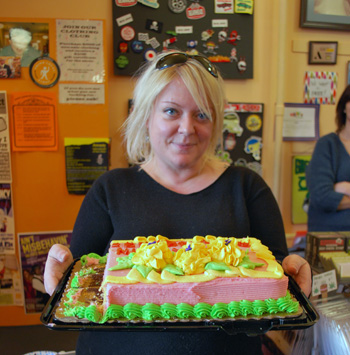
Turns out it’s been a busy week for the owner of Cake Nouveau. On Wednesday, Clark appeared on ABC’s The View, one of three bakers who made birthday cakes for co-host Sherry Shepherd. (Shepherd picked Clark’s cake as her favorite.)

And on Sunday, Clark will be a finalist on Food Network’s Last Cake Standing – the winner of that competition gets a $50,000 prize. Sarah Mayfield, who works in the shop, told us the Food Network show had been taped in January. They know the outcome, of course, but are sworn to secrecy. [Full Story]

Column: A Voice from the Past Calls Out

Bob Dascola

Bob Dascola of Dascola Barbers on South State.

In the old days, downtown was divided into three parts: Main Street (called Downtown), State Street (called Uptown), and South University (called Campus). Each area was different, but all were part of downtown Ann Arbor.

During my early days while attending Angell School on South University, I remember my mother giving me money so I could go have lunch at the Dugout restaurant on South U, owned by the Klepac family (their daughter was in my class), then pick up some ice cream at Miller’s before returning to school. As I grew up I used to hang out at Beaver’s Bike and Hobby on Church Street (owned by Fred Beaver), learning how to repair bicycles from Bill Loy (now owner of the Student Bike Shop).

I remember when the students left at the end of the school year in April, the local business owners wanted more people to come into the campus area during the summer, so Joan Beaver and a couple of her art friends invented the “Art Fair.” Wow, that really worked. Just look what everyone else in town has done with it! [Full Story]

Washtenaw News Wins NY Times Contract

As part of the change in delivery of the Detroit News and Detroit Free Press, which began today, Washtenaw News Co. has gotten a boost – the first good news this local business has seen in several years, according to its CEO, Nick Genova.

Starting today, Washtenaw News – an Ann Arbor-based distributor of newspapers and magazines – will be delivering the New York Times to home subscribers throughout most of Washtenaw County, Genova said. The papers were previously delivered under an agreement with the Detroit Media Partnership, which manages the Detroit papers.

The three-year contract with Washtenaw News also includes delivery of USA Today and Investor’s Business Daily. In addition, Washtenaw News is a distributor locally for the Wall Street Journal, Financial Times and the Ann Arbor News, among other publications. The deal means that Washtenaw News now uses about 20 independent contractors to deliver the papers, Genova said – about double the number they used before.

The Chronicle heard about this news on Sunday morning, when the following note slipped out of the New York Times delivered to Chronicle Central: [Full Story]

Health Media CEO: “Don’t Ever Give Up!”

Ted Dacko

Ted Dacko, CEO of HealthMedia, was named the 2008 Entrepreneur of the Year at the New Enterprise Forum's annual awards event Thursday night.

HealthMedia, says Ted Dacko, is “a company that shouldn’t be here.”

Just a few years ago, the Ann Arbor firm was left for dead. They had 85 employees, a burn rate of $685,000 a month, and very little revenue. Venture capital funding had dried up. Dacko was working there as vice president of sales and marketing when the previous CEO quit – two weeks before the firm would literally run out of money.

The board asked Dacko if he wanted the job. If he took it, he had two choices: Make a go of it, or lock the doors.

If you know the rest of the story, you know why Dacko was honored Thursday night with the New Enterprise Forum‘s Entrepreneur of the Year award. [Full Story]

And Now A Word From Our Sponsors

Occasionally, we like to remind readers of the reason The Ann Arbor Chronicle is able to keep publishing: Advertisers have invested their dollars in ads that appear in the sidebars of the site. So every once in a while we’ll highlight those advertisers here in the center column. [Full Story]