Stories indexed with the term ‘low-income housing’

Lenart, Hall Take New Jobs in Housing

As Jennifer L. Hall prepares to start her new position as executive director of the Ann Arbor housing commission, Brett Lenart has been named to replace her as housing and infrastructure manager at the joint Washtenaw County/city of Ann Arbor office of community development. Hall sent an email on Sunday night to announce the transition.

Hall had been offered the housing commission job at the commission board’s Oct. 19, 2011 meeting. The commission oversees the city of Ann Arbor’s public housing units, as well as the Section 8 program for Washtenaw, Monroe, and western Wayne counties. Hall’s last day with the office of community & economic development is Nov. 23.

Among his various responsibilities at the county, Lenart has managed the … [Full Story]

Urban County Gets Grim Funding Update

Washtenaw Urban County executive committee meeting (Feb. 22, 2011): Leaders of local municipalities got a grim update on Tuesday about looming federal funding cuts that will likely affect projects in many of the county’s low-income neighborhoods.

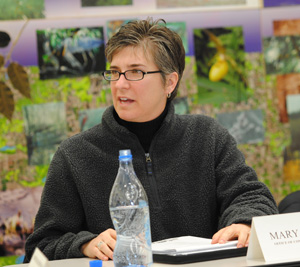
Mary Jo Callan

Mary Jo Callan, director of the Washtenaw County/city of Ann Arbor office of community development, at Tuesday's meeting of the Washtenaw Urban County. (Photo by the writer.)

“I am bringing you some troubling news,” said Mary Jo Callan, director of the Washtenaw County/city of Ann Arbor office of community development. “Do you want to start with the bad news, or the worst news?”

Callan reported that the two major programs that fund projects for low-income neighborhoods – the Community Development Block Grant and HOME Investment Partnership programs, both operated by the U.S. Dept. of Housing and Urban Development (HUD) – have been targeted by Congress and President Obama for significant cuts in both the current fiscal year and in 2012. Washtenaw County communities receive about $2.4 million annually from the CDBG program alone.

Though at this point it’s unclear exactly what the final federal budget will include, Callan said it’s nearly certain that some funding cuts will occur – her staff is planning for a 10% reduction in grants from those two programs for fiscal 2012. “It’s pretty bleak,” she said. [Full Story]

Urban County: Nonprofit Funding Update

Washtenaw Urban County executive committee meeting (Jan. 25, 2011): Urban County members – a group representing 11 municipalities in Washtenaw County – got an update on a new effort to coordinate the funding of local nonprofits.

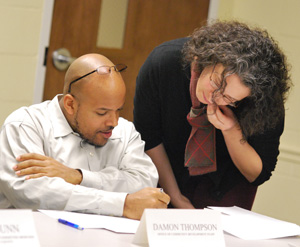
Damon Thompson, Teresa Gillotti

Damon Thompson, operations manager for the Washtenaw County/city of Ann Arbor office of community development, talks with Ypsilanti city planner Teresa Gillotti after the Jan. 25 Urban County meeting.

Nonprofits are vying for funds from the city of Ann Arbor, Washtenaw County, the Urban County, and Washtenaw United Way. Nearly 60 nonprofits applied to the first phase of the process, in which they were asked to supply basic financial and governance documents. Of that group, 51 were qualified to respond to a request for proposals (RFP) that was issued Jan. 28.

It’s still unclear how much funding will be available, but it could be less than the nearly $5 million that was awarded from these groups last year. Budgets for Ann Arbor and the Urban County haven’t been finalized, and the 2011 county budget is facing about $1 million in as-yet-undetermined cuts.

At last week’s meeting, three members of the Urban County’s executive committee – Pittsfield Township deputy supervisor Barb Fuller, Ypsilanti mayor Paul Schreiber and Ann Arbor city councilmember Margie Teal – were appointed to review applications for the coordinated funding process. All governing boards of the four entities involved in this cycle’s funding will appoint members to a review committee. The fifth partner – the Ann Arbor Area Community Foundation – will fund capacity-building grants to nonprofits identified as needing help with internal operations, like infrastructure and staff development.

Also at last week’s meeting, Urban County members got an update on an annual plan being developed for the U.S. Dept. of Housing & Urban Development (HUD), which provides funding for low-income housing and neighborhood projects. The plan will include a list of proposed projects located within the Urban County area that would be eligible for HUD funding. To gather more input, a needs assessment public hearing is set for the Feb. 22 meetings of both the Ann Arbor city council and the Urban County.

Two people spoke during public commentary, both criticizing Avalon Housing for its handling of two low-income housing projects: 1500 Pauline, and Near North. The nonprofit was defended by Leah Gunn, who chairs the Urban County executive committee – she called Avalon one of the “stars of community development.” [Full Story]

Low-Income Housing Project Planned

Documents filed on Monday with the city of Ann Arbor’s planning staff show details of an affordable housing project at 1500 Pauline that includes tearing down the existing apartment buildings and rebuilding a combination of apartments, townhomes and a community center.

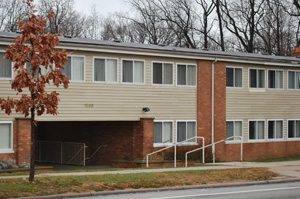
Apartments at 1500 Pauline

Entrance to the apartment complex at 1500 Pauline in Ann Arbor. (Photos by the writer.)

The project is being proposed by the Ann Arbor nonprofit Avalon Housing, though the property is still owned by the Washtenaw Affordable Housing Corp. Avalon took over operations of several WAHC properties, including 1500 Pauline, in 2009.

Also filing with the city on Monday was the Michigan Alpha Chapter of the Sigma Phi Epsilon fraternity, which is seeking a special exception use to transform the Memorial Christian Church building at the corner of Tappan and Hill into a fraternity house. [Full Story]

Urban County Reallocates Housing Funds

Washtenaw Urban County executive committee meeting (Aug. 24, 2010): At just past 1 p.m., Leah Gunn told the gathered group, “We’re waiting for a quorum because we have important business to conduct – and I’m told the cats have been herded!”

Jennifer Hall

Jennifer L. Hall, far left, describes a request to reallocate federal funding at the Aug. 24 Urban County executive committee meeting. Hall is housing manager for the Office of Community Development, a joint Ann Arbor/Washtenaw County unit. To the right are Teresa Gillotti, Paul Schreiber and Andrea Plevek. (Photos by the writer.)

A few minutes later more voting members of the Urban County‘s executive committee, which Gunn chairs, arrived. The group is a consortium of Washtenaw County, Ann Arbor, Ypsilanti and nine townships, responsible for allocating federal funding for low-income housing and other community development projects. The funds are managed by staff of the joint county/city of Ann Arbor Office of Community Development.

On Tuesday, the business they conducted included approval to reallocate federal funds for local housing programs, in an effort to identify how the money will be spent before a Sept. 18 deadline.

The group also got an update on state and federal emergency housing funds for the county, which have been cut by nearly 30%. In response to upcoming changes mandated by state and federal housing agencies, the Urban County executive committee approved several recommendations, including selecting the nonprofit SOS Community Services to coordinate housing crisis management in the county.

Those changes led to a discussion of the homeless situation in Washtenaw County, and the challenges of dealing with a spectrum of housing needs, from people seeking emergency shelter to those ready to buy a home. [Full Story]

Zingerman’s Deli Expansion Moves Ahead

Ann Arbor Planning Commission meeting (May 18, 2010): Two items with ties to Zingerman’s received approval from planning commissioners at their most recent meeting: The site plan for expansion of Zingerman’s Deli, and a special exemption use for the Westside Farmers Market, located next to Zingerman’s Roadhouse.

Grace Singleton, Paul Saginaw

Grace Singleton, a managing partner of Zingerman's Deli, sits next to Zingerman's co-founder Paul Saginaw as the planning commission deliberates on a proposed expansion of the deli, which was ultimately approved. Behind Saginaw is Michael Quinn of Quinn Evans Architects, who is working on the project. (Photos by the writer.)

The farmers market has no further steps to take – it opens on June 3, from 3-7 p.m. But the approval process for the deli expansion is far from over. After seeking approval from city council for its plans, deli partners will need to circle back to the city’s historic district commission – the site is located in the Old Fourth Ward historic district. The Chronicle has previously reported on their earlier efforts down this path: “Zingerman’s: Making It Right for the HDC.”

Pending approvals, Zingerman’s hopes to break ground on the project early next year.

Also at last week’s meeting, commissioners reviewed the site plan for the Windsong affordable housing project off of Stone School Road, north of Ellsworth. They ultimately approved plans for building 32 townhomes financed in part by the Michigan State Housing Development Authority. But concerns were raised over problems that some residents in the site’s existing 12 townhomes are causing for their neighbors. Three of those neighbors spoke at a public hearing, saying they’d like a higher fence around the property, at the least, to deal better with harassment, fighting, graffiti and other issues. [Full Story]

Washtenaw Gets More Housing Funds

More than $400,000 in unanticipated federal funding – including a $250,000 “green” grant for Avalon Housing‘s Near North in Ann Arbor – allowed board members of the Washtenaw Urban County to boost funding for several low-income housing and community development projects at their April 27 meeting.

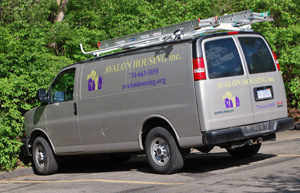
Van for Avalon Housing

A van for Avalon Housing, parked at the nonprofit's headquarters in the Northern Brewery building on Jones Drive. Avalon recently received a $250,000 federal "green" grant for its Near North affordable housing development on North Main.

In addition to the grant for Near North – a proposed 39-unit affordable housing development on Main Street just north of downtown – the Urban County also received nearly $180,000 more than anticipated in federal funding through the Community Development Block Grant program for the coming fiscal year.

The board voted to divvy up those additional funds to projects in the Urban County’s three largest jurisdictions – Ann Arbor, Ypsilanti and Ypsilanti Township. They also approved setting aside nearly $27,000 for as-yet-unspecified human services support, in light of possible cuts in city of Ann Arbor funding to local nonprofits.

The focus on allocations at Tuesday’s meeting prompted this comment from Ypsilanti mayor Paul Schreiber: “It’s a pleasure to sit on a board that has money to spend!” [Full Story]

What’s Your Federal Stimulus Good For?

Washtenaw County Board of Commissioners working session (April 8, 2010): Two presentations at Thursday’s working session were tied to the community’s health: how federal stimulus dollars are being spent, and how former prisoners are being helped, with the goal of reducing repeat offenses.

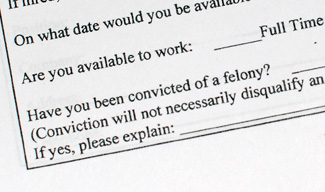
Portion of a Washtenaw County employment application

Washtenaw County employment applications ask about felony convictions.

Mary King, coordinator of the Michigan Prisoner ReEntry Initiative of Washtenaw County, told commissioners how the MPRI is attempting to reduce the county’s high prisoner recidivism rate – a problem dating back several years. She also urged them to consider eliminating a question on the county’s employment forms that asks about an applicant’s felony history. Such questions can be barriers to employment, she said, and the biggest cause of parole failure is lack of a job.

Leaders of two county departments – Mary Jo Callan of the Office of Community Development, and Patricia Denig of Employment Training & Community Services (ETCS) – gave an update on how some of the county’s $22.69 million in federal stimulus funds are being spent. Those two departments alone have received $13.22 million for a wide range of programs, from job training to low-income housing. [Full Story]

“Urban County” Allocates Housing Funds

At their March 23 meeting, members of the Washtenaw Urban County – a consortium of 11 local municipalities that handles federal grants for low-income housing and other projects – approved over $2.6 million in allocations for the Ann Arbor/Ypsilanti area.

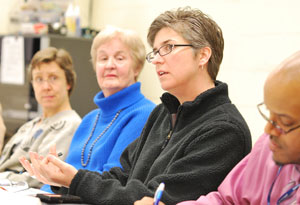
Margie Teall, Leah Gunn, Mary Jo Callan, Damon Thompson

Mary Jo Callan, director of the Office of Community Development, discusses proposed funding for housing projects at the Washtenaw Urban County meeting on Tuesday. At left are Ann Arbor city councilmember Margie Teall and county commissioner Leah Gunn, who chairs the Urban County executive committee. At right is Damon Thompson, OCD's operations manager. (Photos by the writer.)

The group also had a frank discussion about problems with struggling Gateway Apartments in Ypsilanti Township – the complex is operating at a loss and is putting strains on the nonprofit Avalon Housing, which took over management from the nearly-defunct Washtenaw Affordable Housing Corp.

In addition, Urban County members reallocated federal funds that had previously been earmarked to support a county land bank. The county’s board of commissioners voted to dissolve the land bank earlier this month.

Also approved during Tuesday’s meeting was the draft of an annual plan for July 1, 2010 through June 30, 2011. The plan outlines projects and a nearly $4 million budget from two federal programs for low-income neighborhoods. Avalon Housing’s Near North apartment complex, the Delonis Center homeless shelter, and an owner-occupied housing rehab program are among the projects being funded.

Staff of the Office of Community Development, a joint county/city of Ann Arbor department which among other things manages the Urban County projects, also reported on efforts to recruit more local governments to join the Urban County. OCD director Mary Jo Callan joked that there were two perception problems in marketing the Urban County: urban and county. [Full Story]

Water Main Project Set for Bryant Area

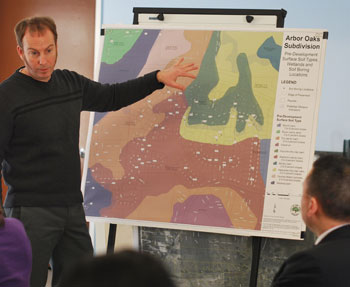
Jerry Hancock

Jerry Hancock, Ann Arbor's stormwater and floodplain programs coordinator, explains how soil composition in the Bryant neighborhood factors in the area's water problems. (Photos by the writer.)

A major project to replace water mains and resurface roads in the Bryant neighborhood will get under way this spring, part of a broader plan to address the area’s chronic drainage problems and other issues.

At a Jan. 14 neighborhood meeting, Ann Arbor city staff gave an overview of the project, which included an historical look at the subdivision off  Stone School Road, just south of I-94.

The meeting at the Bryant Community Center – organized by the nonprofit Community Action Network and attended by residents, city and county elected officials and staff, among others – is the latest in a series of efforts to deal with a wide range of challenges to one of the city’s predominantly low-income neighborhoods.

At the end of Thursday’s two-hour session, a question raised by one of the residents – “Is there a happy ending to all of this?” – might best be summarized by the answer, “It depends.” [Full Story]