Stories indexed with the term ‘mayoral race’

Wall Eyes Ann Arbor Mayoral Campaign

In a press release issued Thursday afternoon, Feb. 9, Tom Wall said he is considering a run for Ann Arbor mayor and is asking for support to fill crucial positions – including campaign manager and fundraising director – before making a final decision. [.pdf of Wall's announcement] Wall is owner of All Star Driver Education, and has run for mayor twice before.

In November 2006, Wall ran as an independent against incumbent Democrat John Hieftje, getting 21% of the vote. In August 2008, Wall contested the Democratic primary against Hieftje, getting 31% of the vote.

In his press release, Wall attributes his previous election performance to not having the “necessary organizational support.” He asks for people to step forward to fill the roles … [Full Story]

Ann Arbor Mayoral Race: Hieftje or Bean

In the mayor’s race, Ann Arbor voters are offered a choice in the Nov. 2 general election between Democratic incumbent John Hieftje and independent candidate Steve Bean. On the last Monday in September, the League of Women Voters hosted a forum for the mayoral candidates. The mayoral forum took place at Community Television Network studios and was recorded – it is available online through CTN’s video-on-demand service.

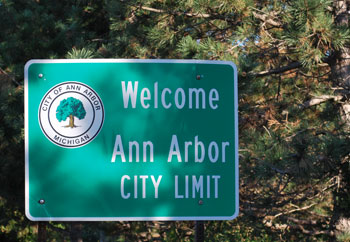
Welcome to Ann Arbor sign

In contrast to other members of the city council, which represent one of five wards in the city, Ann Arbor's mayor is elected by all Ann Arbor voters. Kudos to any reader who can recognize the location of this sign.

By way of general background, in Ann Arbor, the mayor is elected for a two-year term and is a member of the 11-member city council. The other 10 members of the council come from the city’s five wards – each ward has two seats on the council, one of which is elected each year for a two-year term. In addition to the rights and responsibilities of a councilmember, the city charter assigns the mayor other rights, including: a veto power, the responsibility to make appointments to committees, certain powers during emergencies, and the responsibility to preside over city council meetings. The management of the city is handled by a city administrator [Roger Fraser], who is hired by the city council. The mayor’s annual salary is $42,436.

Hieftje has served as mayor for the last 10 years, first elected in 2000 after serving half a term on the Ann Arbor city council representing Ward 1. At the League’s forum, Bean highlighted his own record of 20 years of service to the city on the energy and environmental commissions – currently chairing the environmental commission. Board and commission service for the city is not compensated.

The two men share many similar views – they occasionally expressed their agreement with each other’s views during the forum. They get along well socially – in fact, they carpooled together to the League of Women Voters event. Still, it’s possible to discern some differences between the two candidates on local issues as well as in their national perspective.

For example, Bean’s take on the proposed Fuller Road Station is that a citizen vote is needed and that the accompanying parking deck doesn’t move us in the right direction of alternative transportation. Hieftje, on the other hand, promoted the location as the best place in all of Michigan for a transit center. Hieftje’s focus on the city’s budget is to continue to find efficiencies to reduce expenses in the face of declining state and federal revenues, while Bean’s perspective seems to include more prominently the possibility of a severe national financial crisis that could be further complicated by declining world oil production capacity.

Bean and Hieftje’s responses are described in greater detail below. [Full Story]

Ann Arbor City Incumbents Win

With final unofficial results now tabulated on the Washtenaw County clerk’s website, results for the four contested city races in the Democratic primary show clear wins for all incumbents: John Hieftje for mayor, Sandi Smith in Ward 1, Margie Teall in Ward 4, and Carsten Hohnke in Ward 5.

The closest of the races was in Ward 1, where challenger Sumi Kailasapathy polled 42% of the vote to Smith’s 58% (769 to 1,068 votes) 45% of the vote to Smith’s 55% (833 to 1,004 votes).

In the two other contested council races, challengers received roughly 30% of the vote. In Ward 4, challenger Jack Eaton received 31% to Teall’s 69% (642 to 1,448). In Ward 5, Lou Glorie received 28% to Hohnke’s 72% (933 to 2,415).

In the mayor’s race, however, the margin was even greater. Hieftje took 84% of the vote to challenger Patricia Lesko’s 16% (10,058  to 1,869).

In November, Hieftje will face independent challenger Steve Bean.

In Ward 5, Carsten Hohnke will face John Floyd, who won the uncontested Republican primary on Tuesday, along with independent Newcombe Clark. Teall and Smith are unopposed in November. In Ward 2 and Ward 3, incumbents Tony Derezinski and Christopher Taylor did not face challenges in the Democratic primary and will also be unopposed in November. [Full Story]

Election Day: August 2010

The Chronicle will be spending this primary election day visiting as many of the 30 polling places in wards 1, 4 and 5 as we can – those are the wards in which city council races are being contested this year among Democrats.

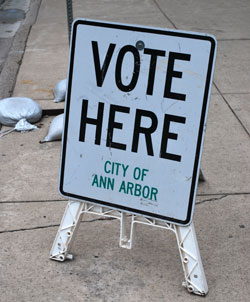
vote here city of ann arbor sign

Sign outside the Michigan Union Building.

[If you're still doing your homework on candidates, click here for The Chronicle's election coverage to date.]

Polls are open until 8 p.m. We’ll report results as we hear about them, filed on The Chronicle’s Civic News Ticker.

If you see us out and about, give a shout. We’ll shout back. The fun starts after the jump. [Full Story]

Column: Who’s-On-First of Local Politics

It’s primary election day. No doubt every one of you Chronicle readers is voting today – if you haven’t already done it by absentee ballot. However, you can almost bet that many of your neighbors won’t.

Home plate at Allmendinger Park

Home plate at Allmendinger Park. It's been scuffed up, even though it hasn't endured a primary election.

On Monday, Washtenaw County clerk Larry Kestenbaum told The Chronicle that he didn’t have a specific forecast in terms of percentage turnout, but he noted that the relatively high turnout he’d been expecting didn’t seem to be panning out in the absentee ballot application and return rates. For the city of Ann Arbor, we’ve been tracking the city clerk’s absentee ballot return reports, and through July 31, 3,092 had been returned for today’s election. That compares with 2,578 absentee ballots cast in August 2006 and 2,803 in August 2008. It’s certainly an upward trend.

But we’re more interested in draft-horse governance than thoroughbred races (and I promise we won’t beat that analogy like a dead horse too much longer). So we decided to see what kind of base-level knowledge people in Ann Arbor had about their elected officials. Base level, as in: Who represents you on the city council?

And what better day than election day to present the results of our admittedly informal survey.

We didn’t ask about the mayor-ship in our survey, or state-level races. But this column is as good a venue as any to speculate about how the gubernatorial horse race on the Republican side might affect the Ann Arbor Democratic primary for mayor.

That’s like suggesting that the games in the American League West Division could have an impact on the outcome of games in the National League East. But there’s got to be a way to transition out of this awful horse race analogy. And a pennant race, yeah, that just might be the ticket. [Full Story]

Seniors Host Ann Arbor Mayoral Forum

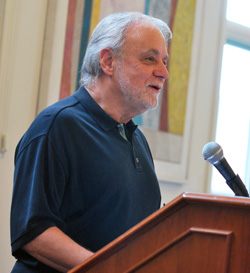
In his introductory remarks, Bill Kinley joked that this was the first mayoral debate – and possibly the last ever – held at University Commons, a condominium community for people over 55 that was founded by University of Michigan faculty. They’d have to see how it turned out, he said.

Bill Kinley

Bill Kinley moderated a mayoral debate at University Commons on Monday between incumbent John Hieftje and challenger Patricia Lesko.

Kinley, a University Commons resident and local developer, moderated Monday’s event, which drew about 50 people to listen as incumbent mayor John Hieftje and challenger Patricia Lesko answered questions for an hour on a range of topics, from Argo Dam and Fuller Road Station to the city budget and possible income tax.

It’s the latest in a series of exchanges between the two candidates, as the Democrats head into next week’s Aug. 3 primary election. [See Chronicle coverage: "Ann Arbor Forums: The More, The Mayor-ier" and "Ann Arbor Dems Primary: Mayoral Race."]

After introducing the candidates, Kinley cautioned that the residents there are “a group of wordy people.” They know that “platform” and “platitude” derive from the French word “plat,” he said, “so if you can keep platitudes to a minimum, you’ll find the reception here is much more responsive.”

Each candidate was given two minutes to answer the question. The first person who answered was also given the option of an additional one minute response. Questions had been developed by Kinley and the program committee for University Commons. [Full Story]

Ann Arbor Forums: The More, The Mayor-ier

On Saturday, July 10, the Ann Arbor Democratic Party hosted a forum for mayoral candidates in the Democratic primary election, which will be held Aug. 3. The following Monday, the League of Women Voters hosted its own mayoral forum. This report combines coverage of those events. Online video of the LWV mayoral forum is available through Community Television Network’s video-on-demand service.

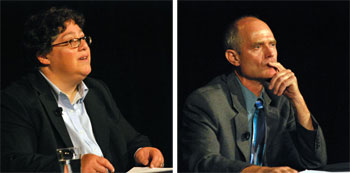
hieftje-lesko

Patricia Lesko and John Hieftje at the League of Women Voters forum filmed at CTN studios on July 12. (Photos by the writer.)

This year Democratic voters will select between challenger Patricia Lesko and incumbent John Hieftje, who was first elected as mayor in 2000. In the November general election, the winner of the Democratic primary will face independent Steve Bean.

Based on campaign finance statements filed Friday, July 23, Lesko has so far collected 49 donations totaling $3,968  – not including a personal loan to her campaign of $1,525. Hieftje has collected 140 donations totaling $16,276. The mean donation to Lesko is $81, compared to Hieftje’s $116. A greater difference is revealed by the median donation: $50 for Lesko  and $100 for Hieftje. Complete financial statements for Lesko and Hieftje are available on the county clerk’s section of ewashtenaw.org. Comparing those statements demonstrates it’s possible for one person to donate to both candidates.

Previous Chronicle coverage of the mayoral race includes: “Ann Arbor Dems Primary: Mayoral Race.”

The city Dems forum was moderated by Jim Leonard, who wrote the piece “Satan For Mayor?!” published in the July edition of the Ann Arbor Observer. [Full Story]

Running for Mayor of Ann Arbor: Steve Bean

Running for mayor as an independent candidate starts pretty easy.

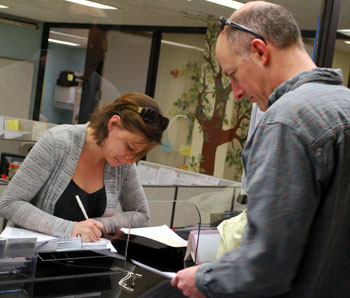
Steve Bean City Clerk Office

Steve Bean obtains nominating petitions as an independent candidate for mayor of the city of Ann Arbor. Behind the glass in the city clerk's office is Lyn Badalamenti. (Photos by the writer.)

It’s a five-minute session at the city clerk’s office.

This brief background piece covers some of the nuts and bolts of that process, based on Steve Bean’s Tuesday afternoon appearance on the second floor of city hall at the city clerk’s office. As a bonus, there’s a bit of city history thrown in.

After Bean told Lyn Badalamenti in the city clerk’s office that he was there to pick up nominating petitions, she set to work assembling a sheaf of papers. The spelling of Bean’s family name was the first order of business: “Like the vegetable,” he offered. Next up: A choice between “Steve” versus “Steven.”

The name that potential signatories of Bean’s petitions will see – as well as voters looking at November’s ballot – is “Steve.”

His name will be recognizable to some readers from his service on the city’s environmental commission. He now chairs that body. Before that, he served for nine years on the city’s energy commission. Some city records, especially older documents like city council minutes from April 9, 1992 – which contain the record of his appointment to the energy commission – show Bean’s name as “Steven.”

But the choice for the shortened variant was one he’d thought through before Badalamenti asked him: “That’s how people know me,” Bean explained to The Chronicle. [Full Story]