The Ann Arbor Chronicle masthead
it's like being there

Stories indexed with the term ‘millage’

Greenbelt Commission Backs County Tax

Ann Arbor Greenbelt Advisory Commission meeting (Feb. 10, 2010): Citing benefits to the city’s own greenbelt program, members of the greenbelt commission at their Wednesday meeting voiced support for a county land preservation millage, which is up for renewal this year.

The commission passed a resolution urging the city council formally to endorse the millage, though it’s up to the Washtenaw County Board of Commissioners to decide whether to put the millage on the ballot. It’s not yet clear the board will do that.

Greenbelt commissioners also discussed the implications of new, lower appraisals that had just been received on the Braun and Gould properties in Ann Arbor Township. The city already has binding purchase agreements with the owners based on older, higher appraised values, but recently learned that new appraisals will result in fewer federal matching funds for the acquisitions. The city could be on the hook for more money than was anticipated to close these deals.

Related to that, some commissioners raised concerns over information they’d received last month from the city attorney’s office, which appeared to be in conflict with what they were being told by staff at Wednesday’s meeting. [Full Story]

AATA Gets Advice on Countywide Transit

Ann Arbor Transportation Authority special board meeting (Dec. 8, 2009): Late Tuesday afternoon at a special meeting, the AATA board heard from two consulting attorneys, as well as heads of three other Michigan transit authorities, on the subject of expanding the geographic scope of AATA service.

Jeff Ammons donut and layer cake

Jeff Ammons, a Grand Rapids area attorney who's been consulting for the Ann Arbor Transportation Authority, explains legal options for establishing an entity that could expand the geographic reach of AATA service. Millage options use the metaphor of "donut" (upper left) and "layer cake" (middle right). (Photo by the writer.)

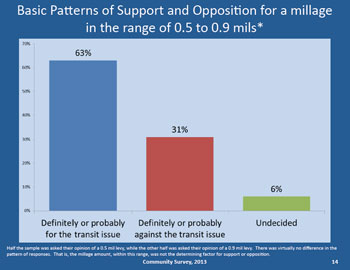
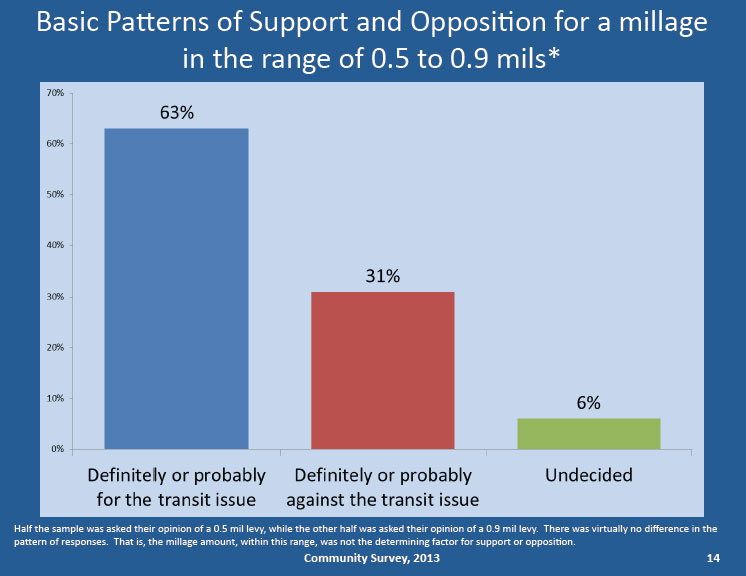
The meeting of the full board, with their five guests, came on the heels of a planning and development committee meeting. At that committee meeting Chris White, AATA’s manager of service development, gave highlights from a recently completed survey of Washtenaw County voters on their attitudes towards a possible countywide transportation tax.

Those who said they would “definitely” or “probably” vote yes on a 1 mill countywide millage eked out a 51% majority countywide.

However, Bob Foy, general manager of Flint’s Mass Transit Authority, repeatedly reminded the full board at their meeting: To get a millage passed, you need a product you can sell. In Flint, which is a countywide authority, Foy reported that the last millage was approved with 68% of the vote.

What the expanded transportation product might look like for Washtenaw County is not yet clear. At the planning and development meeting, AATA CEO Michael Ford indicated that AATA would be bringing in a consultant to address that issue.

The message sent at the board meeting by the two consulting attorneys – Jerry Lax and Jeff Ammons – was that there’s a difference between (i) deciding on the legal authority to be formed, and (ii) deciding on the desired service that AATA wanted to offer. When the board knew what countywide service it wanted to provide and how it wanted to fund that service, they said, at that point it would make sense to decide on the legal mechanism for establishing an expanded authority.

That authority could be established legally under either of the state’s enabling acts: Act 55 or Act 196. [Full Story]

Ann Arbor City Budget: Cuts Begin Now

city administrator Roger Fraser with firefighters in the background

Ann Arbor city administrator Roger Fraser talks with city councilmembers about upcoming budget decisions. That possibility includes layoff notices to 14 firefighters to be sent as soon as the week of Dec. 7. Members of the International Association of Firefighters Local 693 stand in the background. (Photos by the writer.)

Unless he receives other direction from the Ann Arbor city council at its Dec. 7 meeting, city administrator Roger Fraser told councilmembers at their Saturday budget retreat that he’ll begin implementing a plan to trim around $3 million out of the current fiscal year budget.

The moves are necessary to balance the FY 2010 budget, which ends June 30, 2010.

Some of that trimming is a matter of accounting for one-time savings – $500,000 had been budgeted for the Pfizer tax refund, but was settled last year so won’t be on the books for FY 2010. Other trimming is a matter of accepting current situations and committing to them going forward, for recurring savings – for example, vacancies from excess reductions of police through the early-out retirement incentive would not be filled.

But some of the trimming would entail cutting positions currently filled – 14 firefighter positions, which account for around $400,000 of the $3 million to be saved in FY 2010. The move to eliminate firefighter jobs had been part of the FY 2011 plan, but would be implemented six months earlier – now.

For FY 2011, the picture gets even worse, with the city facing a $5.4 million shortfall. And looking ahead one year after that, city council will be faced with constructing a budget for FY 2012 that is 30% smaller than the one they approved for FY 2009. [Full Story]

County Reorganizes 911 Dispatch

Ken Weber

Ken Weber of Weber's Restaurant & Hotel, foreground, sits next to Kevin Gudejko of Main Street Ventures at the Nov. 4 county board of commissioners meeting. They were among the restaurateurs who spoke at a public hearing and questioned the need for a proposed food safety training program. (Photo by the writer.)

Washtenaw County Board of Commissioners (Nov. 4, 2009): After removing a major item from their agenda – the 2010/2011 budget – county commissioners spent the bulk of their Nov. 4 meeting listening to presentations, reports, and a public hearing. Commissioners also voted and approved a new tax to raise roughly $603,000 annually for economic development. The 0.04 mills will be collected on the December 2009 tax bill.

Sheriff Jerry Clayton spoke about plans to reorganize the county’s central dispatch and emergency services operation. Changes include co-location of the county and the city of Ann Arbor’s central dispatch, which will both be housed in Ann Arbor.

Dick Fleece, director of the county’s Public Health/Environmental Health department, gave an update on the H1N1 outbreak and vaccination clinics in Washtenaw County. [On Monday, Nov. 9, the county announced a new clinic for mass immunization of people in expanded priority categories. That clinic will be held on Saturday, Nov. 14 from 9 a.m. to 4 p.m. at Pioneer High School in Ann Arbor.]

Commissioners also heard concerns from local restaurant owners and managers – including Ken Weber of Weber’s Restaurant & Hotel, and Rick Strutz of Zingerman’s Deli – during a public hearing on a proposed new food safety training program. [Full Story]

AATA Sets Meeting on Regional Authority

man giving plaque to woman

New AATA board chair Paul Ajegba presents a plaque of appreciation to Dawn Gabay, deputy CEO, who served for two years as interim director of the authority until Michael Ford was hired as CEO this past summer. In the background at left is board member Jesse Bernstein. To the right, opening a box containing his ceremonial gavel, is outgoing board chair, David Nacht. (Photo by the writer.)

Ann Arbor Transportation Authority board meeting (Oct 21, 2009): Some news of significance announced at the AATA’s board meeting last Wednesday received relatively brief mention and discussion: There will be a special meeting of the AATA board at Weber’s Inn, on Thursday, Oct. 29, 2009 at 5 p.m. in the Varsity Room.

The topic of the meeting will be the possibility of reorganizing as a regional authority under Act 196. That meeting will be a precursor for the conversation about countywide service – and a countywide millage.

As far as the board’s business as reflected on Wednesday’s agenda, the item receiving by far the most discussion was one authorizing a contract for $171,704 for facility camera upgrades. Board member Rich Robben got an animated conversation rolling when he pointedly asked, “Was the bid spec written around a product line??” The board wound up authorizing the contract, with dissent from Robben and fellow board member David Nacht.

Putting a punctuation mark on the past year’s activity was the board’s new chair, Paul Ajegba, who presented the former chair, David Nacht, with a ceremonial gavel in appreciation of his service. Ajegba also presented deputy CEO Dawn Gabay with a plaque in appreciation for her service as interim director of the agency. [Full Story]

New State Cuts Add to School Crisis

Gov. Jennifer Granholm’s decision on Monday to make additional cuts in state funding to some of Michigan’s school districts means an additional $3.7 million loss to the Ann Arbor Public Schools in its current fiscal year, which began July 1.

In addition to $165 per-pupil cuts that were already anticipated, Granholm vetoed a portion of a bill that specified school-aid payments to be made to the state’s “hold harmless” districts, one of which is AAPS. She vetoed that item in a comprehensive K-12 school-aid bill that she signed on Monday. The new cuts of $233 per pupil will take effect unless the state legislature overrides her veto.

AAPS superintendent Todd Roberts told The Chronicle this morning that combined with the previous $165 per-pupil cuts, the Ann Arbor district now must deal with a $6.4 million loss in funding for the current fiscal year. They’ll likely need to tap their $28 million fund equity – the equivalent of a district’s savings account – as well as make cuts to services, trying to identify those that will be the least disruptive to the schools, he said.

Roberts said that Monday’s action at the state level makes it even clearer for the need to take more local control of school funding – referring to a proposed countywide millage that’s on the Nov. 3 ballot. [See Chronicle coverage: "Does It Take a Millage?"] “If we’re going to rely on [the state], then shame on us,” he said. [Full Story]

Does It Take a Millage?

Ann Arbor tax document

An Ann Arbor summer tax bill, showing some of the assessments for Ann Arbor schools. For Ann Arbor Public Schools (AAPS), the millage rates reflect half the amount collected annually.

Among Michigan’s public educators, the 2010-11 fiscal year is being called “The Cliff.” Based on a grim downward trajectory of funding from the state, decreasing revenues from local property taxes and expenses like health care continuing to climb, that’s the year many districts are expected to plummet over the edge into the red.

Robert Allen, deputy superintendent of the Ann Arbor Public Schools, described this scenario at a sparsely attended forum last Thursday at Huron High School, where he and superintendent Todd Roberts made a pitch for voters to support a proposed countywide millage on the Nov. 3 ballot. They didn’t claim that AAPS would be among those districts falling off the cliff, but they did say their district faces a $15 million deficit that year. Without new revenue from the millage, they contend that the district would need to make dramatic cuts, and that those cuts would almost certainly affect students in the classroom. Michigan’s financial crisis is hitting hard, they say.

“As the state goes, so goes our funding,” Allen told the group on Thursday.

The state isn’t going so well.

But opponents argue that school districts haven’t done enough to cut costs, and that taxpayers can’t absorb the added burden of another millage. Beyond that, people on both sides say there’s an urgent need to reform the way schools are funded in Michigan, regardless of the success or failure of the Nov. 3 millage vote.

This Chronicle report looks at how Michigan funds K-12 public schools, why local school districts say they need a special enhancement millage and why critics say they don’t, and what that proposed millage would entail. Ann Arbor Public Schools is the largest of Washtenaw County’s 10 school districts, and would receive over a third of the $30 million collected from the millage annually – we’ll focus our coverage on that district. [Full Story]

Federal Money May Save Bus #5 for Ypsi

Clipping from April 3, 1973 Ann Arbor News newspaper

A clipping from the April 3, 1973 Ann Arbor News newspaper. Headline was: "Bus System Linking City With Ypsilanti Gets Push"

At a meeting of the Ann Arbor Transportation Authority’s planning and development committee on Wednesday evening – attended by some members of Ypsilanti’s city council, plus the mayor – the possible elimination of Ypsilanti’s bus Route #5 became far less likely.

The committee recommended that federal stimulus money be used to cover a shortfall between the amount that Ypsilanti’s city council allocated to transportation, and the cost of the city’s purchase of service agreement (POSA) with the AATA through June 2011. If the recommendation to use federal dollars is approved by the full AATA board at its Sept.23 meeting, the elimination of Route #5, plus reductions in service on Routes #10 and #11, would not be necessary.

On Sept. 8, Ypsilanti’s city council had voted 5-1 (with dissent from Mayor Paul Schreiber) to propose the service reductions – chosen from a “menu” of options provided by the AATA. The Ypsilanti council resolution also included a request that the POSA rate not increase, and that about $100,000 in federal stimulus dollars – part of a $6.45 million grant to the AATA – be used to make up the remaining difference.

The willingness of the AATA’s planning and development committee to increase the federal dollars allotted to around $200,000 was based on a key condition, which is actually built into the language of the Ypsilanti council resolution: either there will be progress towards a dedicated countywide funding mechanism for mass transportation, or else the city of Ypsilanti will put a millage proposal (a Headlee override) on the November 2010 ballot. [Full Story]

Meeting Watch: AATA (15 Oct 2008)

At the Ann Arbor Transportation Authority board meeting on Wednesday night, more support was heard from many different quarters for the formation of an authority that would run WALLY – the proposed north-south commuter rail line from Howell to Ann Arbor – and for AATA to take the lead in forming that authority. [Full Story]

» Text size:

larger text default text smaller text

Skyclock