Stories indexed with the term ‘Natural Areas Preservation Program’

County to Acquire More Nature Preserves

Washtenaw County parks & recreation commission meeting (June 11, 2013): WCPARC’s June meeting, the first since the summer season kicked off on Memorial Day weekend, focused on two of the commission’s main responsibilities: maintaining and improving its parks and recreational facilities, and acquiring land for its natural areas preservation program (NAPP).

DF Land Development LLC, Washtenaw County parks & recreation commission, The Ann Arbor Chronicle

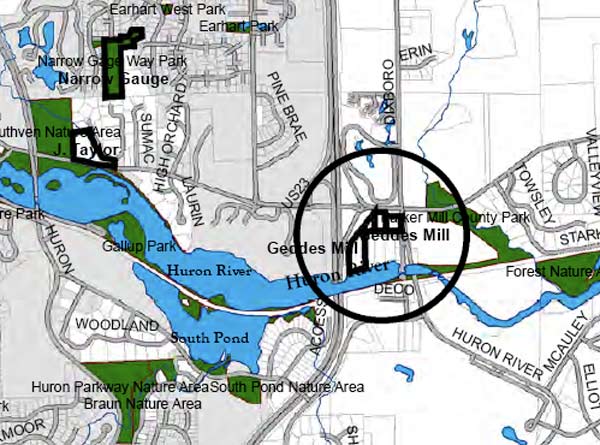
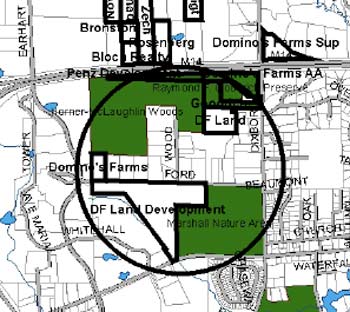
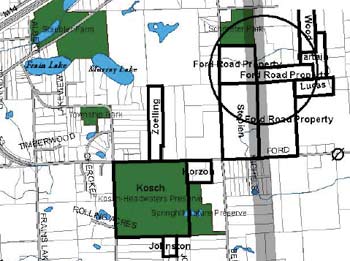
Within the black circle, three parcels outlined in black are owned by DF Land Development LLC and might be acquired by the Washtenaw County parks & recreation commission for nature preserves.

One NAPP deal that’s been years in the works took a step forward, with commissioners giving initial approval to acquire three parcels totaling 71 acres in Ann Arbor Township, owned by a subsidiary of Domino’s Farms. The deal includes a 54-acre parcel that had received widely varying appraisals, which had delayed the acquisition process. That property will cost a total of $3.25 million – with NAPP paying $928,780 and the remainder coming from other partners, including a contribution by the owner. The other two parcels are (1) five acres at a cost of $100,000, and (2) 12 acres for $215,000, with a possible contribution from Ann Arbor’s greenbelt program. The commission will consider giving final approval to all three acquisitions at its July meeting.

In other NAPP-related action, the commission gave final approval to $1,502,336 worth of NAPP purchases: the four-acre Jarskey property in Scio Township for $57,140, and the 249-acre Ramsey-Lippert-Carr properties in Northfield Township for $1,445,196. Both proposals had been described and discussed at WCPARC’s May 14, 2013 meeting.

Commissioners also approved a staff recommendation to expand NAPP’s stewardship program by creating three new staff positions, doubling the county’s investment in NAPP crews to about $350,000 a year. The expansion is possible because of an ordinance change approved by the county board on Sept. 19, 2012, removing constraints on how funds are allocated between NAPP acquisition and maintenance.

Regarding parks & recreation facilities, WCPARC staff updated commissioners on a new water park – called Blue Heron Bay – that’s located at Independence Lake county park. The water park, fenced off from the rest of the facility with a separate admission fee, has amenities designed for younger children, including spray-and-play features and a water slide.

Another expanded facility – Rolling Hills water park, on the east side of the county – includes a wave pool and spray-and-play installations. One of the improvements that seemed of great interest to commissioners was the new three-story water slide.

Commissioners were also briefed on recent market research regarding a proposed east county recreation center, to be built and managed in a partnership with WCPARC, the city of Ypsilanti and the Ann Arbor YMCA. The study indicated support for a 44,000-square-foot center – smaller than the county’s 51,000-square-foot Meri Lou Murray Recreation Center in Ann Arbor and the 70,000-square-foot Ann Arbor YMCA. The full report will be presented on June 25 to WCPARC members and other stakeholders.

In other updates, WCPARC staff noted that bids for construction of the Ann Arbor Skatepark were received, with the lowest bid of $1.2 million coming from Ann Arbor-based Krull Construction. The skatepark’s original budget was $800,000, including a $400,000 contribution from WCPARC. The city of Ann Arbor is working to amend the project’s scope and find additional revenue sources. [The item is on the agenda for the Ann Arbor park advisory commission's June 18 meeting, with a revised construction bid of $1,031,592, based in part on changes to the project's scope. The total project budget is now $1,224,311.] [Full Story]

County Gives More Support to Rutherford Pool

Washtenaw County parks and recreation commission (May 14, 2013): At their most recent meeting, county parks & rec commissioners voted to grant $150,000 to the city of Ypsilanti to help complete the Rutherford Pool project. The Friends of Rutherford Pool is trying to raise about $1 million to rebuild the community pool, located on the eastern end of Recreation Park at 975 North Congress Street.

Recreation Park, Ypsilanti, Rutherford Pool, Washtenaw County parks & recreation commission, The Ann Arbor Chronicle

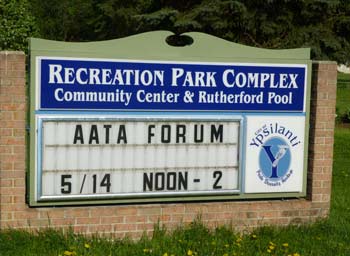
The entrance to Recreation Park in Ypsilanti, where Rutherford Pool is located. (Photos by the writer.)

Commissioners also took steps that could lead to spending over $1.713 million on natural areas preservation. They voted to move forward with the acquisition of three deals for the county’s natural areas preservation program: 17 acres in Scio Township ($55,000); about 245 acres in Northfield Township (about $1.4 million); and 65 acres in Freedom Township ($420,000). The latter two purchases were approved contingent on completing due diligence assessments, followed by final approval from the commission.

In addition, WCPARC approved an initial step in replacing the HVAC system at the Meri Lou Murray Recreation Center on Washtenaw Avenue, and heard reports on upgrades at several other facilities. Those include the nearly-completed major improvements and expansion of water parks at Rolling Hills and Independence Lake parks. Both are set to open Memorial Day weekend, kicking off WCPARC’s summer season.

In other news related to Ypsilanti projects, WCPARC director Bob Tetens reported that the Ypsilanti city council had recently passed a resolution reaffirming support for the east county recreation center project, proposed in the Water Street site near the Huron River. Tetens also presented a report on WCPARC’s marketing and communications program, which staff have expanded into new venues – including AATA buses. The effort is partly in preparation for a millage renewal coming in 2014.

Commissioners also discussed the desire to add another off-leash dog park in addition to Swift Run, which the county runs in partnership with the city of Ann Arbor. Interest is especially keen in light of Ann Arbor’s difficulty in finding a new dog park location. Some commissioners want to include a water element where dogs could play. Jan Anschuetz put it this way: “We’ve done so much to provide water recreation for people – now let’s do it for the dogs.” [Full Story]

County Preps to Buy More Natural Areas

Washtenaw County parks and recreation commission meeting (April 9, 2013): The April meeting, which director Bob Tetens forecast would be “the long-promised very short meeting between our busy seasons,” saw WCPARC take the first step to acquire more properties in two locations for the county’s natural areas preservation program (NAPP). The group also heard a report from the Legacy Land Conservancy about a second round of farmland preservation through a NAPP program that the conservancy helps administer.

Fox Science Preserve, Washtenaw County parks and recreation commission, natural areas preservation program, The Ann Arbor Chronicle

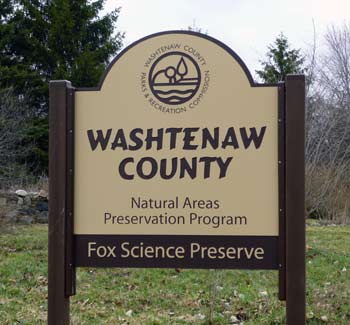
The entrance to Fox Science Preserve in Scio Township. An additional four acres might be added to the county preserve, which is frequently used for environmental education and field study. (Photos by the writer.)

The first proposed acquisition for NAPP was the four-acre Jarskey property in Scio Township, which would become part of the Fox Science Preserve. That preserve lies east of Peters Road and north of Miller. Tom Freeman, retired deputy director of WCPARC and consultant on NAPP matters, briefed commissioners on the proposal. He highlighted two ponds on the property, and the popularity of the former gravel pit for educational purposes. Commissioners ultimately authorized preparation of a purchase offer at $14,285 an acre – or a total of $57,140.

The other NAPP proposal was for four wooded parcels totaling about 18 acres in Pittsfield Township, on the north side of Michigan Avenue roughly across from the Pittsfield Township offices. The value of this property, according to Freeman, is in the quality of the woods and the adjacency to the 535-acre Pittsfield Preserve. Commissioners authorized preparation of purchase offers of $390,000 for two of the properties, and $150,000 for the two other parcels – a total of $540,000.

Also at the April 9 meeting, Robin Burke – land protection coordinator for the Legacy Land Conservancy – briefed commissioners on the process used by the agricultural lands preservation advisory committee (ALPAC) to prioritize possible farmland preservation through the purchase of development rights. There were 72 applications for consideration, totaling 6,500 acres. This is the second round of potential deals that the county is weighing. The initial round was closed in March of 2013, protecting a total of 206 areas of farmland in the Bailo Family Partnership and Trust.

The commission also received reports on its finances, use of its facilities, and ongoing maintenance and improvement of WCPARC buildings and land. [Full Story]

County to Protect More Farmland, Nature Areas

Washtenaw County parks and recreation commission meeting (Feb. 12, 2013): The first meeting of WCPARC in 2013 kicked off when each member received a copy of a half-hour video history of the county park system, in honor of WCPARC’s 40th anniversary.

Miller Creek, Washtenaw County parks and recreation, The Ann Arbor Chronicle

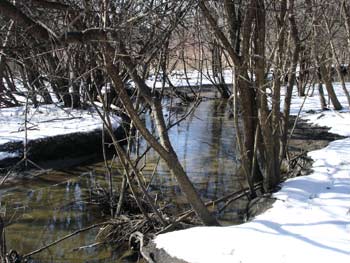
A section of Miller Creek runs through a property off of Geddes Road that the Washtenaw County parks and recreation commission might help preserve, in partnership with the city of Ann Arbor. The land is located in Ann Arbor Township. (Photos by the writer.)

Commissioners were then briefed on what WCPARC director Bob Tetens called a record monthly expenditure for his time with the commission: $3.9 million in January 2013, including $2.9 million for parks and recreation – primarily for capital improvements at Rolling Hills, Independence Lake and Sharon Mills parks – and $1 million for natural areas preservation.

Expenditures in January for the natural areas preservation program included acquiring land from the Ford Road Property LLC on the east side of Berry Road in Superior Township; for improvements at Trinkle Marsh, Spike, Hornback, and Nagle preserves; and for phase 1 due diligence on the proposed purchase of the Trolz property in Manchester Township.

The commission also approved taking the next steps on several additional natural areas preservation proposals. Those steps include applying for (1) federal funds to help cover the purchase of development rights on farmland in Superior and Lima townships, and (2) a state grant to help develop the Staebler Farm, located in Superior Township, into an active park. Commissioners also approved the purchase of a conservation easement on 82 additional acres from the Ford Road Property LLC in Superior Township.

Also discussed was a proposal to help the city of Ann Arbor buy the 8-acre Taylor property on Geddes Road, east of Huron Parkway. The land is immediately east of the city’s Ruthven nature area, and is seen as a priority because a section of Miller Creek runs through it. The creek is subject to flash flooding during heavy rains, and has been the focus of stormwater management efforts by the city and the county water resources commissioner. Conan Smith, a county commissioner who also serves on WCPARC, questioned whether this is an appropriate project for the county’s natural areas preservation program. He indicated that it might be better for the city to partner with the water resources commissioner on this project instead.

In other action, commissioners voted to increase fees at WCPARC facilities, including the Meri Lou Murray Recreation Center, and Independence Lake and Rolling Hills parks. A staff report indicated that the fees would still be lower than comparable public recreation facilities in this region. [.pdf of fee schedule]

WCPARC members were briefed about applications to fund eight projects through the Connecting Communities initiative, under which WCPARC helps pay for non-motorized transportation trails throughout the county. The city of Ann Arbor is among those applicants, asking for $300,000 to fund development of trails along the Allen Creek greenway, including at the city-owned 721 N. Main site. Final decisions will be made at WCPARC’s March meeting.

WCPARC members also re-elected their officers, set the 2013 meeting calendar, and got updates on two months’ worth of activities at the county’s parks and recreation facilities – including a report on flooding at the Meri Lou Murray Recreation Center in January, and steps toward developing a new recreation center in Ypsilanti.

The meeting was attended by six of the current nine-member commission. One vacancy remains to be filled on WCPARC by the Washtenaw County board of commissioners, which appoints all WCPARC members. A vote on that position is expected at the county board’s Feb. 20 meeting. [Full Story]

Washtenaw Preserves Superior Twp. Site

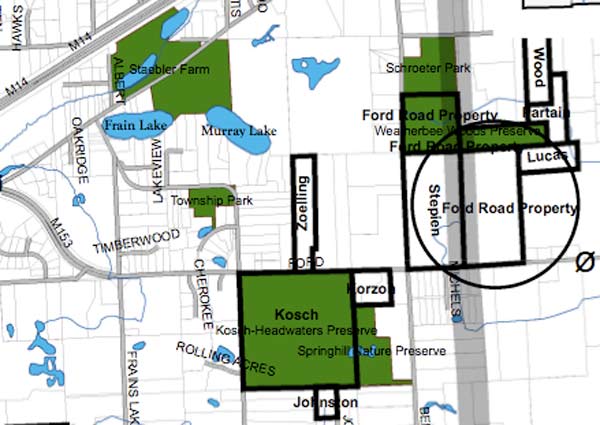
Washtenaw County parks & recreation commission meeting (Dec. 11, 2012): At their December meeting, commissioners took action on properties for the county’s natural areas preservation program. They gave final approval to spend $500,000 for 65 acres on Berry Road in Superior Township, in an area that’s known as the Superior Greenway.

Ford Road Property LLC, Washtenaw County parks & recreation commission, natural areas preservation program, The Ann Arbor Chronicle

Map showing two Ford Road Property LLC parcels (encircled) that the county is purchasing for its natural areas preservation program. A third parcel, which fronts Ford Road, is not part of this deal. The land is located in Superior Township.

In a separate vote, WCPARC authorized staff to undertake due diligence toward a sales offer on 473 acres on the border of Jackson and Washtenaw counties. This deal – for the Trolz property in Manchester Township – is a project that could result in a new state recreation area that includes the southwest corner of Washtenaw County. [See Chronicle coverage: "County Pursues Major New Parks & Rec Deal"]

Commissioners also bid adieu to Jimmie Maggard, who has served on WCPARC for over 30 years, and to outgoing county commissioner Barbara Bergman. Janis Bobrin, who has served on WCPARC for more than two decades by right of her position as Washtenaw County water resources commissioner, did not run for re-election but will continue on WCPARC as a public member. [She was appointed by the county board at their Dec. 5 meeting.] Evan Pratt, who was elected water resources commissioner on Nov. 6, will join WCPARC in January – he attended the Dec. 11 meeting.

In the hour before the meeting started, commissioners and WCPARC staff held their annual holiday party. The highlight was a first viewing of a 30-minute video history of WCPARC, created by county staff over the past several months. The video will be available to the public soon, according to WCPARC deputy director Coy Vaughn. It will run on monitors at the Meri Lou Murray Recreation Center, on cable television, and in smaller segments on the WCPARC website.

Also at the Dec. 11 meeting, the commission approved spending $33,375 to buy grooming equipment for cross-country skiing trails at Independence Lake and Rolling Hills parks. Staff provided reports on finances, highlighted by expenditures to maintain and improve Rolling Hills Water Park and Independence Lake Park; reported on recent projects, including the proposed East County Recreation Center in Ypsilanti; and reviewed WCPARC’s accomplishments in 2012.

An item not on the Dec. 11 agenda will likely receive attention in early 2013: An application from the city of Ann Arbor for up to $300,000 in Connecting Communities funds. If awarded, the grant would be used as matching funds for additional state support to improve the city-owned 721 N. Main property. Applications for WCPARC’s Connecting Communities must be received by year’s end, and the Ann Arbor city council is expected to authorize the application at its Dec. 17 meeting. [See Chronicle coverage: "Grant Applications Recommended for 721 N. Main."] [Full Story]

Change to Natural Areas Ordinance OK’d

An amendment to the ordinance for the county’s natural areas preservation program received final approval from the Washtenaw County commissioners at their Sept. 19, 2012 meeting.

The change removes the previous restriction that only 7% of millage funds could be used for management or stewardship. The Washtenaw County parks and recreation commission had been briefed on the proposal at its May 8, 2012 meeting. At that time, the proposal would have raised the limit from 7% to 25%. The ordinance amendment eventually approved by commissioners eliminated all percentage restrictions on set-asides for management and stewardship.

According to a staff memo, the goal would be to use $600,000 per year for management and stewardship. Of that, roughly $240,000 would be used for ongoing stewardship activities, and … [Full Story]

County Parks OKs More Natural Area Funds

Washtenaw County parks and recreation commission meeting (Sept. 11, 2012): Commissioners took another significant step toward receiving a $2.275 million $975,000 grant from the Michigan Dept. of Natural Resources Trust Fund to buy land for the Arbor Vistas Preserve natural areas connector – by approving $975,000 in matching county funds for the project. The property is located in Ann Arbor Township.

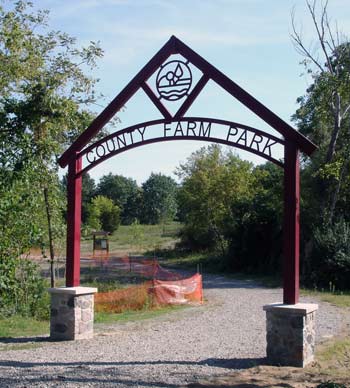
New entrance to County Farm Park

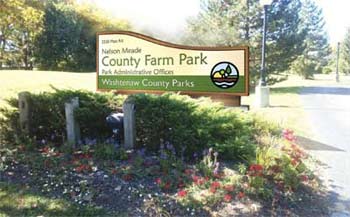
A new entrance archway to County Farm Park off of Washtenaw Avenue. County parks & rec commissioners were briefed on the status of this and several other improvement projects during their Sept. 11 meeting. (Photos by the writer.)

In other action related to natural areas preservation, WCPARC gave initial approval to commit $109,864 to purchase a conservation easement on 124 acres of the Donald Drake property in Lodi Township; and $64,200 toward the purchase of a conservation easement on 73 acres of the Hornback property in Salem Township. Both deals are in partnership with the Ann Arbor greenbelt program.

The commission also approved staff recommendations to increase spending by $522,260 – bringing the total to $1.4 million – on the River Terrace section of the Border-to-Border Trail in Dexter. And the group approved up to $205,587 to replace the pedestrian bridge at Sharon Mills Park, in southwestern Washtenaw County.

Several written financial reports on claims paid and fund balances for parks & recreation functions were approved. The commission also was briefed on a record-setting numbers of users and revenues at the county’s major outdoor parks & recreation facilities this summer – at Independence Lake Park, Pierce Lake Golf Course, and Rolling Hills Park and its water park. However, revenues and attendance for the Meri Lou Murray Recreation Center have declined.

During its Sept. 11 meeting, the commission passed a resolution of appreciation for the public service career of Rodney Stokes, former director of the Michigan Dept. of Natural Resources. Bob Marans, WCPARC’s president, noted that Stokes has helped Washtenaw County secure millions of dollars in state DNR trust fund grants over the years. Stokes is expected to attend the Sept. 19 meeting of the Washtenaw County board of commissioners, when a similar resolution of appreciation is on the agenda. [Full Story]

County Tax Hike for Economic Development?

Washtenaw County board of commissioners meeting (Sept. 5, 2012): Board chair Conan Smith has floated a proposal to raise taxes that support economic development and agricultural programs, and suggested revising the way those revenues are administered.

The proposal came in the context of an initial board vote to levy an annual tax of 0.05 mills, unchanged from the current rate. The Michigan statute authorizing this millage (Act 88 of 1913) predates the state’s Headlee Amendment, so no voter approval is required. The board can levy the tax directly.
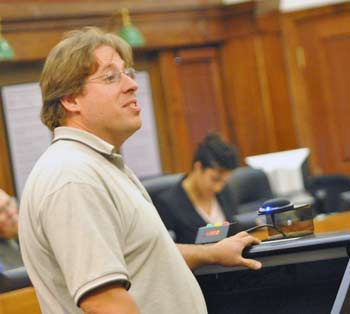
Ken Schrader, PC technician with Washtenaw County

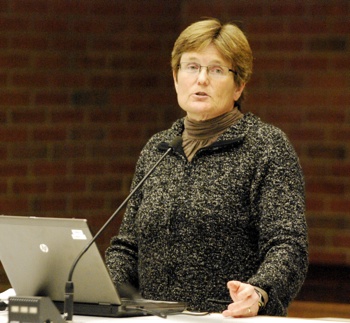
Ken Schrader, a PC technician with Washtenaw County, explained to the county commissioners that recently installed new microphones are more sensitive than the older ones. He jokingly warned them that they should be careful what they say now, because “you can’t take anything back.” Later in the meeting, the county’s information technology department was presented with an award from the Center for Digital Government.

The current rate is expected to bring in about $683,095 in 2013, and is allocated to a variety of organizations, including the economic development agency Ann Arbor SPARK ($200,000) and its Ypsilanti office SPARK East ($50,000). Smith and county administrator Verna McDaniel serve on SPARK’s executive committee.

Smith, a Democrat from Ann Arbor, suggested that by raising the rate to 0.06 mills, property owners would see only a slight increase in their annual taxes. For the average taxpayer, he estimated it would increase from $4.25 to $5.10 per year, while the amount raised countywide would increase about 20% to $838,577. He also proposed that the office of community and economic development – a joint county/city of Ann Arbor department led by Mary Jo Callan – should be given the authority to allocate the funding, rather than having the county board earmark amounts for specific organizations.

No formal amendment was made, but Smith circulated a three-page memo the following night outlining his proposal. [.pdf of Smith's Act 88 memo] It’s likely the board will take up this proposal as an amendment before a final vote at its Sept. 19 meeting. Initial approval was given on Sept. 5 for the current rate of 0.05 mills on a 7-to-3 vote, with dissent from Alicia Ping, Wes Prater, and Dan Smith. Ronnie Peterson was absent.

Another pre-Headlee tax – for support of indigent veterans – also got initial approval from the board, at a slightly increased rate. The initial approval increases that tax from 0.025 mills to 0.0286 mills. Staff of the county’s department of veterans affairs say the increase is needed because of rising claims and services from veterans due to a struggling economy, an anticipated increase in the number of returning soldiers, and a drop in property values. The millage is expected to raise $390,340 in revenues during 2013.

In other action related to tax revenue, commissioners gave initial approval to an ordinance governing the county’s natural areas preservation program. The change would remove the current restriction that only 7% of millage funds can be used for management or stewardship. The intent is to provide more flexibility in managing the funds, allowing the county to build a reserve for long-term stewardship. It’s viewed as an important goal, in the event that the NAPP millage is eliminated in the future. Yousef Rabhi, a Democrat who represents District 11 in Ann Arbor, proposed an amendment that would set a minimum of 25% to be spent on stewardship. The amendment failed on a 1-9 vote.

In an item viewed largely as a formality, county commissioners “ratified” the articles of incorporation for a new countywide transit authority. The document had been slightly revised from what the board had previously approved on Aug. 1, 2012 – on a 6-4 vote. This time, the vote was 6-3, with dissent from Alicia Ping, Wes Prater and Dan Smith. Rolland Sizemore Jr. and Ronnie Peterson were absent. Rob Turner, who had previously voted against the articles of incorporation, supported the item on Sept. 5.

Also approved was a resolution to support a policy change in the city of Ann Arbor related to affordable housing. The item was added to the Sept. 5 agenda during the meeting by Democrat Leah Gunn of Ann Arbor, and was not discussed by commissioners at the meeting. The resolution “encourages the Ann Arbor City Council to direct proceeds from the sale of the city-owned surface parking lots in the downtown to the city’s Housing Trust Fund, to be used to support sustainable, affordable housing.” [Earlier in the day, the Ann Arbor Downtown Development Authority board had passed a similar resolution of support. Gunn is chair of the DDA.] Dan Smith abstained from the vote. The following night, at a board working session, Alicia Ping announced that she had intended to vote against it, but had cited the wrong agenda number in casting her no vote.

Other action at the Sept. 5 meeting included initial approval of the county’s public health budget, which projects a 3.5 net increase in jobs. Voting against the budget were Alicia Ping and Dan Smith, who cautioned against adding new jobs as the county faces a deficit in 2013. A final vote is expected at the board’s Sept. 19 meeting.

Seth Best, a former resident of Camp Take Notice, addressed the board during public commentary about the need to tackle the root causes of homelessness. The homeless encampment had been evicted this summer from its most recent site in Scio Township.

And highlighting a letter that the county had recently received, commissioner Felicia Brabec raised concerns about the intent of Paxton Resources LLC to drill an exploratory oil and gas well in Saline Township. The board will likely revisit the issue of hydraulic fracturing, or “fracking,” at a future working session. Yousef Rabhi, who chairs those meetings, suggested wrapping it into a session he plans regarding the Pall/Gelman Sciences 1,4 dioxane plume. He sees a tie-in to the issue of industrial environmental contamination. [Full Story]

County’s Natural Areas Ordinance Tweaked

An amendment to the ordinance governing the county’s natural areas preservation program received initial approval from the Washtenaw County commissioners at their Sept. 5, 2012 meeting.

The change would remove the current restriction that only 7% of millage funds can be used for management or stewardship. The Washtenaw County parks and recreation commission had been briefed on the proposal at its May 8, 2012 meeting. At that time, the proposal would have raised the limit from 7% to 25%. Now, however, the proposed ordinance amendment would eliminate all percentage restrictions on set-asides for management and stewardship.

According to a staff memo that was part of the county board’s Sept. 5 meeting packet, the goal would be to use $600,000 per year for … [Full Story]

County Parks & Rec System Plans for Future

On Sept. 5, 2012, the Washtenaw County board of commissioners will consider amending an ordinance for the county’s natural areas preservation program. The intent is to create more flexibility in setting aside funds for stewardship, with the goal of eventually building a $6 million fund for ongoing maintenance of county preserves.

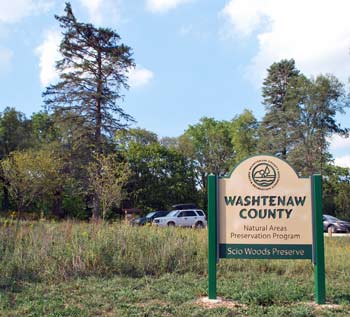
Entrance to Scio Woods Preserve on Scio Church Road

The entrance to Scio Woods Preserve, part of the Washtenaw County parks & recreation commission’s natural areas preservation program. The 91-acre property, off of Scio Church Road, is protected in partnership with Scio Township and the Ann Arbor greenbelt program. (Photo by M. Morgan)

Since the NAPP initiative was established in 2000, nearly 2,500 acres of land have been preserved countywide. The millage-funded program is overseen by the Washtenaw County Parks and Recreation Commission (WCPARC), a body appointed by the county board that also oversees the much older parks and recreation system, which was established in 1973.

WCPARC also partners with other organizations on special initiatives, including the countywide Border to Border Trail, (B2B), the Connecting Communities program, and planning for an east county recreation center on Michigan Avenue in Ypsilanti. That center’s planning effort is also taking another step forward this month, with WCPARC staff holding an open house on Thursday, Sept. 27 to review two design options for the center. The open house will be held at Spark East (215 W. Michigan Ave. in Ypsilanti) from 3-8 p.m., with formal presentations at 4 p.m. and 8 p.m.

In the context of current proposals – the NAPP ordinance change and possible new recreation center in Ypsilanti – this report looks at the history, budget, and scope of the county parks and recreation system, as well as its master planning for the future and its partnerships with local, state and national organizations with a similar purpose. [Full Story]

County Parks Commission OKs $6M in Projects

Washtenaw County parks and recreation commission meeting, July 24, 2012: At its most recent meeting, WCPARC approved contracts totaling nearly $6 million.

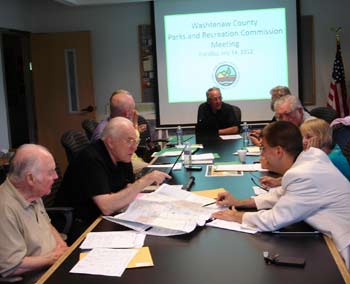
Washtenaw County parks & recreation commission meeting

Members of the Washtenaw County parks & recreation commission at their July 24, 2012 meeting. In the foreground from the left are Nelson Meade and Fred Veigel, who is also a member of the Washtenaw County road commission. At the right (white jacket) is Dan Smith, who also represents District 2 on the county board of commissioners. (Photos by the writer.)

The bulk of the funding – about $5.73 million – is for improvements at three of the county parks facilities: the water park at Rolling Hills ($4,792,530); the River Terrace section of the county’s Border-to-Border (B2B) trail near Dexter ($877,740); and enhancements to the new entrance to the County Farm Park on Washtenaw Avenue (estimated $50,000).

Work at the Rolling Hills water park will dramatically change the entrance to that popular county facility, which employs about 85 workers at the peak of the summer season. Commissioners voted to award the $4,792,530 contract to Sorensen Gross Construction Services (SGCS) of Flint, which submitted the lowest of seven bids.

The commission also approved an expenditure of $267,500 to buy the Baker property in Lima Township for the county’s natural areas preservation program. The land is on the north side of Trinkle Road, between Lima Center and Fletcher Roads – about a mile to the west of the recently protected Trinkle Marsh Preserve.

Staff gave updates on a variety of other projects, including conceptual design work on a recreation center in Ypsilanti. A team of students and faculty from the University of Michigan Taubman College of Architecture and Urban Planning is working on that project. Director Bob Tetens reported that a couple of different approaches are being considered: a long linear facility along the Huron River, or a more traditional box-style building. Both would incorporate the B2B trail along the building, under overhangs, with a design that allows stormwater to flow under the building.

The meeting closed with shared memories of Meri Lou Murray, a former county commissioner who was largely responsible for creating the county parks system. Murray died on July 22. [Full Story]

Greenbelt Group Updated on County Efforts

Ann Arbor greenbelt advisory commission meeting (June 7, 2012): Collaboration was a theme that tied together several items at the most recent GAC meeting, starting with a review of farmland preservation efforts by Washtenaw County.

Liz Rother, Mike Garfield

Greenbelt advisory commissioners Liz Rother and Mike Garfield. The June 7 meeting was the last one for Garfield, whose term is ending this month. He is director of the Ecology Center, a nonprofit based in Ann Arbor. (Photos by the writer.)

The county parks and recreation commission is moving toward a decision on the first farm properties to include in its land preservation program. It has about $1.6 million to work with, using a portion of proceeds from the countywide natural area preservation millage, which was renewed by voters in November of 2010. That 10-year, 0.25-mill tax also funds the county’s acquisition of natural areas and land preserves.

Susan Lackey, executive director of the Legacy Land Conservancy, briefed the greenbelt commissioners on the first round of deals. The Ann Arbor-based nonprofit is under contract to help manage the county program. Out of 57 applications, seven properties are moving forward for appraisals and final consideration, potentially covering 1,100 acres.

Though the county’s efforts at protecting farmland are relatively new, the greenbelt program has focused on farmland preservation since Ann Arbor voters approved a 30-year 0.5 mill tax in 2003. Lackey described the county’s efforts as complementary to the greenbelt program, noting that there’s more work to be done than any single entity can do.

Later in the meeting – during an discussion about efforts to update the greenbelt program’s strategic plan – Mike Garfield suggested that it might be time to shift more of the greenbelt’s efforts to natural areas or recreational projects like the Border-to-Border trail or RiverUp, and scale back the amount of farmland preservation.

One difficulty in this shift relates to matching funds. Ginny Trocchio, who serves as support staff for the greenbelt program, told commissioners that while the greenbelt has been very successful in securing grants through the federal Farm and Ranch Lands Preservation Program (FRPP), there are far fewer options for non-farmland properties. Partnerships with other local entities, like the county parks and recreation department, is one of the main ways that non-farmland land preservation dollars can be leveraged.

Another general challenge for all types of land preservation was cited by Lackey: A mild resurgence of development pressure as the economy improves, which is starting to drive up land values. She urged all groups to get as much preservation work done as possible in the next three to five years.

This month’s meeting was the last one for Garfield, who was instrumental in helping pass the city’s open space and parkland preservation millage, which funds the greenbelt program. He is term-limited. His potential replacement, Archer Christian, was introduced at the meeting. She is development director at the Ann Arbor-based Ecology Center, where Garfield serves as director.

At the end of the meeting, commissioners held a closed session to discuss potential land acquisitions. When they emerged, they voted unanimously to recommend action by city council on the purchase of development rights for four parcels within the greenbelt boundaries, if FRPP grants can be secured. [Full Story]

County Parks: Stewardship Fund an Option?

Washtenaw County parks and recreation commission meeting (May 8, 2012): This month’s meeting of the county parks and recreation commission had three themes: starting new projects, planning for the future of the natural areas preservation program (NAPP), and updating commissioners about ongoing and completed projects.

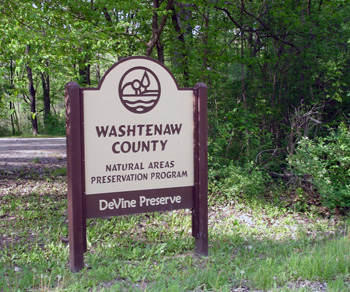
Entrance to Washtenaw County's DeVine Preserve

The entrance to Washtenaw County's DeVine Preserve on West Liberty Road in Scio Township, part of the natural areas preservation program. It is adjacent to other property that the county parks and recreation commission might buy with NAPP millage proceeds. (Photos by the writer.)

Much of the discussion related to NAPP, including a proposed ordinance change to increase the proportion of funds that can be used for maintaining (as opposed to purchasing) property for natural areas or land preserves. The change would allow the county to set aside up to 25% of annual millage proceeds for stewardship, a significant increase from the 7% currently allowed under the NAPP ordinance. NAPP is funded by a 10-year, 0.25 mill tax that voters first approved in 2000 and renewed in 2010. It generates about $3.2 million in annual revenues.

Commissioners authorized staff to pursue the NAPP ordinance change, which would need to be approved by the county board of commissioners. A June 7 board working session is scheduled on the topic. If approved, WCPARC staff estimate they could set aside enough to build a $6 million fund by 2020, when the current NAPP millage ends.

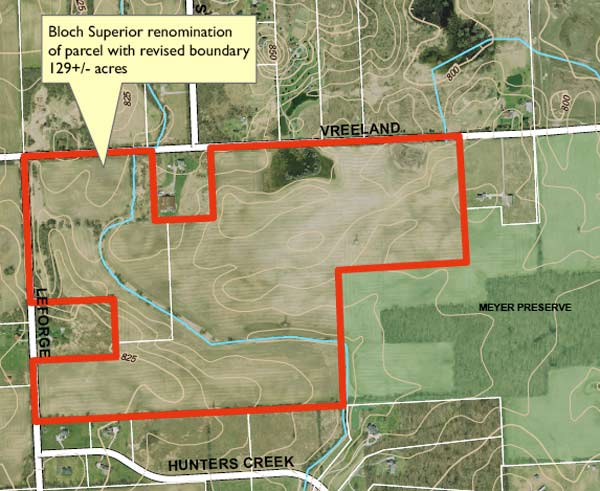
The commission also approved two new NAPP purchases: (1) $75,000 for the Malikah Muhammad property, 20 acres in Scio Township adjacent to the county’s existing DeVine Preserve; and (2) $245,250 for 33 acres in Northfield  Township owned by J.A. Bloch, contingent on partnering with the Ann Arbor greenbelt program for a portion of the cost.

Related to a project on the east side of the county, commissioners approved a $10,000 payment toward planning for the Eastern County Recreation Center on Ypsilanti’s Water Street site. WCPARC had been briefed on the project at its April 2012 meeting. The planning will be guided by faculty at the University of Michigan Taubman College of Architecture and Urban Planning, who will lead a team of six students in developing a conceptual plan for the rec center by the end of December. A grant from UM will pick up $30,000 of the estimated $40,000 in planning expenses.

The commission also got updates on a range of projects, including completion of the extensive Malletts Creek bank stabilization at the County Farm Park, and the receipt of bids for design of the Ann Arbor skatepark, which WCPARC is helping to fund. [Full Story]

More Planning for Rec Center in Ypsilanti

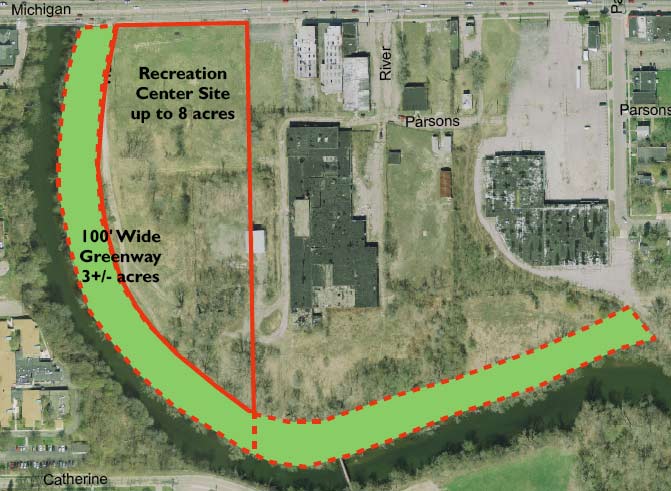
Washtenaw County parks and recreation commission meeting (April 10, 2012): Most of this month’s county parks and recreation commission meeting focused on plans for a recreation center in the eastern part of the county. The proposed center would be near downtown Ypsilanti on the northwest corner of the 38-acre Water Street site, located on the south side of Michigan Avenue and east of the Huron River.

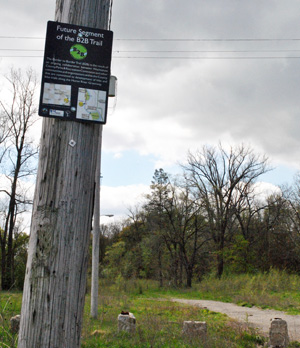
Border to Border Trail sign at Water Street property in Ypsilanti

A sign at Ypsilanti's Water Street property indicating that this will be a future segment of Washtenaw County's Border to Border Trail. A portion of the site adjacent to the Huron River is being considered for a possible new county recreation center. (Photos by Mary Morgan.)

The commission heard from faculty of the University of Michigan Taubman College of Architecture and Urban Planning, who will lead a team of six students in developing a conceptual plan for the rec center by the end of December. They also heard from deputy parks and rec director Coy Vaughn about the steering committee and working groups that will oversee and coordinate the design team’s work, and ensure adequate participation by community members and other stakeholders, including the Ann Arbor YMCA. Some commissioners indicated that community input was especially important for this project.

Among the meeting’s action items, the commission approved the acquisition of additional land through the county’s natural areas preservation program, in partnership with other governmental entities, including the Ann Arbor greenbelt program. The properties include 23 acres in Ann Arbor Township and 33 acres in Northfield Township – both owned by J.A. Bloch & Co. – and the 35-acre Sloan property in Scio Township.

Additional items included a report from parks and rec director Bob Tetens about the department’s help in cleaning up after the March 15 tornado touchdown in Dexter; an update on improvement projects and activities at park facilities and preserves; and the latest milestones in a project to connect the Border-to-Border Trail in the village of Dexter, including a new bridge.

Other major action in the meeting included a review of the parks and rec budget to date, through the first quarter of the fiscal year. Tetens reported that the unusually warm weather this year had two effects: much less participation and revenue from Rolling Hills winter park compared to the last two years; and much more activity and revenue at the Pierce Lake Golf Course, which was also in part related to the March 15 tornado’s damage to other golf courses in the area. [Full Story]

County Working on Farmland Preservation

As the Washtenaw County parks and recreation commission moves closer to making its first decisions about farm properties to include in its land preservation program, the county board of commissioners got an update on the process at its April 5 working session.

Susan Lackey

Susan Lackey, executive director of the Legacy Land Conservancy, updated commissioners about Washtenaw County's farmland preservation efforts at an April 5, 2012 working session. (Photos by the writer.)

Susan Lackey, executive director of the Legacy Land Conservancy – an Ann Arbor-based nonprofit that’s under contract to help manage the program – told commissioners that about $1.6 million is available to preserve farmland, using a portion of proceeds from the natural area preservation millage renewed by voters in November of 2010. That 10-year, 0.25-mill countywide tax also funds the acquisition of natural areas and land preserves.

Prior to 2010, the natural areas ordinance allowed for outright acquisition of land, but not for the purchase of development rights (PDR). PDR is a common mechanism for protecting farmland, letting landowners keep their property for farming but preventing – via a conservation easement – its development. In May of 2010, the county board approved an ordinance revision that incorporated farmland into the county’s natural areas preservation program and clarified the use of PDR for that purpose.

The county received 57 applications for its first round of potential deals, Lackey reported. That list has been narrowed down to seven parcels for final consideration, covering 1,100 acres. The locations of the parcels won’t be released until a final vote by the parks and rec commission. That vote will be taken when the deals are ready to close. That’s likely to happen later this year.

Yousef Rabhi was among the commissioners who praised the program, noting how it ties in with the food policy council that the county board recently created, as well as the food-related business incubator and job training program – called Seeds for Change – focused on the eastern part of the county. Rabhi serves on the Agricultural Lands Preservation Advisory Committee (ALPAC), which makes recommendations to the parks and rec commission about farmland deals.

The April 5 working session also included a briefing on the county’s community corrections unit. This report focuses just on the farmland preservation update. [Full Story]

Greenbelt, County Look to Partner on Farms

Ann Arbor greenbelt advisory commission meeting (March 9, 2011): Changes to Washtenaw County’s natural areas preservation program (NAPP) now allow the county to buy development rights for farmland – a land preservation strategy also pursued by Ann Arbor’s greenbelt program.

Ginny Trocchio, Tom Freeman

Tom Freeman, deputy director of Washtenaw County parks & recreation, and Ginny Trocchio of The Conservation Fund distribute handouts to the Ann Arbor greenbelt advisory commission at GAC's March 9, 2011 meeting. (Photos by the writer.)

Tom Freeman, deputy director for the county’s parks & recreation department, gave commissioners an update on this new aspect of NAPP, which is funded by a 10-year millage that voters renewed in November 2010. He discussed with commissioners areas of overlap between the two programs, and the potential for future partnerships as NAPP’s farmland protection efforts ramp up.

Prompted by a question from GAC chair Jennifer S. Hall, Freeman also updated commissioners about the county’s plans to apply for a grant from the Michigan Dept. of Natural Resources Trust Fund. The grant would help the county buy a parcel in Ann Arbor Township now owned by a subsidiary of Domino’s Farms. The land, which has water and sewer hookups that make it prime for development, is near three other parcels of already preserved property: the county’s Goodrich Preserve; the University of Michigan’s Horner-McLaughlin Woods; and the city-owned Marshall Nature Area. Freeman explained some complicating factors in the acquisition, including two widely divergent appraisals – for $1.9 million and $3.25 million – and the fact that the land is at the center of ongoing litigation between the township and the landowner.

When Hall floated the idea that the greenbelt commission could send a letter of support for the county’s application, Carsten Hohnke cautioned against it. Hohnke, who serves on both GAC and city council, said the city also plans to apply to the trust fund for two projects. [He didn't identify the projects during the meeting. In a follow-up email to The Chronicle, Colin Smith, the city's parks & recreation manager, reported that the applications would be for a skatepark and upgrades to the Gallup canoe livery and park.]

Hohnke felt the county’s application could dilute the city’s chances for success, though it was pointed out to him that the county and city would be applying to two separate pools of funding – the county plans to ask for a grant available for land acquisitions, while the city’s projects are in the category of project development grants. Ultimately, commissioners voted to recommend that the city council consider sending a letter of support for the county’s application. Councilmembers would need to act at their next regular meeting on March 21 – the deadline to apply is April 1.

Also at GAC’s March 9 meeting, commissioner Tom Bloomer – who owns Bur Oaks Farm in Webster Township – reported on a plan to eliminate state tax credits for farmers. It’s part of a broader budget proposal by Gov. Rick Snyder to cut many of the tax incentives currently offered by the state – the most high profile of which is for the film industry. Eliminating the credits for farming could make it unprofitable to farm in this area, Bloomer said. [Full Story]

Talking Trees, Leafing Through Archives

By

[Editor's Note: HD, a.k.a. Dave Askins, editor of The Ann Arbor Chronicle, is also publisher of an online series of interviews on a teeter totter. Introductions to new Teeter Talks also appear on The Chronicle's website.]

Robb Johnston

Last week, Robb Johnston rode the AATA bus from Ypsilanti into Ann Arbor and walked from downtown to my front porch take his turn on the teeter totter. [Robb Johnston's Talk]

Johnston has written and illustrated a self-published children’s book called “The Woodcutter and The Most Beautiful Tree.” And whenever anyone pitches me Chronicle coverage of a project they’re proud of, my first thought is: “Can I get a teeter totter ride out of this?”

Before Johnston’s ride, I test-read his children’s book the best way I could think of, given that my wife Mary and I do not have children: I read the book aloud to her, and did my best to pretend that she was four years old. It was my own first read through the book, so I was satisfied when I did not stumble too badly over the part of the woodcutter’s refrain that goes, “Thwickety THWAK, Thwickety THWAK.”

Oscar Wilde’s “The Happy Prince” notwithstanding, I think it’s fair to expect that a children’s book with a title like “The Woodcutter and The Most Beautiful Tree” will end well and leave everyone with smiles all around. And it does. So it’s not like I was truly surprised when I turned that one page near the end that reveals exactly how the final encounter between The Most Beautiful Tree and the Woodcutter ends.

But the book’s text and its illustrations pull the reader along to that point, and suggest so unmistakably a dark and dreadful ending, that when I did turn that page, I gulped a genuine breath of relief that she did not wind up getting milled into lumber at the end. [The tree in Johnston's book is female.] Well, yes, you might conclude that I am just that dopey. Or more generously, you might try sometime reading aloud a book you’ve never seen before.

But speaking of things we’ve seen before, some Chronicle readers might be thinking: Haven’t we seen this guy Robb Johnston before? Why yes, you have. [Full Story]

Land Bank Revived, Millages Reviewed

Washtenaw County Board of Commissioners meeting (Sept. 1, 2010): During a meeting that lasted less than 90 minutes – including a break for a photo op – commissioners covered a lot of ground at their first meeting following a scaled-back summer schedule.

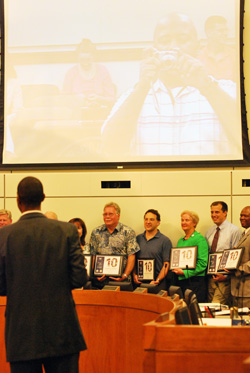
Washtenaw County commissioners get their photo taken.

Washtenaw County commissioners get their photo taken, with plaques given to them by the U.S. Census Bureau. In the foreground, with his back to the camera, is Toine Murphy, a partnership specialist from the U.S. Census Bureau’s Detroit office, who presented the plaques to commissioners. Bonus points to readers who can identify the woman on screen in the background, and what she's doing. (Photos by the writer)

Two millage-related issues were dispatched without discussion: making minor changes to ballot language for renewing the natural areas preservation program millage, and setting a Sept. 15 public hearing for renewal of an indigent veterans relief millage.

Commissioners gave initial approval, again without discussion, to transfer the use of $10 million in federal Recovery Zone Economic Development Bonds from the county to the Washtenaw Community College. WCC plans to use the bonds to fund construction of a parking structure.

Also getting initial approval was a resolution to authorize the county to issue dog license renewals year-round, and to add the option of a three-year license. Currently, one-year dog licenses can be bought starting Dec. 1 for the upcoming year.

An agreement with St. Joseph Mercy Health System was terminated, related to the operation of the Delonis Center – the county’s homeless shelter. The agreement, put in place when the shelter was conceived, called for St. Joe’s to step in and operate the center if the entity created to do that work – the Washtenaw Housing Alliance – couldn’t perform that task. The WHA subsequently subcontracted operations to the Shelter Association of Washtenaw County and Food Gatherers, which have been operating the shelter for eight years. St. Joe’s asked that they be released from the agreement, but will keep their representatives on the WHA board.

And after months of discussion and debate, the board approved two resolutions that revived the county’s land bank, which commissioners had voted to dissolve in March 2010. Leah Gunn dissented, and three commissioners – Ken Schwartz, Jessica Ping and Barbara Bergman – were absent. County treasurer Catherine McClary, Ypsilanti mayor Paul Schreiber and Sabra Briere, an Ann Arbor city councilmember, attended the meeting to support the land bank, a tool used to help the county deal with foreclosed and blighted properties, and after the vote they all thanked the board for its action. [Full Story]
No More “Felony Box” on County Job Forms

Washtenaw County board of commissioners (Aug. 4, 2010): A day after the primary election – one that brought victories to all commissioners who were running for office – the board faced a full agenda, but dispatched most of its business with minimal discussion.

Donald Staebler

Donald Staebler, who'll turn 100 later this month, was honored at Wednesday's county board meeting. He has lived on Staebler Farm, which is now owned by the county, for 98 years.

One item, however, yielded lengthy debate: A resolution that would remove the “felony box” from county job applications, and eliminate background checks for all jobs except those deemed sensitive. Several commissioners were uneasy with even partial elimination of background checks. The resolution was ultimately amended to deal with only the felony box, which asks applicants if they’ve ever been convicted of a felony. Commissioners ended up unanimously approving the removal of that question from job applications.

The board also agreed to put a 10-year millage renewal on the November ballot for the county’s natural areas preservation program, and approved brownfield plans for the Near North housing project and an expansion of Zingerman’s Deli. Both of the brownfield projects are located in Ann Arbor – brownfield status enables them to seek Michigan business tax credits and, in the case of Zingerman’s, to use tax increment financing (TIF) to get reimbursed for project-related expenses.

Commissioners got a second-quarter budget update, which revealed few surprises. However, projections indicate that the budget surplus they need to carry over into 2011 will fall short of their goal by about $987,000. Next year will be a challenging one.

The board had been expected to act on re-establishing a land bank for the county, but ended up tabling resolutions related to that effort until next month, citing the need to gather additional information.

The meeting also included time to honor two people from the community: Joseph N. Cousin Sr., pastor of Bethel AME Church in Ann Arbor, and Donald Staebler, a local farmer whose land is being turned into a county park – and who’ll turn 100 later this month. Both men received standing ovations for their work. [Full Story]

Washtenaw Natural Areas Tweaked for Ballot

Washtenaw County Board of Commissioners working session (April 22, 2010): At their Thursday meeting, commissioners were briefed on proposed changes to the county’s Natural Areas Preservation Program, which would help the county protect more land that’s being used for farming.

Bob Tetens, Susan Lackey

Susan Lackey, executive director of the Legacy Land Conservancy, confers with Bob Tetens, director of Washtenaw County Parks & Recreation, before the start of Thursday's working session of the county board of commissioners. (Photo by the writer.)

The proposal comes as the board prepares to place a renewal of the 10-year NAPP millage on the November ballot. The current millage, which raises about $3 million annually to preserve natural areas in the county, expires at the end of 2010.

Also at Thursday’s meeting, commissioners heard a report on internal controls used within the county government, both in finance and other areas. This has been topic that commissioner Wes Prater has pushed the board to address for several months.

Highlights from a draft report were presented by staff of the county’s new energy and economic development department. The report includes data on job losses, education, housing, transit and other factors, and presents four strategies for improving the county’s economy. Tony VanDerworp, who leads the department, explained that the report is required by the U.S. Dept. of Commerce’s Economic Development Administration so that the county can apply for grants from the EDA.

Finally, Verna McDaniel, incoming county administrator, said she plans to hold a meet-and-greet for candidates of the deputy administrator job on May 5 before that evening’s board meeting, to get commissioners’ feedback on a potential hire. [Full Story]
Greenbelt Commission Backs County Tax

Ann Arbor Greenbelt Advisory Commission meeting (Feb. 10, 2010): Citing benefits to the city’s own greenbelt program, members of the greenbelt commission at their Wednesday meeting voiced support for a county land preservation millage, which is up for renewal this year.

The commission passed a resolution urging the city council formally to endorse the millage, though it’s up to the Washtenaw County Board of Commissioners to decide whether to put the millage on the ballot. It’s not yet clear the board will do that.

Greenbelt commissioners also discussed the implications of new, lower appraisals that had just been received on the Braun and Gould properties in Ann Arbor Township. The city already has binding purchase agreements with the owners based on older, higher appraised values, but recently learned that new appraisals will result in fewer federal matching funds for the acquisitions. The city could be on the hook for more money than was anticipated to close these deals.

Related to that, some commissioners raised concerns over information they’d received last month from the city attorney’s office, which appeared to be in conflict with what they were being told by staff at Wednesday’s meeting. [Full Story]

County Natural Areas Tax Up for Renewal

A resolution to hire Verna McDaniel as the next county administrator is on the Feb. 3 agenda for the Washtenaw County Board of Commissioners, and commissioners gave her a round of applause on Wednesday when that agenda item was announced at their administrative briefing.

But it was an item not on the agenda that yielded the most animated discussion on Wednesday: A countywide millage for Washtenaw County’s Natural Areas Preservation Program. The tax, which was first approved by voters in November of 2000 and took effect in 2002, will expire in 2011 and would need to go back to voters this year for renewal. Based on comments at Wednesday’s briefing, the millage renewal might face resistance from some commissioners. [Full Story]