Editor’s note: This “Live Updates” coverage of the Ann Arbor city council’s Dec. 16, 2013 meeting includes all the material from an earlier preview article. We think that will facilitate easier navigation from live-update material to background material already in the file.
The Ann Arbor city council’s last regular meeting of the year, set for tonight, features an agenda with about a dozen substantive voting items.
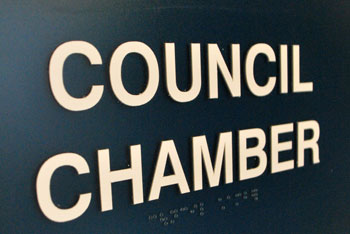
The sign on the door to the Ann Arbor city council chamber, installed in the summer of 2013, includes Braille.
Added to the agenda on the Friday before tonight’s meeting is an item that relates to proceeds from the city’s sale of property known as the former Y lot. The sale of the property to Dennis Dahlmann for $5.25 million will result in a gross difference of $1.75 million compared to the $3.5 million price paid by the city in 2003.
The item added to the Dec. 16 agenda would designate $1.56 million of that amount – which is all but a $190,000 brokerage fee – for deposit in the city’s affordable housing trust fund.
That would reflect a departure from the policy set in a 2012 council resolution, which called first for reimbursement of costs out of the proceeds, including interest paid over the last 10 years, before depositing those net proceeds into the affordable housing trust fund.
Although the city administrator is not required to present next year’s FY 2015 budget to the council until April 2014, at least three items on the council’s Dec. 16 agenda could have an impact on preparation of that budget. Some of those items relate to mobility and traffic issues.
First, the council will consider directing city administrator Steve Powers to include in the FY 2015 budget an additional $10,000 in community events funding to support the Ann Arbor Street Art Fair.
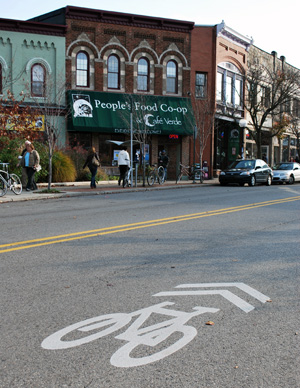
Second, the council will consider directing Powers to present a plan for funding elements of the city’s non-motorized transportation plan by specific dates: by Feb. 1, 2014, the plan’s recommended midblock deployments of rectangular rapid flashing beacons (RRFB); by April 21 the near-term recommendations of the plan; and by June 30 the long-term elements of the plan.
Thematically related to the funding plan for non-motorized improvements is a third budget item: a proposal to allocate $125,000 from the current general fund reserve to pay for police overtime for traffic enforcement.
That item is sponsored by Stephen Kunselman (Ward 3), Jack Eaton (Ward 4) and Jane Lumm (Ward 2), who were part of a six-vote majority that had backed a significant revision to the city’s crosswalk law at the council’s Dec. 2, 2013 meeting. That change – which eliminated a requirement that motorists stop for pedestrians who were at the curb but not within the crosswalk – was subsequently vetoed by mayor John Hieftje. And the text of that veto is attached to the council’s meeting agenda as a communication.
Also generally related to the public right-of-way on streets is a Dec. 16 item that was postponed from the council’s Dec. 2, 2013 meeting. The item assigns a specific cost to the removal of an on-street parking space caused by a development: $45,000. The postponement stemmed from a desire to hold a public hearing on the matter before taking action.
Several of the other Dec. 16 items relate generally to the theme of the environment. In the area of solid waste management, the council will consider a roughly $65,000 allocation from the solid waste fund balance. That allocation will pay for an initiative that will allow residents to add plate scrapings to their brown compost carts for curbside collection. The additional funds will cover an increased level of service at the compost processing facility (daily versus weekly grinding). The funds will also cover the cost of counter-top containers the city plans to give away to residents to encourage the initial separation of plate scrapings from garbage, and a subsidy for the sale of additional brown compost carts. Some of that allocation is expected to be recovered through reduced landfill tipping fees.
Other solid waste items on the Dec. 16 agenda include one to allocate about $63,000 to rebuild a baler at the city’s materials recovery facility. And the council will consider an amendment to the contract with Waste Management, which provides commercial waste collection services – to factor in special event service pricing on Sundays for up to five collection containers that are otherwise serviced daily. The council will also consider authorizing the purchase of about 150 300-gallon carts per year ($42,000) for the next four years – which will be used as part of the city’s commercial and multi-family recycling program.
Also part of the environmental theme on the Dec. 16 agenda is an item that accepts a $50,000 grant from the USDA Forestry Service to be spent on a tree pruning initiative focused on the city’s largest street trees.
Additional items include two standard rezoning approvals in connection with annexations from townships into the city. The recommending body for zoning approvals is the city planning commission. Also on the Dec. 16 agenda is an item that asks the council to approve changes to the planning commission bylaws. Those bylaws changes relate to the required notice for special accommodations like a sign-language interpreter – changing the notification requirement from 24 hours to two business days.
This article includes a more detailed look of many of these agenda items. More details on other meeting agenda items are available on the city’s online Legistar system. Readers can also follow the live meeting proceedings Monday evening on Channel 16, streamed online by Community Television Network.
The Chronicle will be filing live updates from city council chambers during the Dec. 16 meeting, published in this article below the preview material. Click here to skip the preview section and go directly to the live updates. The meeting is scheduled to start at 7 p.m. Updates might begin somewhat sooner. [Full Story]