Stories indexed with the term ‘nonprofits’

Washtenaw County Board Looks to the Future

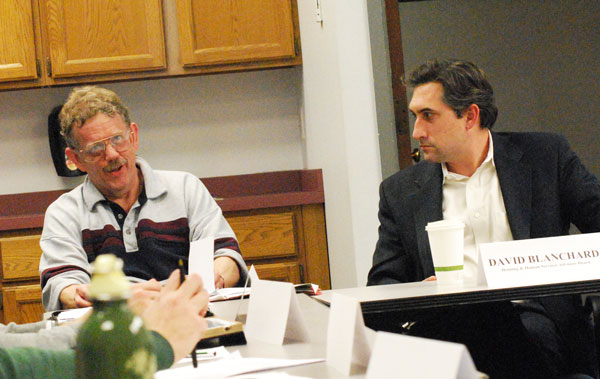
Washtenaw County board of commissioners meeting (Dec. 7, 2011):  At its last meeting of 2011, both the room and the agenda were packed.  A crowd showed up to speak during public commentary, and commissioners acted on several items before year’s end, many of them budget-related and looking toward the county’s future.

Supporters of Lourdes Salazar Bautista

Many of the people attending the Dec. 7 meeting of the Washtenaw County board of commissioners were supporters of Lourdes Salazar Bautista, an Ann Arbor resident who faces deportation. She is standing against the wall in the upper right corner of this photo. (Photos by the writer.)

Public commentary focused on two issues: (1) people lobbying against the imminent deportation of Ann Arbor resident Lourdes Salazar Bautista, and asking commissioners to intervene; (2) nonprofit leaders thanking the board for increasing the budget for coordinated funding, which supports human services agencies. The two-year budget for 2012-2013 approved by commissioners on Nov. 16 had included $128,538 in cuts each year to coordinated funding, but a vote on Dec. 7 restored that amount.

Another budget amendment approved by the board at the meeting relates to the unresolved status of mandated animal control services. County officials are still negotiating with the Humane Society of Huron Valley, which has a $500,000 annual contract for that work. The contract expires Dec. 31, and contingency plans are being made for the case that an agreement can’t be reached. Commissioners approved a budget amendment that requires board approval for any contract for animal control services extending more than 60 days.

Two presentations were made during the Dec. 7 meeting. Michael Ford, CEO of the Ann Arbor Transportation Authority, briefed commissioners about efforts to create a countywide transit system. The board will be asked to approve a four-party agreement between the county, AATA and the cities of Ann Arbor and Ypsilanti that would set a framework for incorporating a countywide transit authority. Voters may eventually be asked to approve a millage for the system – if a dedicated funding sources is not secured by the end of 2014, the effort in its current form would demise.

And in a presentation aimed at priority setting for 2012 and beyond, board chair Conan Smith proposed focusing county efforts on shoring up the county’s east side, an area that’s facing a “perfect storm of despair,” he said, including high unemployment, low graduation rates and poor health. Characterizing his proposal as the start of a board discussion, Smith laid out a variety of options that the county could pursue, including a possible Headlee override or new millage to pay for services. Feedback from commissioners indicated support for developing a strategy to tackle these problems, but a reluctance to limit the focus to only the east side – primarily Ypsilanti and Ypsilanti Township. Several commissioners pointed out that poverty exists throughout the county.

Commissioners also took a range of other actions, including: (1) rejection of a proposal from the Washtenaw County road commission for a possible millage to fund road improvements; (2) a resolution of support for same-sex benefits; (3) an extension of a deadline related to compliance with the state’s 80/20 rule for health care costs; (4) approval of a brownfield plan for Ford Motor Co.’s Rawsonville plant; (5) creation of a board subcommittee on energy policy; and (6) appointments to a variety of boards, commissions and committees. [Full Story]

County Board Increases Nonprofit Funding

At its Dec. 7, 2011 meeting, the Washtenaw County board of commissioners – on a 10-1 vote – increased the county’s budget allocation for human services nonprofits that are supported through the coordinated funding model in 2012-2013. The two-year budget approved by commissioners on Nov. 16 had included $128,538 in cuts each year to coordinated funding. That amount is now restored. In total, the line item for coordinated funding is $1.015 million in 2012 and 2013, the same amount that was budgeted for 2011.

Voting against the increase was Dan Smith (R-District 2). He noted that the board had just approved the budget at its last meeting, and it was premature to increase funding at this point, especially since the county asked … [Full Story]

Nonprofit Supporters Lobby for County Funds

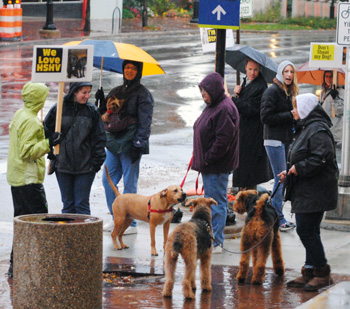
Washtenaw County board of commissioners meeting (Oct. 19, 2011): Lining Main Street in front of the county administration building, a dozen or so protesters stood in the rain – many with their dogs – holding signs in support of the Humane Society of Huron Valley (HSHV), which faces a dramatic funding cut under the proposed 2012-2013 county budget.

Supporters of the Humane Society of Huron Valley

Supporters of the Humane Society of Huron Valley in front of the Washtenaw County administration building at Main and Catherine, prior to the Oct. 19 board of commissioners meeting. (Photos by the writer.)

Inside during their meeting, county commissioners heard from a stream of supporters for various nonprofits, all urging the board to maintain funding for services – from the care of animals to basic safety net services like housing and food. The proposed budget calls for $1.2 million in cuts to outside agencies, including many nonprofits. Funding levels would drop from about $3 million this year to $1.8 million in each of the next two years. The cuts are proposed to address a projected $17.5 million deficit over the next two years.

Much of the public commentary came from HSHV supporters, who argued that the county is already getting more services than it pays for under its contract with the nonprofit, even before cutting annual funding from $500,000 to $250,000. That contract expires at the end of 2011, and leaders from the county and HSHV will be meeting later this month to try to reach an agreement for providing services – including those mandated by the state.

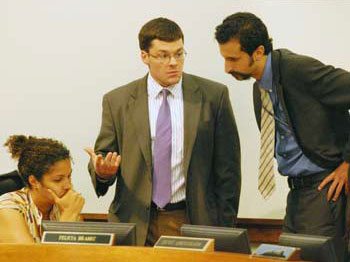
The budget was the focus of much of Wednesday’s three-hour meeting, which started with the appointment of Felicia Brabec to fill the vacant District 7 seat. Commissioners expressed support for the nonprofits they fund, but several argued that cuts are necessary because of the county’s declining revenues. They also pointed to discussions at the state level of eliminating the personal property tax. A recent analysis prepared by county staff estimates that repeal of the PPT would cut county revenues by $5.559 million, and would eliminate a total of $42.961 million in revenues for all local governments in Washtenaw County. [.pdf of PPT report]

Some commissioners urged the public to contact state legislators and oppose the PPT repeal, while others asked that everyone dig into their own pockets and contribute to local nonprofits that face funding cuts. Several commissioners expressed support for putting a human services millage on the ballot as a way to raise money for these safety net services. It would not be possible to add it to the Nov. 8 ballot, but could be considered for 2012. Wes Prater also argued that not enough cuts have been made in the budget – he believes county departments can find additional ways to trim their expenses.

In the only formal action related to the proposed budget, a resolution proposed by Yousef Rabhi reallocated $26,230 in annual dues (or $52,460 over two years) paid to the Michigan Association of Counties, transferring those funds to the Delonis Center, a homeless shelter in Ann Arbor. The resolution was unanimously approved. It followed action at the Ann Arbor city council’s Oct. 17 meeting, when councilmembers appropriated $25,000 from the city’s general fund reserve to keep the Delonis Center’s warming center open this winter. At the council’s meeting, mayor John Hieftje noted that the Delonis Center is a partnership between the city and county, and he hoped the county would uphold its end.

Final decisions on the budget haven’t yet been settled. The board must pass a budget by Dec. 31, and has only three more regular meetings scheduled for the year. The budget must first be voted on by the Ways & Means Committee – a committee of the whole board – then voted on a final time at a regular board meeting.

Though much of the Oct. 19 meeting focused on 2012-2013 budget issues, the board gave final approval to several other items, including: (1) creating a study committee to explore a historic district in Salem Township; (2) renewing a two-year contract with Governmental Consultant Services Inc., a Lansing-based lobbying firm; and (3) authorizing a contract with Sylvan Township related to the township’s bond repayment schedule.

And in non-budget public commentary, Douglas Smith submitted an appeal to the board for a Freedom of Information Act request that had been denied by the county, related to an incident that he says involves a high-ranking member of the sheriff’s office. The board did not respond publicly to his request, other than to clarify with the county’s corporation counsel that appeals are handled by the county administrator. [Full Story]

Literacy Coalition Faces Uncertain Future

In April 2010, Washtenaw County commissioners marked a transition – handing over leadership for a literacy coalition the county had spearheaded.

Washtenaw Literacy Coaltion meeting

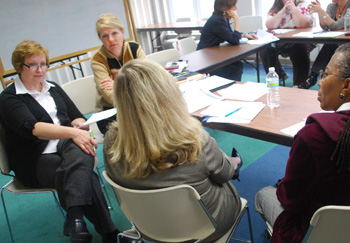
At left, Amy Goodman, executive director of Washtenaw Literacy (a different entity from the Literacy Coalition of Washtenaw County), led the Sept. 26 membership meeting of the Literacy Coalition of Washtenaw County.

At the time, the Literacy Coalition of Washtenaw County had just hired its first executive director – Vanessa Mayesky – and reported progress in goals outlined in the county’s ambitious Blueprint to End Illiteracy.

But at a recent working session of the county board, commissioner Rob Turner reported that the coalition is now in crisis.

Mayesky resigned earlier this month to take a job at the University of Michigan, and funding for the coalition’s efforts is nearly depleted. Amy Goodman, chair of the coalition’s steering committee, had sent out an email on Sept. 20 stating that the coalition is at a crossroads. Based on the coalition’s financial situation, action needed to be taken, she wrote – and one of the options is to dissolve the coalition.

Goodman’s email was also a call for supporters to attend a Sept. 26 membership meeting at the NEW Center, to give input on the future of the coalition. At that meeting, which The Chronicle attended, Goodman and other steering committee members outlined the status of coalition finances. The faltering economy has tightened funding from both private and government sources, and the situation has been made even more challenging by a new coordinated funding approach being used by the county, city of Ann Arbor, Washtenaw United Way and other funders.

The coordinated funding focuses on six community priorities, ranging from homelessness to health care. But despite intense lobbying from coalition members – who noted that illiteracy is at the root of nearly every other social challenge, including unemployment and poverty – literacy is not on that list of coordinated funding priorities.

Options discussed at Monday’s meeting include: (1) trying to operate the coalition at a fully-funded level, which would entail raising funds for an annual budget of at least $71,000; (2) operating at a significantly reduced capacity, with a part-time coordinator and annual budget of $45,000; (3) creating a volunteer group to continue the effort; or (4) dissolving the coalition completely. [Full Story]

County Funds Nonprofits, Sets Deputy Price

Washtenaw County board of commissioners meeting (June 1, 2011): Budget issues again occupied commissioners’ focus at this month’s county board meeting. The board took an initial vote to set the price for a contract sheriff’s deputy and to approve funding for local nonprofits.

Dick Fleece, Monique Reeves, Kelly Belknap, Wes Prater

From left: Washtenaw County public health officer Dick Fleece, newly appointed public health medical director Monique Reeves, interim deputy county administrator Kelly Belknap, and county commissioner Wes Prater. Commissioners approved the hiring of Reeves at their June 1 meeting. (Photos by the writer.)

While the board’s previous meeting drew supporters from a range of human services groups, on Wednesday most public commenters spoke against funding of one specific nonprofit: Planned Parenthood of Mid and South Michigan. Their arguments on financial and moral grounds were ultimately unpersuasive to commissioners, who voted unanimously to approve support for Planned Parenthood and several other agencies, totaling $1.015 million through fiscal year 2013, including $53,040 from the county for Planned Parenthood.

Two commissioners raised concerns that county funding for human services in general is inadequate, especially in light of proposed changes that could bump thousands of beneficiaries statewide off the welfare rolls later this year.

In a vote that also holds budget implications, the board’s move to set the price for a contract sheriff’s deputy was remarkable mainly for its lack of debate – historically it’s been a contentious issue. Commissioners gave initial approval without comment. The price set in 2012 for a police services unit (PSU) is $150,594 – unchanged from this year. That’s followed by 1% annual increases through 2015. The difference between the actual cost of a PSU and the amount charged – roughly $25,500, based on current figures – would be covered by the county. The item will return to the board’s July 6 meeting for a final vote.

Meanwhile, a 2006 lawsuit filed against the county over the amount it charged at that time for contract deputies remains unresolved. Judge Joseph Costello of the 38th Circuit Court Chief has ordered the county and Augusta and Ypsilanti townships into non-binding facilitation, in a meeting set for June 22.

During Wednesday’s meeting, commissioners also approved a raft of other items, including: (1) the hiring of Monique Reeves as new medical director; and (2) five drain projects in Ann Arbor that require bonds backed by the county’s full faith and credit. The board also voted to add five new working sessions to its calendar: on June 16, July 21, Aug. 18, Sept. 15 and Oct. 13. All are focused on the 2012-2013 budget.

Finally, at the end of its meeting the board went into executive session for about an hour to address three issues: (1) a collective bargaining strategy; (2) possible settlement of pending litigation; and (3) review of a legal opinion. [Full Story]

Report Shows Impact of Nonprofits on Economy

The city of Ann Arbor and Washtenaw County office of community development released a 16-page report on Tuesday, May 31, that attempts to quantify the economic impact of the 37 local nonprofits that are funded by the county and city. In 2011, the combined investments from the city and county in those nonprofits totaled $2.7 million. According to the report, those funds leveraged more than $34 million in non-local revenue.[.pdf of nonprofit investment report]

The report highlights six “return on investment” categories: (1) stabilizing the workforce and community by providing services like childcare, food and affordable housing; (2) leveraging millions of dollars in additional funding; (3) providing jobs – if combined, human services nonprofits funded by the city and county … [Full Story]

Packard Square Proposal Moves Ahead

Washtenaw County board of commissioners meeting (May 18, 2011): Two topics took up the bulk of time and attention during the most recent county board meeting: (1) proposals related to the Packard Square development in Ann Arbor; and (2) funding recommendations for nonprofits that provide human services to county residents.

Avalon Housing's symbolic paper cranes

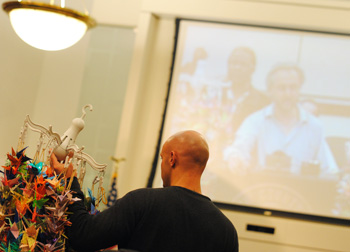
Symbolic paper cranes were on display at the May 18, 2011 meeting of the Washtenaw County board of commissioners. The cranes represent the number of people in the county last year who used homeless support services. On screen in the photo's background is Michael Appel of Avalon Housing, urging commissioners to support such services. (Photos by the writer.)

After much discussion, commissioners gave final approval to a brownfield plan for the Packard Square project, which will help fund environmental cleanup on the site of the former Georgetown Mall. The board also approved a $1 million grant application to the state Dept. of Environmental Quality for brownfield cleanup at the proposed $48 million development. Commissioner Wes Prater voted against the brownfield plan and the grant application.

The board postponed action until June 1 on a $1 million loan application to the MDEQ, as well as a request to authorize designation of the county’s full faith and credit as a guarantee for any loan that might be awarded, up to $1 million. They also discussed but ultimately postponed action on a broader public-private investment policy they’re developing, a policy spurred in large part by the request to back the MDEQ loan.

The policy discussion will likely be pushed back even further. At a May 24 briefing to review the June 1 agenda, commissioners learned from county staff that The Harbor Cos., developers of Packard Square, decided not to apply for the MDEQ loan. In light of that decision, the board is expected to take more time to flesh out details for its policy on public-private investment. And some commissioners – notably Leah Gunn – aren’t sure such a policy is even necessary. [Full Chronicle report on the May 24 briefing: "Loan Request Pulled for Packard Square"]

The other major item on the May 18 agenda related to funding for local human services nonprofits. The recommendations were made as part of a coordinated funding approach, combining support from the county, the city of Ann Arbor, the United Way of Washtenaw County, and the Washtenaw Urban County. More than 20 people spoke on the issue during public commentary, urging continued support for the county’s most vulnerable residents.

Commissioners were asked to give initial approval to $507,500 in human services funding for 2011. Additional funds for 2012 and 2013 were also approved, contingent on the board’s passing those budgets later this year – it’s possible that allocations will change, as the county works to eliminate a $17.5 million deficit. Commissioner Dan Smith voted against the allocations, citing an objection to one line item. He later clarified for The Chronicle that he objected to funding for Planned Parenthood.

The board acted on several other items during its May 18 meeting, including: (1) approval of a brownfield plan for LaFontaine Chevrolet in Dexter; (2) setting the 2011 rate for the county’s general operating millage; and (3) initial approval to hire Experis (formerly known as Jefferson Wells) to perform internal auditing services for the county.

The board also gave inital approval to apply for a federal Dept. of Justice grant worth nearly $500,000 to support the Washtenaw County Cyber Citizenship Coalition (WC4). Commissioner Kristin Judge, who spearheaded the WC4 initiative, reported that Gov. Rick Snyder has asked the coalition to host with him a statewide “cyber summit” later this year. [Full Story]

Urban County Gets Grim Funding Update

Washtenaw Urban County executive committee meeting (Feb. 22, 2011): Leaders of local municipalities got a grim update on Tuesday about looming federal funding cuts that will likely affect projects in many of the county’s low-income neighborhoods.

Mary Jo Callan

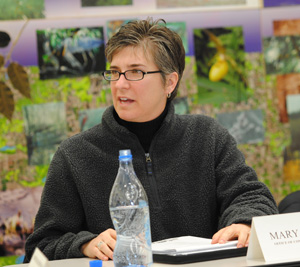
Mary Jo Callan, director of the Washtenaw County/city of Ann Arbor office of community development, at Tuesday's meeting of the Washtenaw Urban County. (Photo by the writer.)

“I am bringing you some troubling news,” said Mary Jo Callan, director of the Washtenaw County/city of Ann Arbor office of community development. “Do you want to start with the bad news, or the worst news?”

Callan reported that the two major programs that fund projects for low-income neighborhoods – the Community Development Block Grant and HOME Investment Partnership programs, both operated by the U.S. Dept. of Housing and Urban Development (HUD) – have been targeted by Congress and President Obama for significant cuts in both the current fiscal year and in 2012. Washtenaw County communities receive about $2.4 million annually from the CDBG program alone.

Though at this point it’s unclear exactly what the final federal budget will include, Callan said it’s nearly certain that some funding cuts will occur – her staff is planning for a 10% reduction in grants from those two programs for fiscal 2012. “It’s pretty bleak,” she said. [Full Story]

Ann Arbor 2012 Budget: Parks, Plans, People

Editor’s note: The Ann Arbor city council has held two retreats to discuss the city’s FY 2012 budget – one in early December 2010 and another in early January 2011. A summary of the material covered in those retreats is provided in previous Chronicle coverage: “Ann Arbor: Engaging the FY 2012 Budget.”

Leading up to the city administrator’s proposed budget in April, the city council is also holding a series of work sessions on the budget. Their typical scheduling pattern is for the weeks between council meetings. That was the case on Jan. 31, 2011 when the council held its budget work session on the community services area, which includes human services, parks and planning. Another session was held on Feb. 7, prior to the council’s regular meeting, regarding the 15th District Court. A report on the Feb. 14, 2011 session, which focused on police and fire, will follow.

Community Services Area Ann Arbor city council budget retreat

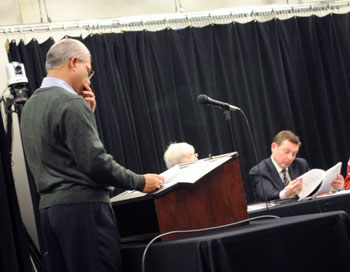
At the podium is community services area administrator Sumedh Bahl. Partially obscured by the podium is councilmember Marcia Higgins (Ward 4). Leafing through the budget impact sheets that the council had been given just prior to the meeting is Stephen Rapundalo (Ward 2). (Photo by the writer.)

The Ann Arbor city council’s budget work session on Jan. 31, 2011 covered a broad range of topics – from the city’s affordable housing stock, to planning and development, to parks and recreation (including golf courses), to human services funding. All these issues fall under the city’s community services area, which is led by Sumedh Bahl.

In a budget year where maintaining the same level of activity in every department is projected to result in a $2.4 million shortfall, city departments have been given reduction targets between 2.5% and 4%. Targets vary across departments depending on health care costs for employees in those departments.

So at their work session, councilmembers heard from heads of individual departments about the specific ways those targets might be met.

For example, Mary Jo Callan, who’s head of the city/county office of community development, told councilmembers that an unrealized $98,000 federal grant would pose an additional challenge. All other things being equal, Callan would meet the reduction target by reducing the city’s allocation to nonprofit human services agencies by $116,714 – from $1,275,744 to $1,159,030. The budget is planned in two-year cycles, even though it’s adopted just one year at a time, so Callan’s reduction strategy for next year’s FY 2013 budget would be to reduce the nonprofit allocation by an additional $48,700.

The planning department plans to meet its reduction target in part by charging the construction fund for 10% of the historic district coordinator’s time, factoring in projected revenue increases due to increased development activity, and leaving a rental housing inspector position vacant. The rental housing inspection activity would be maintained at appropriate levels by using construction inspectors for rental housing inspections as needed.

The city’s housing commission – which maintains more than 350 units of public housing throughout the city – is not proposing to meet reduction targets, but rather to hire what officials say are two crucially needed positions: a financial analyst and a facilities maintenance manager, which together are expected to cost an additional $154,000 per year.

Parks and recreation would meet their targets in part through savings derived from energy improvements that have been made to various recreational facilities over the past few years.

The council focused some of its session on the city’s golf courses, with a council consensus seeming to emerging that for the next two years, the council will be content to stick with the status quo – operating the Leslie Park and Huron Hills facilities as golf courses, and not changing them to other uses.

But the council was also asked to consider a question on which it could be harder to achieve consensus: Should the city continue to help fund park operations, as it has for the last four years, by tapping the city’s general fund reserve for $287,000 annually? The history of the issue dates back to the parks capital improvements and maintenance millage, which was approved in 2006, and which was followed by the council’s approval of its FY 2008 budget the next spring.

That history is rooted partly in a question that the city’s CFO, Tom Crawford, addressed in a straightforward fashion at the work session: What exactly does it mean for a department to have a budget reduction target of 2.5%?  [Full Story]

Urban County: Nonprofit Funding Update

Washtenaw Urban County executive committee meeting (Jan. 25, 2011): Urban County members – a group representing 11 municipalities in Washtenaw County – got an update on a new effort to coordinate the funding of local nonprofits.

Damon Thompson, Teresa Gillotti

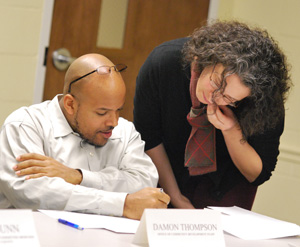
Damon Thompson, operations manager for the Washtenaw County/city of Ann Arbor office of community development, talks with Ypsilanti city planner Teresa Gillotti after the Jan. 25 Urban County meeting.

Nonprofits are vying for funds from the city of Ann Arbor, Washtenaw County, the Urban County, and Washtenaw United Way. Nearly 60 nonprofits applied to the first phase of the process, in which they were asked to supply basic financial and governance documents. Of that group, 51 were qualified to respond to a request for proposals (RFP) that was issued Jan. 28.

It’s still unclear how much funding will be available, but it could be less than the nearly $5 million that was awarded from these groups last year. Budgets for Ann Arbor and the Urban County haven’t been finalized, and the 2011 county budget is facing about $1 million in as-yet-undetermined cuts.

At last week’s meeting, three members of the Urban County’s executive committee – Pittsfield Township deputy supervisor Barb Fuller, Ypsilanti mayor Paul Schreiber and Ann Arbor city councilmember Margie Teal – were appointed to review applications for the coordinated funding process. All governing boards of the four entities involved in this cycle’s funding will appoint members to a review committee. The fifth partner – the Ann Arbor Area Community Foundation – will fund capacity-building grants to nonprofits identified as needing help with internal operations, like infrastructure and staff development.

Also at last week’s meeting, Urban County members got an update on an annual plan being developed for the U.S. Dept. of Housing & Urban Development (HUD), which provides funding for low-income housing and neighborhood projects. The plan will include a list of proposed projects located within the Urban County area that would be eligible for HUD funding. To gather more input, a needs assessment public hearing is set for the Feb. 22 meetings of both the Ann Arbor city council and the Urban County.

Two people spoke during public commentary, both criticizing Avalon Housing for its handling of two low-income housing projects: 1500 Pauline, and Near North. The nonprofit was defended by Leah Gunn, who chairs the Urban County executive committee – she called Avalon one of the “stars of community development.” [Full Story]

Washtenaw Launches OpenBook Website

Washtenaw County Board of Commissioners working session (Oct. 7, 2010): At its recent working session, the board heard presentations on two topics: 1) a new initiative called OpenBook, which is making more of the county’s financial information available online, and 2) an update on efforts to create a coordinated funding model involving the Washtenaw United Way, Ann Arbor Area Community Foundation, Washtenaw County, the city of Ann Arbor and the Urban County.

Screenshot of Washtenaw County's OpenBook website

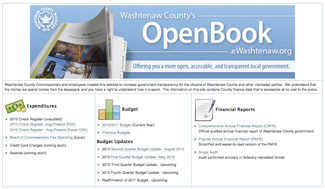
A screenshot of Washtenaw County's OpenBook website, which launched this week. (Image links to ewashtenaw.org/openbook)

Mary Jo Callan, director of the Washtenaw County/city of Ann Arbor office of community development, gave the coordinated funding update and fielded several questions from commissioners. She’d given a similar presentation at last month’s meeting of the Urban County executive committee.

Andy Brush, the county’s webmaster, made a presentation on the OpenBook project, which launched to the public on Friday. Commissioner Conan Smith questioned the amount of staff time involved in the initiative, and asked that they monitor usage of the site, to determine whether it’s worth the resources they need to invest. His comments earned a sharp rebuke from commissioner Kristin Judge, who has spearheaded the project. Minimal staff time is involved, she said, and taxpayers have a right to this information, noting that the push to transparency was a directive from President Barack Obama. Both Judge and Smith are Democrats. [Full Story]

Coordinated Funding for Nonprofits Planned

A strategy for coordinating major funders of nonprofits in Washtenaw County has been in the works for more than a year, and is now being rolled out to governing boards for approval.

Mary Jo Callan

Mary Jo Callan, director of the Washtenaw County/city of Ann Arbor office of community development, described a proposed coordinated funding strategy by local governments, United Way of Washtenaw County and the Ann Arbor Area Community Foundation at the Sept. 28 meeting of the Washtenaw Urban County. (Photos by the writer.)

At Tuesday’s meeting of the Washtenaw Urban County executive committee, members were briefed on the proposal, which involves the Washtenaw United Way, Ann Arbor Area Community Foundation, Washtenaw County, city of Ann Arbor and the Urban County. Together, these entities provide about $5 million annually for local human services nonprofits.

Mary Jo Callan, director of the Washtenaw County/city of Ann Arbor office of community development, told Urban County members that the public/private model would focus funding on six priorities that have been identified for the entire county: housing/homelessness, aging, school-aged youth, children from birth to six, health and food.

The two-year pilot project is grounded in previous coordination between the city of Ann Arbor, Washtenaw County and the Urban County, a consortium of 11 local governments. The office of community development (OCD), which Callan leads, already manages nonprofit funding for those three entities.

Callan also said this could be a national model for communities that are trying to do a better job of delivering human services with constrained resources.

Some members of the Urban County executive committee, while expressing general support, also raised questions and concerns. How do individual nonprofit agencies fit into the funding model, especially if they don’t provide services in the areas identified as priorities? Will small or new nonprofits be able to compete successfully for funding, or will larger, well-established nonprofits have an overwhelming advantage? How well will the different cultures of United Way, the community foundation and local governments work together, and what roles will they play?

Callan acknowledged these challenges, but noted that many of these same concerns exist under the current, more fragmented funding model. Coordinated funding is the best approach to providing needed services to people in the county, she said.

The Urban County is expected to vote on the proposal at its Oct. 26 meeting. The other groups – including Ann Arbor’s city council – are expected to vote at meetings in late October and early November. Callan will also be making a presentation about the initiative to the county board of commissioners at their Oct. 7 working session. [Full Story]

Column: What, If Anything, Is a Bicyclist?

Temperatures hit the high 70s at Sunday’s Artisan Market near Kerrytown, where volunteers for Common Cycle were helping people learn about bicycle repair.

pic-collage-bicycles

Top to bottom: Tom Wright, Frank Schwende, Thomas Kula. (Photos by the writer.)

And as the weather gets warmer, the primary election season will also start to heat up – just as surely as journalists will appeal to hackneyed clichés to describe it. For local office candidates, as well as commentators on local races, part of the sport is to categorize the community into convenient groupings – like parents, homeowners, renters, students, landlords, environmentalists, developers, new urbanists, preservationists, park-lovers, young professionals, old hippies, the handicapped, business people, transit riders, etc.

I’m not certain that bicyclists would make the list as a voter group. But they’ll serve to make the point I want to make.

Yes, that non-exhaustive list of groupings is a sometimes useful and convenient set of labels. But just as the word “zebra” is a convenient label for those horse-shaped animals with a black and white pattern of stripes, that doesn’t mean that all of those “zebras” are necessarily biologically related.

The title of this column, in fact, is a play on the title of a fairly famous essay by Stephen Jay Gould: “What, If Anything, Is a Zebra?” That essay was written back in the early ’80s and I’m not sure if the evolutionary biologists ever settled the question. I don’t really care – zebras don’t live around these parts, and even if they did, they’re notorious non-voters.

But bicyclists do live around here. And they’ll serve as well as any grouping to illustrate the fact that among any “community” we include in a list of labels, there’ll be smaller sub-communities that have more specialized interests. So we’d do well to avoid thinking of these convenient labels as reflective of any one coherent community.

This column takes a look at three groups of people that could fairly be labeled “bicyclists,” with the idea that they’re separate groups, with maybe some overlap in people, but which are fundamentally different: Washtenaw Bicycling and Walking Coalition, Bicycles Are Traffic, and Common Cycle. I look at each group through the lens of one of their events I’ve attended over the last week and a half. [Full Story]

Local Food Isn’t Just for Eating

“How about a round of applause for beets?!” Kim Bayer asked the group gathered for dinner on Thursday night.

Slow Food Huron Valley

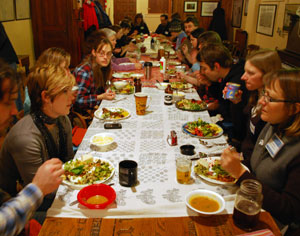
The table was filled at the potluck for Slow Food Huron Valley, held at Hathaway's Hideaway on South Ashley. To make it a zero-waste event, people brought their own dishware. (Photos by the writer.)

When a room of people cheers for root vegetables – and later, for pie – there’s probably a theme at hand. On Thursday, the theme was locally grown food, fêted at a potluck hosted by Slow Food Huron Valley. The 30 or so people at Hathaway’s Hideaway on South Ashley heard an update on the nonprofit’s activities over the past year, and got a preview of what’s to come in 2010.

There was also plenty to eat and drink: Derby sandwiches (with pickles, bacon and mayo), parmigiano pumpkin soup with prosciutto, spinach walnut pesto, vegan “slop,” sweet potato pie – most of these and other dishes made from locally grown or produced food.

The connection between the meal and the mission of Slow Food Huron Valley was clear, as Bayer – a member of the group’s leadership team – told the diners: “Good food needs to be a basic human right.” [Full Story]

Leslie Science Center Turns Calendar

Hijin Kim, wearing his New Year's Eve mask, salutes the end of 2009 with a pencil. Later, he told The Chronicle: "Masks are scarier than hats." (Photos by the writer.)

Hajin Kim, wearing his New Year's Eve mask, salutes the end of 2009 with a pencil. Later, he told The Chronicle: "Masks are scarier than hats." (Photos by the writer.)

Bob Voakes is sitting in the front room of the main Leslie Science and Nature Center building, encircled by more than a dozen children sprawled on the floor. “It’s a special day today – does anyone know what day it is?”

“New Year’s Eve!” they cry out.

It would be hard not to know the answer – everyone is wearing New Year’s Eve hats or masks that they’d made earlier that morning, using construction paper and markers.

They’re all enrolled in the holiday break camp program, with a full agenda of crafts, sledding, hiking, searching for animal tracks, s’more-making, and “who knows what other exciting things we might do!” Voakes, a staff member, tells the kids.

Just down the hall – in Dr. Eugene Leslie’s former study – someone else has a full agenda, too: executive director Kirsten Levinsohn, who’s getting ready to step down from the post in February, after 20 years at the center. With the sound of children happily hollering in the background, Levinsohn talked about the upcoming transition, and why it’s an exciting time for LSNC. [Full Story]

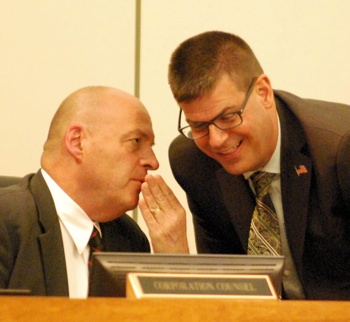
County Board Hears Protests, Passes Budget

Washtenaw County Board of Commissioners (Dec. 2, 2009): During a meeting dominated by public commentary from residents protesting the county’s funding of Planned Parenthood, Washtenaw County commissioners passed the 2010-2011 balanced budget with little discussion, ending a year-long effort to wrestle with a previously projected $30 million deficit.

Washtenaw County commissioner Conan Smith, left, confers with county administrator Bob Guenzel before the Dec. 2 meeting of the board of commissioners. To the right is Rolland Sizemore Jr., the board's chair. Smith is chair of the Ways & Means Committee, on which the entire board serves. (Photo by the writer.)

Washtenaw County commissioner Conan Smith, left, confers with county administrator Bob Guenzel before the Dec. 2 meeting of the board of commissioners. To the right is Rolland Sizemore Jr., the board's chair. Smith is chair of the Ways & Means Committee, on which the entire board serves. (Photo by the writer.)

The board also discussed a situation with Ypsilanti Township’s contract for sheriff deputies, which the township wants to amend as of Jan. 1. Commissioners voted to hold a special board meeting on the issue on Monday, Dec. 7, when they are expected to take action on the request to decrease the number of contracted deputies.

Another special meeting was held on Wednesday afternoon, prior to the evening board meeting. Attended by seven of the 11 commissioners, the group discussed the role of the Michigan Suburbs Alliance, a Ferndale-based nonprofit led by county commissioner Conan Smith, in handling a federal grant to the county for energy efficiency programs. The issue was not discussed at the evening meeting of commissioners, where the board voted to amend a resolution that authorized the county to apply for the grant. The amendment took out a specific reference to the alliance.

Other items at Wednesday’s board meeting included approval of the placement of a display for the Vietnam-era ship USS Washtenaw, and some questions about the progress of a $4 million weatherization grant that hasn’t moved forward as quickly as some commissioners would like.

There was no mention at the meeting of major news that came out the next day – the retirement of county administrator Bob Guenzel, who will step down in May after 37 years with the county. [Full Story]

Growing the Board at Project Grow

garden tomato cages in foreground late season garden in background

Project Grow site at Greenview last Sunday. Near the end of the growing season, gardeners were starting to clear out cages and wire, preparing the plots for the fall tilling. (Photo by the writer.)

At the Project Grow annual meeting, held on Oct. 8 at the Leslie Science Center, the same contentious issue surfaced as at last year’s meeting: Should the organic gardening nonprofit add members to its board or not?

Last year the answer was yes: Kirk Jones and Royer Held were voted onto the board by the members present at the meeting. [Chronicle coverage: "Project Grow Board Expands"]

This year was no different. In addition to re-electing Damaris Suffalko as a continuing board member, members elected Andrew Comai, David Corsa and Alice Telesnitsky as additions.

The ease with which board members can be added by a member vote is a function of Project Grow’s incorporation as a 501(c)3 membership organization as contrasted with a 501(c)3 directorship organization.

And although the meeting’s written agenda indicated board president Devon Akmon as a candidate for re-election to the board, he withdrew his name in the course of the meeting, which an attendee aptly summarized at one point by saying, “It feels very tense in here.”

The departure of Akmon from the board prompted board member Catherine Riseng to caution the roughly 40 people in the room: “We’re going to miss his skills more than you can possibly realize.”   [Full Story]

Alliance Focuses on School-Age Kids

Joan Doughty kicks off the Sept. 29 forum of the Washtenaw Alliance for Children and Youth.

Joan Doughty kicked off a recent forum of the Washtenaw Alliance for Children and Youth. Doughty is executive director of the Community Action Network and a WACY steering committee member. (Photo by the writer.)

In January 2008, the Washtenaw United Way announced plans to focus its funding on five areas: early childhood education and care, aging in place, food, shelter and access to health care. While they didn’t quibble with the importance of those goals, local nonprofits that work with older children were stunned that funding for K-12 kids, especially those who lived in poverty, hadn’t made the cut.

In an op/ed piece published in the April 2, 2008 Ann Arbor News, Joan Doughty, executive director of the Community Action Network, put it this way: “Nonprofit directors like myself who coordinate programs providing academic and life skills and social support to low-income and youth at risk ages 6 and up were astonished and devastated to find that this area was not represented as an established priority.”

The decision by Washtenaw United Way mobilized leaders of about 20 groups that work with school-aged children – the result is the Washtenaw Alliance for Children and Youth (WACY), a coalition that had its coming-out party at a community forum two weeks ago. [Full Story]

Dr. Yun Lu: To Feed a Healing Courage

Roger Newton and Lu

Yun Lu and Roger Newton at the home of Larry and Lucie Nisson, talking about the nonprofit Golden Courage International and a business venture, Dr. Lu's Healing Cuisine. (Photo by the writer.)

At a meeting of the Ann Arbor Public Market Advisory Commission earlier this month, market manager Molly Notarianni reported that she’d received a vendor application from someone who wanted to sell food that incorporated traditional Chinese medicine, including “steamed healing sweet buns” and “sweet lotus rolls.” Because she hadn’t yet approved the application, she didn’t reveal the name of the business, but market commissioners seemed intrigued.

Then at the Sept. 12 Homegrown Festival, The Chronicle encountered a booth for Dr. Lu’s Healing Cuisine, where balls of sticky rice wrapped in lotus leaves were selling briskly. Lucinda Kurtz, who was staffing the booth, confirmed that they had applied for a food cart at the farmers market.

So when The Chronicle arrived at the Eberwhite neighborhood home of Larry and Lucie Nisson in mid-September, it was the third time we’d encountered the venture, but the first time to meet its founder, Yun Lu, and to hear in detail about both the business and a nonprofit he started, Golden Courage International. Accompanying him was Roger Newton, a local entrepreneur best known for helping develop the cholesterol-lowering drug Lipitor and for later founding the Ann Arbor drug developer Esperion Therapeutics. Newton serves as chairman of the board for Golden Courage, and supports the nonprofit through his Esperance Family Foundation.

About a dozen people gathered in the Nissons’ backyard to hear more about these ventures while sampling tea eggs, sweet bean paste buns and rosebud chrysanthemum tea. [Full Story]

How to Sustain a Local Economy

Panelists at the Sept. 23 Michigan Peaceworks forum on the local economy, from the left: Tom Weisskopf, University of Michigan economics professor; Ellen Clement, Corner Health Center executive director; Jeff McCabe, People's Food Co-Op board member; Lisa Dugdale, Transition Ann Arbor; Michael Appel, Avalon Housing executive director; John Hieftje, mayor of Ann Arbor.

Panelists at the Sept. 23 Michigan Peaceworks forum on the local economy, from the left: Tom Weisskopf, University of Michigan economics professor; Ellen Clement, Corner Health Center executive director; Jeff McCabe, People's Food Co-Op board member; Lisa Dugdale, Transition Ann Arbor; Michael Appel, Avalon Housing executive director; John Hieftje, mayor of Ann Arbor. (Photo by the writer.)

When The Chronicle entered the lower level meeting room of the downtown Ann Arbor library, the first things we noticed were three large trays of peanut butter and jelly sandwiches, cut into bite-sized wedges. As public forums go, this was an offbeat gnoshing choice.

It turned out that the sandwiches – and apples, soft drinks, potato chips and other food – were all sourced from Michigan, in keeping with the theme of Wednesday night’s event. The panel discussion focused on the state’s economic crisis, and how the community can respond to it.  Buying local products is one example.

Starting a local currency is another possibility – the Ann Arbor Downtown Development Authority is funding a study to look into that. Generating  electricity locally is also an opportunity – Mayor John Hieftje told the group that he didn’t think the dam at Argo Pond would be removed, in part because it might be used for hydropower in the future.

The forum – “Michigan’s Economic Situation: Crisis or Opportunity?” – was hosted by Ann Arbor-based Michigan Peaceworks and Washtenaw Voice, a coalition of local nonprofits that are working together to increase voter turnout and bolster the community in other ways. Michigan Peaceworks is the lead agency in this effort, part of the broader Michigan Voice initiative.

State and national issues were part of the discussion, but most of the six panelists focused on how the local community can take action in specific areas, including food, health care, housing and the environment. [Full Story]

Nonprofits to County: “Don’t Cut Funding!”

Mimi Harris, left, and Randi Friedman came to Wednesdays county board meeting to support funding for human services. They are board members for the Interfaith Hospitality Network, which runs Alpha House, a homeless shelter for families.

Wearing stickers that say "Protect Our Safety Net," Mimi Harris, left, and Randi Friedman came to Wednesday's county board meeting to support funding for human services. The paper plate was one of over 1,100 with messages written by people who receive aid from local nonprofits that are supported by the county. Harris and Friedman are board members for the Interfaith Hospitality Network. (Photo by the writer.)

Washtenaw County Board of Commissioners (Sept. 16, 2009): Leaders of local nonprofits and people who’ve been helped by their services packed the boardroom Wednesday night, urging Washtenaw County commissioners to continue support for the area’s most vulnerable residents.

The meeting marked the first time that county administrator Bob Guenzel made his official budget recommendations to the board, which include cuts aimed at closing a projected $30 million deficit over the next two years. The county funds a range of local nonprofits – this year, a total of $1.7 million was awarded to agencies like Food Gatherers, the Shelter Association, Interfaith Hospitality Network and SafeHouse, among others. The proposed budget calls for 20% cuts in funding for human services nonprofits in 2010 and another 20% in 2011.

Proposed cuts to these nonprofits were the most difficult part of his budget recommendations, Guenzel told the board. “Those dollars have been well spent – they are the safety net.” Yet he didn’t feel he could ask for concessions from employees and squeeze the county’s mandated services without including cuts to nonprofits as well. He reminded commissioners that when he was hired as administrator 15 years ago, the county spent $300,000 to fund local nonprofits. Even with the proposed cuts, he said by 2011 the county will still be awarding about $1 million to these groups.

Commissioners responded to both the emotional public comment session and to the proposed budget recommendations, which they’ll have two months to review before adopting a final budget in November. Several commissioners cited their support for a human services millage. And commissioner Kristin Judge – saying that there were more creative ways to cut expenses – turned in her county-paid cell phone. [Full Story]

Banking on a Land Bank

Washtenaw County Board of Commissioners meeting (July 8, 2009): In large part because the board has adopted a once-a-month summer meeting schedule, the agenda was full for Wednesday’s meeting. Commissioners asked – in some cases, grilled – the county treasurer about a proposed land bank project, which the board ultimately approved.

They also acted on several budget-related items, including 1) setting a public hearing for a proposed economic development tax, 2) passing the first phase of administrator Bob Guenzel’s recommendations to address a projected $26 million deficit, and 3) briefly discussing a proposal for changing the funding process for some nonprofits. Several leaders from the local arts community also turned out for a presentation on a countywide cultural plan.

But a large portion of the meeting was devoted to deliberations on the land bank, and that’s where we’ll begin our coverage. [Full Story]

Column: Nonprofits Need Culture of Learning

Stephen J. Gill

Stephen J. Gill

The current economic crisis is no time for Ann Arbor area nonprofits to hunker down. Whether social services, health care, arts, education or advocacy, nonprofits should use this time to re-examine themselves, ask themselves the tough questions, and develop a culture of learning that will result in long-term effectiveness and sustainability.

Local nonprofits have been hit hard by the economy. Less corporate money is going to United Way of Washtenaw County (the checking account for local nonprofits) and fewer dollars are being generated by endowments at the Ann Arbor Area Community Foundation (the savings account for local nonprofits). The money earned by our community’s philanthropies that then goes to nonprofits is off by 30% to 40%. [Full Story]

Red Cross Honors Volunteers

Red Cross volunteer Steve Luedders, left, shakes hands with Bill McGill after receiving the Dan Kivel Blackbird award at Wednesday evenings awards ceremony

Red Cross volunteer Steve Luedders, left, shakes hands with board member Bill McGill after receiving the Dan Kivel Blackbird award at Wednesday evening's awards ceremony at Washtenaw Community College. (Photo by Rebecca Friedman.)

When the Washtenaw County chapter of the American Red Cross issued a press release on Thursday stating that its volunteers had responded to a 2 a.m. house fire that morning in Saline, we took special note – just hours before, the chapter had feted volunteers at an annual meeting that The Chronicle attended, where they talked about just this kind of work.

About 150 people came to the event, which for the first time combined the nonprofit’s  awards ceremony with its annual membership meeting – usually the two events are held separately. Though the evening focused on recognizing local Red Cross volunteers, leaders of the organization also spoke of the challenges they face to provide services in the current economy. [Full Story]

The Economics of Entertainment

David Babcock and Ed Koster act out a scene from Hellcab at the Ann Arbor Civic Theatre auditions.

David Babcock and Ed Koster act out a scene from the play "Hellcab" at Ann Arbor Civic Theatre auditions earlier this month. The show will be performed Aug. 21-23. (Photo by the writer.)

The woman is swaying in her seat, inhaling in a drunken hiss and dragging her feet along the floor. The driver stares straight ahead, looking mildly uncomfortable.

Grinning, her head wobbling slightly on her neck, she leans as far forward as possible and whispers loudly to the cabbie, “I looove you!”
The other people in the room – and the director, Paul Bianchi – laugh.

The woman and the man acting as the cabbie are seated in two chairs in the middle of the Ann Arbor Civic Theatre studio in downtown Ann Arbor – a high-ceilinged, mostly empty room with a wood-paneled floor and a piano at one end. It’s an evening in early June, and they’re auditioning for “Hellcab,” a play depicting a day in the life of a Chicago cab driver.

A day in the life of AACT itself is challenging in a different way. Like virtually all nonprofits, including those in the performing arts, the local theater faces some less-than-entertaining concerns this season. Although leaders of the theater say it isn’t in crisis, the nonprofit has made some cuts to save money, and is trying to get creative about ways to bring in revenue. [Full Story]

Pizza, Payroll and Budget Pain

At a pre-board meeting rally held by

Pizza was served at Wednesday's pre-board meeting rally held by AFSCME Local 2733 in the parking lot next to the county administration building, at the southwest corner of Catherine and Fourth. The union wanted its members to turn out as the county Board of Commissioners considered cuts to the 2010-2011 budget.

Washtenaw County Board of Commissioners meeting (June 3, 2009): Before commissioners met on Wednesday, about 50 people gathered in the parking lot next to the county administration building for a rally organized by AFSCME Local 2733, the largest of the unions for county workers, representing about 700 employees. This wasn’t a marching-while-carrying-picket-signs rally, however. It was more of a eating-pizza-and-talking event, designed to get members to attend the 6:30 p.m. board meeting as a show of support for the unions.

Union workers mingled with commissioners and other county staff to talk about how to deal with a projected $26 million deficit in the county’s budget over the next two years – a topic that was the main item on Wednesday’s agenda for the board of commissioners.

Recommendations made during the meeting by county administrator, Bob Guenzel – which were aimed at balancing the $102 million general fund budget – included cuts to many departments and to funding for local nonprofits, the elimination of 26 positions (including 12 that are already vacant) and a caution that there’ll be more cuts to come.

Discussion of those recommendations by commissioners during the Ways & Means Committee portion of their meeting resulted in approval of four budget-related resolutions. Those resolutions will receive a final vote from commissioners during their regular board meeting on July 8. Meanwhile, the administration hopes to negotiate concessions from the 17 unions that represent roughly 1,000 of the county’s 1,350 work force. All parties agree that the outcome of those negotiations will be crucial. [Full Story]

Can I Have a Peace of Your Sandwich?

Governor Granholm with  Peace Neighborhood director and student.

The fundraiser drew visitors from across the region, including the woman in this photograph, who said she drove down from Lansing. Terry Jackson, foreground, is a member of the Peace Neighborhood Center drum corps, which was on hand to perform. At right is Bonnie Billups, Jr., executive director of the center.

When former University of Michigan football coach Lloyd Carr arrived Thursday evening at the Zingerman’s Raucus Caucus fundraiser to benefit the Peace Neighborhood Center, he had no linemen blocking for him.

So Michael Hedin – whose Townie’s Two Step team was competing in the fundraiser’s sandwich design contest – wheeled around from his conversation with us to pitch to Carr the virtues of his team’s two-meat sandwich. The coach was there to help judge the sandwich design contest at the heart of the fundraiser – and he was wise to Hedin’s angle: “Yeah, I always used to talk to the officials before the game, too!”

A few minutes later, Gov. Jennifer Granholm delivered remarks that kicked off the event, which raised around $18,000 for the neighborhood center, according to Rick Strutz, a managing partner of Zingerman’s Deli.   Located on Maple Road near Miller Avenue, Peace Neighborhood offers after-school programming and tutoring for elementary and middle school students.  [Full Story]

So, What’s Up with Social Media?

One of NEWs recent Tweets, commenting on Wednesdays Cultural Alliance meeting

A recent Tweet by the Nonprofit Enterprise at Work (NEW), commenting on Wednesday's Cultural Alliance meeting.

The newly renovated and expanded University of Michigan Museum of Art is a social place: Tuesday night, several hundred people attended a kick-off fête for the Ann Arbor Summer Festival, while Wednesday brought members of the Cultural Alliance of Southeastern Michigan together for their annual meeting. The focus of Wednesday’s day-long event was also social, as in social networking – specifically, how nonprofits can use social media like blogs, Twitter and Facebook to fundraise, market and strengthen their organization.

Being social animals ourselves, The Chronicle dropped by both events, but was able to spend a bit more time at the Cultural Alliance forum, which was well represented by Ann Arbor groups, including the Ann Arbor Civic Theatre, University Musical Society and Arts Alliance, among others. [Full Story]

What’s the (Cultural) Plan?

Elaine Selo

Scott Rosencrans, a member of the Ann Arbor Park Advisory Commission, and Elaine Selo of Selo/Shevel Gallery on Main Street, at a meeting to discuss the city's arts and culture community.

Collaboration – and the need for more of it – was a common theme Tuesday night at a meeting to discuss Ann Arbor’s arts and cultural future. Hosted by the Arts Alliance, it’s part of a series of forums aimed at developing cultural plans for seven communities in Washtenaw County, under a broader plan for the entire county.

Several people spoke about the urgency of supporting local groups, as the economy continues to batter both businesses and nonprofits. Elaine Selo, co-owner of Selo/Shevel Gallery on Main Street, said she’s seen ups and downs for 27 years, and now “all of us are just trying to survive.” [Full Story]

Holidays Are Over, But Horns Play On

Three musicians

At the Ann Arbor School for the Performing Arts, Stephanie Weaver, Ken Kozora and Angela Martin-Barcelona with instruments donated to the Horns for the Holidays program.

Horns for the Holidays still has a trickle of donations coming in – apparently, a lot of people clean out their closets after the new year, and sometimes they uncover an old instrument that’s gathering dust. Four such instruments – a violin, viola trumpet and flute – had been dropped off at the Ann Arbor School of the Performing Arts, and last week The Chronicle headed over there to meet with the man who started this project 12 years ago, Ken Kozora. [Full Story]