Stories indexed with the term ‘performance evaluation’

Ann Arbor Library Board Sets 2012-13 Budget

Ann Arbor District Library board meeting (May 21, 2012): The board’s main action items related to the 2012-13 budget, for the fiscal year beginning July 1, 2012. The public portion of the meeting lasted 45 minutes, following an executive session to discuss a written opinion of legal counsel and director’s evaluation.

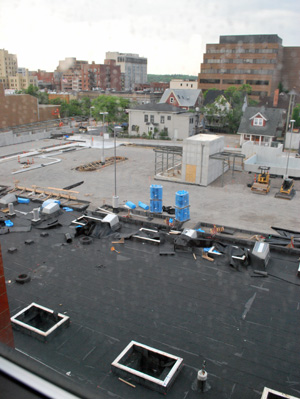
Looking down and to the north from the fourth floor of the Ann Arbor District Library downtown building, overlooking the underground parking structure.

Looking down and to the north from the fourth floor of the Ann Arbor District Library downtown building, overlooking the city-owned underground parking structure being built by the Ann Arbor Downtown Development Authority. The black area in the foreground will be the small road called Library Lane, running between Fifth Avenue and Division. (Photos by the writer.)

In three separate, unanimous votes, the board approved the $12.183 million budget, set a millage rate at 1.55 mills – unchanged from the current rate – and designated the budget as a line-item budget with a policy for disbursements. There were no amendments, and minimal discussion. No one attended a public hearing on the budget.

Several trustees noted that the millage rate is below the 1.92 mills that the district is authorized to levy. If set at that higher rate, the library would see an additional $1.6 million in property tax revenues. The lower rate has been in place since fiscal 2009-10.

Monday’s meeting also included a report on the performance evaluation of AADL director Josie Parker, which was overwhelmingly positive. Parker’s salary will remain unchanged at $143,114.

Board president Margaret Leary read aloud a letter to Parker that praised her accomplishments, and highlighted an upcoming challenge: “The Ann Arbor District Library has increasingly been central to our community and its growth and prosperity. Now AADL has to decide whether its downtown facility is up to providing what the community deserves.”

The reference to a downtown facility reflects a decision by the board and top staff to resume exploring the possibility of a new building, in place of the current four-story structure at 343 S. Fifth Ave. A recent survey commissioned by AADL – and presented to the board at its April 16, 2012 meeting – indicates voter support for a tax increase to pay for major renovations or reconstruction of that building.

In another action item at Monday’s meeting, the board approved a one-year extension to the space-use agreement with Friends of the Ann Arbor District Library (FAADL). The nonprofit operates a used bookstore in the lower level of AADL’s downtown building. Proceeds of the store – about $90,000 annually – are given to the library.

Most of the board’s questions and discussion at the meeting related to a non-action item brought up during Parker’s report on the recent Vision 2012 conference, which drew 400 people from across Michigan and nearby states. The event featured three dozen exhibitors of products and services for the blind and visually impaired. It was hosted by AADL, which administers the Washtenaw Library for the Blind and Physically Disabled. Ed Surovell speculated that there might be an opportunity to grow the event even more. [Full Story]

AADL Director Praised in Evaluation

Josie Parker, director of the Ann Arbor District Library, received a positive evaluation from the AADL board at its May 21, 2012 meeting. Parker’s salary remains unchanged at $143,114. A two-page letter to Parker from board president Margaret Leary, and vetted by all board members, notes that the board believes her salary to be equitable with comparable positions. [.pdf of evaluation letter]

The letter describes Parker’s performance as excellent, and lists several areas of accomplishment, including the attraction and retention of top talent, consistency in presenting a balanced budget, and creativity in providing new services.

The letter also points to challenges ahead: “We are aware that AADL’s community relations efforts have succeeded in creating demand beyond what our existing facilities can support. The … [Full Story]

Ann Arbor Adds Flashers, Alters Traffic Law

Ann Arbor city council meeting (Dec. 19, 2011): At its last meeting of the year, the council ended the current round of discussion on the city’s pedestrian safety ordinance by finalizing changes that clarified conditions under which vehicles are required to stop for people who are trying to cross the street.

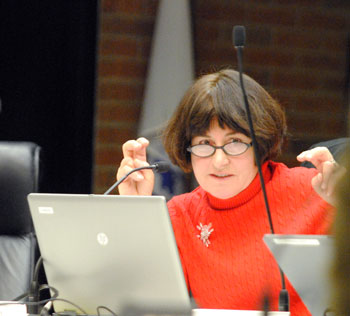
Jane Lumm crosswalk ordinance approaching air quotes

Jane Lumm (Ward 2) made air quotes around the word "approaching" as the council discussed the city's ordinance on crosswalks. (Photos by the writer.)

The current ordinance amendment maintains an existing requirement that motorists accommodate not just pedestrians who are “within” a crosswalk, but also those who are verging on entering a crosswalk. What’s different is the way the concept is expressed. In July 2010, the council chose to describe pedestrians who are about to enter a crosswalk as “approaching” the crosswalk. The version of the ordinance finalized on Dec. 19 requires motorists to accommodate “… a pedestrian stopped at the curb, curb line or ramp leading to a crosswalk and to every pedestrian within a crosswalk …”

As part of the previous amendments made in 2010, the council also had removed language that specified a half of the roadway where drivers needed to accommodate pedestrians. This time around, the council restored similar language, which reads, “… when the pedestrian is on the half of the roadway on which the vehicle is traveling or when the pedestrian is approaching so closely from the opposite half of the roadway as to be in danger.”

In other crosswalk-related business, the council approved an expenditure of $81,000 to install five rectangular rapid flashing beacons (RRFB) on existing pedestrian islands in the city. Four of the locations are along Plymouth Road, at Georgetown, Traver Village, Beal and Bishop. The fifth location is at Seventh and Washington.

Also at the Dec. 19 meeting, the council ended a long process of review by the city and negotiation with neighbors by approving a change to the zoning of the Hoover Mansion property on Washtenaw Avenue, which University Bank uses as its headquarters. The change will allow University Bank to build 13 new parking spaces on the east side – behind the main building, allowing the bank in accommodate expanded employment.

Towards the end of the council’s meeting, a relatively rare debate unfolded about a mayoral nomination to a city board. At issue was the nomination of a city employee – transportation program manager Eli Cooper – to the board of the Ann Arbor Transportation Authority. He’s replacing another city employee on the board, public services area administrator Sue McCormick, who left her position with the city in mid-December. In the end, Cooper’s nomination was confirmed with dissent from two councilmembers. A separate vote on a general policy opposing nominations of city employees to boards and commissions received only four votes of support.

The council considered two compensation-related issues – one for its city attorney, Stephen Postema, and another for election workers who staff the polls. After a closed session to discuss Postema’s performance review, the council voted with dissent from one councilmember to award Postema the ability to cash out 250 hours of banked time. The council delayed its vote on pay increases for election workers, on the possibility that their pay could be increased more than what’s proposed, to match the amount specified in the city’s living wage ordinance.

In other business, the council approved a bond re-funding, authorized reimbursement for a broken electromagnet at the materials recovery facility, accepted additional federal money for solar projects, and heard about a possible strategy for addressing vacant and dilapidated properties. [Full Story]

Postema’s Performance Review: No Raise

At its Dec. 19, 2011 meeting, the Ann Arbor city council conducted a closed session to review the performance of its city attorney, Stephen Postema, for 2011. The result of the session was that the council voted, with dissent from Sabra Briere (Ward 1), to approve an amendment to Postema’s contract that allows him to cash-in up to 250 of hours of accrued banked time before June 30, 2012.

The position of city attorney is one of two positions that reports directly to the council – the other is the city administrator. Under Michigan’s Open Meetings Act, reviews of personnel are allowed to be conducted in a closed session on request from the employee, but are not required to be. However, Postema’s contract contains a clause specifying that: “The results of the evaluation shall be in writing and shall be discussed with the Employee in closed session.”

A performance review conducted just two months ago at the council’s Oct. 24, 2011 meeting had been just for 2009 and 2010. That review did not result in any adjustment to Postema’s base salary, but also allowed him to cash-in up to 250 hours of accrued banked time before the end of 2011.

In a rare move, Sabra Briere (Ward 1) sat out most of the closed session on Dec. 19 and voted no on the contract amendment this time around. She questioned whether the council’s administration committee had provided other councilmembers with opportunity to offer feedback on Postema’s performance since the Oct. 24 review. She noted that other councilmembers had been given an opportunity to provide their view on Postema’s performance before the Oct. 24 review, but that review had specficially been just through 2010.

And Briere did not recall being given an opportunity to provide additional feedback since October for the current review – which included 2011. None of the members of the council’s administration committee could point to an occasion when feedback had been solicited during that time period. Mayor John Hieftje offered that sometimes all the forms are confusing.

This brief was filed from the city council’s chambers on the second floor of city hall, located at 301 E. Huron. A more detailed report will follow: [link] [Full Story]

AATA on Chelsea Bus: Cut Fares, Add Wifi

Ann Arbor Transportation Authority board meeting (March 24, 2010): The transportation news out of this month’s AATA board meeting was that the twice-daily Chelsea-Ann Arbor express bus service will continue, despite low ridership. It will be moved in-house using AATA buses. The $125 monthly fare will be reduced to $99. Up to now, the pilot program has been operated by Indian Trails.

 Ted Annis public commentary AATA board

Ted Annis distributes copies of his treasurer's report during public commentary at the start of Wednesday's AATA board meeting. (Photos by the writer.)

A representative from Indian Trails addressed the board during public commentary at the start of the meeting, in part to convey disappointment, but primarily to thank board members for the opportunity to work on that private-public partnership.

Public commentary also included remarks from Ted Annis, the board’s treasurer, who signed up for a public comment slot, and used it to deliver his treasurer’s report. The report had not been given a slot on the agenda by the board’s governance committee – after reviewing it, the committee decided it did not fit the parameters of the treasurer’s report specified in the board’s bylaws.

The wrangling over the treasurer’s report thus continued from last month’s board meeting, when fellow board members expressed the view that Annis’ monthly reports, which he has submitted since taking over the treasurership last fall, do not include the material specified in their bylaws. Instead, they said, the reports are effectively the expression of an individual board member’s dissent on board policy.

The board voted to establish a bylaws committee to be chaired by David Nacht to examine the matter in more detail.

Board members also voted to change their meeting venue and day, starting in two months. In May, the board will begin meeting at the downtown Ann Arbor District Library on the third Thursday evening of the month at 6:30 p.m. The library board room location, also used by the Ann Arbor Public Schools and AADL for their board meetings, offers more space for attendees, as well as video recording facilities. [Full Story]