Stories indexed with the term ‘planning’

Regular Budget Maintenance for DDA

Ann Arbor Downtown Development Authority board meeting (June 1, 2011): At its regular monthly meeting, the DDA board performed the annual exercise of revising its budget to match actual expenditures for the fiscal year, which ends June 30. It was the only item on the agenda requiring a vote, which was unanimous. The DDA’s FY 2011 budget showed $23,038,310 in expenses against $19,111,321 in total income.

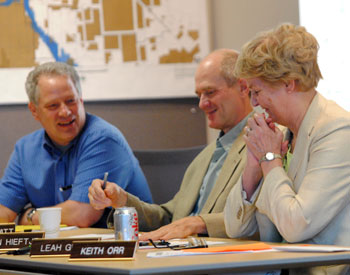
Roger Hewitt, John Hieftje, Leah Gunn

Left to right: Roger Hewitt, mayor John Hieftje, Leah Gunn. Hewitt, a DDA board member, had just handed over a check for $1 million to the mayor. It was the second half of a payment the DDA had agreed to make last year, which had not been required as part of the DDA's parking contract with the city. (Photos by the writer.)

At Wednesday’s meeting, the board also recapped the previous night’s session of the Ann Arbor city council, which had been a continuation of the meeting that began on May 16. At that meeting, the council had finally ratified its side of a new contract under which the DDA would continue to manage the city’s public parking system.

Key elements of that contract include a transfer to the city of Ann Arbor of 17% of annual gross parking revenues, reporting requirements by the city to the DDA about parking enforcement and street repair, and the ability of the DDA to set parking rates and hours without a city council veto.

The DDA board will likely schedule an extended board meeting in September to prepare for a contractually-required joint working session with the city council, which will include a discussion of parking rates and hours of enforcement.

Included in the usual range of the DDA’s reports from its committees was a review of a recent partnerships committee meeting, when DDA board members began to consider how they would handle the responsibility to plan future uses of city-owned surface parking lots downtown. The DDA was given that responsibility in a city council resolution passed at the council’s April 4, 2011 meeting. [Full Story]

Ann Arbor: We’re For Complete Streets

At its March 7, 2011 meeting, the Ann Arbor city council adopted a resolution expressing its commitment to the concept of “complete streets” – the idea that streets should be constructed to accommodate a full range of users, from pedestrians, to bicyclists, to public transit vehicles, to privately owned automobiles.

The impetus for the city’s proclamation comes from the state of Michigan’s enactment in 2010 of Public Act 134 and 135, which amended the state’s planning enabling statute and the transportation funding law. The resolution is meant to make sure that Ann Arbor continues to qualify for state transportation funding.

In the resolution approved by the Ann Arbor city council, the city’s complete streets policy is described as including the city’s transportation master plan, the city’s non-motorized transportation plan, a city council resolution setting aside a percentage of Ann Arbor’s Act 51 funds for non-motorized transportation, and a policy that includes construction of non-motorized elements as part of each road construction project and requirements in the city’s public services standards.

At its March 1, 2011 meeting, the city’s planning commission briefly discussed the resolution that would be coming before the city council.

This brief was filed from the boardroom in the Washtenaw County administration building, where the council is meeting due to renovations in the city hall building. A more detailed report will follow: [link] [Full Story]

Ann Arbor Parks Commission OKs PROS Plan

At its Feb. 15, 2011 meeting, the Ann Arbor park advisory commission voted to recommend approval of the Park and Recreation Open Space (PROS) plan. The plan provides an inventory, needs assessment and action plan for the city’s parks system, and is updated every five years – this version of the planning document covers 2011 through 2015. The updated document is required by the state in order for the city to be eligible to apply for certain grants. The city’s planning commission is expected to vote on the plan at its meeting later on the evening of Feb. 15. Final approval will be needed from the city council – it is slated for the council’s March 6 meeting.

This brief was filed from the PAC meeting at the Washtenaw County administration building. A more detailed report will follow: [link] [Full Story]

Development Déjà Vu Dominates Council

Ann Arbor City Council meeting (June 21, 2010): Heritage Row is a proposed residential project that would have renovated seven older houses along South Fifth Avenue south of William Street, and constructed three new buildings behind the houses.

Alex de Parry

Developer Alex de Parry addresses the Ann Arbor city council in support of the Heritage Row project at council's June 21 meeting. (Photos by the writer.)

The number of houses to be renovated – called the “Seven Sisters” by some in the community who support their preservation – matched the number of votes the project received Monday night from the 11-member city council.

While that is a majority, the seven votes in favor of Heritage Row did not meet the eight-vote minimum that was required. The super-majority requirement came as a result of a protest petition that was successfully filed on the same day as the council’s last meeting, June 7. On that occasion, the council first considered this newest iteration of the project, but postponed it until their June 21 meeting.

The project rejected by the council on Monday in its 7-4 vote was a planned unit development (PUD), which would have required the city to amend its zoning. That leaves in play an already-approved earlier project at the same location, called City Place. City Place was authorized by the council last year as a “matter of right” (MOR) project – because it was judged to meet all applicable codes and zoning regulations.

The City Place (MOR) would demolish the seven houses and replace them with two apartment buildings separated by a parking lot. It’s a project that would be almost certainly denied by the city’s historic district commission – if a historic district were established in the area, as a study committee has recently recommended. The council is expected to make its final vote on the historic district at its July 6 meeting.

But the council gave its initial consideration to establishment of that historic district on Monday night. It’s more customary for councilmembers to vote for proposals on their first reading – to advance a proposal to a public hearing – even if they ultimately plan to vote against it. But Monday’s meeting saw three councilmembers already voting against establishing the district.

The council’s meeting also started off with the theme of historic preservation, as the city’s historic district commission presented its annual preservation awards.

In other business, the council gave a short extension to developer Village Green, which has an option-to-purchase agreement with the city for the city-owned parcel at First and Washington streets. The time for the extension is to be used to work with the city planning staff to put together milestones that need to be met. [Full Story]

Downtown Planning Process Forges Ahead

Ann Arbor City Council meeting (Nov. 16, 2009) Part I: The Ann Arbor city council’s Monday night meeting, which started at its usual 7 p.m. time, stretched to almost 1 a.m. before it concluded. In this part of the meeting report, we focus on planning and development issues, which contributed to the unusually long meeting.

a ball of yarn on somebody's lap

A ball of yarn on the lap of an audience member at city council's Monday meeting. Tony Derezinski (Ward 2) compared his colleagues' proposed amendments on the A2D2 zoning package to unwinding a tightly-wound ball of string. (Photo by the writer)

On the main planning question before the council – the A2D2 rezoning package for downtown Ann Arbor – the council approved the zoning package with its two basic categories of D1 (core) and D2 (interface) zones.

Neither the effort to postpone consideration of the zoning ordinance – led by Sabra Briere (Ward 1) – nor the attempt to reduce maximum height limits in the South University area – led by Stephen Kunselman (Ward 3) and Christopher Taylor (Ward 3) – met with any success.

The maximum building height for the majority of D1 areas is thus 180 feet, with the exception of a swatch along East Huron and in South University, which have maximums of 150 feet. D2 areas have a maximum  building height of 60 feet.

There were also no amendments passed to accommodate the request to change the proposed zoning of an individual parcel at 1320 S. University from D2 (interface) to D1 (core), or to change the proposed zoning of an area along East Huron Street from D1 to D2. [Full Story]

Downtown Design Guides: Must vs. Should

man sits at table with palms in up-turned gesture

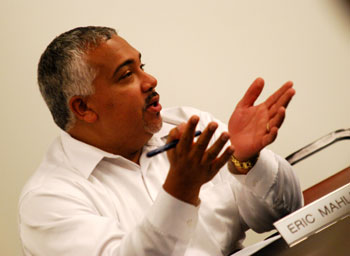
Eric Mahler, city of Ann Arbor planning commissioner, questioned whether the downtown design guidelines, as currently drafted, would pass legal muster, if they were implemented in a mandatory-compliance system. (Photo by the writer.)

Almost every child learns in school that a haiku is a short poem with three lines – lines that adhere to a 5-7-5 syllable count pattern.
But only some children learn that not all poems conforming to that 5-7-5 rule are good haikus. For example:

I saw a tower/Looming, stretching really tall/
Is it ever high!

Many readers will recognize those lines as a generally failed poem. But what specifically makes it a bad haiku, even though it follows the rule? The first-person narrative, the lack of seasonal referent, the lack of any kind of “aha!” moment – there are any number of ways in which that poetic effort fails to meet basic haiku design guidelines.

Similarly, a proposed new downtown Ann Arbor building that follows a basic height rule of “180 feet maximum” – specified in the zoning regulations – might still be generally recognizable as a poorly-designed building.  [Full Story]

Zoning 101: Area, Height, Placement

contrast between pedestrian-oriented development and sprawl Ann Arbor public meeting

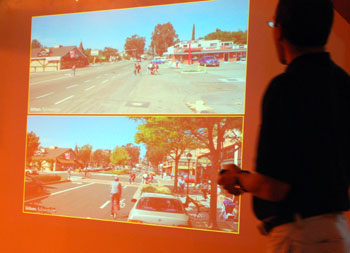
City planner Jeff Kahan shows a slide demonstrating the contrast between sprawl and pedestrian-oriented development – the top and bottom images are of the same corridor. (Photo by the writer.)

At Cobblestone Farm on Thursday evening, planning staff from the city of Ann Arbor presented proposed changes in the area, height, and placement specifications for various zoning districts throughout Ann Arbor.

The proposal is not a “rezoning” of all the area outside of Ann Arbor’s downtown – it’s a proposal to adjust the density, height, and setback requirements of existing zoning districts. There are no parcels designated for rezoning as a part of the AHP project. The project is thus different in character from the A2D2 project, which will result in a rezoning of the downtown.

The AHP proposal was actually intended to come before city council for approval in the fall of 2008, but on direction from the council, city planning staff were asked to get more community input.

About two dozen people attended Thursday’s meeting, the fifth in a series of at least seven public meetings to be held over the summer months – one meeting for each of five wards, bookended by community-wide meetings. Though divided by ward, anyone from any ward can attend any of the meetings, including the Ward 5 meeting to be held from 6:30-8 p.m. on July 30 at Forsythe Middle School Media Center.

So what is the AHP proposal? It’s not simply meant to clean up ordinance language in a way that has no material impact on future development. The proposal is meant to have an impact on how land gets used throughout Ann Arbor. What specifically is being proposed? What’s the zoning for where you live and work? What is zoning, anyhow? More after the break. [Full Story]

Unscripted Deliberations on Library Lot

closeup of printout of Anglin's amendment with edits by Briere

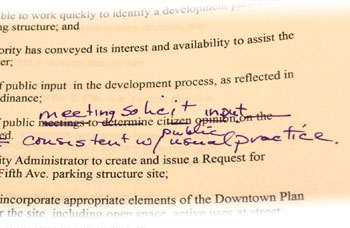
Mike Anglin's (Ward 5) amendment with edits made by Sabra Briere (Ward 1) at the council table.

Ann Arbor City Council meeting (July 6, 2009): The word “public” covered much of the ground of this past Monday’s meeting: public art, public land, public input.

The council got an annual report from the Public Art Commission highlighted by a reminder that Herbert Dreiseitl will be visiting Ann Arbor on July 20 to introduce plans for the storm water art he’s been commissioned to design for the new municipal center. The designs have not yet been accepted.

The council also heard a report from the Greenbelt Advisory Commission on a slight strategy shift in the use of $10 million of public money so far to protect 1,321 acres of land. The  council also approved a resolution to preserve the First & William parking lot as public land.

The discussion of another parcel of public land, the library lot, led to long deliberations on the wording of a resolution to establish an RFP (request for proposals) process for development of the site – below which an underground parking structure is planned. At issue was the timing of the RFP and the explicit inclusion of a public participation component in the process. The deliberations provided some insight into how councilmembers work together when the outcome of their conversations at the table is not scripted or pre-planned. [Full Story]

Planning Commission Draws Line Differently

woman sitting at desk with projected image behind her of a map

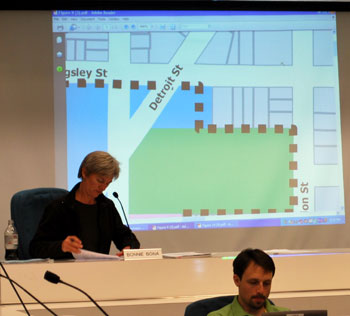
Bonnie Bona, chair of the Ann Arbor planning commission, leads the commission through discussion of the 322 E. Kingsley property. On the map projected behind her, that's the light blue sliver to the east of the thick dashed line. The dashed line is the DDA boundary.

At its Tuesday meeting, Ann Arbor’s planning commission voted to adopt a downtown plan that was different in significant ways from the one they’d previously adopted just three months ago. A small D2 (interface) in the South University area has been carved out, when none previously existed on the planning commission’s map. And  a one-parcel-wide expansion of the D2 area has been undertaken to include a property owned by Zingerman’s Deli.

Why was the commission considering the changes? Since the plan’s previous adoption, the city council had undertaken revisions to the proposed city zoning ordinances that had rendered the downtown plan inconsistent with those ordinances.

While the city council has final say over the ordinances, the council and planning commission must agree on the adoption of the same downtown plan. [See previous Chronicle coverage of the commission-council relationship on this issue.]

The planning commission’s action taken Tuesday night does bring its adopted downtown plan closer to consistency with the city council’s proposal for Ann Arbor’s new downtown zoning, but a significant incompatibility in the South University area remains. Before planning commission met, the revised downtown plan was scheduled to be presented for action by council at its June 15, 2009 meeting, with consideration of the final vote on the zoning package on July 6, 2009.  Now that time frame could change, depending on the path taken by council. More on possible outcomes after the break. [Full Story]

Expansion of Campus onto Monroe Street?

Monroe Street Vacation

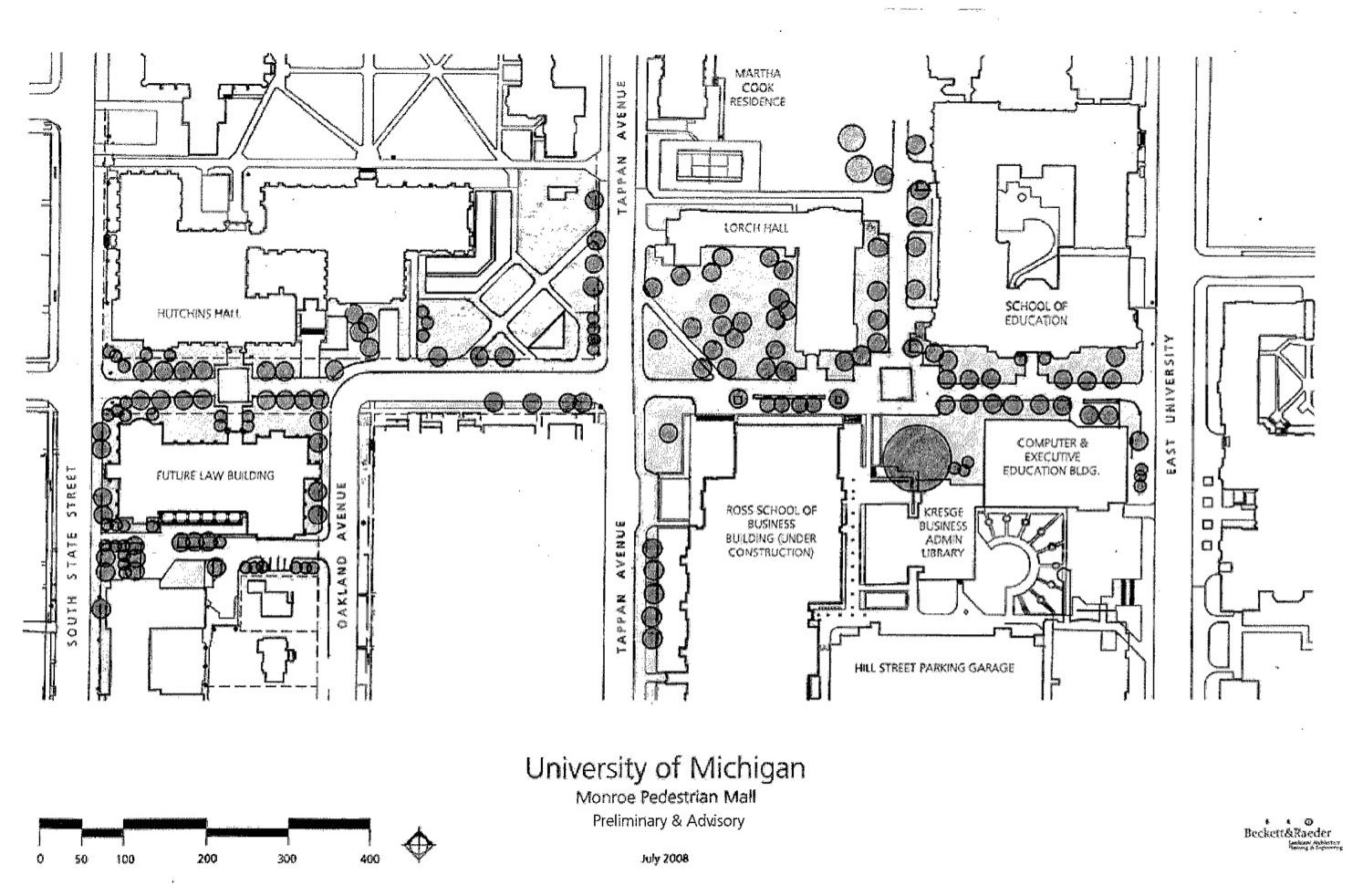
Sketch of the proposed Monroe Street closure. About this sketch, planning commissioner Eppie Potts remarked that it showed only university property and that it appeared that nothing else existed around it. She said that when the proposal came formally before the commission, it would need to include surrounding properties.

At planning commission’s working session on Tuesday night, held in the 6th floor conference room of the Larcom Building, representatives of the University of Michigan described a request for permanent closure of Monroe Street, between Oakland and State streets. Previously, The Chronicle covered the proposed Monroe Street closure as part of UM’s early December 2008 meeting with neighbors, which is now required under the city of Ann Arbor’s citizen participation ordinance.

Sue Gott, university planner, and Jim Kosteva, director of community relations, made the presentation to the commission’s working session for the permanent street closure, which would not come before the commission as a formal request until April 21 at the soonest, according to Connie Pulcipher, senior planner with the city of Ann Arbor, who attended the working session. [Full Story]

Council Begins Downtown Zoning Review

Maximum Diagonal

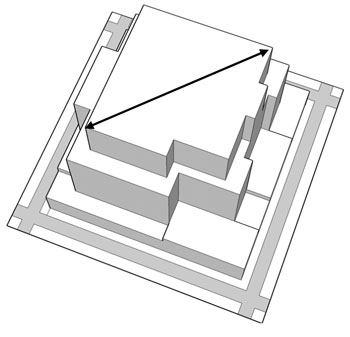
Illustration of the concept of a maximal diagonal. A maximum on this dimension is intended as a check on chunky buildings.

At Monday night’s city council work session councilmember Leigh Greden said that he wanted to see growth. Growth is what he could see (even if not the kind he was looking for) by turning his gaze to his immediate left at the council table to look at his colleague, Christopher Taylor’s upper lip, which is sprouting a mustache for charity. That kind of growth is no longer visible on city administrator Roger Fraser’s chin. Before the work session began, Fraser joked with the Ward 3 council contingent that he’d shorn his whiskers in order to appear as youthful as Greden.

So what kind of growth was Greden talking about?  [Full Story]

Near North Nears Next Review

Near North Avalon Housing affordable housing Ann Arbor

Damian Farrell, architect for Near North. Farrell rotated and panned across the proposed building from various angles to show neighbors the current state of the design.

The gathering on Wednesday evening at the Ann Arbor Community Center to discuss a proposed affordable housing development had been publicized as a 2-hour long “community design charrette.” But the 35 or more immediate neighbors and other interested parties who attended the meeting filled a bit more than the first hour asking questions that addressed the topic of the developer’s motives, the projects’ consistency with the mission of the non-profit partner on the proposal (Avalon Housing) and the conformance of the project to the city’s various planning documents.

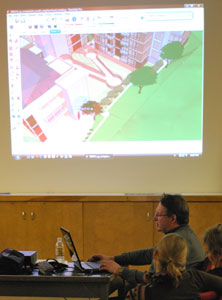
Architect Damian Farrell was eventually given the chance to project live images from his design software onto the wall, and manipulate them to illustrate changes that had been made as a result of the previous two charrettes. But the ensuing conversation on design elements was also interspersed with concerns about topics from the first hour.

Two and a half hours into the meeting, a man stood and said: “I am homeless.” He’d heard people pick at the project, he said, but he hadn’t heard anyone ask this question about it: “What can we do to help?” It was more than three and a half hours after the meeting started when the last of the post-charrette conversational pods headed out the door.

By Jan. 21, the project team hopes to be able to submit responses to any of the city planning staff’s concerns expressed after the project’s initial review, which began after the project was submitted in December. Near North could come before the city’s planning commission as early as Feb. 19. [Full Story]

Trick or Retreat: DDA Board Plans Year

DDA retreat

Final pie chart of proposed DDA board committee structure for 2009. Re-drawn on wall poster by facilitator Fran Alexander from original sketch by Keith Orr.

Ann Arbor’s Downtown Development Authority board held its annual retreat on Tuesday morning, which began with a scrumptious hot breakfast and ended with a giant pie. What the pie offered in size, it lacked in taste: it came in the form of a chart. More on the chart later. Fran Alexander, of Alexander & Associates, acted as the facilitator for the four-hour meeting, which began on time at 8 a.m., and was uninterrupted except for a strictly enforced 10-minute break. It covered three main agenda items: (i) celebrate achievements of 2007-08 (ii) identify priorities for 2009 (iii) establish committee structure for DDA board work. [Full Story]