Washtenaw County board of commissioners special meeting (July 24, 2013): As the staff works on developing a budget to present on Oct. 2, county commissioners have set four broad priorities to guide that process.
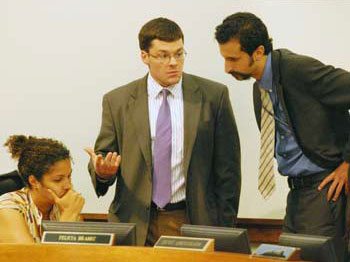
The leadership of the Washtenaw County board of commissioners, from left: Felicia Brabec (D-District 4 of Pittsfield Township), Andy LaBarre (D-District 7 of Ann Arbor), and Yousef Rabhi (D-District 8 of Ann Arbor). Rabhi is board chair. Brabec serves as chair of the board’s ways & means committee, and LaBarre chairs the board’s working sessions. (Photos by the writer.)
Those priorities, listed in order of importance, are: (1) ensure a community safety net through health and human services; (2) increase economic opportunity and workforce development; (3) ensure mobility and civic infrastructure for Washtenaw County residents; and (4) reduce environmental impact. [.pdf of budget priorities resolution] [.pdf of budget priorities memo and supporting materials]
The vote on the budget priorities resolution was 6-1, with dissent from Dan Smith (R-District 2), who indicated that his No. 1 priority is long-term fiscal stability, followed by public safety and justice. Rolland Sizemore Jr. (D-District 5) had left the meeting before the vote, and Alicia Ping (R-District 3) was absent. Although it was not part of the four priorities, a resolved clause was added during the meeting, stating that “the long-term fiscal stability of the county [will] continue to be of import throughout the budget development process.”
The resolution was brought forward by Felicia Brabec (D-District 4), who’s leading the budget process for the board. It also laid out a framework for developing strategies to measure the effectiveness of county investments in these priorities.
Brabec described this approach as “both a policy and a paradigm shift” that can’t happen overnight, but one that’s critical for the county’s future. The board is forming work groups focused on each of the four priorities, as well as on the topic of human resources. These work groups will be meeting to develop as many as five “community impact” goals in each category, in work that’s expected to continue into next year and beyond.
The July 24 meeting also included an update from county administrator Verna McDaniel about the county’s current financial condition and preliminary projections for 2014. At her last presentation, on May 15, 2013, McDaniel told commissioners that the county needed to identify $6.99 million in structural reductions for the 2014 budget. The approach to addressing this $6.99 million target depended on whether the county moved ahead with a major bond proposal to cover obligations to retirees, she said at the time. That bond proposal was put on hold earlier this month.
Now, the projected general fund shortfall is $3.93 million on a roughly $101 million budget. McDaniel indicated that the shortfall will be addressed primarily with operating cost reductions ($3.83 million) as well as $100,000 in cuts to funding of outside agencies, including support for nonprofits. The lower shortfall resulted from revised actuarial data that significantly lowered the contribution that the county is required to make toward its unfunded retiree obligations. Other factors include: (1) a decision not to make a $1 million contribution to the general fund’s fund balance; and (2) $2.4 million in higher-than-previously-anticipated revenue.
McDaniel noted that if the county had chosen to bond, then operational cuts would not be needed, and the fund balance contribution could be made. She also reported that the general fund budget doesn’t factor in serious state and federal cuts to non-general fund programs. “Revenue is needed,” she said. “We need to figure that out.”
Commissioners Yousef Rabhi (D-District 8) and Conan Smith (D-District 9) both voiced interest in exploring possible new taxes. “I think it’s important that we strongly consider asking the voters of Washtenaw County if they’re willing to support some of the ongoing operations that we have,” said Rabhi, the board’s chair. “We need to pose that question at least to the voters in the form of a millage of some kind.”
Smith cited human services and public safety as areas that might gain voter support for a millage. During public commentary, representatives from SafeHouse Center urged commissioners to continue funding of that nonprofit, as well as for human service organizations in general.
The upcoming budget will be prepared without the major bonding initiative that until earlier this month was anticipated to occur later this year. The bonding was intended to cover unfunded pension and retiree healthcare obligations – for the Washtenaw County Employees’ Retirement System (WCERS) and Voluntary Employees Beneficiary Association (VEBA). The original maximum amount for the bonds had been estimated at up to $345 million, but updated actuarial data resulted in a lower estimate of about $295 million. During the July 24 meeting, commissioner Conan Smith said it’s unlikely that bonding could occur this year, although he’s still supportive in general of taking that approach.
McDaniel plans to present the 2014 budget to the board at its Oct. 2 meeting. Commissioners are required to adopt a balanced budget for 2014 by the end of 2013. At its May 1, 2013 meeting, the board had approved development of a four-year budget. However, commissioners have not yet decided whether to follow through by adopting a budget with that four-year horizon. And some commissioners – notably Ronnie Peterson (D-District 6) – have expressed skepticism about this longer-term approach. For the past few years, budget plans have been developed for a two-year period, though the board must confirm the budget annually. [Full Story]