Stories indexed with the term ‘public education’

Column: Saying Thanks to Teachers

John U. Bacon

John U. Bacon

Teachers in our country rarely get the respect they deserve – a uniquely American pathology. But this year they’ve endured not just indifference, but disrespect – and from Congressmen, no less.

Teachers are now blamed not just for falling test scores, but failing state budgets and rising healthcare costs.

There was once a politician who took a different view. In 1787, Thomas Jefferson’s Northwest Ordinance – what some scholars believe to be one of the three most important documents in the founding of America, along with the Constitution and Declaration of Independence – provided funding for public schools and universities. In it, he declared, “Religion, morality, and knowledge being necessary to good government and the happiness of mankind, schools and the means of education shall forever be encouraged.”

The idea is so central to American public education, the University of Michigan has it engraved on the façade of its central building, Angell Hall. But few of the people walking by Angell Hall even know the line is there, or why. Ignorance makes it easy to take what’s good for granted. [Full Story]

Does It Take a Millage?

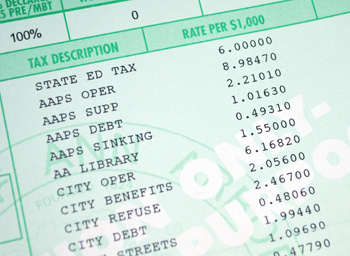
Ann Arbor tax document

An Ann Arbor summer tax bill, showing some of the assessments for Ann Arbor schools. For Ann Arbor Public Schools (AAPS), the millage rates reflect half the amount collected annually.

Among Michigan’s public educators, the 2010-11 fiscal year is being called “The Cliff.” Based on a grim downward trajectory of funding from the state, decreasing revenues from local property taxes and expenses like health care continuing to climb, that’s the year many districts are expected to plummet over the edge into the red.

Robert Allen, deputy superintendent of the Ann Arbor Public Schools, described this scenario at a sparsely attended forum last Thursday at Huron High School, where he and superintendent Todd Roberts made a pitch for voters to support a proposed countywide millage on the Nov. 3 ballot. They didn’t claim that AAPS would be among those districts falling off the cliff, but they did say their district faces a $15 million deficit that year. Without new revenue from the millage, they contend that the district would need to make dramatic cuts, and that those cuts would almost certainly affect students in the classroom. Michigan’s financial crisis is hitting hard, they say.

“As the state goes, so goes our funding,” Allen told the group on Thursday.

The state isn’t going so well.

But opponents argue that school districts haven’t done enough to cut costs, and that taxpayers can’t absorb the added burden of another millage. Beyond that, people on both sides say there’s an urgent need to reform the way schools are funded in Michigan, regardless of the success or failure of the Nov. 3 millage vote.

This Chronicle report looks at how Michigan funds K-12 public schools, why local school districts say they need a special enhancement millage and why critics say they don’t, and what that proposed millage would entail. Ann Arbor Public Schools is the largest of Washtenaw County’s 10 school districts, and would receive over a third of the $30 million collected from the millage annually – we’ll focus our coverage on that district. [Full Story]