Stories indexed with the term ‘public engagement’

AAPS Budget Forum Feedback

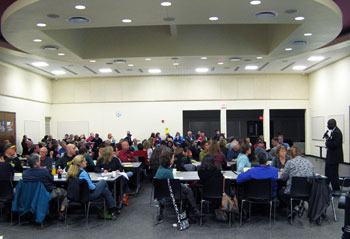
Ann Arbor Public Schools budget forum (November 14, 2011): It was standing-room only in the Pioneer cafeteria annex as over 140 people gathered to hear an overview of how the school district is funded, and to add their ideas to the mix as the district faces an anticipated $14 million shortfall in 2012-13.

Robert Allen (standing at right) with the large gathering at the budget forum held Nov. 14 at Pioneer High School. (Photos by the writer.)

The district’s approved budget for 2011-12 is $183.62 million.

As staff scrambled to bring in more folding chairs and photocopy additional handouts, AAPS superintendent Patricia Green and AAPS deputy superintendent of operations Robert Allen opened with a presentation on funding and budget challenges.

The presentation had been tweaked since a similar forum held last week. [For the details from that forum, see previous Chronicle coverage: "AAPS Seeks Public Input on Budget"]

This report highlights some of the changes made to the budget presentation, but focuses on the questions and suggestions offered by the community members who attended Monday’s forum. [Full Story]

Downtown Planning Poised to … Pause

The July 13 partnerships committee meeting of the Ann Arbor Downtown Development Authority drew an audience of around 35 people, many of them prominent community members.

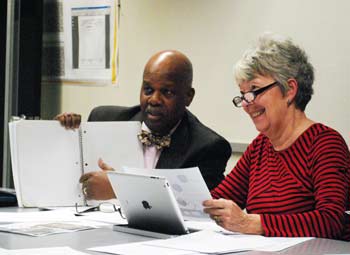
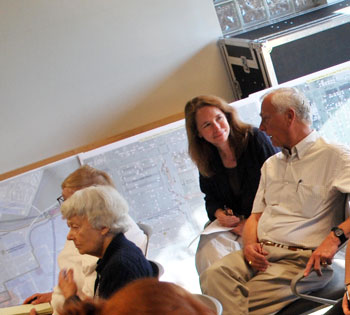
Kit McCullough, Peter Allen, Mary Hathaway, Vivienne Armentrout

Before the start of the July 13 DDA partnerships committee meeting. Back row: Kit McCullough, Peter Allen. Front row: Vivienne Armentrout (partially obscured), Mary Hathaway. (Photo by the writer)

Based on the committee’s May and June meetings, many in the audience expected the committee to come up with some kind of recommendation for a public engagement process that would ultimately lead to alternate uses of some downtown city-owned parcels. The parcels currently serve as part of the public parking system. The context of the DDA’s planning for the public engagement effort is a city council resolution, approved on April 4, 2011, that outlined a detailed plan for the DDA to lead the process.

The so-called parcel-by-parcel plan emerged in late 2010 as part of “mutually beneficial” committee meetings that handled negotiations lasting over a year between the city of Ann Arbor and the DDA on a new parking contract. Under the new contract, which the two bodies finally ratified in May 2011, the DDA will continue to operate the city’s public parking system for the next 11 years.

The city council’s approval of the parcel-by-parcel plan in April and DDA partnerships committee meetings in May and June – the three months prior to Wednesday’s meeting – had provided some momentum towards translating the city council resolution into an actual timeline with action steps.

In fact, two attendees of Wednesday’s meeting had pitched their professional services to the DDA to lead that public engagement process, with events tied to tentative calendar dates. Doug Kelbaugh, former dean of the University of Michigan’s college of architecture and urban planning, and Kit McCullough, a lecturer at the college, had provided a detailed timeline of meetings they could host during the fall, with delivery of a concept plan in January 2012, which could then be used to craft requests for proposals from developers.

If the process would not be led by Kelbaugh and McCullough, the committee was expected by many in attendance at its Wednesday meeting to chart some other path forward. But that’s not where the conversation led. DDA board member John Mouat described it as a “far-reaching, vague conversation,” which he had expected it would be. At one point, committee members even expressed uncertainty about whether the DDA or the city council would lead the process.

Typically, DDA executive director Susan Pollay gleans specific direction from the vaguest of conversations by her board’s committees. But when asked by Mouat at the conclusion of the meeting if she had clear direction, Pollay allowed only that she felt like she had more direction than before the meeting.

Based on the conversation at the meeting, part of that direction is that some kind of timeline for the process – which committee members thought would take at least a year – should, if possible, be included in an October 2011 city council working session.

In a follow-up phone interview, Pollay told The Chronicle that having the October 2011 working session as a target for a proposed plan would allow the committee and the full board to use their meetings over the next two months to work on the content of that presentation to the council. Checking in with the council on the public process before settling on it, she said, was important to the board. [Full Story]

Transit Planning Forum: Saline Edition

Editor’s note: Since July 2010, the Ann Arbor Transportation Authority has been developing a transit master plan (TMP) for transit service throughout Washtenaw County. Countywide service would represent an expansion of the service it currently offers in Ann Arbor, which is supported by a transit millage. The AATA also offers limited service in the rest of the county through purchase of service agreements (POS) with three of the county’s townships and the city of Ypsilanti. In November 2010, Ypsilanti voters passed a millage to fund its POS agreement with the AATA.

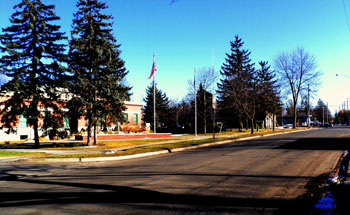
Saline City Hall, Harris Street

The view southward on Harris Street in Saline. Saline city hall, where the Feb. 8, 2011 transit master planning forum was held, sits to the left of the frame. (Photo by the writer.)

A second public engagement phase of the countywide planning exercise is now wrapping up, with 20 community forums held through the month of February at locations across the county. The final four of those forums will take place next week. Coverage of the forum hosted in the Saline area is provided by Chronicle intern and Saline resident Hayley Byrnes.

On Feb. 8, at Saline city hall, the Ann Arbor Transportation Authority sponsored the ninth of 20 community forums being held from the end of January through February. Every forum is open to all Washtenaw County residents, but they’re being held at locations across the county – like Saline – to make it easier for people to attend.

The goal of a previous round of 20 public forums, held last year, was to get participants to brainstorm about countywide transit. But the current set of forums is all about presenting participants with three specific scenarios that have been developed so far, based in part on those first 20 meetings. The AATA is calling these three scenarios: Lifeline Plus, Accessible County and Smart Growth. From those three scenarios, a preferred scenario will be developed. An AATA board consensus on that scenario is expected in March, with board action on adoption of a countywide transit plan expected in April.

Michael Benham, who’s coordinating the project for the AATA, and Juliet Edmonson, a consultant with Steer Davies Gleave (SDG), hosted the Saline forum. Michael Ford, CEO of the AATA, made an appearance in video form. For county residents who cannot attend any of the forums, the AATA is also seeking feedback on the three scenarios using an online survey. [Full Story]

Zoning 101: Area, Height, Placement

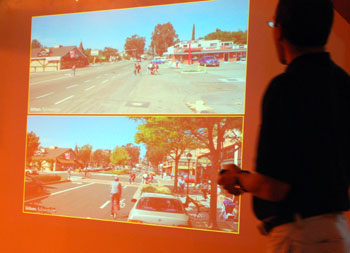
contrast between pedestrian-oriented development and sprawl Ann Arbor public meeting

City planner Jeff Kahan shows a slide demonstrating the contrast between sprawl and pedestrian-oriented development – the top and bottom images are of the same corridor. (Photo by the writer.)

At Cobblestone Farm on Thursday evening, planning staff from the city of Ann Arbor presented proposed changes in the area, height, and placement specifications for various zoning districts throughout Ann Arbor.

The proposal is not a “rezoning” of all the area outside of Ann Arbor’s downtown – it’s a proposal to adjust the density, height, and setback requirements of existing zoning districts. There are no parcels designated for rezoning as a part of the AHP project. The project is thus different in character from the A2D2 project, which will result in a rezoning of the downtown.

The AHP proposal was actually intended to come before city council for approval in the fall of 2008, but on direction from the council, city planning staff were asked to get more community input.

About two dozen people attended Thursday’s meeting, the fifth in a series of at least seven public meetings to be held over the summer months – one meeting for each of five wards, bookended by community-wide meetings. Though divided by ward, anyone from any ward can attend any of the meetings, including the Ward 5 meeting to be held from 6:30-8 p.m. on July 30 at Forsythe Middle School Media Center.

So what is the AHP proposal? It’s not simply meant to clean up ordinance language in a way that has no material impact on future development. The proposal is meant to have an impact on how land gets used throughout Ann Arbor. What specifically is being proposed? What’s the zoning for where you live and work? What is zoning, anyhow? More after the break. [Full Story]