Stories indexed with the term ‘public health’

County Supports Clean Air Act

A resolution passed by the Washtenaw County board of commissioners at their May 2, 2012 meeting expresses support for the U.S. Clean Air Act, and opposes “attempts to weaken, dismantle, overrule or otherwise impede the Environmental Protection Agency from enforcing or implementing” the act. Rob Turner (R-District 1) voted against the resolution, citing concerns about the impact on business and employment. Dan Smith (R-District 2) abstained.

The resolution was requested by Dick Fleece, director of the county’s public health department. A staff memo accompanying the resolution notes that since the Washtenaw County Clean Indoor Air Regulation was implemented in 2003, the number of county residents using tobacco has dropped from 18% in 2003 to 12% in 2012. The memo notes that ”supporting the … [Full Story]

County Acts on Disaster Relief, Health Care

Washtenaw County board of commissioners meeting (March 21, 2012): Public health, welfare and budget issues dominated the most recent county board meeting, which began with a briefing on the aftermath of a March 15 tornado touchdown in the Dexter area.

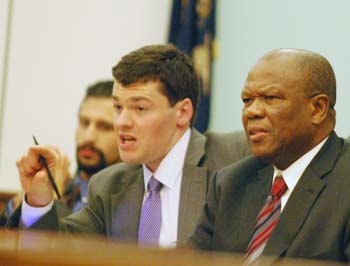
Mark Ouimet, Pat Kelly

Dexter Township supervisor Pat Kelly, right, attended the March 21, 2012 Washtenaw County board of commissioners meeting to thank the county for its help in the aftermath of the March 15 tornado that touched down in the township and caused considerable damage. To the left is Mark Ouimet, a former county commissioner who is now state representative for District 52, which includes the Dexter area.

Pat Kelly, Dexter Township supervisor, attended the meeting along with Mark Ouimet, a former county commissioner who is now state representative for District 52, which includes the Dexter area. Both thanked the county for its support and praised county staff – from sheriff’s deputies who provided security, to parks workers and others who helped with cleanup.

Later in the meeting, the board unanimously approved up to $500,000 from capital reserves to fund disaster relief and assistance to residents, including overtime costs for staff and payment for dumpsters to haul away debris. County administrator Verna McDaniel said that full amount might not be used, but it’s also possible that she’ll return to ask for more funding if it’s needed.

The board received a budget update for 2011 from finance staff, with the caution that minor changes might be made after an audit is completed. Although the originally approved budget had anticipated needing to use more than $5 million from the county’s general fund balance, only about $800,000 was actually used for the year – significantly less than expected.

Also related to the budget, the board authorized the county treasurer, Catherine McClary, to borrow up to $45 million against the amount of delinquent property taxes in all of the county’s 80 taxing jurisdictions. This is a standard request at this time of year as taxing jurisdictions – including cities, townships, schools systems and libraries, among others – turn their delinquent taxes over to the county, and are reimbursed for that delinquent amount. The county treasurer then assumes responsibility for collecting the delinquent taxes.

McClary noted that delinquent taxes are a leading economic indicator, and in that respect the trend is positive. This year, there is a drop in delinquent taxes for the first time since 2005. All jurisdictions saw a decrease, she said, and that’s really good news for the economy. McClary also gave her annual treasurer’s report for 2011, noting that revenues earned from delinquent taxes and fees totaled $5.557 million – about $3 million more than had been budgeted.

Also at the March 21 meeting, the board took a first step toward becoming a charter member of the Washtenaw Health Initiative (WHI), an effort to expand health care coverage for the county’s low-income residents. The membership includes a $10,000 annual fee in both 2012 and 2013, which would be funded through the county’s office of community and economic development. The 8-1 vote included dissent from Alicia Ping, who said she preferred funds to go directly to services, not for administrative purposes. Barbara Bergman was absent and Ronnie Peterson was out of the room when the vote was taken.

Among its other action items, the board gave final approval to creation of a county food policy council, and to an increase in certain fees charged by the public health department.

As an item for future discussion, several commissioners raised concerns over the issue of hydraulic fracturing – known as “fracking” – in rural parts of the county, to access oil or gas. Paxton Resources, a Gaylord, Mich.-based firm, has been acquiring mineral rights in the county’s rural areas for several months. A group of local residents called “No Paxton” has formed to oppose the company’s actions. The board discussed the possibility of a resolution urging more state oversight of the practice, and will likely schedule a working session on the issue. [Full Story]

Public Health Fee Increases Finalized

The Washtenaw County board of commissioners gave final approval to an increase in fees to treat sexually transmitted diseases – one of the mandated services provided by the county’s public health department. The unanimous vote came at the board’s March 21, 2012 meeting, following initial approval at its March 7 meeting. The changes are being made in response to federal funding cuts and an increase in charges for state services.

The board also approved changes at the medical examiner’s office, including fees for organ procurement services provided to the Michigan Gift of Life program, and a new late payment policy. According to a staff memo, about 10% of revenues are not realized because of non-payment. [.pdf of revised fee schedule]

By way of … [Full Story]

County OKs Public Health Fee Increases

An increase in fees to treat sexually transmitted diseases – one of the mandated services provided by the county’s public health department – was given initial approval by the Washtenaw County board of commissioners at their March 7, 2012 meeting. The changes are being made in response to federal funding cuts and an increase in charges for state services.

The board also approved changes at the medical examiner’s office, including fees for organ procurement services provided to the Michigan Gift of Life program, and a new late payment policy. According to a staff memo, about 10% of revenues are not realized because of non-payment. [.pdf of revised fee schedule]

By way of background, the adult clinic – which treats sexually transmitted … [Full Story]

County Board OKs Nursing Director Salary

At its Nov. 16, 2011 meeting, the Washtenaw County board of commissioners gave initial approval to hire a director of nursing for the public health department at a salary above the midpoint for this non-union job. All hires above the midpoint must receive approval by the board. A final vote is expected at the board’s Dec. 7 meeting.

The requested salary of $83,000 is less than the $95,342 paid to the previous director of nursing – Susan Lee, who retired in September – but above the position’s $73,964 midpoint. The suggested salary range is between $59,641 and $88,285. According to a staff memo, the previous salary reflected an 8% increase because of a temporary assignment of duties – part of a restructuring in the … [Full Story]

County’s Public Health Budget Approved

At their Sept. 21, 2011 meeting, Washtenaw County commissioners gave final approval to the county’s 2011-2012 public health budget, which includes elimination of a net of nearly seven full-time positions.

The $11,839,496 budget includes a $3,553,575 allocation from the county’s general fund – a net decrease of $583,597 from the previous year. Unlike the county’s general fund budget, which is aligned to the calendar year, the public health budget runs from Oct. 1 through Sept. 30, in sync with the state’s fiscal year.

Though a total of nearly 12 full-time-equivalent positions (a combination of part-time and full-time jobs) will be eliminated in the proposed budget, five positions will be created or reclassified, for a net loss of nearly seven FTEs.

The budget also calls … [Full Story]

Washtenaw Public Health Dept. to Cut Jobs

A net of nearly seven full-time positions will be eliminated in the 2011-2012 public health budget that was given initial approval by Washtenaw County commissioners at their Sept. 7, 2011 meeting.

The $11,839,496 budget, which will receive a final vote at the board’s Sept. 21 meeting, includes a $3,553,575 allocation from the county’s general fund – a net decrease of $583,597 from the previous year. Unlike the county’s general fund budget, which is aligned to the calendar year, the public health budget runs from Oct. 1 through Sept. 30, in sync with the state’s fiscal year.

Though a total of nearly 12 full-time-equivalent positions (a combination of part-time and full-time jobs) will be eliminated in the proposed budget, five positions will … [Full Story]

County Funds Nonprofits, Sets Deputy Price

Washtenaw County board of commissioners meeting (June 1, 2011): Budget issues again occupied commissioners’ focus at this month’s county board meeting. The board took an initial vote to set the price for a contract sheriff’s deputy and to approve funding for local nonprofits.

Dick Fleece, Monique Reeves, Kelly Belknap, Wes Prater

From left: Washtenaw County public health officer Dick Fleece, newly appointed public health medical director Monique Reeves, interim deputy county administrator Kelly Belknap, and county commissioner Wes Prater. Commissioners approved the hiring of Reeves at their June 1 meeting. (Photos by the writer.)

While the board’s previous meeting drew supporters from a range of human services groups, on Wednesday most public commenters spoke against funding of one specific nonprofit: Planned Parenthood of Mid and South Michigan. Their arguments on financial and moral grounds were ultimately unpersuasive to commissioners, who voted unanimously to approve support for Planned Parenthood and several other agencies, totaling $1.015 million through fiscal year 2013, including $53,040 from the county for Planned Parenthood.

Two commissioners raised concerns that county funding for human services in general is inadequate, especially in light of proposed changes that could bump thousands of beneficiaries statewide off the welfare rolls later this year.

In a vote that also holds budget implications, the board’s move to set the price for a contract sheriff’s deputy was remarkable mainly for its lack of debate – historically it’s been a contentious issue. Commissioners gave initial approval without comment. The price set in 2012 for a police services unit (PSU) is $150,594 – unchanged from this year. That’s followed by 1% annual increases through 2015. The difference between the actual cost of a PSU and the amount charged – roughly $25,500, based on current figures – would be covered by the county. The item will return to the board’s July 6 meeting for a final vote.

Meanwhile, a 2006 lawsuit filed against the county over the amount it charged at that time for contract deputies remains unresolved. Judge Joseph Costello of the 38th Circuit Court Chief has ordered the county and Augusta and Ypsilanti townships into non-binding facilitation, in a meeting set for June 22.

During Wednesday’s meeting, commissioners also approved a raft of other items, including: (1) the hiring of Monique Reeves as new medical director; and (2) five drain projects in Ann Arbor that require bonds backed by the county’s full faith and credit. The board also voted to add five new working sessions to its calendar: on June 16, July 21, Aug. 18, Sept. 15 and Oct. 13. All are focused on the 2012-2013 budget.

Finally, at the end of its meeting the board went into executive session for about an hour to address three issues: (1) a collective bargaining strategy; (2) possible settlement of pending litigation; and (3) review of a legal opinion. [Full Story]

A Night of Transitions at County Board

Washtenaw County Board of Commissioners (March 17, 2010): The theme of Wednesday night’s meeting was one of transitions, as commissioners voted to dissolve the county’s land bank authority, join a regional energy office, and approve a contract for the next county administrator, Verna McDaniel.

Wes Prater, Paul Schreiber

County commissioner Wes Prater, left, talks with Ypsilanti mayor Paul Schreiber before the start of Wednesday's county board of commissioners meeting. Schreiber came to speak in support of the county's land bank. In the background is deputy clerk Jason Brooks. (Photos by the writer.)

Commissioners also got an update from their lobbyist in Lansing, who spoke of upcoming transitions in state government that will impact the county. Kirk Profit said the turnover in the legislature, governor’s office and other administrative posts could lead to opportunities for the county. Several commissioners raised concerns over the state budget and state funding for local programs, and are worried that the situation will get worse before it gets better.

Wednesday’s meeting also included two official farewells to long-time county employees: finance director Pete Ballios and Trenda Rusher, director of the county’s Employment Training and Community Services (ETCS) department. Both received standing ovations from commissioners, staff and others in the boardroom. [Full Story]

County Revamps H1N1 Vaccine Strategy

At Wednesday’s briefing of the Washtenaw County Board of Commissioners, the county’s top two public health officials gave an update on the H1N1 flu situation and their plans to retool previously planned clinics to deliver the vaccine to high-risk groups.

High demand and lower-than-anticipated supply has led to a “tremendous shortage,” said Dick Fleece, director of the county’s Public Health/Environmental Health department. And in the wake of Tuesday’s public clinic that drew hundreds of people and created safety concerns because of traffic and crowds, the county is canceling four clinics planned for next week at local high schools.

Instead, they’re scheduling a community clinic that will likely be held on Saturday, Nov. 7, at either Eastern Michigan University or Washtenaw Community College. Details will be released on Thursday, Fleece told commissioners. Update: The county will hold a clinic to vaccinate people in its high-priority categories on Thursday, Nov. 5 from 10 a.m. to 7 p.m. at the EMU Convocation Center. [Link to directions] [Full Story]

County’s Budget Crisis Gets Emotional

Nina Johnson, Washtenaw County's human resources manager, prepares awards that were given out to employees during Wednesdays board of commissioners meeting. (Photo by the writer.)

Nina Johnson, Washtenaw County's human resources manager, prepares awards that were given out to employees during Wednesday's board of commissioners meeting. (Photo by the writer.)

Washtenaw County Board of Commissioners (Sept. 2, 2009): Emotions ran high during parts of Wednesday night’s county board meeting, as residents made impassioned pleas for continued funding of programs for the developmentally disabled. Commissioners responded, some with equal passion, with Leah Gunn saying this is the worst year she’s ever faced in her career as a commissioner, and Jeff Irwin breaking down as he described his reaction to hearing constituents’ stories. The county faces a projected $30 million budget deficit over the next two years in its $102 million general fund, and is working on ways to cut expenses.

Commissioners also heard budget presentations from leaders of two departments – Public Health, and Community Support and Treatment Services – and got a brief budget update from county administrator Bob Guenzel, who said that their 2009 general fund projections are on target.

The board also voted unanimously – and with no discussion – to approve a $1.375 million deal that would settle two lawsuits related to the 2006 death of Clifton Lee Jr., who died after a struggle with Washtenaw County sheriff’s deputies in the Ypsilanti Township of West Willow. [Full Story]

Healthcare, Tourism, Food and Online News

David Canter, former head of Pfizers Ann Arbor research campus

David Canter, former head of Pfizer's Ann Arbor research campus, is now director of healthcare research at UM's William Davidson Institute.

An eclectic mix of speakers at Wednesday’s Morning Edition breakfast talked about healthcare in developing countries, commercials promoting tourism in Michigan, computer security, the upcoming Ann Arbor Restaurant Week and an update on the venture that will replace the Ann Arbor News.

Russ Collins, the event’s emcee and executive director of the Michigan Theater, also noted that they were now installing a state-of-the-art 3D projector, just in time for the May 29 opening of Disney-Pixar’s animated film “Up” – which features, he noted, “a hyperactive nine-year-old named Russell.”

David Canter, former head of Pfizer’s Ann Arbor research campus, kicked things off with comments about the University of Michigan’s acquisition of that site. [Full Story]

Commissioners Get Public Health Update

Commissioners each received a Red Cross personal safety kit at Wednesdays meeting.

Commissioners each received a Red Cross personal safety kit at Wednesday's meeting.

Washtenaw County Board of Commissioners (May 6, 2009): At Wednesday’s meeting, commissioners got an update on how the county is responding to the swine flu threat, plus a bonus: Every commissioner was presented with a Red Cross personal safety kit. The implicit message was  that the county is prepared for emergencies, be it virulent viruses or something else entirely. Dick Fleece, interim director of the county’s public health department, assured commissioners that funding for the kits came from the feds, not the county’s general fund budget.

Commissioners also discussed a federal grant aimed at helping track purchases of pseudoephedrine. [Full Story]

UM Business School Building Disinfected

Elevator buttons in the new UM Ross School of Business building are among the spots where the norovirus could have been transmitted.

Elevator buttons in the new UM Ross School of Business building were among the areas treated during the disinfection protocol.

Overnight from Monday to Tuesday at the new UM Ross School of Business building, plant and custodial staff, along with employees of Aramark, which provides food services in the building, implemented a disinfection protocol for norovirus.

As of early Tuesday afternoon, there were no cases of norovirus yet confirmed among the 20-30 people who had become ill over the past week since the newly constructed building first opened on Jan. 5.  Further, according the Jennifer Nord, of UM Occupational Safety and Environmental Health (OSEH), the last date of onset for a new case of illness was on Jan. 10. People who have become sick have been requested to provide stool samples for analysis by the Michigan Department of Community Health in Lansing. As yet no samples have been provided for testing.

Nord and David Peters of OSEH, in a conference call (arranged by Pamela Koczman, manager in occupational safety and community health at UM), confirmed that the decision to act aggressively by starting the cleaning protocol last night was made based on: (i) the symptoms shown in cases reported, (ii) the quick spread, and (iii) the commonness of norovirus as the cause of such cases. [Full Story]